Wednesday, August 31, 2016

Helen Levitt

Flashback
On a day like today, American photographer Helen Levitt was born
August 31, 1913. Helen Levitt (August 31, 1913 - March 29, 2009) was an American photographer. She was particularly noted for "street photography" around New York City, and has been called "the most celebrated and least known photographer of her time. She lived in New York City and remained active as a photographer for nearly 70 years. New York's "visual poet laureate" was notoriously private and publicity shy


Founder:
Ignacio Villarreal
Editor & Publisher: Jose Villarreal - Consultant: Ignacio Villarreal Jr.
Art Director: Juan José Sepúlveda Rmz.
 

Tuesday, August 30, 2016

Vintage Subway Etiquette Posters

Articles

Vintage Subway Etiquette Posters Reveal Manspreading Has Always Been Annoying

Japan, 1976
Poster by Hideya Kawakita, Japan (1976) (image courtesy Tokyo Metro Cultural Foundation/New York Transit Museum)
When the New York Transit authority rolled out a courtesy campaign targeting manspreading last year, Men’s Rights Activists and angry netizens accused “anti-spread” crusaders of being whiny “pseudo-feminists.” More debate followed when the word “manspreading” was added to the Oxford English Dictionary. But though the word itself is new, the practice of manspreading — whereby a man spreads his legs while sitting on public transit, taking up too much space — has apparently been pissing people off since around the time public transit became a thing.
Manspreading, NYC, 1947
Amelia Opdyke Jones, anti-manspreading poster for New York City subway (1947), New York Transit Museum Collection
In the New York Transit Museum’s current exhibit, Transit Etiquette or: How I Learned to Stop Spitting and Step Aside in 25 Languages, courtesy campaigns spanning decades and continents reveal a nearly universal anti-manspreading sentiment. A poster on the New York City subway in 1947, featuring cartoons of flagrant manspreaders in fedoras, implored commuters not to be “space hogs” or “leg pests.” Another ad simply labels manspreaders “BAD!”. Both these designs were by cartoonist Amelia Opdyke Jones, who signed her work “Oppy.” From 1946 to 1966, Jones illustrated etiquette posters with Monopoly-like characters for the “Subway Sun,” a faux-newspaper plastered in train cars. The term “litterbug” is said to have originated from one of Oppy’s subway posters. The New York MTA’s current “Dude… Stop the Spread” campaign, which caused so much internet kerfuffle when installed, is only a watered-down rehash of these earlier designs, with boring pictograms instead of Oppy’s retro comic book flair.
Subway Sun, NYC, 1953
Amelia Opdyke Jones, Subway Sun, New York City (1953) (image courtesy the New York Transit Museum Collection)
And manspreading is an international plague, according to the designs on view: A disturbing poster on the Japan Metro in 1976 depicted Charlie Chaplin’s The Great Dictator as “The Seat Monopolizer,” squishing smaller Charlie Chaplins seated next to him. An ad from Tokyo trains in 2012 featured a cartoon manspreader encroaching on the space of a child inexplicably wearing a bear suit. “I’d like to sit too. There should be enough room,” she says.
プリント
Tokyo (2012) (image courtesy Tokyo Metro Cultural Foundation)
If you’re a Men’s Rights Activist and these ads hurt your feelings, please get some help and don’t freak out at the New York Transit Museum: The exhibition also features retro ads scolding “Birdy Big Bags,” discouraging what’s now called “she-bagging,” whereby people (according to some, mostly women) hog seats with their bags. There’s also a poster from the London Underground in 1986, depicting a rare example of womanspreading: A female punk with a rainbow mohawk splays her legs on a bus seat while an elderly gentleman stands and waits for a chance to sit.
London Underground, 1986
London Underground (1986) (image © TfL from the London Transport Museum collection)
The rest of the exhibit, with posters from Barcelona, Brussels, Chicago, London, Madrid, New York, Philadelphia, Rio de Janiero, Taipei, and Tokyo, colorfully illustrates the laws of how not to be an asshole on public transit, laws that apparently transcend time and place.
IMG_5412
Subway etiquette posters by Amelia Opdyke Jones at the New York Transit Museum, installation view (photo by the author for Hyperallergic)
SEPTA, 2014
Trinh Loi, poster for Southeastern Pennsylvania Transportation Authority (2014) (image courtesy the New York Transit Museum)
Transit Etiquette Exhibit Logo
Transit Etiquette at the New York Transit Museum (image courtesy the New York Transit Museum)
Transit Etiquette Or: How I Learned To Stop Spitting And Step Aside In 25 Languages continues at the New York Transit Museum in the Gallery Annex at Grand Central Terminal (89 E 42nd St, Midtown East, Manhattan) through October 20. 


For Fluxus Artist Alison Knowles, Anything Can Be Art

Museums

For Fluxus Artist Alison Knowles, Anything Can Be Art

Archive Red Objects
Alison Knowles, “Archives of red objects from Celebration Red by Alison Knowles, Carnegie Museum of Art” (May 19, 2016) (all photos by the author for Hyperallergic)
PITTSBURGH — There are hardly any figures in the Alison Knowles exhibition at the Carnegie Museum of Art, but the presence of bodies, especially that of the artist, resonates throughout the prints, scroll books, and multimedia installations. The show features the artist’s work starting with the Fluxus movement, which she helped found in the 1960s, to her participatory “event” scores, or series of written instructions for participatory performances, transforming the gallery into an artful playland.
Knowles performed during the opening night, including a renewed “Celebration Red” (1962), one of her notable instructional “event” scores. For the occasion, hundreds of Pittsburghers brought found red objects, including shoes, an album cover, and candy boxes (Knowles brought her own tiny, red rose), creating “Archive of red objects” (2016), now brightly arranged in the vast entryway. The pristine grid arrangement of the nostalgic, random items in Fluxus spirit exemplifies that everything is art.
BoatBook5
“The Boat Book” (2014–15), installation view at the Carnegie Museum of Art, wood and metal frame with screenprinting, digital print on silk, handmade paper, collage and assemblage elements, personal ephemera, beans, books, fishing net, photographs, ship anchor, fabric tunnel, electrical lights, and audio recording
Knowles’s voice is heard throughout the exhibition, emanating from an audio recording in the provocative installation “The Boat Book” (2014–15). The eight-foot tall wood book, bound to a central spine, is derived from Knowles’s original “The Big Book” (1966), where visitors climbed through the structure in order to read. Knowles, now 82 years old, scaled the new multimedia work on opening night, and dedicated the piece to her fisherman older brother through the personal ephemera adorning the work: books, toys, shipyard items, and beans. Though viewers cannot touch this nautical-themed work, one can get up close, hearing Knowles tell stories about the ocean, the sounds of waves and seagulls, and becoming engrossed in the artist’s persona.
Book Jacket
“Book Jacket” (2006), installation view, clothing with collage elements and found objects, ink and graphite on paper, cotton, handmade flax paper, pins, paperclips and string, courtesy the artist and James Fuentes Gallery, New York (click to enlarge)
Such tactile and personal work fills the tight gallery space, allowing the viewer an intimate encounter with the artist and the breadth of her art. The multigenerational works, displayed alongside one another, demonstrate the artist’s persistent interest in collage and traditional printmaking, and the beauty in everyday simplicity. “In and Out the Window (Banner)” (2010), a 33-foot long collaged scroll, is installed along a wall, with “Bean Rolls” (1963), a series of tiny paper scrolls of found text set beside an open can of beans (one of her early experimentations with the sculptural potential of the book), displayed in a glass pedestal underneath. Above hangs “Shoe Print” (1972), a sepia blueprint paper depicting a single used shoe. And, nearby, is “Book Jacket” (2006), a collage of found objects, such as ink and graphite on paper, cotton, handmade flax, pins, paperclips and string, all framed in a wood rectangle without a distancing glass frame. Together these works emit Knowles’s presence and compilation of life, literature, and art.
Knowles asks us to physically experience the now, which is refreshing in a society with a relatively short attention span. Viewers are invited into “Bean Garden” (1976/2016) a large wooden box filled with navy beans, a favorite and reoccurring item in her work, as well as a common meal of her upbringing. Feeling the beans between your toes, you feel closer to the earth, sharing a giggle with other gallery-goers. Each shuffle echoes via microphones at the bottom of the bin, each movement audibly present around every corner of the exhibition. Tiny beans scatter across the floor, like sand after a beach trip, a reminder of the carefree moment that has passed.
More is to be observed: the ephemera and slides from Knowles’s Spring Street studio in New York; her handmade flax paper instruments and ghostly, gorgeous screen prints of everyday objects; and her poetry, including a collaboration with fellow Fluxus artist Philip Corner.
Bean Garden
“Bean Garden” (1976/2016), wooden box, navy beans, and contact microphones with amplifier and speakers (photograph features the author)
Knowles continues to create and perform profoundly, seemingly around mostly men (though she has collaborated with Yoko Ono). While this isn’t a story about another overlooked female artist, perhaps the most renowned Fluxus members are Knowles’s colleagues, George Maciunas, much credited for solely founding the movement, and Allan Kaprow, Joseph Beuys, and Dick Higgins. As an artist who happens to be a woman, Knowles began her career during a time period also known for socially minded, innovative feminist art, though there is no explicit indication of gendered inquiry in her work. There is no mention of feminism or gender in any of the exhibition text, which instead often refers to collaborations or relations with her male cohorts. There is, however, a small Venus of Willendorf replica inside “The Boat Book” installation, perhaps a quiet reminder of women’s strength and art historical precedents, whether ancient or her contemporaries.
Knowles’s work strikes me, above all, as being approachable. Calming and humble, the work bridges art and life in a way in which viewers can coolly connect with, and maybe walk away with a new outlook, if subconsciously, for seeing art in the everyday.
objects editions ephermera from studio
“Objects, editions, ephermera, and 35mm slides from Alison Knowles’s Spring Street studio, New York City,” dates vary
Alison Knowles continues at the Carnegie Museum of Art (4400 Forbes Ave, Pittsburgh) through October 24. Various participatory activities will take place throughout the duration of the exhibition. Please visit the museum website for hours and information. 


Comics | The Mind Games We Play

Comics

The Mind Games We Play

mindgames-300-BIG

Comics | How to Make Museums Fun

Comics

How to Make Museums Fun

Comic-MuseumsFun

Monday, August 29, 2016

A Brief History of the Artist’s Studio

A Brief History of the Artist’s Studio

Paul Cézanne’s studio. Photo by Sjaak Kempe, via Flickr.
It was 2 a.m. when the skies of Paris opened over Claude Lantier. Dashing through the rain, the gifted but impatient painter arrived at his studio facing the river Seine to discover a young woman seeking shelter from the storm. After weathering the downpour inside—she on the bed, he on the couch—Claude awoke to find the woman asleep, covered in little else but sunlight. Inspired, the artist began to sketch his unconsenting model, quietly, attentively, until she woke herself and discovered him in the act.
So begins the 1886 novel The Masterpiece by Émile Zola, a fictional portrait of a tortured Impressionist painter. Drawing on the bohemian trappings of 19th-century Paris, the lives of a number of French artists, and male fantasies that entwine creative talent with sex and power, Zola’s text offers what is now a stereotypical vision of the artist’s studio as the locus of creativity—one that persists (if to a lesser degree) today. So why does the artist’s studio still hold such magnetism, and what can we learn from studying an artist’s workspace?
The studio of Paul Cézanne, one of the most influential painters in history and a primary source for the fictitious Claude Lantier, is still preserved today. Nestled on a hill in the South of France, with an airy view of Mont Sainte-Victoire, the studio is maintained by the government of Aix-en-Provence, with scores of the artist’s accoutrements on display. And Cézanne’s is just one in the constellation of studios that welcomes visitors each year. Other noteworthy examples are the distinctive “Blue House” of the Frida Kahlo Museum in Mexico City; the “Villa des Brillants,” which served as the sculptor Auguste Rodin’s studio and home on the outskirts of Paris; the recently opened Manhattan home of Louise Bourgeois; and the evolving performance and installation manifested in conceptual artist David Ireland’s house at 500 Capp Street in San Francisco.
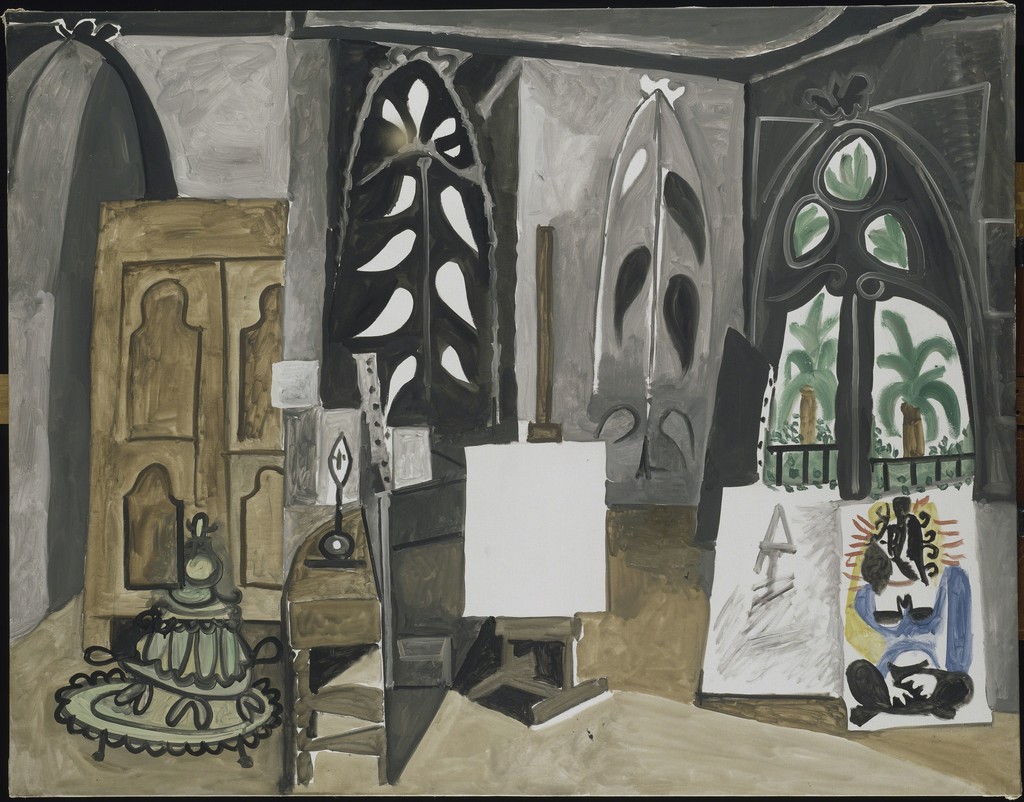
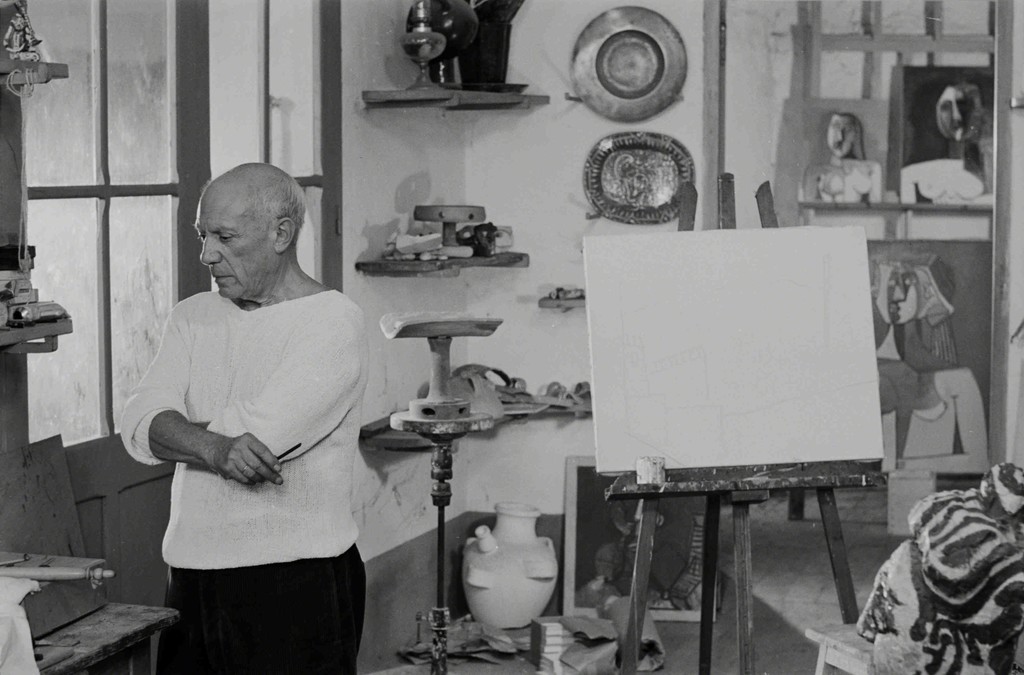
Though Cézanne was more sympathetic than Zola’s protagonist, the alluring mystique of the modern artist in his studio may have found its archetypal expression in Pablo Picasso. His most iconic portraits depict women in the studio, like those of Dora Maar, his “private muse.” In 2001, the Cleveland Museum of Art exhibition and accompanying catalogue Picasso: The Artist’s Studio explored the artist’s work in the context of his workspace. And the theme has endured; Picasso: In the Studio was the subject of a spring 2016 issue of the journal Cahiers d’Art and a show in its Paris gallery featuring previously unpublished photographs of the artist at work—where else?—in the studio.
The studio is where strange magic happens, as much for the artist’s imagination as for the public’s. It’s the conjuring place of new concepts, styles, or forms. Sometimes it even comes to be seen as sacred, a place where visitors become pilgrims to the altar of art. On the other hand, as the artist Joe Fig recently told me, it is also “a place where mundane tasks and very non-glamorous things go on.” A sculptor and painter, Fig has also authored two books of interviews, Inside the Painter’s Studio (2009) and Inside the Artist’s Studio (2015), that explore artists’ working habits and the places that nourish them. Both aim “to shed light on the real day-to-day process of the artist, the time, hard work, and persistence it takes to succeed,” as he explains.
The modern artist’s workspace has its roots in the Renaissance, when masters taught apprentices in workshops. By the 17th century, artists were inviting patrons into these spaces. In her celebrated book Rembrandt’s Enterprise: The Studio and the Market (1988), the art historian Svetlana Alpers argued that by selling works produced by studio assistants, the Dutch master exerted unprecedented control over the sale of his own work, effectively transforming the meaning and market value for paintings like The Jewish Bride (1665). Opening the studio turned out to be good business.
Left: William Merritt Chase, The Tenth Street Studio (1880). Image via Wikimedia Commons; Right: Interior view of Olana. Photo by Mary Alice, via Flickr.
The studio gradually evolved to become a kind of stage for the performance of making art. By the 19th century, the growing arts community in the United States had come to understand this theater of art as valuable real estate. When completed in 1857, the Tenth Street Studio Building in Manhattan became the first facility of its kind in the United States or Europe. Built with the needs of artists (and their potential patrons) in mind, the Studio Building became the epicenter of the American art scene. Any painter worth their weight in salt had a space there, including the most famous member of the so-called Hudson River School, Frederic Edwin Church.
Church recognized the benefits of using the studio to stage his work in dramatic ways. When he exhibited his monumental canvas Heart of the Andes (1859) in the Tenth Street Studio galleries, he requested that visiting members of the public bring opera glasses to pick out salient details from the large painting. And his audience consisted not only of the public; with other renowned artists like Albert Bierstadt, Winslow Homer, John LaFarge, and William Merritt Chase also renting space in the same building, it was a place for artists to cross-pollinate and measure themselves against one another.
While the Studio Building was pivotal for Church’s career, Olana, the name of his opulent home and studio overlooking the Hudson River Valley, is justly more famous. Drawing architectural inspiration from Greece and Persia, Church transformed the house into, in his words, “a feudal castle.” Part villa, part fortress, Olana was adorned with bright bands of color and filled with intriguing objects collected during his travels. Now officially named the Olana State Historic Site, it is a National Historic Landmark and still holds, among many other artworks, the final large study for Heart of the Andes.
Olana is also part of another preservation network: Historic Artists’ Homes and Studios (HAHS). Founded in 1999 under the National Trust for Historic Preservation, HAHS has grown to a coalition of more than 30 museums that were once the homes and working studios of American artists.
Grace Hudson’s Sun House. Photo by Binksternet, via Wikimedia Commons.
Among the legacies that HAHS helps to maintain are those of important but lesser-known artists, such as Grace Carpenter Hudson (1865-1937), whose modest craftsman-style home stands in the small town of Ukiah, California, at the southern edge of the Mendocino National Forest. It testifies to the lifetime Grace and her ethnologist husband Dr. John Hudson spent representing and recording the lives of the local Pomo, an indigenous people of coastal California. Hudson’s home and studio effectively documents a period of Pomo cultural reconstruction following massacres and dispossessions by the U.S. government, offering insights into how European Americans tried to see Native Americans as the frontier came to a close.
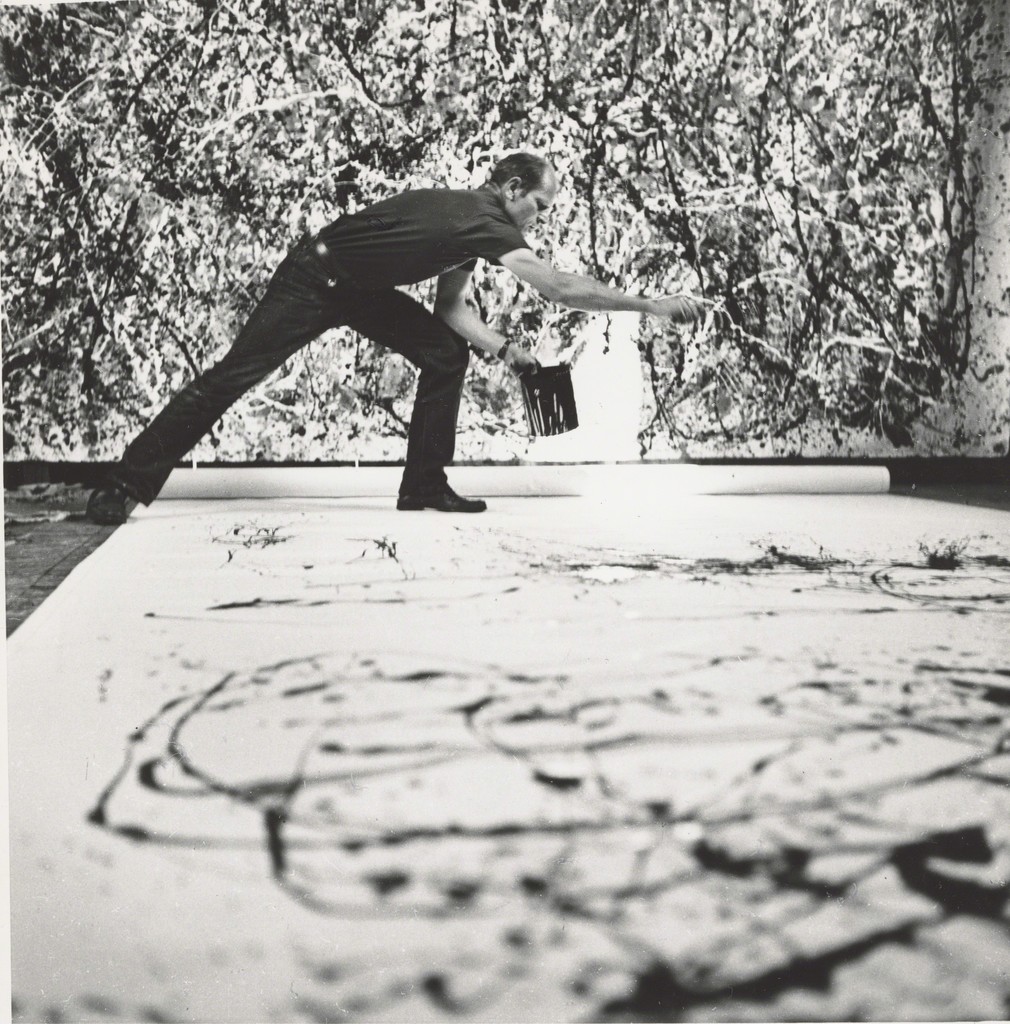
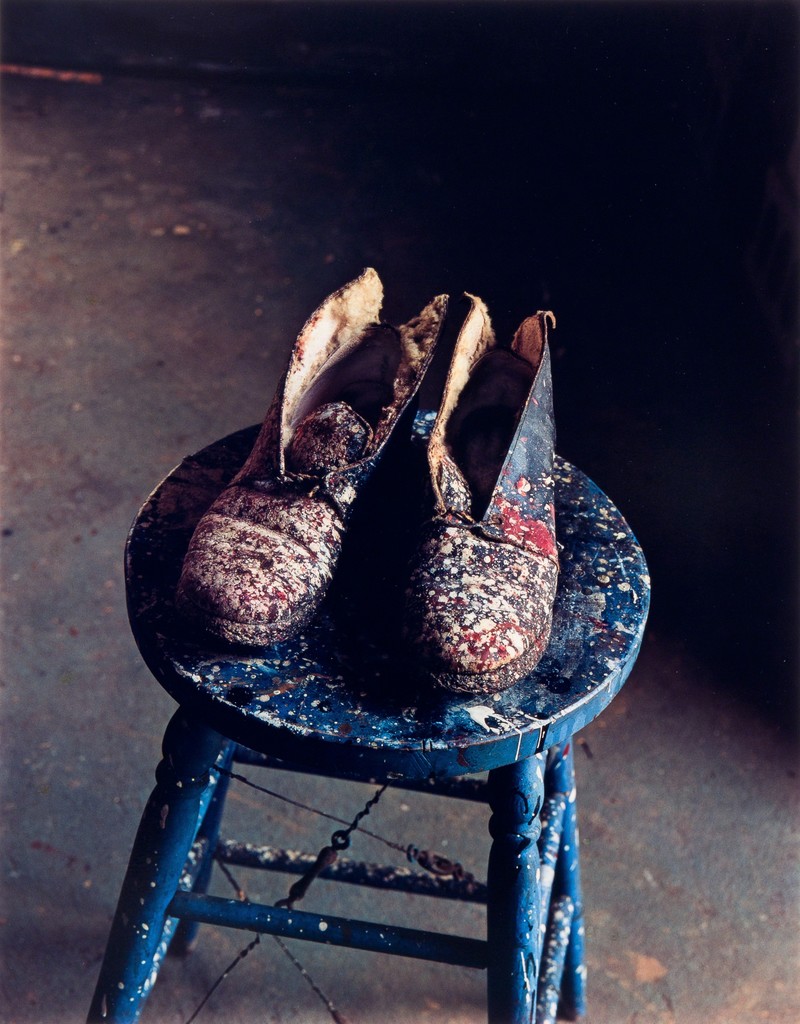
HAHS also counts studios of some of the most famous artists on its roster. After they married in 1945, Jackson Pollock and Lee Krasner moved from New York City to a small 19th-century fisherman’s home on Long Island’s East End. Although Pollock had already emerged as a leader of the Abstract Expressionist movement, a move away from the city—and the vices it whipped up—proved a needed change. It was there, in a converted barn, that Pollock made his legendary innovation: He began to pour, drip, and fling paint across canvases spread on the floor.
Helen Harrison, director of the Pollock-Krasner House and Study Center, says that the almost numinous quality of the place has been invaluable to other artists, filmmakers, and scholars. This is the very scene that Joe Fig painstakingly reproduced in miniature as part of his series of models of artists at work in their studios. It’s the historical setting that actor and director Ed Harris said was essential for filming the Oscar-winning biopic of the artist, Pollock. And it’s where documents stashed in a suitcase in the attic were discovered (in addition to several unpublished works on paper), shedding new light on Pollock’s and Krasner’s personal and professional lives. Pollock scholar Francis V. O’Connor says these discoveries represent the most gratifying moments of the ongoing work of preserving studios.
One might also argue, of course, that the mythology of the studio as an active creative force is another high modernist fantasy, one eroded by the emergence of conceptual art in the 1960s. Robert Smithson invoked Cézanne directly when describing the necessity of moving out of the studio and into the world to make his site-specific land art. “We now have to reintroduce a kind of physicality,” he insisted in an interview, “the actual place rather than the tendency to decoration which is a studio thing.” In his 1971 essay, “The Function of the Studio,” Daniel Buren called the studio “purgatory,” a space of “ossification,” one that John Baldessari would also later rail against in his “Post-Studio Art” class at CalArts.
For these artists, the post-studio practice was as much a political stance as an aesthetic one, an attempt to dissolve the constrictive joints between studio, gallery, and museum. But the rapidly rising costs of city life since the 1980s has had other, more practical consequences for artists, especially those grappling with the fraught financial conditions that tend to go with the beginning of a career. The Jeff Koonses of the world aside, how do artists afford a functional studio in a place like New York or London, where rent checks siphon off most of your income?
Then again, do you even need a studio at all? As web-based media, mobile interventions, and 3D printing proliferate in the art world, an artist working today with a phone or laptop might find the studio an antiquated notion altogether.

—George Philip LeBourdais

Share article

Sunday, August 28, 2016

TFT'd new play censorship is a bitch with the Sugarburg boy as "THE BITCH"

TFT'd new play censorship is a bitch with the Sugarburg boy as "THE BITCH"

Inside Facebook’s (Totally Insane, Unintentionally Gigantic, Hyperpartisan) Political-Media Machine

Inside Facebook’s (Totally Insane, Unintentionally Gigantic, Hyperpartisan) Political-Media Machine

cala-te puta foi o nbew york times q1ue disse 1º ao trump e agora ao menino zuckerberg IS A BITCH

TFT'd new play censorship is a bitch with the Sugarburg boy as "THE BITCH"

cala-te puta foi o nbew york times q1ue disse 1º ao trump e agora ao menino zuckerberg IS A BITCH

Inside Facebook’s (Totally Insane, Unintentionally Gigantic, Hyperpartisan) Political-Media Machine


cala-te puta foi o nbew york times q1ue disse 1º ao trump e agora ao menino zuckerberg IS A BITCH


  • cala-te puta foi o nbew york times q1ue disse 1º ao trump e agora ao menino zuckerberg
  • cala-te puta foi o nbew york times q1ue disse 1º ao trump e agora ao menino zuckerberg
cala-te puta in June. This accelerating growth is attributed by Rivero, and by nearly every left-leaning page operator I spoke with, not just to interest in the election but especially to one campaign in particular: “Bernie Sanders is the Facebook candidate,” Rivero says. The rise of Occupy Democrats essentially mirrored the rise of Sanders’s primary run. On his page, Rivero started quoting text from Sanders’s frequent email blasts, turning them into Facebook-ready memes with a consistent aesthetic: colors that pop, yellow on black. Rivero says that it’s clear what his audience wants. “I’ve probably made 10,000 graphics, and it’s like running 10,000 focus groups,” he said. (Clinton was and is, of course, widely discussed by Faceboo cala-te puta k users: According to the company, in the last month 40.8 million people “generated interactions” around the candidate. But Rivero says that in the especially engaged, largely oppositional left-wing-page ecosystem, Clinton’s message and cautious brand didn’t carry.)
Because the Sanders campaign has come to an end, these sites have been left in a peculiar position, having lost their unifying figure as well as their largest source of engagement. Audiences grow quickly on Facebook but can disappear even more quickly; in the case of left-leaning pages, many had accumulated followings not just by speaking to Sanders supporters but also by being intensely critical, and often utterly dismissive, of Clinton.
Continue reading the main story


cala-te puta foi o nbew york times q1ue disse 1º ao trump e agora ao menino zuckerberg IS A BITCH