https://europeanconservative.com/articles/commentary/against-muzzling-the-right/
https://europeanconservative.com/articles/commentary/why-division-among-conservatives-is-a-virtue/

December 3, 2025
During the nearly four years since Russia invaded Ukraine, satellite constellations have been a lifeline for Ukrainian forces, keeping the Internet and the military connected despite ongoing attacks.
China has taken notice.
With an eye toward future conflicts, the People's Republic of China has sought for ways to disrupt or jam constellation-satellite networks. In an academic paper published in Chinese last month, researchers at two major Chinese universities found that the communications provided by satellite constellations could be jammed, but at great cost: To disrupt signals from the Starlink network to a region the size of Taiwan would require 1,000 to 2,000 drones, according to a research paper cited in a report in the South China Morning Post.
National government and space companies should take the research as confirmation that, if there is a conflict in Asia — especially between China and Taiwan — that disrupting satellite connectivity will be an opening gambit, says Clémence Poirier, a senior cyber defense researcher for the Center for Security Studies (CSS) at Swiss technical university ETH Zürich.
"Space companies ... have to closely monitor their systems, segregate their networks between civilian and military customers, and eventually update their threat models should the conflict occur," she says.
From their ability to provide low-cost, high-speed bandwidth to rural and developing communities to their capabilities to provide communications in conflict zones, satellites play an increasingly important role, and that makes them targets. Global navigation satellite systems (GNSS) are increasingly jammed or spoofed around conflict zones, while security researchers and nation-state hackers are increasingly targeting satellites with cyberattacks to control orientation and positioning. Even criminal organizations are using satellite constellations to make their communications more resilient.
Cyber- and electronic-warfare attacks against satellites are being embraced because they pose less risk of collateral damage and are less likely to escalate tensions, says Clayton Swope, deputy director for the Aerospace Security Project at the Center for Strategic and International Studies (CSIS), a Washington, DC-based policy think tank.
"Kinetic attacks are still a concern, but it's hard to see kinetic attacks happening during times of relative peace or even high tension — they are too escalatory," he says. "Whereas cyberattacks and jamming and spoofing of signals happen often and are gray-zone tactics that do not seem to threaten unintended escalation."
Constellation-satellite networks are difficult to jam because they are fast moving, numerous, and use a variety of techniques to avoid and correct for interference. Taiwan has already signed a contract with Eutelsat OneWeb, another satellite constellation of more than 600 satellites, to provide connectivity in the event of a disaster. Starlink uses an order of magnitude more satellites — currently about 9,000 — traveling in low-earth orbit (LEO).
The constellations are resilient to disruptions. The latest research into jamming constellation-satellite networks was published in the Chinese peer-reviewed journal Systems Engineering and Electronics on Nov. 5 with a title that translates to "Simulation research of distributed jammers against mega-constellation downlink communication transmissions," the SCMP reported.
The research is a continuation of a theme: China has created detailed strategies for counter-space operations, including a concept of multidomain precision warfare, which the People's Liberation Army (PLA) outlined in 2021, ETH Zurich's Poirier says. Every major nation, however, is preparing for war in the space domain, especially in low-earth orbit, she says.
"Space has become the backbone of all military operations — there is no conflict that does not somehow rely on space today," Poirier says. "Satellites are thus interesting targets."
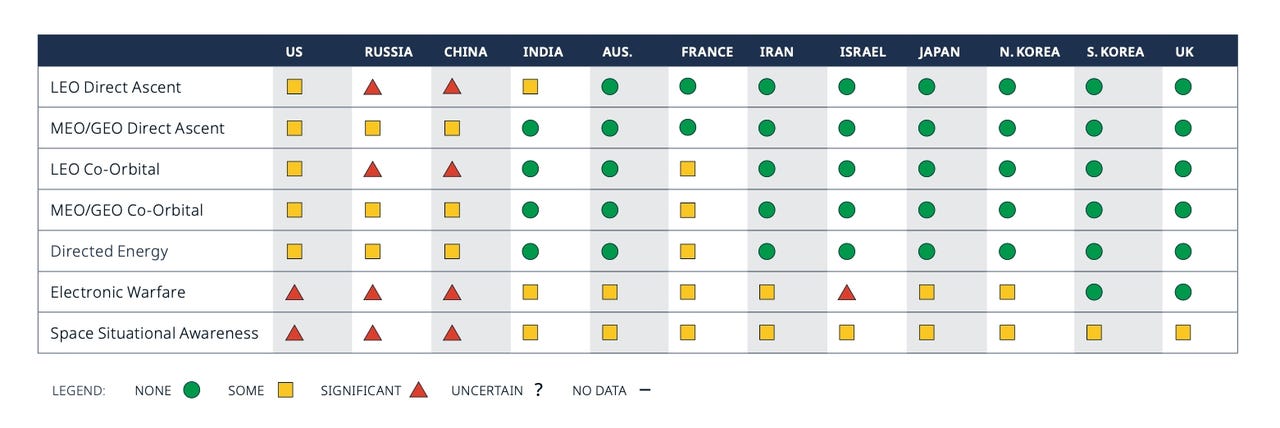
China, Russia, and the United States have all developed significant anti-satellite capabilities. Source: Secure World Foundation
And, with the US and other countries shifting to large distributed satellite constellations, previously researched weapons, such as direct ascent anti-satellite munitions (ASATs), have become less strategically valuable, says Sam Wilson, director of strategy and national security at the Center for Space Policy and Strategy at The Aerospace Corp., a federally funded research and development center (FFRDC).
"While knocking out a single asset would cause damage and potentially escalate conflict, it would not achieve taking the entire constellation offline," he says. "This has pushed adversaries to consider other types of threat vectors, including [electronic warfare] and cyber."
China is not just researching ways to disrupt communications for rival nations, but also is developing its own constellation technology to benefit from the same distributed space networks that makes Starlink, EutelSat, and others so reliable, according to the CSIS's Swope.
"Since China will have its own constellations [similar to] Starlink soon, the United States would be wise to consider how it could deny or disrupt the PLA's access to such a system during any potential conflict," he says.
China and Russia have sped up tests of anti-satellite technology in the past decade, with Russia conducting 13 ASAT tests, China conducting six tests, and India conducting two tests since 2015, according to a report published by the Secure World Foundation.
While the most common threat to satellite communications is space-based interference, various countries have announced plans to conduct satellite operations in space, including a plan by France to deploy small nano-satellites for defense, India's focus on creating a capability to dock with satellites in orbit, and China's practice of "dogfighting" satellites, performing on-orbit space operations from one satellite to another, says ETH Zurich's Poirier.
"So far, no state has launched an anti-satellite missile against an adversary's spacecraft," she says. "They only demonstrated the capability against their own old satellites."
Read more about:
DR Global Asia Pacific