Save Europe Act patriots rock Ceuta .... and more
Save Europe Act <newsletter@save-europe-act.com>
|

|
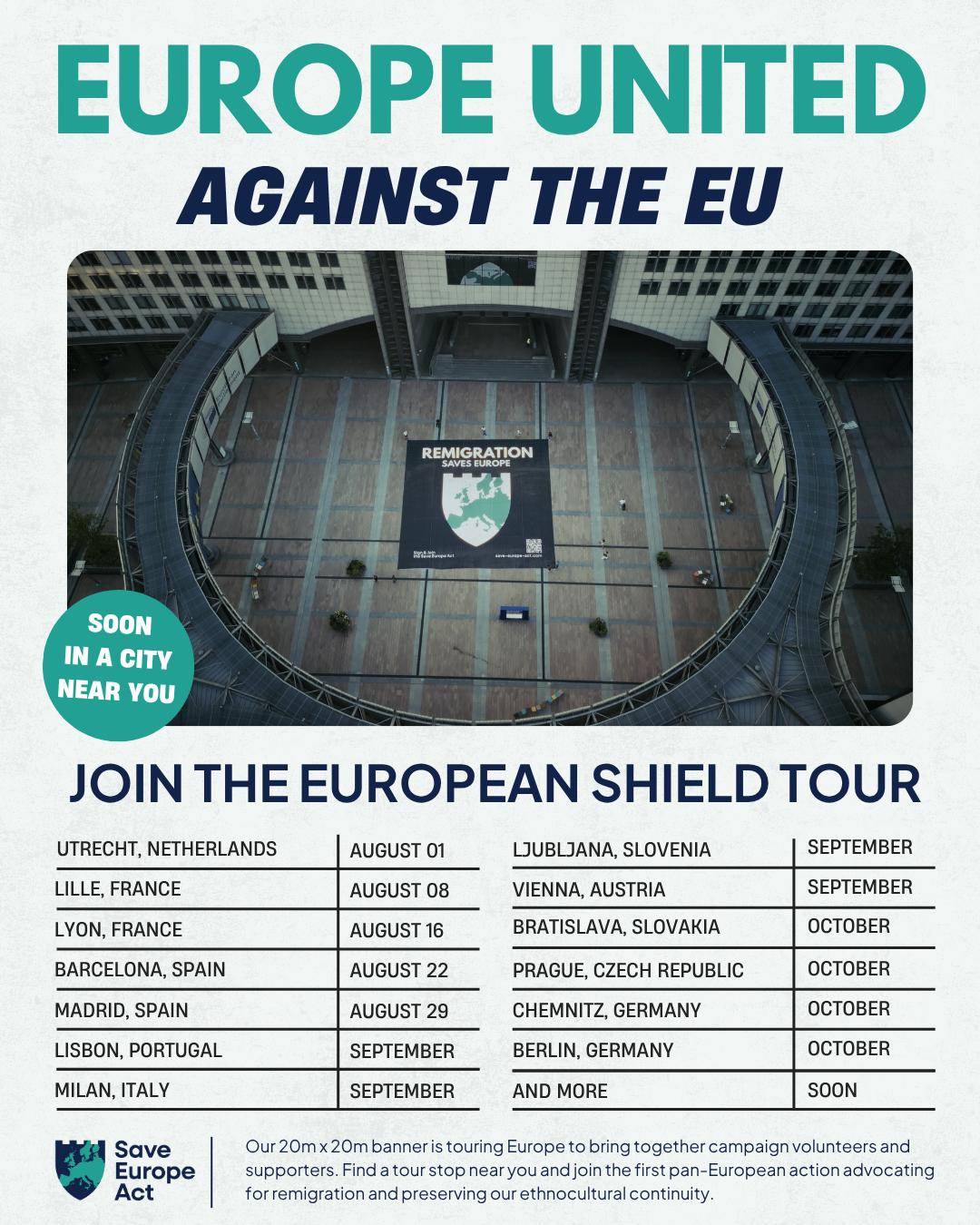


|
Save Europe Act patriots rock Ceuta .... and more
Save Europe Act <newsletter@save-europe-act.com>
|
|
|
2000 Volunteers take to streets...help them
Save Europe Act <newsletter@save-europe-act.com>
|
Rory McIlroy and Scottie Scheffler tee off together at TPC Southwind. Kevin C. Cox / Getty Images
The FedEx Cup playoffs begin, and they do so in style. For the first time since the 2025 Tour Championship, world No. 1 Scottie Scheffler and world No. 2 Rory McIlroy are teeing off together.
A significant challenge awaits that prolific pair. It’s expected to be scorching hot at Memphis’ TPC Southwind, with a heat advisory in place for much of the region and forecasts cracking triple-digit temperatures. Water hazards don’t sound too bad for once.
Scheffler and McIlroy lead a competitive group of 69 PGA Tour pros — the usual field of 70 is down a man due to Daniel Berger’s injury withdrawal. The progressive cut narrows to 50 for the BMW Championship next week, then a final 30 for the Tour Championship on Aug. 27-30.
Tournament coverage is spread across three networks and various streaming options. Here’s what to know for the next four days of playoff golf.
All times listed below are ET.
Thursday (R1) | 9 a.m. | ESPN | |
Thursday (R1) | 2 p.m. | Golf Channel | GC Mobile |
Friday (R2) | 9 a.m. | ESPN | |
Friday (R2) | 2 p.m. | Golf Channel | GC Mobile |
Saturday (R3) | 1 p.m. | Golf Channel | GC Mobile |
Saturday (R3) | 3 p.m. | CBS | |
Sunday (R4) | Noon | Golf Channel | GC Mobile |
Sunday (R4) | 2 p.m. | CBS |
For additional streaming options, there is daily “PGA Tour Live” coverage on ESPN Unlimited from 7:45 a.m. to 6 p.m.
CBS is free over the air and also available with a Paramount+ subscription. ESPN is also available with an ESPN Unlimited subscription.
Michael Eaves anchors the ESPN network presentation. Golf Channel’s broadcast has Terry Gannon calling play-by-play and Curt Byrum on analysis.
The wall-to-wall coverage on ESPN Unlimited focuses on select pairs and holes. There are different streams to toggle between: a main feed, an isolated marquee group, a featured group with two parallel pairings, a “betcast” and a featured hole option.
Jim Nantz, alongside analyst Trevor Immelman, has anchored CBS’ golf coverage this season.
Scheffler enters atop the standings with 11 top-10 finishes in 17 events. His lone win this season came at the American Express in January. The planet’s top-ranked golfer endured an up-and-down July: He shockingly missed the cut at the Scottish Open, but tied for fourth at the Open Championship and had a second-place bid at the 3M Open. Scheffler leads the PGA Tour in scoring average, birdie average and scrambling. The 2024 champion is now three weekends away from his second FedEx Cup title.
Matt Fitzpatrick is chasing Scheffler at No. 2 on the playoff board. The Englishman won March’s Valspar Championship, then the RBC Heritage and the Zurich Classic of New Orleans in April. He claimed the 2026 Heritage through a thrilling playoff against Scheffler. Fitzpatrick paces the PGA Tour in strokes gained approaching the green. His best FedEx Cup finish is ninth in 2022-23.
Cameron Young sits third behind Scheffler and Fitzpatrick. He prevailed at both the Players Championship and the Cadillac Championship earlier in the season, and he placed second in last month’s Open Championship. The 29-year-old was No. 4 in the 2025 FedEx Cup standings.
The top five is rounded out by Wyndham Clark and Chris Gotterup. The former won his second U.S. Open major in four years; the latter has three 2026 wins, most recently at July’s John Deere Classic.
McIlroy is just 12th in the standings because he’s only competed in 11 events this season. But the pride of Northern Ireland is a factor on any given course. He won the FedEx Cup in 2016, 2019 and 2022. He also notched the ultra-rare back-to-back Masters triumph with his Amen Corner brilliance.
Tommy Fleetwood, Jordan Spieth
9:10 a.m. on Thursday
12:10 p.m. on Friday
Tom Kim, Ludvig Åberg
9:20 a.m. on Thursday
12:20 p.m. on Friday
Rory McIlroy, Scottie Scheffler
9:30 a.m. on Thursday
12:30 p.m. on Friday
Russell Henley, Rickie Fowler
10:25 a.m. on Thursday
1:25 p.m. on Friday
Justin Thomas, Si Woo Kim
10:35 a.m. on Thursday
1:35 p.m. on Friday
Viktor Hovland, Hideki Matsuyama
10:45 a.m. on Thursday
1:45 p.m. on Friday
Chris Gotterup, Min Woo Lee
12:20 p.m. on Thursday
9:10 a.m. on Friday
Michael Brennan, Justin Rose
12:30 p.m. on Thursday
9:20 a.m. on Friday
Wyndham Clark, Matt Fitzpatrick
12:40 p.m. on Thursday
9:30 a.m. on Friday
Alex Fitzpatrick, J.J. Spaun
12:55 p.m. on Thursday
9:45 a.m. on Friday
Ryan Fox, Adam Scott
1:25 p.m. on Thursday
10:15 a.m. on Friday
Xander Schauffele, Sam Burns
1:35 p.m. on Thursday
10:25 a.m. on Friday
Cameron Young, Collin Morikawa
1:45 p.m. on Thursday
10:35 a.m. on Friday
All groups can be found here.
2025: Justin Rose
2024: Hideki Matsuyama
2023: Lucas Glover
2022: Will Zalatoris
2025: Tommy Fleetwood
2024: Scottie Scheffler
2023: Viktor Hovland
2022: Rory McIlroy
2021: Patrick Cantlay
2020: Dustin Johnson
2019: Rory McIlroy
2018: Justin Rose
2017: Justin Thomas
2016: Rory McIlroy


 vença
vençaStreaming links in this article are provided by partners of The Athletic. Restrictions may apply. The Athletic maintains full editorial independence. Partners have no control over or input into the reporting or editing process, and do not review stories before publication.

Find the hidden link between sports terms