At first glance, this illustration looks like the depiction of a rather cool Victorian hangout. The image was commissioned in 1908 for a political magazine of the era, Puck, predicting a liberated woman of the future. Fashionably-dressed women are shown smoking cigars and ignoring children, drinking, gambling using stock tickers and generally hanging out like barflies. The title underneath reads: Why not go the limit? For the benefit of those ladies who ask for the right to smoke in public.
Between the 1890s and early 1900s, thousands of illustrations like this were produced and distributed around the United States and England, on postcards, in magazines and on public billboards. The message was that women’s rights were dangerous and letting women think for themselves could only end in a nightmarish society.
I went digging for more of these illustrations on the net and found a plethora of examples. Many of them are so detailed and well-drawn, you can imagine the kind of influence they must have had on young impressionable minds …
Why Prints and Editions Prints Are Leading the Art Market’s Shift to Online Auctions
New artnet Auctions specialist Jannah Greenblatt explains how changes in buyer behavior and advances in technology are creating a sea change in the field.
Pablo Picasso's Nature morte au verre sous la lampe (Still Life with Glass under the Lamp), 1962, sold to an online bidder through Phillips for $250,000. Image courtesy of Phillips.
The auction world has long lagged behind other sectors in the shift to digital. But given collectors’ increasing confidence in online bidding, combined with rising costs associated with the brick-and-mortar model, traditional auction houses are investing in rapidly developing their online capabilities—at the same time that more online-only auction platforms are emerging to join the fray. As these changes are taking place, prints and multiples are emerging as collecting categories that are particularly well positioned to thrive.
Historically speaking, the art market has always been built upon human relationships, with buyers and sellers coming together to view artworks in person. The traditional auction season is shaped around these in-person encounters, clustering sales with extended-viewing exhibitions to attract the collectors and dealers who converge in New York or London for the market festivities. But just as people are streaming TV rather than planning their viewing time around regularly scheduled programing, art collectors are looking to find new, high-speed ways to acquire work that are more convenient than the traditional model.
Online auctions make this easy. The efficiency of digital-image sharing allows sellers to submit their artworks online, and lets specialists share visuals of a work’s condition and details of signatures to collectors around the world instantly. Online-only platforms are capable of significant reach, too—for example, artnet receives 3.7 million visits per month, with subscribers and bidders from over 235 countries and territories. Collectors are able—and eager—to bid 24 hours a day, from any time zone, whenever they have a free moment.
Entirely digital auction platforms like artnet Auctions are capitalizing on the these advantages. There is now a continual stream of auctions available at all times—with most sales limited to a digestible size of 25 to 75 lots—meaning that consigners don’t have to wait for a designated week in the traditional auction calendar, and are instead able to put up artworks and sell them within days or weeks of submission. Also, because online houses are able to lower operational costs, fees and commissions are streamlined, resulting in better deals for both buyers and sellers. Bidding is immediate, and payment is faster.
Online auction houses host and administer their own online sales, which are fully virtual throughout the sale process but still entail the same rigorous standards upheld by brick-and-mortar sellers. In the digital model, specialist expertise is used to vet sellers and artworks prior to sale by examining photos in dialogue with the consigner of the artwork, confirming that details are consistent with other examples, researching in catalogue raisonnés, confirming provenance, and liaising with experts in the field.
Prints in particular are appealing to new collectors, who are more comfortable experimenting due to the lower prices and the fact that you can acquire examples by established names like Picasso, Warhol, Haring, and Banksy. Because the works are not unique, prints are sold at lower prices, which in turn opens up the number of collectors for whom these works are accessible. Original editioned artworks like screenprints or lithographs by leading artists can be purchased for far less than an artist’s unique artworks—in the $2,000 to $500,000, say, range rather than $500,000 to $50 million (or more) range for paintings by the same artist. With prints published in editions of 10 to 1,000, buyers are likely familiar with other examples from the edition—some of which are represented in major museum collections—so there are fewer surprises.
This generational shift to online is apparent across all industries. Many young people have never hailed a cab by raising their hand on the street, or ordered takeout over the phone. Shopping for this demographic is naturally facilitated through digital means, including when it comes to works of art. This younger generation is tech-savvy but new to art collecting, educating themselves by navigating through the art world online through portals like Instagram and artnet. Resources like artnet’s renowned Price Database, which lists all available auction results from public auctions, empower collectors to search and compare recent auction history, giving them a sense of confidence when purchasing. Print raisonnés, many of them online—like the Sol LeWitt print raisonne compiled by Barbara Krakow Gallery, or the archive of prints published by Gemini G.E.L. at the National Gallery of Art website—allow collectors to verify the dimensions and edition information without leaving their computers.
Once informed, collectors new and experienced alike are increasingly confident in bidding and buying online, even for relatively higher priced works. After investing in its ability to support live auctions with digital services, including by posting condition reports online and offering in-house online bidding, the Phillips auction house managed in 2017 to sell the Picasso linocut Nature morte au verre sous la lampe (Still Life with Glass under the Lamp) for $250,000 to an online bidder. artnet Auctions has experienced a similar uptick in business over the past year, with three times more sales above $75,000 in 2017 versus the prior year.
The auctioning of prints and multiples online is clearly an emerging marketplace with enormous potential. As collectors and consigners acclimate to this shifting environment, improvements are constantly being made to the technology while record-setting prices continue to be achieved. With young collectors rising to become the new establishment, it’s not inconceivable that online will someday in the not-too-distant future surpass the live sale as the preferred method for auctioning art. If the increasingly sparse salesrooms at live auctions are any indicator, the transitional moment is already coming to pass.
*****
Jannah Greenblatt, a veteran of the brick and mortar auction houses Christie’s and Phillips, is senior specialist in prints and multiples at artnet Auctions.
At Art Fairs, Keep an Open Mind, but Watch the Wallet
Photo
Bernard Lumpkin, next to a work of art by Wardell Milan, at a gala on Tuesday for the Art Show. Mr. Lumpkin said he attends art fairs primarily to network, not to buy.CreditJeenah Moon for The New York Times
Before Bernard Lumpkin was an art collector, he went to art fairs for the same reasons that someone might go to any exposition: to explore a new world. His first fair was in 2008 at the Armory Show in New York, where he made his first offer on a piece of art.
Since then, after years of collecting, Mr. Lumpkin’s approach to art fairs has evolved. He may still buy something, but that is not his primary motivation for going.
“Now that I have more connections in the art world and other buying options, I go mostly to look, learn and network,” he said. “I might not be buying, per se, but I’m still getting a lot of business done.”
Whatever the motivations, art fairs have grown in importance to dealers and collectors in the past decade. This week and next, two established fairs are back in New York: the Art Show, which runs through this weekend, and the Armory Show, which opens on Thursday.
They compete on the world stage with big international gatherings like Art Basel, which has expanded from Switzerland to Hong Kong and Miami Beach, and the Frieze shows in London and New York.
The pull that fairs exercise over attendees’ minds and wallets is substantial. Just as the fairs can educate visitors about artists, they can seduce them into paying too much or buying too quickly. But experienced collectors advise caution for newcomers, saying it’s better to wade in slowly.
On the other side, the mix of money and a broad audience has made fairs important not just to young artists and gallery owners but to some of the top artists and dealers in the world.
The David Zwirner Gallery, with spaces in New York, London and now Hong Kong, will show and sell work at 20 fairs around the world this year.
“We’re educating the world about our program, but we’re also getting to know the buyers in each market,” Kristine Bell, a senior partner at Zwirner, said.
Thaddaeus Ropac, who operates five galleries in Europe, said he often used fairs to highlight different works by an artist he was showing in one of his galleries. Last year, he mounted a show of works by Georg Baselitz, a German painter and sculptor, in one of his Paris galleries. At the same time, he sold pieces by the artist from different points in his career at several fairs. The idea was to reinforce, not cannibalize, what was being sold in the gallery.
“The important thing is, you always treat art fairs like a show,” Mr. Ropac said.
That is as much a business decision as an aesthetic one. Even if the vast majority of fairgoers cannot or will not buy an expensive piece of art this week, a few will, and that’s what matters to even the most successful gallery owners.
“We have one of the largest galleries in New York, and we do all the things we’re supposed to do,” said Sean Kelly, a gallery owner who represents about 30 artists, including Kehinde Wiley, who painted former President Barack Obama’s portrait and will have a booth at the Amory Show. “But the fact of the matter is, if you go to an art fair and get 60,000 people through in five days, we’d never get that in the gallery. It’s a very simple statistical game.”
The fairs are circuslike endeavors, with scores of galleries rolling into town and setting up displays of millions of dollars’ worth of art for a multiday spectacle. And then everyone departs, as if leaving town at night with the big top.
“When we started, there were maybe six fairs,” said Nicole Berry, executive director of the Armory Show, which is in its 24th year. “Now, there’s a fair somewhere in the world every weekend.”
Photo
The Art Show opened Wednesday at the Park Avenue Armory in New York.CreditJoshua Bright for The New York Times
The Armory Show, spread over more than 250,000 square feet, will include about 200 galleries from 31 countries and sell art priced from several thousands of dollars up to millions, Ms. Berry said.
Opinion about fairs among art advisers — those people who guide the hearts, minds and wallets of top collectors — is split.
“A fair offers the opportunity to see as much work as possible in a short amount of time,” said Ashley Carr, a co-founder of the Modica Carr Art Advisory in New York. “That has its benefits for people who are incredibly busy and can’t go to galleries every weekend or can’t travel to shows.”
She creates a plan for her clients so they can make the most of their time, looking at art, talking to the gallery owners and sometimes meeting the artists.
But Lisa Schiff, an international art adviser who has consulted for the actor Leonardo DiCaprio’s foundation, takes a different view. “I don’t like fairs because it’s a pileup of merchandise,” she said.
Ms. Schiff cautioned collectors, particularly new ones, not to buy at an art fair. That same atmosphere that creates excitement makes it hard to properly assess an artist, she said. But she acknowledged the convenience, comparing the experience to ordering online as opposed to shopping at a smaller business.
“I usually end up doing a lot of business at fairs even though it’s not my intention,” she said.
Mr. Lumpkin, who sits on the board of the Studio Museum in Harlem, had several pieces of advice for a first-time fairgoer or buyer. Avoid being taken in by any hype around an individual artist, he said: “Buy with your eyes and not with your ears.”
Attendees also need to strike a balance between impulse and hesitation. On the one hand, he said, people should not be afraid to wait and follow up after the fair if they see something they like. On the other hand, he said, “if you see something good and like it, jump on it before it’s gone.”
It’s those types of conflicting emotions that make fairs exciting but also risky for buyers prone to quick decisions. The lead sponsor of this year’s Armory Show is Athena Art Finance, which specializes in lending quickly to collectors buying art.
“Clients, literally in front of the painting, text me a picture and say, ‘How much would you lend me if I bought this painting?’” said G. Andrea Danese, president and chief executive of Athena.
The answer is less than the purchase price. “The sale price isn’t so relevant to us — it’s inflated,” Mr. Danese said. Generally, if the work is by a known artist with a sales history, the firm takes 20 to 25 percent off the price and then lends about half that amount.
The company, which has been open for about three years, has $180 million in loans outstanding, ranging from four months to five years.
But that type of financial engineering is at the top of the art fair market.
Mr. Lumpkin, who attended a private reception on the opening night of the Art Show this week, said he still appreciated the fairs for the openness they projected in the otherwise rarefied world of high-priced art. He called them “one of the few democratic arenas where anyone can, in theory, walk in and buy something.”
“Of course, the reality is that a lot of the best work is already presold or on reserve when the fair opens,” he added. “And just because you can afford to buy a work of art doesn’t mean the gallery will sell it to you,” because galleries often want their artists’ work in the hands of respected collectors.
But for an afternoon, at least, an art fair lets you dream. “Enjoy the people-watching,” Ms. Schiff said, “and the food.”
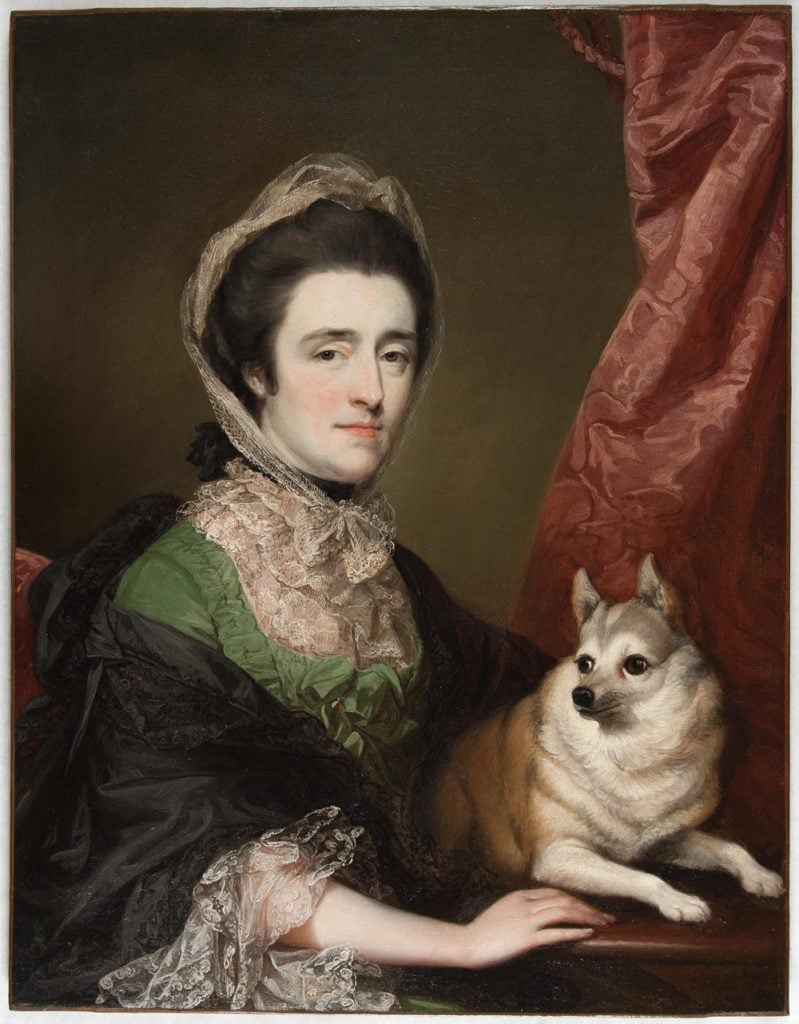
George Romney Portrait of Mrs. Anne Dashwood, c. 1770 oil on canvas Carnegie Museum of Art, Gift of Mr. and Mrs. Charles Dreifus, Jr. and Mr. and Mrs. A. Cass Sunstein in memory of Annette Dreifus
More than a dozen works in the Carnegie Museum of Art’s collection are the subject of new attributions or major new discoveries following a marathon research initiative. Three years ago, the 120-year-old Pittsburgh museum decided to hunt through its vaults to re-examine works from the Enlightenment era that had rarely been shown.
The results are, well, enlightening. A number of objects have been re-attributed, including one painting now confirmed to be by the celebrated English portrait painter George Romney. That work, along with dozens of others, will be shown for the first time in decades in the exhibition “Visions of Order and Chaos: The Enlightened Eye,” which opens at the Carnegie on March 3.
“We’ve got all these interesting paintings that have not been properly appreciated,” Louise “Lulu” Lippincott, the Carnegie’s curator of fine arts, tells artnet News. She explains that the institution’s earliest holdings are heavy on British portraiture because Gilded Age collectors in Pittsburgh took cues from the wealthy Mellon and Frick families, who were also buying them.
But “as the works went out of fashion, they went off view,” Lippincott says. “A great many things just sort of disappeared into storage.”
The prolonged research effort involved investigations into “condition, provenance, conservation, and interpretation of the meanings of some works,” she says. Some of the new discoveries were exciting, while others—like the downgrading of a work originally believed to be by British artist John Hoppner—were deflating.
“The good thing is that because we’re a museum, the impact on value is not a primary consideration,” Lippincott says. “We are mostly interested in getting it right, even if it means that the name of the artist is not as prestigious or valuable as before.”
Below, Lippincott walks us through some of the Carnegie’s most consequential new discoveries.
A Romney Work Hiding in Plain Sight
Carnegie experts long believed that this painting (above), one of many in storage, was by the British portraitist Francis Cotes. So when the author of the catalogue raisonné for the far more renowned British painter George Romney asked the curators for a rundown of their Romney holdings, they didn’t even consider sharing this one. Later, when the Romney catalogue raisonné was published, they spotted a familiar image: their very own “Francis Cotes” painting. While the catalogue had marked the location of the work “unknown,” the Carnegie knew just where it was—sitting in its own storage unit.
Further research allowed the museum to “very securely” confirm it was an early work of George Romney, Lippincott says. Furthermore, researchers were able to re-identify the sitter as a relative of the person it was originally thought to depict.
Dashed Hopes for Hoppner
John Hoppner, Miss Home with Kitten (circa 1795). Carnegie Museum of Art, J. Willis Dalzell Memorial Collection, gift of Mrs. J. Willis Dalzell
Not every new attribution has been an upgrade, however. Museum officials originally believed that this 18th-century portrait of the adorable Miss Home and her furry feline was the work of celebrated English portrait painter John Hoppner. While conducting research on the work ahead of the show, an expert uncovered handwritten notes from esteemed art historian Sir Ellis Waterhouse, who had long ago cast serious doubt on that attribution. Now, the Hoppner name is officially followed by a question mark. However, there is no doubt that the portrait of Master Order (below) is the real deal.
John Hoppner’s Master Order (1806). Courtesy of the Carnegie Museum of Art.
A Potentially Famous Original Owner of This Ghostly Tracing
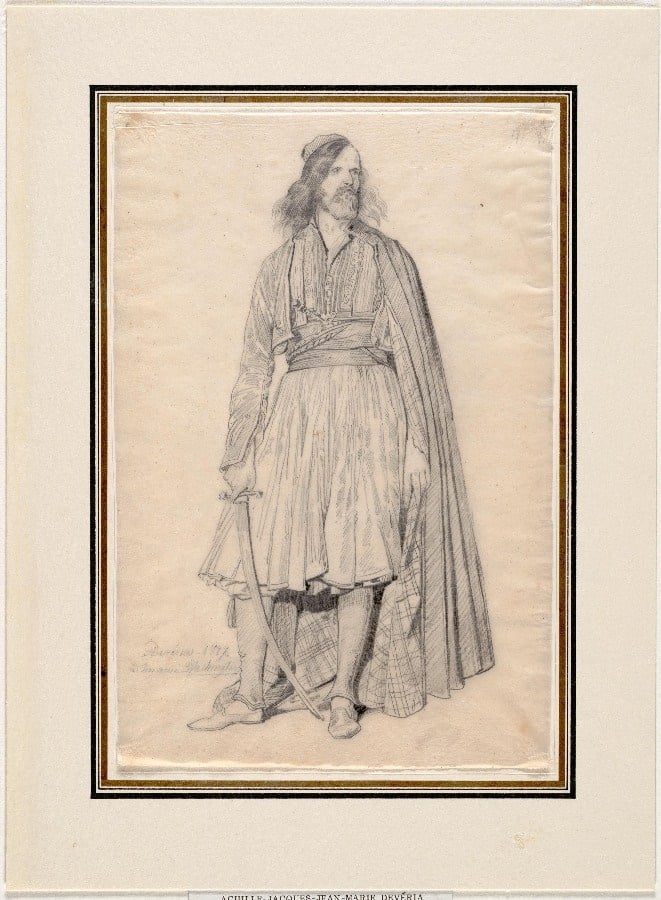
Achille Devéria, Soldat Souliote (Souliote soldier) (1827). Graphite on translucent paper Carnegie Museum of Art, Gift of Dr. and Mrs. Daniel Fishkoff
French artist Achille Devéria’s tracing of his original drawing of a Greek freedom fighter (circa 1826–7) has long been part of the Carnegie’s collection. (The Louvre owns the original.) The Carnegie’s version on translucent paper bears an inscription on the lower left that reads: “A mon ami Washington… [to my friend Washington…].” Now, experts have set out to confirm the identity of the mysterious “Washington.”
They suspect it could be the American writer Washington Irving, who was in Paris serving as a diplomat at the time. He was also known to be a major supporter of Greek independence from the Ottoman Empire, which would make a drawing of a freedom fighter a fitting gift. But while Lippincott says “it’s possible” the Washington referred to in the note is Irving, only further art historical sleuthing will prove it for sure.
French artist Achille Devéria’s drawing and detail of signature, right. Courtesy of the Carnegie Museum.
A Serious Upgrade for Goya’s ‘Los Caprichos’
Francisco de Goya Los Caprichos (The Caprices) (1796–1799) Carnegie Museum of Art, Gift of Charles J. Rosenbloom
The Carnegie has always treasured its set of Goya’s satirical 80-print series “Los Caprichos.” But it wasn’t until very recently that curators learned, with the help of Old Master expert Armin Kunz at C.G. Boerner in New York, that its version is actually a first edition in its original binding. It also includes a number of proofs for Goya’s most famous image, TheSleep of Reason Produces Monsters (El sueño de la razon produce monstruos).
“We knew it was Goya. We knew it was ‘Los Caprichos.’ But we did not understand the importance of that first edition or the presence of so many proofs,” Lippincott says. “This is a case where we had to add two zeroes to the value.”
Who ever said art history doesn’t pay?
Francisco de Goya, El sueño de la razon produce monstruos. (The Sleep of Reason Produces Monsters.). Courtesy Carnegie Museum of Art, Gift of Charles J. Rosenbloom