Thursday, January 30, 2020

Greek Myths You Should Know to Understand Art History


https://www.artsy.net/article/artsy-editorial-6-greek-myths-understand-art-history?utm_medium=email&utm_source=19307946-newsletter-editorial-daily-01-30-20&utm_campaign=editorial&utm_content=st-S
Art

6 Greek Myths You Should Know to Understand Art History

Greek myths have captivated the imaginations of artists since ancient sculptors created gods and goddesses out of marble. The trials of ancient Greek heroes and monsters have served as inspiration for   masters,  , and   artists alike. Although no unified telling of Greek mythology exists, sources like Homer’s Iliad and Ovid’s Metamorphoses provide an alternate history of humanity, from the creation of the first woman to the downfall of Troy. Below, we detail six myths essential to understanding the Greek mythology that has been woven into art history.

Pandora’s Box

Pandora's Box
View Slideshow
2 Images
Pandora's Box
Pandora, the first woman on Earth, was created in an act of vengeance. Zeus, the king of the sky and the gods, was angry with the Titan Prometheus for creating man in the image of the gods and providing them with fire that he stole from heaven. Zeus ordered the god Hephaestus to create Pandora to exact revenge on Prometheus. Pandora was placed into an idyllic version of Earth, and Zeus gave her a box that he told her never to open. Pandora couldn’t resist the temptation and opened the box, releasing a score of plagues into the world, like disease, old age, and death.
French painter   was fascinated by women from classical mythology, and he painted Pandora several times. In a painting from ca. 1914, Pandora appears nude and surrounded by scores of bright flowers, yet she is intently focused on the small box in her hands. Redon painted the work in the years leading up to World War I, potentially drawing a parallel between the horrors inflicted by the opening of her box and those of the war. Pandora’s influence reaches into contemporary art as well; Filipino artist  , for example, created Cosmic Pandora Micro-Box (2010) by collecting objects he found during a residency in Brazil, like socks, a bar of soap, and oyster shells. By linking ordinary objects and mythology, he questions how pedestrian items can be as impactful as the divine contents of Pandora’s box.

Perseus and Andromeda

Perseus and Andromeda
View Slideshow
2 Images
Perseus and Andromeda
Perseus is one of the foremost heroes of Greek mythology, known primarily for slaying Medusa and Cetus, the sea monster that guarded the princess Andromeda. Queen Cassiopeia, who ruled a mythical version of Ethiopia with her husband, boasted that she and her daughter Andromeda were as beautiful as the Nereids, or sea nymphs. This remark offended Poseidon, god of the sea, and in an act of vengeance against Cassiopeia, he set Cetus loose on the kingdom. After consulting an oracle, Andromeda’s father King Cepheus tied her to a rock on the shore, sacrificing her to appease Poseidon. Perseus then slayed Cetus and made Andromeda his wife.
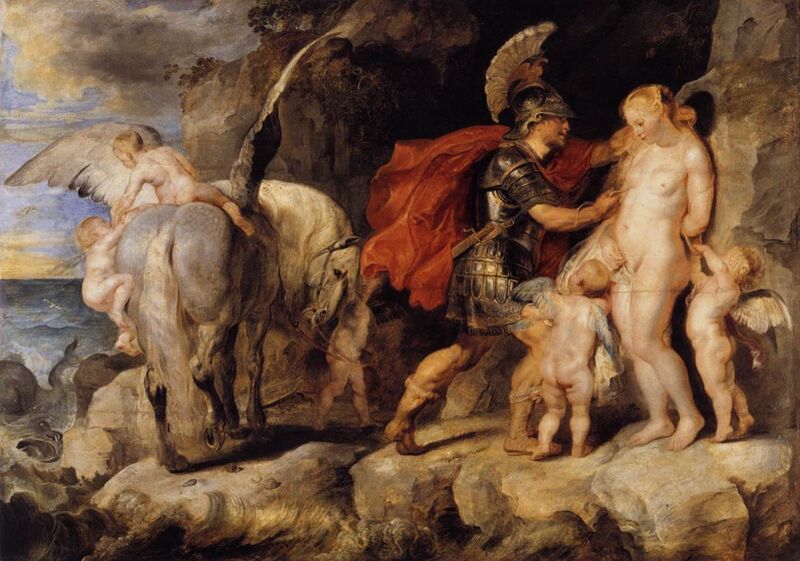
Perhaps the most famous depictions of this myth are by  , who returned to the subject several times. In Perseus frees Andromeda (1620–1622), we see Perseus approaching a chained Andromeda, aided by several putti, or cherubs. The slain Cetus is visible in the lower left corner. Andromeda’s plight also inspired artists centuries later:   depicted her twisted beneath Cetus as Perseus pierces him with an arrow; while David Gascoyne appropriated the tale in a surrealist take where Andromeda’s head is perched atop a tennis racket.

The Minotaur

Minotaurs
View Slideshow
2 Images
Minotaurs
The Minotaur is a half-human, half-bull monster born to Queen Pasiphae of Crete. Daedalus, King Minos’s prized inventor, created a labyrinth to conceal the beast, which demanded a payment of seven young men and seven virgins (accounts vary on how frequent that payment was required, ranging from annually to every nine years). The Greek hero Theseus eventually slayed the Minotaur, but the mythical creature and its symbolism of forbidden desire, lust, and greed lives on.
 became particularly interested in the Minotaur during a period of personal turmoil—when his marriage to Olga Khokhlova was in trouble, and his mistress at the time, Marie-Thérèse Walter, was pregnant. However, his frequent depictions of the monster also coincided with rising political tensions in 1930s Europe. The artist connected the mythical creature with the bullfighting of his Spanish heritage, producing etchings like Minotaurmachy (1935), which depicts the Minotaur leaning toward a young girl holding a candle. The work served as source imagery for Guernica (1937), which also features a bull. Other artists embraced the Minotaur, too:   and Pierre Mabille published a magazine entitled Minotaure in the 1930s, while   immortalized the beast’s mother Pasiphaë in his 1943 work by the same name. In  ’s And Then We Saw the Daughter of the Minotaur! (1953), a robed bull figure sits at a table, surrounded by two children and a ghostly figure.
The Minotaur has also been used to more moralizing ends:   painter   used the monster in an 1885 work in which the Minotaur gazes out at the sea, waiting for his annual feast to arrive. In his depiction of an expectant beast, Watts invokes male lust, born out of concerns over child prostitution in Britain.

Icarus

Icarus
View Slideshow
2 Images
Icarus
Aside from trapping the Minotaur in his labyrinth, Daedalus is also known for the tragic death of his son Icarus, who has inspired countless songs, poems, and artworks. To escape from Crete, Daedalus fashioned wings for himself and his son. Despite warnings from his father, Icarus flew too close to the sun and the wax holding his wings together melted, causing him to fall into the ocean and drown. The story is often told as a cautionary tale of the pitfalls of excessive pride and ambition.
The most famous depiction of Icarus by far is Landscape with the Fall of Icarus (ca. 1555), which depicts a falling Icarus masked within a larger scene of domestic life on the seaside. The viewer can only see Icarus’s flailing legs disappearing; he is entirely ignored by all the other depicted figures. The oil painting is attributed to   though some experts doubt its authenticity due to eccentricities in the work itself and the lack of a precise date or provenance for the painting.
 created a more lighthearted depiction of Icarus in his cut-out from the illustrated book Jazz (1947). There, Matisse embraced his new invention—paper cut-outs—and snipped away at sheets of red, black, yellow, and blue paper to create the image of a man dancing among the stars.

Leda and the Swan

3 Images
View Slideshow
Open Slideshow
Leda and the Swan is perhaps one of the most perplexing tales in Greek mythology to the modern reader. It is also one of the most prominent myths that echoes across centuries of art history. In the myth, Zeus takes the form of a swan to rape Leda, the queen of Sparta, resulting in the birth of Helen. The story becomes even more distressing when considering that Helen ran off with, or was abducted by, the Trojan prince Paris, inciting the Trojan War.
The image of woman and bird, and the destruction it would bring, has captivated various artists over the years.   painted two versions of Leda and the Swan, yet both have been lost. Other versions by Leonardo’s students survive, all depicting a demure, nude woman holding a swan; several preparatory sketches by the master himself still exist. Around 1880,   created his own Leda and the Swan, depicting a blonde woman staring at a swan biting her hand, a look of ambivalence upon her face. French avant-garde artist   shows a contemplative Leda dressed in pink, leaning over a black railing to pet the bird.   put his own Abstract Expressionist take on the tale, creating a maniacal mess of crayon, pencil, and paint, with some discernible elements, like hearts and a penis.

Achilles

2 Images
View Slideshow
Open Slideshow
Achilles arose as a hero of the Trojan War, leading the Greeks through a 10-year siege of Troy. One of his most notable feats is killing Hector to avenge the death of his supposed lover Patroclus. Achilles eventually falls victim to a prophecy foretelling his death at Troy; in most versions of the story, the god Apollo guides the arrow of the Trojan prince Paris to Achilles’s heel, his only vulnerable spot. His story was central to Homer’s Iliad, and his feats of heroism, as well as his deeply human tragedy, have kept the story alive.
 was particularly inspired by Greek mythology; he often used titles from the Bible or antiquity, and once wrote a letter to Clement Greenberg defending the Greek style and figure, writing, “It was the Greeks who invented the idea of beauty. Before their time a work of art was concerned with the problem of meaning and was a visible symbol of hieratic thought.” Newman’s admiration of Greek civilization is particularly evident in Achilles (1952), which depicts a red vertical stripe surrounded by brown. The red is most likely a reference to the armor Hephaestus created for Achilles to wear into battle. Twombly also created his own abstract version of the Greek tragedy in Fifty Days at Iliam: Shades of Achilles, Patroclus and Hector (1978).
A more traditional take on Achilles’s story exists in Achilles Lamenting the Death of Patroclus (1760–1763) by  ; in the work, Achilles is draped over a ghostly white Patroclus, pushing away the other Greek soldiers.  ’s 2015 Self Portrait as Achilles pictures a woman stepping into the shell of the Greek hero; she hunches away from the camera, showing the viewer bruises up and down her back. Her right hand claps an arrow aimed at her foot, alluding to the myth of the Achilles heel.


Christy Kuesel is an Editorial Intern at Artsy.

Tuesday, January 28, 2020

Alfred Jarry’s ‘King Ubu’ Inspired Everyone From the Dadaists to the Beatles

    Alfred Jarry’s ‘King Ubu’ Inspired Everyone From the Dadaists to the Beatles—and His Fascist Buffoon Is Now More Relevant Than Ever

    Without the 19th-century French firebrand, we may never have had Surrealism, Dada, or $120,000 bananas.
    Alfred Jarry, Photo by adoc-photos/Corbis via Getty Images.
    Alfred Jarry, Photo by adoc-photos/Corbis via Getty Images.
    A portrait of the French playwright and legendary bohemian Alfred Jarry, with his long dark hair and manicured goatee that evokes The Three Musketeers, appears alongside family photos in Linda Klieger Stillman’s home in Potomac, Maryland.
    In fact, art and memorabilia related to the proto-Dadaist and inventor of “pataphysics” is scattered all over the house, though some of it is missing now that Linda and her husband, Robert Stillman, gave a significant gift of Jarry’s books and manuscripts to the Morgan Library. Those objects are on view there now as part in the new show “Alfred Jarry: The Carnival of Being,” through May 10.
    On a recent visit to Potomac, Linda, who has been obsessed with Jarry for more than 40 years, was wearing earrings, a ring, and necklace in designs she associates with Jarry’s drawings, and the same emblem appears on a purplish hand towel in one of her bathrooms.
    Stillman, who is part of the Collège de ‘Pataphysique, founded in Paris in 1949, first became interested in Jarry early on in her language and linguistics studies at Georgetown University. After completing a project on the language in Jarry’s most famous play, Ubu Roi (or King Ubu), her professor suggested she write her dissertation on the subject.
    “I’ve had this entire Ubuesque and Faustrollian and pataphysical life ever since,” she says. (Dr. Faustroll was another Jarry character, based on Faust.) “I think he was the launch pad of the entire avant-garde of 20th-century Western culture,” she says.
    Jarry’s grotesquely tyrannical King Ubu has recently reemerged with surprising relevance to today’s politics. Critics including Hal Foster and Charles Simic have described President Trump as a modern-day King Ubu, “who was a buffoonish pretender to the throne of Poland, a brutal and greedy megalomaniac who, after killing off the royal family, starts murdering his own population in order to rob them of their money,” Simic writes, noting that Ubu is the only literary character he knows of who approximates the president. Meanwhile, playwright Paula Vogel organized national Ubu “bake-offs” in 2018 to protest President Trump.
    And what’s currently going in Ukraine and Russia is intimately connected to what Jarry wrote about in the Ubu, Stillman says. (She also believes Jarry’s writings anticipated some of Einstein’s theories.)
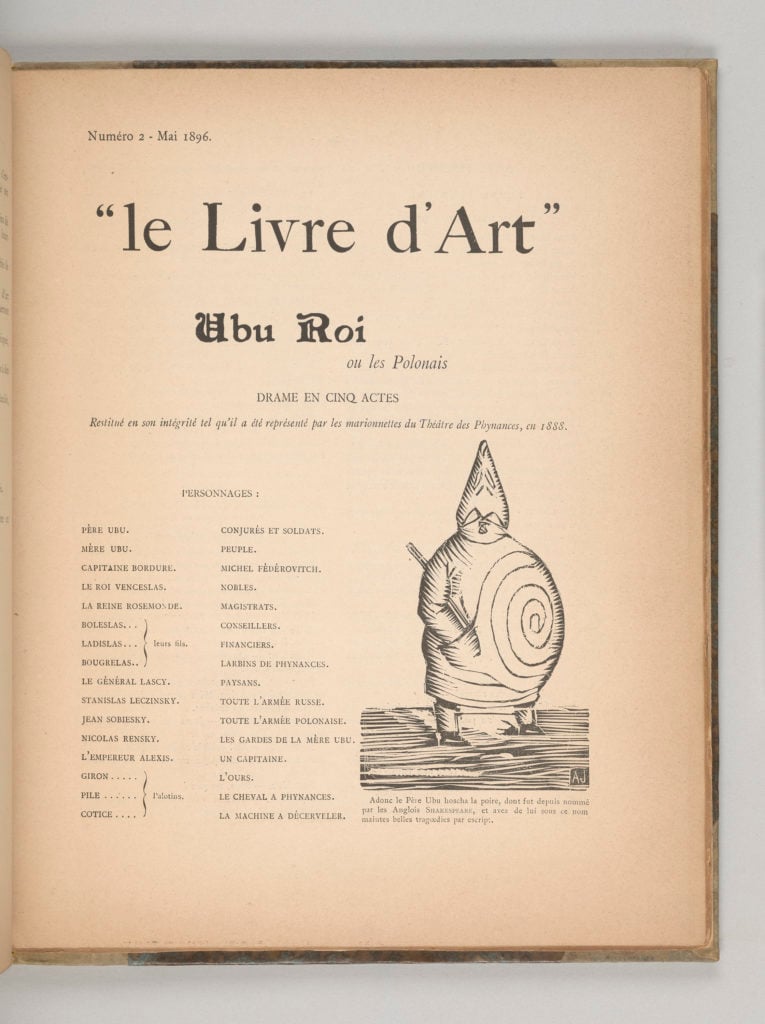
    Alfred Jarry, Ubu roi in Livre d’Art no. 2 (April 1896). The Morgan Library & Museum. Photo: Janny Chiu.
    Alfred Jarry’s Ubu roi in Livre d’Art no. 2 (April 1896). The Morgan Library & Museum. Photo: Janny Chiu.
    However, Sheelagh Bevan, the curator of the exhibition at the Morgan, says that Jarry’s life was more one of the imagination than of politics, and notes that the writer made very few political statements in his lifetime. “Jarry was too much of a pure artist and individualist to be nailed down by anything,” she says. “That sort of pure artistry would be difficult in the contemporary moment. It would be difficult to be that pure of an artist right now.”
    Despite this renewed relevance, Bevan has been surprised by the public’s lack of familiarity with Jarry’s name, “even much less what his work was really about, and I’m not sure how to account for that,” she says. A museum director in France told her that even French people who use the term Ubuesque to mean something negative about power and authority don’t necessarily know that it comes from Jarry’s play.
    “It has just become a term,” Bevan says. “’We’re hoping that this [show] will stimulate further scholarship and a broader familiarity with just how important he was.”
    Historically, Jarry had more success finding his way into famous circles. Pablo Picasso and Pierre Bonnard both drew his portrait, and Paul McCartney was reading Ubu Roi in 1968 while composing The Beatles’ song “Maxwell’s Silver Hammer,” which opens with the lines “Joan was quizzical / studied pataphysical science in the home.”
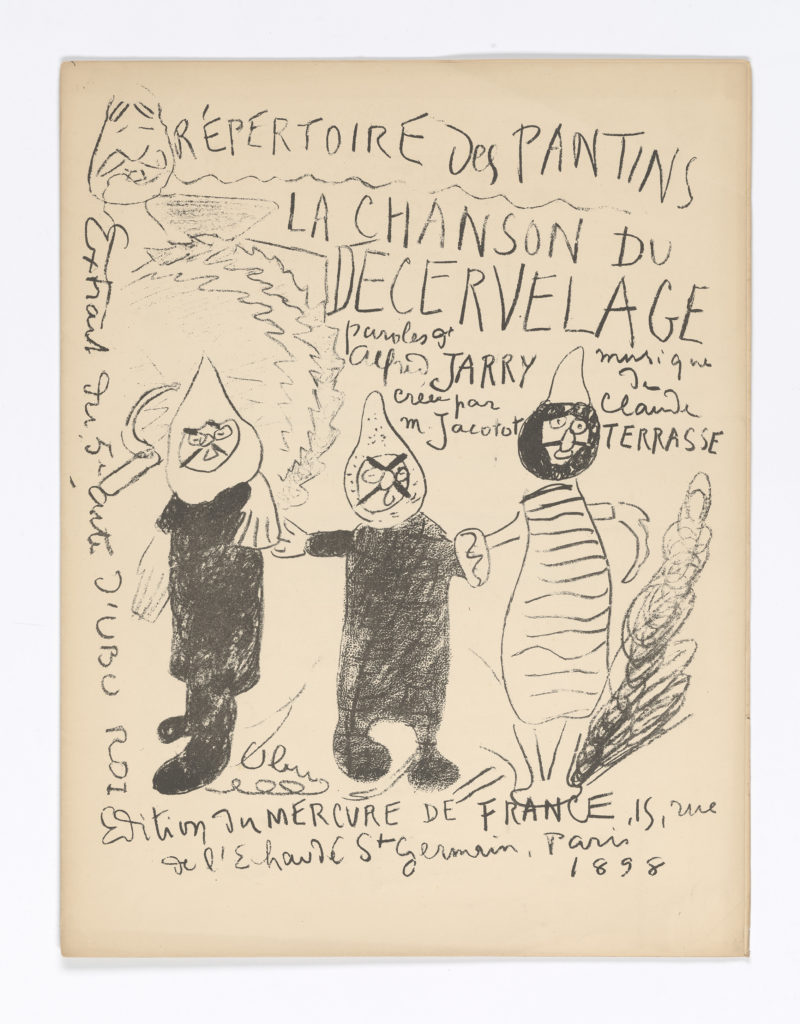
    Alfred Jarry and Claude Terrasse, Répertoire des Pantins: La chanson du décervelage (Paris: Mercure de France, 1898). Photo: Janny Chiu.
    Alfred Jarry and Claude Terrasse, Répertoire des Pantins: La chanson du décervelage (Paris: Mercure de France, 1898). Photo: Janny Chiu.
    Artists from the Surrealists to Dadaists saw Jarry as their patron saint, which raises the question of how different modern and contemporary art history would be without Jarry’s pataphysics. (Certainly, there wouldn’t have been the rock band Pere Ubu.)
    Bevan first learned about pataphysics in her 20s, and Jarry’s books, which she encountered in a Museum of Modern Art exhibition about artists’ books in the mid-1990s, made a “huge impression” on her. But his writings are difficult to read, and there are barriers in the availability of translations.
    Pataphysics, in one translation, is “the science of imaginary solutions, which symbolically attributes the properties of objects, described by their virtuality, to their lineaments.” On a first read, that’s about as clear as mud. Merriam-Webster offers a simpler, if rather dismissive, definition: “intricate and whimsical nonsense intended as a parody of science.”
    Performances are also tough to document, Bevan adds, particularly given how Jarry’s life imitated his art. Jarry adopted Ubu’s outlandish way of speaking. When describing his parents, for example, he said, “Our father was a worthless joker—what you call a nice old fellow. He no doubt made our older sister … but he cannot have played much of a role in the confection of our precious person. Our mother was a lady of Coutouly ancestry, short and sturdy, willful and full of whimsey, of whom we had to approve before we had a voice in the matter.”
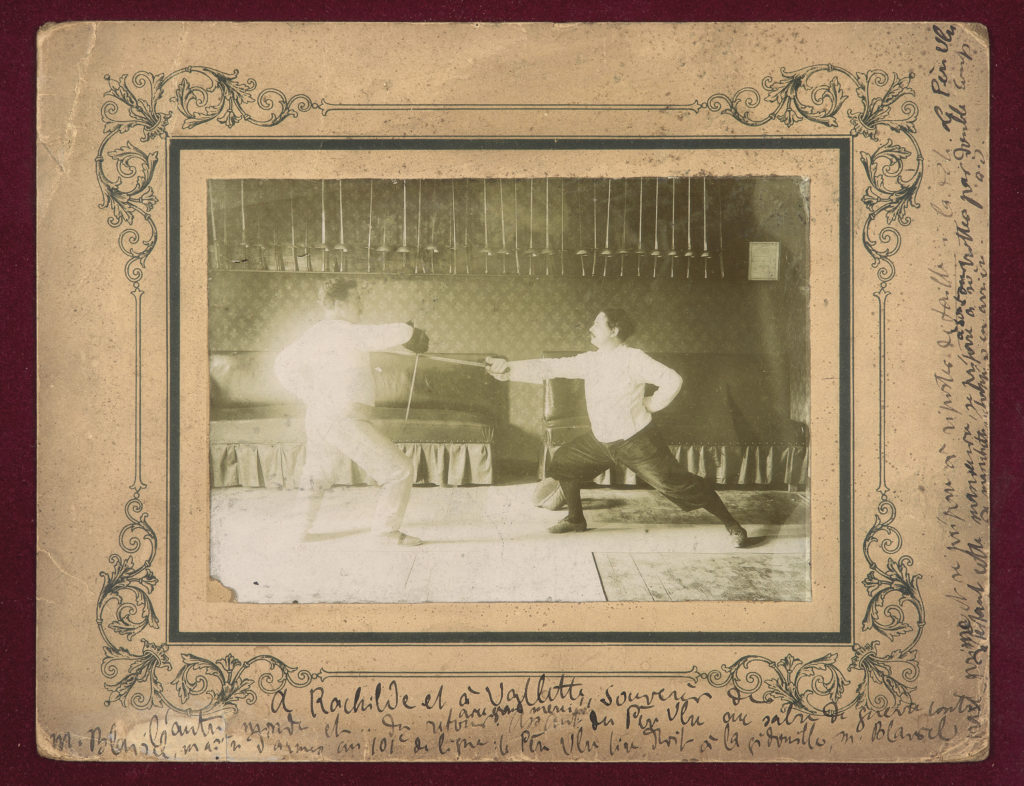
    Alfred Jarry (at right) fencing with Félix Blaviel in Laval, 1906, photograph. Courtesy of the Morgan Library & Museum.
    Alfred Jarry (at right) fencing with Félix Blaviel in Laval, 1906, photograph. Courtesy of the Morgan Library & Museum.
    Jarry’s life was brief, dramatic, and filled with plenty of controversy. In his short story “The Passion Considered as an Uphill Bicycle Race,” Jarry, who was an avid cyclist, imagines Jesus Christ bike-racing against some thieves and then wrecking on a turn. Jarry’s blasphemy, wrote Roger Shattuck in his 1968 book The Banquet Years, “transformed religion into a sport, just as the mechanical idea of the athletic record gave him the opportunity to victimize romantic love. … He said categorically, ‘Screw good taste.’”
    And when King Ubu premiered, the first word uttered—merdre, a variation on the French word for “shit”—caused a scandal by voicing a curse word in formal theater.
    A decade later, Jarry died, at just 34 years old, in part due to his heavy drug and alcohol habit.
    Stillman with Ubu Tells the Truth by William Kentridge. Photo: Menacham Wecker.
    Stillman with Ubu Tells the Truth by William Kentridge. Photo: Menachem Wecker.
    The Morgan show is a corrective to Jarry’s better-known antics, Bevan says, by focusing instead on printed books. Visitors will discover Jarry’s collages, for example, which might juxtapose a 17th-century recipe for turning your hair green with a snippet of his own writing. “He didn’t care about tempering the various illustration styles,” Bevan says. “It’s an unorthodox approach to authorship in general.”
    Taken together, the books go beyond Ubu to offer a deeper and more rounded look at Jarry’s oeuvre. “You just see so much more, and you see the serious side of the comedy,” she says.
    This duality is what initially drew South African artist William Kentridge, who played the character of Captain Manure in his university’s production of King Ubu, to Jarry’s work. “There’s something about the absurd and the political absurd that intrigued me with Jarry which has stayed with me,” Kentridge says. He, along with two other South African artists, has since made Ubu-inspired etchings that explore “the combination of the burlesque and the grotesque, and the violent and the comic, that is the heart of the writing.” (Another painting that Kentridge made about Ubu hangs in Stillman’s home.)
    Initially, Ubu adaptations in South Africa satirized apartheid rule, “but now it could also equally be done about the new rulers in the South African political arena,” Kentridge says. He credits Jarry with “understanding the absurd as a kind of political critique rather than the foolish or just the joke or the funny” and applying it as “a corrective, as a warning, as a demonstration of what happens when self-love and self-pity become the motivating factors of politicians.”

    Follow artnet News on Facebook:

    Want to stay ahead of the art world? Subscribe to our newsletter to get the breaking news, eye-opening interviews, and incisive critical takes that drive the conversation forward.
    artnet news
    It looks like you're using an ad blocker, which may make our news articles disappear from your browser.
    artnet News relies on advertising revenue, so please disable your ad blocker or whitelist our site.
    To do so, simply click the Ad Block icon, usually located on the upper-right corner of your browser. Follow the prompts from there.
    SHARE

    Banksy gives financially stretched boys club his ‘blessing,’


    Morning Mix
    The latest officially confirmed Banksy artwork, “Mobile Lovers,” on display inside the Broad Plain & Riverside Youth Project on April 16 in Bristol, England. (Matt Cardy/Getty Images)
    The latest officially confirmed Banksy artwork, “Mobile Lovers,” on display inside the Broad Plain & Riverside Youth Project on April 16 in Bristol, England. (Matt Cardy/Getty Images)
    May 9, 2014 at 9:17 a.m. GMT+1
    Picture this: You’re running a financially strapped boys club in a youth project in a city that’s seen better days. Things are so bleak you may have to shut down. Then, one day, a famous artist comes along quietly and creates a painting on a stray piece of wood in your doorway and disappears.
    That’s what happened to a 120-year old boys club in Bristol, England. The artist was Banksy, the world-famous guerrilla graffiti artist. And experts told the BBC yesterday that the painting could fetch between $500,000 and $800,000.
    The painting is called “Mobile Lovers.” Though he generally doesn’t like to mix art and money — he’s famous for that — Banksy has given his okay to having it auctioned off by the club.
    He painted “Mobile Lovers” on a piece of wood that was being used to block a doorway in his home town of Bristol. When the club’s leader, Dennis Stinchcombe, happened upon it, he pried it off with a crowbar, intent on auctioning it off as a way to raise money for the club.
    The town’s mayor, George Ferguson, threw a wrinkle in those plans, however, when he declared that the artwork was the property of the town and should be housed in a museum, which is where it is now.
    Banksy confirmed that “Mobile Lovers” was his last month when he posted it on his Web site.
    In a letter marked “private and confidential,” Banksy, who is famously laconic, told Stinchcombe:
    As you know, I recently painted on a doorway near the club. This was meant as a small visual gift for the area — but apparently a financial one would have been more useful.
    I don’t normally like to admit to committing criminal damage, but seeing as it looks like charges won’t be brought any time soon you have my blessing to do what you feel is right with the piece.
    BBC News, which has a picture of the letter, reports that the letter has been authenticated.
    Banksy has said in the past that he’d rather his work not be worth anything, but his works have commanded hundreds of thousands of dollars at auction. Last year, he sold his prints in New York’s Central Park for $60 apiece, making $420 total. One lucky, unwitting woman even bargained him down to half-price. The total was valued at more than $200,000.
    It looks like everything will work out, as Ferguson appears to be honoring Banksy’s wishes.
    “This is a proper resolution — we’ve done our job by looking after it and in the meantime we’ve collected a bit more for the boys’ club, and thousands of people in Bristol and farther afield have seen it,” Ferguson told the BBC. “This was never a case of Dennis and I not seeing eye to eye. Dennis has said that if it fetches as much as auction as it could do, the money will go not just to the boys’ club but also to youth projects in Bristol.”