Thursday, May 2, 2019

Britain’s super-rich are Corbyn-proofing their finances


The pips squeak againBritain’s super-rich are Corbyn-proofing their finances

Efforts to protect wealth should Labour take power are being stepped up
Jeremy corbyn may have it in for tax havens, but they are not all cursing the Labour leader. Well-heeled types worried about the prospect of a Corbyn-led government have been buying property on Guernsey with a view to moving to the island, attracted by its flat 20% income-tax rate and lack of capital-gains or inheritance taxes. Demand for homes there is buoyant, and Jo Stoddart of Locate Guernsey, an investment-promotion agency, says queasiness over Mr Corbyn is one of the main reasons.
The opposition leader makes no secret of his disdain for the rich. The real divide in Britain, he said recently, is not over Brexit but “between the many, who do the work, create the wealth and pay their taxes, and the few, who set the rules, reap the rewards and dodge their taxes.” The super-rich, he has warned, are “on borrowed time”.
Small wonder, then, that plutocrats are seeking advisers’ counsel—and increasingly taking action—to keep their incomes, mansions and pensions out of Labour’s clutches. “How to Corbyn-proof your wealth”, an event held in London in February by an investors’ club, sold out.
Bookmakers offer odds as short as 3/1 on Mr Corbyn becoming the next prime minister. If that happened, says the chief executive of a ftse 100 company, the rich would “take all the money offshore, wait for the economy to crash, and come back and get richer.” Private-client advisers have warned of Britain’s multi-millionaires moving up to £1trn ($1.3trn) out of the country. But the “mass affluent”, those with liquid assets in the hundreds of thousands, also have cause to fret.
Such fears have fluctuated in line with recent political turmoil. Wealth advisers agree that clients worry more about Mr Corbyn than Brexit—though the two are linked, as some fear a disorderly Brexit precisely because it could usher in a Labour government. Iain Tait of London & Capital, who advises dozens of rich families, says anxiety about Labour has reached its highest point yet in the past couple of months. When clients of Saunderson House, a wealth manager, were asked in October about the biggest threat to their finances, the most likely answer, mentioned by 42%, was a change of government. The number would almost certainly be higher now.
The worries fall into three categories. The first concerns existing tax and pension arrangements. Labour is likely to target pension tax relief for high earners. On income tax, it has promised to reintroduce the 50% rate on earnings over £123,000 (rather than £150,000) and add a 45% rate that kicks in at £80,000. It is likely to reverse the Tories’ cuts to capital-gains tax. And it is expected to tighten the inheritance-tax regime, possibly by reducing or removing allowances for those giving to discretionary trusts or handing property or gifts to relatives. To cap it all, Labour promises to levy vat on private-school fees.
The second area is brand new taxes. Labour hopes to raise almost £5bn a year from a new financial-transactions levy. This would cream 0.2% off every transaction executed by financial firms. Some hedge funds are reportedly considering moving overseas in response. The bigger worry is the possibility of a wealth tax on assets, perhaps focused on high-value homes, to help fund social care. In 2012 John McDonnell, who has since become shadow chancellor, backed a proposal for a one-off, 20% wealth tax to help reduce government debt.
The third category—and the biggest bogeyman—is the spectre of capital controls, measures to restrict the flow of capital in and out of the country, in the event of severe economic turbulence. Labour has repeatedly denied it would consider such a measure, last seen in Britain in the late 1970s. Even Mr Corbyn’s critics see it as a long shot. Nevertheless, contingency plans are being put in place. A year ago, says Mr Tait, it would have seemed “ludicrous” to be mulling measures to protect against capital controls. Yet clients raised the issue in “around half” the meetings he attended in the run-up to Easter. As an insurance policy, some have arranged for custody of their investment accounts (used to buy and sell securities) to be moved to the Channel Islands or Switzerland. Changing the jurisdiction in which accounts are booked is all about “asset access”, not tax, says Mr Tait.
With a property-based wealth tax in mind, some rich folk are accelerating the transfer of homes to children. “They might have done this anyway when the kids were in their 20s. Now they’re doing it in their teens,” says one adviser, who has “dozens” of clients who have opted to speed up handovers. Some are also using up tax-free pension allowances, or vesting tax-free cash, earlier than required, for fear of such benefits evaporating under Labour.

Sunny places for gloomy people

A smaller number are considering moving offshore. Rather than emigrating now, most of these Jeremiahs are considering buying foreign residence permits to hold alongside their British passports, in order to be well placed to hop abroad if things turn nasty. Advisers say they are looking not only at obvious places like Monaco and the Channel Islands but also at eu countries that have become friendlier to rich foreigners, such as Portugal (where a “golden visa” can be bought for €500,000, or $561,000) and Italy (where income from abroad can be taxed at a flat €100,000).
Among those tempted to up sticks are resident “non-doms”: foreigners who live in Britain but declare their domicile as elsewhere to avoid tax on their non-British income. The Tories took away some of their privileges in 2016, but the non-doms are still handled fairly generously for up to 15 years. The threat of a Corbyn government, though, is leading some who were wavering to go elsewhere. Another wealth adviser has Swedish and French clients who are returning home. “Sweden and France, those well-known tax havens!” he guffaws.
Were Britain’s 90,000 or so non-doms to leave, many Corbynistas might say good riddance. Some Labour strategists believe the public would welcome a falling-out with the super-rich. Mr Corbyn has long accused them of dodging tax and contributing little to the economy. But non-doms paid a not-so-paltry £9.4bn in tax—equivalent to a third of the transport budget—in the year to April 2016.
Mr McDonnell’s team dismisses the bleating from Belgravia as alarmist. Fears over a wealth tax are as misplaced as those concerning capital controls, aides say. Yes, income tax will rise, but to nowhere near the rates of the 1970s. Mr McDonnell may have an avowedly Marxist past, but he has been on a charm offensive in the City, assuring moneymen he has nothing up the sleeves of his branch-manager suit.
Moreover, when it comes to squeezing the rich there is less to separate the two main parties than the Tories admit. As well as turning the screws on non-doms, the Conservatives have cut high-earners’ tax-free pension allowances and are mulling an inheritance-tax grab. The chancellor, Philip Hammond, has warned that taxes must rise to fund an ageing population.
Still, tone matters, and there is a difference between measured tax increases and what looks to some like anti-capitalist bloodlust. Mr Corbyn has said he is “coming for” the rich. Some of Labour’s plans suggest a taste for confiscation. The party wants to nationalise several industries, including water, for which it is considering basing compensation for investors on “book” value—currently a third of the industry’s market value—or even less. A plan to snatch 10% of shares in big British firms and give them to workers and the state has nauseated many business leaders. “The rich are prepared for higher taxes,” says Bobby Vedral of Macro Eagle, an advisory business, “but not for expropriation.”
Mr Vedral caused a ruckus in 2017 when he predicted a Britain led by Mr Corbyn would be like “Cuba without the sun”. That is unfair—but ever more of the monied seem unwilling to take any chances.

This article appeared in the Britain section of the print edition under the headline "The pips squeak again"

TIME BY DANCE BY PAIK

Gagosian Quarterly


April 29, 2019

TIME BY DANCE BY PAIK

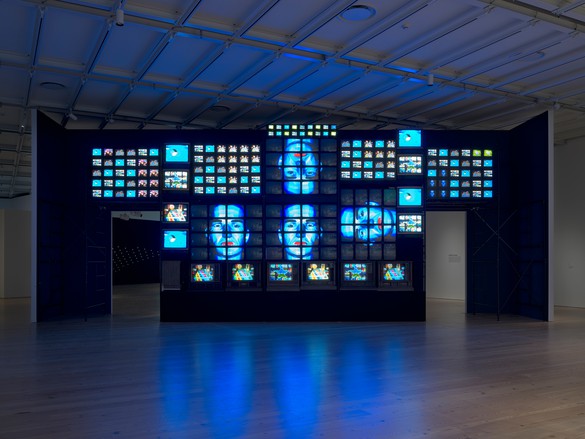
Gillian Jakab considers the role of choreography in Nam June Paik’s 1989 video installation Fin de Siècle II.

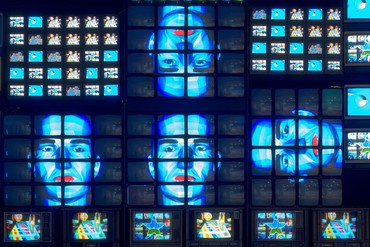
Nam June Paik, Fin de Siècle II, 1989 (partially restored, 2018), seven-channel video installation, 207 televisions, sound, 168 × 480 × 60 inches (426.7 × 1219.2 × 152.4 cm), Whitney Museum of American Art, New York, gift of Laila and Thurston Twigg-Smith. Installation view, Programmed: Rules, Codes, and Choreographies in Art, 1965–2018, Whitney Museum of American Art, New York, September 28, 2018–April 14, 2019
Nam June Paik, Fin de Siècle II, 1989 (partially restored, 2018), seven-channel video installation, 207 televisions, sound, 168 × 480 × 60 inches (426.7 × 1219.2 × 152.4 cm), Whitney Museum of American Art, New York, gift of Laila and Thurston Twigg-Smith. Installation view, Programmed: Rules, Codes, and Choreographies in Art, 1965–2018, Whitney Museum of American Art, New York, September 28, 2018–April 14, 2019
Gillian Jakab
Gillian Jakab works for La Napoule Art Foundation and has served, since 2016, as the dance editor of The Brooklyn Rail.
Screens flicker and bodies groove across time in Nam June Paik’s monumental installation Fin de Siècle II (1989). Framed within the displays of more than two hundred 1980s television sets, Merce Cunningham and his sinuous outline momentarily dance a duet. The two figures multiply across the kaleidoscopic screens—some remaining upright, some now sideways—before the footage cuts to a segment of David Bowie performing with dancer Louise Lecavalier of the group La La La Human Steps. In this programmed progression, Paik propels us from 1978-and-before to 1988-and-beyond, from the vanguard of avant-garde dance to pop music performance art, from video as a means of preservation to video where the medium is very much the message.
Time is Paik’s through thread, expressed in the sub-rhythm of the dancers depicted, in the grand rhythm of Paik’s video symphony, in the history and the future conjured by the images, and in the title, which transports us at once backward and forward to the twentieth century’s turns.
The Korean-born artist first fashioned Fin de Siècle II for the Whitney Museum of American Art’s 1989 exhibition Image World. After a stint in private ownership following the exhibition, the video sculpture returned to the Whitney and entered its collection. A seven-year conservation project ensued—involving the sourcing of vintage consoles and restoration of the work’s seven video channels—before Fin de Siècle II reentered public view for the first time in three decades with the exhibition Programmed: Rules, Codes, and Choreographies in Art, 1965–2018. While the last category in the exhibition title describes a conceptual frame shared by many of the works on view—choreography as a set of instructions to be carried out at a later time—the dance term is also a nod to the interdisciplinary spirit of the show in general, and Fin de Siècle II in particular.
Working across media, as he did in Fin de Siècle II, had long been an aspect of Paik’s approach. Following training in classical music and formative interactions with modernist composers Karlheinz Stockhausen and John Cage in Berlin, Paik became an early member of the pioneering cross-disciplinary group Fluxus. In a 1966 essay, Fluxus co-founder Dick Higgins expressed the term “intermedia” with a utopian fervor, heralding the end of rigid categories and class distinctions.1 Paik’s “intermedia” work comes off as less an echo of this singular political assertion and more an embrace of complexity in a time of myriad, intertwined modes of communication. Though often dubbed the “father of video art,” Paik created work that sprawls far beyond a single medium and explores ways in which art forms can manipulate and mediate one another.2 Time and again we see in Paik the intersections of live performance, broadcast television, sculptural installation, and rhythm, using media new and old.
Dance, while playing a minor role in the grand scheme of his oeuvre, is closely tied to a grand theme in his work: time. Paik’s use of dance—as exemplified by Fin de Siècle II—is both a meditation on time-based art and a reflection of the time in which the work was made, channeling the past and forecasting the future.
Time by Dance by Paik
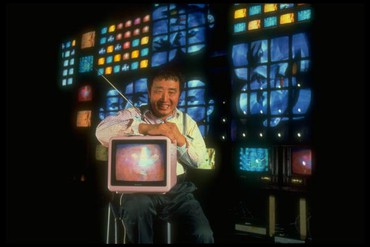
Nam June Paik with Fin de Siècle II, 1989. Photo: Mario Ruiz/The LIFE Images Collection/Getty Images
Time in Dance and Video Media
The Cunningham footage in Fin de Siècle II is a sampling from Paik’s earlier single-channel video Merce by Merce by Paik (1978). This two-part collaborative work is an homage to both the choreographer and Marcel Duchamp. In part one, Blue Studio: Five Segments, created by Cunningham and artist Charles Atlas, the video moves between personal and official records of time. The opening frames, with the credits “From New York / WNET Presents,” suggest that we are watching a public media production. We then hear a phone ring, and Merce Cunningham asks to speak to Jasper Johns. An empty electric blue studio morphs into a dimly lit city street as Merce and Jasper catch up. A superimposed Merce glides through the street, moving in place in the blue studio. The camera zooms in on his hand gestures, and an authoritative voiceover declares: “Merce Cunningham’s long career has been marked by daring experiment and consummate execution. At Lincoln Center in 1965, he was the first to combine dance with video, foreshadowing a new art form that has become known as video dance.” As Merce morphs from studio to street, so the experience of time transforms from that of a dancer’s memory to a page of dance history.
AS A PORTRAIT OF LATE-1980S VISUAL CULTURE, “FIN DE SIÈCLE II” DRAWS ITS MOST LIVELY SOURCE MATERIAL FROM THE MOVING BODY, HUMAN AND GRAPHIC.
In part two, Merce and Marcel, the question of who is presenting whom is further complicated by the presence of another subject: Duchamp. An inspiration to both Cunningham and Paik, Duchamp sets the stage for the changing nature of authorship over time. He invites an artist to put a new stamp on a found object—or footage or movement. Duchamp’s presence also ties in as the inspiration for Johns’s sets in Cunningham’s Walkaround Time (1968), film of which recurs throughout Merce by Merce by Paik.
Dance appears in many of Paik’s video works but is not often the primary subject. Even less often is it the element that draws attention or acclaim from observers and commentators. Perhaps that is to be expected; dance is commonly relegated to the margins of the larger cultural playing field. Yet some do champion Paik’s work with dance. David A. Ross, former director of the Whitney and a friend of Paik’s, writes: “The 1978 work, Merce by Merce by Paik, is probably one of Paik’s most underrated, but should be seen as one of his most direct and profound.” Underscoring the power of dance and video to throw light on time, he continues: “What quickly emerges is the notion that time is the subject of this work, time as experienced by the dancer in action, and the relative nature of time as the malleable component of video art.”3
Merce by Merce by Paik layers explicit philosophical prompts on the concept of time—in the form of Duchampian puns and rhetorical questions—with audiovisual time warps produced by the choreography and layered frames. In a motif of Blue Studio, Cunningham glides his feet as if figure skating yet stays centered on the screen: a video-art treadmill. The choreographer is superimposed on footage of a railway track streaming by. We hear a clip from what sounds like a post-talk Q&A. A woman’s voice asks:
Merce Cunningham mentioned occupying time. On the other hand, one often hears the expression “I’m going to kill some time.” It’s a silly question, but can one kill time?
The answer is both verbal and danced. Cunningham quips that it “seems to be the other way around.” Then, adding to the thought, he mentions “watching a lot of video” and “this thing that happens . . . ” His voice trails off; movement continues and takes over. A female dancer rendered in old black-and-white film, Cunningham dancer Ellen Cornfield, occupies the background with measured, elongated port de bras and forward penchées. In the foreground, Cunningham dances within a different aesthetic and rhythmic time, wearing a yellow jumpsuit and mirroring the staccato sounds of an electronic score with quick pivots, retirés, and small jumps. Who knows what it means to kill time, but Paik and Cunningham certainly annihilate any attachment one might have to a linear notion of time.
Past and present converge with the introduction to Duchamp in Merce and Marcel. The voiceover prompts:
Television obscures art in life and life in art, a theme favored by the late Marcel Duchamp, who believed a toilet bowl could be a work of art. Can we reverse time and bring back Marcel?
Dance theorist Mark Franko locates Merce and Marcel as the moment in which the notion of time emerges as the organizing principle of the work. Mortality is questioned. Interviews given by Duchamp and by Cunningham are interspliced, allowing the two artists from distinct eras to coexist. In a 1976 text, “Input-Time and Output-Time,” Paik wrote: “Once on video tape, you are not allowed to die . . . in a sense.”4 Paik emphasizes this temporal embalmment, this deployment of video to manipulate time in Merce by Merce by Paik, by playing sequences of footage in reverse and repeat—a “dance of time,” he is known to have termed it. Franko muses on this dancing of time in the work and its power of reincarnation: “While video adds a fourth dimension of time to painting, it adds to dance a different temporal dimension—that of the past, or replay.”5
DANCE AND VIDEO COMBINE TO LEAVE THE VIEWER WITH A PLAYFUL YET PROFOUND SENSE OF AN ENDLESS PAST AND A PERPETUAL PRESENT.
Viewers of Fin de Siècle II, however, see only an isolated clip of Merce by Merce by Paik—that is, if they arrive at the right moment or stay long enough. There is no voiceover to guide a theoretical investigation, yet Cunningham and his fellow dancing bodies on the installation’s screens bump up against, and break through, the contours of time. Curator Christiane Paul has spoken of the “different kinds of gestural expression” in the work’s videos of Cunningham, Bowie, and German band Kraftwerk.6She calls attention to the juxtaposition and visual parallel of the figural diagram and Cunningham, and the wireframes of the disembodied heads bopping to the robotic beat in the Kraftwerk music video. Another piece of footage recalls the treadmill effect in Merce by Merce by Paik, showing a nude woman moving in perpetual linear motion yet making no progress.
These individual time-based experiments flash and smash against one another in the collage of Fin de Siècle II as Paik choreographs moving bodies across screens with his intricately programmed sequence of videos. Dance and video combine to leave the viewer with a playful yet profound sense of an endless past and a perpetual present. Bowie sings, “I’ve been waiting so long,” and Kraftwerk chants, “Music non-stop.”
Time by Dance by Paik
Nam June Paik, Fin de Siècle II, 1989 (partially restored, 2018; detail)
Reflection of Historical Time
Just as Fin de Siècle II cracks open the metaphysics of time à la Deleuze’s “crystals of time” in cinema, so too does the installation refract history’s periodization of time. Paik’s title was, in a sense, part of a renewed interest in the art and culture of the late nineteenth century—the language nods to France as the epicenter—that arose as the end of the twentieth century set in. The video sculpture takes the pulse of its time, situating the approaching turn of the century in relation to its historical precedent one hundred years before, and priming the viewer for the brink of the new century ahead.
In The Politics of the Very Worst, philosopher Paul Virilio connects the “transportation revolution of the nineteenth century and the virtual technologies of our own fin de siècle.”7 The central link, for Virilio, is speed. Paik seems to agree. Fin de Siècle II channels the speed of bodies in motion and 1980s mass communication technology to choreograph a high-velocity collage. Smaller television screens around the installation’s perimeter form a frame with twentieth-century iconography,8 evoking the transportation revolution through images of cars and planes and the communication revolution through meta-images of television and video cameras. This juxtaposition also draws a line between the fear of drab conformity associated with the Industrial Revolution and the fear of the surveillant, dystopian powers of the Communication Revolution. (Paik countered the latter notion most explicitly in his Good Morning Mr. Orwell, aired on New Year’s Day, 1984.)
TIME AND AGAIN WE SEE IN PAIK THE INTERSECTIONS OF LIVE PERFORMANCE, BROADCAST TELEVISION, SCULPTURAL INSTALLATION, AND RHYTHM, USING MEDIA NEW AND OLD.
The central cross-section panels of Fin de Siècle II present or allude to figures of the twentieth century: Bowie, Cunningham, Duchamp (the latter through images of a female nude in computerized motion, rather than descending a staircase). Contemplating the video wall, one could draw another parallel (and surely more) between the two fins de siècle. While the work puts forth an accumulation of mostly male auteurs, gender comes off as anything but definitive. Writer Tara Isabella Burton sees Bowie, gender bender par excellence of the twentieth century, as an inheritor of the dandyism of the nineteenth century, embodied by the likes of Oscar Wilde.9The clip in Fin de Siècle II displays a white-clad Bowie suavely trading partnering roles with Lecavalier; Bowie supports her barrel jump over his back and then stands still while she lifts him vertically below the hips.
By contrast, these trans-historical threads illuminate what is inarguably distinct about the work’s time, the late 1980s. As a portrait of late-1980s visual culture, Fin de Siècle II draws its most lively source material from the moving body, human and graphic. Dance can sometimes function as visualized music (though Cage and Cunningham would insist on the autonomy of each10 ), and visualized music was precisely what was on everyone’s television screens at the time, the lifeblood of MTV. Rather than shun mass culture as distinct from “high art,” Paik saw its genius and its resonance with his artistic concerns of time and accelerated mass communication across media. Paik’s spotlighting of TV programs and music videos in his work is distinct from the earlier Pop art movement, which sought to comment on the banality of mid-century material consumerism. Instead, Paik placed art and entertainment on the same plane, reflecting a sociological phenomenon of the late twentieth century: the cultural omnivore.11 Paik responded to and whetted the zeitgeist’s appetite for Bowie and Cunningham, for MTV and Philip Glass, served on the same channel, performing at the same time.
—
Paik channeled a hundred years of revolutionary art that came before him, yet, he was ahead of his time—global before the global trend of contemporary art.12 Christiane Paul sees in the choreography across screens in Fin de Siècle II an anticipation of today’s YouTube remix culture: “I think he always was a visionary with that. I’m actually not sure if Fin de Siècle, for him, wasn’t the future of the ‘electronic superhighway’ that he saw coming.” But as Martha Graham once said, “No artist is ahead of his time. He is his time; it’s just that others are behind the time.” To me, in Fin de Siècle II, Paik seems neither before his time, of his time, nor ahead of his time. Rather he was all these, at one time.
1Dick Higgins, “Intermedia,” The Something Else Newsletter 1, no. 1 (February 1966). Available online at http://www.primaryinformation.org/oldsite/SEP/Something-Else-Press_Newsletter_V1N1.pdf.
2William S. Smith, “Nam June Paik at Asia Society,” Art in America, February 27, 2015. Available online at
3David A. Ross, “Nam June Paik’s Videotapes,” in John G. Hanhardt, Nam June Paik (New York: Whitney Museum of American Art in association with W. W. Norton & Company, 1982), p. 108.
4Nam June Paik, “Input-Time and Output-Time,” in Video Art: An Anthology, ed. Beryl Korot and Ira Schneider (New York: Raindance Foundation, 1976), pp. 98–124.
5Mark Franko, “The Readymade as Movement: Cunningham, Duchamp, and Nam June Paik’s Two Merces,” Res: Anthropology and Aesthetics 38 (Autumn 2000), pp. 211­–19.
6Interview with the author, February 2019. Paul is adjunct curator of digital art at the Whitney and co-organizer, with Carol Mancusi-Ungaro, of Programmed.
7Paul Virilio, Politics of the Very Worst: An Interview with Philippe Petit, (New York: Semiotext(e), 1999), p. 13.
8Bonnie Marranca, “The Century Turning: International Events,” Performing Arts Journal 12, no. 2 (1990), pp. 66–74. Available online at muse.jhu.edu/article/654715.
9Tara Isabella Burton, “Bowie, Wilde, and the Fin de Siècle Dandies,” Jstor Daily,March 17, 2016. Available online at https://daily.jstor.org/bowie-fin-de-siecle-dandies/.
10See, for example, Merce Cunningham, “Space, Time, and Dance,” Trans/Formations 1, no. 3 (1952), pp. 150–51.
11Irmak Karademir Hazir, “Cultural Omnivorousness,” Oxford Bibliographies, 2015. Available online at http://www.oxfordbibliographies.com/view/document/obo-9780199756384/obo-9780199756384-0134.xml.
12In 1973, for example, Paik’s Global Groove engaged a network of cities around the world through a broadcast of a cross-cultural dance montage (in which Cunningham made an appearance).
Programmed: Rules, Codes, and Choreographies in Art, 1965–2018, Whitney Museum of American Art, New York, September 28, 2018–April 14, 2019
Artwork © Nam June Paik Estate; photos: Ron Amstutz, unless otherwise noted

Tuesday, April 30, 2019

How to Publish a Perfect Book


How to Publish a Perfect Book

April 28, 2019

By Brooke Warner

An industry veteran looks at how to publish an error-free book.


Photo courtesy of the author.
Brooke Warner.


“Mistakes are reminders that books are made by humans and not gods,” a publisher once told me when I was a relatively new editor, bemoaning a typo that had managed to slip through. Those words brought me some comfort at the time. And now, all these years later, in my role as publisher of two imprints, those words come to mind often—because where there are books, there are errors.
Newly published authors’ reactions to typos and other errors range from resignation to distress. Some authors put the blame on their editors and publishers; others blame themselves. Understandably, frustration with errors in finished copies will increase with the quantity of said errors.
I’ve learned a lot from shepherding books through the production process over the years, but even with more than 20 years of experience, books still go to the printer with typos. Some authors believe that turning their manuscript over to a professional—any professional—means abdicating their authority and responsibility to an editor, a proofreader, or a publisher. But I have some concrete advice that might prevent the kind of frustration, and sometimes horror, that comes from discovering what got missed when it’s already too late.
First, be discerning about the actual level of editing required for any given book. Over the years I’ve helped a number of authors self-publish and found too many of them willing to send their manuscripts straight to a proofreader when, in fact, the book needed a developmental edit and it most certainly needed a copyedit. In some cases, I tried to persuade authors to get a heavier level of edit, only to be met with refusals and excuses. Any author who opts out of necessary editing will likely get feedback from future readers that the book could have been better.
I recommend that authors get all three levels of editing: developmental, copyediting, and proofreading. Editorial is not the place to skimp, and the consequence of doing so is potentially disastrous.
"Authors would do well to take their editorial authority into their own hands—always."
Second, always order an advanced reading copy of any final book for the purpose of catching final errors. Getting an ARC should be a no-brainer. In its simplest form, an ARC is a proof of the final book, and yet I find that too few authors treat it that way. A proof is a sample, a representation of what the final will look like once it’s printed. I recommend that authors read their proofs out loud. Reading aloud is an amazing experience because the brain hears things when they are read aloud that it somehow overlooks when reading silently.
Third, engage beta readers to catch final typos. These readers might read a PDF of final pages (a book’s final designed interior), or they might read the hard copy ARC. I personally find that I catch errors on hard copies that I do not catch when I read on-screen. More and more these days, all editing is done online, so if no single editor or proofreader has read a final version of the manuscript in hard copy form, I’d argue that someone—and ideally more than one person—ought to.
Authors can and should give their final files to trusted readers or, better yet, hire final proofreaders. It’s important to give firm parameters: the purpose is to catch typos only. I’ve seen far too many authors at this phase send their files to readers and proofreaders and then come back with aesthetic and subjective changes, which is a huge industry no-no because those kinds of changes have the potential to introduce new errors into a final proof. But this exercise is otherwise useful, and it’s better to have a good reader catch any final errors before a customer does.
Authors would do well to take their editorial authority into their own hands—always. Editorial work varies. As much as editors follow and should follow The Chicago Manual of Style and in-house styles, I’ve found that individual editors are not objective. They bring their own sense of style, too, frustrating many authors who get contradictory marks from their copy editors and proofreaders.
My experience has taught me that editorial pitfalls are around every corner. The reason authors sign contracts that include language around errata is because books have always been printed with errors. Most of us don’t remember a time when books were published with errata sheets, but they used to be commonplace, and they were not a source of shame; they existed to correct errors and alleviate confusion.
Today, books don’t include errata sheets, and errors that slip through just make the author and publisher look bad. And yet books are made by humans and not gods. Account for that reality. Any author who wants an error-free book must take measures to ensure that outcome. The definition of proofreading is the careful reading (and rereading) of a proof. So read, and read, and read again out loud. Then hand the final thing over to be read again, and read one more time. In some cases, gods can be thwarted and, with the help of many humans, perfect books can and do get made. 
Brooke Warner is the publisher of She Writes Press and Spark-Press, a TEDx speaker, writing coach, and the author of Write On, Sisters! (She Writes, Aug.).

No photo description available.

A ÁRBORE DA VIDA @ MARCO | Vigo | Galiza


(fotos Jorge Cardoso & Luís Maria Castelo Branco)