Wednesday, July 25, 2018

Dealers Are Scrambling to Secure the Future of the Art Gallery


The End of Exhibitions? As Attendance Plummets, New York Dealers Are Scrambling to Secure the Future of the Art Gallery

To lure the public back into art galleries, dealers are banding together and adopting vintage tactics like the old-fashioned gallery walk.

Kate Kendall's The Port Was Longing (2015). © 2018 Kate Kendall, courtesy of the artist.
Kate Kendall's The Port Was Longing (2015). © 2018 Kate Kendall, courtesy of the artist.
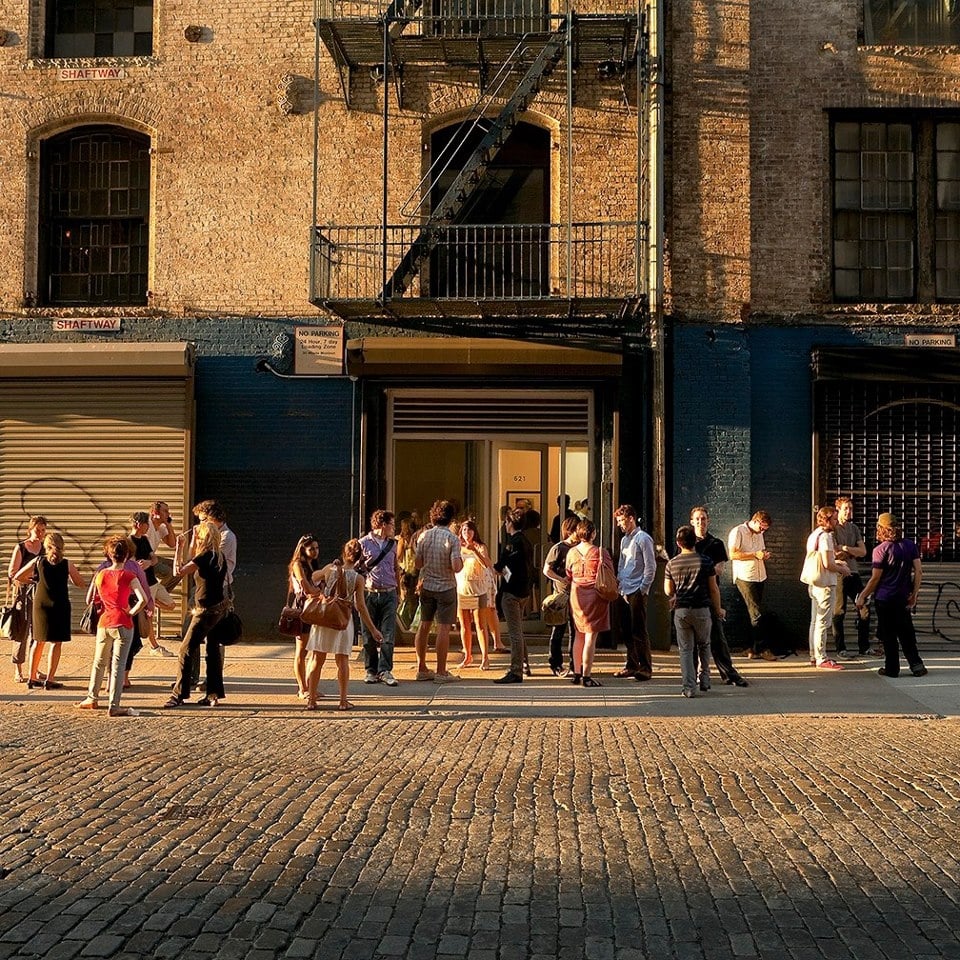
On Wednesday night in New York, 30 art galleries stayed open late to accommodate visitors to the inaugural Chelsea Art Walk, a new initiative spearheaded by the Art Dealers Association of America. It’s a “great example” of how galleries are “finding ways to work together to encourage the public to visit their spaces,” says Andrew Schoelkopf, the association’s president.
If you read between the lines, it’s also a great example of how New York galleries are pushing vintage approaches to art viewership to fight plummeting foot traffic—a trend that’s threatening not only galleries’ commercial viability, but also their existential purpose as a free place to exhibit art. To people.
“I’ve seen attendance diminish a lot,” says Julie Saul, who has run a gallery in Chelsea for the past 18 years. “So about six weeks ago my gallery director said to me, ‘We gotta get some people in here.'” That’s when she called up the Art Dealers Association with the idea for the gallery walk. “I don’t think this art walk is going to change anything that significantly,” she says, but special occasions do seem to drive traffic more than mere exhibitions these days. And indeed, the art walk—which also included performances and talks—drew a turnout more typical of the September rush than the dog days of summer.

Installation view of the group show “DIY: Made In the Studio” at Julie Saul Gallery. Courtesy of the gallery.

Attendance on the Decline

“People are approaching art differently today. They’re not seeking out the thoughtful, complete statement that artists make when they create gallery exhibitions,” the dealer Wendy Brandow told the Los Angeles Times in 2012 to explain why she and her partner closed Margo Leavin Gallery after more than 40 years. “The exhibitions have been such an important part of what we do, and they are no longer valued as much by the public.”
Although commercial galleries don’t keep official visitor records, arts attendance on the whole has been on a long, well-documented decline. The number of Americans who visited art museums dropped from 40.8 percent in 1993 to 32.5 percent in 2012, according to a 2015 report from the National Endowment for the Arts.
Today, dealers say they no longer view physical galleries as the primary site of sales and networking. Instead, they name art fairs as the number one venue for meeting new clients, followed by the internet, according to TEFAF’s 2017 art market report. Nearly a third of dealers expect to do even fewer sales at galleries in the future, the report says—and they expect greater drops in this area than in any other, including private sales, auctions, online sales, and fairs.
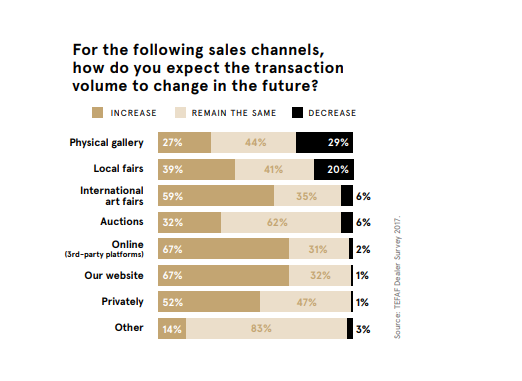
Thirty percent of David Zwirner‘s sales today are made to buyers who see only emailed images, the dealer recently told the Wall Street Journal.
“The proliferation of ‘other options’ to encounter art is clearly the culprit,” says Magdalena Sawon, who owns Postmasters gallery. Brick-and-mortar spaces must now compete with “the vastness of visual data available online. Instagram, gallery websites, and selling platforms [that] are alternatives. So are art fairs.”

What’s at Stake?

Even though there are more places than ever to buy and look at art, many lament the educational and social resources the public stands to lose if galleries go under.
“I go around to galleries regularly and I hear everyone complaining that no one comes and looks at work and asks questions. No one wants to go to artists’ studios anymore,” says the art advisor and collector Thea Westreich. “Well, they’re missing all the fun: Looking at the work in person, particularly in a gallery when the dealer is present and available to talk with you about the work and why they’re showing it and how it fits in with their program and where it fits in historically.”
Gallery shows are also the primary instrument for artists to work through new ideas, market themselves, and receive critical feedback. “Gallery exhibitions are the most prolific stage for the creation and display of art. There would be very little contemporary art without brick-and-mortar galleries,” says dealer Stefania Bortolami. “It’s not just about the selling of art, it is about dialogue and an environment for creating culture.”
Like most downward trends in the art market today, small and mid-size galleries are the hardest hit by the drop in foot traffic. (The trailblazing Lower East Side gallerist Mitchell Algus told artnet News earlier this year that if three people walk through the door, he considers it a “good day.”)
Large galleries seem to be faring better. “We have not seen a decline in attendance,” says Hanna Schouwink, a senior partner at David Zwirner. In fact, the gallery saw a record number of visitors—a staggering 80,000—to its Yayoi Kusama exhibition in Chelsea last year. “Our clients and our general audience want to see our exhibitions and they want to see art works in person. However, we have noticed that more of our New York clients visit during the week for focused visits, rather than everyone stopping by on a Saturday afternoon, as was the norm for many years,” Schouwink says.
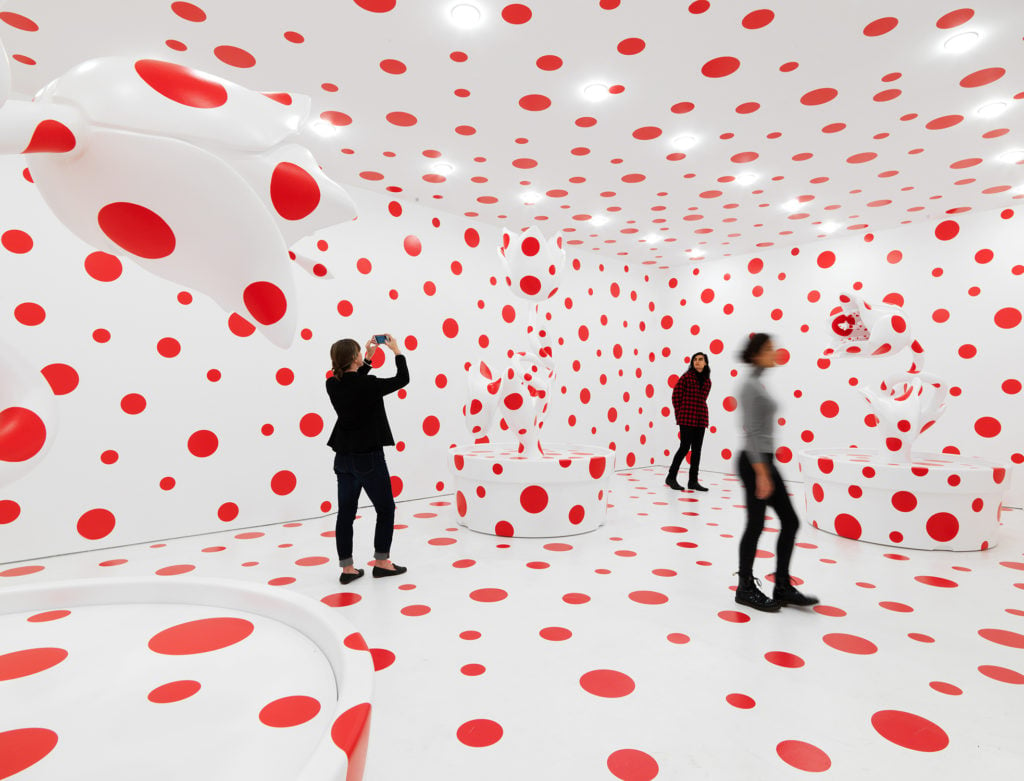
Yayoi Kusama, Installation view, Yayoi Kusama: Festival of Life, David Zwirner, New York (2017). Image © Yayoi Kusama. Courtesy of David Zwirner, New York; Ota Fine Arts,Tokyo/Singapore/Shanghai; Victoria Miro, London; YAYOI KUSAMA Inc.
Installation view of “Yayoi Kusama: Festival of Life” at David Zwirner (2017). Image © Yayoi Kusama. Courtesy of David Zwirner, New York; Ota Fine Arts,Tokyo/Singapore/Shanghai; Victoria Miro, London; YAYOI KUSAMA Inc.
The New York-based artist Sean Scully says he’s noticed a growing chasm between the scene at the “uber galleries,” as he calls them, and comparatively “quiet” mom-and-pop shops in recent years. “If you look at individual shops everywhere, like newspapers, they seem to be dying out, and this might be happening in the art world too, which is a crying shame.”
Scully’s own gallery, Cheim and Read, shocked art insiders last month when it announced it would close its Chelsea space after 21 years and transition into private practice—a move that Scully attributes to the rise of mega-galleries like David Zwirner, which recently poached the Joan MitchellFoundation from Cheim and Read. Now, Scully is going to the London- and Berlin-based blue-chip gallery Blain Southern, which he says is opening a space in New York in the coming months. (A representative for the gallery declined to confirm the expansion.)

What’s Next?

So what’s a small, unter-gallery to do? There’s a double bind in the current state of the market: Art fairs introduce risk and added expenses to the already costly overhead of running a New York gallery, yet many of the top events require dealers to maintain physical spaces in order to participate.
Meanwhile, online-only art intermediaries are increasingly looking to open physical galleries—a hybrid “bricks-and-clicks” model, like Amazon’s, that some predict will be the future of art sales. “If, or when, a gallery’s fair and inventory offerings are fully integrated into easily accessible and searchable databases, how much easier would it be for a potential art buyer to arrange to see a work of interest at an art fair near them or find a gallery close enough that has exactly the right piece?” the 2017 TEFAF report’s authors asked.
Still, others anticipate more collaboration between galleries and fairs to keep both afloat. “I envision strategic overlap becoming much more sophisticated, whereby gallery exhibitions are coordinated with art fair presentations more and more to where the strongest potential within both (critical acclaim in the space and sales at the fair) is nearly scientifically calibrated,” the dealer Ed Winkleman once wrote on his blog.

A post from @pearl_river_mart during Tribeca Art and Culture Night. Image via Instagram.
Or perhaps it’s all part of a natural cyclical change that will recalibrate itself. After all, the debate over the necessity of seeing works of art in person (or not) isn’t new to the 21st century. “This notion of being able to look at art in JPG or online goes back to the mid-1980s, when they were sending out these giant eight-by-ten transparencies,” Westreich says. “But my guess is that really great collectors will still insist on being in the room.”
In the meantime, we may see more throwbacks like this week’s Chelsea Art Walk or the quarterly Tribeca Art and Culture Night, which Sawon says has been “very successful” in bringing foot traffic to Postmasters.
One inducement for in-person viewing that didn’t exist decades ago, however, is the potential to share the experience online later. “Join us tonight for the #ADAA Chelsea Gallery Walk,” tweeted Pace/MacGill Gallery ahead of Wednesday’s event. But don’t forget, it added, to “share your visit on #instagram.”

Follow artnet News on Facebook: 
 
Want to stay ahead of the art world? Subscribe to our newsletter to get the breaking news, eye-opening interviews, and incisive critical takes that drive the conversation forward.
SHARE
Article topics

Art Gallery Attendance Is the Wrong Metric to Measure


The Gray Market: Why Art Gallery Attendance Is the Wrong Metric to Measure (and Other Insights)

Our columnist on lessons from the Chelsea Art Walk, a subsidized House for Artists, and the complications of New York's Culture Pass.
Visitors outside a gallery on 27th Street in New York's Chelsea gallery district. Photograph by Etienne Frossard.
Every Monday morning, artnet News brings you The Gray Market. The column decodes important stories from the previous week—and offers unparalleled insight into the inner workings of the art industry in the process.
This week, stories about multiple scarcities in the arts—and their effects on both the for-profit and nonprofit sides of the industry…
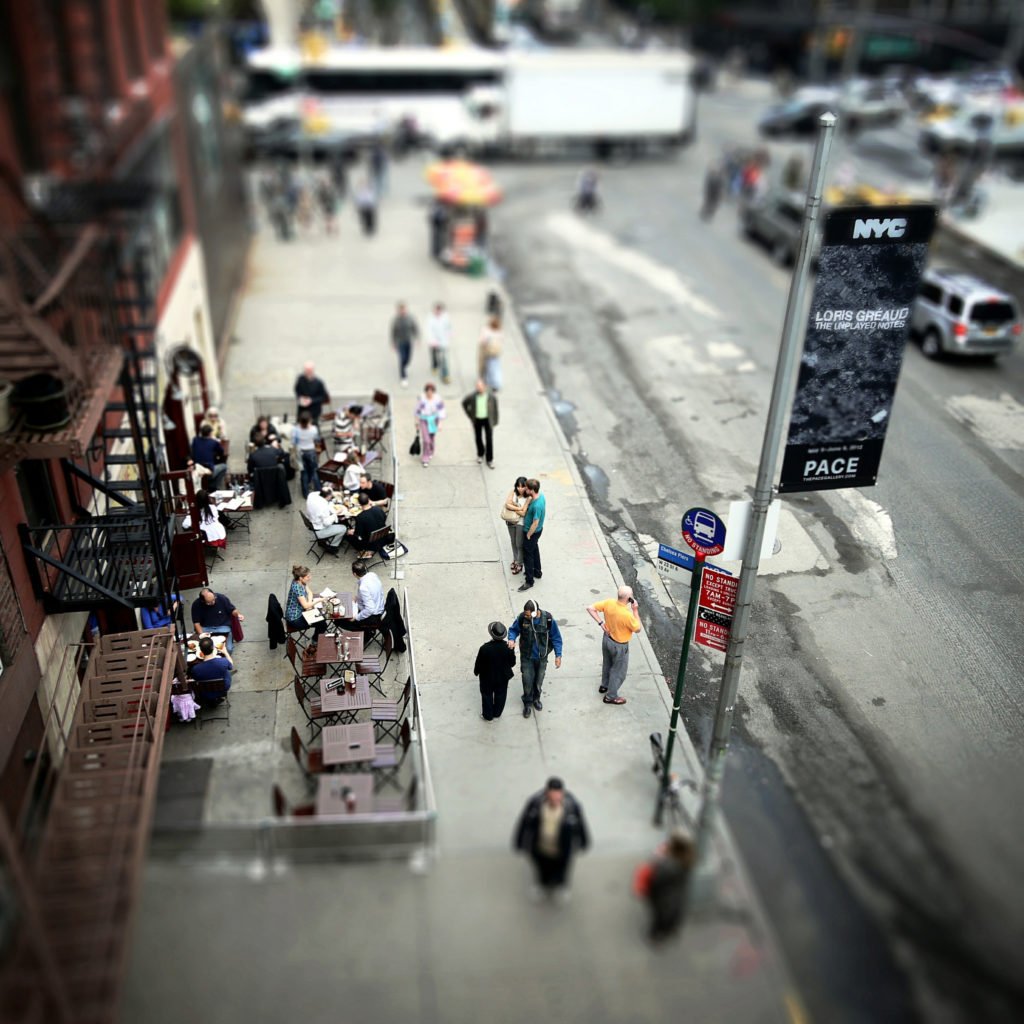
Chelsea’s Gallery District. Photo via Flickr.

WALK THIS WAY

On Wednesday, my colleague Rachel Corbett used the first-ever Chelsea Art Walk, an evening gallery crawl in New York’s most lux and concentrated for-profit art district, to examine dealers’ “vintage approaches” to the near-extinction of foot traffic in permanent commercial exhibition spaces around the world.
But with all due respect to the Art Dealers Association of America (ADAA), who organized the event, and the member galleries who participated in it, my concern isn’t so much that they’re looking to the past for answers. It’s that they may not be interrogating history hard enough, or doing as much as they need to with the results of the inquiry, to actually solve the problem long term.
In fairness, I’m encouraged that even the Chelsea Art Walk’s originator sees the event as more of an opening act than a resolution. Corbett quotes Julie Saul, the Chelsea gallerist who proposed the idea to ADAA leadership six weeks ago, saying, “I don’t think this art walk is going to change anything that significantly.”
Still, I’d wager even that note of caution qualifies as an understatement. To me, expecting one gallery walk to re-ignite in-person viewership in the digital era would be like expecting one screening of Gone with the Wind to convince legions of teenagers to permanently abandon their favorite YouTubers and binge on Golden Age cinema instead.
Maybe it’s not a bad first step, but it does beg the question of what comes next.
Although I understand the impulse to simply get people back into galleries, I also strongly believe that gallerists, particularly those of the midlevel and emerging variety, would do much better to focus on engagement rather than sheer attendance. In other words, the goal should be to try to actively draw and meaningfully connect with potential viewers over and over, not just convince them to pop in and glance around occasionally.
Based on what I heard and read, the Chelsea Art Walk showcased both sides of the issue. While some galleries staged special programming, such as performances and artist talks, other were only nominally active. The latter group was open to visitors, but nearly devoid of staff (particularly the gallerists themselves), and they apparently offered little else to help introduce anyone to, or transfix anyone with, the works on view.
I’d love it if we lived in a world where significant numbers of people could waltz into a gallery once and be pierced by Cupid’s arrow, so that they instantly fall in love with contemporary art for the rest of their lives. But I also wish we lived in a world where major news organizations were rigorous enough about facts not to blindly parrot a fourth grader’s admirable but wildly flawed estimate that humanity uses 500 million plastic straws a day.
Sadly, the world we live in is neither of these.
Which is why I think galleries’ best chance for building (or rebuilding) sustainable audiences now revolves around developing robust, long-term, event-based programming on top of their exhibition cycles.
I covered this in much greater depth in my book, but the upshot is that both historical and recent evidence suggests that live, socially based experiences may be the most viable way to activate people’s interests in the arts, even in a digital age.
Remember, the original Parisian salons were as much see-and-be-seen social clubs as they were intellectual investigations. Fast forward to the 21st century, and IRL events are still drawing major crowds. In 2016, auditing giant PricewaterhouseCoopers estimated that ticket sales to live shows made up 43 percent of the US music industry—about 2.5 times all revenue from Spotify and other streaming outlets.
I’d also argue that gallery longevity has most often been built on establishing communities of engagement. Examples span a wide range of time periods and business sizes, from powerhouse Lisson Gallery’s start in the 1960s, to Night Gallery’s growth in Los Angeles in the 2000s, to Postmasters Gallery’s ability to hold steady in the mid-market since the 1980s (most recently with a crowdfunding campaign whose rewards eschew collectible objects). All of these galleries (and more) succeeded as much by becoming community hubs for kindred spirits as by showing interesting art.
In that sense, the healthy attendance at the ADAA’s first Chelsea Art Walk offers additional support to the idea that art events can still be magnetic in the social media era. The danger would be to fool ourselves into believing that intermittent programming and passive participation can be enough for galleries to regain traction. Here’s hoping more gallerists take the right lessons from history—and accept the challenge of activating their spaces with more events (and more frequent ones) than just exhibition openings.
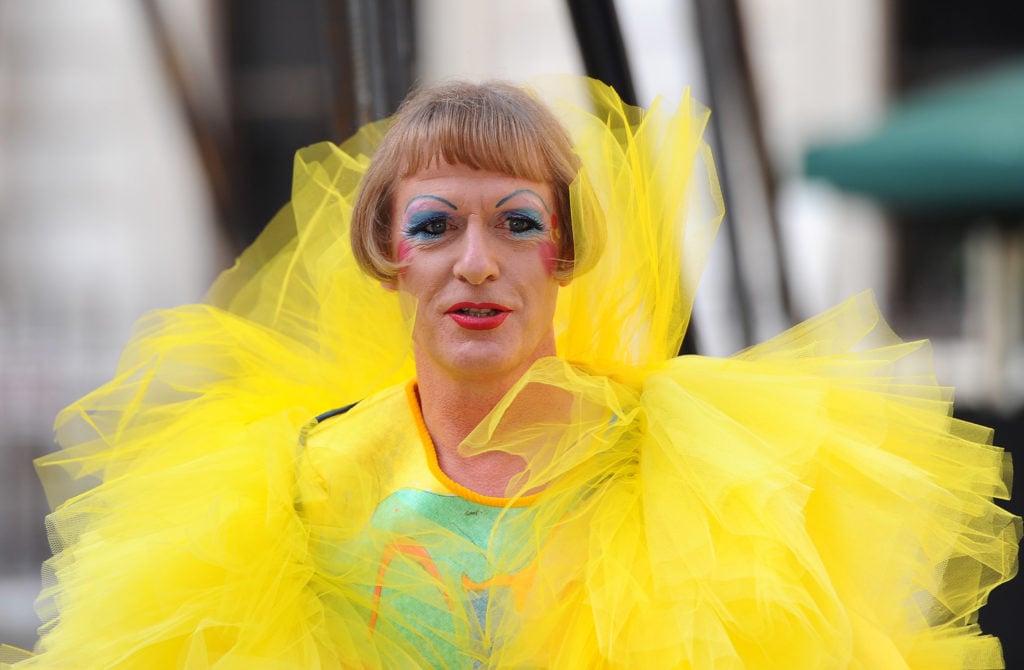
The artist Grayson Perry in 2015. Photo Stuart C. Wilson/Getty Images.

A HOUSE DIVIDED

On Tuesday, Jess Denham of Homes & Property reported that former Turner Prize recipient Grayson Perry will lead a judging panel to award 12 British artists subsidized flats in a new development in Barking, East London. In exchange for “promot[ing] arts through arts groups, film screenings, and local meetings held in the building’s new community art center,” the winners will pay only 65 percent of the market rate for their two-bedroom apartments. Denham says that the building, appropriately dubbed A House for Artists, should be ready for its new residents to move in by November 2019.
On one hand, I think it’s great that 12 artists will be rewarded for their labor with brand new, reduced-rate housing in a global arts hub. With the possible exceptions of starry-eyed utopian dreamers and people who have just recently taken mind-altering drugs, everyone reading this recognizes that it’s relatively rare for artists to be able to sell enough work to cover 35 percent of the rent for a two-bedroom apartment in London.
A House for Artists at least reopens the door to an alternative art economy, in which artists can earn meaningful compensation without making and selling works in a harsh capitalist system dominated by big galleries and big names. That’s not nothing, especially if it’s a first step to many more significant ways to rethink the value of art and its makers.
At the same time, I think that celebrating any setup like this without some serious qualifiers would shoot so wide of the actual target that it could shatter windows in the nearest parking lot. In my eyes, A House for Artists is not unlike those “feel-good” stories where some unfortunate American without health insurance manages to crowdfund their own cancer treatment, or where caring co-workers give their unspent vacation days to expecting American mothers whose employers have no legal obligation to award them paid maternity leave.
Perry isn’t wrong when he calls A House for Artists “a golden opportunity.” I just think that the development is also an emblem of how a supposedly advanced society has transformed basic human rights like affordable housing into a scarce reward only bestowed upon a chosen few in a perversely meritocratic system—more Hunger Games than game changer.
To be clear, the UK is not the only leading art market both to resort to this concept and to get some good press out of it. Broadly similar subsidized housing projects for artists are either in development or already active in American metropolises like New York, San Francisco, and even Nashville. Which wouldn’t seem so dubious to me if the scarcity of affordable housing for anyone, period, wasn’t announcing itself as perhaps the next great global crisis.
If you’d like some examples, they range from the macro to the micro. A recent report estimated that, from 2000 to 2015 alone, “the US produced 7.3 million fewer homes than it needed to [in order] to keep up with demand and population growth.” In Los Angeles, the American art industry’s west coast capital, homelessness rose by 75 percent in the past six years. And as of this April, the median house price in San Francisco hit an unconscionable $1.6 million.
Again, I’m not trying to lash out at Perry or the rest of the organization behind A House for Artists. But before we congratulate them for gracing a few lucky artists with desirable real estate in exchange for non-market labor, we should consider what the program’s shining exceptionalism says about our baseline expectations for anyone living in a civilized society today, not just artists alone.
And from that perspective, maybe the best way to help artists would be to expand our lens far beyond a narrow focus on art world needs.
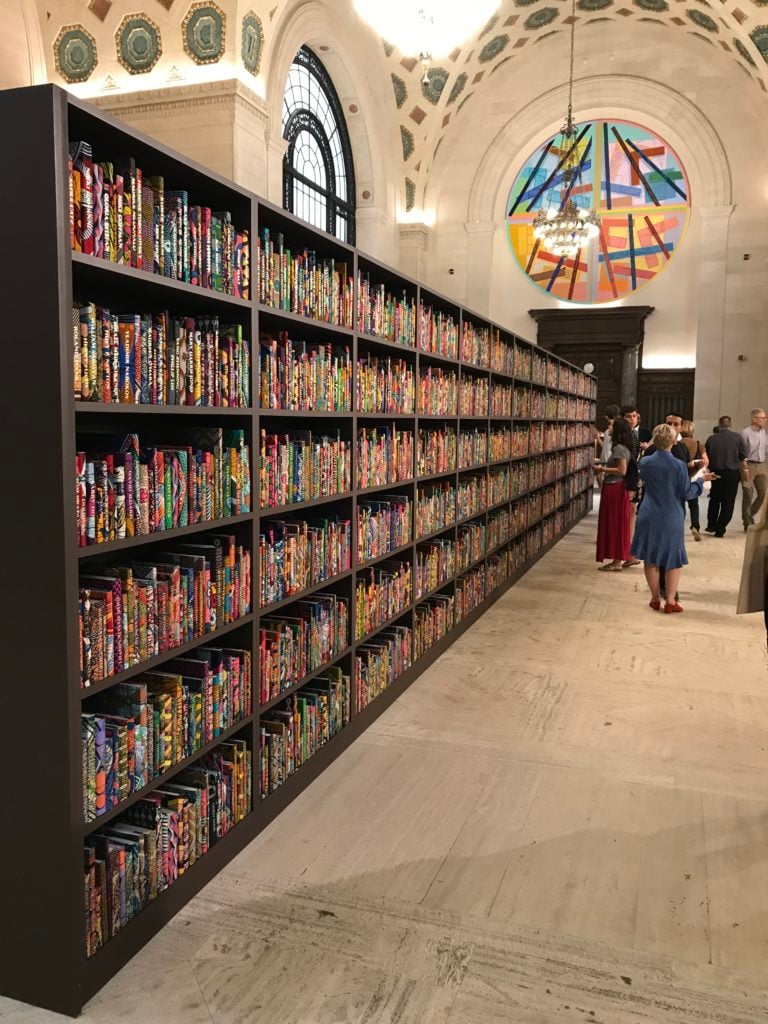
Yinka Shonibare MBE, The American Library, 2018. Photo by Tim Schneider.
Yinka Shonibare MBE, The American Library, 2018. Photo by Tim Schneider.

JUST PASSING THROUGH

Finally this week, my colleague Sarah Cascone added a sobering update to a story that many people met with jubilation only a few days earlier. Monday saw the announcement of Culture Pass, a new initiative in which anyone with a New York Public Library, Brooklyn Public Library, or Queens Library card would be able to secure a set of up to four tickets annually from 33 museums and cultural institutions in the five boroughs.
In a year when the art world has gotten more aggravated by museum admission prices than old socialists by Kardashian scion Kylie Jenner’s alleged $900 million net worth, Culture Pass sounded like a huge win for New Yorkers, particularly since participating organizations could allocate blocks of tickets specifically for residents of underserved neighborhoods.
But one important detail of the program appears not to have been unpacked clearly enough in the triumphant press release: namely, that only a limited number of Culture Passes would be available from each museum in any given month. And in tandem with that detail, few people probably expected there to be as much truth as there is to Queens Library President Dennis M. Walcott’s declaration that “Culture Pass is going to be one of the hottest tickets in town for New York City’s public library cardholders.”
According to a spokesperson, 9,500 of October’s roughly 14,500 Culture Passes had already been reserved by last Friday. As of publication time, this initial surge of demand takes 10 of the 33 participating institutions—including the Met, MoMA, the Whitney, and the Frick—off the table completely for the initiative’s opening month. (The spokesperson says that organizers are in conversation about adding more passes to the monthly pool.)
Now, I’m generally in favor of anything that opens up access to cultural institutions for more people, especially in communities that have often been left behind. But Culture Pass’s limitations, which only took four days to emerge in blazing neon lights, also demonstrate an important wrinkle in the museum admission debate.
Outside of specially ticketed exhibitions, most people (understandably) tend to think of museums as what economists call a non-rival good. This means that my ability to access them has no effect on anyone else’s ability to do the same simultaneously.
Sure, the galleries can be more or less crowded. But how many times in your life have you been turned away from the general admission counter because the museum is at capacity? Probably fewer times than you and your neighbors have had to ration running water (another non-rival good in developed countries).
Yet this is a misconception of how museums work. Even if you want to ignore the attendance limits set by fire code, museums can only serve a certain amount of people at a certain time. Otherwise, the galleries would overflow with frustrated patrons, security would be overwhelmed, art would get knocked around like it had been installed on a rugby field, and pandemonium would ensue.
Nor can museums stay open 24/7 to meet the demand. Staffing, utilities, maintenance—you need all of these to present exhibitions to the public, and each comes at a price. As I wrote earlier this year, there’s no such thing as a free museum. It’s just a matter of who’s paying the costs—and why.
Culture Pass reinforces this idea. Why are the tickets free for New York library cardholders? Because the entry fees are being paid by the Stavros Niarchos Foundation, the Charles H. Revson Foundation, and the New York Community Trust’s Thriving Communities program.
This fact highlights that there are really only two ways to generate more Culture Passes in a given month: Get those same foundations to contribute even more cash, or source more funding from other philanthropists. Otherwise, we’d be asking the museums themselves to sacrifice their own operating revenue to create more “free” tickets. And given how many of them are already struggling financially, I don’t think that’s really a viable plan.
In short, I understand why people who were overjoyed about Culture Pass last Monday might feel hoodwinked a week later. But I also understand why the unglamorous realities of running museums make Culture Pass more complicated than most people (including me) would like. It’s not a perfect program, obviously. Let’s just not make the mistake of turning the perfect into the enemy of the good, however modest it may be.
That’s all for this week. ‘Til next time, here’s hoping that, in another seven days, our problems are all a little scarcer than today.

Follow artnet News on Facebook: 
 
Want to stay ahead of the art world? Subscribe to our newsletter to get the breaking news, eye-opening interviews, and incisive critical takes that drive the conversation forward.
SHARE

What is Derrida Saying to Us?


Continental Thoughts

What is Derrida Saying to Us?

Mike Sutton gives us his present interpretation of Derrida’s traces.

Jacques Derrida (1930-2004) is a philosopher everybody has heard of, but few non-specialists can manage to read; a clear case of ‘many are called but few are chosen’. Opinions of him range from those who say he is one of the greatest philosophers of the twentieth century to those who say he was a charlatan. In the mid-1970s he had a debate of unusual acrimony with the distinguished American philosopher of language, John Searle. In 1992 he was almost refused an honorary degree at Cambridge because of the opposition of several philosophers, some of them eminent. So, a controversial figure.
The question of why Derrida’s texts are so difficult is interesting in itself. One reason is the unfamiliarity of his concepts. Another is his concern that statements asserting knowledge always assume other knowledge. As Hilary Lawson says in his excellent 1985 book Reflexivity: The Post-Modern Predicament, “our ‘certainties’ are expressed through texts, through language, through sign systems, which are no longer seen to be neutral. It appears, therefore, in principle there can be no arena of certainty.” Derrida wants to avoid making statements which depend either on fixed linguistic meanings or on assumptions made elsewhere.
So what is Derrida trying to say to us?

The Problem With Logocentrism

I want to try to answer this question by concentrating on the first part of his early book Of Grammatology (1967), which I believe is the Rosetta Stone that gives us the key to all his writings.
He takes a lead from the Swiss linguist Ferdinand Saussure (1857-1913), who maintained that words derive their meaning from other words, and that meanings work by differences not similarity. For example, we notice that a triangle differs from a square. Neither are related in our minds to some ultimate standard shape; instead we know them by their differences from each other. Similarily, we can’t trace meanings of words back to any gold standard. If we want to know the meaning of a word we look in the dictionary, and this defines it in terms of other words. If we want to know what they mean, we have to look them up too, and so on ad infinitum, or at least until we have arrived at words we think we already understand. But there is no natural connection between the word (Saussure called this the signifier, eg the written or spoken word ‘dog’), and the idea or concept the word stands for (the signified; the general concept ‘dog’). Signs are composed of the relation between the signifiers and the signified. The connection between the signifiers and the signified is a practice or norm which has been built up over time, which continues to evolve, and is of course different in different languages. To learn the links, that is, to learn the meaning of the words, we have to learn the practice.
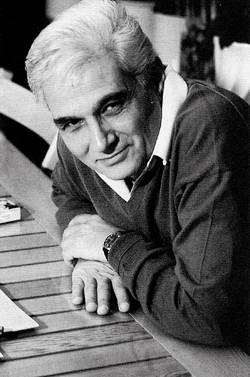
Jacques Derrida
A trace of Jacques Derrida low quality scan of a printed card sent to Philosophy Now by Jacques Derrida himself in about 1993.
Writing which argues a case, such as philosophical writing, often attempts to reduce meanings to set definitions; those definitions in turn depend on the signifier and its relationship to the signified. This is motivated by a desire for a focal point for understanding. Derrida calls this sort of desire logocentrism, which means aiming to try to get to the logos, the ultimate definition, which might be called true knowledge by some.
Logocentrism initially implies phonocentrism. Originally, Western philosophy relied on speech rather than writing. Socrates never wrote a book; instead he argued with people in the marketplace. Later philosophers, including Aristotle, also championed speech over writing. Speech is somehow considered closer to the thinking of the speaker. Derrida argues against this prioritising at some length in Of Grammatology. I shall not concentrate on this argument but on Derrida’s proposals for the interpretation of texts.
Philosophy works through language, and constantly makes the logocentric assumption that stable meanings of concepts – set definitions – are available to us. But because a signifier (word) and the signified (its conceptual meaning) have more independence than we would perhaps like to think, there is not always a single, fixed meaning, so texts are capable of more than one interpretation.
Take the word ‘justice’. The word signifies an abstract concept. Our concept of justice is moreover associated with the concrete institutions of justice – the courts, the police. The complainant wants justice (in the abstract), and looks to the courts for it, and considers the abstract concept and what the courts deal in as the same. But are they? Meaning evolves all the time, and the concept of justice changes: it would have had a different meaning in the minds of most people before there were any courts. On the other hand, one concept of justice – these days the institutional concept – is likely to dominate.
This flexibility also means that texts are capable of more than one interpretation. Peter Benson gave a good example of this in this very magazine: “the medieval Christian approach to the Bible declared there to be four ways to read each passage: literal, anagogic, typological and tropological. These interpretative traditions have been challenged by fundamentalists, who seek to pin an immediately-known fixed meaning to every word… Fundamentalism is therefore one manifestation of the metaphysics of presence. From Derrida’s perspective, it involves a misunderstanding of the nature of language” (Issue 100, 2014).

The Presence of Derrida

In Of Grammatology Derrida introduces the important phrase ‘the metaphysics of presence’. What does he mean by this?
Logocentrism leads immediately to the favouring of present certainties. This is something that’s done automatically by Western philosophers, particularly metaphysicians. Indeed, we all seek certainty: we want to know if and what God is, what the good is, what our Being is, why we are here… Moreover, we rely on language to tell us the answers. The Western philosophical tradition as a whole insists on chasing objective truth, demanding certainty in the present; and to achieve this it relies utterly on the connection between the signifier and the signified, between words and their meaning in the text – words which have no gold standard for that meaning but are defined from other words. This is already a problem for the meaning of metaphysical texts, which therefore do not have fixed meanings. Derrida’s thesis is further that metaphysics seeks not only to impose an interpretation in the present, but also seeks transcendental signifieds – concepts which overarch past and future, near and far, similar and dissimilar. Such metaphysical concepts are incoherent, a prioritising of presence and similarity at the expense of change and difference. We would like, here and now, to define God, the good, our Being, and many other impossible-to-define things, all with certainty, simply, with as few words as possible. But we can’t.
So it is words that are the problem in metaphysics, as they need continual reinterpretation. Perhaps philosophers are aware of this. In ‘Philosophy as a Kind of Writing: An Essay on Derrida’ in New Literary History, Vol. 10, No. 1 (Autumn, 1978), the American pragmatist Richard Rorty points out that scientists use few words to describe conclusions from their experiments. It is philosophers, and investigators of things that are impossible to know, who need to write and rewrite, and to re-interpret and re-visit problems. And especially, it is metaphysicians. Rorty says, “it is characteristic of the Kantian tradition that, no matter how much writing it does, it does not think that philosophy should be ‘written’ any more than science should be. Writing is an unfortunate necessity; what is really wanted is to show, to demonstrate, to point out, to exhibit, to make one’s interlocutor stand at gaze before the world… [whereas] In a mature science, the words in which the investigator ‘writes up’ his results should be as few and as transparent as possible.” (p.141).
One might be inclined to say “So what?” Everybody knows that scientists write up experiments and philosophers write essays, and that writings can be interpreted in various ways. But it goes further than that. Derrida’s critique of metaphysics is not limited to the shaky relationship between signifier and signified. Derrida is famous as the inventor of deconstruction.

Interpreting Deconstruction

More meaning is available from a text than any immediate intuitive interpretation of the words and concepts. As well as the alternative interpretations beloved of all critics and commentators, there are hidden meanings in texts not necessarily intended by the author. Deconstruction is an attempt to prise out these hidden meanings. As Derrida puts it in Of Grammatology, deconstruction aims to “designate the crevice through which the yet unnameable glimmer beyond the closure can be glimpsed” (p.14 in G.C. Spivak’s translation). It is important to note that deconstruction, at least as conceived by Derrida himself, is not a method – it has no clear modus operandi. Instead, it is a way of reading texts by opening them to question, all the time asking: is that the only essence or meaning of a concept?
To understand this better, we need more concepts. Derrida defines (well, given his reluctance to commit himself, sort of defines) what these are in Of Grammatology, Part 1. There he claims that metaphors and metonyms are always present in writing, whether intended or not. The meaning of words, he says, is often only understandable by their metaphoric implication.
Since words are only defined by their difference from other words there are also binary hierarchies, pairs of words which are defined by their opposites such as left and right, male and female, presence and absence. Take justice again. Whenever the word is used it implies something about injustice. The path or trace to its definition is accompanied by its opposite in a binary hierarchy. If one says or writes “man”, one means “not woman”. So a word contains a trace of what it does not mean, and the trace is there but not there, the track of something absent. There is a Freudian element here. All signifiers have a history, they are changed by history, but understanding has to take place in a present.
For clarity, I have taken a liberty in being more definite than Derrida, who refuses to define a trace as a concept. It is easier to see why if we regard a language as a flexible system. Words, defined by their differences from other words, not by some gold standard, do not maintain meaning; rather they change in meaning over time and in different contexts. The trace represents that change. It is not even itself a static concept.
Derrida sees binaries as a problem for metaphysics because metaphysicians tend to be biased towards the dominant word in the binary hierarchy. It is unjustified and misleading, but pervasive. As he writes: “All metaphysicians, from Plato to Rousseau, Descartes to Husserl, have proceeded [by] conceiving good to be before evil, the positive before the negative, the pure before the impure, the simple before the complex, the essential before the accidental, the imitated before the imitation, etc. And this is not just one metaphysical gesture among others, it is the metaphysical exigency, that which has been the most constant, most profound and most potent” (Limited Inc, 1988, p.236.). Writers about feminism have, not surprisingly, taken up this notion of dominance bias.
The definition of words by their difference from other words goes further. It can also be deferred, so that no meaning of any word is ever fully present. The deferring of meaning can take place in time or context, or simply because a meaning is subjugated to a related or opposite meaning.
The process of differing and deferring is combined into one word by Derrida – differance. This word indicates that words (signifiers), as well as being defined by other words (signifiers) from which they differ, also have their meaning deferred as the meaning constantly changes. This differing and deferring process goes on continually when using a language or understanding texts. Texts may have different meanings to the perceiver on re-reading. Words change as contexts change too. This flexibility in interpretability is easy to see with government legislation and legal rulings, which require expert interpretation. And my conception of this article will be different from your conception, and in any future rereading, our conceptions may also differ, either more or less than they do now. If we were reporting the reading from an instrument such as a galvanometer or a weighing machine dial, our conceptions would not differ nearly as much. But in situations where it is hard to put our finger on what is meant – as in philosophy articles – our conceptions may vary radically, and some discussion between us (using yet more words) might, or might not, enlighten us both.
Hilary Lawson illustrates the implication of the concepts of the metaphysics of presence, trace, and differance well in his example of a statement of the form ‘the chair is black’. He writes: “we are not able to prove the truth of the statement… by going to look at the chair, for there is no present experience which provides the data against which we can check the statement…” rather, “there is no single meaning of the sentence ‘the chair is black’, and there is no single meaning to our experience at any point. The meaning of the sentence takes place in the play that is the web of language, and experience is not an independent thing which stands outside of that play” (Reflexivity, p.100). The sentence is therefore devoid of the means of physical verification, and we will each conceive the meaning of the statement differently.
These are the rudiments of deconstruction.

(No Definite) Conclusions

There is, of course, a great deal more to Of Grammatology than I have indicated here. As well as arguing against the prioritisation of speech, Derrida attempts to work out whether grammatology, a science of writing, is even possible. He reaches no definite conclusion. His difficulty seems to be that science seeks present solutions successfully, for the most part, unlike metaphysics. He is doubtful whether such solutions would be available for texts. He also has much to say on other philosophers (particularly Nietzsche, Husserl and Heidegger) and linguists (particularly Saussure, Peirce, and Jacobson). He criticises the two dominant philosophical movements of his day, phenomenology and structuralism, as both indulging in the metaphysics of presence. And that’s only Part 1. The second part of the book is given over to putting deconstruction into practice, particularly for the writings of Jean-Jacques Rousseau and Claude Levi-Strauss.
Derrida spent much of the rest of his career, particularly the early part, deconstructing the work of philosophers and other writers, often showing that their meaning was unclear, and that their texts often said more than they intended. There is much to read; Derrida was one of the most prolific of writers.
The intention of this article has been to give a brief introduction to the way Derrida’s thinking works. He would have no doubt hated my attempt to provide such a closed summary of meaning and reference. But to quote him out of context, I have aimed only to “designate the crevice through which the yet unnameable glimmer beyond the closure can be glimpsed.”
© Mike Sutton 2018
Mike Sutton lives in Birmingham and writes about philosophy, sociology, science and technology.

Portugal é dos países que mais recebe de Bruxelas

Logótipo Mundo Português 48 anos


Portugal é dos países que mais recebe de Bruxelas

Portugal é dos países que mais recebe de Bruxelas
Portugal recebeu, nos últimos três anos, quase cinco mil milhões de euros da Comissão Europeia, ocupando o terceiro lugar entre os Estados-membros que mais fundos comunitários receberam, segundo dados divulgados por Bruxelas.
“Até ao final de março de 2018 foram transferidos 4.849 milhões de euros para Portugal pela Comissão Europeia (CE). Este valor equivale a 18,6% do valor programado no Portugal 2020 e mantém-se acima da média da União Europeia (que se encontrava em 12,9%)”, lê-se no último Boletim Informativo dos Fundos da União Europeia, divulgado em 31 de março.
Trata-se da “taxa mais elevada de entre os Estados-membros com envelopes financeiros mais elevados (acima de sete mil milhões de euros)”, segundo a mesma fonte.
Nos últimos três anos, altura em que foram abertos os primeiros concursos do programa Portugal 2020, no total, foram transferidos pela CE para os 28 Estados-membros 58.819 milhões de euros, sendo que, desse montante, 8,2% foram destinados a Portugal.
No período em causa, mais de dois mil concursos foram abertos e apresentadas mais de 382 mil candidaturas, tendo sido aprovadas mais de 297 mil operações.
No que se refere à aplicação dos fundos europeus em Portugal, até ao final do período em causa, foram apresentadas candidaturas com intenções de investimento até 51 mil milhões de euros, 53% dos quais ligados ao setor da competitividade e internacionalização.
Por sua vez, o volume de fundos aprovados no Portugal 2020 fixou-se em 16,6 mil milhões de euros, “destinados a financiar operações de investimento no valor de 24,7 mil milhões de euros”.
“A taxa de financiamento média sobre o investimento elegível era de 67%. A taxa de compromisso situava-se em 64%, tendo registado uma evolução de 5,3 pontos percentuais [p.p.] em relação ao último trimestre”, explica a CE.
A liderar os valores de fundos aprovados estão os apoios às pequenas e médias empresas (24%), destacando-se ainda a educação (11%), ciência e investigação (9%), ambiente e recursos naturais (7%) e a área da competitividade, no âmbito do desenvolvimento rural (6%).
A concretização dos projetos financiados fixou-se em cerca de 6,1 mil milhões de euros de fundos executados, o que se traduziu numa taxa de execução de 24%, mais 2,3 p.p. do que em dezembro de 2017.
“Do lado da execução destacam-se os domínios temáticos do desenvolvimento rural e da competitividade e internacionalização com 28% dos fundos executados e o domínio do capital humano com 22%”, revelou. Por fundos, os maiores acréscimos em termos de aprovações registaram-se no Fundo Europeu de Desenvolvimento Regional (FEDER), com um aumento de 708 milhões de euros, e no Fundo Social Europeu/Iniciativa Emprego Jovem (FSE/IEJ), com uma subida de 470 milhões de euros.
Com uma dotação global de cerca de 26 mil milhões de euros, o programa Portugal 2020 consiste num acordo de parceria entre Portugal e a Comissão Europeia, “no qual se estabelecem princípios e as prioridades de programação para a política de desenvolvimento económico, social e territorial de Portugal, entre 2014 e 2020”.