Monday, May 14, 2018

China’s Last Cave Dwellers Fight to Keep Their Underground Homes


Continue reading the main story
GEBENG, China — When armed bandits prowled this remote, mountainous stretch of the southwestern province of Guizhou in the chaotic years before the founding of modern China, the ethnic Miao villagers hid in the region’s enormous caves.
And there they have remained, even after China was united under Communist rule, grinding out an existence of profound rural poverty and isolation.
Beijing
Yellow R.
CHINA
Shanghai
Yangtze R.
GUIZHOU
Zhong cave
Hong Kong
South China Sea
VIETNAM
250 MILES
The area is in one of the poorest provinces in China. The only link to the rest of the country, and the outside world, is over a mountain footpath — a brisk one-hour hike through a steep valley — that leads to a nearby road.
Over the past 20 years, though, the caves have become less secluded because of a steadily increasing trickle of tourists, who come to experience what local media have described as the last continuously inhabited cave in China.
A cottage industry has popped up in which the cave dwellers earn extra money by renting out rooms in their homes, which over time have clustered within Zhong cave, a limestone cavern big enough to hold four American football fields. The hangar-like cave is so large that their wooden or bamboo-made residences form a small, subterranean village built along its undulating walls.
Continue reading the main story
During the day, the cave is filled with the sound of cows and roosters. On Friday afternoons, the laughter of children echoes and the smell of cooking fires permeates the cave’s cool, damp air, which offers relief from the heat of the valley below.
Continue reading the main story
Photo
Children doing chores during their weekend break from boarding school. CreditBryan Denton for The New York Times
Photo
A resident of the Zhong cave walking through the cavern’s interior. CreditBryan Denton for The New York Times
The county government wants the residents of Zhong cave to move to a nearby block of housing: low-slung, white-walled farmhouses with wooden window frames that were completed nearly 10 years ago.
Officials say that residents have not taken care of the cave, leaving it unsuitable for inhabitation, and that the government should oversee the village as it is listed as a protected community by the Getu River Tourism Administration, a local agency. They have offered each resident 60,000 renminbi, or approximately $9,500, to leave.
Only five families have agreed to move.
The remaining 18 families have held on stubbornly to their homes inside the cave. They say that the new homes are too small, that they fear losing access to their land, and that they alone, because of their historical connection to the cave, should have the right to independently control its small tourism economy.
“The residents of this cave should be the administrators of tourism here, regardless of whether or not we are paid,” said Wang Qiguo, the head of the local village, who established the first hostel there.
As he spoke, his wife prepared a steaming array of dishes made from home-smoked pork and local vegetables grown in the valley.
After all, Mr. Wang noted, “The best thing about this cave is its inhabitants.”
Continue reading the main story
Photo
Wong Qicai working in the terraced fields below the Zhong cave, pictured behind. Residents of the cave subsist primarily off farming crops like millet and raising pigs and other livestock.CreditBryan Denton for The New York Times
Photo
The unfinished terminus of a half-built cable car system that was intended to bring tourists up to the Zhong cave. Some local residents say the project, which was supposed to be completed last year, halted after the investor ran out of money. CreditBryan Denton for The New York Times
Even residents who are considering moving out seem to agree that $9,500 per person is too little money, especially because many are elderly and speak little or no Mandarin, meaning they could feel isolated if they leave the cave community. They still rely on their nearby land to grow the millet and vegetables on which they subsist.
Villagers have also complained about the quality of the new housing, saying it’s too small and poorly made.
During the 1980s, the outsiders who most often visited the Zhong cave were local government officials conducting checks to enforce China’s “one-child” policy. The measure was deeply unpopular among the villagers whose children work alongside their parents in the fields, tending to livestock.
Mr. Wang said that during those years, violators of the policy would sometimes be taken away for forced abortions and sterilization.
The single greatest change in the history of the cave was the introduction of electricity, only in 2002.
Surprisingly, the Chinese government did not bring electricity to the area. Instead, a wealthy American businessman from Minnesota, Frank Beddor Jr., was responsible.
Continue reading the main story
Photo
A resident herding his cattle out to pasture past some of the cavern’s newer homes, built with wood rather than woven bamboo. CreditBryan Denton for The New York Times
Photo
A man at his home, constructed from woven bamboo. CreditBryan Denton for The New York Times
Mr. Beddor first visited the Zhong cave in 2002, and would ultimately return several more times — donating tens of thousands of dollars to connect the cave to the region’s electrical grid.
His continuing financial support also built a schoolhouse and a communal bathroom, and delivered livestock and other assistance to the villagers, dramatically improving their quality of life.
But in 2011, the school was closed by the local government, forcing residents to send their children, some as young as 5, to the region’s boarding school nearly two hours away.
Mr. Beddor died at age 83 in 2007. His emotional connection to the village is still a mystery to the villagers, some of whom remember the few times he visited the cave.
Wang Qicai, 39, a farmer who also runs a small general store out of his home in the cave, said young people may move out to become migrant workers, but many end up returning to have their families.
The cave, he said, “feels like home.”
“The weather inside the cave is amazing,” he added. “It feels like heaven.”
Continue reading the main story
Photo
Frank Beddor Jr., an American businessman from Minnesota who first visited in 2002, donated the money to finally bring electricity into Zhong cave. CreditBryan Denton for The New York Times
Continue reading the main story

"no words" was the thing


there was no internet and therefore no site to follow up on the information needed 
but this hotel had a wordless booklet and... it was fine :)


Ellen von Unwerth: Ladyland in a Man’s World


Ellen von Unwerth: Ladyland in a Man’s World

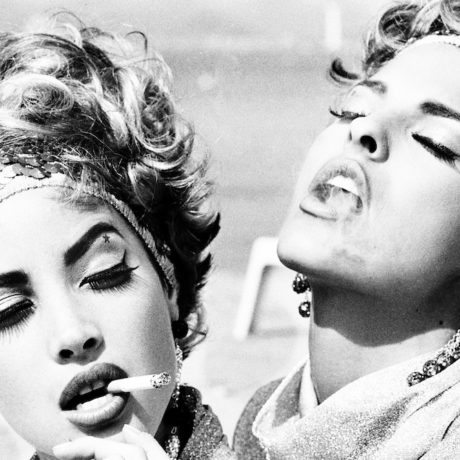
Her photographs may scream female sexual liberation, but Ellen von Unwerth isn’t for everyone. Emily Steertakes a trip to Ladyland—the German photographer’s latest show in London.

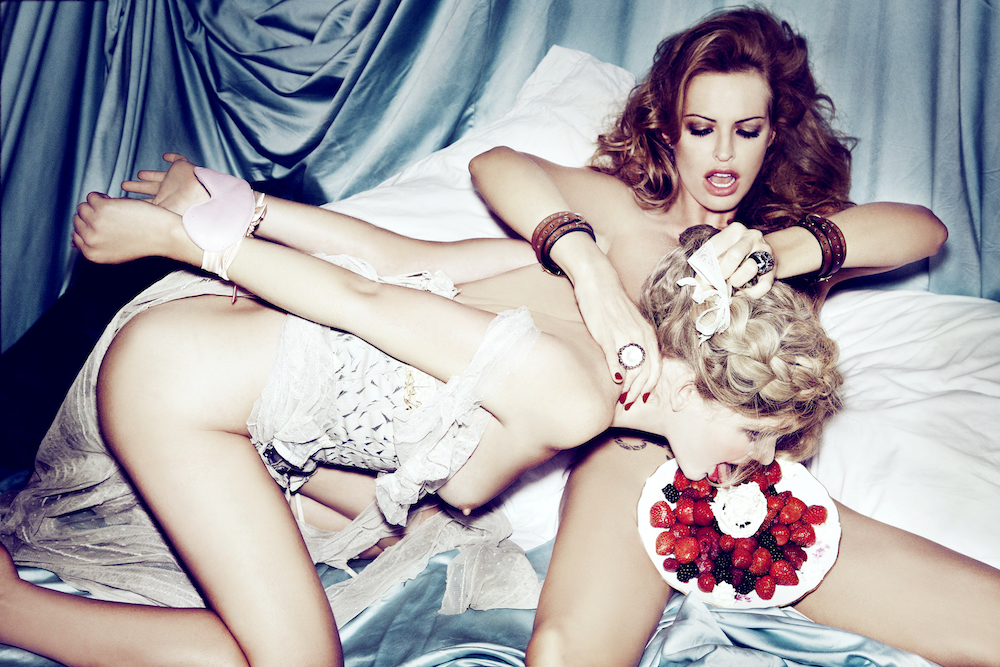
Pudding, Paris, 2011
“We can’t film in that direction; we’ll get the nipples in shot.” I’m jostling my way around a sizeable TV crew who are squeezed into Ellen von Unwerth’s Ladyland, shouting instructions to one another and hauling large pieces of equipment through the claustrophobic basement of Mayfair’s Opera Gallery. The sight of this burly crew feels at odds with the suggested female utopia of Ladyland. It is also a very obvious reminder of the huge proportion of men who tend to work behind the camera. This is where Von Unwerth comes into the picture. At a discussion I went to recently about the female gaze she was one of the only female commercial photographers who anyone on the panel could name (alongside Annie Leibovitz, of course), which puts her in a position rather loaded with expectations to beat the boys at their own game. Although Von Unwerth is a woman primarily photographing women, her work evades easy categorization alongside the growing number of female photographers who explore the female gaze, as it plays into as many cliches as it subverts. As someone whose bookshelves were loaded with weighty tomes on Sam Haskins and Roy Stuart as a teenager, I am hugely drawn to her work, but I feel conflicted—I like it (a lot), but I’m not sure if I should. 
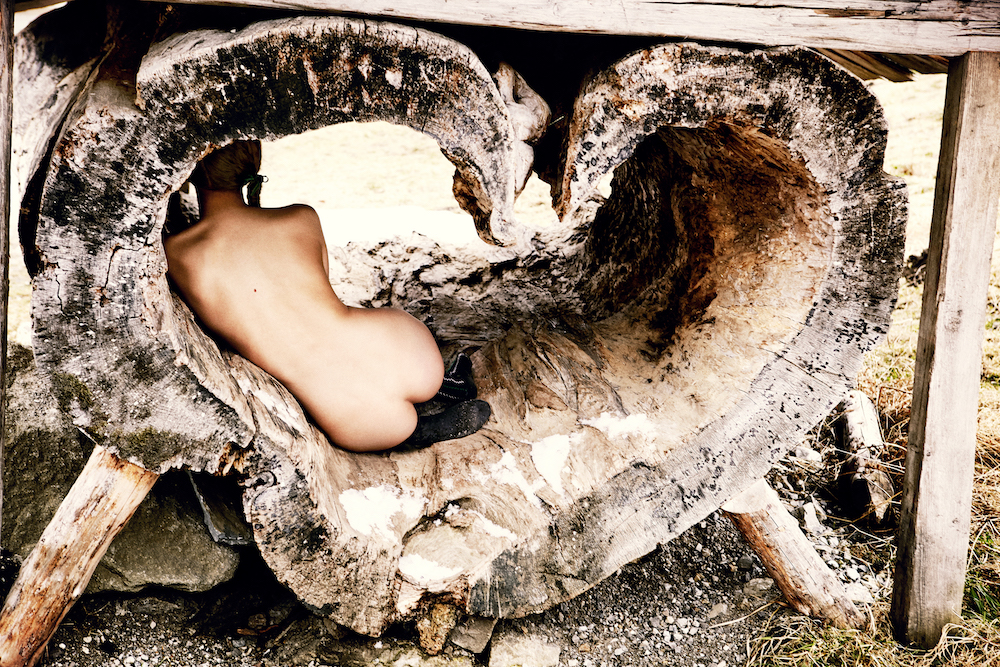
Tree of Love, Bavaria, 2015
Von Unwerth began her career in the fashion industry as a model. “I think that because I know what it feels like to be in front of the camera, I can be more sympathetic to my subjects,” she writes to me. “Being in front of the lens, you are very vulnerable. It’s not a nice feeling, and I don’t miss it. But it’s very helpful to know exactly what it’s like. When I was a model I hated when I wasn’t allowed to move, so I love movement and I encourage my subjects to play around, to move and to be silly. In terms of the way I portray women, I want to immortalize a woman’s personality, enhanced and exposed. Often, women appear self-assured, having a lot of fun in my pictures, and that is because it is what is actually happening during the shoot.”
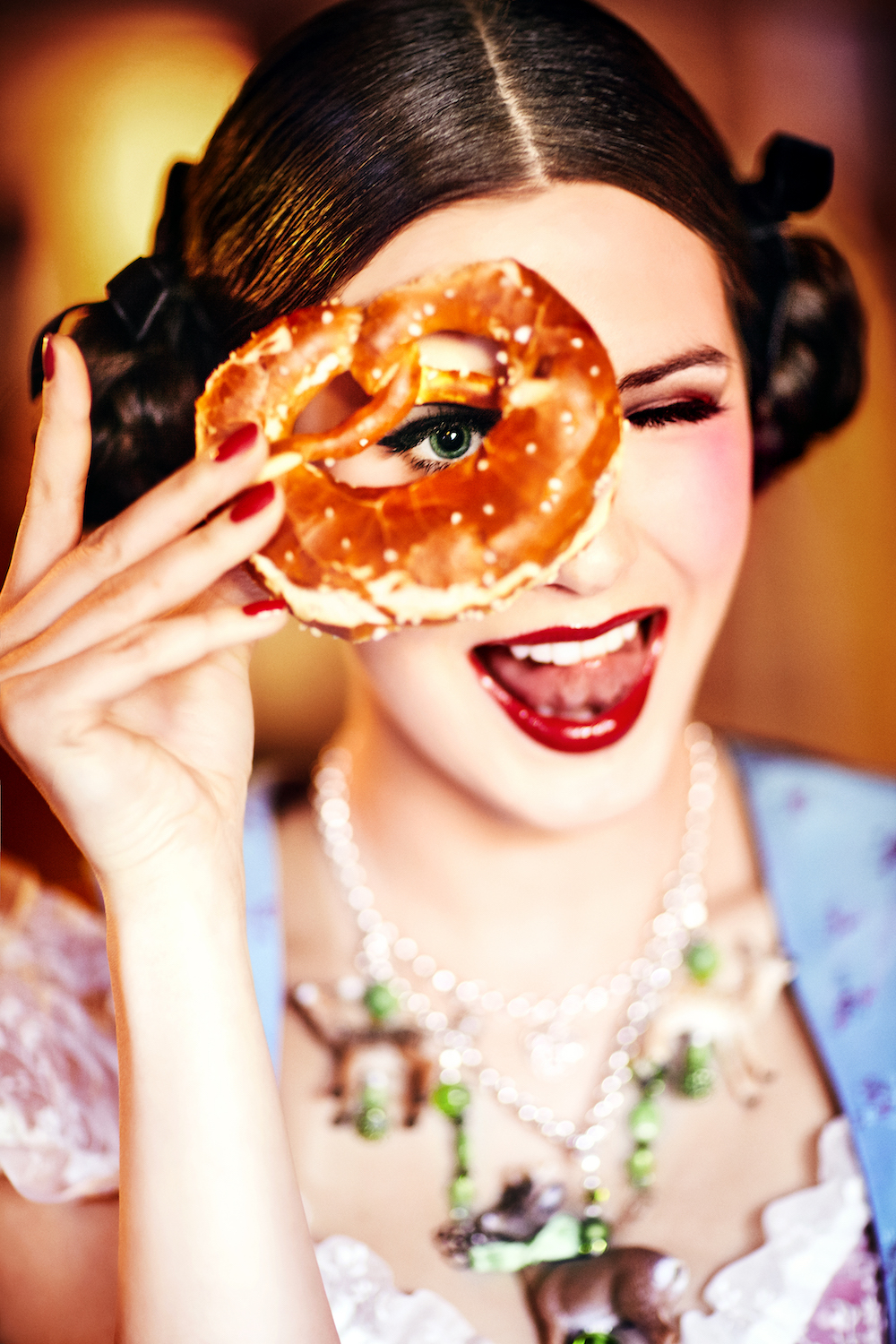
Spy Device, Bavaria, 2015
Her female subjects—depicted as sexually liberated and playful—cackle and glare into the camera with piercing, snake-like eyes, celebratory and overbearing. There is a sense of fun that pervades, present in the tongue-in-cheek Coca-Cola cans that take the place of hair rollers in one photograph of Naomi Campbell, and in the Cheshire-Cat-like toothy grins that shape the heavily-lipsticked mouths of her models. It’s confronting to see a female photographer work in this zone. Leibovitz (who famously headed up the Pirelli Calendar’s 2016 reboot with a more sedate take on female empowerment), for example, eschews the lineage of Helmut Newton to show her subjects in a classically dignified manner, which can often veer into drabness. 
Claudia Schiffer, Morocco, 1989 as part of a Guess campaign
Von Unwerth focuses almost entirely on female subjects, and when men do appear in shot, they tend to be shown with women who they already know intimately—David Bowie is photographed with close friend Kate Moss in one massive print in the doorway to Ladyland, and Vincent Cassel with his then-wife Monica Bellucci—or they take an apparently submissive role.
Kate and David, New York, 2003. Kate Moss and David Bowie for Q Magazine
There’s an element of the ridiculous to her work, a cartoonishness that propels the images into a realm beyond the dynamic of the watcher and the watched, as her subjects appear to inhabit lively characters and imagined versions of the world in a manner akin to the pomp and preposterousness of David LaChapelle. “I take pictures all the time and I am always thinking about new narratives to feed my work,” Von Unwerth writes. “I am lucky that I get inspired by many various sources in life: art, music, cinema and fashion. I always organize my shoots like movies. Initially I have a narrative in mind, it can often be a mixture of inspirations and I work from that. Which means I write a little story, then cast the people accordingly, choose the location and the crew, and always work with music on set that fits the story.”
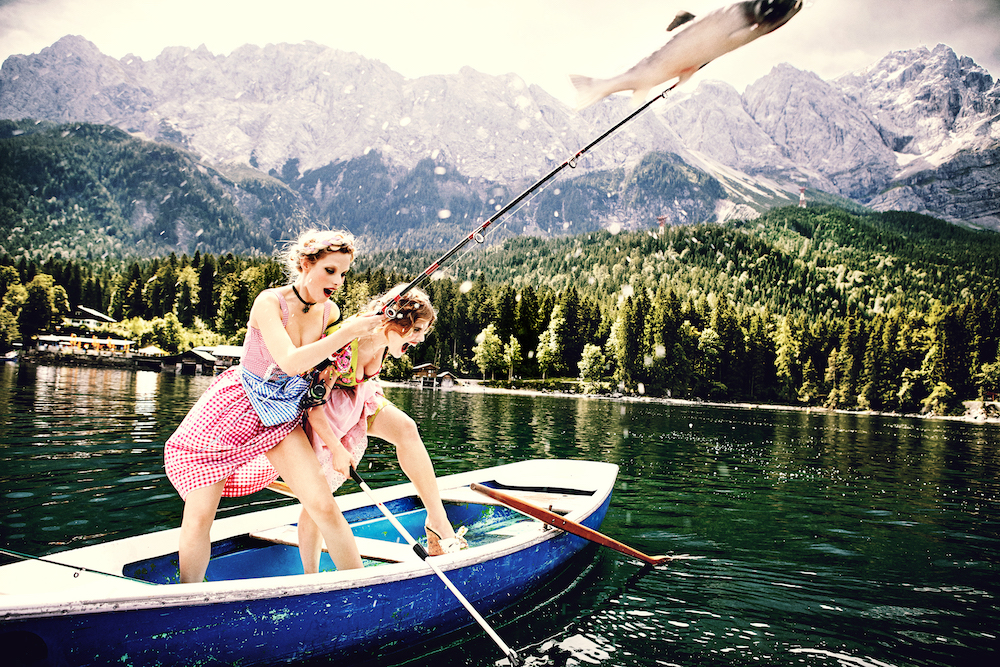
The Big Catch, Bavaria, 2015
Von Unwerth walks a fine line, purposefully screwing with the image historically created by male photographers for female models to act out, but also abiding by many of the rules that come with it, not least in her choice of models, which tends to fit with the accepted beauty standards of our time. Seeing the works en masse, I wonder how I might feel about them if I knew the photographer was male—and have to consider the extent to which the gender of the photographer should influence the way we feel about the images they’re putting out into the world. Is Ladyland accessible to all women, or just the chosen few?

Ladyland

Until 18 May at Opera Gallery, London
VISIT WEBSITE


Saturday, May 12, 2018

Azzedine Alaïa’s Final Projects Open in London


Azzedine Alaïa’s Final Projects Open in London

A new exhibition at the Design Museum and a new store in Mayfair are testaments to the late designer’s exploration of form and style.
Image
One of the displays at “Azzedine Alaïa: The Couturier,” which opened this week at the Design Museum in London.CreditMark Blower
LONDON — When Azzedine Alaïa died suddenly in Paris last November, he left behind not just his brand but two major unfinished projects: an exhibition at the Design Museum and a new store in Mayfair.
In the last two weeks both of them have finally come to fruition, and the results are testaments to the career of the Tunisian-born designer, a kind of continuing conversation from beyond the grave.
In April, a 6,000-square-foot three-story flagship store opened on New Bond Street — the brand’s third store and its first outside Paris. Designed by Mr. Alaïa, the boutique is light, airy and furnished with bespoke pieces from artists and designers like Naoto Fukasawa, Piero Lissoni and Pierre Paulin, the better to showcase the ready-to-wear, accessories and cosmetics on display.
And this week, at the Design Museum, the doors opened on a major new exhibition on Mr. Alaïa’s life, work and design legacy, co-curated by him in the months before his death.
ADVERTISEMENT
“We were 90 percent of the way there with our plans and knew exactly what we still had to do,” said Mark Wilson, an American who is chief curator of the Groninger Museum in the Netherlands, and Mr. Alaïa’s co-curator on the show. The two men were good friends for more than two decades, though neither could speak the other’s first language.
“When he died, we were all adamant that we shouldn’t change anything about the way he had planned it and that the exhibit should go ahead on schedule,” Mr. Wilson said. “We all wanted to keep going for Azzedine.”
You have 2 free articles remaining.
Subscribe to The Times
On display in “Azzedine Alaïa: The Couturier,” alongside black and white photographs, short films, quotes and timelines, are 60 of Mr. Alaïa’s most influential designs, largely grouped by design technique. These include the designer’s initial explorations of structured volume in the 1980s, a series of his signature body-conscious densely knit tricot dresses, and a trio of his famous flamenco dresses from 2011, embroidered in bright metallic layers.
A 2003 couture version of the long black fitted dress around which twists a seemingly endless zipper, memorably first worn by Naomi Campbell in 1987, is a true showstopper, as is a shimmering purple hooded dress with a train that spills across the mirrored floor, once worn by Grace Jones.
ADVERTISEMENT
The show begins and ends with several of Mr. Alaïa’s final works, including a collared chain mail evening gown with wafer-thin black chiffon pleats that was finished by his studio after his death.
Image
Mr. Alaïa was working on the exhibition just before his death last November.CreditMark Blower
“He absolutely loved doing exhibits like this; it wasn’t so much work to him as a little bit of extra fun on top of his collections,” Mr. Wilson said, adding that, to fit the plastic mannequins used for the show, Mr. Alaïa remade each garment in an elongated silhouette and then fit them all to the displays.
Dividing the room and its installations are a series of five screens, each almost 33 feet tall, especially commissioned for the show to highlight the sculptural quality and extraordinary form of Mr. Alaïa’s garments. Friends of the designer, including the industrial designer Marc Newson and the artist Kris Ruhs, were asked to imagine the backdrops; indeed, during his lifetime, Mr. Alaïa collected the works of all the contributors.
For Mr. Alaïa, as this show makes clear, his work and his life (and his stores and his exhibitions) were simply different expressions of the same aesthetic approach to the world.
“The finished show is, I think, totally in line with his vision for the exhibit,” Mr. Wilson said, standing amid the result of their labors. “It is a current artistic installation rather than just a retrospective of the past. ”
Indeed, on Wednesday night, at an opening party at the museum attended by Mr. Alaïa’s closest friends and collaborators, many spoke not so much sadly or mournfully but rather fondly of a man of ferocious curiosity and meticulous attention to detail, always determined to do things his way, from cutting each of his own designs to ignoring the traditional fashion calendar.
Carla Sozzani, the Italian editor, gallerist and retailer who was one of Mr. Alaïa’s closest collaborators, laughed as she looked at a simple strapless black dress. “Azzedine called it the Carla dress, because I was fired from Italian Elle when I wanted to put that dress on a cover,” she said. “He was so delighted and proud, of me.”
Ms. Sozzani added that the designer was always planning to safeguard the future of his house.
“He really wanted his work to continue. He wanted his work to keep on going, he became totally passionate about it towards the end of his life,” she said. “Azzedine, the man, knew he would die. But he was always determined that his unique design legacy would live on.”
Elizabeth Paton is a reporter for the Styles section, covering the fashion and luxury sectors in Europe. Before joining The Times in 2015, she was a reporter at the Financial Times both in London and New York.@LizziePaton