Tuesday, January 30, 2018

Hidden Home Buyer Closing Costs


In October, the night after the Mets’ season ended, the bright lights of Citi Field flickered back on again as a handful of players — the former All-Stars Jose Reyes, Jeurys Familia and David Wright among them — returned to the field one more time.
Except these Mets weren’t there to play baseball. They signed autographs, posed for pictures and schmoozed with the guests of honor: real estate officials who had rented out the ballpark. Children took batting practice; real estate executives roamed the outfield; the Jumbotron flashed photos of the crowd using the hashtag #AmTrustTitleDreamTeam.
And New York home buyers picked up the tab, at least indirectly.
The extravagant evening was just one night of entertainment in the title insurance industry, an obscure corner of the real estate world that has spent tens of millions of dollars to win the favor and business of its clients at ballparks, Madison Square Garden luxury suites, exclusive country clubs, expensive steakhouses, even strip clubs.
All that spending has been baked into the title insurance rates that New Yorkers seldom scrutinize in the stressful rush to complete a closing, which state regulators say are hundreds, sometimes thousands of dollars higher than in neighboring states like Connecticut, Massachusetts and New Jersey.
Adam R. Rose, vice chairman of Rose Associates, a major New York real estate developer and owner, likened it to “state-sponsored corruption and money-laundering in developing countries.”
Continue reading the main story
“The egregiousness of title insurance in New York State is something that inflates premiums to fund lavish entertainment, and it’s easily combated,” Mr. Rose said.
Nine months ago, New York officials proposed a fix: a complete ban on such expenses. The new rule has drawn praise from consumer advocates, Gov. Andrew M. Cuomo and even some business leaders. It is set to go into force on Thursday.
But in Albany, industry opponents are pushing back hard. Lawmakers, perhaps feeling the effect of a $400,000 lobbying campaign in 2017, have urged state regulators to delay or rewrite the looming gift ban. And the chairmen of the powerful insurance committees in the State Senate and Assembly are backing legislation that would undercut the new rule.
Maria Vullo, who heads the New York State Department of Financial Services, which has adopted the new regulations, told lawmakers this month that such legislation would amount to a “license to commit bribery.”
She was ignored. Days later, the State Senate took up its bill to undercut the new rule. It passed, without debate, in less than two minutes. The vote was unanimous.
“The legislators, instead of saying, ‘Oh, good for consumers,’ they’re saying, ‘My God — oh, the poor industry,’” said J. Robert Hunter, director of insurance for the Consumer Federation of America.
Not every state is like this. In Iowa, for instance, the state government took over the title business decades ago, and it charges a fraction of the price in New York: $110 for a residential purchase up to $500,000, according to the state.
The price for title insurance on a $500,000 home in or near New York City, with 20 percent down, is around $2,700.
Title insurance in New York is a particularly peculiar market. Customers are typically required to buy it to guarantee clear ownership of their property. But most rely on real estate agents or attorneys to decide which title insurance to buy, because all the biggest companies charge the exact same regulator-approved price. (Two upstart firms charge lower rates.)
So how do title companies here stand out? For years, industry veterans said, it’s been by dangling an array of perks for real estate developers and other mortgage-industry insiders.
“This industry more than any other lives and dies by providing entertainment,” said Jonathan Miller, the president and chief executive of Miller Samuel, a real estate appraisal and consulting firm. “Everybody has the same price. Yeah, their logos are different. But the way that you differentiate is by providing entertainment.”
Mr. Hunter, who studied the data from a New York title insurance investigation from 2008 to 2012, said “improper expenses” in those years amounted to $79.5 million — roughly 6.3 percent of premiums.
Robert Treuber, executive director of New York State Land Title Association, argues that Ms. Vullo’s proposal — which would ban expenses as small as buying a client a cup of coffee — overreaches. He broadly defended the industry’s expenses as necessary business development, and said title companies are following rules and rates set by the state. “They’re spending their profit to grow their business,” he said.
The gold-plated expense accounts in the title industry have rarely been publicly detailed. In the late 1990s, a lawsuit against one title insurance salesman revealed the breadth of his wining and dining: $150,000 in reimbursements in 1997 alone, including Broadway shows, “exclusive club memberships” and sports tickets.
One title agency, Riverside Abstract, is known for its lavish holiday partiesthat lure more than 1,000 people to open bars, carving stations, hand-rolled cigars and fine food. “A better way to close is our motto and I guess better parties as well,” Yoel Zagelbaum, president of Riverside Abstract, is quoted saying in one company document that promoted its 2015 soiree. The company, whose marketing expenses are under investigation by the financial services department, did not respond to requests for comment.
Photo
Gov. Andrew M. Cuomo’s chief counsel, Alphonso David, said that new state regulations to curb client spending by the title insurance industry were supported by the governor’s office “in concept.”CreditBenjamin Norman for The New York Times
The industry-backed legislation advancing in Albany would narrow the entertainment prohibition to more explicit “quid pro quo” gifts — the direct exchange of tickets or meals for particular business. Entertaining in luxury boxes or handing out gift cards to designer stores without such an explicit connection would thus be considered legal.
Current law already prohibits using entertainment as “an inducement” for business. The debate between Ms. Vullo and the title insurance industry is what exactly “inducement” means.
“There’s no reason to do the tickets unless you’re ‘inducing’ business,” she said.
She gave the example of one title firm, which she declined to name, that spent “$5.4 million for tickets, just tickets” in 2008, plus another $120,000 on country club dues and $833,000 on meals. The company collected $30.9 million in premiums that year — meaning more than 18 percent of its revenue was spent on entertainment.
“I’m protecting home buyers,” Ms. Vullo said of the new rule, which would immediately slash title insurance rates in the state by 5 percent. (Companies could avoid that cut by opening their books to the state to show their entertainment expenses amounted to less than that.) “I’m trying to reduce closing costs.”
But Mr. Treuber and lawmakers have asked, if the current expenses are so outrageous, why hasn’t Ms. Vullo cracked down on any of the supposed bad actors, like the firms she found visiting strip clubs?
“Sure, some may be able to point to some sensational incident or two, but let’s not harm the entire industry,” said Senator James L. Seward, the Republican chairman of the insurance committee, who wrote the bill that passed unanimously.
“If it’s illegal, prosecute,” Kevin A. Cahill, a Democrat who is chairman of the Assembly’s insurance committee, said of Ms. Vullo. “If it’s not illegal, come to the Legislature and let’s make it illegal.”
The expense ban had originally been set to go into effect in mid-December but was postponed to Feb. 1 after legislators asked for time to examine it. They’ve pushed for a six-month delay; Ms. Vullo has resisted. Alphonso David, counsel to Mr. Cuomo, said the governor’s office was leaving the timing up to the financial services department but that, “We support these regulations in concept.”
Title insurance companies have marshaled a half-dozen lobbying firms to make their case, including big Albany players like Brown & Weinraub, Ostroff Associates and Jackson Lewis. Hank Sheinkopf, a longtime Democratic strategist, was paid $90,000 by a title company last year, and George Haggerty, a former top official in the Department of Financial Services, earned more than $100,000 from two title companies. Richard Bamberger, a former communications director for Mr. Cuomo, is providing messaging assistance.
One company, AmTrust Financial Services, which, along with a subsidiary, First Nationwide Title Agency, hosted the Citi Field event in October, opened a political action committee in New York and quickly raised more than $100,000. Another, State Street Title Agency, gave Mr. Cuomo $50,000 in December.
Some title insurance executives are political players in their own right. Steven M. Napolitano, president of First Nationwide, has given New York politicians nearly $475,000 since 2006. Another $222,000 came from Carnap L.L.C., which is listed at Mr. Napolitano’s home address.
The Mets declined to comment on the cost of renting out the stadium. A spokesman for AmTrust, Hunter Hoffmann, said that “thousands of prospective and current clients were invited” to the event, and about 600 commercial real estate professionals did attend.
“From our perspective, it was a cost-effective event to communicate and connect with our clients,” he said, adding that it was in “full compliance with the regulations at the time.”
First Nationwide is known for its hospitality. The company logo has been affixed to the wall of a Madison Square Garden suite in recent years, according to social media posts. And last year, the company’s marketing team invited clients to watch the A.C.C. college basketball tournament at a “luxury suite” at the Barclays Center. “Contact your FNT sales representative to secure your seat!” said an invitation obtained by The New York Times.
Back in 2012, one of the firm’s first tweets featured a company executive sitting with the then-New York developer Donald J. Trump at what appears to be a sporting event, urging its executives to “get out there and build those relationships!”
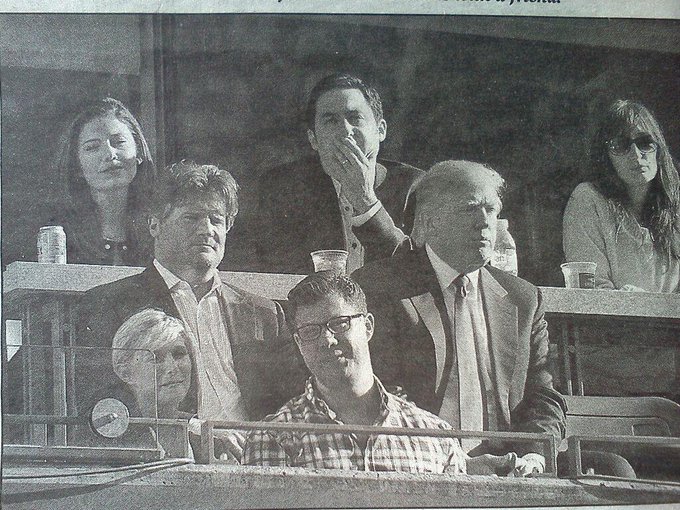
“We believe these activities are an efficient method of maintaining communications with our large commercial real estate clients, which are represented by some of the most sophisticated and prestigious law firms and real estate investors in the world,” Mr. Hoffmann said.
Mr. Napolitiano declined to comment. Mr. Hoffmann noted that Mr. Napolitano had “no significant political activity in the past year beyond support of his local elected officials” and that his giving is allowed.
Mr. Treuber said the gift rule, when combined with new caps on fees that title companies can charge, could cost jobs in an industry that employs thousands.
“If we can solve this problem through talking with D.F.S., if we can get relief through legislative measures, that would be great. If going to litigation is necessary, then that’s an option that we’ll have to consider,” he said.
Mr. Treuber’s association has retained a major law firm, Gibson Dunn, as they consider suing, and is raising hundreds of thousands of dollars to cover the potential legal bills.
For now, the title insurance parties are rolling on.
At a real estate gala in mid-January, AmTrust Title hosted three open bars across two ballrooms in Midtown Manhattan, as hundreds of real estate officials mingled between bites of tuna tartare and fresh mint mojitos that came with a stirrer with AmTrust’s logo on it. A few blocks away, at the upscale restaurant Nobu 57, an after-party co-sponsored by at least one title agency, Royal Abstract, currently under state investigation for its expenses, kept the cocktails flowing and sushi rolling through midnight.

Sunday, January 28, 2018

Kaia Gerber’s Dad Was a Model, Too


Photo
The Gerber family at their house in Malibu, Calif. From left: Presley Gerber, Kaia Gerber, Rande Gerber and Cindy Crawford. CreditJake Michaels for The New York Times
PARIS — Maybe the gods were jealous.
A storm drenched the courtyard of the Hotel de Sully, a 17th-century mansion in the Marais district, just as Cindy Crawford; her 16-year-old daughter, Kaia Gerber; and 18-year-old son, Presley Gerber, took the stage at a Paris fashion week party in September.
As the new brand ambassadors for Omega, the family was as perfectly sculpted as the allegorical figures of the four seasons, carved into the building’s facade. But there was some confusion when, after it was Ms. Gerber’s turn to speak (“Omega always takes such great care of our family,” she said), the M.C. tried to wrap up the presentation prematurely.
“There’s a fourth member of the Gerber family,” said Ms. Gerber, who had emerged as one of the world’s most in-demand celebrity models, ever since she made her runway debut in New York a few weeks earlier.
Oh, right.
Standing alongside, but almost lost amid their sheer wattage, was the family’s 55-year-old patriarch, Rande Gerber. Tall, fair-complexioned and background-handsome (think Kevin Costner in “The Bodyguard”), he exuded the patience of a man who was used to being overlooked.
Mr. Gerber, a former model, took the mic and, with the modesty of a supporting player, thanked Omega for employing his family. “Because now I can retire,” he said, to polite chuckles. “They’re all working.”
Photo
The family at a party for Omega in Paris.CreditKamil Zihnioglu/Associated Press
In fact he may have been one of the richest men at the party.
Casamigos, a tequila brand that he created with the actor George Clooney and the developer Michael Meldman, was acquired last June by Diageo, the multinational beverage giant, for $700 million to $1 billion. The deal was a new high in Mr. Gerber’s successful career as a night-life entrepreneur, which began in the 1990s with a string of hip bars, with the Morgans Hotel Group, that defined an era.
Continue reading the main story
Now, more than 25 years later, this slacker-perfectionist not only finds himself a part-billionaire, but he also enjoys newfound cultural currency as the husband and father in a genetically blessed family of supermodels who can be seen everywhere these days, including a Pepsi commercial to be aired during the Super Bowl (starring his wife and son), the current cover of French Vogue (daughter), the global advertising campaign for Calvin Klein Jeans (daughter and son) and, of course, Omega watches (entire family).
“He comes off as very laid-back and he is, but he’s also constantly thinking, and he notices ev-ery-thing,” said Ms. Crawford, 51. “He always has his finger on the pulse of what the next cool thing is going to be.”

’80s Model to Mogul

Not that you can tell from his California drawl, but Mr. Gerber was born in Queens and grew up on the South Shore of Long Island.
Scouted by Ford Models on the streets of Manhattan when he was 16, he alternated between classes at the University of Arizona, where he studied television production, and flying internationally for shoots with quintessential ’80s brands like Sassoon and Benetton.
Photo
Ms. Crawford and Mr. Gerber in 1997. CreditAlbert Ortega/Getty Images
In those vintage modeling shots, Mr. Gerber epitomized the male beauty ideals of the era: a blow-dried beefcake, lounging on the range in double denim, or sweatlessly working out in scoop-cut tank tops.
His life-changing break came after college, after he had retired from modeling and was brokering commercial real estate in Manhattan as an agent for Edward S. Gordon in the early 1990s. One of his clients, the hotelier Ian Schrager, asked him to find a bar tenant for the Paramount Hotel in Times Square, which would become one of the prototypes of the designer boutique hotel.
After passing on several options, Mr. Schrager proposed an unusual idea. “One day he said to me, ‘Why don’t you just do it yourself?’” Mr. Gerber said.
The Whiskey opened in 1991 and was an instant hit, drawing celebrities and offering a sophisticated alternative to the throbbing mega-clubs of the time, with its Philippe Starck design, high-priced cocktails, mood lighting and ambient music.
“Rande had a graciousness about him, and he was graceful as a person,” Mr. Schrager said. “He was a bright, articulate guy, sociable, likable. And, running a bar — it’s not rocket science. I thought he could do it.”
Continue reading the main story
Photo
Mr. Gerber at the Malibu offices of Casamigos, his tequila company. CreditKendrick Brinson for The New York Times
Mr. Gerber replicated the formula (which he described as “candlelit; the right incense burning, the right music playing”) for a string of Mr. Schrager’s other hotels, including the Morgans Hotel on Madison Avenue and the Mondrian in Los Angeles.
His hospitality company, the Gerber Group, which he operated in partnership with his brothers, Scott and Kenny, would open 37 bars and restaurants in 17 cities, including a network of Whiskey spinoffs with W Hotels, as well as a mini-chain of cafes inside Emporio Armani stores.
The sleek aesthetic of low-slung sofas, clever design and mellow electronica music would soon become a ’90s cultural cliché, replicated by many budget imitators with “Wayne’s World” thrift-store couches and fire-hazard candelabra right out of “The Phantom of the Opera.”
Also on fire during this period: Mr. Gerber and Ms. Crawford. The pair met in 1991 at the wedding of Michael Gruber, Ms. Crawford’s agent at the time and a childhood friend of Mr. Gerber’s. “She was dating Richard,” Mr. Gerber said, referring to Richard Gere, Ms. Crawford’s former husband.
They stayed in touch over the phone, and reconnected in Los Angeles in 1995, a few months after Ms. Crawford and Mr. Gere got divorced. “They split up and we connected,” Mr. Gerber said. The couple married in 1998.
Photo
A delivery truck for Casamigos. It was started by Mr. Gerber and George Clooney, and was recently sold in a deal worth up to $1 billion. CreditGeorge Rose/Getty Images
Also in their social orbit was Mr. Clooney, who patronized Mr. Gerber’s bars and was also a client of Mr. Gruber’s. Mr. Clooney and Mr. Gerber would go on to build neighboring beach houses in Cabo San Lucas, Mexico.
That’s also how the tequila got started, at least according to the official Casamigos story: It was a fluke created by two buddies who enjoyed drinking tequila in their “house of friends.” (Mr. Meldman, the third partner, developed the houses.)
“We made it to drink at our houses and give to our friends, and that was the only reason we were doing it,” Mr. Clooney said by phone from Los Angeles. “We went through 700 different variations. So that’s a lot of very fun taste testing that went on over a three-year period.”
But their real talent lay not so much in tequila making as it did in viral marketing and not-so-subtle celebrity branding. The tequila was unveiled in 2013 with a funny online video featuring Ms. Crawford sharing a bed with Mr. Clooney that got lots of free airtime. Somehow, Casamigos’s agave-shaped logo also found its way into countless paparazzi shots of Mr. Clooney and Ms. Crawford going to the chiropractor or running errands, as if by serendipity.
Slowly, their “hobby” took off, and paid off handsomely when Diageo decided it wanted in. The deal to buy Casamigos included $700 million in cash, plus up to another $300 million depending on sales.
Continue reading the main story
Photo
“He always has his finger on the pulse of what the next cool thing is going to be,” Ms. Crawford said of her husband. CreditJake Michaels for The New York Times
Mr. Gerber plans to funnel some of those riches into a start-up incubator, based in the Malibu celebrity hang pad that serves as his office.
He rattled off some of the pitches he has received in his new role as a venture capitalist: “different app ideas, a coffee company, a milk delivery company.”
“There’s a lot of good ideas, some crazy ideas, and some that are not so good,” he said.
“He’s a model for ‘hard work pays off,’” Mr. Schrager said of his former protégé. “He was a kid from Queens, and he went on to marry a beautiful woman and have a beautiful family and great success. And it’s always nice when a nice guy does good.”

First Family of Supermodels

In the Gerber household, Sunday night home-cooked pizza is a family tradition, as is jumping into the pool whenever one of the brood comes home from a far-flung assignment.
But such homey get-togethers are becoming harder to organize, now that each member of the family has their own work schedule and jealously protective team of publicists, stylists, managers and other gatekeepers, whose job is to control and monetize their very lucrative time.
Photo
Kaia and Presley Gerber at Paper magazine’s “Beautiful People” party in New York in the fall.CreditRebecca Smeyne for The New York Times
That value shot up considerably last September, when Ms. Gerber made her runway debut at the Calvin Klein show, “instantly becoming,” in the words of Vogue, “the model of the moment.” She has since walked in shows for top international houses including Chanel (most recently for Wednesday’s couture collection), Fendi and Burberry; appeared on the February cover of Vogue Paris; announced a design collaboration with Karl Lagerfeld; and starred in ad campaigns for Versace and Marc Jacobs Beauty, among others.
While the media’s reaction to Ms. Gerber’s debut was frenzied (“Cindy Crawford’s mini-me” was a popular response), her preternaturally centered parents were unfazed by the celebri-bomb going off in their midst.
“I think we both wish they could have been a little older, but the world is different now, and Kaia wanted to do it,” Ms. Crawford said. “When she was 13 we said to her, ‘mmm, when you’re 16.’ And then, all of a sudden. …”
Presley Gerber, while not a superstar on his sister’s level (567,000 Instagram followers versus her 2.8 million), has nonetheless booked a string of campaigns, including Dolce & Gabbana, Calvin Klein Jeans and Pepsi.
“Those kids have every reason in the world to be screwed up,” said Mr. Clooney, who has known them since birth. “They’re beautiful kids and they were born into fame and wealth. But Cindy and Rande were very aware of raising kids in Malibu, and how that can go horribly wrong. So they’ve been really hands-on parents.”
Ms. Crawford said that the name Kaia was inspired by a character in the 1988 fantasy film “Willow,” while Mr. Gerber said she was named for “Kaya,” the title track of a 1978 Bob Marley album (and slang for marijuana).
They did agree that the name Presley can be traced to a long-ago dinner with the Hollywood music producer David Foster, who was then married to Elvis Presley’s ex-girlfriend, Linda Thompson. Mr. Gerber recalled him asking, “Can you imagine being me, having to follow Presley?” For whatever reason, the name stuck.
When all four are together, fueled by the children’s Tigger-ish, teenage energy, the family comes across as a writhing puppy pile of mutual affection.
“He’s like the coolest person in the world,” Ms. Gerber said about her father. Her sophisticated all-black evening wear at the Omega party — stilettos, crystal-embroidered tulle skirt and low-cut, lacy top — was at odds with her 16-year-old hyperactivity, which fizzed out of her like a shaken-up soda bottle.
“He knows how to throw a party, which, I don’t even have friends who know how to throw a party this good,” she said.
Her brother said, “He’s a perfectionist and an all-around happy guy. He’s like my best friend.”
The Gerbers can sound a little corny, and that’s because they are. Nothing confounds a celebrity profile like a happy family. They are four golden figures that, even viewed up close, seem to be constantly dissolving into a Malibu sunset.
“When I meet people from my past, they’re not really shocked where my life has taken me,” Mr. Gerber said, clinking his Casamigos and ice, flanked by his wife and equally symmetrical daughter.
“Most people just figured I would have been successful,” he said, and shrugged.