Saturday, November 4, 2017

Police Seize a $1.2 Million Sculpture at the Ritzy TEFAF New York Art Fair


Police Seize a $1.2 Million Ancient Persian Sculpture at the Ritzy TEFAF New York Art Fair

The artifact was taken as evidence in a stolen property investigation.
The Park Avenue Armory. Photo: Wikimedia Commons.
Just as the preview of TEFAF New York, the swanky fall edition of the international art fair, was getting underway on Friday, a group of unlikely visitors walked in. Three police officers and two prosecutors entered the Park Avenue Armory at 2 p.m. with a search warrant for a Persian limestone bas-relief. They seized the work, worth an estimated $1.2 million, from the booth of London dealer Rupert Wace.
The eight-inch-square relief dates back to ca. 518–330 B.C.E. and depicts a bearded Persian imperial guard holding a spear. The carved limestone once adorned a building at the Persepolis ruins in Iran. According to the warrant, prosecutors seized the artifact as evidence in a possession of stolen property investigation. A representative of the New York district attorney’s office declined to comment on the charges or the investigation.
According to the New York Times, which broke the story, the artifact was first excavated by a team from the University of Chicago in 1933, three years after the Persian government passed a law making it illegal to export antiquities out of the country.
Ebrahim Shaqaqi, an Iranian cultural official, told the Tehran Times that efforts are underway to prove that the relic belongs to Iran and ultimately repatriate it.
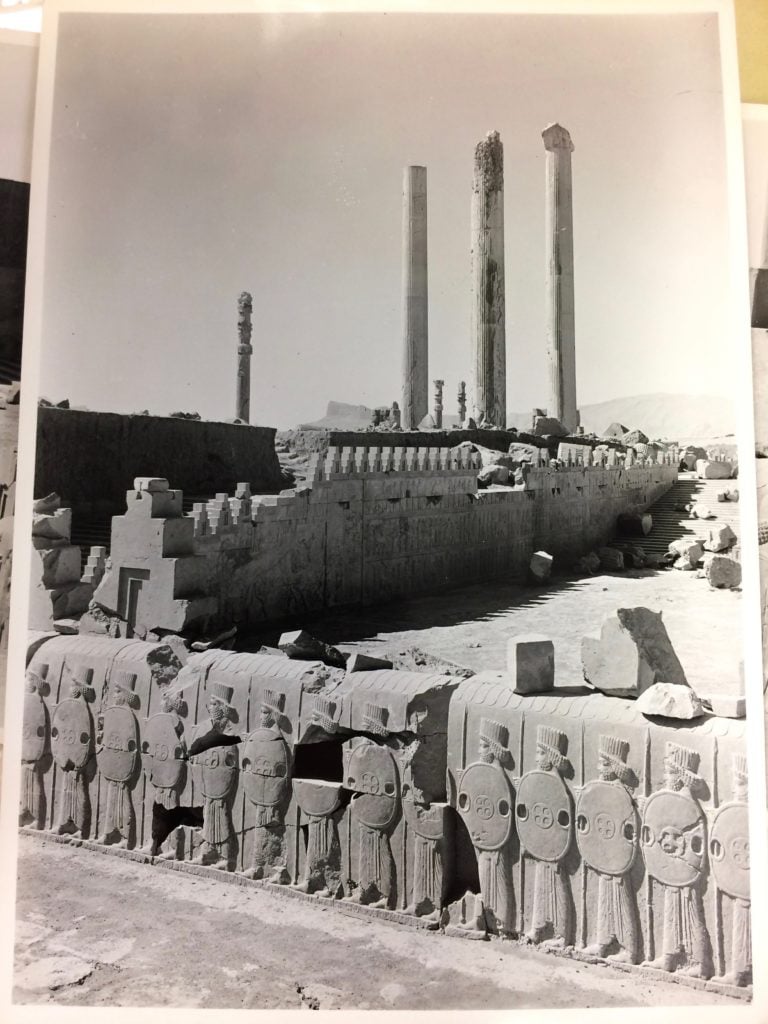
A 1933 photo of the reliefs in situ in Iran. Photo: New York District Attorney.
In an email to artnet News, dealer Rupert Wace laid out the relief sculpture’s more recent history. He said the Canadian department store heir and collector Frederick Cleveland Morgan donated it to the Quebec National Museum in 1950–1951, where it was openly exhibited until it was stolen in 2011.
Following the theft, the museum received a payout from an insurance company; when the artifact was recovered in 2014, the museum’s leadership opted to let the insurer keep the artifact rather than reimburse them. Wace said he bought the relief from the insurance company.
“We are at a loss to comprehend the events which occurred last Friday at TEFAF New York,” the dealer told artnet News. “This work of art has been well known to scholars and has a history that spans almost 70 years. We are currently investigating the matter, and will form a conclusion once we have evaluated the situation.”
The relief is just one of a number of objects the district attorney’s office has seized in recent years as part of a push to recover antiquities that have been transported unlawfully out of their country of origin. On October 11, officials announced plans to return a sculpture of an ancient bull head to Lebanon that had previously been on loan to the Metropolitan Museum of Art.

Follow artnet News on Facebook: 
 
Subscribe to our newsletter to get the news, views, and stories behind the art delivered straight to your inbox every day.
SHARE

Own the Future With a Cutting-Edge New App


A ‘Shazam’ for Art Fairs? The Company Behind Art Basel Looks to Own the Future With a Cutting-Edge New App

PRNCPL makes its debut this month at the first-ever Art Düsseldorf, also run by MCH Group.
A visitor snaps a picture of "Untitled 2016" by Rirkrit Tiravanija during Art Basel Rhona Wise/AFP/Getty Images.
Switzerland’s MCH Group, which owns the prestigious Art Basel, is turning to tech in its bid to stay at the top of the art-fair pyramid. Its new app, PRNCPL, is an attempt to create a “Shazam for art” specifically engineered for a fair context. Describing itself as “a new technology platform for the art industry,” it promises to let smartphone-wielding visitors to Art Basel’s partner fairs aim their phones at any artwork on view and call up all its details: title, artist, medium, gallery, and—in some but not all cases—price.
PRNCPL makes its debut this month at the first-ever Art Düsseldorf fair, part of the MCH Group’s Regional Art Fair portfolio, which is set to come to the former factory complex Areal Böhler, November 17–19.
In a press release, PRNCPL co-founder Moenen Erbuer noted that “the art fair experience hasn’t evolved much in recent years,” adding that the industry is “ripe for sweeping digital innovation.”
Ben Sledsens, Cawing Crows, (2017). Courtesy of Art Düsseldorf.
Ben Sledsens, Cawing Crows, (2017). Courtesy Tim Van Laere Gallery, Antwerp.
artnet News gave the beta version of the yet-to-launch app a spin in our offices. Since Art Düsseldorf remains a few weeks away, we were limited to scanning hi-res artwork images from our computer screen.
In that limited and controlled situation, at least, it worked. Fairly quickly, the app loaded up all of the aforementioned info, albeit sans pricing information, for which it instructed us to contact the gallery. (You can try out scans of the pictures embedded here after downloading the app.)
Though the technology did not strike us as particularly revolutionary feeling, it certainly will help eliminate some steps that are all too familiar to regular fairgoers, such as photographing both individual works and wall labels to keep track of potential favorites.
PRNCPL’s proponents list a variety of advantages offered by the app: its professional photo replaces “poorly framed and badly lit mobile photos”; the data within the app is easily shared; its “frictionless experience” potentially increases gallery sales; and, since the image-recognition technology works entirely offline, it allows visitors to access contact information quickly, without any pesky data roaming charges.
The app’s co-founders concede that not every artwork at a fair will be easily recognized. In particular, sculptures, videos, and the ever-popular reflective works all present challenges.
Label of Ben Sledsens' Cawing Crows, (2017). Courtesy of Art Düsseldorf.
Label of Ben Sledsens’ Cawing Crows, (2017). Courtesy Tim Van Laere Gallery, Antwerp.
As a company, PRNCPL evolved out of its sister platform Curiator, which was co-founded by Erbuer and Tobias Boonstoppel in 2014, and was acquired by MCH Group in 2016. Its core product is a database system for art fairs, promising to help them better manage and utilize their data.
Despite PRNCPL’s debut in Düsseldorf, don’t expect to use it at MCH Group’s more prominent fairs, like the upcoming Art Basel in Miami Beach—at least not just yet.
“We are mainly focused on the regional art fairs which we consider a more ‘experimental’ platform,” a representative told artnet News. “There is no plan in place to implement this for Art Basel in the near future, but this might happen later on.”
This is not the first attempt to make a “Shazam for art” work. Recently Smartify, which can identify artworks in the collections of partner museums including the Metropolitan Museum of Art and the Hermitage, has drawn headlines
MCH Group has recently been on an ambitious acquisition streak of regional art fairs. It took a minority stake in Art Düsseldorf earlier this year, following the announcement of their majority stake in the India Art Fair in fall 2016.

Follow artnet News on Facebook: 
 
Want to stay ahead of the art world? Subscribe to our newsletter to get the breaking news, eye-opening interviews, and incisive critical takes that drive the conversation forward.
SHARE
Article topics

Price Check! See What Sold—and for How Much


Price Check! See What Sold—and for How Much—at the TEFAF New York Art Fair

From a $4 million plaster by Anthony Canova to a $100,000 Fortuna cabinet, here is what flew out of the booths at this year's fair.
Francesco Guardi Piazza San Marco. Photo: courtesy of Adam Williams Fine Art, New York.
What does a 1st-century bronze run you these days? What about an ancient Egyptian wood sculpture fragment? The fall edition of TEFAF New York is one of the few occasions to survey this kind of material under one roof.
Ninety-five art and antiques dealers descended on the Park Avenue Armory to present work ranging from ancient antiquities to early 20th-century paintings. Dealers reported steady sales at the second fall edition of the fair, which came to a close on Wednesday. And as with any art fair, dealers are there to schmooze, but also to sell. Over the course of the six days, we spoke to dealers to see how they fared. (Prices were self-reported by dealers and fair representatives.)

Paintings

  • Francesco Guardi‘s Piazza San Marco sold at Adam Williams Fine Art, New York, for $2.9 million.
  • Theo van Rysselberghe‘s Torse de blonde (Blonde Nude) (1919), sold at Jack Kilgore & Co., New York, for $185,000.
  • Renato Tomassi‘s Portrait at the Front (1918) sold at Jack Kilgore & Co., for $120,000.
  • Clémence Roth‘s Young Girl in Black (1887) sold at Jack Kilgore & Co., for $95,000.
  • Allan Clarke‘s Arab (1929) sold at Taylor Graham for $45,000.
  • Edwin Lord Weeks‘s Across the pool to the gated temple of amritsar sold at Taylor | Graham, New York, for $38,000.
  • Sir Lawrence Alma-Tadema‘s Autumn (Scene in a Roman Garden) sold at Taylor | Graham for $32,000.
  • Edwin Lord Weeks‘s Polishing the Sword sold at Taylor | Graham for $25,000.
Lodovico Ferruccio Maria Pogliaghi’s Neptune and Venus & Cupid (ca. 1910-15). Photo: courtesy of Tomasso Brothers Fine Art.

Sculpture

  • Anthony Canova‘s Plaster Copy of Anthony Canova’s Rezzonico Genio (1793) sold at Carlo Orsi – Trinity Fine Art, London, for $4 million.
  • Elie Nadelman‘s Female Head (ca. 1915) sold at Bernard Goldberg Fine Arts, New York, for $200,000.
  • Lodovico Pogliaghi‘s Pair of bronze oval medallions portraying Neptune, and Venus with Cupid at Tomasso Brothers Fine Art, London, sold in the region of $175,000.
  • Pietro Cipriani‘s Bronze Farnese Hercules by sold at Tomasso Brothers Fine Art for in the region of $200,000.
  • Roman bronze, Statuette of Mercury, from Gaul (1st century CE) sold at Charles Ede for $120,000.
  • Erastus Dow Palmer‘s Bust of Elizabeth Street Plumb (1851) sold at Taylor | Graham for $32,000.
Ancient Egyptian Wood Sculpture Fragment (ca. 1960-1900 B.C.). Photo: courtesy of Rupert Wace Ancient Art, London.
Ancient Egyptian wood sculpture fragment (ca. 1960-1900 B.C.). Photo: courtesy of Rupert Wace Ancient Art, London.

Antiques

  • Ancient Egyptian wood sculpture fragment (ca. 1960-1900 B.C.) sold at Rupert Wace Ancient Art, London, for $380,000.
  • Naophoros statue, Egyptian, New Kingdom, 18th Dynasty (c. 1400 BCE) sold at Charles Ede for $350,000.
  • Greek bronze, Griffin protome, Archaic Period (ca. 625-600 BCE), sold at Charles Ede for $225,000.
  • Egyptian limestone relief (unknown date), sold at Charles Ede for $125,000.
  • Fortuna cabinet (ca. 1620), sold at Kunstkammer Georg Laue of München, Germany, for over $100,000.

Follow artnet News on Facebook: 
 
Want to stay ahead of the art world? Subscribe to our newsletter to get the breaking news, eye-opening interviews, and incisive critical takes that drive the conversation forward.
  • Access the data behind the headlines with the artnet Price Database.
SHARE
Article topics