Wednesday, December 28, 2016

The 8 Biggest Forgery Controversies of 2016

The Year of the Fake: The 8 Biggest Forgery Controversies of 2016

The most ridiculous—and expensive—fake art scandals and spats of the year.
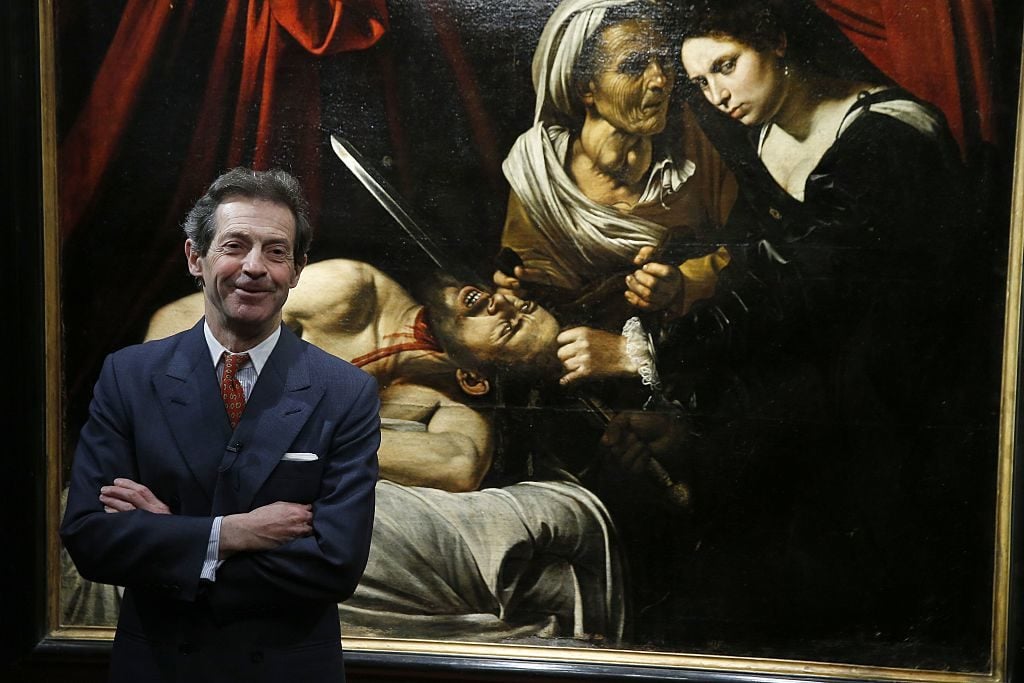
French painting expert Eric Turquin poses on April 12, 2016 in Paris with Judith cutting off the head of Holofernes, presented as being painted by Italian artist Caravaggio (1571-1610), while experts are still to determine its authenticity. Photo courtesy Patrick Kovarik/AFP/Getty Images.
Fakes and forgeries in the art world are the stuff of legend, the subject of books, films, and television series the world over. In real life, they land people behind bars. 2016 brought us many unwanted things, but it also appears to have been a year when a huge amount of authenticity disputes took place. The spats took shape from contested provenance, to painters faking their own work, to a multimillion dollar Old Masters scandal. From farce to tragedy, we’ve compiled the highlights of this year’s biggest art forgery scandals below.

When a painting that appeared to be the long-lost second version of Judith Beheading Holofernes by Caravaggio turned up in an attic in France, the world was watching. Before the authenticity of the painting was even established, an unnamed American institution tried to put in an offer for the potential Baroque masterpiece.
The painting was claimed to be a fake by Caravaggio expert Mina Gregori, but in light of some recent mistakes on her part, judgement was still reserved. Then, expert Eric Turquin stepped in to authenticate and value the painting at €120 million.
While the authenticity of the painting remains unconfirmed, the “yeses” were enough for some. The work went on view to the public on November 10 at Pinacoteca di Brera in Milan, to some outcry from the art community.
Lee Ufan poses near one of his artworks entitled "L'arche de Versailles" ('The arch of Versailles'), on June 11, 2014. at the Chateau de Versailles, during the exhibition "Lee Ufan Versailles". Painter and sculptor Lee Ufan, 77, has created a variety of artworks made of stone and steel for an exhibition at the Chateau de Versailles, outside Paris. Photo courtesy Fred Dufour/AFP/Getty Images.
Lee Ufan poses near one of his artworks entitled “L’arche de Versailles” (‘The arch of Versailles’), on June 11, 2014. at the Chateau de Versailles, during the exhibition “Lee Ufan Versailles”. Photo courtesy Fred Dufour/AFP/Getty Images.
The forgery scandal surrounding the work of minimalist South Korean artist Lee Ufan was puzzling at best. In the first instance, the accused forger, known as Hyeon, confessed to police—only to have Ufan himself contradict him, verifying that thirteen alleged fakes were, in fact, genuine.
In an added twist, new charges were brought against a second Korean forgery ring. This involved a master forger known only as Park selling forgeries to a Seoul gallery for hundreds of thousands of dollars. The gallery, run by a husband and wife known as Kim and Ku, then sold them on for millions. Park confessed to forging a total of forty works.
The scandal led the Korean government to introduce new legislation to prevent the eruption of any more similar scandals. In the aftermath, however, all owners of Ufan’s work are undoubtedly checking their provenance.
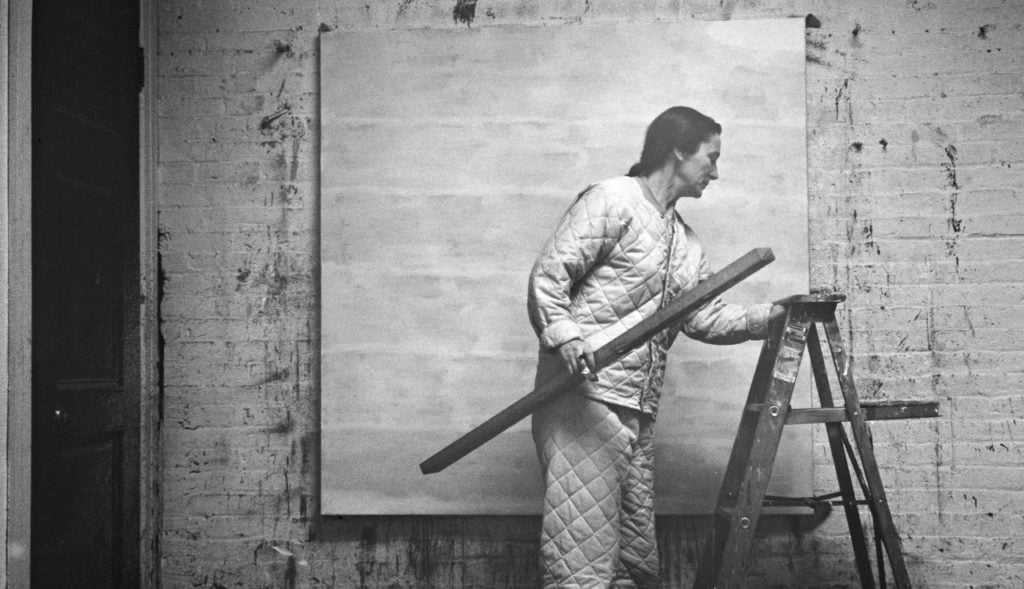
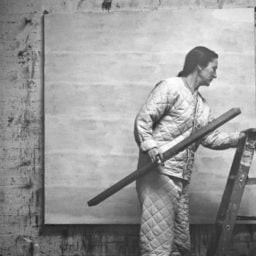
Alexander Liberman, Agnes Martin with Level and Ladder (1960). Photogrpahy Archive, Getty Research Institute. Photo: © J. Paul Getty Trust.
Alexander Liberman, Agnes Martin with Level and Ladder (1960). Photography Archive, Getty Research Institute. Photo ©J. Paul Getty Trust.
The London-based Mayor Gallery launched legal action against the estate of Agnes Martin in October, after they refused to authenticate 13 works that the gallery had already sold. The potential costs were both the gallery’s reputation, and around $7.2 million in refunded sales.
The works in question were Night and Day, an untitled work, and eleven more works on paper. 
In an added twist, Pace Gallery‘s Arne Glimcher was named in the suit because, as both the founder of the Agnes Martin Foundation and the owner of Pace, Glimcher could be involved in a conflict of interest, which could void the estate’s rejection of the works.
If the case finds in favor of the estate—which is the most common result in cases such as these—the works will be rendered valueless. The gallery, which has already refunded two of the three clients involved, would have to refund its third client in this matter to the tune of millions.
Lucas Cranach the Elder, Venus (1531). Courtesy of Wikimedia Commons.
Lucas Cranach the Elder, Venus (1531). Image courtesy of Wikimedia Commons.
The image of the dapper crook knocking out Raphaels in a garret, secretly making millions, is fodder for many a Hollywood script, but it’s most fascinating because it really happens. This summer, a multi-million dollar forgery scam came to a head around the first iteration of TEFAF New York.
In a hot mess that drew in everyone from European Royalty to London’s National Gallery, forgeries of work by 25 Old Masters totalling an estimated $225 million were brought to the market by the French dealer Giulano Ruffini.
The scandal kicked off with the high drama of French authorities seizing Venus by Lucas Cranach the Elder—owned by the Prince of Liechtenstein—from the Caumont Centre d’Art in Aix, and spread through the art world like wildfire, taking Orazio Gentileschi’s David with the Head of Goliath, and Velázquez’s Portrait of Cardinal Borgia with it, calling the authenticity of the Old Master works into question.
The original source of the suspected forgeries is a mystery, although they were of such a high standard that they passed muster at such prestigious institutions as Christie’s, The Met, and the aforementioned National Gallery.
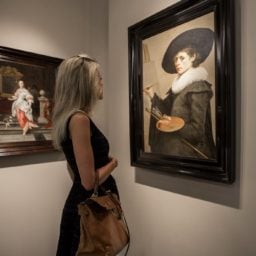
Ross Bleckner, Sea and Mirror (1996). Courtesy Artnet
Ross Bleckner, Sea and Mirror (1996). Image courtesy Artnet.

This has all the elements of a classic New York art world spat. From celebrity and art world royalty, to in-court name calling and accusations of interstate tax evasion, this case had it all.
The crux of the matter is that Alec Baldwin claims he thought be was buying the original work Sea and Mirror (1996) by Ross Bleckner, whereas Boone claims he always knew the work would be a copy, painted for Baldwin by the artist.
The case rumbles on, but pinnacles so far have included Baldwin likening Boone to a bank robber in a court of law, and Boone trying to have the case thrown out of court on the grounds that Baldwin had the work shipped to LA, and then New York, to avoid paying sales tax. The saga continues.

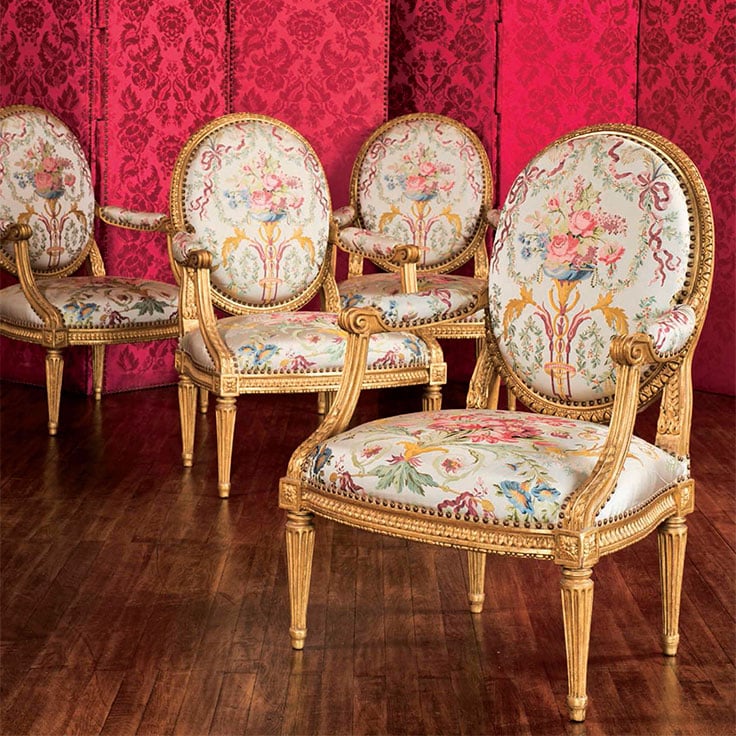
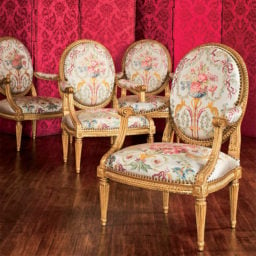
A suite of four Louis XVI gilt-walnut armchairs stamped by Louis Delanois that sold at Christie's Paris in 2015.
A suite of four Louis XVI gilt-walnut armchairs stamped by Louis Delanois that sold at Christie’s Paris in 2015.
These pesky forgers don’t limit their scams to painting, and are capable of turning their hands to many types of fakery. In the case of this set of six Louis XIV chairs—sold by highly-respected Parisian antiques dealer Kraemer Gallery to the Palace of Versailles itself—it emerged after the sale was made public that there just were not as many chairs in the court of Versailles as there are currently in circulation. The natural conclusion would be that some of the presumed authentic chairs must indeed be fakes.
The authenticity of the chairs is still under investigation by the French authorities, but the scandal attached to the story led the respected Kraemer Gallery to drop out of of the Biennale des Antiquaires.
Lawrence Ulvi. Photo: Multnomah County Sheriff's Office
Lawrence Ulvi. Photo courtesy Multnomah County Sheriff’s Office.
Lawrence Ulvi spent years running a tidy little business in fakes of the Northwest School, including works by Mark Tobey, Morris Graves, and Kenneth Callahan.
Ulvi had been knocking out and selling these works to galleries in Canada and the US since 2008, netting himself a cool $66,232 in the process.
Once caught, the artist’s lawyer pleaded for no prison term on the grounds of ill health. Facing a maximum sentence of twenty years, the presiding judge did offer some leniency to the forger, sentencing him to one year and one day in prison, and encouraging him to bring his paintbrushes and artistic talent with him behind bars.
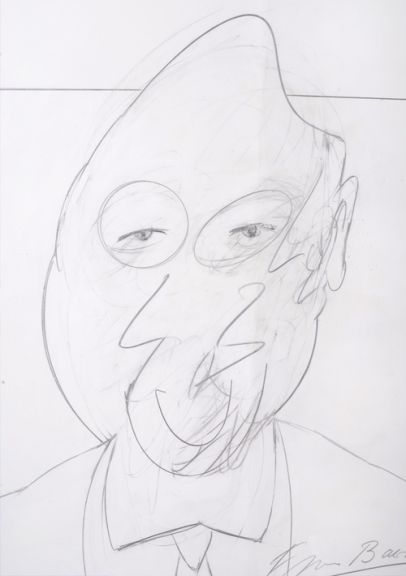
Drawing signed Francis Bacon Photo: Herrick Gallery
Drawing signed Francis Bacon. Photo courtesy Herrick Gallery.
8. Fakon
Fakon: Fake Bacon. Francis Bacon made it notoriously difficult to authenticate his work, by refusing to take part in the compilation of his catalogue raisonné or speak to those entrusted with the task.
That being said, when these gems (see above) came onto the market via an ex-boyfriend of Bacon, they were rejected from the catalogue raisonné before going up for sale at a London gallery. Just looking at these loose sketches, one is forced to consider—even if Bacon himself did make them—whether he would ever want them to see the light of day.
Follow artnet News on Facebook.
SHARE
Article topics

Art World | The Stand-Out Art Essays From 2016

The Stand-Out Art Essays From 2016

On color photography, the #lovehustle of art, and how to wear your backpack.
A
A Kodak "scanning text image."
1. “Color Goes Electric,” by Claire Lehmann, Triple Canopy, May 31, 2016An outstandingly entertaining, erudite trip through the history of color photography as technology and as art. As a bonus, it delivers nicely on Triple Canopy’s unique digital magazine format.
Key passage:
[Kodak researcher C. James] Bartleson found that test subjects consistently remembered the saturation of familiar colors with exaggerated intensity, or to be “more characteristic of the dominant chromatic attribute of the object in question.” In other words, “grass was more green, bricks more red.” Rather than increasing accuracy, our familiarity breeds a kind of mnemonic distortion. And because most people consider themselves quite capable of judging the colors in photographs “taken by people other than themselves, of objects that they have never seen, at times when they were not present,” as the scientist R. W. G. Hunt puts it, the crucial industrial mandate in photographic color reproduction is accordance with memory, not reality. Thus the technologies that record our memories have been materially imbued with memory’s subtle alterations.
Artnews, Spring 2016.
2. “Go Pro: The Hyper-Professionalization of the Emerging Artist,” by Daniel S. Palmer, Artnews, March 9, 2016Starting from an account of a studio visit gone wrong, Palmer, an art historian and curator, painted a picture of the state of contemporary art that immediately became the go-to reference for discussions of the scene’s soullessness.
Key passage:
The entire system seems designed, predominantly, to disappoint. What has arisen from these failures is a marked distinction between product- and project-based artists. Product-based artists have been led to think of an artwork as a product serving a demand, rather than a single step in a longer, sustained development, as is the case with project-based artists.
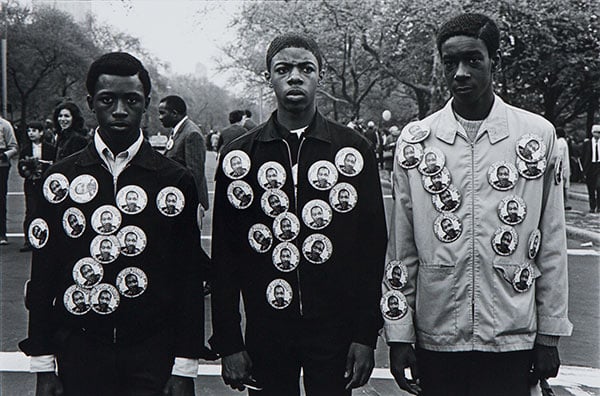
Benedict Fernandez, Memorial to Martin Luther King, Jr., Central Park, New York, 1968. Courtesy Harvard Art Museums/Fogg Museum
Benedict Fernandez, Memorial to Martin Luther King, Jr., Central Park, New York, 1968. Courtesy Harvard Art Museums/Fogg Museum.
3. “Vision & Justice: Guest Editor’s Note,” by Sarah Lewis, Aperture, Summer 2016
I place this essay here as standing for the entire, Lewis-edited Aperture issue on photography and the black experience, which features a formidable list of contributors ranging from Henry Louis Gates, Jr. to Ava DuVernay. Still, Lewis’s assured lead-in centers the discussion of the role that images has played in the history of struggles for racial justice.
Key passage:
The gravity of this connection between vision and justice is crucial to understand, as we live in a polarized climate in the United States; sociologists tell us that people now congregate, live, worship, play, and learn with those like themselves more than ever before. Save for constructed societies, we come into close contact with those who do not share our political and religious views less and less. How we remain connected depends on the function of pictures—increasingly the way that we process worlds unlike our own. The tool we marshal to cross our gulf is irrevocably altered vision. The imagination inspired by aesthetic encounters can get us to the point of benevolent surrender, making way for a new version of our collective selves.
4. “Gallery Guide Rant: Wear Your Backpack on the Front and Don’t Be a Jerk,” by Kate Rhoades, ArtSlant/Arts.Black, July 18

Here’s a fun one: Rhoades, an artist, reflects on her time as a museum “gallery guide,” and the very unglamorous realities of being on the museum floor day in, day out.
Key passage:
That day I saw a child beat a painting with both hands as if he were playing a bongo drum. Children climbed up on plinths and tried to rip headphones out of the interactive displays. It was pandemonium.
Screen capture from <em>Cosmology of Kyoto</em>.
Screen capture from Cosmology of Kyoto.
5. “Towards an Art History for Videogames,” by Lana Polansky, Rhizome.org, August 3
A great foundation for some ambitious institution to put together a really cool show: Polansky walks readers through some of the weirder early artifacts of gaming, from the psychedelic J.J. Squawkers to the unsettling-sounding Cosmology of Kyoto, convincingly making the case that art doesn’t need to redeem the medium because there has always been a strand of game that represents all the weird and quirky values we associate with art.
Key passage:
It seems surprising to say that the idea of the “artgame” goes back to at least the early 2000s, and that such works were being exhibited in spaces like the MASS MoCA. It seems even more surprising, given the hardened assumptions of the culture, that, as developer G.P. Lackey put it, “Artgames are as old as games!”
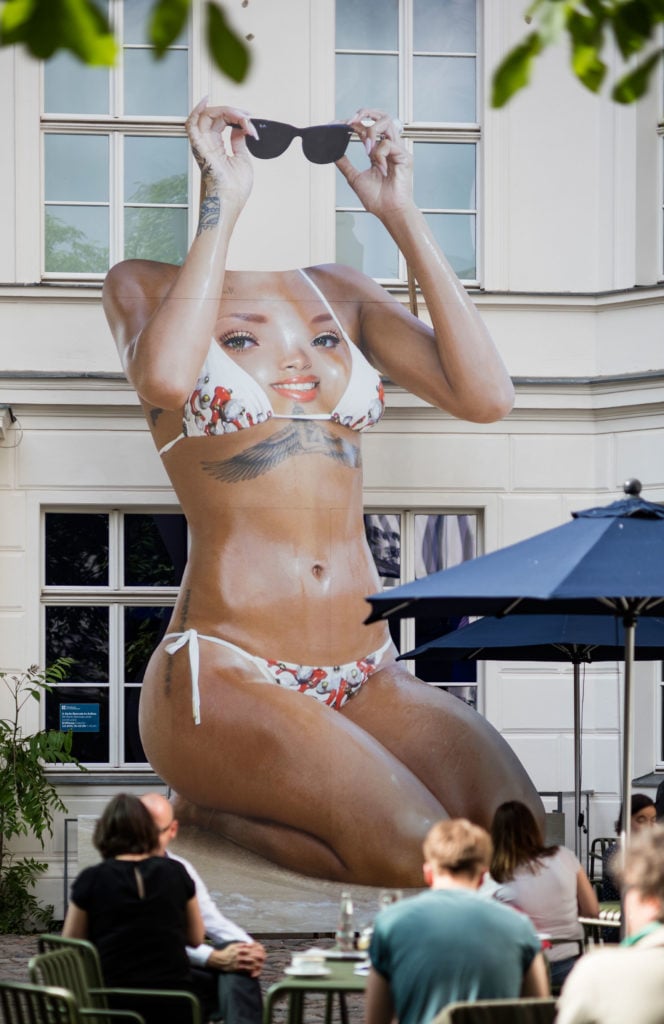
Installation view of "Ewaipanoma (Rihanna)," 2016, courtesy Juan Sebastián Peláez, photo: Timo Ohler
Installation view of “Ewaipanoma (Rihanna),” 2016, courtesy Juan Sebastián Peláez, photo: Timo Ohler.
6. “9th Berlin Biennial Review,” by Hannah Black, Artforum, September 2016
Jason Farago’s savage takedown of the DIS-curated Berlin Biennial in the Guardian became the reference point for most later takes on the event, pro and contra, but Black’s review stands out as one of the most admired pieces of analysis (Kareem Estefan called it an example of “reparative criticism”), sensitive to the distinctive vision of the event, while also naming its blind spots.
Key passage:
The show has been pummeled by critics for its vacuity and cynicism, but in fact it comes across as relentlessly anxious about the conditions and possibilities of art and life. Taken together, the works on view express the despairing atomization, and the compromised longing for solidarity, of a postbourgeois creative class hovering on the brink of its own obsolescence. The paradigmatic racial and class position of this despair goes without saying.
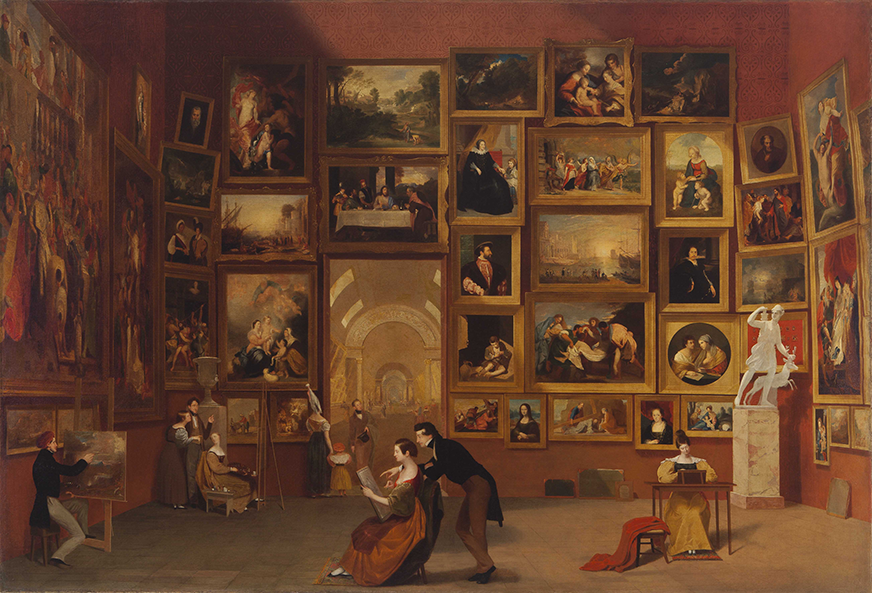
Samuel F. B. Morse, <em>Gallery of the Louvre</em> (1831–33), Terra Foundation for American Art,
Samuel F. B. Morse, Gallery of the Louvre (1831–33), Terra Foundation for American Art.
7. “Unknown Makers,” by Alexander Provan, Art in America, October 2016

From Art in America’s very useful issue on the “digital museum,” Provan’s essay relating the art institution’s changing contemporary relationship to ideas of originality goes so far beyond the conventional discussion of “aura” and “mechanical reproducibility,” via copious art history, examples of contemporary practice, and discussion of legal precedent, that it makes most other discussion of the subject look embarrassing.
Key passage:
What might be lost as the greatest hits of human civilization are safely transferred to hard drives? The passage of centuries registered in the fissuring of the supple flesh and glinting pool of Courbet’s The Source; our sense of ourselves as stewards of objects that testify to our histories and capabilities, given that everything can so simply be stored and retrieved.
Image for "Brouhaha" at Recess.
Image for “Brouhaha” at Recess.
8. “Get In Where You Can Fit In,” by Danielle Jackson, Recess, December 2016
Written as an accompaniment to the New York art space Recess’s “Brouhaha” show (featuring artist Željka Blakšić and feminist collective Brujas), Jackson’s time capsule is the perfect companion piece to Daniel Palmer’s “Go Pro” essay, above. With a perspective radiating out from the Bronx (Jackson is co-founder of the Bronx Documentary Center), the essay economically captures the strains and compromises of the #lovehustle of creative labor in 2016 New York.
Key passage:
For a few weeks every artist I speak to is running to class. Caroline teaches four and we attempt to find a snatch of time in between, Sai’s filmmaking students are waiting for him down the block, Mike is heading to Columbia and has to cut our conversation short, and Zeljka has to go right now—her class at Cooper Union starts in twenty minutes.
Teaching is appealing for any number of reasons: the satisfaction that comes with transferring knowledge, access to an engaging intellectual community, the sense of purpose conferred on to the instructor. The flexible schedule.
Still, the promise of more time can feel illusory. Of dance classes and grantwriting a choreographer told me, “If I could only tell you how much time I spend doing the work that allows me to do the work.”
Interviewees from Human Rights Watch's "Migrant Workers’ Rights on Saadiyat Island in the United Arab Emirates: 2015 Progress Report"
Interviewees from Human Rights Watch’s “Migrant Workers’ Rights on Saadiyat Island in the United Arab Emirates: 2015 Progress Report”
9. “The Loneliness of the Long-Distance Campaign: On Gulf Labor and Western Museums in the Middle East,” by Naeem Mohaiemen (text) and Hans Haacke (photos), Walker Art Center Magazine, December 7, 2016
Mohaiemen offers a sober and human account of the ins-and-outs of the artist-led campaign to make Abu Dhabi’s Guggenheim project deliver on its commitments to workers rights. In a year characterized by the rise of the New Artistic Activism (see Not An Alternative’s manifesto on “Institutional Liberation” from e-Flux Journal), he gives a sense of what a serious campaign really takes: An unglamorous familiarity with bureaucracy, and a commitment to strategy that transcends single, spectacular protests. The accompanying documentary photos by the legendary Haacke don’t hurt in lending it authority, either.
Key passage:
One of the radical moves artists can make is to challenge the conditions under which institutions exhibit their work. But why do such tangible demands get bracketed as posturing, while metaphoric confrontations are celebrated? Defiance is welcomed when it is sanctioned and staged as art. Drill a crater in the floor, flood a gallery, embalm an animal, smash an object, stage a pitiful death—critics hail these gestures as having the power to “shape worlds.” But when artists sit down at a conference table with museum administrators and read from a list of demands for labor rights, this work—involving conversation, negotiation, research, protest—suddenly becomes illegible to the same museum. The artists whose projects were previously praised as stretching boundaries are now tagged as maverick spoilers.
Follow artnet News on Facebook.
SHARE
Article topics