Wednesday, August 31, 2016

How Italy stopped Venice being put on Unesco’s Heritage In Danger list

Conservation
Conservation

How Italy stopped Venice being put on Unesco’s Heritage In Danger list

The government lobbied the director of the World Heritage Centre, diplomats and national delegates
by Anna Somers Cocks  |  31 August 2016
How Italy stopped Venice being put on Unesco’s Heritage In Danger list
Uncontrolled tourism is killing the city. Wolfgang Moroder/lusenberg.com      
Unesco’s World Heritage Site Committee meeting in Istanbul this July voted not to put Venice on its list of World Heritage in Danger sites, but instead to postpone the decision until the 2017 meeting. This was despite the highly critical conclusions of Unesco’s own recent State of Conservation report on Venice, and appeals by the lobby group Europa Nostra and other civil society organisations.

Venice’s addition to this list (currently 55 sites, with only three in the West) would not only be embarrassing for the Italian government, which regularly uses its cultural assets and conservation know-how as an instrument of foreign policy, but would also lead to close and potentially unwelcome monitoring of Venice by Unesco officials.

Italy was put on warning at the 2014 Unesco meeting in Doha that it had until 2016 to act, or plan effective action on, a list of problems. These included: the vast cruise ships sailing through Venice; infrastructure, navigation and construction projects in the lagoon that would damage both lagoon and city; the impact on buildings and the lagoon ecology of waves caused by motorised vessels; the absence of a sustainable tourism strategy, of a buffer zone around the city and its lagoon; and of a co-ordinated approach to the protection of everything that makes Venice of “outstanding universal value”, the Unesco criterion for being called a World Heritage Site.

A damning report

In October 2015, the International Council on Monuments and Sites (Icomos), sent a mission to Venice on behalf of Unesco to investigate the situation, and its report concluded that no significant progress had been made towards resolving any of the specified problems. The city council tried to prevent the mission from meeting representatives of civil society, who have been increasingly active in recent years drawing attention to the cruise ships, uncontrolled tourism and declining resident numbers, but the mission insisted on receiving them.

The Icomos report was sent on 9 June 2016 to the Italian government for any factual corrections to be made so that it could be included among the action papers supplied to members of the World Heritage Sites Committee before it convened on 10 July. The report was delayed, however, so it was not attached to the main papers, but buried among attached documents, making it less likely that its very critical comments would be read by members, who might then have objected to Unesco’s recommendation that Italy submit yet another report by 1 February 2017—in other words, be spared listing for another year.

Lebanon a lone voice

Members had a further disincentive to read the report because Venice was not even included among the sites to be discussed. This ploy was, however, foiled by Jad Tabet, the member for Lebanon, despite pressure to withdraw his request from the Lebanese ambassador to Unesco, who had been lent on by the director of the World Heritage Centre, Mechtild Rössler, and from the Lebanese minister of foreign affairs, who had been contacted by the Italian ambassador.

In his speech, Tabet said that Venice and the Egyptian temples of Abu Simbel had been the foundation stones of Unesco’s first campaigns and had led to the World Heritage Convention of 1970. He continued, “The reaction of our committee comes very late. We should act at once and launch a new campaign for Venice, yet we are delaying again.”

Only a handful of the committee members chose to respond, all reassuring the Italian government of their faith in its capacity to protect Venice. Some seemed to confuse Italy’s visible support of world heritage (for example, the 60 carabinieri now in training to protect monuments in war zones) with the capacity of decentralised government to deal with the complex, long-term problems presented by Venice and its lagoon.

Unesco caved in before

The member for Kuwait said: “We thank Italy for the aid it gives to countries present, therefore we trust the Italian authorities.” The member for Azerbaijan said that he believed Italy “has competence in conservation and that it will work closely with Icomos to implement all the recommendations”.

This is not the first time that Unesco has given in to pressure from the Italian government. In November 2011, an important international conference on all aspects of Venice, social and ecological, was cancelled at less than two weeks notice after pressure was applied on Unesco’s head office by Renato Brunetta, then a member of Silvio Berlusconi’s government. The reason: scientists were invited who were critical of aspects of the mobile barriers being built between the Adriatic and Venice lagoon by a consortium of businesses, the Consorzio Venezia Nuova. This was still at the height of its political influence, which was revealed in 2013 to be due to widespread corruption, both local and national.

The 9 reasons why Unesco's own specialists think Venice is in danger


1.
THE 2014 WORLD HERITAGE COMMITTEE KEY RECOMMENDATIONS HAVE BEEN IGNORED


■ Still no heritage impact assessments of the effects of the proposed deep-dredging of the lagoon to allow the passage of cruise ships.
■ No enforcement of speed limits on motor boats to prevent wave erosion.
■ No prohibition on the largest ships and tankers entering the lagoon.
■ No buffer zone around the city and the lagoon.

2. HIGHLY DAMAGING PROJECTS ARE BEING PUSHED


If the proposed projects (excavation of a new shipping channel, extension of the existing channels, the extension of the airport), as outlined in governmental reports and during the mission, are implemented, in addition to the already constructed buildings, new port terminal and ongoing transformation of buildings for tourism purposes, Venice and its lagoon will be irreversibly damaged. This damage would include serious deterioration of the lagoon system and the architectural and urban coherence of the historic city, resulting in a serious loss of its authenticity.

3. THERE IS NO PLAN FOR VENICE AND ITS LAGOON


There is no shared vision for Venice among the many different stakeholders at national, regional and local levels, which prevents a coherent response to [the many] negative factors. The principal stakeholders, being the Ministry of the Environment, the Ministry of Culture, the Port Authority and the City of Venice, should reconvene and come up with a new scheme that includes the observations put forward in this report, as well as a strategy for all ongoing and planned developments within the boundaries of the World Heritage property, taking into account its outstanding universal value.

4. LOCAL MANAGEMENT IS FEEBLE


There are no established procedures for co-ordination and decision-making between the 21 official bodies involved in the management of Venice and its lagoon. The meetings of the Steering Committee (co-ordinated by the City of Venice), which has no real power and can only make recommendations, are limited to an exchange of information and points of view, without any mandatory results. The city council’s 2012 management plan for Venice is not a practical instrument for management and Icomos’s previous comments on it have been ignored.

5. CIVIL SOCIETY IS EXCLUDED


Formal participation of non-governmental and civil society organisations in governance is lacking and they often feel excluded from official decisions. This is a serious management issue that needs to be addressed.

6. STATE FUNDING FLUCTUATES AND IS INADEQUATE


The city council must receive exceptional financial help [from the state] for restoration, including the acquisition and the conservative restoration of buildings, in particular if privately owned. The amounts awarded to the city council by the Special Law for Venice have varied from €268.9m in 1997 to zero in 2008. Between 1992 and 2004, the average amount was €143.2m; between 2005 and 2014, it was €19.9m. At least the average for the first period should be granted and paid regularly.

7. THE MOBILE BARRIERS (MOSE) ARE ONLY A TEMPORARY SOLUTION


These should be considered a large-scale experiment. It is likely that they will need to be adapted or changed after becoming operational. Continuous monitoring and action in light of environmental developments arising from changes in climate, sea level, water and sediment flows are necessary. With changes probably occurring as a consequence of sea level rise and intensified land-use (sediment reduction, bottom erosion, water quality deterioration), additional solutions to the mobile barriers will almost certainly be required to prevent further flood damage to the cultural heritage of Venice.

8. TOURIST CROWDING IS OUT OF CONTROL…


The relationship between the number of Venice’s inhabitants and the number of tourists is out of balance and is causing significant damage. The loss of population from Venice is alarming. It has several causes, the most important being the shortage of affordable apartments. A further grave problem is the changing use of buildings, converted from housing into accommodation for visitors. Urgent measures to manage tourism should be implemented, based on the consultative model of the Unesco World Heritage and Sustainable Tourism Programme.

9. …BUT THE CITY COUNCIL ISN’T EVEN COUNTING


The authorities admit they do not gather exact tourism figures. It is important that an efficient and precise management tool for collecting data on tourism be developed, including analysis of the transport of visitors to Venice.


Vladimir Putin arrested at Publix


Vladimir Putin arrested at Publix


Vladimir Putin is facing trespassing and resist/obstruction charges for screaming at employees at Publix. (Image Courtesy: PBSO)
Vladimir Putin is facing trespassing charges.
Not Vladimir Putin, the President of Russia. But Vladimir Putin of West Palm Beach, according to the police report.
Police responded to a Publix supermarket at CityPlace in West Palm Beach following a report of a man screaming at employees.
Managers tried to get Putin to leave but he refused.
He told West Palm Beach Police officers he missed his ride.
Putin appeared in court Monday morning.
He's also facing a charge of resisting/obstructing officer without violence.

Exhibitions | Fall Art Preview: 20 Museum Shows in Europe Everyone Should See


Fall Art Preview: 20 Museum Shows in Europe Everyone Should See

Tino Sehgal takes over Paris, Francis Bacon in Bilbao, and Robert Rauschenberg comes to London.
Ahmet Öğüt, Bakunin's Barricade, (2014/ 2016),. Courtesy the artist, Museum Ludwig.
The summer is over and the new art season is officially open, with a host of great exhibitions across Europe coming up to combat your post-vacation blues. The editors at artnet News have sourced the most exciting, long-awaited, and thought-provoking exhibitions this fall, with performance and dance featured ever more prominently in major institutions.

1. “We Call It Ludwig” at Museum Ludwig, Cologne, August 27, 2016 – January 8, 2017.
For the 40th Anniversary of Cologne’s Museum Ludwig, the director and curators put together a special group exhibition titled “We Call It Ludwig.” The show includes works by 25 artists invited by the institution to engage with the museum’s history, its present, and future. The exhibition features representatives from every continent, and includes works endorsing a variety of different political and social perspectives, and takes a cross-generational approach.
Participating artists include: Ge­orges Adéag­bo, Ai Wei­wei, Ei Arakawa & Michel Au­d­er, Min­er­va Cue­vas, Maria Eich­horn, An­drea Fras­er, Meschac Ga­ba, Guer­ril­la Girls, Hans Haacke, Dian­go Hernán­dez, Can­di­da Höfer, Bodys Isek Kin­gelez, Kuehn Malvezzi, Chris­tian Philipp Müller, Mar­cel Oden­bach, Ah­met Ögüt, Claes Ol­d­en­burg, Pratchaya Phin­thong, Alexan­dra Piri­ci & Manuel Pel­muş, Ger­hard Richter, Av­ery Singer, Jür­gen Stoll­hans, Rose­marie Trock­el, Vil­la De­sign Group, and Chris­to­pher Wil­li­ams. Henri Neuendorf
Related: Guerrilla Girls Unfurl Giant Banner on Facade of Museum Ludwig in Cologne
Paul McCarthy. Photo: Courtesy Kunstmuseum St. Gallen.
2. Paul McCarthy at Kunstmuseum St. Gallen, Switzerland, September 3 – November 13.
The Kunstmuseum St. Gallen presents a solo exhibition by the influential American artist Paul McCarthy. The show is a survey of McCarthy’s work spanning his early “action paintings”—in which he used his body as the paintbrush and body fluids as paint—up to his critique of mass culture manifested through the depiction of Disney cartoons and Hollywood movies.
The extensive survey includes numerous key loans from the collection of Ursula Hauser, including the complete group of silicone statuettes from the Disney cartoon Snow White. Running concurrently to the exhibition, the Kunstmuseum St. Gallen will also premiere two new films by the artist White Snow Mammoth, and the seven-hour saga White Snow, 4 Channel, Single Projection, 7 Hours. For the most dedicated of fans. Henri Neuendorf

Wassily Kandinsky Blue Mountain (1908/09). Photo: Courtesy Fondation Beyeler.
Wassily Kandinsky Blue Mountain (1908/09). Courtesy Fondation Beyeler.
3. “Kandinsky, Marc & Der Blaue Reiter” at Fondation Beyeler, Basel, September 4, 2016 – January 22, 2017.
The Foundation Beyeler presents a comprehensive exhibition dedicated to Wassily Kandinsky and Franz Marc’s 1911 manifesto Der Blaue Reiter, which advocated abstraction and revolutionized Western art. Featuring around 60 works by Kandinsky, Marc and other notable artists involved in the manifesto’s creation, the show includes pieces from the Beyerler Collection as well as selected, prized loans.
It is the first time in almost 30 years that an exhibition on this exciting time in modern art comes to Switzerland and promises to give visitors an unparalleled insight into the work of a radical group of avant-garde artists that irrevocably altered the course of art history and continues to influence the practice of artists working today. Henri Neuendorf
Mohamed Bourouissa, Untitled, from: Horse Day (2013). Photo: © Mohamed Bourouissa, courtesy Stedelijk Museum Amsterdam.
Mohamed Bourouissa, Untitled, from Horse Day (2013). Photo ©Mohamed Bourouissa, courtesy Stedelijk Museum Amsterdam.
4. Mohamed Bourouissa, “Horseday” at the Stedelijk Museum, Amsterdam, 10 September, 2016 – 1 January, 2017.
Mohamed Bourouissa is an Algerian photographer best known for his unapologetic photographs of young people and the turbulent everyday in Paris’ neglected banlieues. In an installation designed by the artist across two gallery spaces, the Stedelijk Museum will host a series of preliminary studies, photographs, and a video that are part of Bourouissa’s ongoing “Horseday” project.
Bourouissa’s oeuvre is preoccupied with the rituals and objects that hold meaning in specific communities, and “Horseday” emerged from the artist’s fascination with urban horse-riding in a predominantly black community in Philadelphia. The project centers around a “Horse Tuning Expo” arranged by the artist to select the most beautifully decorated horse. The exhibition will also feature the resulting experimental film, which transposes the motifs of classic Western films onto a contemporary urban setting. Naomi Rea
Anne Imhof Angst Kunsthalle Basel (2016). Photo: Philipp Hänger, courtesy Kunsthalle Basel.
Anne Imhof Angst Kunsthalle Basel (2016). Photo Philipp Hänger, courtesy Kunsthalle Basel.
5. Anne Imhof, “Angst II” at Hamburger Bahnhof, Berlin, September 14-25.
Having won Berlin’s Preis der Nationalgalerie for young artists last year, Anne Imhof mesmerized visitors to Art Basel this past June with a triumphant solo show titled “Angst” at the Kunsthalle Basel. For 10 days this September, the main hall of Berlin’s historic train station-turned-museum will become the site of the work’s second cycle, “Angst II,” a slowly unfolding multi-part “exhibition as opera.” The artist evokes the Latin meaning of the word opera, relating to “work” or “care,” rather than a narrative driven, sung performance.
Multiple objects and artworks strewn or installed around the space contextualize the actions carried out by a number of performers, human or animal, who come together, interact, break away, and create new formations that in turn echo captured moments painted by the artist and featured in wall-hung works. After the Berlin performance, Imhof will stage the third part of “Angst” in October at La Biennale de Montreal, which co-commissioned the piece. Hili Perlson
Related: Anne Imhof’s Electrifying Show at Kunsthalle Basel Is the Week’s Unexpected High Point
Michelangelo Pistoletto, Venus of the Rags (1967). Photo Courtesy Philadelphia Museum of Art.
6. Michelangelo Pistoletto at Blenheim Palace, Oxfordshire, September 15 – December 31.
In September, Blenheim Art Foundation will present a solo exhibition devoted to the extensive oeuvre of Italian artist and Arte Povera grandfather Michelangelo Pistoletto.
In his most comprehensive UK exhibition to date, a selection of paintings, sculptures, new site-specific works, and a large scale installation will showcase Pistoletto’s diverse range as an artist. The show will take place in the sumptuous building and grounds of Blenheim Palace and will emphasize the blurring of the lines between “high” and “low” art characteristic of the Arte Povera movement. Particularly of note will be his celebrated interactive ongoing series, Mirror Paintings, as well as one of his best known pieces, Venus of the Rags (1967). Naomi Rea
Anthea Hamilton, Vulcano Table (2014). Photo: Aurelien Mole, courtesy Glass Fabrik.
Anthea Hamilton, Vulcano Table (2014). Photo Aurelien Mole, courtesy Glass Fabrik.
7. “Kettle’s Yard Reimagined: Anthea Hamilton” at the Hepworth Wakefield, West Yorkshire, September 15, 2016 – March, 2017.
A new installation by Turner Prize nominee Anthea Hamilton will be unveiled at The Hepworth Wakefield this fall. Hamilton’s latest project will see her reinstall the existing presentation of “Kettle’s Yard at The Hepworth Wakefield” that has been on display at the gallery, while Kettle’s Yard is closed for refurbishments.
The reimagined installation will feature several never-before-seen works created in response to pieces from the Kettle’s Yard Collection. Hamilton will re-appropriate objects and create new, functional, artifacts such as a working display cabinet, and a new “Kimono” piece inspired by a painting by Christopher Wood, in an exploration of her interest in how the choreographing of space and objects shapes our understanding and experience of art.
Several British and international artists have also been invited to contribute to the installation: Laëtitia Badaut Haussmann, Nicholas Byrne, Daniel Sinsel, and the celebrated American photographer Robert Mapplethorpe are among those known to be involved. Naomi Rea
Related: Women Dominate Turner Prize 2016 Shortlist
Pina Bausch in Tablet, by Paul Taylor, with constumes by Ellsworth Kelly, performed in Spoleto, Italy, 1960. Courtesy ©Pina Bausch Foundation.
Pina Bausch in Tablet, by Paul Taylor, with costumes by Ellsworth Kelly, performed in Spoleto, Italy, 1960. Courtesy ©Pina Bausch Foundation.
8. “Pina Bausch and the Tanztheater” at Martin Gropius Bau, Berlin, September 16, 2016 – January 9, 2017.
Organized in cooperation with the Pina Bausch Foundation, Wuppertal, this retrospective show celebrates the career of one of the most influential choreographers of the second half of the 20th century. A pioneer of the Tanztheater genre, Bausch developed a new artistic language, together with her company, that transgresses the clear-cut boundaries between dance, performance art, and theater, leaving a lasting impact on modern dance.
The show, which was first staged at the Bundeskunsthalle in Bonn, consists of photographs and videos from the Pina Bausch Archives. But, in addition to objects and set designs, the exhibition also recreates the “Lichtburg,” the legendary rehearsal space in an old Wuppertal cinema in which Pina Bausch developed most of her pieces in collaboration with her dancers. In it, members from the company will give visitors the rare opportunity to learn short movement sequences from famous pieces; and performances, dance workshops, public rehearsals, conversations, and film screenings will transform the reconstructed rehearsal studio into a vibrant space for interactions. Hili Perlson
René Magritte, La lampe philosophique (1936). Image: © Photothëque R. Magritte / Banque d'Images, Adagp, Paris, 2016.
René Magritte, La lampe philosophique (1936). Image ©Photothëque R. Magritte / Banque d’Images, Adagp, Paris, 2016.
9. “René Magritte: La trahaison des images” at the Centre Pompidou, Paris, September 21 – January 23, 2017.
“René Magritte: La trahaison des images” (the treachery of images) promises visitors to the Parisian modern art hub a novel approach to the works of the celebrated Belgian surrealist painter. The Centre Pompidou will showcase around 100 of the artist’s paintings, drawings, and documents in the latest of a series of monographic exhibitions devoted to key figures of 20th century art.
The exhibition will display some of Magritte’s most recognizable masterpieces alongside lesser known works with a fresh outlook that emphasizes the artist’s interest in philosophy, arguably a driving influence on his art’s turn away from his early surrealist works.
The exhibition captures the “reasoning turn” from the random meetings between sewing machines and umbrellas that defined his surrealism to the precise logic of his search for solutions to what he dubbed “problems,” which would culminate in 1973 with the publication of  Michel Foucault’s Ceci n’est pas un pipe. Naomi Rea
Ed Ruscha The Back of Hollywood (1977). Photo: Courtesy Astrup Fearnley Museet, Oslo.
Ed Ruscha The Back of Hollywood (1977). Photo courtesy Astrup Fearnley Museet, Oslo.
10. “Los Angeles: A Fiction” at Astrup Fearnley Museet, Oslo, September 23 – January 22, 2017.
A group show split into two parts—one literary, and one visual—as Oslo’s Astrup Fearnley Museum presents a survey of work from Los Angeles artists and writers ranging from established superstars such as Larry Bell, David Hockney, and Ed Ruscha to young contemporary artists such as Alex Israel, Lizzie Fitch/Ryan Trecartin, and Jonas Wood.
Alongside the exhibition, the museum is also publishing a book presenting a selection of literature written about Los Angeles over the course of the last 50 years. Featuring quotes and extracts the texts, and the stories they tell, have been chosen to act as an amplification of the artworks. Henri Neuendorf
Ed Atkins. Photo: Courtesy Castello di Rivoli Museo d’Arte Contemporanea.
Still from work by Ed Atkins. Courtesy Castello di Rivoli Museo d’Arte Contemporanea.
11. Ed Atkins at Castello di Rivoli Museo d’Arte Contemporanea, Rivoli, September 27, 2016 – January 29, 2017.
In association with the Fondazione Sandretto Re Rebaudengo, and curated by Caroline Christov-Bakargiev and Marianna Vecellio, the Castello di Rivoli,  located 20km West of Turin, will present a solo exhibition of the multidisciplinary British artist Ed Atkins, whose practice spans the mediums of video, drawing, and writing.
The exhibition is a “retrospective” of sorts, featuring major works from the young artist’s short but impressive career. Spread over five galleries within the museum, the exhibition incorporates images, sound, language and color into an immersive and comprehensive encounter with Atkins’s work. Henri Neuendorf
Marc Camille Chaimowicz: Installation view, Secession, Vienna, 2 November 2009 – 24 January 2010; Courtesy the artist and Cabinet, London.
Marc Camille Chaimowicz: Installation view, Secession, Vienna, 2 November 2009 – 24 January 2010. Courtesy the artist and Cabinet, London.
12. Marc Camille Chaimowicz, “An Autumn Lexicon” at the Serpentine Gallery, London, September 29 – November 20.
Not exactly a retrospective, but close enough, “An Autumn Lexicon” will survey several key pieces in the oeuvre of the Paris-born, London-based artist. Among the re-visited pieces will be a re-staging of his seminal work Enough Tiranny, which was first presented at the Serpentine Gallery in 1972. Described by the artist as a “scattered environment,” it combines art historical references with glam-rock elements in an immersive installation filtered by colored lights and a soundtrack. The show will also feature artworks by guest artists that Chaimowicz has invited to participate.
Chaimowicz’s elegant use of sophisticated cultural references and his talent to create displays that emulate carefully designed interiors have turned him into a hugely influential figure for a younger generation of artists, so this is your chance to discover where the art trend of installations that look like interior spaces actually comes from. Lorena Munoz-Alonso
Donna Huanca Muscle Memory (2015). Photo Peres Projects, Berlin.
13. “Annual Commission: Donna Huanca” at the Zabludowicz Collection, London, September 29 – November 30.
Donna Huanca will have her first UK solo show at the Zabludowicz collection in North London—the institution’s first show dedicated to performance art— as part of their annual commission, which last year resulted in a highly popular John Rafman exhibition.
Huanca’s work is concerned with the human body and the skin that covers it; for her slowly unraveling pieces, she uses live models painted and draped in fabric alongside sculpture and painting. For this exhibition, Huanca has designed a three story glass structure to fill the high, open ground-floor exhibition space at the Zabludowicz Collection. The structure will function as a performance space for the live models in the show. Huanca has also created sound works and sculptures which will be installed around the structure; the sound works will respond to the movements of the models within the space. Amah-Rose Abrams
Francis Bacon, Three Studies for a Crucifixion (1944). Courtesy of Guggenheim Museum Bilbao.
14. “Francis Bacon: From Picasso to Velázquez” at the Guggenheim, Bilbao, September 30 – January 8, 2017.
Although a touring show from Monaco’s Grimaldi Forum, where it opened on July 2 under the title “Francis Bacon: Monaco and French Culture,“ the Spanish branch of the Guggenheim has shifted the focus of this phenomenal exhibition from Bacon’s relationship with French culture to the influence that Spanish masters such as El Greco, Velázquez, Goya, and, most specially, Picasso had on his oeuvre.
The exhibition will feature a selection of nearly 90 works by the Anglo-Irish painter, including many rarely exhibited works that have been painstakingly tracked down in private collections by its curator, the Bacon expert Martin Harrison, who has recently also published the artist’s new catalogue raisonné.
Alongside some of the most compelling paintings that Bacon produced, visitors will be also be able to enjoy works by the artists who influenced his career, from Vincent van Gogh to, of course, Picasso. Definitely a must see. Lorena Muñoz-Alonso
Related: Francis Bacon’s New Major Exhibition Will Transform Our Understanding of His Work
Marcel Broodthaers, Tableau et tabouret avec oeufs (1966). Courtesy Museo Nacional Centro de Arte Reina Sofia.
15. “Marcel Broodthaers. A retrospective” at Museo Reina Sofía, Madrid, October 5 – January 9, 2017.
The fantastic touring retrospective of Broodthaers’s work that kicked off at New York’s MoMA this past February is finally crossing the pond. Madrid’s superb Museo Reina Sofía is the next destination of this much-needed survey, which artnet News’ Ben Davis found succeeds “in making Broodthaers read as the romantic realist that his widow, Maria Gilissen Broodthaers, insists he always actually was.”
A struggling poet for over 20 years, Broodthaers only began making art around 1963. By the time of his death 13 years later, in 1976, he had created a solid and hugely influential body of work that straddled the movements of institutional critique, surrealism, and conceptualism.
Witty, humorous, critical, and literary-minded, the legacy of Broodthaers’s oeuvre can be traced in many contemporary artists, making him an “artists’ artist,” a celebrated cult figure rather than a museum household name. Which is why this survey is so timely and relevant. Don’t miss it. Lorena Muñoz-Alonso
Related: MoMA Gives Us the ‘Romantic-Realist’ Marcel Broodthaers That We Deserve
Palais de Tokyo. Photo: Florent Michel, courtesy Palais de Tokyo.
16. Tino Sehgal at Palais de Tokyo, Paris, October 12 – December 16.
Tino Sehgal has been given carte blanche over the entirety of Paris’ Palais de Tokyo this fall. The British born, Berlin-based artist will showcase an extension of his 2013 presentation Ann Lee, which will be displayed in conjunction with a selection of the artist’s major works and those of other artists Sehgal has invited.
The original Ann Lee saw a live action incarnation of the eponymous manga character break the fourth wall to share her disquieting ideas about her own character and being with visitors. If that wasn’t enough for you, there’s more Sehgal to be seen in Paris as, between September 26 and 9 October, the artist will also be working with the dancers of the Paris Opera Ballet, staging and directing performances as part of a diverse line up in celebration of modernity. Naomi Rea
Pablo Picasso, Buste de Femme (1931). Photo © RMN-Grand Palais, Musée Picasso de Paris / Adrien Didierjean.
Pablo Picasso, Buste de Femme (1931). Photo ©RMN-Grand Palais, Musée Picasso de Paris/Adrien Didierjean.
17. “Picasso Sculptures” at Bozar, Brussels, October 26 – March 5, 2017.
If you missed them at MoMA last year, now’s your chance to see the infamous “Picasso Sculptures” exhibition on this side of the Atlantic. This fall, the Musée Picasso in Paris will bring the sculptures to the Bozar in Brussels, displaying more than 80 works in a range of materials and techniques that demonstrate Picasso’s extensive imagination and engage with themes that both supplement and extend those explored in the rest of his oeuvre.
Resplendent totems and figures dance throughout the show zigzagging through time and materials, from the precise wire of his early constructions and his ceramic works of the 1940s, to the famous sheet metal creations of later years. You might remember the international legal battle over his 1931 Bust of a Woman (Marie Therese) that went on last year, a bronze and a cement version of which will be included in the selection on view at Bozar. Naomi Rea.
Related: The Legal Feud Over ‘Picasso Bust’ Is Settled, but Who’s the Mystery Owner?
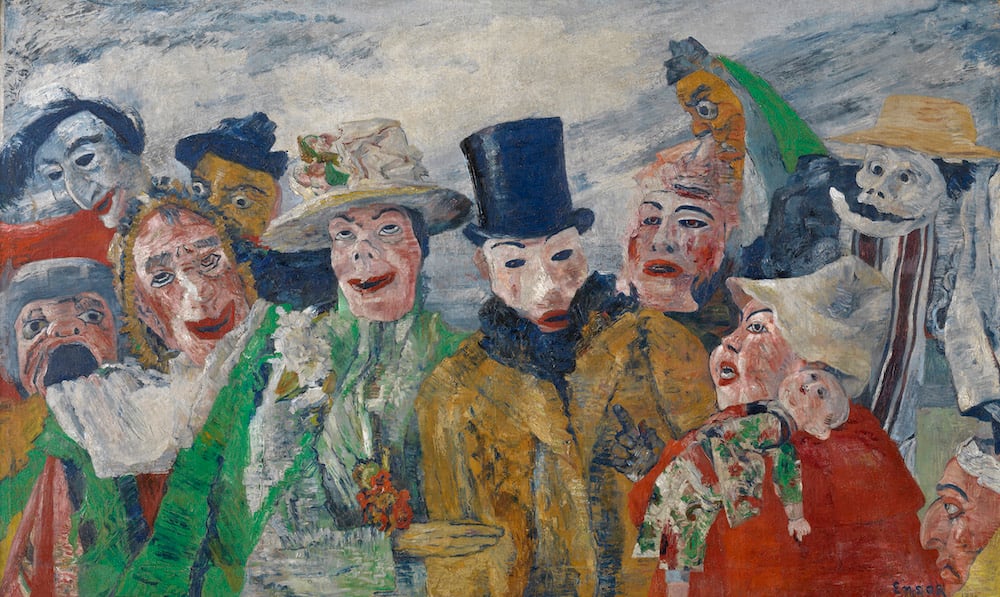
James Ensor, The Intrigue, 1890 Koninklijk Museum voor Schone Kunsten, Antwerp. Photo ©Royal Museum for Fine Arts Antwerp / www.lukasweb.be - Art in Flanders vzw. Photo Hugo Maertens/©DACS 2015.
James Ensor, The Intrigue (1890). Koninklijk Museum voor Schone Kunsten, Antwerp. Photo ©Royal Museum for Fine Arts Antwerp / www.lukasweb.be – Art in Flanders vzw. Photo Hugo Maertens/©DACS 2015.
18. “Intrigue: James Ensor by Luc Tuymans” at the Royal Academy of Arts, London, October 29 – January 29, 2017.
This next show is a dream for painting lovers. London’s RA is presenting the first major exhibition of the work of James Ensor to be held in the UK in over 20 years. Ensor was one of Belgium’s most prominent modernist artists, and widely considered to be a key precursor of Expressionism.
Crucially, the show has been curated by the renowned Belgian painter Luc Tuymans, who has carefully handpicked over 70 paintings, drawings, and prints by Ensor, the vast majority of which have been drawn from major Belgian collections and therefore rarely seen.
Tuymans is set to bring a fresh perspective to the work of an artist who, because of his long-held interest in the world of carnivals and fairs, was dubbed “the painter of masks” by the Symbolist poet Émile Verhaeren. “The mask means to me: freshness of color, extravagant decorations, wild generous gestures, strident expressions, exquisite turbulence,” Ensor wrote of the recurrent theme of his oeuvre, which allowed him to experiment with form and explore the subjects of life and death. Lorena Muñoz-Alonso
Installation view of Nairy Baghramian, "Scruff of the Neck" at Marian Goodman, London. Courtesy of the artist and Marian Goodman, New York, Paris & London. Photos by Thierry Bal.
Installation view of Nairy Baghramian, “Scruff of the Neck” at Marian Goodman, London. Courtesy of the artist and Marian Goodman, New York, Paris & London. Photo by Thierry Bal.
19. Nairy Baghramian, Déformation Professionnelle, at SMAK, Ghent, November 26 – February 17, 2017.
The German-Iranian artist is one of the most intriguing sculptors working today, constantly pushing the viewer’s understanding of the three-dimensional medium. Some of her strategies include a dismantling of recognized forms and structures to infuse them instead with elements taken from the fields of design or fashion.
Taking its title from a French phrase that describes a change or development in one’s worldview as a result of being overly specialized in one’s specific field, this survey show also speaks to the taking apart and making transparent of the sculptor’s own method. Through her playful take on the retrospective gaze, Baghramian unpacks and interrogates the conceptual, physical, and social aspects of sculpture. The show will travel to Museum der Moderne, Salzburg and Walker Art Center, Minneapolis, both co-organizers of the show. Hili Perlson
Robert Rauschenberg, Pelican (1963). First performed at Concert of Dance no. 5, an evening of performances by Judson Dance Theater, Pop Festival, Washington D.C., 9 May 1963. Photo Peter Moore The Robert Rauschenberg Foundation, New York ©Barbara Moore.
20. Robert Rauschenberg at Tate Modern, London, December 1 – April 2, 2017.
We really can’t wait for what will surely be London’s winter blockbuster: a major retrospective of the work of Robert Rauschenberg at Tate Modern, which the British museum has organized in collaboration with The Museum of Modern Art in New York, where it will travel in 2017.
This will be Rauschenberg’s first posthumous retrospective, and the most comprehensive survey of the artist’s six-decade oeuvre in over 20 years. The show will thoroughly survey not just Rauschenberg’s best known works in the media of collage, painting, and sculpture (such as Monogram and Bed), but also his seminal collaborative and performative works, in which he collaborated with range of cultural luminaries, including John Cage, Merce Cunningham, Jasper Johns, David Tudor, Cy Twombly, and Susan Weil.
Curated by Tate’s Achim Borchardt-Hume and MoMA’s Leah Dickerman, with Tate Modern’s senior performance curator Catherine Wood, the exhibition will also explore his pivotal work as founder of the organization Experiments in Art and Technology (E.A.T). Lorena Muñoz-Alonso
Related: Robert Rauschenberg’s Most Ambitious Artwork Arrives in Beijing
Follow artnet News on Facebook.
Share


Art World | Is Getting an MFA Worth the Price?


Is Getting an MFA Worth the Price?

When you crunch the data on where successful artists went to school, the pattern is striking.

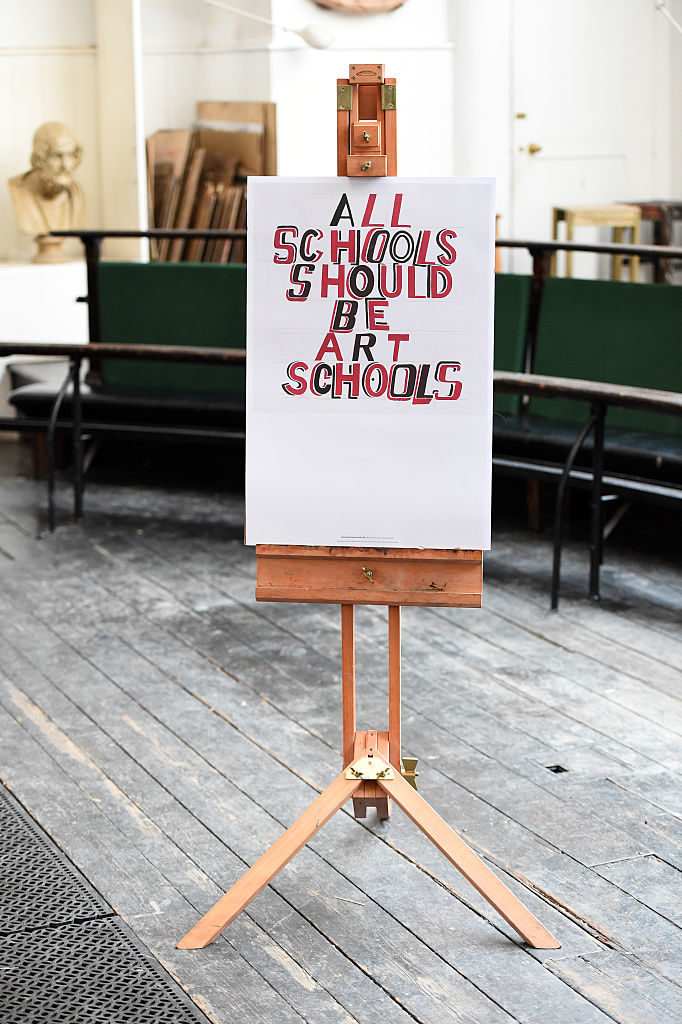
Artists unite in the Royal Academy's Life Room with Bob & Roberta Smith's All Schools Should be Art Schools poster. Photo by Eamonn M. McCormack/Getty Images for Royal Academy of Arts.

What’s the value of going to art school? The question has become a hot topic of late.
The charge that contemporary art has become over-academic, producing “zombie” art, is not new. “The proverbial romantic artist, struggling alone in a studio and trying to make sense of lived experience, has given way to an alternate model: the university artist, who treats art as a homework assignment,” Deborah Solomon wrote in an article about the MFA boom in the New York Times. That was 1999.
In the 2000s, the MFA was pitched as a Golden Ticket, with an ever more youth-oriented art market generating rumors of dealers snapping up artists right out of school. A degree that was originally designed to allow you to teach became seen as the pathway to a gallery career.
Related: The USC Roski Fiasco Points to the Corrosion of Art Education Nationwide
In more recent years, angst about art school has become entangled with the political debate about student debt’s crushing toll. Art collectives like the Bruce High Quality Foundation have founded their own alternative art schools, while the group BFAMFAPhD seeks to raise awareness about the high number of art students who default on their loans. The Atlantic calls the MFA “an increasingly popular, increasingly bad financial decision.”
Is it?
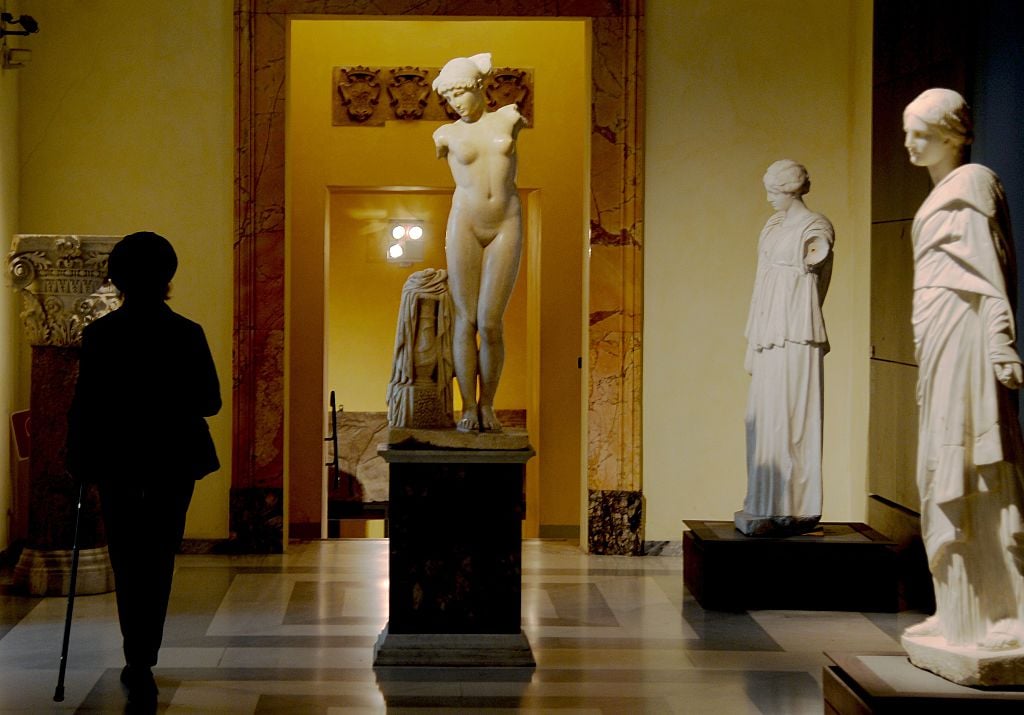
A picture taken on January 26, 2016 shows a visitor walking past an ancient Roman marble statue at Rome's Capitoline Museum (Musei Capitolini) on Capitol Hill. Courtesy of FILIPPO MONTEFORTE/AFP/Getty Images.
A picture taken on January 26, 2016 shows a visitor walking past an ancient Roman marble statue at Rome’s Capitoline Museum on Capitol Hill. Courtesy of FILIPPO MONTEFORTE/AFP/Getty Images.
To try and answer that question, Caroline Elbaor and I created a list of the 500 most successful American artists at auction from artnet’s Price Database, looking at figures born in 1966 or later. We picked that year because it gave us a neat 50-year time span, and roughly corresponds to the beginning of Generation X, essentially a way of getting a snapshot of the market fortunes, to date, of millennials and the generation immediately prior.
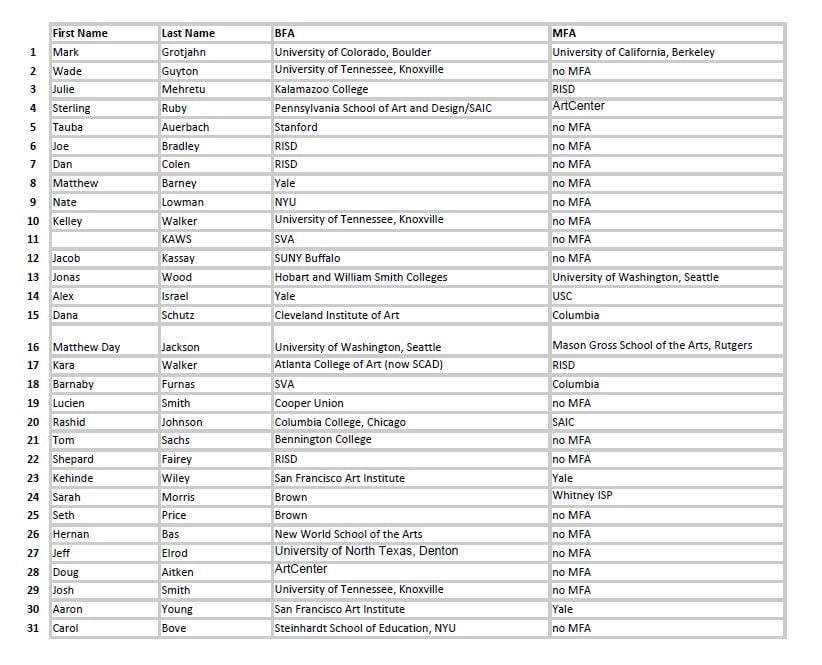
The sample ranges from figures with records in excess of $100 million (Mark Grotjahn, with more than $184 million at auction, or Wade Guyton, with $130 million), down to figures whose fortunes, as measured by this method, are quite modest, with just over $13,000 in career sales at auction.
We tracked down where each artist on the list went to graduate school, either from publicly available sources or by contacting the artists or their representatives. (For a very few, we were unable to find any information; we’ve left their fields blank in the attached table.) With that data in hand, we could then look for patterns as to how educational choices correlate with this measure of early-career success.
Related: Why You Should Be Suspicious of the ‘Creative Economy’
Some caveats, before we look at the results: The secondary market for art is one sign of success, but certainly not the only one. There are artists who make a good living but, for whatever reason, do not create works that are resold at auction. Some artists focus on public or community-based art, or simply don’t create objects. An auction track record simply means that someone thought a particular artist’s work was valuable enough, over time, to resell it.
A second point: Getting your art sold is certainly not the only reason to go to art school. Some artists go to hone their craft, or to learn to communicate their ideas, or to teach, or simply because they need the time to focus on themselves—all fine things.
But if someone is pitching you a career in art, here are some things to think about first.
The Persistence of the Non-Academic Artist
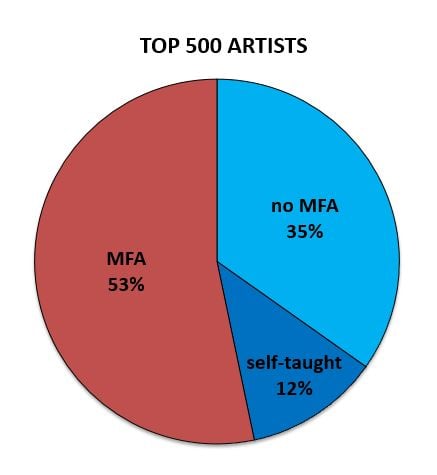
There is hope for those who hate school: Despite the widespread perception that contemporary art is dominated by an MFA mafia, nearly half of the figures on our list of 500 successful early-career artists either did not have an MFA, or didn’t study art academically at all.
Even among the 10 most successful figures, six lack an MFA: Wade Guyton (#2), who “attended,” but did not graduate from Hunter, as far as we can tell; Tauba Auerbach (#6); Joe Bradley (#7); Dan Colen (#8); Matthew Barney (#9); and Nate Lowman (#10).
mfas vs non mfas
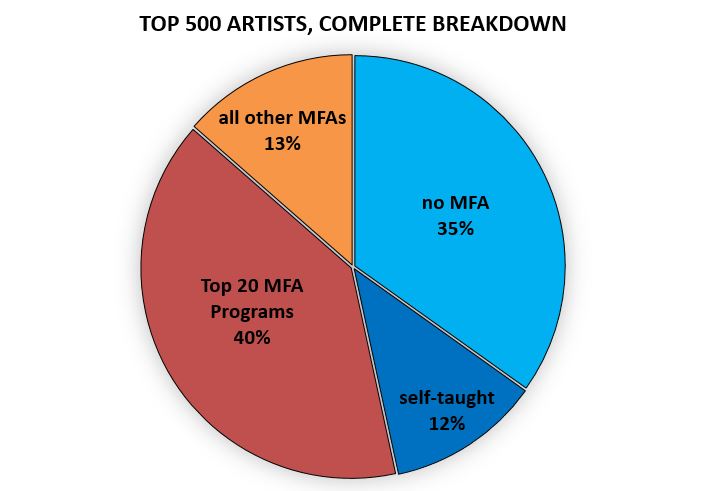
Overall, some 35 percent of artists here have no MFA—and another 12 percent have no degree in art, period. (For our purpose, we counted artists who attended a school but didn’t finish as “self-taught.”)
Something else worth noting: A substantial chunk of the non-academic figures came to attention not through the gallery scene, but through street art: KAWS (#12), RETNA (#55), Chris Johanson (#83), etc. Arguably such figures represent a totally different career path than the one set out by the MFA, with a different set of gatekeepers altogether.
Related: 11 Affordable Art Schools in Art World Centers (and Some Alternatives)
The art scene of the American West, which encompasses figures like Kyle Polzin (#59), Nicholas Coleman (#115), or Logan Hagege (#138), is also something of its own world. And there are a few figures on the list—modern-day Michelangelos such as Adrien Brody (#167), Marilyn Manson (#218), and Kurt Cobain (#277)—who are celebrities first, artists second.
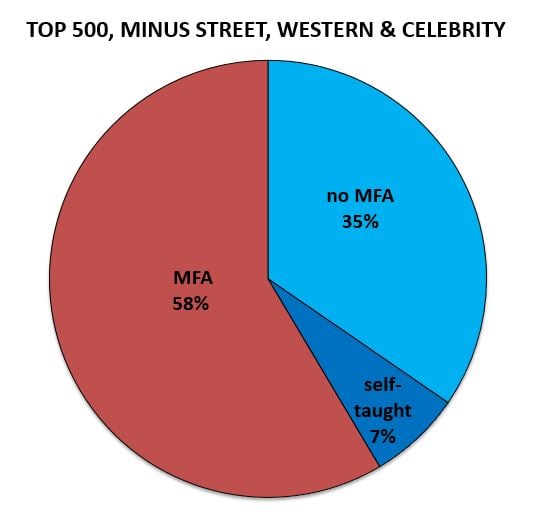
If we subtract such figures, does it change the picture? Excluding from our tally the 52 names that fit these categories does make the “self-taught” approach look like a slightly less viable route to success. In this graph, the MFA-trained artists are more clearly in the majority:
mfa vs no mfa minus street
Yet even looking at things this way, over 40 percent of the Top 500 artists did without an MFA or were self-taught, proving that the degree is far from a necessity.
Yale and the “Power Law”
If you can, is it worth going to graduate school for art, though? The answer is fairly clear. Yes—if you go to Yale.
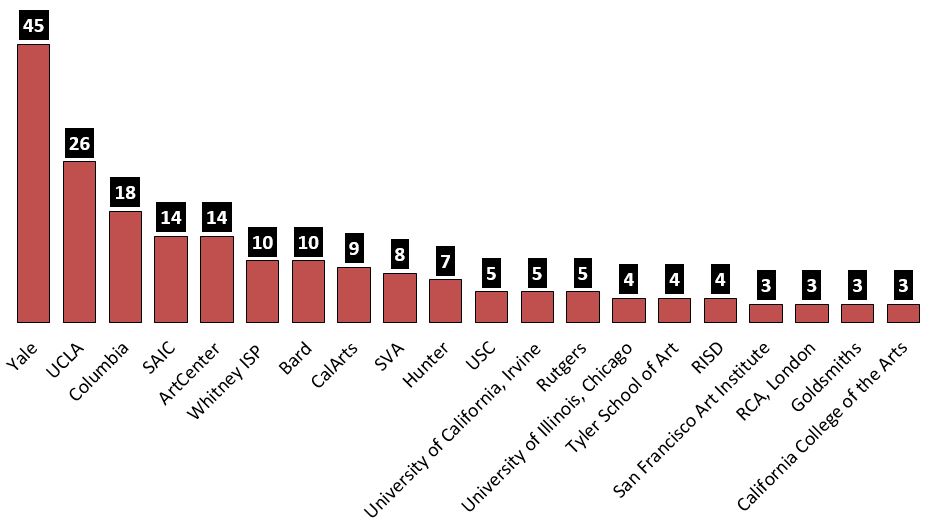
Over this 50-year period, Yale’s Graduate School of Art has pumped out nearly 10 percent of all our successful artists.
Indeed, if you look at the distribution of schools on the list, it follows what statisticians call a “power law”—is has a tall head and a long tail. As one blog on the concept explains, “power law” distributions are ones in which “a small number of outcomes have dramatically higher values than the remaining population.”
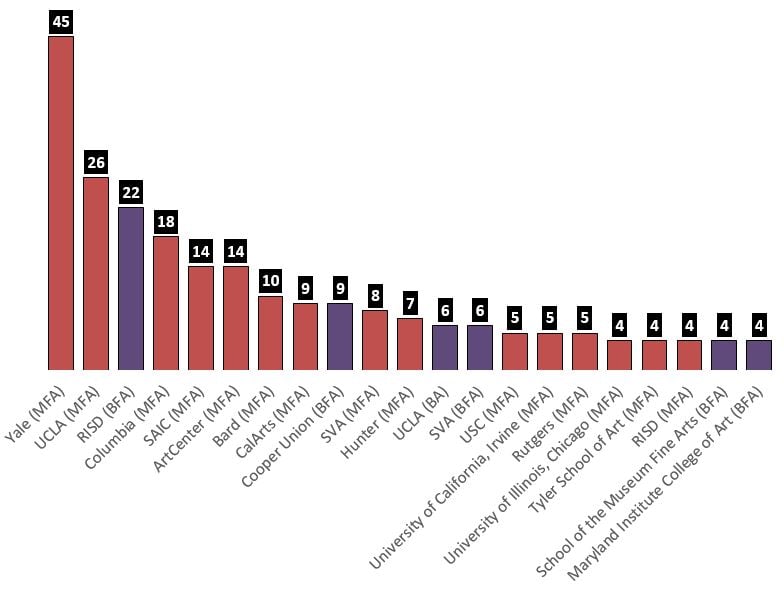
Here is the list of the top 20 MFAs in this sample, with the number of artists holding the credential:

top 20 mfas
When it comes to art, what this means, practically, is that going to the best school really, really matters—but very quickly the value of any program over any other levels off.
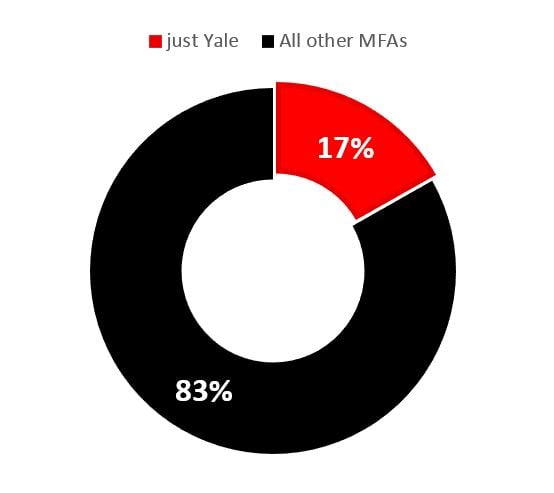
Yale’s weight in this Top 500 is already more than its next two competitors, UCLA and Columbia, combined. Looking just at the MFA-trained artists on this list, a full 17 percent went to Yale.
mfas just yale

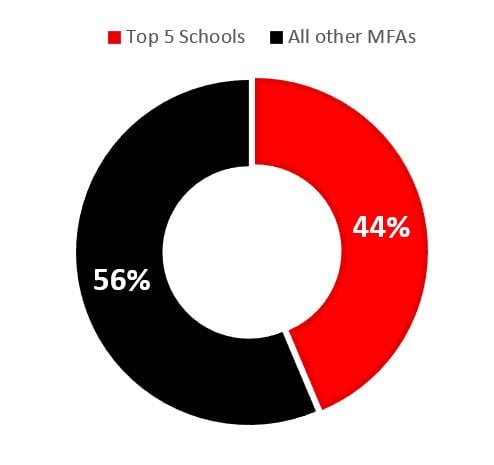
Expanding the selection to look at the Top Five programs, they account for 44 percent of all the MFAs in the Top 500.
mfas top 5 schools

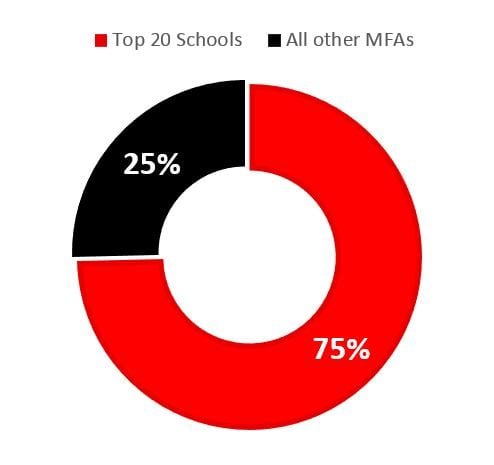
Finally, expanding to the Top 20 schools takes us to 75 percent. That is, of all the artists who got an MFA and went on to the kind of early-career success captured by our Top 500, three quarters went to one of just 20 schools.
mfas top 20 schools

Leaving the top 20 graduate programs represented here, you are talking about a large number of schools with no more than two artists on the list—and many, many with only one. That makes these schools’ ability to predict early-career success appear fairly random, since a single sale by an artist from another institution could shake up the ranking.
RISD Rules
We also looked at undergraduate studies.
In general, the data is much fuzzier, and harder to parse (NYU appears in the top, for instance, which is misleading, since artists like Nate Lowman or Carol Bove went there, but not as art students).
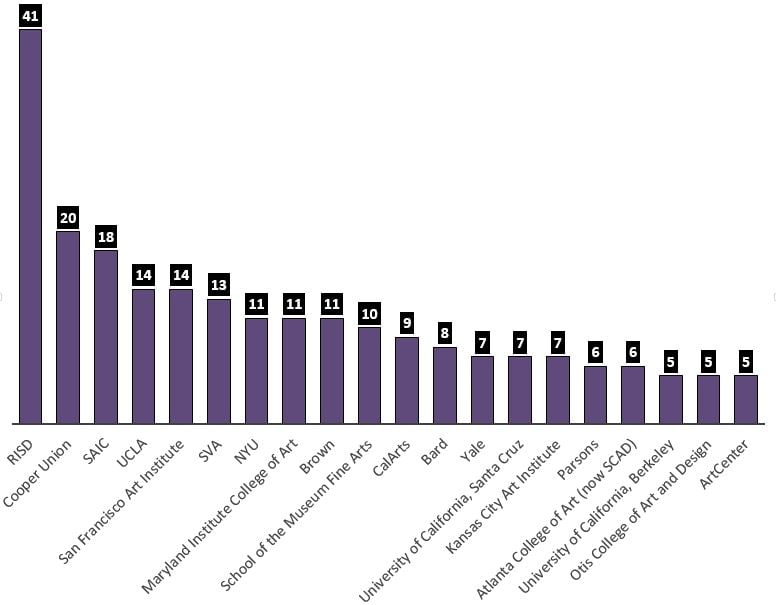
But the results still follow the same “power law” distribution, with the Rhode Island School of Design in the top spot.
Related: Sydney’s Art World Up in Arms Over Plans to Close Art School
Indeed, RISD has more than twice the weight on the list as Cooper Union, its nearest competitor. The School of the Art Institute of Chicago comes in next, followed by UCLA (which eats Yale’s lunch at the undergraduate level) and the San Francisco Art Institute.
undergraduate top 20
Looking deeper, we find 22 artists in the Top 500 list who went to RISD but have no MFA. That makes the RISD undergraduate degree about as predictive of success, here, as an MFA from UCLA, which has 26 figures on the list, and more valuable than an MFA from Columbia, which has 18.
Looking just at the most common terminal degrees on the list, here is what you see:
most valuable terminal degrees

School Ties
Are there particular combinations of undergraduate and graduate programs that came up over and over again?
You might expect the RISD/Yale path to dominate, and there are indeed three figures who followed it: David Benjamin Sherry (#215), Adam Helms (#224), and Schandra Singh (#460).
For what it’s worth, though, several combinations of schools actually had a higher representation in the Top 500, occurring four times each:
In recent decades, these appear to be modestly well-trod routes into the art industry. Mainly, it seems that people with elite undergraduate art education are well set up for elite MFA education—which is more or less what you would expect.
The Takeaway
What accounts for the extreme skew towards a few programs?
Perhaps the top schools get the best of a small pool of gifted applicants, and offer resources that allow students to flower in a way that they don’t elsewhere. But are Yale grads really twice as creative as graduates from UCLA? Probably not.
It seems likely that, in art, connections and pedigree open doors, and that the best MFAs signal to dealers and collectors that students are proximate to these status networks, making their art more bankable.
On this level, the value of the MFA as a signal would decline rapidly, since the whole point is to signify that the artists in question belong to an exclusive set. (“Power law” phenomena often occur in fields that follow a “rich-get-richer” pattern.)
The exact proportion of the two factors is hard to reckon without further research.
top 500 mfas total breakdown

Looking at the backgrounds of American artists born since 1966, you could sum up a potential lesson of the recent past like this: If you can get into one of the very top programs, it may well give you a better shot at cracking the puzzle of art-career success than going without. Even that decision, though, has to be weighed against the high number of artists who have skipped that step, with the time and expense that it entails.
Outside of those elite brands, though, going to art school becomes a very different kind of choice. It may be worthwhile for a great many artistic reasons, but it does not have a noticeable career-boosting effect, at least not among the first rank of peers. You are essentially following your own path.
Indeed, it looks very much like you could have not gone to school at all, and have been about as likely to capture the attention of the art market.
The full list of our data is embedded below. Click on the list to expand it:
top 500
—Research by Caroline Elbaor.
Follow artnet News on Facebook.
Share


Ben Davis

National Art Critic