
Tuesday, February 23, 2016

Photography | From Paris to Tokyo, Leo Berne’s cinematic portraits

Curadora esfomeada e fan do macaco tyson || It's the end of civilization as we never knew it

People

Curator in Tiara Accused of Biting Seatmate on Flight to JFK

                                                
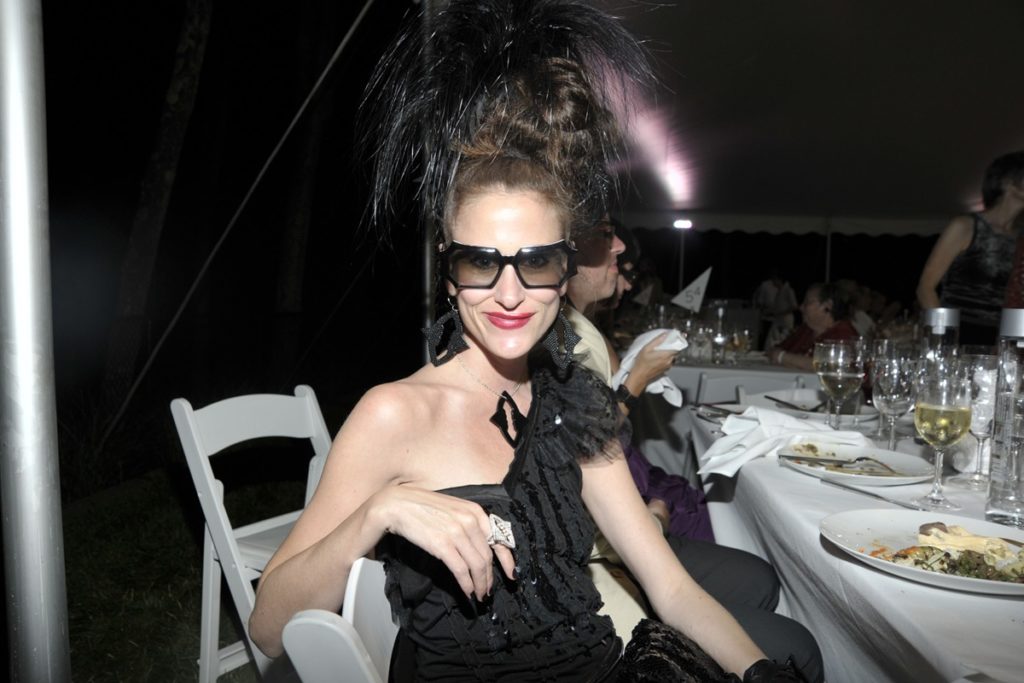
Stacy Engman==Paradiso: The 17th Annual Watermill Summer Benefit 2010==Watermill Center, NY==July 24, 2010==©Patrick McMullan==Photo - PATRICK MCMULLAN/PatrickMcMullan.com====
Stacy Engman (2010).
Photo: Courtesy of ©Patrick McMullan.
Stacy Engman, a curator and Manhattan socialite, has been accused of biting a fellow airplane passenger on a flight from Istanbul to New York. Engman received a summons for an assault charge, filed Monday in US District Court in Manhattan. 
The tiara-clad Engman, according to the violation notice, engaged passenger Christina Tyler in a heated argument on July 14, 2015 after Engman "was almost resting her head in her lap." "Engman began to raise and lower the adjustable armrest into the woman's leg before launching into a stream of insults," Tyler claimed according to the notice. These insults, according to special agent Karen Ferra at the FBI's JFK Resident Agency at Terminal 1, include calling Tyler "ugly," and telling her to "move her fat ass." One thing led to another, which led to Engman reportedly biting Tyler on her lower back.
Officers from the Port Authority Police Department interviewed Tyler when the aircraft landed in New York, along with a man who witnessed the mishap and confirmed the details including that Engman "was aggressive from the beginning of the flight" and also that she "turned and bit" Tyler. While the PAPD attempted to interview Engman at JFK, Engman requested an attorney and refused to sign an "advice of rights" form at which point the interview was terminated.
The complaint states that “[Engman] told anyone who would listen she had been on a yacht for five days."
Fire Department personnel examined Tyler, noting that "skin was not broken [from] the bite on her back."
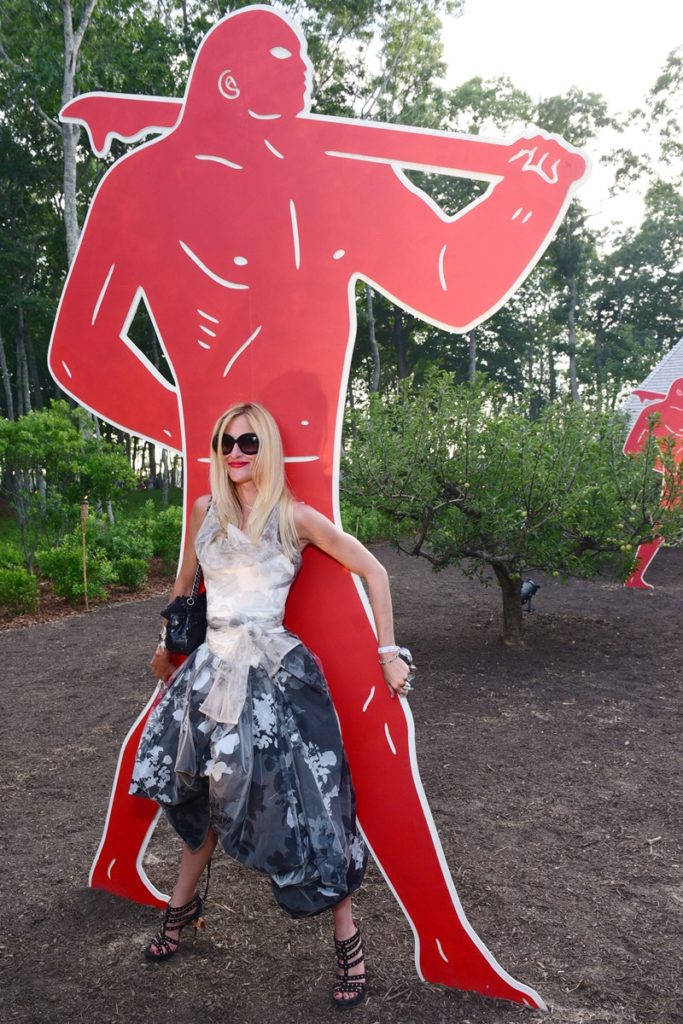
Stacy Engman== Circus of Stillness... the power over wild beasts?: The 22nd Annual Watermill Center Summer Benefit & Auction== The Watermill Center, Watermill, NY== July 25, 2015== ©Patrick McMullan== Photo - Sean Zanni/PatrickMcMullan.com== ==
Stacy Engman (2015)
Photo: Courtesy of ©Patrick McMullan
In a feature by W Magazine, Eric Shiner, the director of the Andy Warhol Museum, dubbed Engman “the art world's Lady Gaga." The fashionista has served as an independent curator at numerous galleries and museums, and is a former curator of contemporary art and member of the National Arts Club. Engman has collaborated with artists such as Tracey Emin, Marina Abramovic, and Vik Muniz, among others.
Follow artnet News on Facebook.

Sight Reading: Photography and the Legible World

     
Curator Joel Smith discusses the exhibition Sight Reading: Photography and the Legible World, on view February 19 through May 30, 2016.


The Morgan opens new exhibition exploring the diverse visual languages of photography
Nina Katchadourian (American, born 1968), Indian History for Young Folks, from Once Upon a Time in Delaware/In Quest of the Perfect Book, 2012. Chromogenic print. Purchased by the Photography Collectors Committee, The Morgan Library & Museum.


NEW YORK, NY.- As its name declares, photography is a means of writing with light. Photographs both show and tell, and they speak an extraordinary range of dialects.

The Morgan Library & Museum explores the history of the medium as a lucid, literate— but not always literal—tool of persuasion in a new exhibition, Sight Reading: Photography and the Legible World. A collaboration with the George Eastman Museum, the show features more than eighty works from the 1840s to the present and reveals the many ways the camera can transmit not only the outward appearance of its subject but also narratives, arguments, and ideas. The show is on view through May 30.

Over the past 175 years, photography has been adopted by, and adapted to, countless fields of endeavor, from art to zoology and from fashion to warfare. Sight Reading features a broad range of material—pioneering x-rays and aerial views, artifacts of early photojournalism, and recent examples of conceptual art—organized into groupings that accentuate the variety and suppleness of photography as a procedure. In 1936, artist László Moholy-Nagy (1895–1946) defined “the illiterate of the future” as someone “ignorant of the use of the camera as well as the pen.” The JPEG and the “Send” button were decades away, but Moholy-Nagy was not the first observer to argue that photography belonged to the arts of commentary and persuasion. As the modes and motives of camera imagery have multiplied, viewers have continually learned new ways to read the information, and assess the argument, embodied in a photograph.

"Traditional narratives can be found throughout the Morgan's collections, especially in its literary holdings," said Colin B. Bailey, director of the Morgan. "Sight Reading encourages us to use a critical eye to read and discover the stories that unfold through the camera lens and photography, a distinctly modern, visual language. We are thrilled to collaborate with the Eastman Museum, and together unravel a rich narrative, which exemplifies photography's deep involvement in the stories of modern art, science, and the printed page.”

THE EXHIBITION
Sight Reading cuts across conventional historical and geographic divisions. Featuring work by William Henry Fox Talbot (1800–1877), Eadweard Muybridge (1830–1904), John Heartfield (1891–1968), Lewis Hine (1874–1940), Harold Edgerton (1903–1990), John Baldessari (b. 1931), Sophie Calle (b. 1953), and Bernd and Hilla Becher (1931–2007; 1934–2015), among many others, the exhibition is organized into nine “conversations” among diverse sets of works.

I. The Camera Takes Stock
Photography’s practical functions include recording inventory, capturing data imperceptible to the human eye, and documenting historical events. In the first photographically illustrated publication, The Pencil of Nature (1845), William Henry Fox Talbot used his image Articles of China to demonstrate that “the whole cabinet of a ... collector ... might be depicted on paper in little more time than it would take him to make a written inventory describing it in the usual way.” Should the photographed collection suffer damage or theft, Talbot speculated, “the mute testimony of the picture ... would certainly be evidence of a novel kind” before the law.

A century later, Harold Edgerton, an electrical engineer at the Massachusetts Institute of Technology, used the pulsing light of a stroboscope to record states of matter too fleeting for the naked eye. Gun Toss, an undated image of a spinning pistol, is not a multiple exposure: the camera shutter opened and closed just once. But during that fraction of a second, seven bright flashes of light committed to film a seven-episode history of the gun's trajectory through space.

II. Crafting A Message
The camera is widely understood to be “truthful,” but what photographs “say” is a product of many procedures that follow the moment of exposure, including page layout, captioning, and cropping of the image. During World War I, military personnel learned to interpret the strange, abstractlooking images of enemy territory made from airplanes. Their specialized training fundamentally altered the nature of wartime reconnaissance, even as the unusual perspective unique to aerial photography introduced a new dialect into the expanding corpus of modern visual language. An Example of an Annotated Photograph with Local Names of Trenches Inserted (1916), on view in the exhibition, shows that the tools of ground strategy soon included artificial bunkers and trenches, designed purely to fool eyes in the sky.

In László Moholy-Nagy’s photocollages of the late 1920s, figures cut out of the plates in mass- market magazines appear in new configurations to convey messages of the artist’s devising. Images such as Massenpsychose (Mass Psychosis) (1927) propose a new kind of visual literacy for the machine age. To contemporary eyes, Moholy’s collages seem to foreshadow cut-andpaste strategies that would later characterize the visual culture of cyberspace.

III. Photographs in Sequence
Photography’s debut in the late 1830s happened to coincide with the birth of the modern comic strip. Ultimately the narrative photo sequence would lead to the innovations that gave rise to cinema, another form of storytelling altogether. Exact contemporaries of one another, Eadweard J. Muybridge in the United States and Étienne-Jules Marey (1830–1904) in France both employed cameras to dissect human movement. Muybridge used a bank of cameras positioned to record a subject as it moved, tripping wires attached to the shutters. The result was a sequence of “stop-action” photographs that isolated gestures not otherwise visible in real time. Beginning in 1882, Marey pursued motion studies with a markedly different approach. In the works for which he is best known, he exposed one photographic plate multiple times at fixed intervals, recording the arc of movement in a single image.

IV. The Legible Object
Some photographs speak for themselves; others function as the amplifier for objects that can literally be read through the image. In her series Sorted Books, American artist Nina Katchadourian (b. 1968) composes statements by combining the titles of books drawn from the shelves of libraries and collections. Indian History for Young Folks, 2012, shows three books from the turn of the twentieth century that she found in the Delaware Art Museum’s M.G. Sawyer Collection of Decorative Bindings. The viewer’s eye silently provides punctuation: “Indian history for young folks: Our village; your national parks.” Though at first glance it appears merely to arrange words into legible order, Katchadourian's oblique statement—half verbal, half visual— would be incomplete if divorced from the physical apparatus of the books themselves.

V. The Photograph Decodes Nature
As early as 1840, one year after photography’s invention was announced, scientists sought to deploy it in their analysis of the physical world. Combining the camera with the microscope, microphotographs recorded biological minutiae, leading to discoveries that would have been difficult, if not impossible, to obtain by observing subjects in real time. Similarly, the development of X-ray technology in 1895 allowed scientists to see and understand living anatomy to an unprecedented degree. Such innovations not only expanded the boundaries of the visible world but also introduced graphic concepts that would have a profound impact on visual culture. In other ways, too, nature has been transformed in human understanding through the interpretive filter of the lens, as seen in Sight Reading in the telescopic moon views of astronomers Maurice Loewy (1833–1907) and Pierre Henri Puiseux (1855–1928) and in the spellbinding aerial abstractions of William Garnett (1916–2006).

VI. The Photograph Decodes Culture
The photograph not only changed but to a great extent invented the modern notion of celebrity. Modern-age celebrities live apart from the general public, but their faces are more familiar than those of the neighbors next door. Since the mid-nineteenth century, viewers have come to “know” the famous through accumulated photographic sightings, which come in formats and contexts that vary as much as real-life encounters do. In four images that would have communicated instantly to their intended viewers in 1966, Jean-Pierre Ducatez (b. 1970) portrayed the Beatles through closeups of their mouths alone. The graphic shorthand employed by Jonathan Lewis in his series The Pixles is of a more recent variety, but he, too, relies on the visual familiarity conferred by tremendous celebrity. Each print in the series reproduces the iconic art of a Beatles album cover at life size (12 x 12 inches) but extremely low resolution (12 x 12 pixels). Like celebrities themselves, perhaps, the images look more familiar to the eye at a distance than close-up.

VII. Meaning is on the Surface
Photographs are not just windows onto the world but pieces of paper, which can themselves be inscribed or otherwise altered in ways that enrich or amend their meaning. The group portrait Joint Meeting of the Railway Surgeons Association, Claypool Hotel, Indianapolis (1920) is contact printed, meaning that the negative was the same size as the print. After the portrait sitting, the photographer appears to have presented the developed film to the sixty-four sitters for signing during the three days they were assembled for their convention. The result is a document that unites two conventional signifiers of character: facial features and the autograph.

VIII. Photography and the Page
News of the world took on a newly visual character in the 1880s, when the technology of the halftone screen made it practical, at last, to render photographs in ink on the printed page.

Among the earliest examples of photojournalism is Paul Nadar’s (1820–1910) “photographic interview” with Georges Ernest Boulanger, a once-powerful French politician. The article’s introduction explains that the photographs were printed alongside the text in order to provide evidence of the encounter and to illustrate Boulanger’s dynamic body language during the conversation.

IX. Empire of Signs
The plethora of signs, symbols, and visual noise endemic to cities has attracted photographers since the medium’s invention. Their records of advertisers’ strident demands for attention, shopkeepers’ alluring displays, and the often dizzying architectural density of metropolitan life chronicle sights that are subject to change without notice. The photographer’s perspective on contemporary social life—whether it is anectodal, as in John Thompson’s (1837–1921) Street Advertising from Street Life in London (1877), or haunting, as in Eugène Atget’s (1857–1927) Impasse des Bourdonnais (ca. 1908)—is embedded in each image.


Sight Reading: Photography and the Legible World
February 19 through May 30, 2016
As its name declares, photography is a means of writing with light. Photographs both show and tell, and they speak an extraordinary range of dialects.
This exhibition explores the history of the medium as a lucid, literate—but not always literal—tool of persuasion. A collaboration with the George Eastman Museum, the show features more than eighty works from the 1840s to the present and reveals the many ways the camera can transmit not only the outward appearance of its subject but also narratives, arguments, and ideas.
Over the past 175 years, photography has been adopted by, and adapted to, countless fields of endeavor, from art to zoology and from fashion to warfare. Sight Reading features a broad range of material—pioneering x-rays and aerial views, artifacts of early photojournalism, and recent examples of conceptual art—organized into groupings that accentuate the variety and suppleness of photography as a procedure. In 1936, artist László Moholy-Nagy (1895–1946) defined “the illiterate of the future” as someone “ignorant of the use of the camera as well as the pen.” The JPEG and the “Send” button were decades away, but Moholy-Nagy was not the first observer to argue that photography belonged to the arts of commentary and persuasion. As the modes and motives of camera imagery have multiplied, viewers have continually learned new ways to read the information, and assess the argument, embodied in a photograph.
Watch video: 
Video thumbnail
Sight Reading is co-organized by the Morgan Library & Museum and the George Eastman Museum, Rochester. The exhibition in New York is made possible by Jane P. Watkins.
Exhibition tours: 
Tuesday, Thursday, Saturday, March 3 through May 30
Image Caption: 
László Moholy-Nagy (American, b. Hungary 1895–1946), Massenpsychose, 1927. Photomontage of photomechanical and drawn (ink and pencil) elements. Overall: 64.2 x 49.2 cm (25 1/4 x 19 3/8 in.); matted: 86 x 71 cm (33 7/8 x 27 15/16 in.). George Eastman Museum, purchased from Mrs. Sibyl Moholy-Nagy with funds provided by Eastman Kodak Company 1981.2163.0049.
Courtesy of George Eastman Museum. © 2015 Artists Rights Society (ARS), New York / VG Bild-Kunst, Bonn. Reproduction, including downloading of László Moholy-Nagy works is prohibited by copyright laws and international conventions without the express written permission of Artists Rights Society (ARS), New York.

Related programs

Retro Posters for the Future of Space Exploration

In Brief

NASA Releases Retro Posters for the Future of Space Exploration


by Allison Meier on February 17, 2016
Visions of the Future (courtesy NASA)
Visions of the Future poster for the “Grand Tour” of planets, a reference to when NASA’s Voyager mission used the once-every-175-year alignment of our solar system’s outer planets to stage its orbiter spacecraft. (courtesy JPL/NASA)
Back in the 1930s and ’40s, during the height of the Great Depression, artists designed posters for the Works Projects Administration (WPA) to encourage travel to national parks and other tourist sites in the United States. NASA’s Jet Propulsion Laboratory (JPL) design studio is taking a similar approach to promote a future of travel to other planets at a time when its funding is up against budget constraints and even a journey to our galactic neighbor Mars may seem almost impossible.
Visions of the Future (courtesy NASA)
Visions of the Future poster for Jupiter, where auroras are hundreds of times more powerful than those we see on Earth. (courtesy NASA) (click to enlarge)
JPL released the 14 downloadable Visions of the Future posters this month, stating that “imagination is our window into the future.” These posters join NASA’s exoplanet designs, released last year. In addition to work from the JPL design studio, Don and Ryan Clark of Invisible Creature were commissioned to create posters for Mars, Enceladus (a moon of Saturn), and the Grand Tour for the alignment of the outer solar system planets, a rare event which enabled the Voyager mission to visit these distant bodies. In the Grand Tour poster, spacecraft rocket by abstracted spheres rendered in a style akin to midcentury airline advertisements, made when earthbound flight was still gaining postwar public interest.
While the illustrations on the posters are fantastic, like a diamond-shaped “Cloud 9 Observatory” perched above the dense atmosphere of Venus, and a vision of Mars in which the Pathfinder and Rovers have become historic sites, they are intended to spark real thinking on the human potential for space exploration. The initiative is much like the Mars travel posters released by SpaceX last year, and the space travel posters created by Steve Thomas, some of which were included in Guerilla Science’s Intergalactic Travel Bureau, which proposed fictional bookings to space destinations.
Aspirational travel can only do so much, but perhaps by vividly illustrating the distant “Super Earth” HD 40307g with its huge gravitational pull as a base jumping haven, or the dual shadows of an astronaut on Kepler-16b that orbits a pair of stars, some will consider how much we’ve already discovered about the worlds outside our atmosphere, and how far we could go.
Visions of the Future (courtesy NASA)
Visions of the Future poster for Titan, the largest moon of Saturn, where there are rivers and lakes of liquid ethane and methane. (courtesy NASA)
Visions of the Future (courtesy NASA)
Visions of the Future poster for Mars, imagining a future in which the current NASA Mars Exploration Program relics are historic sites. (courtesy NASA)
Visions of the Future (courtesy NASA)
Visions of the Future poster for Earth, for a future when it’s no longer our only home planet. (courtesy NASA)
Visions of the Future (courtesy NASA)
Visions of the Future poster for Venus, where visitors can watch the transit of Mercury even closer than James Cook during his 1769 South Pacific trek. (courtesy NASA)
Visions of the Future (courtesy NASA)
Visions of the Future poster for exoplanet Kepler-16b, which orbits a pair of stars. (courtesy NASA)
Download all of the Visions of the Future posters online from NASA’s Jet Propulsion Laboratory.

America’s Secret Societies: A New Book Probes Their Art and Mysteries

Books • Museums • Weekend

America’s Secret Societies: A New Book Probes Their Art and Mysteries


by Edward M. Gómez on February 20, 2016
Chest lid with Masonic painting (c. 1825–45), maker unknown, paint on pine, 22.25 x 37.25 x 2 5/8 inches (photo by José Andrés Ramírez, courtesy of American Folk Art Museum) (click to enlarge)
What is more titillating — knowing that someone is guarding a delicious secret you might never be invited to share, or being charged with protecting some precious confidence of your own? Now pump up the circumstances and bring many more people into the arena of the big hush-hush: Depending on your penchant for mystery or puzzles, is it more exciting to be on the outside looking in, wondering what a particular family, club or clique might be concealing, or to be on the inside track of a coterie that, for whatever reasons, might have something very special to hide?
Cover of ‘As Above, So Below: Art of the American Fraternal Society, 1850–1930’ (2015) (click to enlarge)
Such an air of mystery and secretiveness wafts inescapably through the pages of Lynne Adele and Bruce Lee Webb’s new book, As Above, So Below: Art of the American Fraternal Society, 1850–1930 (University of Texas Press). In fact, that peculiar atmosphere is as much its subject as are American “secret societies,” as they often have been called, and the many unusual objects and images that have been created for their rituals. Adele and Webb illuminate these related themes in this superbly illustrated volume, the first of its kind to investigate secret societies with such an uncommonly rich and informative visual presentation.
Tennessee-based Adele is an art historian who formerly lived in Austin for more than 30 years; while there, she worked at the Blanton Museum of Art on the campus of the University of Texas. In her research, she has focused on 20th-century American self-taught artists, especially those from Texas. In 1992, after presenting a talk at Rice University in Houston, she met Bruce Lee Webb and his wife, Julie Webb, collectors and art dealers who operate the Webb Gallery in Waxahachie, a small town south of Dallas, where they also live. Well known regionally and nationally for their interests and activities in the fields of folk art and outsider art, over the years the Webbs have been enthusiastic explorer-promoters of a wide range of vernacular forms that are now known as American “visual culture” and ”material culture,” including, for example, circus sideshow banners, tramp art and self-taught artists’ works.
“All-Seeing Eye of Deity” (c.1890–1900), Freemasons’ hand-colored magic-lantern slide (photo courtesy of Webb Collection)
In getting to know the Webbs, Adele learned that Bruce was a deeply knowledgeable collector of fraternal-lodge paraphernalia. Visiting the Webbs’ gallery, as she recalls in her preface to As Above, So Below, she discovered a room filled with objects from the Freemasons, the Independent Order of Odd Fellows, and other fraternal groups, which impressed her with their “mystery, power and haunting beauty.”
In 2011, Webb gave a talk in Austin, which Adele attended, about fraternal associations and their ritual/decorative objects in conjunction with a similarly themed exhibition he had organized for a venue in that city. After his presentation, Adele asked Webb to recommend a good book on the subjects he had just discussed, but he replied that no such volume existed. Soon thereafter, the two set out to assemble a book that would trace the evolution of the Freemasons, the Odd Fellows and other fraternal societies in the United States, and the temples, lodges and other meeting halls they built and filled with their distinctive creations.
Odd Fellows heart-in-hand staff (c. 1890s), maker unknown, polychrome wood, 10 x 4 x 2 inches, mounted on 52-inch-long rod (photo courtesy of Webb Collection) (click to enlarge)
Exactly what is a fraternal society, and what do its members actually do? As Above, So Below looks at the roots of such organizations, but its main focus is on their so-called golden age, which began as the country was emerging from the devastation of the Civil War, gained momentum in the late 19th century, and lasted until the arrival of the Great Depression of the 1930s. By the late 1800s, the authors note, “some 70,000 local lodges, affiliated with hundreds of distinct American fraternal societies, claimed roughly five and a half million members.”
These groups, with affiliate chapters around the country (known as “lodges” among the Freemasons and the Odd Fellows, two older societies that originated in Britain), were, as Adele and Webb write, “repositories of esoteric knowledge revealed only to the initiated.” Their gathering places were “cloistered spaces open only to [their] members.” All were characterized by “the significance of secrets — usually in the form of passwords, handshakes, signs, rituals and the esoteric knowledge revealed in them — and the taking of oaths to preserve the secrets.”
Odd Fellows banners (c. 1890s), maker unknown, oil paint on silk, with brass trim and tassels, 28 x 20 inches each (photo courtesy of Webb Collection) (click to enlarge)
Generally speaking, fraternal societies’ guiding principles are rooted in hermeticism, a religious-philosophical, esoteric tradition that developed in late antiquity, concurrent with the evolution of early Christianity and other belief systems. (As Above, So Below’s title comes from an ancient hermetic text; it posits that there is a kind of unity between the spiritual realm and the material world, and between a person’s inner life and the spirit of the universe.)
In their book, Adele and Webb point out that, as fraternal associations grew in the US in the late 1800s, they looked to Etruscan, ancient Greek and Egyptian, Gothic, Moorish and so-called Oriental sources for themes and influences (echoing that era’s popular fascination with the “exotic”), which were reflected in their rituals, costumes and objects, and even in the fantasy architecture of some of their assembly halls (the medieval-Norman-style Masonic Temple in Philadelphia, for example, or, in Indianapolis, the temple of the Murat Shriners of the Ancient Arabic Order of the Mystic Shrine, with its plump, distinctive minaret).
“George Washington as a Freemason” (1867), chromolithograph produced by Strobridge & Co., Cincinnati, Ohio, 24 x 19 inches (photo courtesy of Webb Collection)
George Washington was a Freemason (he became a member of a Masonic Lodge in Virginia when he was 20 years old); so were Benjamin Franklin (who published numerous texts about the fraternity); Duke Ellington; and the former astronaut and US senator, John Glenn. Webb noted in a recent telephone interview that the organization, ethos and mission of the Freemasons (who are also known as Masons, and their assembly halls as Masonic Halls or Temples) provided a general template for those of other fraternal associations.
Webb explained, “These groups offered — they still do — an opportunity to become a member of a close-knit community — instant fellowship and camaraderie, which a lot of people sought or are seeking.” The Odd Fellows’ motto is “Friendship, Love and Truth.” The group’s purpose is summed up in its basic statement of purpose: “Visit the sick, relieve the distressed, bury the dead and educate the orphan.” In addition to charitable programs serving their local communities, fraternal societies often provide special benefits to their members, such as the insurance policies the Nebraska-based Woodmen of the World (now known as WoodmenLife) offers its participants.
Rebekah souvenir (1872), chromolithograph produced by Strobridge & Co., Cincinnati, Ohio, 20 x 16 inches (photo courtesy of Webb Collection)
Traditionally, applicants wishing to join fraternal societies must go through initiation rituals and, as they seek to rise up through their hierarchical ranks (commonly known as “degrees”), they must take part in subsequent rites at each stage. Typically they are required to memorize texts incorporating moral or inspirational lessons, which convey what Webb, who himself is a longtime member of several fraternal associations, described as “esoteric knowledge” handed down from generation to generation. Often shrouded in secrecy, these rites may include instructive-allegorical dramas, acted out by members dressed in special costumes and guided by traditional scripts or customs. Such activities help reinforce the bonds of friendship as well as the sense of mystique surrounding their organizations. Webb noted that, with some exceptions, such as the Roman Catholic Knights of Columbus, most fraternal groups are religiously non-denominational, although their members tend to recognize the supreme power of a “deity.”
Webb’s maternal grandparents were American, evangelical-Christian missionaries in India for 30 years. His mother was born in India and grew up there, moving to the US when she was a young woman. When she died in 1986, Webb inherited and dipped deeply into her personal library, which included books about the occult.
Odd Fellows skull-and-crossbones plaque (c. 1870s), unknown maker, probably M.C. Lilley & Co., carved and painted wood, 16 inches in diameter (photo courtesy of Webb Collection)
Webb would visit flea markets in East Texas with his parents as a young boy, already showing an interest in acquiring such curiosities as baboon skulls and military swords. That is where he first encountered fraternal-group objects. Years later, with his wife, Webb routinely bought fraternal items for their gallery’s inventory and their personal collection. Acting on tips from pickers or other sources, the Webbs were sometimes able to purchase the entire holdings — banners, costumes, ceremonial objects and more — from small-town fraternal-society lodges that were closing down.
Masonic Scottish Rite painting (c. 1900), unidentified artist, oil paint on linen, framed in a lightbox and illuminated from behind, 42 x 30 inches (courtesy of Webb Gallery) (click to enlarge)
Among Bruce Webb’s treasures that appear in As Above, So Below, one finds an Odd Fellows skull-and-crossbones plaque of carved and painted wood (circa 1870), which was produced by one of several late-19th-century companies that sold whole ranges of fraternal-group ritual and decorative items. There is also an oil-on-linen Masonic Scottish Rite painting (circa 1880–90) from a Wisconsin lodge, which features letters in overlapping triangles that, as the book explains, refer to the “nine names of Deity.” This geometric composition was used in the ritual for Freemasons of the so-called Scottish Rite who sought their group’s Secret Master degree.
Webb also owns superb examples of banners trumpeting various fraternal societies’ professed ideals; magic-lantern slides depicting fraternal symbols or allegorical scenes; and precisely printed color lithographs of such subjects as George Washington in his Freemason’s apron or an iconic Rebekah, the biblical character chosen as the namesake for the degree the Odd Fellows created for their female members (in 1851, that fraternal society became the first in the US to invite women into its fold).
Odd Fellows summer bedspread (c. 1875–1900), maker unknown, cotton, 76 x 76 inches (photo by José Andrés Ramírez, courtesy of American Folk Art Museum)
In New York, the American Folk Art Museum is now presenting (through May 8) Mystery and Benevolence: Masonic and Odd Fellows Folk Art from the Kendra and Allan Daniel Collection, a selection of some 200 items donated to the institution by a New Jersey-based couple, who found and gathered them over several decades. “We were attracted by their strangeness and by the overall social-service, charitable message of the groups with which they were associated,” Allan Daniel recently told me.
On display in the exhibition is one of the Daniels’ prizes, an Odd Fellows banner whose big, painted letters command, “BURY THE DEAD.” Also on view are meticulously hand-crafted tables whose inlaid-wood designs incorporate fraternal motifs; a painted, wooden-chest lid decorated with Masonic symbols, including the all-seeing eye of Deity; assorted hand staffs; and a modern-looking, red-and-white summer bedspread with the Odd Fellows’ three-link chain (standing for friendship, love and truth).
Independent Order of Odd Fellows banner (c. 1900–20), maker unknown, paint on canvas, with wood and metal, 88.5 x 71 inches (photo by José Andrés Ramírez, courtesy of American Folk Art Museum) (click to enlarge)
Of the many different pictures and objects fraternal groups produced or had made for them, their “forms themselves,” as AFAM’s chief curator Stacy C. Hollander writes in the exhibition’s catalog, had to “be beautiful in order to express the beauty of the ideas that [lay] behind them.” (Hollander co-curated the show with Aimee E. Newell, the director of collections at the Scottish Rite Masonic Museum & Library in Lexington, Massachusetts.)
Webb noted that, although their total membership and visibility today might not be what they were more than a century ago, fraternal organizations continue to attract participants looking for fellowship or opportunities to serve their communities through charitable programs. “Plus,” he added, with a nod to the strange, compelling art and objects he has spent years studying and amassing, “they’re still selling mysteries.”
As Above, So Below: Art of the American Fraternal Society, 1850-1930 is published by University of Texas Press and is available from Amazon and other online booksellers.
Mystery and Benevolence: Masonic and Odd Fellows Folk Art from the Kendra and Allan Daniel Collection continues at the American Folk Art Museum (2 Lincoln Square, Upper West Side, Manhattan) through May 8.