


Years of international cooperation and enforcement actions have managed only to displace Southeast Asia's cyber-fraud industry, not shrink it, as corruption, cryptocurrency settlement networks, special economic zone (SEZ) jurisdictions, and crime-as-a-service models have allowed transnational criminal organization to quickly relocate.
The failure of nations' law enforcement to keep up with the innovations in transnational criminal operations (TCOs) has resulted in estimated costs of between $88 billion and $114 billion for the region in 2025, according to the latest report from the United Nations' Office on Drugs and Crime. The costs are largely due to the use of four technologies — cryptocurrency, secure messaging such as Telegram, generative AI, and satellite networks — allowing TCOs to industrialize.
The significant costs to Southeast Asian economies show the damage that a fully industrialized fraud ecosystem can cause, the UNODC stated in its Transnational Organized Crime Threat Assessment for Southeast Asia 2026 report.
"What began as a regional crime threat in parts of Southeast Asia has become a global organized crime crisis, with millions of potential trafficking victims for forced criminality across the world," the report stated. "These are fully fledged organized crime economies, dependent on cross-border networks, specialized roles, illicit labour, logistics, corruption, shared financial systems, and a maturing criminal service infrastructure."
Southeast Asian cybercriminal syndicates have exploded as an economic and political force in in the region, profiting from cybercrime to the tune of tens of billions of dollars every year, forcing citizens from more than 80 countries to work in their operations, and creating a resilient cybercriminal infrastructure. With profits that account for significant fractions of some nations' GDP in Southeast Asia, local corruption has also become a major issue.
While the cybersecurity and financial industries do not have an easy way to estimate the profits of transnational criminal organizations (TCOs), the shift from small groups to industrialized, service-based operations has dramatically expanded profits across the ecosystem, says Patrick Dannacher, CEO of ITSEC Asia, an Indonesian provider of information-security services.
"What is clear from the threat landscape is that cyber-enabled fraud now runs on an industrialized model — different groups specialize in different pieces — stolen data, malware, hosting infrastructure, recruitment and laundering — and monetize each piece independently," he says. "That's closer to a service industry than a single criminal operation."
The Fab Four of Cybercrime Technologies
The advances in four specific technologies have broadly enabled the criminal ecosystem to expand, according to the UNODC report.
The growth of cryptocurrency — and in particular, the cheap and fast TRON blockchain and the dollar-pegged Tether stablecoin — have allowed easy laundering of funds through a parallel financial system. Encrypted messaging systems, specifically Telegram, have allowed secure communications for the TCOs. Generative artificial intelligence has allowed for more sophisticated fraud while lowering the technical hurdles for cybercriminals workers. Finally, satellite Internet connectivity, such as Starlink, has decoupled criminals from local telecommunications infrastructure, shielding them from investigation by local officials.
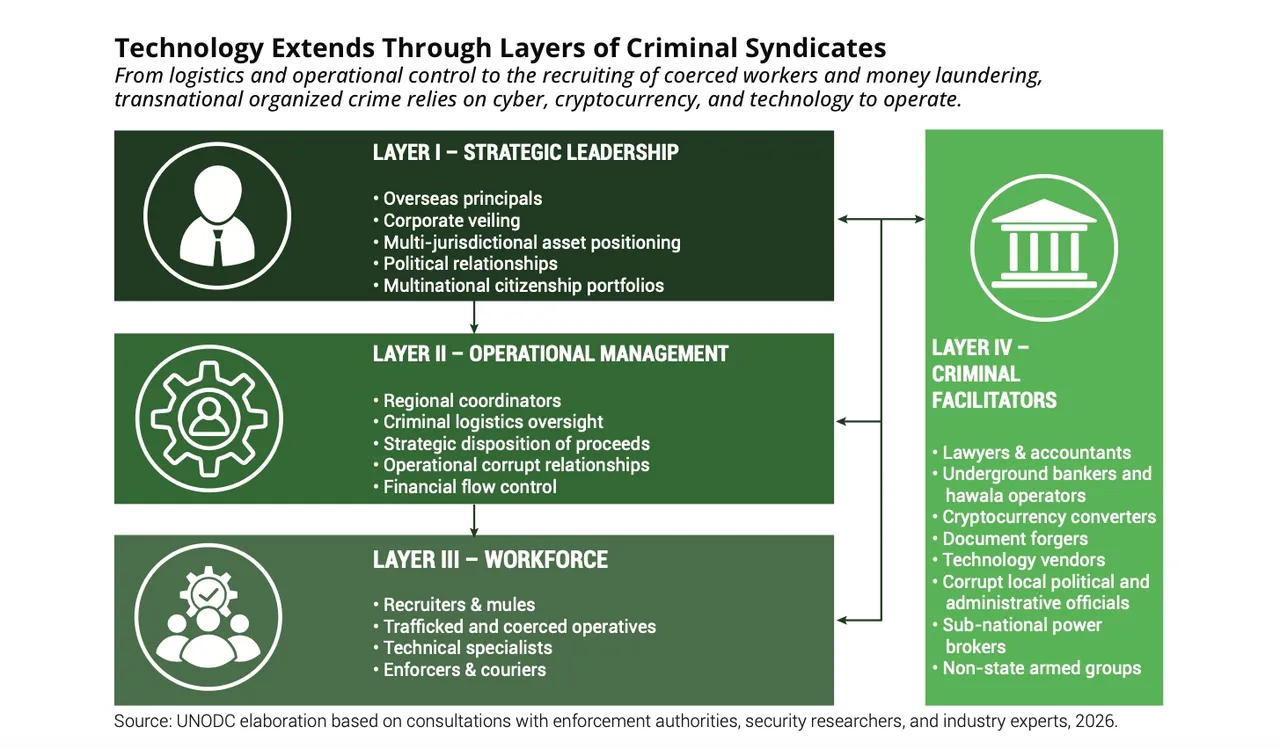
While each of these technologies is dual-use — with significant legitimate uses — they have enabled industrial-scale cybercrime, money laundering, and communications in a way not previously possible. Telegram-based guarantee services — such as Huione Guarantee and Xinbi Guarantee, which allow vendors to advertise and sell criminal services such as money laundering and stolen data — processed more than $53 billion in on-chain flows in 2025, up from $6 billion in 2022, while the advent of AI service vendors has accelerated profits, according to blockchain analysis firm Chainalysis.
"These same guarantee marketplaces now openly advertise AI-powered tools, from deepfake face-swapping software to AI services for social engineering, lowering the barrier to entry for increasingly sophisticated fraud," says Xue Yin Peh, a senior intelligence analyst at Chainalysis.
While the profits of the transnational criminal organizations are hard to estimates, the cryptocurrency inflows of scam-related entities more than doubled in 2025, to $22 billion, from $9.8 billion the prior year, according to Chainalysis. Other revenues and transfers use more traditional banking channels, into which the company does not have visibility, but the economic impact is widespread, Peh says.
"A single scam operation can simultaneously destroy individual victims' savings, exploit trafficked workers through forced labor, launder proceeds through global financial infrastructure, and in certain instances, undermine governance and the rule of law," she says. "The answer is not to focus on one enabler over the others. It is to recognize that these technologies form an integrated stack, and that effective disruption requires coordinated action across all of them simultaneously."
Global Crime That Relies on Corruption
Corruption and jurisdictional complexities have benefitted TCOs, according to the UNODC report. When authorities moved against the notorious compounds at KK Park and Shwe Kokko in Myanmar, the operators simply reconstituted elsewhere — in Poipet, Sihanoukville, Bavet — as new nodes in a network built to survive exactly this kind of pressure.
Most of the TCOs originated with Chinese criminal organizations and operated in industrial-scale compound across the border in SEZs in Myanmar, Cambodia, and Lao People's Democratic Republic (formerly Laos). Yet, the reach of the networks extend far beyond that, to East Asian criminal networks, South Asian trafficking and recruitment networks, West African fraud networks, and non-state armed groups in Myanmar's conflict zones, according to the report.
Collusion between government officials, local law enforcement, and the TCOs have given the criminals groups greater longevity, the UNODC stated in the report.
"Corruption and criminal foreign direct investment (C-FDI) are not peripheral concerns but a key enabler of this criminal economy," the agency said. "Corruption is a structural variable — one that determines where criminal networks locate, how they scale, and how long they survive enforcement pressure."
Read more about:
DR Global Asia PacificAbout the Author


Want more Dark Reading stories in your Google search results?
Add Us NowExperts Explain How to Develop a Framework for Cyber-Fraud Fusion
Prevention at Machine Speed: Hunting Beyond Known Detections
0-Day to 10x Discovery: Security at the Speed of Mythos
When AI Becomes an Insider: Rethinking Risk in Critical Infrastructure
Governing the Agent; Identity Security in the Age of Autonomous AI
You May Also Like






Want more Dark Reading stories in your Google search results?



No comments:
Post a Comment