Climate change is wreaking havoc on the insurance market. But socializing the costs is absolutely the wrong approach.
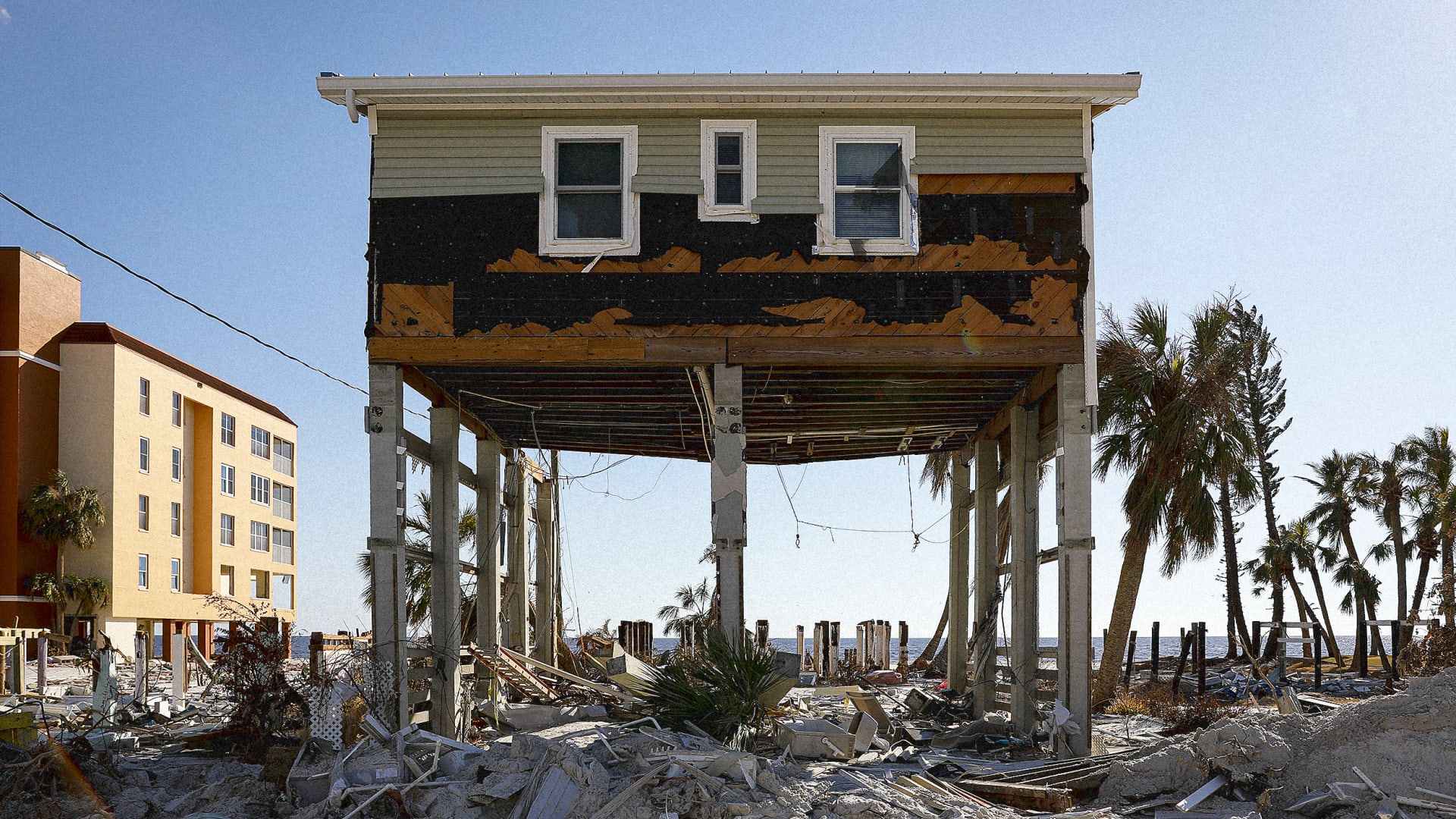
[Photo: Eva Marie Uzcategui/Bloomberg/Getty Images]
BY HAMILTON NOLAN7 MINUTE READ
Few things are as easily predictable as the path that America is walking down toward its awful, inevitable national political war over the costs of climate change. Each catastrophe will propel us to take another step toward our looming irrational meltdown. Hurricane Helene has now done her part, and our short-sighted politicians are doing theirs.
Helene devastated portions of the Florida coast, mangled inland towns in Georgia, and caused Biblical flooding in the Carolinas that has been compared to an Appalachian version of Hurricane Katrina. In the desperate atmosphere that rushes in as every major storm dissipates, Florida Congressman Jared Moskowitz took to Fox News to promote the bill he filed last year to require the federal government to backstop disaster insurance costs for high-risk states. Florida Politics reports:
“It would add no money to the deficit. It would allow states to buy bonds that when we have these 1 in 1,000 year storms would take that off of the plates of the insurance companies, which is driving up 25% of the cost on reinsurance,” Moskowitz said. “Even if my bill doesn’t move or go anywhere, I think the United States government and Congress has to start realizing that we have to amortize the risk.
“We have to spread this risk around,” he added. “It can’t just be on one state or two states to deal with this. Just like FEMA [the Federal Emergency Management Agency] spreads risk around when there’s a big disaster, FEMA comes in and helps local cities, counties, and the states recover, I think we’re going to have to do the same thing in the insurance market.”
What you are seeing here is the unfolding of a process that is as certain as the rising sun. Humans emit greenhouse gasses that cause climate change. This generates a lot of short-term wealth as well as problems that reveal themselves in the long term, incentivizing companies to keep snatching profits as long as possible despite exacerbating the eventual costs. This is similar to the proverbial “picking up nickels in front of steamrollers” strategy, except that the people with all the nickels will die rich, and the people who eventually get crushed by the advancing machine will be their—and our—children and grandchildren.
Natural disasters, particularly storms and wildfires, grow more intense over time. Insurance rates for homeowners in areas prone to these disasters rise, quickly becoming unaffordable. Said homeowners panic and demand relief from their politicians. This is where we are now.

There are two paths out of this dilemma. One is the more socialist path: The government enforces limits on carbon emissions to curb climate change, and publicly funds a rational plan for the managed retreat of homeowners from disaster-prone areas. This is an expensive and politically difficult but humane solution.
Then there is the free market path: Allow insurance companies to set rates where math dictates they should be set to properly account for risk. Living in disaster-prone areas quickly becomes impossible to afford for many people, who are forced to move. Banks will not write mortgages on uninsured homes, so new construction in these areas declines. Fewer people move in, more people move out, and the population shifts to safer locations. This method would be accompanied by tremendous human suffering, as people are forced out of their homes by economic pain, but it would accomplish the same goal as the more humane path, in a way that is consistent with the American valorization of capitalism.
We are not going to follow either of these paths. Instead, due to the nature of our political system, which rewards cowardice and punishes anyone who might dare to tell coastal homeowners that they’re screwed, we are going to get a blend of the worst aspects of both options. Politicians will demand federal bailouts of the costs associated with each disaster, and they will introduce various regulations and financial schemes to artificially hold down the price of insurance—well below its true price, meaning a price that would allow insurance companies to fully pay for all of the costs that climate change will impose. These costs will continually increase.
Eventually, the costs to the nation of subsidizing the ability of people to live in unwise locations will be so enormous that all the rest of the citizens will revolt. “Save our homes!” one side will cry. “Why should I pay for you to live at the beach, or in a flood zone, or in a forest sure to catch fire?” everyone else will cry. A vicious political war will ensue. It will be brutal. All the while, climate change will continue apace. The only real question is how long we will spend dithering on our unproductive and childish bickering before we are forced by nature to address the root causes of this problem. Knowing America, I suspect that we can dither deeper into disastrous territory than you might imagine.
In his demand for the federal government to rescue Florida’s homeowners from their insurance costs, Jared Moskowitz is playing his part in this process. It is easy to spot the flaws in his plan. “It would add no money to the deficit,” he says. This means nothing. Costs are costs. “We have these 1 in 1,000 year storms,” he says. We seem to be getting these 1 in 1,000 year storms every five years now, Jared. Why do you think that is? “We have to spread this risk around,” he says.
Do we?
I am a socialist and I fully believe that the most rational way to manage a country is for the federal government to take on the costs of goods that everyone needs. If we socialize the costs of the fire department and the police and the military and schools and health care and roads and the other necessities of life, we build a safety net that ensures that even poor people and poor places have access to the necessities that everyone in our rich nation deserves.
However, there is a difference between socializing the costs of things we need more of, and socializing the costs of things we need less of. Universal public health care would be good. Universal public insurance for people to continue to build more beachfront homes that scientists tell us will be at ever-increasing risk of destruction from climate change—allowing us to delay our ultimate reckoning with the need to phase out fossil fuels? Not good. Socialism is a tool. It demands at least a minimal level of judgment. If you socialize the costs of a bad thing you make that bad thing cheaper and ensure that you will get more of it.
This issue, more than any other I can think of, combines almost all of America’s systemic flaws into a single toxic stew that we will all be forced to choke down. The flaws in our electoral system ensure that politicians who tell voters the hard truths about the changes that will be necessary to deal with this problem are defeated by those willing to tell voters cheap lies about easy fixes that allow everyone to maintain their current lifestyles. The flaws in our cutthroat economic system ensure that the needs of rich people in expensive beach houses will drive this discussion far more than the needs of poorer people who live in disaster-prone areas and cannot afford to relocate. The flaws in our hysterical post-Cold War attitudes about the evils of socialism ensure that no adult conversation can be had about what a responsible solution will look like. And the flaws in our national political media discourse ensure that as this issue comes to a head, and the states begin to sort themselves into “those who want bailouts” and “those who do not want to pay for bailouts,” the arguments between the two sides will become absolutely poisonous.
Imagine pouring all of the political attack ads around welfare and billionaires and red state bastards and blue state commies into a blender and mixing it with the tears of a million people whose homes have been washed away and the outrage of a hundred million other people who are struggling to make a living and believe that they are being asked to pay for some asshole to live in a mansion on Miami Beach. And then allow the entire conversation to be led by, you know, Ron DeSantis. It will be terrible.
What makes me especially morbid about all of this is the fact that we are still in the early stages. It is clear that climate change’s disastrous cost will have to get much, much higher before Americans begin to genuinely consider the idea that we will have to change the way that we live. A big truck and a big house on the beach with a big air conditioner is still seen as a birthright in this country. The indignation that will accompany the increasingly loud demands for the federal government to defend this birthright will be incredible to behold. I hope that we can reach the point of pulling off the Band-Aid on this issue sooner rather than later. But I admit that I am not optimistic. Every excruciating step of this long path is going to have to happen. We can only try to make it happen before it’s too late.
A version of this piece first appeared on Hamilton Nolan’s Substack, How Things Work.
Apply to the Most Innovative Companies Awards and be recognized as an organization driving the world forward through innovation. Extended deadline: October 11.