Friday, December 22, 2023

Generate New Ideas


The One Thing Our Brains Rely on to Generate New Ideas
BY KEVIN J. MITCHELL
Kevin Mitchell explores how our brains rely on a little bit of randomness to help us think outside of the box.
READ MORE »


The One Thing Our Brains Rely on to Generate New Ideas

IDEAS
Mitchell is Associate Professor of Genetics and Neuroscience at Trinity College Dublin. He studies the interplay between genes, brains, and minds. He is the author of Innate: How the Wiring of Our Brains Shapes Who We Are and Free Agents:How Evolution Gave Us Free Will

Humanity’s evolutionary superpower is our behavioral flexibility. As we go through life, we learn how to navigate the world, building a store of knowledge, habits, and policies that have served us well in the situations we’ve encountered. But there will always be new scenarios that may require new solutions—something we’ve never done before or even thought of doing before. Such scenarios require “thinking outside of the box,” and when we need to do that, we draw on an unlikely resource: a little bit of randomness in the brain circuits that offer up options for action.

We have the cognitive capacity to adapt to complex, unpredictable scenarios across all kinds of new environments. But that flexibility—the almost infinite range of behaviors open to us at any moment—creates a problem. How do we narrow down the options and choose the best one?

It’s no use considering literally every possible thing we could do in every situation we encounter—we’d never finish trying to decide. What we need to do is narrow down the search space: come up with a few decent options and evaluate them for the best one. That is exactly what learning enables us to do.

As we grow and explore the world, we gradually accumulate knowledge and build up a model of how the world works. We learn about the properties and relations of objects in the world—especially what we can do with them, or what they can do to us. We learn about sequences of events that tend to follow each other. And, especially, we learn about the consequences of our own actions across all kinds of scenarios.

When we encounter a new situation, our behavior will therefore be more or less informed by all this prior knowledge, depending on how familiar the situation is. For very familiar ones, we may know very well what the best thing to do is. We don’t need to waste time and effort thinking about it because we’ve already done all that work—it just becomes habitual or automatic. That’s super efficient.

More From TIME


But for situations that are at least somewhat novel, we have to think a bit more about what to do. We need to draw on all that prior knowledge to come up with a few possible actions that we can then evaluate. At some level, these ideas just “pop into our minds”. But despite what some free-will skeptics argue, this doesn’t mean that you are not involved in generating them. They arise intuitively from largely subconscious processes that conduct a search of possible actions, a search that is informed or biased by the implicit model of the world that you have constructed from your past experiences.

Read More: How Listening to Silence Changes Our Brains

The pioneering psychologist William James incorporated these ideas into what he called a two-stage model of free will. Importantly, there’s a little bit of randomness—and yes, a bit of freedom—at play in this search process, which affects the options that actually spring to mind. But once these subconscious processes have generated a set of possible actions, they are submitted to systems of evaluation so that we can exercise our will in order to select one of them, based on how well we think they’ll turn out for us. As Robert Doyle summed up James’s position: “Our thoughts come to us freely; our actions go from us wilfully.” The ideas that spring to mind are effectively competing to “grab the wheel” and drive action. Our evaluation systems allow us to simulate the likely outcomes from the range of suggested actions, evaluate the predicted utility of those outcomes with respect to all our goals, and select one of them for execution, while inhibiting all the others. Both the suggestive and the evaluative systems are thus configured to enable us to do things for our own reasons.

But what happens when we don’t have any good reasons? When we really don’t know what to do? This could be the case, for example, when we encounter a truly novel scenario, when circumstances are changing and our world model is no longer reliable, or when our current behaviors are just not achieving our goals. In those circumstances, we may need to come up with some new ideas. 

That’s when we can turn to specialized brain systems, ones that rely on the noisiness of networks of neurons. When we’re frustrated in our goals, regions in the front of our brains—the prefrontal and cingulate cortex—register this fact and send signals to regions in the brainstem that regulate our behavioral states. One of these regions is the locus coeruleus—the “blue spot”—deep in the brainstem. Neurons in this region project throughout the brain and release the neurotransmitter known as noradrenaline, signalling that our current model of the world is no longer working, increasing arousal and vigilance, and focusing attention on areas of volatility or uncertainty. In particular, this can be a signal that we need to do something different.

In the cerebral cortex, options for one possible action or another are encoded by patterns of neurons that are active together. In any given situation, rival ensembles compete within a larger set of neurons. Because neurons that fire together, wire more strongly together, patterns that are regularly active become well-worn—it becomes more likely for the population of neurons to settle into that pattern. They wear a rut, becoming habits of thought.

But those systems have to be flexible and responsive to changing conditions. It’s adaptive, in a changeable world, to not just lock into doing one particular thing, but to be a little bit variable—to at least have the scope to explore other possibilities every once in a while. These circuits are therefore a little bit noisy and poised in what is known as a critical state—they can shift from one pattern to another in response to new information, or sometimes just at random. The noradrenaline released from the locus coeruleus increases the noisiness of all the neurons in those cortical regions. This “resets the network,” shaking up the system and allowing it to resettle into possibly novel patterns.

In machine learning, this is known as raising the “temperature” of the system, a well-known method to shake systems out of locally optimal, but globally suboptimal states. In our own brains, it enables us to expand the search space for options of what to do—to think outside the box. As Nobel laureate Linus Pauling said, “The best way to have a good idea is to have lots of ideas”. But you still need a system to tell the good ones from the bad ones. These options are thus subjected to the normal systems of evaluation so we still choose what we eventually do.

This mechanism of creativity is similar to how evolution allows exploration of new forms: by generating variation at random and then subjecting it to selection. The same principle applies in the immune system in the generation of antibodies. In all these cases, a controlled source of randomness is used as a creative resource, in combination with a powerful selective filter. More error and trial, than the other way around. Thus, even when we choose to use this noisy idea generator to expand our possible options, our final actions are still very much up to us.

MORE MUST-READS FROM TIME

CONTACT US AT LETTERS@TIME.COM
TIME Ideas hosts the world's leading voices, providing commentary on events in news, society, and culture. We welcome outside contributions. Opinions expressed do not necessarily reflect the views of TIME editors.


Frenemies in Art History


Artnet News


Best Frenemies: 5 Notorious Rivalries in Art History
Art History
Best Frenemies: 5 Notorious Rivalries in Art History
By Jo Lawson-Tancred


"Manet/Degas" exhibition at the Metropolitan Museum of Art in New York City. Photo: Liao Pan/China News Service/VCG via Getty Images.


Best Frenemies: 5 Notorious Rivalries in Art History

These duos went from healthy competition to all-out war.


The Met’s latest blockbuster exhibition “Manet/Degas” has made headlines for bringing Édouard Manet’s Olympia (1863)—one of art history’s best known and, at one time, most controversial paintings—to the U.S. for the very first time. It also dramatizes the tension between the two French painters, telling their stories side-by-side and reveling in the productive rivalry that would generate so many masterpieces and go on to inspire new generations of modernists.


In their lifetimes, Manet was more readily embraced by the mainstream, frequently exhibiting at the official Salons. Edgar Degas, meanwhile, struggled to find much commercial success and became involved with independent Impressionist exhibitions that would perplex and aggravate traditional critics.

So did the two artists get on? They belonged to the same Paris milieu and are said to have first bumped into each other at the Louvre. Degas, aged 30, was etching a copy of Velázquez’s Infanta Margarita Teresa (1653) onto a waxy copper plate, supposedly causing Manet, aged 32, to exclaim: “How bold of you to etch directly without any kind of preparatory drawing, I would never!” It was likely received as a backhanded compliment.

Edgar Degas, Ã‰douard Manet and Mme. Manet (1868-69). Photo: Fine Art Images/Heritage Images/Getty Images.

The artists met on several more occasions, and the evidence suggests that these were amicable. The Met’s show includes several sketches that Degas made of Manet, although there is a notable absence of portraits that Manet did of Degas, hinting at an imbalance of affections. Any simmering resentments eventually came to a head in around 1868, when Degas painted Manet and his wife on a canvas that now bears the scars of their fallout. For reasons that aren’t known, Manet slashed the painting and returned it to Degas, who in turn sent back a work he had been given by Manet.

The volatility of their relationship is hardly unique in the history of art. Over the centuries, many artists have struggled to stop their admiration or camaraderie slipping into competition, or even conflict. Below are five more pairs of notorious artist rivalries.

Van Gogh and Paul Gauguin

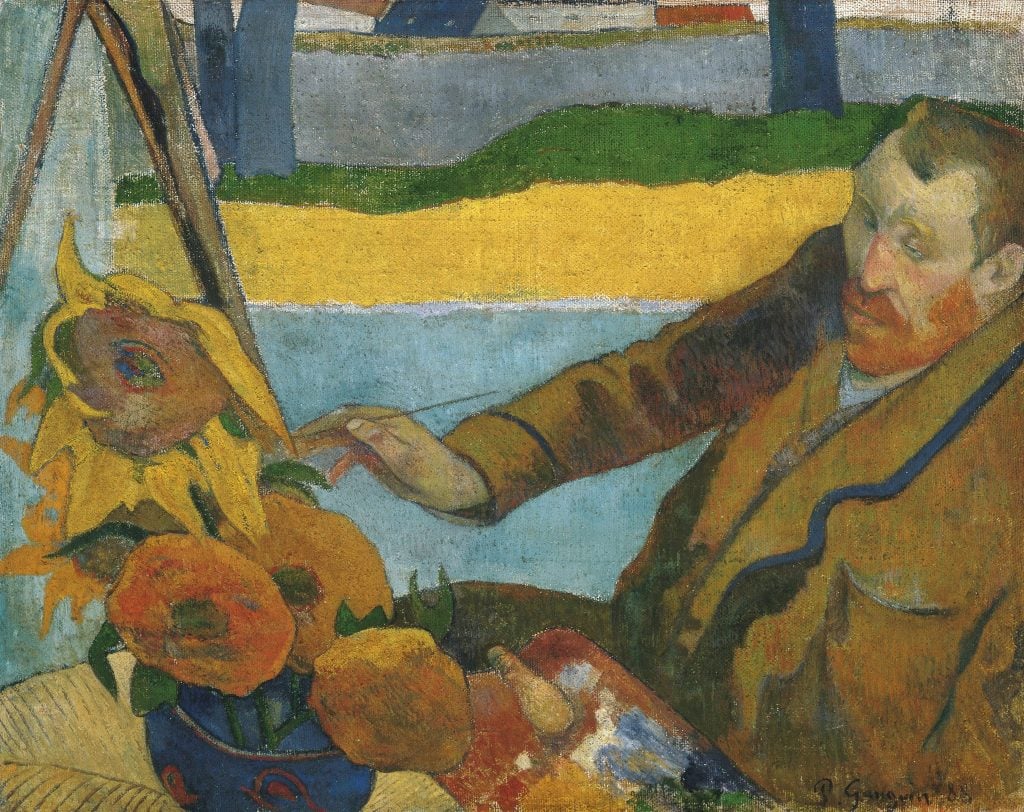
Paul Gauguin, <i>Vincent van Gogh Painting Sunflowers</i> (1888).

Paul Gauguin, Vincent van Gogh Painting Sunflowers (1888). Photo: VCG Wilson/Corbis via Getty Images.

After Vincent van Gogh and Paul Gauguin met in Paris in 1887, they got on well enough to start up a regular exchange of paintings and letters, with Van Gogh sending Gauguin two of his sunflower studies. Their rapport was strong enough that when Van Gogh set up an artists’ commune at the “Yellow House” in the southern city of Arles in 1888, he invited Gauguin to join. At first, the cohabitation passed easily enough and the two artists became close companions, often painting each other and enjoying vigorous debates about their different approaches to art in the wake of Impressionism. Eventually, however, these sparring matches became a bit too impassioned or, to quote, Van Gogh, “excessively electric.”

Gauguin fled not long after Van Gogh threatened him with a knife on December 23 and eventually cut off a piece of his own ear. The pair never met in person again, but correspondence continued until Van Gogh’s death in April 1890. Nonetheless, the short-lived, intense relationship left a lasting mark, and Gauguin paid tribute to Van Gogh a few times by placing sunflowers in his paintings.


Leonardo da Vinci and Michaelangelo

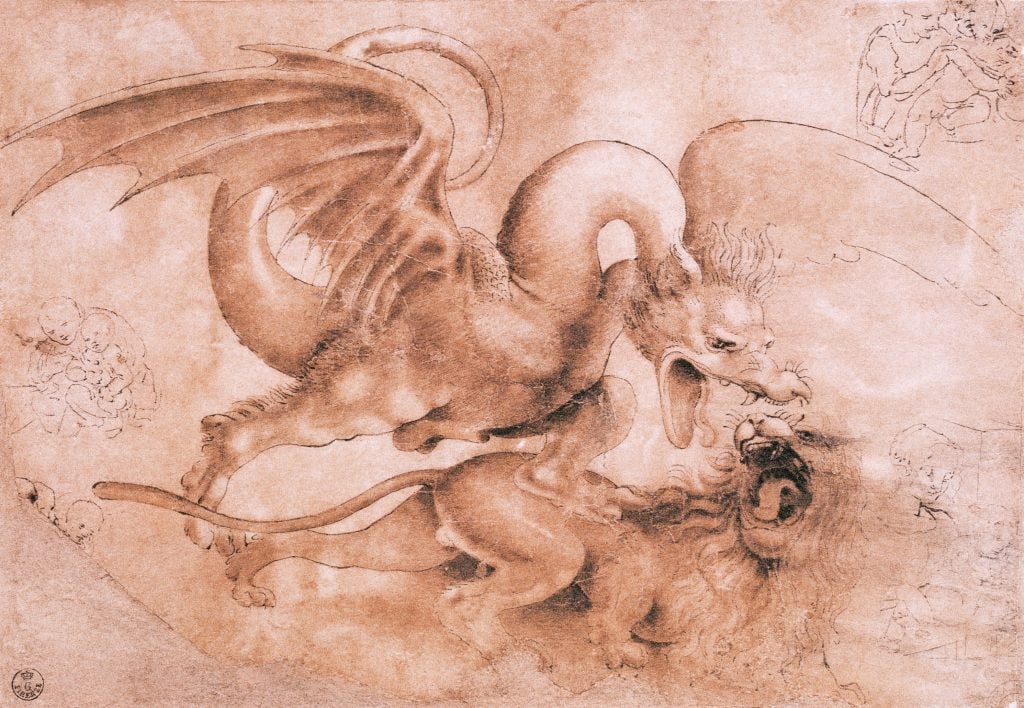
Leonardo da Vinci, <i>Fight Between a Dragon and a Lion</i>.

Leonardo da Vinci, Fight Between a Dragon and a Lion. Photo: © Arte & Immagini srl/CORBIS/Corbis via Getty Images.

At first glance, it seems like Leonardo and Michelangelo—perhaps the most legendary artists of the Renaissance era—were straightforward enemies, but is there more to it? Their mutual hatred was well-known to contemporaries, with the great art historical chronicler Vasari noting that they harbored “an intense dislike for each other.” One anonymous manuscript described a heated public spat in which Michelangelo sought to humiliate Leonardo, who was 23 years his elder, bringing up a failed commission from 1482 to make a bronze horse sculpture. “[You] were unable to cast it, and were forced to give up in shame,” sneered Michelangelo. If Leonardo had a good comeback, there is no record of it.

With both artists completing high profile projects in Florence and Rome, however, their work was pulled into an inevitable dialogue and, although their approaches differed considerably, clear influences can be detected. For example, it is widely believed that the position of baby Jesus in Madonna of the Yarnwinder (c.1501) by Leonardo must have informed the infant’s similar pose in Michelangelo’s marble relief known as the Taddei Tondo, from around 1505. Perhaps he was more influenced than he was willing to let on.


Francis Bacon and Lucian Freud 

Francis Bacon, Three studies for a portrait of Lucian Freud at Sotheby’s London. Photo by Anthony Devlin/PA Images via Getty Images.

Two painters whose expressive, psychologically complex figurative work would come to define British art in the 20th century, met in London in the 1940s. Lucian Freud and Francis Bacon soon formed a complicated and intense friendship, meeting almost everyday and portraying each other often. The reason for their dramatic fallout has never been entirely clear, but both made caustic assessments of the other’s work. Freud once called Bacon’s paintings from the 1980s “ghastly”, and Bacon described some works of Freud’s bought by Charles Saatchi as “the worst ones I have ever seen.”

Bacon’s friend Barry Joule has since claimed that the animosity only grew when Freud, who owned Bacon’s Two Figures (1953), refused to lend it. Bacon was infuriated by not being able to include the work in his retrospective at Tate in 1985. It appears that the dispute was never resolved. In 1991, the year before Bacon died, Joule recalled sitting with him at a café when Freud walked in. “I saw Francis stiffen,” he said. “Lucian did a double-take, but marched right past him.”


Willem de Kooning and Jackson Pollock 

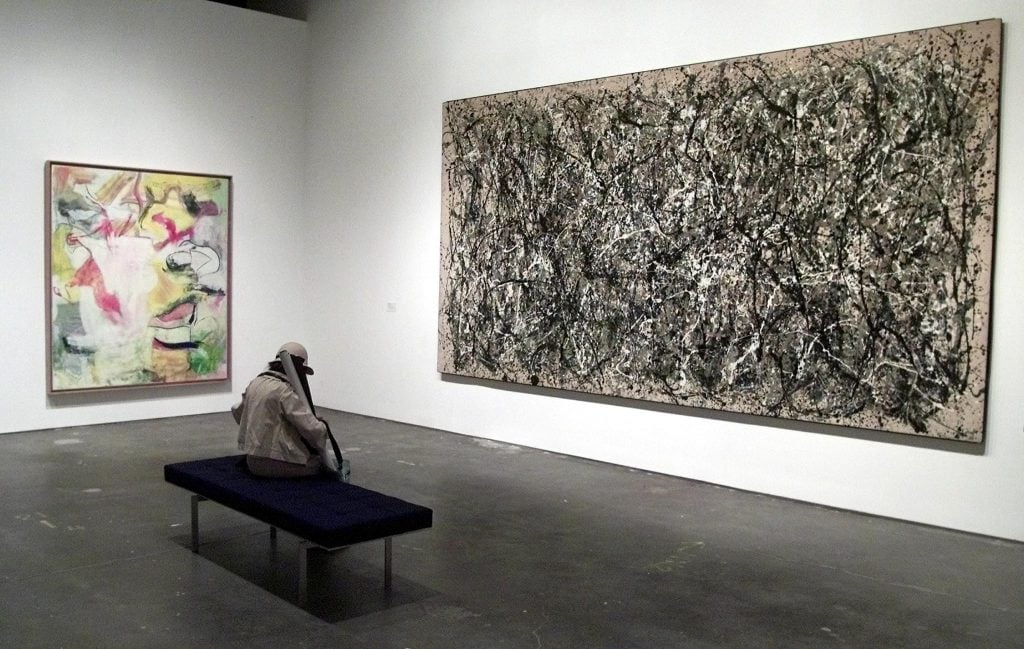
Jackson Pollock, One (Number 31, 1950) (right) and Willem de Kooning Pirate (Untitled II) (left) at MoMA PS1 in 2002. Photo: MATT CAMPBELL/AFP via Getty Images.

Two titans of Abstract Expressionism, Willem de Kooning and Jackson Pollock, met while both exhibiting in a group show at McMillan Inc. in New York in 1942. By the 1950s, Pollock’s highly unique drip paintings had stolen the spotlight and De Kooning openly admitted to feelings of jealousy. “He busted our idea of a picture all to hell,” he once said of Pollock, admiringly. “Then there could be new pictures again.” Though his paintings were also respected within artistic circles —Pollock named De Kooning as one of his favorite artists in a splashy profile for Life magazine in 1949—it would be some time before De Kooning received the same widespread acclaim.

Pollock’s problem drinking, along with his combative nature, eventually pushed him to the fringes of the New York art scene. Any rivalry was ultimately severed following his death in 1956, with De Kooning reportedly declaring at the artist’s funeral, “It’s over. I’m number one”. A scandal followed a year later, when Pollock’s lover Ruth Kligman, who had survived the car crash, became romantically involved with De Kooning for about four years. He went on to live until the age of 92, and was able to see his work achieve the mammoth commercial success that he had always dreamed of.


Henri Matisse and Pablo Picasso 

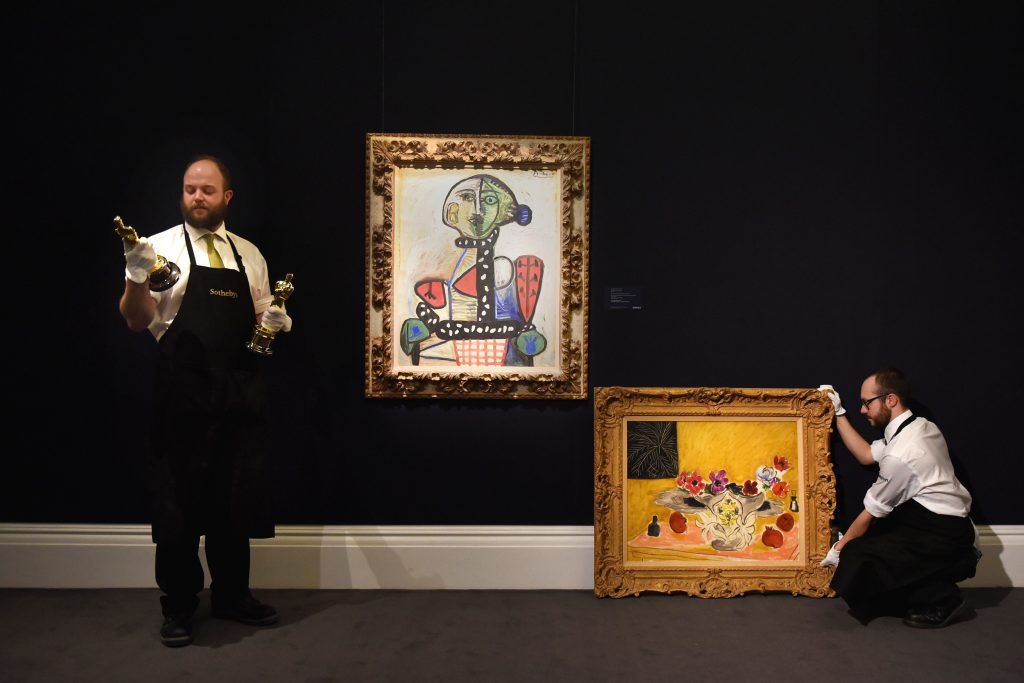
Two gallery technicians pose with Picasso’s Femme au chignon dans un fauteuill(1948) (left) and Henri Matisse’s Anemones et gremones (1946) (right). Photo: Mary Turner/Getty Images for Sotheby’s.

Matisse and Picasso first met in 1906 and quickly cultivated a decades-long friendship; Picasso’s partner Françoise Gilot once remarked that “no one meant quite as much to him as Matisse.” Nonetheless, they kept a watchful eye on each others’ work and maintained a healthy lifelong rivalry. It is widely believed that Picasso’s Demoiselles D’Avignon (1907)—a landmark declaration of intent that kickstarted Cubism and its radical deconstruction of traditional illusionism—was directly inspired by Matisse’s flattened Fauvist canvas Le Bonheur de vivre, which Picasso had seen the year before. Nonetheless, Matisse was a vocal skeptic of Cubism and, decades later, Picasso was frank about his disappointment when Matisse accepted a commission to create the Chapelle du Rosaire de Vence (Vence Chapel) due to its religious affiliations.

In private, the artists’ mutual admiration was also charged with a competitive undercurrent. “In their meetings, the active side was Pablo; the passive, Matisse,” remembered Gilot. “Pablo always sought to charm Matisse, like a dancer, but in the end it was Matisse who conquered Pablo.”

More Trending Stories:  

Artists to Watch This Month: 10 Solo Gallery Exhibitions to See In New York Before the End of the Year 

Art Dealers Christina and Emmanuel Di Donna on Their Special Holiday Rituals 

Stefanie Heinze Paints Richly Ambiguous Worlds. Collectors Are Obsessed 

Inspector Schachter Uncovers Allegations Regarding the Latest Art World Scandal—And It’s a Doozy 

Archaeologists Call Foul on the Purported Discovery of a 27,000-Year-Old Pyramid 

The Sprawling Legal Dispute Between Yves Bouvier and Dmitry Rybolovlev Is Finally Over 


Follow Artnet News on Facebook:


Want to stay ahead of the art world? Subscribe to our newsletter to get the breaking news, eye-opening interviews, and incisive critical takes that drive the conversation forward.

SHARE