Saturday, January 15, 2022

Talking gibberish


Weekend reads
 
Saturday 15 January 2022


Language and linguisticsEditors’ pick
Talking gibberish
The study of languages has long been prone to nonsense. Why is linguistics such a magnet for dilettantes and crackpots?
by Gaston Dorren


Edited bySam Dresser


 Photo by the Hulton Archive/Getty

Ah, for the days of fact-free linguistics! The pre-scientific era might have produced a lot of codswallop and hogwash, but how entertaining it is to look back upon. Scholars erred in ways that few modern linguists ever would. Today, their field of study is a respectable social science, exacting in its methods, broad in its scope and generous in its harvest. Without phoneticians, computers wouldn’t be able to process spoken English. Without sociolinguists, prejudice against dialects and non-Western languages would still be rife – or rather, rifer still. Forensic linguists help to solve crimes, clinical linguists treat people with language impairments, historical linguists shed light on language change and even on prehistoric culture and migration – the list goes on and on. As in other disciplines, pertinent questions and rigorous methods to answer them have been at the root of success.

When natural philosophy began to slowly develop into physics and other natural sciences, learned speculation in the human domain did not immediately follow suit. But it too gradually developed into what we now call the social sciences, and the study of language was one of the earliest adopters of the new methods. Its practitioners would pore over ancient texts written in long-dead languages and long-forgotten scripts, and compare them ever more systematically. This led to a breakthrough in the late 18th century, when there emerged new ideas about the historical origins of modern languages. Most of these ideas have stood the test of time.

But the budding discipline did not merely come up with new answers, it also changed the questions. Scholars of yore, when reflecting upon language, would wonder things such as: which of the contemporary languages was spoken by the first man? Which one is superior to the rest? And which of the human tongues deserves the label ‘divine’? Modern linguists will not touch those with a 10-foot pole. The oldest language is unknowable, but it was certainly different from anything spoken today. The ‘best’ language is impossible to define in any meaningful way. And as for ‘divine’ – the very word is meaningless in relation to languages, except in a cultural sense.

Not so in the olden days. Indeed, the answers seemed pretty obvious to many thinkers, if only thanks to that most anti-scientific habit of mind known as ethnocentrism. To the ancient Greeks, determining the world’s most excellent language was a perfect no-brainer: it could only be theirs. People who spoke differently were ‘barbarians’ or babblers. The Romans were only slightly more broad-minded. Their appreciation extended beyond Latin to other languages with a tradition of writing, especially Greek (which might conceivably even be superior), but also Punic, spoken by the Carthaginians, and Etruscan. All scriptless languages, however, were sneered at. Even in the late 5th century, with Rome’s power gone, the Roman aristocrat Sidonius Apollinaris called the Germanic language of the new rulers ‘an instrument of but three strings’.

Other cultures were equally self-complacent. In the last centuries BCE, the people of North India felt that their Sanskrit was nothing less than divine, and 1,000 years later the Arabs would feel likewise about the language of the Quran. For the Chinese, civilising the neighbouring peoples was practically tantamount to familiarising them with the only great language. The French of the Enlightenment, not to be outdone, deemed their language better than divine – it was logical.

This claim was perhaps most famously defended by the 18th-century writer Antoine de Rivarol on grounds that were both illogical and plain wrong. He argued that the French word order (subject first, followed by verb and then object) is both unique and more logical than any other. But not only is it extremely common among the world’s languages, it’s also an order that French itself very often does not respect – and these are only some of the more obvious objections.

As silly as it is, the notion of ‘French as the pinnacle of logic’ became an idée reçue. The cover of my first French dictionary, published in the 1950s (and not even in France!) claimed that the language was ‘an unsurpassed creation as a vehicle for the mind’. The Arabs, Chinese and Greeks would beg to differ.

Today, the language of choice is English, especially in most of the Western world. And sure enough, it has inherited French’s status as the allegedly superior language. How rich in vocabulary it is, how suitable for song and science, how clear, concise and, in a word, cool. And how this makes me – as a non-English speaker – chuckle. English is not a bad language as languages go but, a century from now, all the exultant praise will sound as silly as it would have sounded less than a century ago, before its rise to dominance.

Sign up to our newsletter

Updates on everything new at Aeon.

See our newsletter privacy policy here.

Speakers of big languages are not the only ones to get carried away by love for their lingo. Quite a few people in Tamil Nadu in South India used quite literally to consider the Tamil language a goddess, and some still do. And early medieval Irish monks spun this elaborate yarn to prove that Irish Gaelic stood alone: after God had destroyed the Tower of Babel and confused the tongues of man, King Phenius of Scythia travelled thither with his son and 72 scholars. Out of the best elements of all the confused languages they found there, they created a new one: Irish.

As for the oldest language, this was Hebrew. At least, this is something that Christians commonly believed for more than 1,000 years. (Only Saint Ephrem the Syrian held that his own Syriac was older.) The Church Father Augustine, for instance, wrote in the 5th century:

so when the nations, by a prouder godlessness, earned the punishment of the dispersion and the confusion of tongues, … there was still the house of Heber in which the primitive language of the race survived. … His family preserved that language which is not unreasonably believed to have been the common language of the race, it was on this account thenceforth named Hebrew.

For a long time, it was considered heresy to doubt that the Hebrew language and script of the Bible were inspired by God – including the so-called vowel points, which were actually added by rabbis several centuries after the beginning of our era.

Even today, Christians who take the Bible literally adhere to the traditional view. In 2011, the Dutchman Willem Westerbeke published a theological tract titled ‘God Spoke Hebrew’. And as in Christianity, so elsewhere: one Thakur Prasad Verma in 2005 claimed not only that Sanskrit was the original language of all humankind, but that it was a direct gift from above: ‘Vedas are verbal transformations of God.’ And in a scholarly tome, too.

Outside the churches, the consensus slowly began to crack and crumble from the Renaissance on and, between the 16th and 18th centuries, one scholar after another came up with other ‘first languages’ (see table below). German was a popular candidate, but the 17th-century Swedish scholar Olof Rudbeck favoured his own mother tongue, for a reason that was nothing if not creative: Sweden, he argued, was Atlantis, and thus the cradle of human civilisation.

Christian Europe used to consider Hebrew as the language of Adam and Eve, the first humans. But after the Middle Ages, many alternatives were suggested. This is an incomplete list of ‘first languages’.

Perhaps most famous was the Flemish author Johannes Goropius Becanus. He claimed that the Dutch language, and the Flemish dialect of Antwerp in particular, was the direct descendant of the original language and the source of all others. His evidence was of an etymological nature. The name Adam, for instance, was derived from haat-dam (‘hate dam, dam against hate’), while Diets or Dutch was synonymous with d’oudste (‘th’oldest’). In the Low Countries, Goropius would enjoy some support for centuries to come; abroad, his name literally became a byword for fanciful etymologising: the eminent German scholar Gottfried Wilhelm Leibniz called the activity ‘goropising’. Even today, the hypothesis of Dutch as the oldest language is kept alive by at least one linguist and one poet, both of whom seem to be embarrassingly serious about it.

It was merely a matter of time for the Turks to proclaim, just as rightfully, that their language was oldest

It wasn’t just Germanic tongues such as German, Swedish and Antwerp Dutch that were declared to be the origin of all human language. (English, it seems, was too obvious a hybrid to make such a claim remotely plausible.) Greek and Polish were nominated by German scholars, Hungarian by a Hungarian, and three Celtic languages – Welsh, Breton and Gaelic – had their champions as well. The English antiquarian John Webb suggested Chinese.

Even at the time, many right-thinking men and women did not take these flights of fancy seriously. In the early 18th century, the Swedish historian and satirist Olof von Dalin poked fun at Rudbeck and his way of thinking. To Rudbeck, he said, the name ‘Adam’ was probably a corruption of av damm, Swedish for ‘(made) of dust’. While funny and incorrect, this reference to God’s creation of the first man is less far-fetched than Goropius’s ‘hate dam’.

Another Swede, Anders Kempe, suggested ironically that God in paradise had undoubtedly spoken Swedish, with Adam speaking Danish and the snake French. And Leibniz wrote in 1699 that it was merely a matter of time for the Turks to proclaim, just as rightfully, that their language was oldest. History would bear him out.

If we can feel smugly superior to all these learned men with their embarrassing theories, that’s merely because we live after 1784. An iconic event in that year marks the break between old-fashioned speculation about language and modern linguistic science: an address given in Calcutta by the British philologist William Jones, in which he proposed the Indo-European language family (which encompasses most languages of Europe, India and Iran). As with many icons, the choice is somewhat arbitrary. Jones was not the first to float the idea, as scholars had first noticed the similarities between Latin, Greek, Slavic, Germanic, Celtic and some Asian languages more than a century before. Neither was Jones the first to identify the historical processes of language change that have cemented the idea since, for that task would fall mostly to 19th-century German and Danish scholars, including the Grimm brothers of fairytale fame.

They, more than Jones, have set linguistics on the path to scientific rigour. They worked out methods to identify and laws to describe the changes that languages have undergone over thousands of years. They discovered how the Germanic languages were not just intuitively similar, but also systematically different: how an initial s pronounced ‘s’ in English would be an initial s pronounced ‘z’ in German and an initial z in Dutch: seven, sieben, zeven. They also showed how certain sound changes, for instance from a ‘k’ sound to a ‘ch’ or ‘s’ sound (compare Scots kirk to English church) would occur again and again throughout Europe (in Frisian and Swedish, in late Latin and in Slavic) and beyond. Later still, scholars would study a much wider range of linguistic phenomena, analysing language in increasingly abstract ways and focusing more and more on speech. But studying linguistic history by systematically comparing written languages is what got the discipline going.

Given the extensive body of historical knowledge they’ve collected since, especially about Europe and Asia, one would expect that claims of Goropian and Rudbeckian absurdity would be a thing of the past. They aren’t, however. To this day, dissidents seriously assert that mainstream linguistics has it spectacularly wrong. Science is not above errors, of course, some of them collective and persistent – think phrenology, think behaviourism – and linguistics is no exception. But if correcting the errors is a tall order, many dissidents believe it is best met with tall stories.

One such unlikely tale centred on ‘Lemuria’. In the late 19th century, biologists and geologists suspected the prehistoric existence of a large continent that had later sunk into the Indian Ocean – a kind of Atlantis of the East. Scholars in the region were quick to deduce that the world’s oldest language must be sought here. Tamil of India and Sri Lanka was suggested, as was Malagasy of Madagascar. In the mid-20th century, the new theory of plate tectonics killed the idea of Lemuria.

In 1935, Leibniz’s playful prophecy came true when a congress in Turkey launched and officially accepted the so-called Sun-language theory. It was advanced by Hermann Feodor Kvergić, an obscure Austrian linguist, who saw the origin of all language in some prehistoric person looking up at the Sun and exclaiming: ‘Ah!’ Wielding a logic all his own, Kvergić argued that this first utterance developed into Turkish, and from there into all other languages. For three years, the theory was in vogue, though exclusively in Turkey, only to fall from favour as swiftly as it had risen.

So, the word doctor derives from the Basque ‘a bloody injury, come right now’ – dishwater could not be clearer

The year 1935 was an auspicious one for pseudolinguistics. A book published in Germany backed a hitherto overlooked candidate for the status of oldest language: Finnish. But rather than swell with nationalist pride, the Finns merely chuckled. They knew the author, Sigurd Wettenhovi-Aspa, to be an eccentric artist whose musings about life, the universe and everything failed to meet the standards for serious scholarship, however forgiving.

Even in this highly competitive field of linguistic fantasists, pride of place undoubtedly goes to the late Edo Nyland. A Canadian forester by training, he found his calling after retiring in 1982, aged 55, when he began to develop a new and original branch of historical linguistics. First, he reinterpreted Homer’s Odyssey, arguing that it was set not in the Mediterranean, but in and around Ireland and Scotland. The language spoken there at the time was, still according to Nyland, a close relative of Basque, which he named ‘Saharan’. He drew this conclusion from toponymical evidence: many regional place-names became meaningful when considered as Basque, or so Nyland believed.

Perhaps most distinctively, Basque in his theory has not gradually branched into the world’s many known languages today. Instead, Nyland posited that Benedictine monks, for obscure reasons, designed one new language after another, and somehow surreptitiously introduced these into as many communities. To illustrate, let’s take the English word ‘doctor’. This consists of the elements .do, ok., .to and or., or in their full forms: odo, oke, eto and ora, short for the Basque words odoldun (‘bloody’), okerkeria (‘injury’), etorri (‘come!’) and orain (right now). So, the word doctor derives from the Basque sentence ‘a bloody injury, come right now’ – dishwater could not be clearer. Not that this is proper Basque grammar (Nyland, who doesn’t seem to have spoken the language, pieced his ‘etymologies’ together with the aid of a Basque dictionary), but in the grander scheme of things, these are mere trifles.

Not all bizarre linguistic theories are about the oldest language. Take climate theory. In 18th- and 19th-century France and Germany, there was a strong current of thought to the effect that climate determines how people speak. ‘The temperate, milder climes are the most favourable for the formation of pure languages,’ wrote the German Romanticist August Wilhelm Schlegel, and the rough, guttural sounds of the north were inextricably linked to its bracing cold and rugged rocks. And Rivarol, of ‘logical French’ fame, wrote that languages are ‘melodious and voluptuous in mild climes, harsh and dull under a sad sky’. Remarkably enough, modern science has actually found one correlation between climate and language: tonal languages, such as Chinese, in which the pitch of every syllable matters, occur significantly more often in humid than in dry regions.

Another offbeat theory was linguistic Marxism or Marrism, so named after the Georgian linguist Nicholas Yakovlevich Marr, who ventured a class analysis of Europe’s languages. To his mind, there was no such thing as language families, only stages of development. If the Indo-European languages seemed similar, it was because they were spoken in class societies. Those spoken in the Caucasus region, on the other hand, including his own Georgian, were typical of an earlier stage in history, that of classless societies. The notion of ‘national languages’ was a figment of false class consciousness. (If you feel you’re not quite getting this, try to keep it that way.) Marr became the leading light of Soviet linguistics and was awarded the Order of Lenin just before his death in 1934. In 1950, however, Stalin announced that Marrism was a mistake, thereby obviating the need for further discussion. With Stalin being who he was, Marr was probably lucky to be dead.

A common thread running through these theories is that the theorists want them to be true

While all disciplines attract the occasional eccentric, it seems that two fields exert a particularly strong pull: historiography and linguistics. Two reasons spring to mind. One is that the history and language of one’s own group – whether it be nation, region, minority or faith – are tied up closely with its identity. (With some students of language, it’s not their own group they deeply care about, but some fascinating minority; Basque and the Celtic languages are the favourites.) The prestige that comes with a noble past and an ancient pedigree is an irresistible lure, so no effort is spared in the search for supporting facts – or, failing those, near-facts. Rudbeck would have liked his Swedish to be the oldest tongue, Rivarol would have preferred French to be of exemplary logic, Marr would have loved the workers of the world to speak one global class language. That seems to be a common thread running through the theories mentioned above: the theorists want them to be true.

The tricky thing about history is that so much has happened; about languages, that there are so many of them. And there’s the second reason why linguistics and historiography provide such fertile ground for bizarre theories. The fantasists and dilettantes trawl through source after source in the hope of pulling aboard what seem to be relations and other connections. But in fact, the more documents they sift through, the more likely they are to find chance similarities and connections and draw spurious conclusions. And if established scholars disagree with them, they will typically respond in a petulant manner, rather than take their criticism seriously. Of course, no scholar is quite above such all-too-human reactions, but in academia there’s nothing for it but to try to convince one’s peers by answering the opponent. But those who accuse mainstream science of being blinkered often can’t see the beam in their own eye: a poor grasp of methodology. As a result, their patient labour typically produces patent nonsense.

History of sciencePhilosophy of languageLanguage and linguistics

In pursuit of the hole


Weekend reads
 
Saturday 15 January 2022
 

ArtLast week’s most read
In pursuit of the hole
Dig into the voids, pin-pricks and cut-outs of art and history, and those absences speak volumes about what’s been missed
by Kim Beil


Edited byPam Weintraub


In pursuit of the hole | Aeon

In pursuit of the hole

Dig into the voids, pin-pricks and cut-outs of art and history, and those absences speak volumes about what’s been missed

Untitled photo, possibly related to Corner of general store, Ericsburg, Minnesota by Russell Lee. Courtesy The Library of Congress


Holes are full of potential. We can only imagine what was in them before they were emptied out, why they became nothing instead of something. Like a kaleidoscope, the picture made by holes is always changing. Like history or art itself, holes are never finished. Archaeologists use soil analysis to identify postholes, the marks of ancient settlements. They excavate sewers at the Colosseum to find things the Romans thought not worth writing about. Holes leave space for projecting both forwards and backwards in time.

Museum and library collections are full of holes. Some are the product of hungry bookworms and moths. Others are deliberate, made by humans. These holes are, arguably, the most crucial bits, even though they are missing. This is the hole’s paradox. A hole points, through absence, to importance. The object wasn’t just used; it was used up. Philosophers struggle mightily over this question: is the hole something or nothing at all?

In his small artist’s book Hole Theory (2002), the American artist William Pope.L lays out the case for holes. The spiral-bound book is annotated with handwritten notes (denoted here by square brackets) and the text is crossed out in places, making its own black holes on the page. In this text, which is a hybrid poem-manifesto, Pope.L embraces the paradox of the hole:

Hole Theory presupposes
That there is possibility
Even in the face of nothing …

He concludes:

… this theory
Could only come from someone
Who lacks something
As a political condition.
[…] Hole Theory engages lack
Across economic and cultural
And political boundaries.

He adds, in pencil, overlaid with purple highlighter: [‘LACK IS WHERE IT’S AT.’]

Sign up to our newsletter

Updates on everything new at Aeon.

See our newsletter privacy policy here.

Some of the oldest intentional holes in art museum collections were used to create more art. Holes can be generative. In a technique known as pouncing, artists or their assistants would poke tiny holes in the lines of a drawing, then lay it flat on top of another surface. By dusting the pin-pricked drawing with charcoal or crushed black chalk, they transferred the image to another sheet, a wall, or repeated on fabric. By placing a blank sheet below the drawing to be copied, assistants could make an intermediary copy, which saved the original drawing from obliteration by charcoal clouds.

Pouncing likely originated in 10th-century China, as evidence of pin-pricked drawings found in the Caves of the Thousand Buddhas at Dunhuang suggest. These drawings were used to create murals, but pin-pricked paper stencils could also be used to create repeating patterns by copying a design multiple times. It’s thought that the practice travelled the Silk Route to Italy after Marco Polo’s return to Venice in 1295. It was first described in Europe around 1390 by the Italian painter Cennino Cennini who recommended it for creating patterns on gold brocade.

Stencil for a Buddha, Chinese (c926-975). Courtesy the Trustees of the British Museum

During the Italian Renaissance, pouncing was used widely to transfer a master’s sketch from paper to the wet plaster of a frescoed wall. Raphael was especially known for the use of pouncing in his workshop. Surviving drawings reveal holes poked along all the major lines and they show his use of both sides of a sheet, as the holes sometimes interrupt a drawing on one side in order to copy the drawing on the other. Even though they were seemingly destroyed by holes, Raphael’s pounced drawings were carefully preserved by his workshop.

The Adoration of the Shepherds (c1499-1501), attributed to Raphael. © Ashmolean Museum, University of Oxford
Studies of the heads of two apostles and of their hands (c1519-20) by Raphael. © Ashmolean Museum, University of Oxford

Pins and their accompanying holes are found in old books, too. The Bodleian Library in Oxford can date some of their collection’s pin-holes to the 15th century. Before staples and paperclips, straight pins were used to repair bindings and hold loose pages together. Pins were frequently used as bookmarks and for editing. Jane Austen pinned paper patches to the unfinished manuscript of her novel The Watsons in order to add new sections of text.

Only in recent years have holes been routinely catalogued, alongside other reader’s marks

Pins were also used as tiny pointers, highlighting letters or words in books for children who were learning to read. Patricia Crain, a historian of early children’s books, notes that ‘occasionally one comes upon pages with the pin pricks still visible’. The hole points to something necessary, even as it marks its absence.

The humble pin was an all-purpose instrument, widely available in Europe by the end of the 17th century and ready to hand, especially for women and girls who wore them in hats and used them for sewing. But Caroline Duroselle-Melish of the Folger Shakespeare Library cautions that finding a pin in a book doesn’t necessarily mark its owner as a woman. Although women were the chief consumers of pins, pins were used by men, too, even from childhood. A black-and-red pincushion was sold with John Newbery’s 18th-century book for children, A Little Pretty Pocket-Book. Young girls were expected to mark their good (or bad) deeds by putting a pin in either side of the pincushion. For boys, a two-tone ball accompanied the book, also ready for pins. The title page promised that this embodied practice of learning would ‘infallibly make Tommy a good Boy, and Polly a good Girl’.

Title page from A Little Pretty Pocket-Book (1770) by John Newbery. Courtesy the Trustees of the British Library

Another late-18th-century children’s book personified the pin: The History of a Pin, as Related by Itself. The title character introduces itself:

I began my career in life with the best hopes and fairest prospects; I had a good head, and was prepared by various hands with sharp qualities, to make myself useful in the world.

Owned by a woman, the pin participated in the mistress’s work of educating her children, as was common in the 18th century. The pin admits that it hadn’t much formal education itself, but ‘no one was better able than myself to point out the beauties and useful part of language to the young learner. It was my business particularly to teach the youngest child her letters,’ in a reference to the use of pins as pointers. The frontispiece bears a portrait of the pin, although it takes a while to identify. A young woman seated at a parlour table is drawing from a print of an angel. Upon close inspection, the object of her attention becomes clear; the woman gazes admiringly at the pin holding the paper in place on the easel.

Frontispiece of The History of a Pin, as Related by Itself (1798) by Miss Smythies. Image supplied by the author

Holes became their own art among genteel women of the late 18th century. Pin-prick pictures were a popular craft, created by poking holes in paper. The image was the result of the play of light and shadow. Sometimes these pin-prick pictures appeared in books. The American Antiquarian Society has at least two volumes that were decorated with pin-prick pictures by distracted readers.

Pin-prick picture (c1830), bequeathed by Mrs E Bardsley © Victoria & Albert Museum, London

Searching for holes in books may be harder than finding needles in haystacks. Holes cannot be removed and collected like pins. Holes remain distributed, housed in their original pages. Only in recent years have holes been routinely catalogued, alongside other reader’s marks such as underlining, in collection databases. Holes were long thought to devalue rare books. However, collectors and scholars have taken new interest in reader’s marks since the mid-1980s. These marks, which are not always related to the text – penmanship exercises, shopping lists, calculations, correspondence drafts, recipes – reveal a host of behaviours that are coincident with books, even if not evidence of reading the text at hand. In this changed scholarly climate, holes take on new significance.

Holes are foundational to the optical principle that gave rise to photography. Light passing through a hole in a lens will project an image of the outside world onto light-sensitive material hidden within the camera. A small aperture in a darkened room creates the same effect. The world reproduces itself, in all its colour and motion, on the wall inside. For Leonardo da Vinci, this trick of physics was nothing short of miraculous. He wrote about it in the Codex Atlanticus (1478-1519):

Who would believe that so small a space could contain the images of all the universe? […] This it is that guides the human discourse to the considering of divine things.
Here the figures, here the colours, here all the images of every part of the universe are contracted to a point.
O what point is so marvellous!

This point of light echoed Leonardo’s work as an artist. In the hole, the Universe drew itself. It’s as if the visible world was pushed through a sieve and came out the other side, strained into its purest self.

Nearly 500 years later, Roland Barthes’s theory of the power of photography also hinges on a pin-prick. In Camera Lucida (1980), Barthes designates a Latin word to stand for the sharp, personal experience of photographs: punctum. He describes the punctum as a

sting, speck, cut, little hole – and also a cast of the dice. A photograph’s punctum is that accident which pricks me (but also bruises me, is poignant to me).

He doesn’t find a hole in the picture. Rather, there’s something that rises up from the photograph, ‘shoots out of it like an arrow, and pierces me’.

These affective, wounding elements are never intended by the photographer; they are always accidents, according to Barthes. It’s not the general meaning of the photo – horror of war, familial love, or a photographer’s lucky find – that Barthes sees in many popular images. The punctum is something small, inessential to the scene, likely unnoticed by the photographer. It speaks directly to a viewer’s personal experience or memory. Barthes points to the fingernails of one subject or the necklace of another. These are the small, incidental things that move him. The photograph creates a hole in the viewer.

The hole is meant to obliterate, but instead it draws attention, like water down a drain

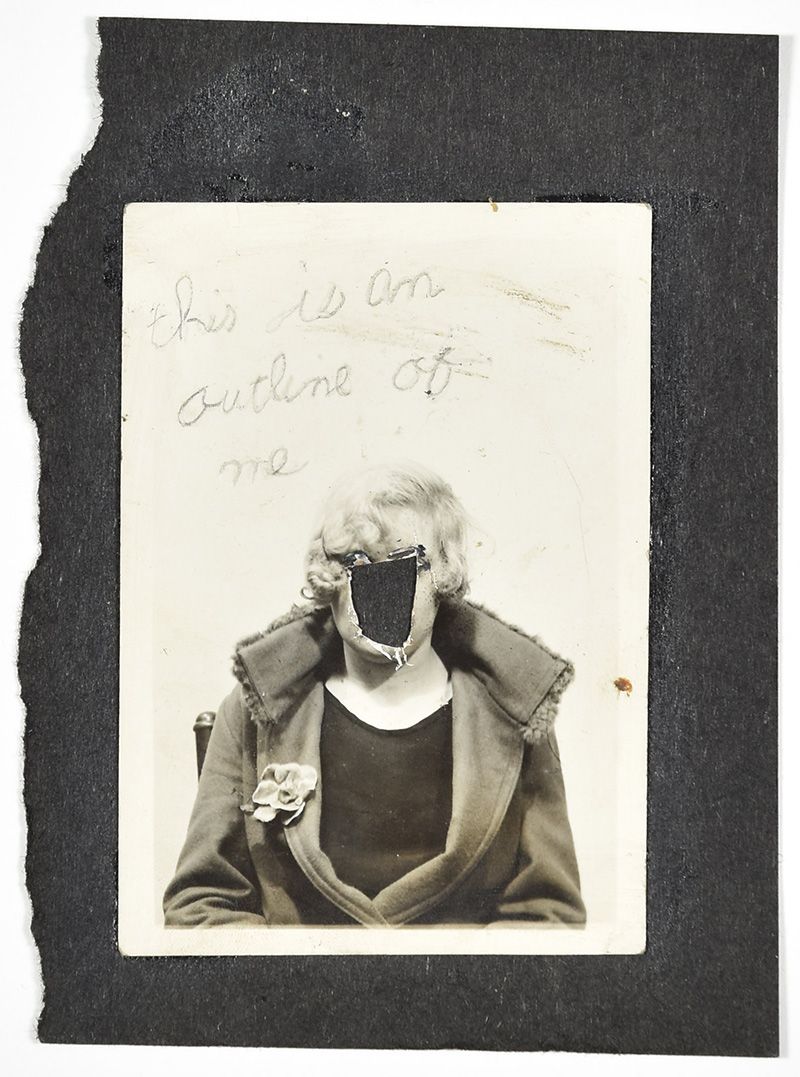
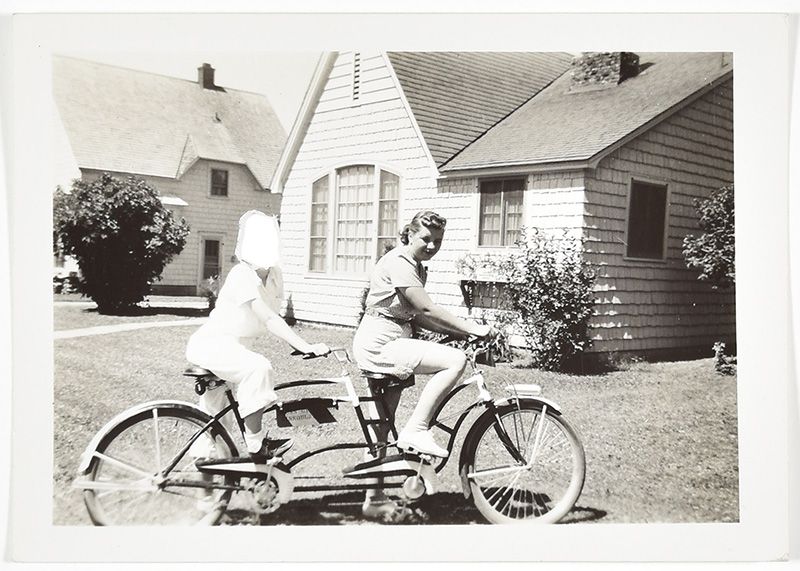
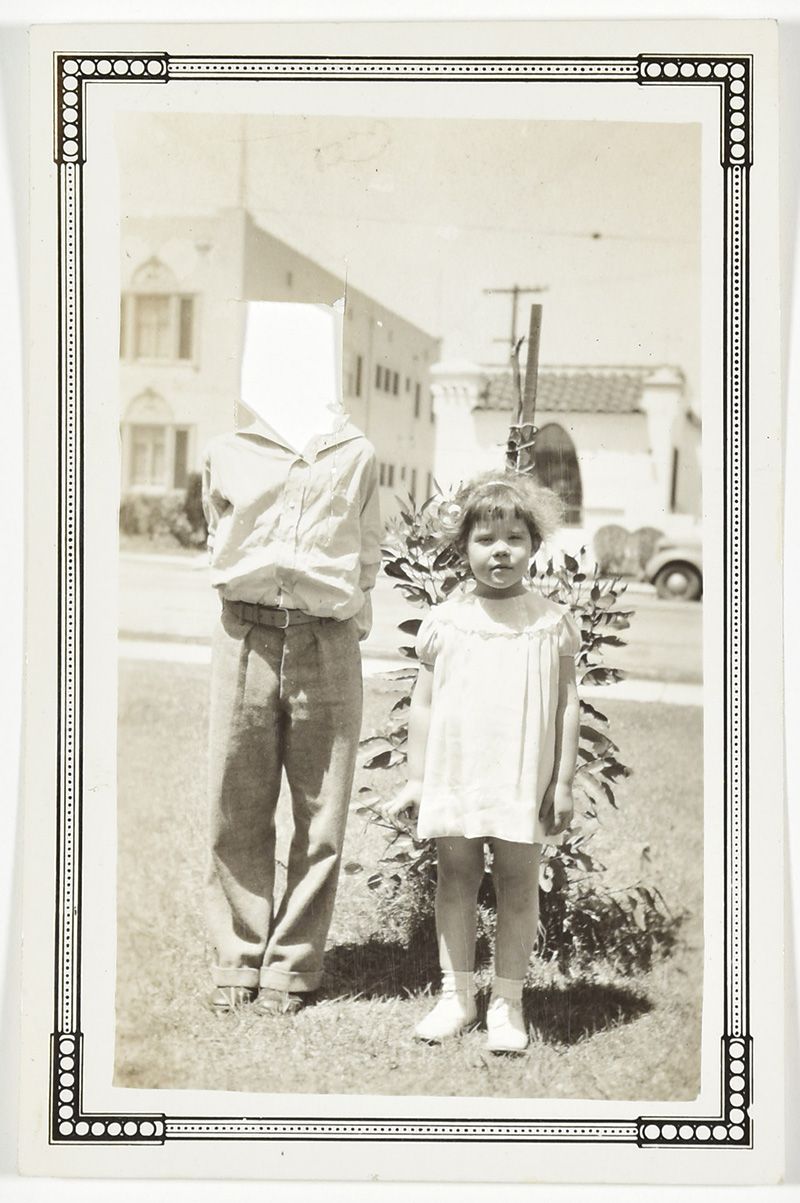
Sometimes, a photograph is too powerful. A hole is cut in it, as if to deflate its power. A face is snipped out, torn or erased. Family photo albums preserve holes like these. They may include light-hearted captions, such as ‘this is an outline of me’ or ‘omitted by request’. But, uncaptioned holes can be just as loud. Two women on a tandem bicycle, bound together in the frame. A small, erratic hole removes the head of one, the torn edges like a halo of hair. On the photo’s verso, nothing but the photo finisher’s stamp from Minneapolis and the date: ‘JUL 24 1940’. Who was she? Was her erasure immediate or retroactive? Another example: a little girl in a baby-doll dress posing outdoors with an older boy. He holds his hands neatly behind his back; his head is carefully cut out of the frame. The hole is meant to obliterate, but instead it draws attention, like water down a drain.

1 of 3

Recently, a particular set of holes has attracted the attention of artists and writers. During the economic depression of the 1930s in the United States, photographers hired by the Resettlement Administration, later the Farm Security Administration (FSA) – a federal agency of the New Deal government – created tens of thousands of pictures showing the impact of drought and migration on labourers. These photographs were at first meant to demonstrate the need for government assistance programmes, then to celebrate the success of such programmes. The head of the FSA’s Information Division, Roy Stryker, punched holes in the negatives that didn’t serve these purposes. Of the 145,000 images made, about 68,000 were considered rejects and 4,200 of these were hole-punched. The practice was dubbed ‘killing’ a negative.

In 2018, the Whitechapel Gallery in London hosted an exhibition of prints made from scans of the hole-punched negatives, alongside work made by contemporary artists in response. Press materials described the re-presentation of the killed negatives as ‘transform[ing] an act of censorship into abstract, conceptual and strangely beautiful pictures’. Articles in the popular press both preceded and followed the gallery’s attention to the holes. Writing in Atlas Obscura, Aïda Amer claimed that Stryker ‘tended to kill images with people smiling’, preferring pictures that were unambiguous in their demonstration of hard times and need. In The Atlantic, Alan Taylor chose images for their strangeness: holes that appear as a baseball cracking off a bat, a UFO in the sky, and an uncanny, empty mask.

Although the negatives had been held by the US Library of Congress since the mid-1940s and made widely accessible by digitisation in the 1990s and early 2000s, such articles emphasised the holes as visible evidence of Stryker’s ‘ruthless’ editorial practice. The holes were becoming visible. Nothing was becoming something. Elsewhere, forces that were mute for decades were also making themselves heard. In the United Kingdom, the historic Brexit vote of June 2016 led to the British prime minister David Cameron’s resignation. Months later, Democrats in the US watched in shock as the country voted to elect Donald Trump as president. Suspicion and resentment reigned. Rediscovery of the ‘killed’ negatives paralleled these political events. Holes were rent in society and these examples of 1930s US government propaganda seemed to confirm the hidden forces at work in everything.

The filmmaker and literary theorist Trinh T Minh-ha finds something politically powerful in holes. In her essay ‘The Image and the Void’ (2016), she recounts a story told by China’s longest-held woman political prisoner, Ngawang Sangdrol, formerly a Tibetan monastic who was sentenced to 23 years’ imprisonment. Sangdrol recalled that Chinese guards showed their Tibetan prisoners newspaper articles that revealed the West’s support for the Dalai Lama and Tibet. The guards took these articles as evidence of Western brainwashing, but the prisoners read them another way. The Tibetans were happy to see their country mentioned favourably in the press. Eventually, the guards understood that their tactic was not working, and they took to cutting out any positive notices about Tibet from the newspapers. Minh-ha relays:

However disconcerting this might have been, it did not deter the Tibetan prisoners from rejoicing upon seeing those glaring holes, for they knew each one represented something good someone was saying about Tibet. A lack thus loses its negative connotation to become an affirmation, and an absence is received as a much-anticipated presence. Fullness and emptiness yield similar results in their representative functions; whether granted for viewing or censored from view, the articles had the same effect on the prisoners.

Museums and libraries preserve other kinds of holes, too. There are many thousands of artists and authors whose work has not been collected or preserved by official archives. Maybe it was deemed unimportant, tangential or in conflict with history’s dominant narrative. There are millions of people whose words never made it into print; there are millions upon millions of thoughts that never made it into words. These absences are also holes in the archive. Contemporary authors have started paying attention to them.

Her method doesn’t fill in all the holes. She uses them to gain purchase, to crack the veneer of historical fact

Toni Morrison reflected on holes in the archive in her essay ‘The Site of Memory’, written while she was at work on the novel Beloved (1987). She explained that, although there exist more than 100 books written by formerly enslaved people in the US, none of these included the interior lives of their authors. The so-called ‘slave narratives’, written for a white abolitionist readership, largely spared their readers the most horrific experiences of enslavement, as well as their authors’ feelings about the trauma. Instead, 18th- and 19th-century Black authors gestured at and glossed over scenes of brutality in order to escape criticisms by the white press of sensationalism or impropriety. Morrison digs into these holes in her fiction. She describes it as ‘a kind of literary archaeology’. She continues:

On the basis of some information and a little bit of guesswork you journey to a site to see what remains were left behind and to reconstruct the world that these remains imply. What makes it fiction is the nature of the imaginative act: my reliance on the image – on the remains – in addition to recollection, to yield up a kind of a truth.

In her book Wayward Lives, Beautiful Experiments (2019), Saidiya Hartman gives voice to Black women and girls of the early 20th century whose lives are represented in official archives only as problems to be dealt with. These women imagined and enacted modern ways of living and loving that would be celebrated only when they were adopted later by white women called flappers. Hartman sees these earlier Black women as pioneers of liberation. Their ‘beautiful experiments’ were attempts ‘to make living an art’, despite being pathologised by white institutions as deviant or ‘wayward’.

Hartman had to work actively against the holes in the archive to tell these stories. The documents that name Hartman’s heroines include trial transcripts, reports by vice investigators, social workers and parole officers, sociological surveys, and prison case files: nothing that records the women’s own voices, their hopes or satisfactions. Hartman describes

read[ing] these documents against the grain, disturbing and breaking open the stories they told in order to narrate my own. It required me to speculate, listen intently, read between the lines, attend to the disorder and mess of the archive, and to honour silence.

She gives voice to a speculative past by drawing heavily on details found in the archives, but she focuses on the emotion and agency of the women who were subjects of the archive, rather than its primary authors. Crucially, Hartman’s method doesn’t fill in all the holes. She uses them to gain purchase, to crack the veneer of historical fact. Although she adds more voices to the archive, these few stories are also reminders of all the other stories not yet told.

Holes in the archive are so omnipresent as to be like the water the surrounds a fish, leaving the fish unaware of what water is. In his Kenyon commencement address ‘This Is Water’ (2005), David Foster Wallace unpacked the parable: ‘The point of the fish story is merely that the most obvious, important realities are often the ones that are hardest to see and talk about.’

Visible holes in the archives – a hole-punched photograph, a document with rusty pin holes – ought to remind researchers of the many holes that are so vast as to be nearly invisible. When we attend to them like Morrison or Hartman or Pope.L, these holes may reveal all the Universe, what it feels like to live in water. Through these holes flows the air we breathe. Holes in the archive are beacons that invite a search for what – and who – made today possible.

O what point is so marvellous.

ArtStories and literatureHistory