|\| ART BLOG HUMOR BLOG PHOTO BLOG CULTURE BLOG |:| FOR THE RENAISSANCE MAN & THE POLYMATH WOMAN |/|
Friday, August 9, 2019
Two of Helmut Newton’s Muses on What It Was Like to Work
Partner Content
‘He Felt I Was a Strong Woman’: Two of Helmut Newton’s Muses on What It Was Like to Work With the Notorious Fashion Photographer
Models Sylvia Gobbel and Linda Morand remember career-changing photo-shoots.

“My women are always victorious,” Helmut Newton once surmised. Of the great fashion photographers of the 20th century, the German-Australian photographer was among the most influential and likely the most imitated. From the 1950s through the 1990s, he perfected a frank, erotic vision that pushed the boundaries of fashion photography.
Certain models came to figure prominently in his oeuvre. These were women who, in Newton’s view, were more than attractive models, standing out as emblems of an empowered sexuality. Among these were Arielle Burgelin, Sigourney Weaver, Gunilla Bergstrom, Charlotte Rampling, and Henrietta Allias (who famously graced the cover of Sumo, Helmut Newton’s extravagantly oversized book). Newton once remarked, “I like photographing women who appear to know something of life.”
Currently, the online fine art photography space ONGallery is presenting a rare selection of Newton’s most highly regarded images. Below, we speak with two of his significant muses, Sylvia Gobbel and Lisa Morand, along with ONGallery director Keith Allsopp, offering insights into the legendary fashion photographer’s career.
Sylvia Gobbel on being chosen for Sie Kommen:

Helmut Newton, Sie Kommen (1981). Courtesy of ONGallery. Models (Left to right): Alexandra Pin, Henrietta Allias Purcell, Lisa Thorensen, Sylvia Gobbel.
“I think he [Newton] selected me because he felt I was a strong woman. I didn’t know it at that time yet. I went to the casting for French Vogue for the 1981 haute-couture edition. We were hundreds of models and he sent an assistant to pick me out of the line. He asked me a few questions and, with my accent, realized I was Austrian. We began to speak German together. It was a great connection, immediately, to speak the same language.

Helmut Newton, Sie Kommen (1981). Courtesy of ONGallery.Alexandra Pin, Henrietta Allias Purcell, Lisa Thorensen, Sylvia Gobbel.
I knew and understood his work. He asked if I would do nudes. I knew his nude photographs, for instance of Charlotte Rampling, and these were fantastic. Of course, I said ‘Absolutely, no problem.’ With any other photographer I would have refused but not with Helmut Newton. He booked me for the photo-shoot, which was the famous photo-shoot of four girls dressed in haute couture, and then the four girls in the same position naked, called Sie Kommen.”
Linda Morand on the Infamous Jackie O shoot for Vogue:

Helmut Newtown, Comme Jackie O. Photograph taken 1970. Print 1985. Courtesy of ONGallery. Model: Linda Morand.
“For my entire career, I had tried NOT to look like Jackie… I was disguising myself (rather unsuccessfully) with short hair and later with plucked eyebrows and dark lips, very un-Jackie. One day I met Helmut Newton who encouraged me to celebrate my own beauty and own my image. He said I should not cut my hair, but wear it long and big, because it suited me and the look of the time.
“He convinced me to stomp around the streets of Paris dressed in haute couture. I did wear couture at the time and had several garments in those styles. It was impossible to resist the temptation to be in Vogue and work with such a great master. (I had worked with him in 1966 at the French Space Center. Those pictures were very good but it was before Newton developed his distinct style).
“We used Vogue studio at Place de Bourbon. I remember that Ursula Andress was also being photographed that day, by someone else. She remarked that I looked so much like Jackie. We went to the American Embassy and the Ritz. He would stake out a location, have me stand there, near policemen or Marines, and have me stroll by. Newton stood across the street and shot with a telephoto lens. It was all very unobtrusive and the Marines and police didn’t realize that I or they were being photographed.
“For the shoot, he directed me to be very forceful, angry and strong, with a serious face. This was contrary to my more gentle, gamine style. The results are a testament to his skills not only as a photographer but also as a director. They looked like paparazzi style photos of Jackie.
“The use of my name was important because as it turned out I looked exactly like Jackie O. She was livid. When the photos were published, people were calling Jackie from all over the world, freaking out that she was in Vogue. If you read the fine print it said I was Linda Morand (Forquet de Dorne), a ‘certain client.’
Rumors of my parentage abounded. Oleg Cassini, the designer who was also romantic interest of mine, was convinced I was Jackie’s secret half-sister. I was appalled. I denied it.”
Dealer Keith Allsopp on Rare & Controversial Triptych:

Rue Aubriot, Yves St Laurent, triptych (1975)
Courtesy of ONGallery.
“To the best of my knowledge, these three pictures, each of them rare in itself, have never been seen together before and, as I can’t find any record of the kissing version having come to market before. I doubt they have ever been available for sale as a triptych before: truly rare individually; uniquely rare together.”

Helmut Newton, Rue Aubriot (1975). Courtesy of ONGallery.
“In the first image, Vibeke Knudsen stands alone dressed in what became known as the ‘Le Smoking’—the signature Yves St Laurent jacket. Newton has deliberately styled her in an androgynous way, perhaps influenced by his friendship with David Bowie. She is waiting in the lamp-lit street, for what, we wonder?

Helmut Newton, Rue Aubriot (two models) (1975). Courtesy of ONGallery.
Now, the story begins to unfold. A car has appeared in the background. Vibeke is joined by a companion, nude except for shoes and a barely-visible veiled hat. Who is she? We don’t know, and maybe never will know. The two are seen in half embrace, as if they just met. It’s sexually charged, but suggestive rather than overtly so.

Helmut Newton, Rue Aubriot for Yves St Laurent, French Vogue (1975). Courtesy of ONGallery.
Here, the two models, in the same setting, are seen in a passionate kiss. This is not the kiss of two friends, but of lovers. A highly and overtly sexually charged photograph in an era when same-sex relationships were, generally, still taboo and in many countries illegal. The story is complete. This picture was selected as an addition by June Newton in her revision of Newton’s book Sumo, published in 2013, which then accompanied the preceding two images. Perhaps she concluded that attitudes had changed enough for its publication. I don’t recall seeing it in any other publication, and this is only one of two that I have ever seen available for sale. It is the rarest of Newton’s pictures that I know.”

Article topics
Venice Decides to Ban Giant Cruise Ships Once and For All
| ||||||||
Art WorldAfter Damaging Collisions (and Too Many Near Misses), Venice Decides to Ban Giant Cruise Ships Once and For All
The Italian government has decided to begin diverting the giant ships away from Venice's central waterway.
![]()
Italian authorities have decided to begin diverting cruise ships away from Venice’s central waterway, the Giudecca canal. The historic move follows a series of collisions and years of protest against the giant vessels’ environmental impact on the famous lagoon city.
On Wednesday, officials from the Italian government said that cruise ships would be gradually diverted away from the city center and its ecologically sensitive lagoon. Danilo Toninelli, the Italian minister for transport, explained that the decision was “to avoid witnessing more invasions of the Giudecca by these floating palaces, with the scandals and risks that they bring,” according to the Financial Times.
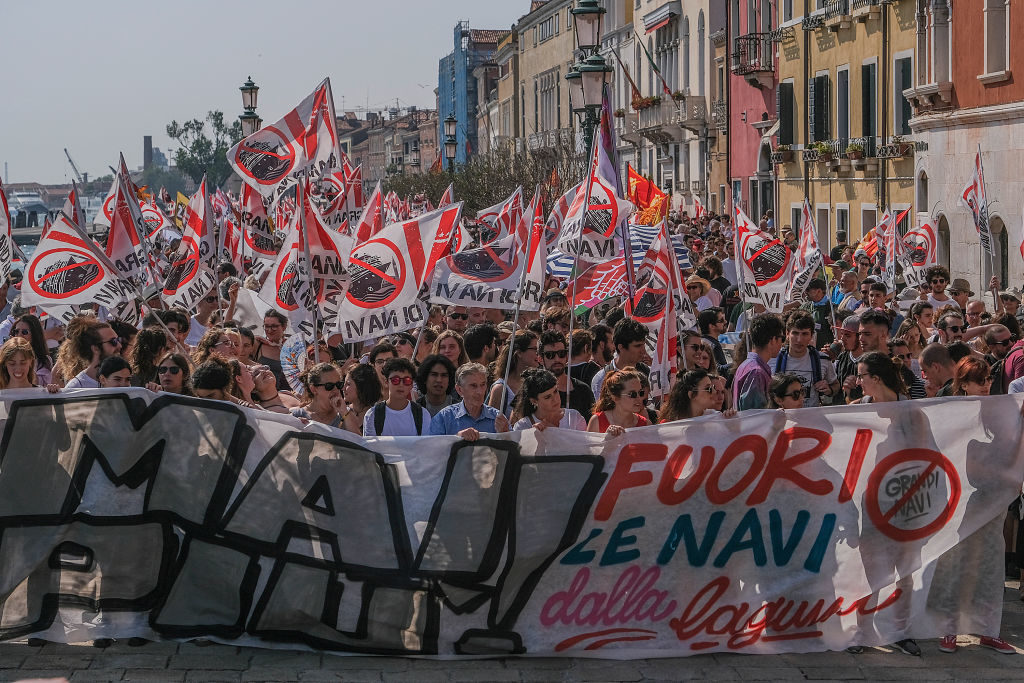
Growing calls for a solution to the increasing volume of traffic peaked this summer when five passengers were injured after the cruise ship MSC Opera struck a local tourist boat. The collision in the Giudecca canal in June saw the ship giant hitting a crowded jetty. Not long after, another ship nearly hit a restaurant during a storm.
The mayor of Venice, Luigi Brugnaro, said that a major tragedy was narrowly avoided in the MSC Opera incident. He had already announced earlier this year the introduction of a €3 tourist tax aimed at day-trippers, many of whom arrive by ship. The tax will come into effect as of December 31, a spokesperson for the local government told artnet News.
![]()
Protest in Venice, Italy, following the incident of MSC Opera. Photo: Stefano Mazzola/Awakening/Getty Images.
For decades, Venice has been been debating the economic costs and benefits of cruise ships in particular and mass tourism in general. Venice attracts 25 to 30 million foreign visitors per year, according to the Italian tourist bureau. Less than a third of them spend a night there. The local population is only 50,000 citizens.
Earlier this week, Venice called on other busy cruise ports in Europe, including Barcelona, Amsterdam, and Dubrovnik, among others, to help find ways of curbing the problem large ships pose to local communities in historic port cities.
“The growing size of the vessels, their environmental impact on the areas around our ports, and the pressure exerted by the increasing number of tourists, are creating a conflict situation,” explained Pino Musolino, the head of the Venetian port, according to Brussels Times. Musolino made the international request, and it has been reported that several ports have responded positively.
The newest initiative to begin reducing the number of massive liners sailing through the central canal is due to begin next month. Some cruise ships will be docked at two terminals away from the center of the city. The Fusina and Lombardia terminals are still inside the lagoon, however. The Italian transport minister says that, by next year, a third of cruise ships will be rerouted and that, in the longer term, new berths outside the lagoon will be found at Chioggia, at the opening of the lagoon, or Lido San Nicolo, a ferry terminal on the Adriatic side of Lido Island.
Mayor Brugnaro has other ideas, and favors the port of Marghera, where oil tankers dock, which is inside the lagoon.
Jane Da Mosto, who is a scientist and founder of the conservation group We Are Here Venice, told the Financial Times that the diversion of the liners is not enough to make a real difference, arguing that it would just create the same problems in a different part of interconnected and relatively small waters.
![]() |
Thursday, August 8, 2019
Subscribe to:
Posts (Atom)