Friday, August 17, 2018

Targeted Ads Stalking You? Here’s How to Make Them Stop


Are Targeted Ads Stalking You? Here’s How to Make Them Stop

Image
CreditTom Grillo
Online ads have always been annoying, but now they’re worse than ever.
Consider what happens when you shop online for a wristwatch. You peruse a few watch websites and the next thing you know, a watch advertisement is following you everywhere. On your computer, it’s loading in your Facebook feed. On your phone, it’s popping up on Instagram. In your web browser on either, it’s appearing on news sites that have nothing to do with watches. Even if you end up ordering the watch, the ads continue trailing you everywhere.
They’re stalker ads.
And they are a symptom of how online ads are becoming increasingly targeted and persistent. Tracking technologies like web cookies are collecting information about our browsing activities from site to site. Marketers and ad tech companies compile that data to target us across our devices. And trackers are now so sophisticated that they can see when you are thinking about buying something but don’t follow through — so they tell the ads to chase you around so you make the purchase.
To the ad industry, targeted ads are better for people than the old days of randomly blasting commercials.
“The content isn’t free, so what would you rather see?” said Sarah Hofstetter, the chairwoman for the ad agency 360i. “Ads that are at least trying to be of interest to you, or ads that are spray and pray?”
ADVERTISEMENT
That’s a fair point. On the other hand, these creepy ads can be extremely annoying, especially when they make incorrect assumptions. They are another example, along with obnoxious auto-play videos and internet trolls taking over internet comments, of how a few bad actors are breaking the integrity of the web.
Stalker ads also raise privacy concerns. A 2012 survey by Pew Research Center found that 68 percent of internet users did not like targeted advertising because they do not like having their online behavior tracked and analyzed. Your browsing history can reveal a lot about you, including your health issues, political affiliations and sexual habits.
You have 3 free articles remaining.
Subscribe to The Times
Fortunately, I have good news. After several years of interviewing internet companies and privacy experts and testing many web tools, I finally managed to make my stalker ads go away.

Why are ads stalking me?

Before you try to exorcise targeted ads, it helps to understand what’s going on behind the scenes.
Let’s say you are shopping online for a blender. You load a webpage for a blender from Brand X, then close the browser. The next time you open the browser, ads for the blender are following you from site to site. They’re also showing up in some of your mobile apps like Facebook and Instagram.
When you visited Brand X’s website, the site stored a cookie on your device containing a unique identifier. Brand X hired multiple ad tech companies to do its marketing. The ad tech companies embedded trackers that also loaded on Brand X’s website, and the trackers took a look at your cookie to pinpoint your device.
ADVERTISEMENT
The trackers can tell if you are interested in buying something. They look for signals — like if you closed the browser after looking at the blender for awhile or left the item in the site’s shopping cart without completing the purchase. From there, the ad tech companies can follow your cookie through trackers and ad networks on various sites and apps to serve you an ad for the blender.
Ms. Hofstetter said that among ad tech companies, there are good actors and bad actors. The good ones will try to minimize the chances of annoying you by showing you the blender ad only a few times and stopping if they detect that you made the purchase. The bad ones only care to persuade you to buy the blender, so they will relentlessly serve you the ad and not bother to determine whether you already bought it.
Things get extra messy when brands employ multiple ad tech companies that employ different approaches. Perhaps one ad company finished serving you the blender ad after a few times on Facebook. But elsewhere on the web or inside another app, another ad tech company served you that same ad endlessly.

What are some easy ways to sidestep stalker ads?

Here are a few simple steps you can take if you are being pestered by an ad and want that to end:
• Periodically, clear your cookies. Ad trackers will have a tougher time following you around if you delete your cookies on each of your devices. Apple, Google and Microsoft have published instructions on how to clear data for their browsers Safari, Chrome and Edge. (Click the links for instructions.)
• Reset your advertising ID. In addition to cookies, Android and Apple phones use a so-called advertising ID to help marketers track you. You can reset it whenever you want. On Android devices, you can find the reset button in the ads menu inside the Google settings app, and on iPhones, you can find the reset button inside the settings app in the privacy menu, under advertising.
• Periodically purge your Google ad history. Google offers the My Activity tool, myactivity.google.com, where you can take a deep look at the data that Google has stored about you, including the history of ads you have loaded, and choose the data you want to delete.
ADVERTISEMENT
• If possible, hide the annoying ad. On some web ads, like those served by Google and Facebook, there is a tiny button in the top-right corner that you can click on to hide the ad.

Can I bring that up a notch?

There are more extreme methods to take if you want to prevent targeted ads from ever following you around. But this isn’t for the faint of heart: In my experience, you have to take all, not just some, of these steps to get the pesky ads to leave you alone forever.
• Install an ad blocker. For your web browser, you can install add-ons that block ads. My favorite one for computer browsers is uBlock Origin, and on iPhones I recommend 1Blocker X. (For Android users, Google banned many ad blockers from its official Play app store, so the simplest way to block ads is by using a private web browser.)
• On mobile devices, use a private browser. Firefox Focus, DuckDuckGoand Ghostery Privacy Browser are privacy-centric mobile browsers that include built-in ad and tracker blocking. These are handy when you want to do a discreet web search. (They can be impractical to use as everyday browsers because the built-in blockers can break important parts of websites.)
• Install a tracker blocker. Tracker blockers detect snoopy code on websites and prevent them from loading. My favorite tracker blocker for desktop and mobile systems is Disconnect.me.
• Wherever you can, opt out of interest-based advertising. Tech companies including Google, Facebook, Twitter and Apple offer instructions on opting out of receiving ads based on your interests.
It will probably take you a couple of hours to set yourself up to prevent ads from haunting you. I gradually made all these changes to my devices and internet accounts over the last few years and only recently stopped seeing targeted ads. It was a grueling process.
But I’ve been happy with the results. Those wristwatch ads that once followed me are gone. And recently, I was served an ad for 7-11 on Instagram.
Was that ad irrelevant to me? Yes. But was it a sign that I was no longer being well tracked? Also yes. I confess I was pretty happy to see it.
Brian X. Chen, our lead consumer technology reporter, writes Tech Fix, a column about solving tech-related problems like sluggish Wi-Fi, poor smartphone battery life and the complexity of taking your smartphone abroad. What confuses you or makes you angry about your tech? Send your suggestions for future Tech Fix columns to brian.chen@nytimes.com.
A version of this article appears in print on , on Page B5 of the New York edition with the headline: Targeted Ads Stalking You? You Can Make Them Go Away. Order Reprints | Today’s Paper | Subscribe

Tuesday, August 14, 2018

How Conservators Keep Masterworks of Outdoor Sculpture Safe


Art
How Conservators Keep Masterworks of Outdoor Sculpture Safe
Claes Oldenburg and Coosje van Bruggen, Shuttlecocks, 1994. © Claes Oldenburg and Coosje van Bruggen. Courtesy of  Nelson-Atkins Media Services / Louis Meluso and the Nelson-Atkins Museum, Kansas City.
Claes Oldenburg and Coosje van Bruggen, Shuttlecocks, 1994. © Claes Oldenburg and Coosje van Bruggen. Courtesy of  Nelson-Atkins Media Services / Louis Meluso and the Nelson-Atkins Museum, Kansas City.
A   sculpture at New York’s Storm King Art Center just got a military-grade update. After years of exposure to the elements, the 23-foot-tall, matte-black, painted-steel City on the High Mountain (1983) needed a restoration. Storm King conservator Mike Seaman, working with the Getty Conservation Institute, decided on a durable solution: a special paint that the U.S. Army Research Laboratory has formulated for helicopters. At the end of the August, City on the High Mountain will return to the outdoor sculpture park after more than seven months, battle-ready.
Though the Department of Defense rarely gets involved with art institutions, the case study dramatizes a longstanding challenge that’s often invisible to the average sculpture garden visitor. How exactly does one go about protecting outdoor artwork?
Louise Nevelson, City on the High Mountain, 1983. © 2018 Estate of Louise Nevelson/Artists Rights Society (ARS), New York. Photo by Jerry L. Thompson. © Storm King Art Center, Mountainville, New York.
Louise Nevelson, City on the High Mountain, 1983. © 2018 Estate of Louise Nevelson/Artists Rights Society (ARS), New York. Photo by Jerry L. Thompson. © Storm King Art Center, Mountainville, New York.
According to Getty Conservation Institute associate scientist Rachel Rivenc (who worked on the Nevelson restoration with Seaman), “the sheer fact of being outdoors, exposed to the environment, rain, snow, or huge amounts of sunshine” makes for unpredictable decay. Additionally, the public is often free to engage with sculpture away from the watchful eye of guards—sometimes, artists even welcome these kinds of interactions (climbing, touching, walking atop). Yet, said Rivenc, “too much love is not always a good thing. The interaction can be detrimental for the preservation.”
Beyond the vicissitudes of the weather, external sources of deterioration come from materials both synthetic and natural. Rubbed-off sunscreen from a visitor’s curious hand is a nightmare for conservators; it’s especially difficult to remove. Dana Turkovic, curator at Laumeier Sculpture Park in St. Louis, Missouri, mentioned that bird poop requires a nonionic cleanser (gentler than everyday soaps).  
Matte coatings on painted outdoor sculptures offer another struggle. Artists from Nevelson and   to   and   have all finished their work with low-gloss paints. These require “fillers”—various materials (like clay, lime, or earth) that decrease the amount of resin on the surface, and ultimately reduce the hue’s shine. When there’s less resin protecting pigments, said Rivenc, they’re prone to chalking, flaking, and fading.
Before cleaning: Tony Smith, Lipizzaner, 1976. Courtesy of the New Orleans Museum of Art.
Before cleaning: Tony Smith, Lipizzaner, 1976. Courtesy of the New Orleans Museum of Art.
After cleaning: Tony Smith, Lipizzaner, 1976. Courtesy of the New Orleans Museum of Art.
After cleaning: Tony Smith, Lipizzaner, 1976. Courtesy of the New Orleans Museum of Art.
Repainting a work, said Seaman, can be an arduous process. Enormous outdoor sculptures, some weighing in at multiple tons, would need to be removed from the lawn, trucked to a facility, stripped, and painted—with each step of the process being documented along the way. His team has to determine whether to clean off or remove the paint on the surface, whether it should be abrasively blasted off, and how the surface of the underlying material (pre-paint) should feel. Some areas may need chemical stripping.“We’re not just applying paint,” said Seaman. “We’re applying different coats of different types of primers to protect the substrate, and then to allow for a proper adhesion for a top coat.”
Sometimes, however, a certain amount of material corruption is actually integral to a sculpture. At Laumeier,   incorporated an abandoned 1929 swimming pool into a larger wood, stone, steel, and concrete structure that functions as a meeting place comprised of stairs, a raised platform, and a shaded pavilion.
The functional sculpture, Pool Complex: Orchard Valley (1983–85), hosts poetry readings, cocktails, and special events. Such use has weakened the architecture over the decades, and the park must be cognizant of safety hazards. Miss has visited Laumeier to consult on strategies for upkeep, and the discussion is ongoing. “She really feels strongly about it maintaining its natural life,” said Turkovic. The park may yet have to compromise on aesthetics to ensure visitor safety.
Mary Miss, Pool Complex: Orchard Valley, 1983-85. Courtesy of Laumeier Sculpture Park.
Mary Miss, Pool Complex: Orchard Valley, 1983-85. Courtesy of Laumeier Sculpture Park.
Many conservators noted that ongoing conversations with artists are crucial to ethical practices. Susie Seborg Anders, of Southern Art Conservation, LLC, once worked with   to discuss the pros and cons of different conservation approaches for one of his large-scale sculptures. “It was amazing to have his input and explain to him why we would make certain decisions from a conservation perspective,” she said. Ultimately, they were able to align their ideas about how to alter the work.
Seborg Anders recorded her discussions with Oldenburg, uploading them to a database created by the International Network for the Conservation of Contemporary Art. The organization maintains the archive (available only to members) to ensure that conservators have access to artists’ wishes, even after they’re deceased.
Joe Rogers, an object conservator for Kansas City’s Nelson-Atkins Museum and its Donald J. Hall Sculpture Park, has also worked with Oldenburg. The park owns four of his famed Shuttlecocks (1994), which do indeed resemble giant badminton accoutrements, scattered in varying positions across the lawn. “He wants them to look brand new,” said Rogers, “which is hard to do when people are climbing on them.” Accordingly, he must arrange consistent upkeep, using scaffolding and a hydraulic lift to reach the top of the nearly 18-foot-tall works. It takes at least four people to clean it at a time using mild detergent.  , in contrast, told the garden while he was still alive that he wanted his contribution, Rush Hour (1983/1995), to look—according to Rogers—as though it had been “in the ocean for a thousand years.”
Susie Seborg Anders with Claes Oldenburg looking at Giant Soft Fan, 1966-67, at the Museum of Modern Art, New York. Courtesy of Susie Seborg Anders.
Susie Seborg Anders with Claes Oldenburg looking at Giant Soft Fan, 1966-67, at the Museum of Modern Art, New York. Courtesy of Susie Seborg Anders.
’s Three Bowls (1990) is another particularly tricky work for Rogers and his crew. A blackening layer of graphite covers the exterior of the massive cedar sculpture, which comprises three 15-foot-tall conic forms. Every year, the work requires waterproofing. Additionally, to meet von Rydingsvard’s aesthetic requirements, the team must reapply the graphite with a brush every three years. For years, the artist used to visit the park to conduct the upkeep herself. Now, it’s the park’s responsibility. “It goes everywhere,” said Rogers. “It’s really kind of a mess.”  
According to Cindy Burlingham, deputy director of curatorial affairs at the Hammer Museum, the biggest challenge for the museum’s Franklin D. Murphy Garden is “to make sure that the blades on the kinetic sculpture by   stay appropriately balanced so that they move freely with the breezes in the way the artist intended.” The sculpture, Two Lines Oblique Down, Variation III (1970–74), comprises a stainless steel Y-formation with arms that gracefully rise and fall as the wind passes. Rickey died in 2002, and the Garden honors his original vision.
When an artwork’s creator is deceased, conservators rely on their estates for guidance. To maintain outdoor sculptures by   and Alexander Calder, the Hammer Museum consults with the artists’ archives, which specify the correct type of paint for each work.
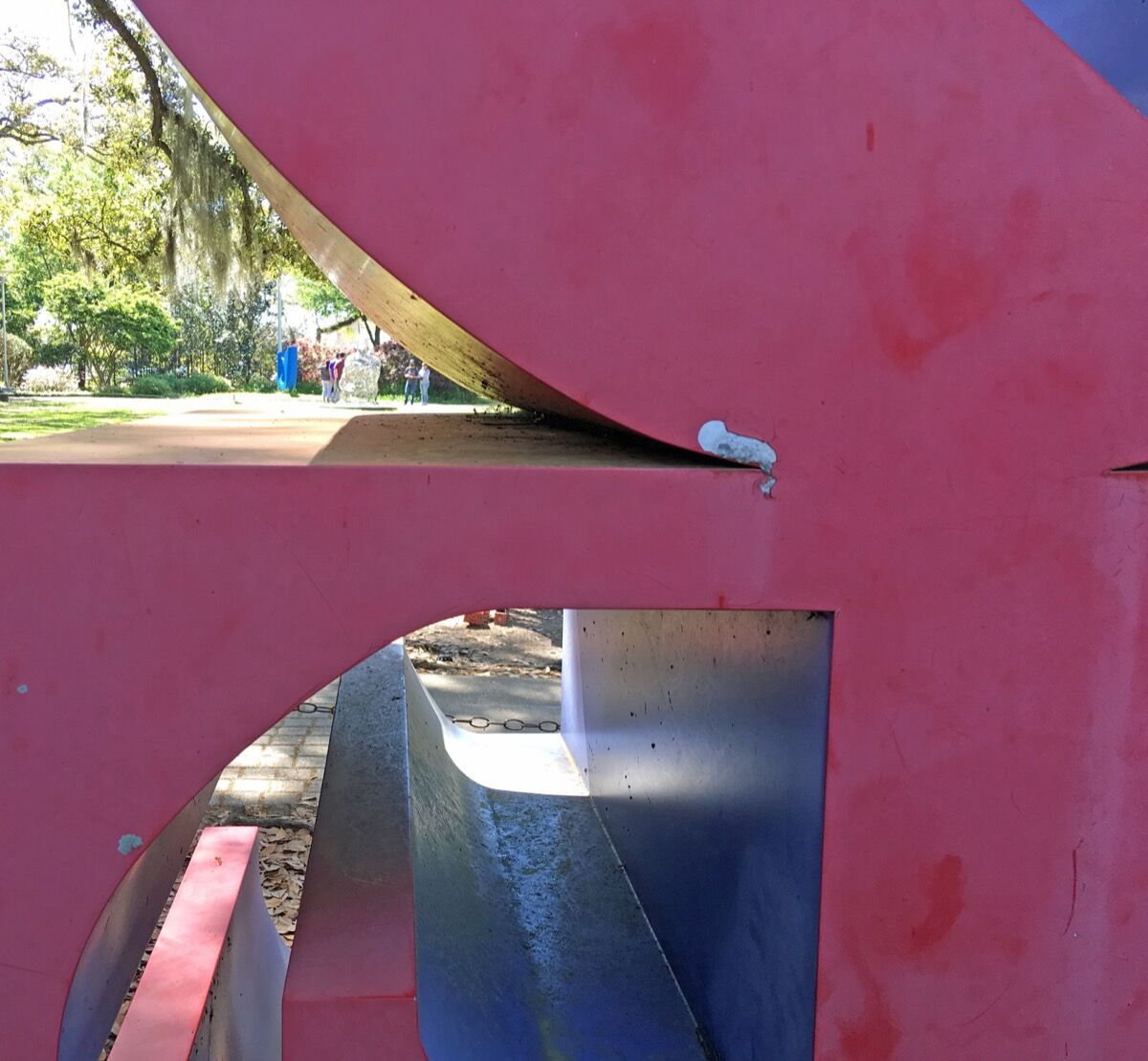
Flaking paint in a detail of Robert Indiana, LOVE (red outside violet inside), 1966-97.  Courtesy of the New Orleans Museum of Art.
Flaking paint in a detail of Robert Indiana, LOVE (red outside violet inside), 1966-97.  Courtesy of the New Orleans Museum of Art.
Robert Indiana, LOVE (red outside violet inside), 1966-97.  Courtesy of the New Orleans Museum of Art.
Robert Indiana, LOVE (red outside violet inside), 1966-97.  Courtesy of the New Orleans Museum of Art.
Sometimes, an artist’s estate has more pressing business than consulting with conservators. Seborg Anders noted that one of her most demanding tasks at the New Orleans Museum of Art’s Besthoff Sculpture Garden is conserving Love, Red Blue (1966–97) by  . “The colors are faded significantly,” she said. As the estate has been “dealing with other things” (a raging legal fight over Indiana’s $28 million legacy, perhaps), Seborg Anders has developed a short-term plan to address issues of paint flaking and a long-term plan for repainting. She’s hesitant about taking more aggressive steps. “What level of damage [means it’s] too much to fix locally, and do we have to resurface?” she said. “Those are irreversible decisions that will also establish the protocol for the future preservation of the works.”
Sometimes, outdoor sculpture upkeep more closely resembles gardening. In 2013, Laumeier commissioned   to erect Topiary, which is comprised of three intricately shorn hetz juniper trees. “That’s a good metaphor for conservation,” said Turkovic. “It requires pruning, real care, maintenance, and someone who is very in tune with those materials. That’s a perfect example of what it takes to maintain all of the pieces here.” 
Alina Cohen is a Staff Writer at Artsy.
Correction: A previous version of this article contained an error, which incorrectly stated that Rachel Rivenc was a scientist with the J. Paul Getty Trust. She is a scientist with the Getty Conservation Institute.