Friday, May 11, 2018

I Am a Person Who Flosses Every Day


I Am a Person Who Flosses Every Day

What can I say? I love flossing! Some people think that makes me weird, but I think that people who don’t like flossing are the crazy ones.
What’s my favorite part of flossing? It’s impossible to choose. I mean, obviously, practicing good oral hygiene is just generally thrilling, but for me it’s really about the specifics of the daily ritual. I love hunching over my sink and drooling all over the place. I love making hideous faces into my mirror while I strain to see what could possibly be crammed between my back molars. I love desperately trying to manipulate a garrote-like piece of string that’s pulled so tight around my fingers that it cuts off circulation. I love how when you try to throw the floss away, it sticks to you, and you have to shake your hand really hard to try to get it into the trash, but then you shake too hard and the floss flies off and lands in the dirtiest, most out-of-the-way corner of your bathroom, and you have to reach back there, and your hand brushes up against some kind of filth, and you feel like no matter how much you scrub and scrub you’ll never be clean again.
Man, just talking about it makes me want to go and floss right now!
And flossing really doesn’t hurt. Sure, there might be a little blood at first, but, if you floss every day, your body will adapt. My gums used to be weak, like tissue paper, but now I can flex my gums. To think that I didn’t even realize that you had muscles in your gums! I barely even chew things with my teeth anymore; I just mash food up between my lips and my big strong gums. Take it from me: once you become a regular flosser, you’ll start smiling extra wide so that everyone can see your thick, beautiful gums.
If I was trapped on a desert island and had to choose between having food and no floss, or floss and no food, I think at this point I don’t need to tell you which I would pick.
I’m not saying that there’s no sacrifice involved. I spend easily two hundred dollars every week on floss. Plus, I now have to drive all the way to a drugstore in a different town, after I got banned from my local drugstore for repeatedly asking everyone there to “behold my gums.” But it’s all worth it for the pride I feel every time I run my tongue over my glorious beefcake gums.
Don’t ever speak of floss picks in my presence! That’s not real floss.
I used to be afraid of going to the dentist, but, now that I’m a daily flosser, appointments are a breeze. I remember the first time I went in for a cleaning after I started my flossing regimen. Dr. Flynn took one look into my mouth and shrieked, “No! No! No one is actually supposed to floss every day! What have you done?!” He ran away and never came back, and I got to take as many floss samples as I could carry. These are just some of the benefits of having slightly above-average dental health.
I guess what I’m saying is, flossing really isn’t as bad as you think. So why not join me, friend? Become a daily flosser, and together we can usher in a new era in which we rule the world, as half-gum, half-human overlords. You might suspect that all the flossing has driven me mad, but, under my reign, never again will anyone be forced to suffer the humiliation of having a little piece of food stuck in his teeth. All teeth will be spotless; mouth inspections will be mandatory; and floss will come in never-ending spools. And if being a Fascistic floss tyrant doesn’t appeal to you, you really should be flossing, anyway. For your oral health.
    Sign up for the Daily Humor newsletter and get The New Yorker cartoons and Shouts—plus more funny stuff—every day in your in-box!

    Tuesday, May 8, 2018

    VANTAG's been there!!! VANTAG's done that... AND MORE!


    PHOTOGRAPHY ON A POSTCARD

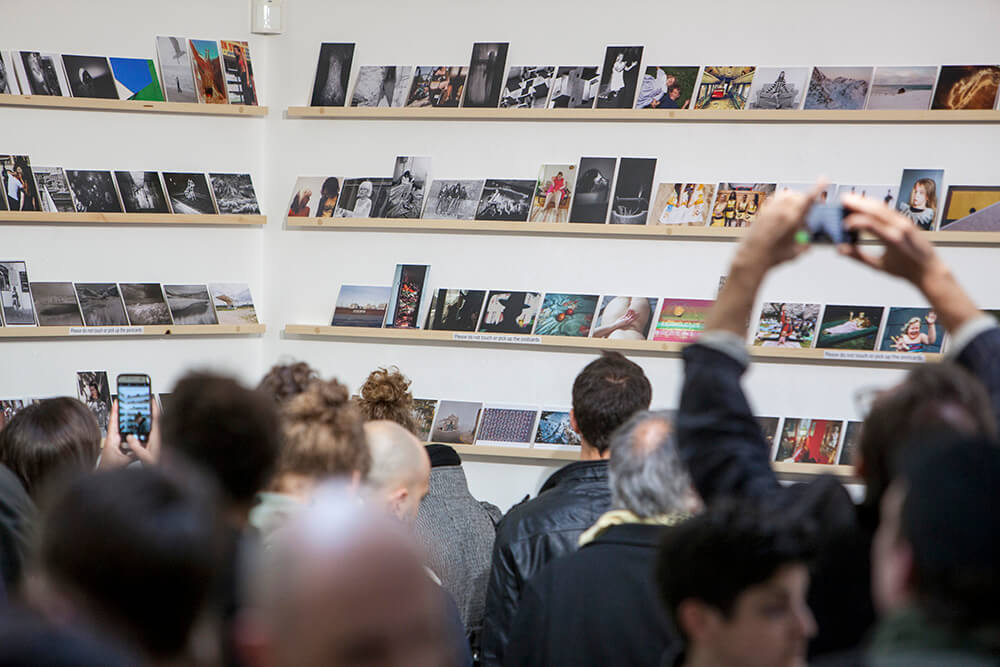
    Art on a Postcard and Photo London are delighted to announce their partnership for this year’s Fair. Art on a Postcard’s “Photography on a Postcard” will offer fairgoers the unique opportunity to own a one-off edition by a world-renowned photographer for just £55. But there’s a twist – the images will be anonymous. Fairgoers are able to choose which of the 350 postcard sized photographs they would like buy but the photographer will only be revealed at the end of the Fair.
    Priority will be given to those pre-registered online and all money raised goes to The Hepatitis C Trust’s campaign to eliminate hepatitis C from the UK by the year 2025.
    Photographers taking part this year so far include Bruce Gilden, Mark Power, Homer Sykes, Maggie Taylor, Lottie Davies, Nick Brandt, David Titlow and, Alma Hasar Karine Lavan, Scarlett Hooft Graafland. A full list of the photographers taking part in this year’s Photography on a Postcard will be available before the event.
    Register your interest to be first in the queue.


    With thanks to


    How did the Rockefellers shape the modern art market?


    How did the Rockefellers shape the modern art market?

    Ahead of the sale of the David and Peggy Rockefeller collection at Christie’s this week, the family's archivist examines their approach


    David and Peggy Rockefeller in 1973 Courtesy of the Rockefeller Archive Centre
    The name Rockefeller is inextricably linked with

    How did the Rockefellers shape the modern art market?

    Ahead of the sale of the David and Peggy Rockefeller collection at Christie’s this week, the family's archivist examines their approach


    The name Rockefeller is inextricably linked with an astute understanding of markets. In 1870, aged barely 30, John D. Rockefeller, Senior created Standard Oil, and by the early 20th century, he was worth at least a billion dollars. His descendants displayed similar market savvy in investing their considerable inheritance, notably in art.
    an astute understanding of markets. In 1870, aged barely 30, John D. Rockefeller, Senior created Standard Oil, and by the early 20th century, he was worth at least a billion dollars. His descendants displayed similar market savvy in investing their considerable inheritance, notably in art.
    The Rockefellers entered the Modern art market in its earliest days, and the manner in which they collected reflects, perhaps influenced, its dramatic growth through the 20th century. Alongside Henry Clay Frick, J.P. Morgan and Andrew Mellon, John D. Rockefeller, Junior was a client of the British art dealer Joseph Duveen. Duveen built a business out of selling the collections of European aristocrats to American millionaires and once said: “Europe has a great deal of art, and America has a great deal of money.”
    Junior was traditional in his collecting tastes, and in 1915, through Duveen, spent $1.8m on a portion of J.P. Morgan’s vast collection of Ming and Kangxi porcelain. But his wife, Abby Aldrich Rockefeller, had a much greater impact on Modern museum collections and the art market as we know it.
    Despite modest financial resources and her husband’s loathing for contemporary art, Abby began collecting the work of living artists in the 1920s. More importantly, she joined with like-minded collectors to create a space where this art could be displayed, what would become the Museum of Modern Art (MoMA). This group sought to stimulate a market demand for Modern art by legitimising what were, to many, disturbing forms of art. They fought to expand the accepted canon of art to include Monet, Cézanne, Picasso, Braque, Klee, Kirchner and their contemporaries—and eventually succeeded.

    In good taste

    Abby’s tastes had a powerful impact on her children, David Rockefeller in particular. When he and his wife, Peggy, began collecting in the late 1940s, Alfred Barr was their principal mentor, as he had been for Abby in the 1920s and 30s. He honed their knowledge of the Impressionists, Post-Impressionists, Fauves and their successors, and introduced the couple to dealers he thought reputable–Dalzell Hatfield, Georges and Daniel Wildenstein, Sam Salz, Justin Thannhauser and Paul Rosenberg.
    In 1955, Rosenberg and Barr played a role in the Rockefellers’ acquisition of Manet’s La Brioche (1870), Seurat’s the Roadstead at Grandcamp (1885) and Cézanne’s Boy in a Red Waistcoat (1893-95) for a total of $500,000 from the mining magnate A. Chester Beatty. In return for the Rockefellers’ agreement to leave the Cézanne to MoMA, Barr convinced Rosenberg to allow them the first choice of the 80-odd Impressionist paintings in Beatty’s collection. As David later said: “Had I been able to afford them, I would have been very tempted to buy them all.”
    A decade later, William S. Lieberman, MoMA’s curator of paintings and sculpture, negotiated the $6m sale of 47 paintings by Pablo Picasso and Juan Gris from Gertrude Stein’s estate to a syndicate headed by David and his brother, Nelson Rockefeller. Among the works was Picasso’s Girl with a Basket of Flowers (then valued at $845,000) and Reservoir: Horta de Ebro (valued at $325,000), which was later donated to MoMA.
    The library at East 65th Street, where Picasso’s Fillette Ã¥ la corbeille fleurie (est in the region of $90m) was displayed Courtesy of Christie’s

    Hefty returns

    MoMA’s curators (including Dorothy Miller, William Rubin, Kirk Varnedoe, Christophe Cherix, and its current director, Glenn Lowry) continued to advise the Rockefellers, alongside dealers, particularly the late Eugene Thaw. But inevitably, there were a few misjudged buys: an Albert Bierstadt landscape that turned out to be a much less valuable Hermann Herzog, and a Thomas Sully portrait of a young gentleman actually painted by an unidentified artist. Most intriguing is a small Diego Rivera watercolour, bought by David from a Maine lobsterman, who had inherited it from his wealthy employer. More than 40 years later, it was found to be a well-done fake.
    The post-war works of the Abstract Expressionists were, for the most part, not to the Rockefellers’ tastes. However, they did buy an early Rothko in 1960 for $9,000, which David hung in his office. He sold it at auction in 2007 for $72.8m, a then-record price, and remarked to me at the time that it “might have been the best investment I ever made”.
    However, in general the Rockefellers bought art because it appealed to them, not because they expected a hefty return on their investment. Neither would have anticipated the value of their collection today, nor would Abby have foreseen the impact her own avant-garde leanings would have on the museum collections and the art market of today.
    • The Peggy and David Rockefeller Collection, 8-10 May, Christie’s New York. All proceeds will be donated to charity

    Appeared in The Art Newspaper, 301 May 2018