Friday, December 29, 2017

What Sold—and for How Much—at Art Basel Miami Beach


Price Check! Here’s What Sold—and for How Much—at Art Basel Miami Beach

Here's what art dealers say they sold at the fair (though watch out for number-fudging and other kinds of general sneakiness).
Art Basel 2017.
There’s a reason why Art Basel in Miami Beach has been dubbed the art world’s Black Friday. Judging from gallery reports, the pace of sales—replete with six- and seven-figure blue-chip works—went at a reasonably fast clip during the fair, which closed on December 10.
As usual, sales reports are slippery—some purchases may have been finalized long before the fair, while others might only be hypothetical, still awaiting the all-important paperwork (and cash). Prices, however, are far more reliably telling, giving a valuable snapshot of where individual artists stand in the art-market matrix today. As a result, some dealers prefer to report ranges or the “asking price,” to obscure the actual price and, for instance, cover up any favorable treatment that another buyer of a comparable work may not have received.
So take all of this with a grain of salt.
That said, to hear it from galleries, a considerable number of works sold for over $1 million during the week. Among them was Bruce Nauman‘s eerie ceiling-hung Untitled (Two Wolves, Two Deer) (1989), which had a price tag of $9.5 million and was sold by Hauser & Wirth to a collection in Asia.
Ellsworth Kelly,<i>Sumac</i> (1959). Courtesy Lévy Gorvy.
Ellsworth Kelly’s Sumac (1959). Courtesy Lévy Gorvy.
PUBLICIDADE
Another top price—and hardly surprising given the artist’s current rock-star status—was for a just-completed Mark Bradford triptych, Moon Rocks(2017), also sold by Hauser & Wirth, for $5 million. Mnuchin Gallery also had a red dot for another, much earlier Bradford work with a $3 million asking price, Fly in the Buttermilk (2002).
There’s a lot more where that came from. Here is a (partial) roundup of notable sales at the fair as reported to artnet News, helpfully listed by price:
Bruce Nauman's Untitled (Two Wolves, Two Deer) (1989). © ARS, NY and DACS, London, 2017. Courtesy of Hauser & Wirth.
Bruce Nauman’s Untitled (Two Wolves, Two Deer) (1989). © ARS, NY and DACS, London, 2017. Courtesy of Hauser & Wirth.

Sculpture

$9.5 million: Bruce Nauman’s installation Untitled (Two Wolves, Two Deer) (1989) placed by Hauser & Wirth into a collection in Asia
$1.35 million: John Chamberlain‘s Sahsimi Mendoza (1979) at Galerie Thaddaeus Ropac
$1.2 million: Ugo Rondinone‘s towering tree sculpture Hunger Moon (2013)—perhaps the most-Instagrammed work at the fair—sold at Galerie Eva Presenhuber
$850,000: Donald Judd‘s Untitled (1991) at David Zwirner
$800,000: Franz West‘s Untitled (2009) at David Zwirner
$750,000: Urs Fischer’s statue of the artist Adam McEwen at Sadie Coles HQ
$700,000: Hannah Wilke’s latex wall work Mellow Yellow (1975) at Alison Jacques Gallery
$500,000: Carmen Herrera’s geometric red sculpture from 1962/2015 at Lisson Gallery
$250,000: Carol Bove’s sculpture at David Zwirner
$200,000: Terry Adkins’s Yuma (2013) at Lévy Gorvy, which just began representing the Adkins estate
$165,000 (approximately): Daniel Buren‘s Prisms and Mirror, high reliefs, situated works 2016/7 for Sao Paulo (2017) at Galeria Nara Roesler
$175,000–200,000: Erwin Wurm’s Untitled (bag with 2 legs) (2017) at Lehmann Maupin
$141,344: Sculpture by Katharina Grosse at König Galerie
$125,000: Ivan Navarro’s Sediments (2017) at Paul Kasmin Gallery
$100,000–110,000: Ha Chong-Hyun’s Conjunction 17-05 (2017) at Tina Kim Gallery/ Kukje Gallery
$80,000: Jose Dávila’s Joint Effort (2017) at Galleri Nicolai Wallner sold to the Museo de Arte Contemporáneo de Buenos Aires
$65,000: Haegue Yang‘s Semi-dépliable-Andante (2011) at Tina Kim Gallery
$50,000: Sam Durant‘s electric sign Speak The Truth Even If Your Voice Shakes (2015) at Blum & Poe
$11,000: Mariela Scafati’s hanging painting Pesos (2017) at Isla Flotante
Mark Bradford’s Moon Rocks (2017). Courtesy of Hauser & Wirth.

Painting

$7 million: Lee Krasner‘s Sun Woman 1 (1957) at Paul Kasmin Gallery
$5 million: Mark Bradford’s triptych studded in luminous black stones, Moon Rocks (2017) at Hauser & Wirth
$4 million–5 million: Ellsworth Kelly‘s historical painting Sumac (1959) capped off day three at Lévy Gorvy’s booth
$3 million: Mark Bradford’s Fly in the Buttermilk (2002), a painting named for critic Greg Tate’s description of Jean-Michel Basquiat, sold at Mnuchin Gallery
$3 million: A painting by Joan Miró at Di Donna Galleries
$2.9 million: Yoshitomo Nara‘s Young Mother (2012) at Pace Gallery
James Rosenquist's Coenties Slip Studio (1961). Courtesy of the artist and Galerie Thaddaeus Ropac.
James Rosenquist’s Coenties Slip Studio (1961). Courtesy of the artist and Galerie Thaddaeus Ropac.
$2.7 million: James Rosenquist‘s Coenties Slip Studio (1961) at Galerie Thaddaeus Ropac
$1.75 million: Sigmar Polke‘s Transparent #8 (1988) at Michael Werner
$1.5 million: Alberto Burri‘s Bianco Plastica B 1 (1967), made from plastic, acrylic and combustion on celotex, at Mazzoleni
$1.2 million: Neo Rauch‘s Tank at David Zwirner
In excess of $1.2 million: Pierre Soulages‘s Peinture 130 x 97 cm, 28 Octobre (1966) from first-timer Applicat Prazan gallery
Above $1 million: Pierre Soulages’s painting from the Outrenoire series at Lévy Gorvy
$1 million: Yayoi Kusama‘s Standing at the Flower Bed (2013) at David Zwirner
$900,000: A work by Paolo Scheggi from 1967 at Tornabuoni Art
$850,000: Urs Fischer’s painting at Sadie Coles HQ
$400,000: Roberto Matta’s The Birth of the Dream (1953) at Robilant + Voena
$450,000: George Condo‘s Giant Head Composition (2017) at Sprüth Magers
$300,000–500,000: Paintings from the ’60s and ’70s by Frank Bowling at Hales Gallery
$350,000: A.R. Penck’s tskrie 4 (1984) at Michael Werner Gallery
$275,000: Dana Schutz‘s Self-Exam (2017) at Friedrich Petzel Gallery
Mary Corse’s Untitled (2017). Photo: courtesy of Lehmann Maupin.
$250,000–300,000: Two Mary Corse paintings from DNA Series (2017) at Lehmann Maupin. Corse has a big year ahead of her: she has a major solo exhibition at the Whitney Museum and a presentation at Dia: Beacon, both slated for spring of 2018.
$250,000–275,000: Jonas Wood‘s WKS NPP #6, DKG NPP #1, DKG NPP #2, Maritime NPP #8 (all 2017) at David Kordansky Gallery
$225,000: Markus Lüpertz‘s Susanne (2017) at Michael Werner Gallery
$150,000: Stanley Whitney’s East Orange (2017) at Galerie Nordenhake
$150,000: Robert Colescott’s Magic Act II: Reverse Miscegenation (1970) at Blum & Poe. The Colescott estate is a new addition to the gallery’s stable.
$130,000–140,000: Liza Lou’s Relief 3 (2017) at Lehmann Maupin sold to a trustee of the Albright-Knox Art Gallery.
$120,000: Jennifer Guidi’s large-scale Elements of All Entities (Universe Mandala SF #6G, Green, Black Sand) (2017) at David Kordansky
$110,000: Henry Taylor‘s Sungtae Kim – Drinking coffee in my chinatown Studio (2012) at Blum & Poe
$100,000–110,000: Ha Chong-Hyun’s Conjunction 17-05 (2017) at Tina Kim Gallery/ Kukje Gallery
$100,000: a Josh Smith painting at David Zwirner
$75,000: an untitled painting from 2017 by Lesley Vance at Bortolami Gallery
$65,000–75,000: Angel Otero’s Chasing the Tear (2017) at Lehmann Maupin
$60,160: Sam Moyer’s stone, marble, dyed canvas mounted to MDF, Georgia (2016
), at Sean Kelly Gallery
$45,000: Two paintings by Julia Wachtel, Making History and Black and White (both 2017) at Elizabeth Dee Gallery
$42,000: a large oil on linen painting by Julia Rommel (2017) at Bureau
$35,000 (approximately): Keltie Ferris’s Gray Matter (2017) at Mitchell-Innes & Nash
$35,000: William N. Copley’s Untitled (1964) at Paul Kasmin Gallery
$22,000 each: Several paintings from the ’80s by Judith Bernstein at The Box
$10,000–60,000: Portraits by Nathaniel Mary Quinn sold out at Rhona Hoffman Gallery
$5,000: Silvina Der Meguerditchian’s Ellis Island (2017) sold to a Chicago-based collector at Kalfayan Galleries
Jonas Wood's WKS NPP #6 (2017). © the artist and David Kordansky Gallery.
Jonas Wood’s WKS NPP #6 (2017). © the artist and David Kordansky Gallery.

Works on Paper, Photographs, and Editions

$1–1.5 million: Sol LeWitt‘s gouache on paper 100 Cubes (1991) at Paula Cooper Gallery sold within the first hour of the VIP preview to a large public collection in Europe.
$875,000: Lee Krasner’s Untitled (1962) at Paul Kasmin Gallery
$700,000: Robert Longo‘s charcoal on paper Untitled (Trumpsville) at Metro Pictures
$100,000: a Thomas Ruff photograph at Konrad Fischer Galerie
$95,000 each: Photographs by Wolfgang Tillmans at David Zwirner
$94,405: Two editions of Thomas Struth‘s inkjet print Chemistry Fume Cabinet, the university of Edinburgh (2010) at Galerie Greta Meert
$80,000: Carrie Mae Weems‘s The Blues (2017) at Jack Shainman Gallery
$65,000: Two unique vintage prints by Ana Mendieta at Alison Jacques Gallery
$45,000 each: All 100 editions of KAWS‘s set of nine silkscreens, THE NEWS (2017), sold at Pace Prints for a total of $4.5 million
$30,000–40,000: Alex Prager‘s Anaheim (2017) at Lehmann Maupin. Prager’s solo show at the gallery’s Hong Kong location opens in January.
$25,000–35,000: A small 1979 work on paper by Gerald Williams, the co-founder of AfriCOBRA, at Kavi Gupta Gallery
$30,000: Catherine Opie’s debut photograph for her The Modernist series at Regen Projects
$8,000: Several photographs by Kwame Brathwaite from the 1960s (printed 2017) at Cherry & Martin
$8,000 (approximately): Edgardo Antonio Vigo’s letterpress on paper Argentina 1974 (1974) at Richard Saltoun Gallery

Follow artnet News on Facebook: 
 
Want to stay ahead of the art world? Subscribe to our newsletter to get the breaking news, eye-opening interviews, and incisive critical takes that drive the conversation forward.
  • Access the data behind the headlines with the artnet Price Database.
SHARE

Why Small Galleries Do Art Fairs Even When They Don’t Make Money


Art-Fair Economics: Why Small Galleries Do Art Fairs Even When They Don’t Make Money

As the middle market shrinks, many dealers are finding they can’t afford to do fairs—but they can’t afford not to, either.
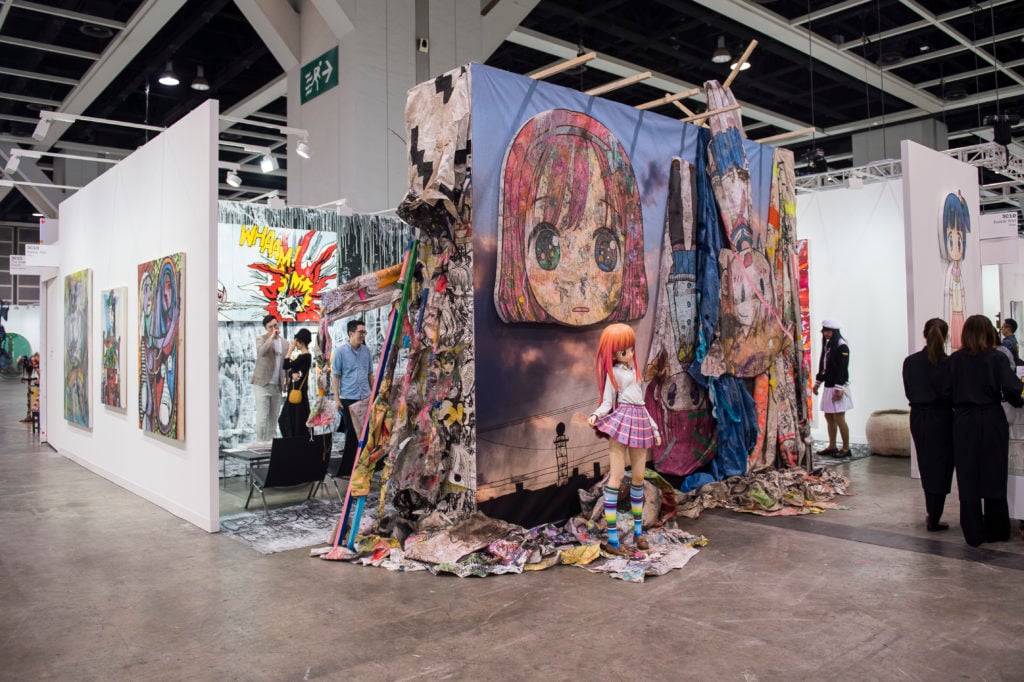
Kaikai Kiki Gallery at Art Basel Hong Kong 2017. Photo courtesy of Art Basel.
Think art fairs are all about sold-out booths, comfortable shoes, and exclusive dinner invitations? Think again. For many small to mid-size galleries, fairs—like Art Basel in Basel, which opens to VIPs today—are an increasingly nail-biting gamble that involves paying hundreds of thousands of dollars up front with no guarantee of a payoff.
As the middle market shrinks, many dealers are finding they can’t afford to do fairs—but they can’t afford not to, either. “It’s very hard to estimate what the revenue will be, so a gallery’s decision to do a fair is highly uncertain,” says Olav Velthuis, a professor at the University of Amsterdam who specializes in economic sociology. “People don’t realize that fairs are loss leaders for many small galleries.”
Indeed, fairs—which multiplied from 55 worldwide in 2000 to at least 180 in 2014, according to the 2015 TEFAF art market report—pose an economic riddle for mid-market dealers. It doesn’t cost that much less money for a small gallery to participate in a major fair than a large one, but the stakes are much higher for small businesses. The potential upside, meanwhile, is far greater for large ones. (See the end of this article for a breakdown of galleries’ costs and revenue at Art Basel in Miami Beach.)
Galleries surveyed by artnet News with staff sizes ranging from five to 35 people estimated that the cost of participation in Art Basel Miami Beach—including everything from shipping to renting furniture and hosting dinners—ranged from $120,000 to over $275,000. The base cost for a booth in the fair’s main section ranges from $50,400 to $100,800, depending on the size; special sections that often host smaller galleries start at $10,000.
But small galleries, particularly those that specialize in emerging artists, also have disproportionately smaller profit margins. They are more likely to offer work priced at $10,000 than $100,000 or $1 million. “You can sell one work as David Zwirner Gallery and go home with a handsome profit, while a smaller one could sell out and barely recoup their costs,” Velthuis notes.
PUBLICIDADE
Art Basel in Miami Beach, 2015. Courtesy of Art Basel.
Squeeze in the Middle
This dynamic isn’t new. But the pressure on the middle market and the rising popularity of art fairs makes it more pronounced than ever. “Mainstream galleries are getting squeezed at the bottom by internet, in the middle by rising rents, and at the top by losing artists,” says Don Thompson, the author of the forthcoming book The Orange Balloon Dog: Bubbles, Turmoil and Avarice in the Contemporary Art Market.
At the same time, “the pressure to go to fairs has increased, because people are much less inclined to go to a physical space than in the past,” Velthuis says. In this year’s TEFAF report, nearly 50 percent of dealers surveyed listed the costs associated with showing at art fairs as one of their top five business concerns.
And while larger dealers often spend more money to rent a bigger booth—with some shelling out an additional six figures to have the stand designed by a celebrity production designer—smaller galleries have their own unique costs to bear. They can find themselves paying for short-term insurance that is proportionally pricier than a larger gallery’s blanket policy, and may have to hire additional temporary staff to man the booth or keep the gallery open during a fair.
Meanwhile, other costs, like airfare and shipping (which can run around $50,000), are similar regardless of the size of the business. “Transport costs are the same for a $10,000 work as a million-dollar work,” Thompson notes.
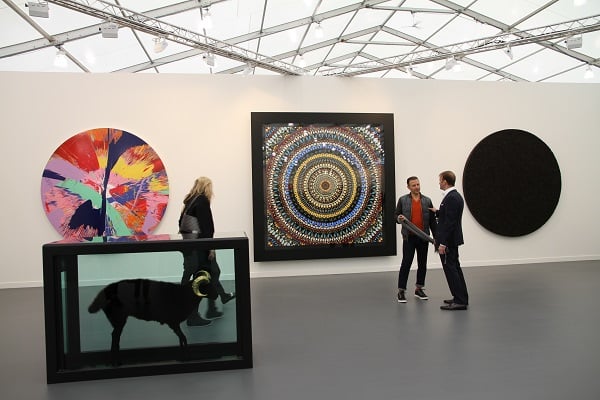
Visitors to Frieze New York at Gagosian Gallery's Damien Hirst booth. Courtesy of Sarah Cascone.
Visitors to Frieze New York at Gagosian Gallery’s Damien Hirst booth. Courtesy of Sarah Cascone.
Covering All the Bases
The risks that come with fair participation are also greater for a smaller gallery than a large one. When galleries fail to make a profit, which dealers surveyed by artnet News said can happen between 15 to 50 percent of the time, bigger businesses are also better equipped to handle the short-term blow to their bottom lines.
“Large firms are better able to absorb fairs without distorting other aspects of their business,” says the New York-based economist Benjamin Mandel. “If a big chunk of your expenses are being cornered by fixed costs of participation in art fairs, the other parts of your business pay the price, whether that’s investment in infrastructure, investment in shows, or investment in the artists.”
Mandel notes that galleries can fall victim to what economists call the “Washington apples effect.” The state of Washington, which is home to large apple farms, is more likely to export the best apples and sell mediocre ones locally. Similarly, “smaller galleries in general are going to prioritize their highest quality contributions to art fairs, while a large gallery is probably going to show a pretty representative selection of artists and work. Smaller dealers have a bigger distortion.”
Art critic Jerry Saltz at Jeffrey Deitch's 2017 Armory Show booth, titled “The Florine Stettheimer Collapsed Time Salon.” Courtesy Sean Zanni, © Patrick McMullan.
Art critic Jerry Saltz at Jeffrey Deitch’s 2017
Armory Show booth, titled “The Florine Stettheimer Collapsed Time Salon.” Courtesy Sean Zanni, © Patrick McMullan.
Different Motivations
If small and mid-size galleries get the raw end of the financial deal at elite fairs, why do they continue to go? Despite the risk, occasional losses, and high cost of participation, dealers we surveyed said they still make between 20 and 60 percent of their annual sales at such events. (One dealer reported making up to $5 million at Art Basel in Miami Beach, which he called “the black Friday of the art world—when dealers get in the black for the year.”)
And even when they lose money in the short-term, most dealers agree that fairs are a worthwhile investment in a gallery’s future—and its reputation. “I think everyone would agree if you can afford it, the effort is always worthwhile—it is just in some ways a waiting game to see if and how it pays off,” says the San Francisco-based dealer Anthony Meier, who participates in around seven fairs a year. “It could be on the sell side, the buy side, a referral, or an introduction to an artist.”
Smaller dealers also stand to benefit disproportionately from showing alongside larger galleries. “If we are next to a high-powered gallery and are working with a fraction of their budget, but have the same size booth and access to the same collectors, that works out to our benefit,” says the New York-based dealer Franklin Parrasch, though he adds, “ultimately, it’s up to the booth to drive interest.”
Frieze London 2016. Photo by Linda Nylind, courtesy of Linda Nylind/Frieze.
What’s Next?
As market pressures continue to make fairs an increasingly challenging proposition for small to mid-size galleries, experts agree something will have to give.
Homa Zarghamee, an assistant professor of economics at Barnard College in New York, suggests some galleries may stop relying on brand-name fairs and transition to smaller, less expensive events like NADA or Independent. Consider that booth prices for boutique fairs can be as low as £2,000 for London’s Sunday; €4,000 for Grand Palazzo (outside Rome); and €4,200–8,200 for Paris Internationale.
“It’s going to keep becoming more segmented,” Zarghamee says. “At some point, you stop competing with Louis Vuitton if you’re the Gap. You just have a different model.”
Perhaps the most utopian—but least likely—solution, put forth by Velthuis, is for top galleries to subsidize smaller galleries’ participation (even beyond the existing special sections). “I could imagine a situation where the community and the fair organizers recognize it’s important to have a mixed ecology,” he says. “It’s just healthy for a market to have that.”
Others suggest smaller galleries will increasingly team up to split the cost of a booth. “I do think this mid-career market needs a twist or a turn, and to me that is an opportunity for people that are collegial,” says Anthony Meier, who has partnered with the Düsseldorf-based gallery Schönewald Fine Arts for Frieze Masters in London, among others.
Regardless of the solution, however, experts—including many of the dealers we interviewed, a number of which declined to be named—say that fairs have hit a saturation point. Mandel observes: “The global art market has slowed, so the rate of art fairs, I believe, will level off, and the number of fairs will probably also start to level off as well.”
In the meantime, art fairs remain a microcosm of the broader market forces squeezing the middle market. “We are in a moment of extreme concentration at the top—there are galleries that are making out like bandits, and galleries that are basically running on a dollar and a dream,” says Magda Sawon of the New York-based gallery Postmasters. “Yet the ones that make tons of money at fairs are paying the same to participate as those that lose money. That’s a proper capitalist model—you don’t expect charity—but it’s a fact.”
P.P.O.W at Frieze 2016. Photograph by Linda Nylind. Courtesy of Linda Nylind/Frieze.
Case Studies: Galleries’ Balance Sheets for Art Basel
We asked galleries of different sizes to break down their costs and revenue at Art Basel in Miami Beach. Here are their estimates.
Small gallery (5–10 staff members)
Booth rental: $75,000
Extras (lighting, furniture rental): $8,000
Flights, hotel: $20,000
Shipping: $15,000
Entertainment (hosting dinners, etc.): $10,000
Total cost: $128,000
Approximate gross sales: $2 million
Mid-size to large gallery (25–35 staff members)
Booth rental: $100,000
Extras (walls, trussing, scrim, carpet, electrical, etc.): $50,000
General operations (installation, framing, production): $30,000
Freight and shipping (including equipment and storage): $45,000
Staff travel: $30,000
Entertainment and gallery events: $20,000
Total cost: $275,000
Approximate gross sales: $5 million
Additional reporting by Eileen Kinsella.

Follow artnet News on Facebook: 
 
Want to stay ahead of the art world? Subscribe to our newsletter to get the breaking news, eye-opening interviews, and incisive critical takes that drive the conversation forward.
  • Access the data behind the headlines with the artnet Price Database.
SHARE