The art market has changed drastically since Joel Mesler started dealing 14 years ago, and Mesler has adapted and changed with it. As a dealer, he’s no longer tied to the idea of exclusivity (he thinks representing artists is a thing of the past), he applauds the artists who have left him for bigger galleries (it’s a testament to his success in developing them), and he thinks that the future of the mid-tier gallery is seasonal, project-based, or off the beaten path.
But this wisdom comes at a price. The comically self-deprecating dealer (and now artist, too) laments that he probably should have closed his gallery in the Lower East Side five years ago, and describes his trajectory as a
survival story rather than a
success story—but if you ask any of the artists he championed along the way, you might get a different story. At Untitled gallery in the Lower East Side, Mesler was a flag-bearer for artists like
Henry Taylor,
Matthew Chambers, and
Artie Vierkant. He then joined forces with dealer Zach Feuer (who had been operating in Chelsea) to make Mesler/Feuer and Feuer/Mesler—two exhibition spaces in the Lower East Side that showed artists like Loie Hollowell,
Brad Troemel,
Phoebe Washburn, and
Keren Cytter. Now, less than six months after Mesler/Feuer announced their closing in February, Mesler is re-opening Rental, a project space he started during his Los Angeles "stoner-hippie" years. But this time, Rental is in East Hampton, where, as Mesler points out, live the one percent of the one percent of the one percent.
In anticipation of tonight’s inaugural opening of Rental Gallery (or as he’d reluncantly say, Rental Gallery 2.0), Artspace’s editor-in-chief Loney Abrams racks Mesler’s brain about his Darwanistic view of the art world—and his responses are as insightful and illuminating as they are laugh-out-loud funny.
This past January you and your partner closed Mesler/Feuer. Now, six months later, you’re opening Rental Gallery. Did you know you’d be opening Rental Gallery when you closed Mesler/Feuer?
No. I have a son, and when we found out [my wife] Sarah was pregnant with twin girls we thought, this city is no longer for us. New York is wonderful when you're single and hustling and doing drugs and being out until five o’clock in the morning—then it's the greatest place ever. But as soon as you need to make an appointment with five people just to negotiate a time to go to Whole Foods, it's time to move. Especially when you become the guy who's screaming at 10:00 PM "Quiet down!" to your neighbors when they’re just waking up from their disco nap. That’s when you know it’s time to move on.
So, we decided to move out to Sag Harbor and the idea was to commute back to the city four days a week, maybe even stay in the gallery sometimes. I was trying to figure out different strategies because I was planning shows literally up until the summer. But when I found out that Glenn Horowitz’s old space was available [in East Hampton], it was kind of a no-brainer. Once I crunched all the numbers and figured out if it could work, I had to do it.
Was your choice to leave the LES purely because you wanted to get out of the city? Or was there something that wasn’t working with the gallery, and maybe with the Lower East Side gallery model in general?
I think there's an unintentional war onslaught on mid-tier galleries, which I was functioning as for the past ten years. A gallery like mine succeeding in its intentions and reaching its goals is actually the downfall of the gallery. Unless there is continual growth, and unless you're working with a David Zwirner model, you’re going to be a failure if you succeed at your goals: making your artists very successful, getting them museum shows, etc. And unless you're able to grow and expand at the pace of your artists, which most people can't do unless there's some independent financing, you essentially defeat yourself. So, being able to jump out of that paradigm and that model was totally liberating, and I wish I reclaimed my business and my life five years ago—but it's never too late.
Just to clarify: When you say that if you do your job well, you fail, you mean that if you develop your artists so that they are much more successful than when they started showing with you, they will leave your gallery for a bigger gallery, and you’ll no longer be able to profit off of your investment in the career of that artist?
Right. It's not even like it’s a malicious thing. The artists should leave you because they need a different type of infrastructure and if they stay with you, there actually might be a problem down the road with their careers and their markets. So if they are to grow the way that they have the potential to grow, it’s almost a necessity that they leave.
What can larger galleries offer them that mid-tier galleries can't?
Pretty much just gallery infrastructure—the amount of attention, time, finances, and production support that an artist needs at the height of their success. They need a personal artist liaison full time, and most of the time mid-tier galleries just can't afford to hire an extra staff person just to concentrate on one or two of their more successful artists. And, we're living in a market-driven time, so as everybody tries to auction and sell their works because the market has changed so quickly and so drastically, artists also need a gallery to also support those market demands.
What does this mean for artists and art? If we imagine an art world without mid-tier galleries, how do young, emerging artists grow?
Like every generation always has. Every generation has their support system. The charming, outgoing, social people in your group should be opening spaces. Just to clarify, what we’re talking about here is kind of like the larger economy—it's not that smaller spaces are closing, it’s that the middle class is actually shrinking. So you still have a plethora of emerging and artist-run galleries because if you're in your mid-20s and you're only paying $1500 in rent, you have a very low overhead and your business doesn't need to make as much money. So galleries like that will continue to open and thrive and hopefully have two or three successful years if they do their jobs right, and hopefully two or three artists who were the mix will do well.
47 Canal is a really great example of this model, where two or three artists of that community were able to continue on. And so, I think that there will always be artist-run galleries whether they’re in the L.E.S. or Harlem or Brooklyn, or whether they’re in apartments or hotels or pop-up spaces. As long as there is a community of creative individuals spending time together, things will happen. It's just a collapse of that middle tier. The middle-tier dealer where the artist has some support and is maybe making $100,000 a year—that's going to shrink and shrink I think because the 5-staff galleries are going to disappear, or are disappearing.
That's what I'm worried about. Because the artists I’m showing at my artist-run space don’t have their next shows at Hauser and Wirth. There needs to be a stepping stone between the artist-run space or project space, and the established or blue-chip gallery, right? Or does the disappearance of the middle-tier mean that established galleries in Chelsea will start cherry picking artist from artist-run spaces?
Well looked at what happened with an artist that I was working with, Loie Hollowell. She had a show at 106 Green, which is run by Holly [Coulis] and Ridley [Howard], who showed six of her paintings. Nobody had heard of her. I mean, they had their community but outside of that community not a lot of people knew the gallery. I saw her work via a friend, did one show with her, and now she's with Pace Gallery. So she's having her first show at Pace this Fall and paintings that were like $4,000 when I was involved with her market are now like $45,000—and that happened within a year and a half. And this is Pace, which is in many people's eyes is a very blue chip, high-tiered gallery, and is now working with an artist who essentially had one show with an artist-run space, one show with a mid-tier space, and now she's with one of the top galleries in the world. I mean, I have the upmost respect for Loie; I think she's incredible and I think she deserves to be there. Loie made the right choice to go to Pace, and nobody questions that. Why should another 100 paintings go out in the world being sold by a mid-tier gallery when Pace could be selling them to the one percent of the one percent?
I think, like you said, more situations like that will happen, where you have this quick ascent.
Anicka Yi at Metro Pictures all of a sudden is another example. These things happen so much quicker now because we’ve seen what happens when artists become stagnant and stay with their mid-tier gallery too long: not much happens. And if those galleries can't support their practices, there are so many artists to feed into the machine that they'll just pass you by. It's a tough paradigm that we're in but it's the harsh reality of how things work, and it's either you adapt or you die. It's pure Darwinism.
So where does Rental fit into this survival-of-the-fittest world you’re talking about?
In this new situation we all find ourselves in, I think you have to do things like your own operation [Hotel Art Pavilion], or artist-run spaces and seasonal galleries (I know that sounds like a bad word, or it usually has been, but I think it won't be anymore)—places that, again, have their own communities. This summer the entire world—or the one percent of the one percent of the percent—will be seeing these works at Rental, while in October maybe five people will see the shows. That kind of extreme makes sense in this type of location.
I’m not going to represent artists and have a traditional gallery. It's more of an open, neutral ground that Rental has historically always been. Let's say
David Salle, who’s a local Hamptons artist, wants to do a show with me because he supports his smaller community (that of the Hamptons): he has many dealers that could perhaps use this gallery as well. So I could work with artists, I could do my programing, and there are many different options on the table with a situation like this. It's not like you're going to see the same six artists every two years here.
So it'll operate like a project space, with rotating shows and no set roster.
Exactly.
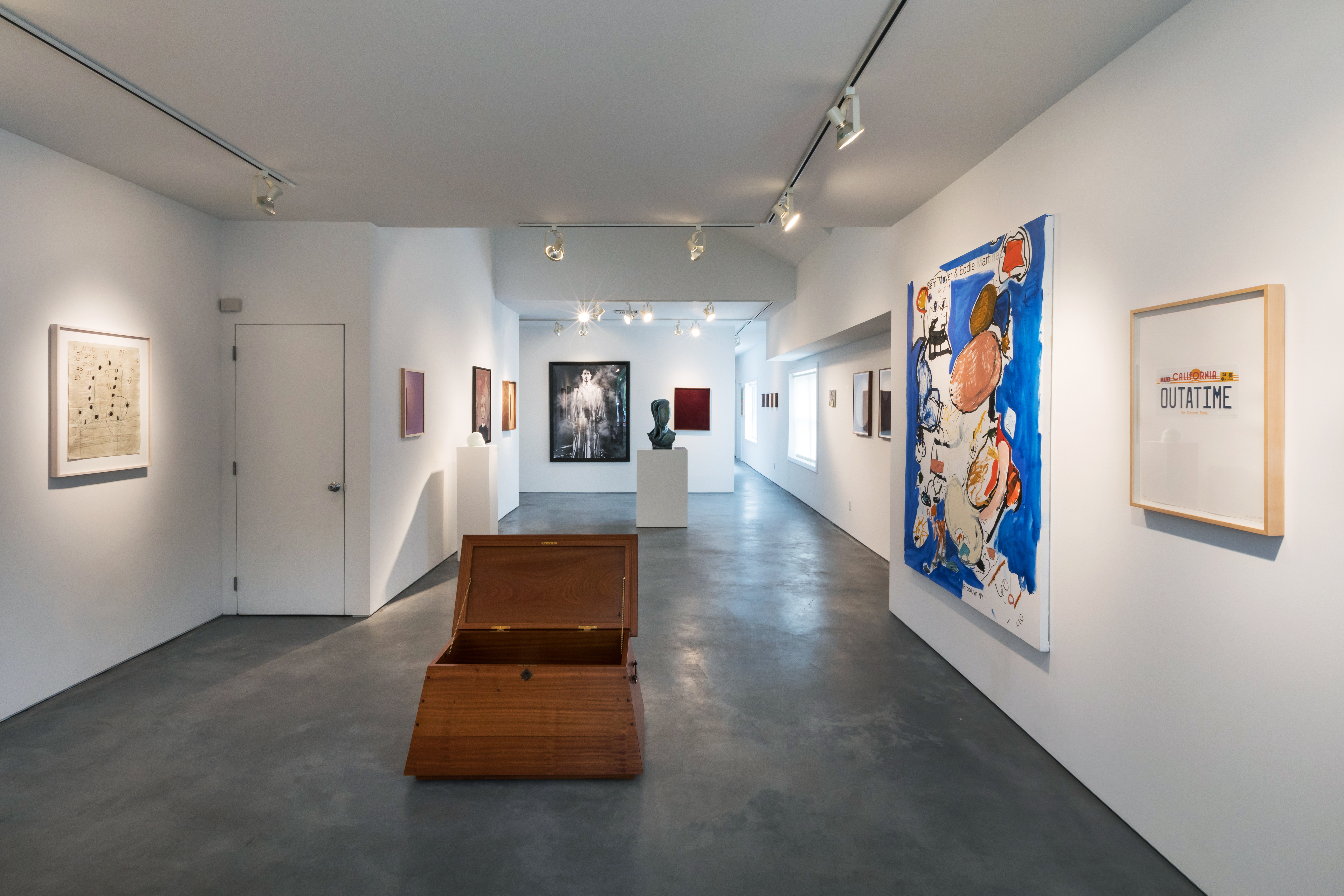
Photo credit:Jenny Gorman; Courtesy Rental Gallery
Can you tell me about the history of Rental, because I know this is the second iteration?
It's funny; it's actually the third. So, in Los Angeles in 2003, Daniel [Hug] (who is now the director of Art Cologne) and I opened a gallery. We got a space very inexpensively and didn't know what to do with it. He was running his gallery and I was running a printing press at the time, so we were making our money elsewhere. But there was so much attention on Los Angeles coming from the international gallery world, so we decided to host galleries in this space, and we called it Rental Gallery. The name was kind of tongue-and-cheek but in a way, it was totally transparent as to what it was. Christian Nagel from Cologne literally rented our space and paid our staff to mount an exhibition in the gallery and sell to their Los Angeles clients. So that kind of worked, but we did it very LA-style, like “hippie-stoner.” It was so inexpensive; not much money moved around. And then when I moved to New York to open Rental here, I tried to make a real business out of it and tried to get more legit. That ran until 2010 when I opened Untitled and that was an attempt to just represent artists and let go of the other model.
Now you're returning to this older model. Do you think that this way of operating can be more lucrative than representing artists since you don't have that extra responsibility/overhead?
That's the thing… if you look at the numbers, representing artists is always financially better. But it does require more of an overhead. So again, you have to ask where you are in the food chain of things. For me, right now in this type of gallery, it's much smarter to do projects and work for certain artists, be involved with their practices, but not represent them. That idea of exclusivity is no more. Any time you try to hold too tight in today's world, things seem to fall away.
Can you tell me a little bit about your first show at Rental?
It's pretty amazing. All of the artists in the show are artists I have worked with in some capacity or shown at Rental before. It’s a pretty crazy list. I was looking through all the previous shows and I had done a group show with
Sherrie Levine, so I was like, “You know what? I'm
totally going to ask Sherrie Levine.” I mean, we're friendly, but it's not like we're brother-sister. So, I sent her an email and she was the first one to respond. She said, "Oh my god, Joel, I'd love to show with you. What do you want?" I thought, "Are you kidding? Is this
really Sherrie Levine?" I told her I would love a skull, so she CC’ed
David Zwirner and all of a sudden it was like I was in the matrix of Zwirner’s Sherry Levine inventory! So I literally got to pick an opal skull and a purple mirror—and they're incredible. She’s an art hero of mine so the fact that she was so warm and open to helping me, supporting me, and being part of this was really great. Pretty much across the board, everybody that I asked participated.

Photo credit:Jenny Gorman; Courtesy Rental Gallery
It’s a great concept for an inaugural show because if functions almost like a “where are they now?” type scenario. It’s a testament to your eye and intuition because a lot of the artists you worked with long ago have become big names and are doing really well.
It's a really nice to see it all contained visually like that. There’s a
Jordan Wolfson print we did together when he was trying to hawk his prints at the park in Park Slope for $5,000. Jordan is so excited to be in it, and is really involved down to the detail about the framing and whether to cut the edge of the paper, asking, "Who am I hanging next to?" Welcome back, neurotic Jordan. It’s great.
You made a promotional video for Rental and artnet News wrote about it, saying it was a hilarious comedy. I thought it was light-hearted, but it didn’t read to me like a satire or a joke. Was it meant to be?
It was really confusing! It kind of changed as it was happening and we were figure it as we went along. When they first came out to film it was in the winter and I just moved out here. I had a long beard, my hair was a mess, I smelled bad, I was just kind of a wreck, and Sara was gone for the day so I was taking care of all three kids. So, here’s this poor, schlubby guy with three kids and he can't even tie his own shoes let alone take care of three kids, not to mention he’s trying to restart a mom-and-pop business out in the Hamptons. It occurred to us that the story itself is pretty humorous, and if you take it too seriously you'll just start crying. The film crew was like, “Alright, say ‘Rental Gallery 2.0’” and I was like, “Isn't that terrible?” So it wasn't intentionally trying to be funny but I think we all realized that if we really tried to make a serious, commercial-type thing it would come off as ridiculous. There’s always hopefully a little humor in everything.
For my last question I want to ask you some advice. We talked about artist-run galleries and project paces as a places for emerging artists to show new work, and we talked about some of the ‘donts’ of running a gallery-business. But for people who are trying to start an artist-run space or an emerging gallery and are trying to enter the market and make money, what advice do you have?
I wrote an article called the “Art of Art Dealing” for the Observer and it’s kind of like a self-help guide to how to be a successful art dealer. It was done as a parody but if you actually follow those steps and you had the right personality, you could totally pull it off. Some of the headings are things like “Understand Why People Buy Art” or “Learn the ABCs: Always Be Closing.” I list questions dealers should be asking their buyers, like “Do you love it?" Do you want it? Could you live with it? Could you live without it? Are you living with it and you just don't have it? Are these works guaranteed to outlive you and your storage unit?” The joke is this: I’m surprised I’m not richer.
[Laughs.] Well it’s like you say in your video, you’re a survivor story, not a success story.
Totally. When I moved to New York people kept giving me the same advice: if you just stick around, you'll be fine. And it’s this funny thing that everybody across the board accepts. Even Gagosian is fighting to make his overhead—it's just that he has a much higher overhead than everybody else. But there's still fear and anxiety on every level so it's sort of like, “Just stick around!” Everyone has the same insecurities and fears and id dialogue. Like, “Can I downsize or can I not downsize? Will it look bad?” The question is, are you still around? And if you're still around and you're at that dinner and you're looking around thinking, “you're still around, you're still around, you're still around”—that's success at a certain point. Pay your bills, pay your artists, and just show up.
RELATED ARTICLES: