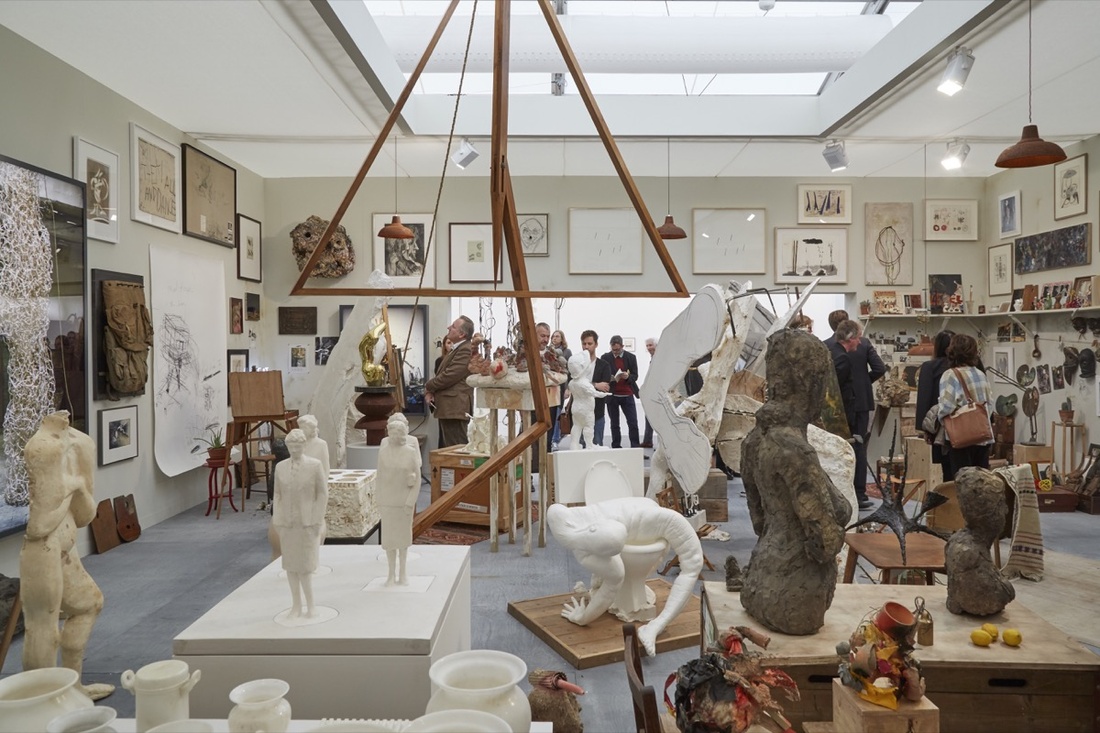
Installation view of Hauser & Wirth’s booth at Frieze London, 2016. Photo by Benjamin Westoby for Artsy.
2016 will likely go down as one of the most turbulent in recent history, with the U.K.’s vote to leave the European Union and Donald Trump’s election to the U.S. presidency contributing to an increasingly uncertain global economic outlook.
Big changes at major auction houses
It was not an easy year in the art market, either. There were a slew of high-profile staff departures at Sotheby’s, including heads of Impressionist, modern, and contemporary art departments. Some of them took voluntary redundancy as part of a cost-cutting drive instigated by the auction house’s new chief executive Tad Smith a year ago. Until this month, Christie’s had kept major departures to a minimum, but that changed with the announcement that Brett Gorvy, its international head of post-war and contemporary art, is leaving after 23 years to partner with the dealer Dominique Lévy, starting in January. Gorvy will, however, continue to work with the post-war and contemporary team at Christie’s “on specific exhibition projects and key consignments.”
Bespoke services begin to change the trade
Among other services, Lévy Gorvy gallery will offer “a new bespoke advisory”—a reflection of the increasingly blurred lines between auction houses, dealers, and advisers. According to a statement, their advisory service will “work very closely with artists’ families, foundations and estates,” which places them in direct competition with Gorvy’s former Christie’s colleague, Amy Cappellazzo. In January, Sotheby’s bought the art advisory firm Art Agency, Partners (AAP) for around $85 million to create a new Fine Art Division run by Cappellazzo, Allan Schwartzman, and Adam Chinn. The move signaled the auction house’s intention to diversify its services. The latest string to its bow is Orion Analytical, the high-tech scientific research firm that Sotheby’s announced it bought this month in a bid to fight fraud. James Martin, who has conducted high-profile art fraud investigations for the FBI, including working on the Knoedler case, has been appointed director of the new scientific research department at the auction house. And Sotheby’s also recently hired Robert Rauschenberg Foundation CEO Christy MacLear to help launch an effort by the auction house to manage artists’ estates.
Emerging market contracts
If cracks began to appear in the market for emerging artists at the end of 2015, by the end of 2016 the bottom had dropped out of it. “Zombie Formalist” works, a term coined by the critic Walter Robinson to describe a quasi-minimalist type of abstract art, were virtually nowhere to be seen at Phillips’s contemporary evening sale in London during Frieze week. Artists such as Dan Colen and Lucien Smith used to be staples at the auction house, but for the past year it has been incorporating more modern and classic contemporary art into its sales. Of the few emerging artists on the block in October, a 2004 work by Alex Israel was withdrawn prior to the auction, while a 2008 spray painting by Sterling Ruby was bought in at £340,000 (est £400,000–600,000). However, many in the trade view the contraction at the very contemporary end of the market as healthy. “[Emerging art] became devoid of its original content and instead became a receptacle for imagined monetary value,” says the New York-based art advisor Lisa Schiff. “When the market for that segment revealed itself as entirely artificial, the bulk of those buyers retreated to less risky investments.”
Artists’ estates grow in importance
Searching for greater stability and better value in times of uncertainty, buyers turned to art history in 2016. Artists’ estates duly boomed. Loretta Würtenberger, who co-founded the Institute for Artists’ Estates in Berlin in March, which offers practical advice on all aspects of managing an artist’s legacy, says collectors are not only looking to the past for financial security. “We are living in a ‘memory boom’; in a globalised world it’s important to connect to our roots,” she says. Galleries are also joining the fray and choosing to represent more artists’ estates. Ahead of the curve, Hauser & Wirth has been focusing on this area for the past decade and now represents 22 estates, which account for roughly a third of its program. Recent additions include the estates of Arshile Gorky, Lygia Pape, and Philippe Vandenberg. “We take a highly individual approach to each estate, working closely with those who knew the artist best to help shape their legacy,” says a spokeswoman for the gallery.
Amid contraction, galleries and museums band together
Collaboration proliferated across all sectors of the art world, from artistic production to gallery sales and museum shows. One of the most recent examples sees the Philadelphia Museum of Art teaming up with the Turin-based collector and private museum owner Patrizia Sandretto Re Rebaudengo to commission and buy video works. The New York artist Rachel Rose is the first to be commissioned under the new deal, which will culminate in shows in Philadelphia in April 2018 and Turin later that year. Other examples include an increasing number of gallery collaborations at art fairs—18 dealers partnered on their presentations at Frieze Masters this year—and a growing trend for auction houses to join forces with independent digital platforms. These collaborations are innovative examples of how artists, galleries, and auction houses are having to adapt in times of uncertainty and rapid change. But for some commentators, collaborations can also muddy the water. “At no other time has the art industry been more confusing, with auction houses bringing in advisory businesses and galleries acting as artists’ representatives, private dealers, and advisories,” Lisa Schiff says. “The future of the art business has never been more unclear.”
Donald Judd, Artist, Revealed as a Philosopher-Critic by His Children
Photo
Rainer and Flavin Judd, Donald Judd’s children, who oversee his legacy and who have ensured that his writings reach a wider audience.Credit George Etheredge for The New York Times
The sculptor Donald Judd, one of the most important artists of the mid20th century, declared that he took up writing in the early 1960s purely as a “mercenary,” to earn money as a critic in his spare time. The statement was about as sincere as the oft-cited one of the novelist John Cheever — that literature is not a competitive sport. Both men might have wanted, or needed, to believe their pronouncements, but they knew they weren’t exactly true.
For Judd, who died in 1994, the overwhelming confirmation has arrived in the form of a new collection of his writings, the first to cover the entire prolific sweep of his output, much of it never before collected or published, a dense volume that one critic has described as resembling a “brick and a bible.” At more than 800 pages of essays, reviews and uncompromising observations about art, history and subjects as particular as Dallas (“very disagreeable”) and psychology (“the astrology of the mind”), the book, “Donald Judd Writings,” is aimed at adding Judd’s singularly contrarian voice not just to the list of great artist-writers but also to the canon of American literature.
Widely known, and sometimes reviled, for his critical writing about the art of the 1960s, Judd could be as damningly final in his judgments as he was rigorously clear in his descriptions of work. A piece by Anselm Kiefer, he once wrote, was “one of the worst paintings I’ve ever seen in all respects.”
The task of shepherding his many words into print was not simple. Judd — who will be the subject of a major retrospective at the Museum of Modern Art in the next few years that will explore his role as a pioneer of Minimalism, a term he derided as woefully simplistic — did not type, for one thing. Throughout his life, he was known for the yellow legal pads always within his reach, a body of longhand writing that came, along with other manuscripts, to fill 30 boxes.
Over a period of months, his son, Flavin, who was 25 when his father died and now oversees his legacy along with his sister, Rainer Judd, became in a sense his father’s translator, deciphering Judd’s serpentine handwriting, reading some of it for the first time. In the process, he said, he felt as if he had been able to spend time once again in the presence of Judd, a famously domineering man, though one who had a close relationship with his two children after his divorce from their mother, the dancer Julie Finch.
Photo
The sculptor Donald Judd in 1982 at La Mansana de Chinati, a.k.a. the Block, in Marfa, Tex., where he established permanent installations of his work.Credit Jamie Dearing/Courtesy Judd Foundation
“Rainer and I were the only people who could argue with him,” said Mr. Judd, now 48, in a recent interview at 101 Spring Street, the cast-iron SoHo building that Judd bought in the late 1960s and which has been preserved as a museum. “We could talk with him in a way that employees and girlfriends really couldn’t.”
Of the time spent putting the book together, he said: “It was beautiful. It’s about as close as you can get to someone again when you’re with what they wrote.”
Judd lived with his children between New York and Marfa, Tex., the small high-desert town where he established permanent installations of his work, in part to get as far away from the art establishment as possible.
His considerable reputation as a writer rested mostly on a collection that came to be called “the yellow book,” for its cover, but it contained writing only up to 1975 and became hard to find. His son, who lives in Los Angeles with his wife, Michèle, a psychoanalyst, and their three children, said his father never spoke about what he wanted done with the mass of unpublished notes. But Mr. Judd said he had always been on the side of publishing, as Max Brod was in ignoring his friend Franz Kafka’s request to burn his papers.
“Basically, after you die,” Mr. Judd said, “it’s not yours anymore.”
The book, which Mr. Judd edited with Caitlin Murray, archivist for the Judd Foundation, shows Judd much more fully than ever before in all his ranges — philosophical, furious, dryly funny and oracular. It also shows him as a deeply read student of history who tended to believe Western culture hadn’t yet emerged from the Middle Ages and that, more than people cared to acknowledge, violence, oppression and ignorance continued to be societal defaults.
“Even a year ago, some of that seemed paranoid and a little far-fetched,” Mr. Judd said. “But now, you know, really not at all.” (In February of 1991, during the gulf war, Judd wrote: “The circumlocutions of liberalism went so far as to become the statements of fascism. Both met.” A year earlier, about the citizens of modern societies, he observed: “… you are free, indigenous and important, but for your protection your life is completely monitored.”)
Photo
An example of Donald Judd’s longhand writing (he didn’t type) from 1959, concerning James Brooks’s 1957 work “Ainlee.”Credit Judd Foundation Archives
David Raskin, a professor at the School of the Art Institute of Chicago and the author of a 2010 monograph about Judd’s work, said he saw Judd, who studied philosophy at Columbia University, as an heir of American thinkers like Charles Sanders Peirce, whose essay “How to Make Our Ideas Clear” was a founding document of pragmatism. “Judd wrote to figure out what he believed in,” Mr. Raskin said, adding, “He really paved the way for later artists who wanted to get their ideas out through writing.”
Mr. Judd, an open, funny, friendly man with something of his father’s look, though leaner and without Judd’s ever-present beard, said he hoped the book, published by the Judd Foundation and David Zwirner Books, would deepen understanding about Judd beyond clichéd views of his boxy, industrially canted work as cold and reductive. “This is more than just an artist writing about his work,” he said. “It’s an artist writing about how you should think about how you live.”
Rainer Judd, a president of the Judd Foundation along with her brother, added in an interview: “I guess I feel a little bit bad that readers don’t get Don along with these writings, because the guy had such a sparkle, like a twinkle in his eye, and it so balanced out the fervor and aggression that could be in his language.” (Rainer was named for the dancer Yvonne Rainer and Flavin for the artist Dan Flavin, friends of their parents.)
Mr. Judd, who also studied philosophy and was interested in filmmaking and architecture, said that before his father’s death, he had felt that he would probably spend a good deal of his adult life working for his father in some form or fashion. “So I guess, in a weird way, what would have happened, happened in the end anyway,” he said. “Just without him around.”
Move Over, Marie Kondo: Make Room for the Hygge Hordes
Photo
Credit Marc Rosenthal
As soothing as a video of a basket of baby sloths, and borne on a raft of lifestyle books, hygge is headed for your living room.
Hygge (pronounced HOO-gah, like a football cheer in a Scandinavian accent) is the Danish word for cozy. It is also a national manifesto, nay, an obsession expressed in the constant pursuit of homespun pleasures involving candlelight, fires, fuzzy knitted socks, porridge, coffee, cake and other people. But no strangers, as the Danes, apparently, are rather shy. Hygge is already such a thing in Britain that the Collins Dictionary proclaimed it one of the top 10 words of 2016, along with Brexit and Trumpism.
Denmark frequently tops lists of the happiest countries in the world, in surveys conducted by the United Nations, among other organizations, consistently beating its Scandinavian cousins, Sweden and Norway — as well as the United States, which hovers around 13th place. While all three Nordic countries share happiness boosters like small populations and the attendant boons of a welfare state (free education, subsidized child care and other generous social supports), what distinguishes Denmark is its quest for hygge.
At least, that is the conclusion of Meik Wiking, the founder and chief executive of the Happiness Institute, a think tank based in Copenhagen dedicated to exploring why some societies are happier than others.
“We talk about it constantly,” Mr. Wiking said. “I’ll invite you over for dinner and during the week we’ll talk about how hyggelig it’s going to be, and then during the dinner we’ll talk about hyggelig it is, and then during the week afterwards, you’ll remind me about how hyggelig Saturday was.” (The adjectival form of the word is pronounced HOO-gah-lee.)
Photo
Candles, many of them, are vital to the hygge experience. So is a steaming cup of glogg.Credit Photo Illustration by David Brandon Geeting for The New York Times; Getty Images (cup and blanket); Mattia Balsamini for The New York Times (backdrop image)
“Danes see hygge as a part of our culture,” he said, “the same way you see freedom as inherently American.”
When we spoke, Mr. Wiking — pronounced Viking — was home in Copenhagen for a few days after a multicity tour. He has written “The Little Book of Hygge,” which is already a best seller in Britain and will be out next month in the United States. It is the most engaging of what is becoming a full-fledged lifestyle category. More than 20 how-to hygge books were published here in 2016, though the Marie Kondo of the discipline has yet to be anointed. Perhaps it is anti-hygge to suggest that any one of its gurus might prevail.
Also coming stateside in January is “How to Hygge: The Nordic Secrets to a Happy Life,” by Signe Johansen, a chef and food writer, to be followed in February by “The Book of Hygge: The Danish Art of Contentment, Comfort and Connection,” by Louisa Thomsen Brits, who is half-Danish and half-British and who sells Danish furniture from hygge.com, a domain name she was savvy enough to claim.
“It had the feel of the feng shui phenomenon,” said Cassie Jones, executive editor at HarperCollins, the parent company of William Morrow, which is publishing “The Little Book of Hygge.” “An opportunity to look to another culture for something intuitively familiar yet refreshingly new.”
Mr. Wiking is the only author to include a bacon metric in his hygge dissertation, which is embedded with charts, surveys, statistics, recipes and craft projects. Noting that candles (unscented) are a vital hygge accessory, he reports that Danes burn 13 pounds of candle wax a person a year, doing so even in classrooms and office buildings. (He uses the bacon metric for context: Each Dane consumes only half as much bacon, or just over 6 1/2 pounds, though bacon itself is very hyggelig.) Where Americans see a fire hazard, the Danes see an antidepressant. The Danish word for spoilsport, Mr. Wiking notes, is lyseslukker, “which literally means, ‘one who puts out the candles.’”
Photo
Cake is cozy …Credit Photo Illustration by David Brandon Geeting for The New York Times; Getty Images (fireplace); Tony Cenicola/The New York Times (cake)
In his own book, “How to Be Danish,” out in 2012, Patrick Kingsley, a reporter at The Guardian, wrote of his bemusement at the ubiquity of the term. His bike was hyggelig but so was someone’s table, or a walk through the Vesterbro district in Copenhagen. (These days, Mr. Kingsley is reporting from Turkey on the migrant crisis in Europe, and perhaps it is this vantage point that has made him see a darker, more insular side to all things hygge. Coziness, he said recently, is by nature exclusionary. “It’s built on the idea of withdrawing from the rest of society and building a sort of micro-commune among a select group of friends.”)
How to get hygge? Go home and stay there, preferably in your hyggekrog — a.k.a. “cozy nook” — wrapped in a blanket, drinking a cup of coffee and watching a Danish police procedural about a serial killer with your friends. (In his book, Mr. Kingsley speculates that the Danes elevate home life because eating out is so expensive — the food at Danish restaurants carries a 25 percent value-added tax.)
Scary stuff, if it’s fictional, can increase your hygge, as can a raging storm outside, said Mr. Wiking, who notes in his book that, on average, there are 179 days of rain annually in Denmark. Actual scary stuff, like the news, is not advised.
The avatar of the Danish procedural is “The Killing,” popular in Britain but available only on DVD, though not in whatever format it is the American DVD players run on. But you can find “Borgen,” the Danish political drama that has been compared to “The West Wing,” on iTunes. The show features some very attractive interiors embellished with iconic Danish modern designs, like Poul Henningsen pendant lamps, which Mr. Wiking explains are a sine qua non of hyggelig décor. To observers like Mr. Kingsley and Mr. Wiking, these shows were the Trojan horses of all things Danish in Britain, with the chunky, star-patterned sweater worn by the main character on “The Killing,” the detective Sarah Lund, becoming a particular fetish item (you can see it on a tribute website, sarahlundsweater.com).
The question posed by Ms. Johansen, the chef, in her book, “How to Hygge” is largely answered not by furniture or clothes, but in recipes for glogg, muesli, fruit compote, salt cod fritters and roast lamb, her own versions of the highlights of the New Nordic Cuisine.
NYT Living Newsletter
Get lifestyle news from the Style, Travel and Food sections, from the latest trends to news you can use.
For her part, Ms. Brits, the author of “The Book of Hygge,” eschews recipes and goes in hard for a moody, meditative approach in which she extols the virtues of wooden bowls, cuddling, brushing your teeth while your partner brushes his or her teeth and stands next to you, being naked, vintage textiles, pendant lights, circular tables, burned spatulas, old shoes, honking geese and line-dried laundry, among many other wholesome items and behaviors. You may find yourself agreeing with her when she writes, “Hygge is a fragile bloom that can’t be forced.”
You can see why hygge is ripe for parody. As is the Danish language, which Mr. Wiking describes as sounding like a dead seal choking. The writer John Crace, in his column for The Guardian, found “The Little Book of Hygge” an easy mark. “One of the reasons the Danes are so much happier than anyone else is because there is very little to do in Denmark, so we have got used to having very low expectations,” he wrote in September, when Mr. Wiking’s book was published in Britain. “For us, a bike ride in the pouring rain with a candle on our heads or sitting on the beach in the pouring rain eating cake can be pure hygginess.”
As Jacob Gallagher, men’s fashion editor of The Wall Street Journal, posted on Twitter recently, “Hygge is the wabi-sabi of 2016 which was the sprezzatura of 2015.”
Indeed: Why hygge, why now? Lucie Greene, the resident futurist at J. Walter Thompson, said she thought it was a reaction to “the well-being movement,” noting the elitism of a lifestyle predicated on $100 Lululemon leggings and $10 bottles of cold pressed juices.
“Hygge is an easier trend to adopt because it’s so personal and so accessible,” Ms. Greene said. “You’re not just indulging for the sake of it. You’re supposed to savor it. It’s no surprise it came from a nation seeking comfort from the dark winters. It lends itself quite naturally to these uncertain times.” As for how it might play out on a retail level, she said she imagined “a massive emphasis on textiles and home wares, from affordable cashmere to candles, kind of like the cocooning thing in the ’90s.”
Photo
So are hand-knit things ...Credit Photo Illustration by David Brandon Geeting for The New York Times; Getty Images (chair
Cozy as an ideal is showing up in other unlikely arenas, like the preamble to a mixtape by ASAP Mob, a rapper collective, called the Cozy Tapes, a kind of Christmas album. A paean to boxer shorts, terry cloth and old man socks, the group debates who is the coziest of them all, with phrases like: “I was so cozy I fell asleep before I left the house.” (Speaking of cozy invasions, you will recall that the Russian hacker “Cozy Bear,” along with his or her colleague, “Fancy Bear,” have been wreaking havoc at the Democratic National Committee, among other organizations.)
Meanwhile, Hyggelife.com sells soft, furry Nordic home goods like reindeer skins, goat and sheep skins, startlingly adorable suede and sheepskin baby bootees, and an assortment of candles and candle holders. Its owners, Alexandra Gove and her fiancé, Koen van Renswoude, based in Colorado, were working in the hospitality business a few years ago when they took a trip to Copenhagen, Ms. Gove said, and had a hygge epiphany, something about the candles in all the cafes.
“I thought, whoa, Americans need more of this and I need more of this,” she said. “Once you have a word like hygge in your vocabulary, you can’t stop using it. I said, ‘This is it, we have to start business revolving around hygge.’”
The couple bought an early 1970s Opel Blitz camper van (with plump, Herbie-like curves and anthropomorphic styling, vintage Opels are very hyggelig). They painted the sides with the words “Hygge Life” and drove around Europe in summer 2014, selling Dutch pancakes called poffertjes at campsites and farmers’ markets. Back in Colorado, they started an online store, which is now a year old. They hope to build a hygge-themed hotel in the mountains, toward which dream they have bought the domain names hotelhygge.com and hyggelodge.com.
Groggy from reading glogg and pancake recipes, and the accompanying reflections on hugging, sledding and board games by Mr. Wiking and others, I was poised to hygger here at home.
Photo
… particularly socks.Credit Photo Illustration by David Brandon Geeting for The New York Times; Getty Images (fireplace)
I wanted a real Dane as my guide — “cozy” and “New Yorker” being contradictory terms — so I called on Claus Meyer, a founder of the New Nordic cuisine and of Noma in Copenhagen, ground zero for his country’s slow food and farm-to-table movement. (Mr. Wiking rates Noma as one of the world’s most hyggelig restaurants, because even though it is pricey — things that are expensive are not cozy — it has the right lighting.) A year or so ago, Mr. Meyer moved with his family to New York City to roll out a number of projects. Could he show me a hyggelig time, I wondered?
A few months ago, Mr. Meyer opened the Great Northern Food Hall, a collection of hyggelig food stalls serving smorrebrod (open faced sandwiches), porridges and craft beers, among other New Nordic offerings, in Grand Central Terminal. Designed by Christina Meyer Bengtsson, Mr. Meyer’s wife, and her partner, Ulrik Nordentoft, it has hyggelig touches like tiles laid in a mosaic that recalls traditional Nordic knitting patterns. All December, Great Northern offered a Holiday Hygge Program, which included knitting workshops by Ms. Bengtsson’s mother, Anne Grethe; talks by Mr. Meyer on mulled wine, baking bread and vinegar; and craft classes for children.
Mr. Meyer suggested a hygge marathon in his family’s Chelsea townhouse. “I would go as far as to say that my wife is an authority in the discipline, and also in this field I am no loser myself,” he said. “We both grew up in families where hygge was everything. My parents then suddenly lost it, but that’s a different story that has only spurred my sense of it.”
On a recent Sunday, the Meyer family and friends convened for an extreme hygge performance. Three of the four Meyer children, Elvira, 20; Viola, 13; and Augusta, 11, were there along with Lydia Holness, a film executive, and her 12-year-old daughter, Lola Byrd. Lacking a fireplace, the girls had obligingly streamed a fire video on their television. Mr. Meyer, who is tall and lanky and speaks with a kind of barking precision, set out steaming glasses of glogg, otherwise known as spiced wine, and plates of chestnut-size balls of dough made with lemon peel, cardamom and apple and sautéed in butter.
That was the snack part. Normally, Mr. Meyer said, you would follow the pancake eating with a two-hour walk, then have dinner. Without the time for such an interlude, this being Manhattan, we bravely tucked into the next course. There was beef tartare with horseradish and pomegranates, freshly baked bread and an extraordinary “porridge” of rye, barley and black lentils, with bits of pumpkin and turkey in it.
Porridge, Mr. Meyer said, is both a hyggelig exemplar and a linchpin of the New Nordic cuisine. “But in this porridge, there is no fat,” he added. “That is the funny thing. So tonight you will digest as small angels.”
Mr. Meyer, who had clapped a knitted cap on his head that had been made by his mother-in-law, was feeding turkey bits to the dog, while Ms. Holness and I lolled in our seats. Leftover turkey does seem very hyggelig, I ventured at last.
“Porridge,” Mr. Meyer asserted crisply, “is even more compliant with the idea. Comfort food. Comfort food and hygge must be coinciding.”