Monday, September 14, 2015

Required Reading, says Hyperallergic
 From Spoon & Tamago we learn: “Film director and animator Kazuhiko Okushita creates unique artwork using a technique known as ippitsugaki – one of those great Japanese words that doesn’t really have an English equivalent.” Check it out:
Reactor • Weekend
Required Reading

Dubai is already home to the world’s tallest building, Burj Khalifa, but now local developers Emaar Properties have announced plans to build the world’s tallest twin towers — though strangely no architect has been officially named for the project. (via Emaar Properties)
This week, an alternative history of US art, making bad reviews disappear, the art of sushi, LA and sci-fi, Picasso and the camera, and more.
A show at RISD is telling an alternate history of post-1960s American art — in other words, screw the mainstream narratives that are dominated by Conceptual art, Minimalism, Color Field, and all the other -isms:As “What Nerve!” shows, mutated versions of Surrealism and Pop Art and tendencies without a name arose and flourished outside of New York and Los Angeles throughout the 1960s, 1970s, and 1980s in the work of groups such as Chicago’s Hairy Who (most active in the mid 1960s), Detroit’s Destroy All Monsters (which coalesced a decade later), Providence’s Forcefield (who came together in the 1990s), and the Bay Area “funk” artists (named for a 1967 museum show and less a clique than a curator-defined association). Many attended art school together. Young and defiantly provincial, these artists were represented by small galleries or none at all. They made their own scenes, working in styles antithetical to the established canon.
… Generally speaking, the art is grotesque, garish and exuberant, cranky, sometimes menacing, often hilarious and, in the case of the Hairy Who and Destroy All Monsters, particularly fresh. Much could be considered representational, albeit with a fondness for squiggly, tubular forms and faces that suggest something splattered against a wall. Vectors abound.
Do artists have the right to have bad reviews removed? Well, one pianist wants the Washington Post to do just that. This is troubling:The pianist Dejan Lazic, like many artists and performers, is occasionally the subject of bad reviews. Also like other artists, he reads those reviews. And disagrees with them. And gripes over them, sometimes.
But because Lazic lives in Europe, where in May the European Union ruled that individuals have a “right to be forgotten” online, he decided to take the griping one step further: On Oct. 30, he sent The Washington Post a request to remove a 2010 review by Post classical music critic Anne Midgette that – he claims — has marred the first page of his Google results for years.
I’d wager all those who dine at this Larry Gagosian and Masayoshi Takayama collaboration, which opened earlier this month, are up to their lilac nipples and ruby aureoles in entitlement.
… The art also tidily sums up my thoughts about Kappo Masa, a restaurant that stirs questions of how, what, who and how much we valuate the dining experience. It’s expensive, which should be no shock to those familiar with Masa’s other restaurants. Masa, at the Time Warner Center, is among the priciest in the world. But to me, Kappo Masa’s cuisine is inscrutable, as opaque as any art world transaction, and therefore invaluable, in both its contemporary and obsolete meanings.
Ouch:“Ms. [Cady] Noland would like it to be known that she has not approved this chapter,” but it states that Noland once threatened to shoot Larry Gagosian if he did a solo exhibition of her art. “Artists go to Gagosian to die,” Noland says
From Spoon & Tamago we learn: “Film director and animator Kazuhiko Okushita creates unique artwork using a technique known as ippitsugaki – one of those great Japanese words that doesn’t really have an English equivalent.” Check it out:Los Angeles does not, perhaps, get enough credit for feeding the imaginations of science fiction writers. Our original cinematic visions of imagined futures — often dystopian wastelands — were shaped by their film locations on what was then undeveloped land outside Los Angeles. Even the futuristic worlds on soundstages called back to Los Angeles, a city whose rapid growth was multi-pronged and haphazard. But despite the sprawl and isolating car culture that fueled dystopian fancies, the city has certainly not been a dystopia. When we talk about the pace and occasionally impractical results of LA’s development, often conducted without long-term considerations, we tend to overlook the beauty, inventiveness, and quirky charm of so much of LA’s architecture. It’s no wonder Los Angeles has long been a home to writers who found comfort, space, and privacy to let their minds wander through the thicket of human experience.
A new Gagosian exhibition, curated by John Richardson, explores Picasso’s relationship with photography:Never a threat to the painter, photographs became a perspective on his own work, Richardson says, citing volumetric sensual busts inspired by the artist’s teenaged mistress Marie-Therese Walter. These were begun at his country estate in Boisgeloup in 1931, when they were photographed by Brassaï and Picasso, then reproduced in photographs in an art magazine in 1933, but not exhibited publicly until 1936.
“One of his great uses of the camera was in all the endless photographs he took of sculptures as he did them. The necks vary all the time, and he needed to have a record of what they looked like,” Richardson explained, making the photographs “a crucial element for his sculpture”.
The troubling story of artist Walter Keane, whose wife was actually the person who painted his renowned work of big-eyed children:After 10 years of marriage, eight of them horrific, they divorced. Margaret promised Walter that she’d keep on secretly painting for him. And she did for a while. But after she’d delivered maybe 20 or 30 big eyes to him, she suddenly thought: “No more lies. From now on, I will only ever tell the truth.”
Which is why, in October 1970, Margaret told a reporter from the UPI everything. “He wanted to learn to paint,” she revealed, “and I tried to teach him to paint when he was home, which wasn’t often. He couldn’t even learn to paint.”
And so on. Walter went on the offensive, swearing that the big eyes were his and calling Margaret a “boozing, sex-starved psychopath” who he once discovered having sex with several parking-lot attendants.
“He was really nuts,” Margaret says. “I couldn’t believe he had so much hate for me.”
In what has to be a first, former military dictator of Panama Manuel Noriega sued Activision for depicting him in the video game Call of Duty:In July, Noriega sued Activision over the game, seeking lost profits and damages; the declaration about his grandchildren was part of a back-and-forth with Activision establishing each side’s case. Noriega argued that Activision had violated a section of California’s civil code that calls for anyone “who knowingly uses another’s name, voice, signature, photograph, or likeness, in any manner, on or in products, merchandise, or goods, or for purposes of advertising or selling,” and does so without permission, to “be liable for any damages sustained” by that individual. In September, Activision requested that the judge assigned to the case, William F. Fahey, dismiss it on multiple grounds—among them that Noriega’s claims violated both the First Amendment and a free-speech section of the California Constitution.
A Hong Kong–based photographer is suspected by China as being a “prime exhibit in their allegations of a Western conspiracy behind the city’s political tumult.” A sad situation:Citing his professed past working for United States intelligence agencies, they have said Mr. Garrett has engaged in Washington-sponsored subversion, seeking to kindle a revolt against the Chinese Communist Party. The claim is part of the effort by Chinese officials and state-controlled news media to discredit Hong Kong’s pro-democracy movement as an insurrection ignited from abroad.
A really thoughtful piece by Omri Boehm on whether Israel can be both a democracy and a Jewish state:Neither is it possible to be a Muslim or an Israeli Christian, and not merely because the Israeli Supreme Court has rejected Israeli as a civil identification. As long as Israel is essentially a Jewish state, being Jewish is essential to being Israeli. A non-Jew can be an Israeli citizen, of course, and carry a blue identification card and passport, but she or he would not for all that be Israeli. Therefore, there is no telling analogy between the political-cultural standing of (say) an Italian Jewish minority and a Muslim minority in Israel. Whereas Jews in Italy can be inherently included in the political identity of that state, Muslims in Israel, because of their ethnic belonging, are excluded from Israel’s political identity. Hence, if there is no contradiction in the notion of a Jewish liberal democracy, there is no contradiction in the notion of a liberal-democratic ethnocracy. It makes little sense to attempt to use a philosophical argument to square this political circle.
Greek life! LOL:With the pressure on, students troll Facebook and Pinterest for the hottest trends in sorority artwork.
Required Reading is published every Sunday morning EST, and is comprised of a short list of art-related links to long-form articles, videos, blog posts, or photo essays worth a second look.
Get Hyperallergic in your Inbox!
Subscribe to our email newsletter. (Daily or Weekly)Pop Music’s Love Affair with Contemporary Art
Articles
Pop Music’s Love Affair with Contemporary Art

Jay-Z admiring an untitled painting by Jean-Michel Basquiat (1983)

Screen capture from the music video for Rihanna’s “Rude Boy” (2009), referencing Andy Warhol

Screen capture from the music video for Rihanna’s “Rude Boy” (2009) with homage to Keith Haring.
Jay-Z was recently featured in an advertisement (seen at top) for a fancy cognac called D’Ussé. The rapper is pictured while admiring a painting by Jean-Michel Basquiat, “Untitled,” (1983) (hat tip to Benjamin Sutton at ARTINFO, here). The ad is no surprise, considering Jay-Z has rapped about famous artists in the past.....
:::::||CONTINUE READING||---»-» http://hyperallergic.com/59347/pop-musics-love-affair-with-contemporary-art/
Electronic Music Made Visual
Interviews
From the Club to the Gallery, Electronic Music Made Visual

“Destructive Observation Field” (photo by Robert Henke)
Fascinated by what happens at these border points, I met Robert Henke at the Krake Festival for Experimental Electronic Music in Berlin, which this year held a parallel visual arts exhibition featuring a number of artists, all of whom use sound in their installations. Destructive Observation Field was up for the duration of the festival and the undoubted highlight. Currently on international tour.....
:::::||CONTINUE READING||---»-»
Get Hyperallergic in your Inbox!
Subscribe to our email newsletter. (Daily or Weekly)
Sunday, September 13, 2015
ALELUIA... pensei que era o único a reparar... E A RECLAMAR!!!!
ALELUIA... pensei que era o único a reparar... E A RECLAMAR!!!!
CIRCULE COM PRECAUÇÃO NAS ESTRADAS DE
PORTUGAL

Numa atitude segura e
responsável, respeite e incentive os demais condutores a Circular pela Via
da Direita nas Estradas de Portugal
O semanário MUNDO PORTUGUÊS, em colaboração com a Autoridade Nacional de Segurança Rodoviária, Guarda Nacional Republicana, Prevenção Rodoviária Portuguesa, a Infraestruturas de Portugal e a BRISA, lança este Verão uma campanha de prevenção rodoviária intitulada CIRCULE PELA VIA DA DIREITA NAS ESTRADAS DE PORTUGAL.
Nos anos mais recentes assistiu-se à construção de estradas com 3 vias de rodagem o que veio a originar muitas vezes maus hábitos de condução. De uma forma surpreendente muitos condutores praticamente deixaram de usar a via da direita que é onde é obrigatório circular.
Segundo o artigo 13º do Código da Estrada, é dito de forma clara:
1 – O trânsito de veículos deve fazer-se pelo lado direito da faixa de rodagem e o mais próximo possível das bermas ou passeios, conservando destes uma distância que permita evitar acidentes.
2 – Quando necessário, pode ser utilizado o lado esquerdo da faixa de rodagem para ultrapassar ou mudar de direção.
Em estradas com 3 vias, naturalmente, as faixas da esquerda só podem ser usadas em situação de ultrapassagem ou mudança de direção. Tem-se assistido a uma degradação significativa da segurança na circulação nestas vias, tendo em muitos casos originado acidentes e um perigo crescente na via publica que urge por fim na salvaguarda do interesse e defesa de todos.
Para mais
informações: campanha@mundoportugues.pt
Tel. (+351) 21 795 76 68 /9
Av. Elias Garcia, 57 - 7º · 1049-017 · Lisboa - Portugal
Av. Elias Garcia, 57 - 7º · 1049-017 · Lisboa - Portugal
http://www.mundoportugues.tv/mp119/
Who Should Pay for Public Art?
A Court Case in Oakland Could Radically Affect Public Art Across the U.S.
Cities across the country have laws requiring that government or private developers set aside a percentage of construction costs for public art. There are more than 400 such “Percent for Art” programs nationwide, according to the organization Americans for the Arts. But in a court case with broad implications for other public art programs, a building trade group is now charging that Oakland’s new Percent for Art law, which took effect this year, is unconstitutional because it burdens private developers with the cost.
SEP 8TH, 2015 7:26 PM
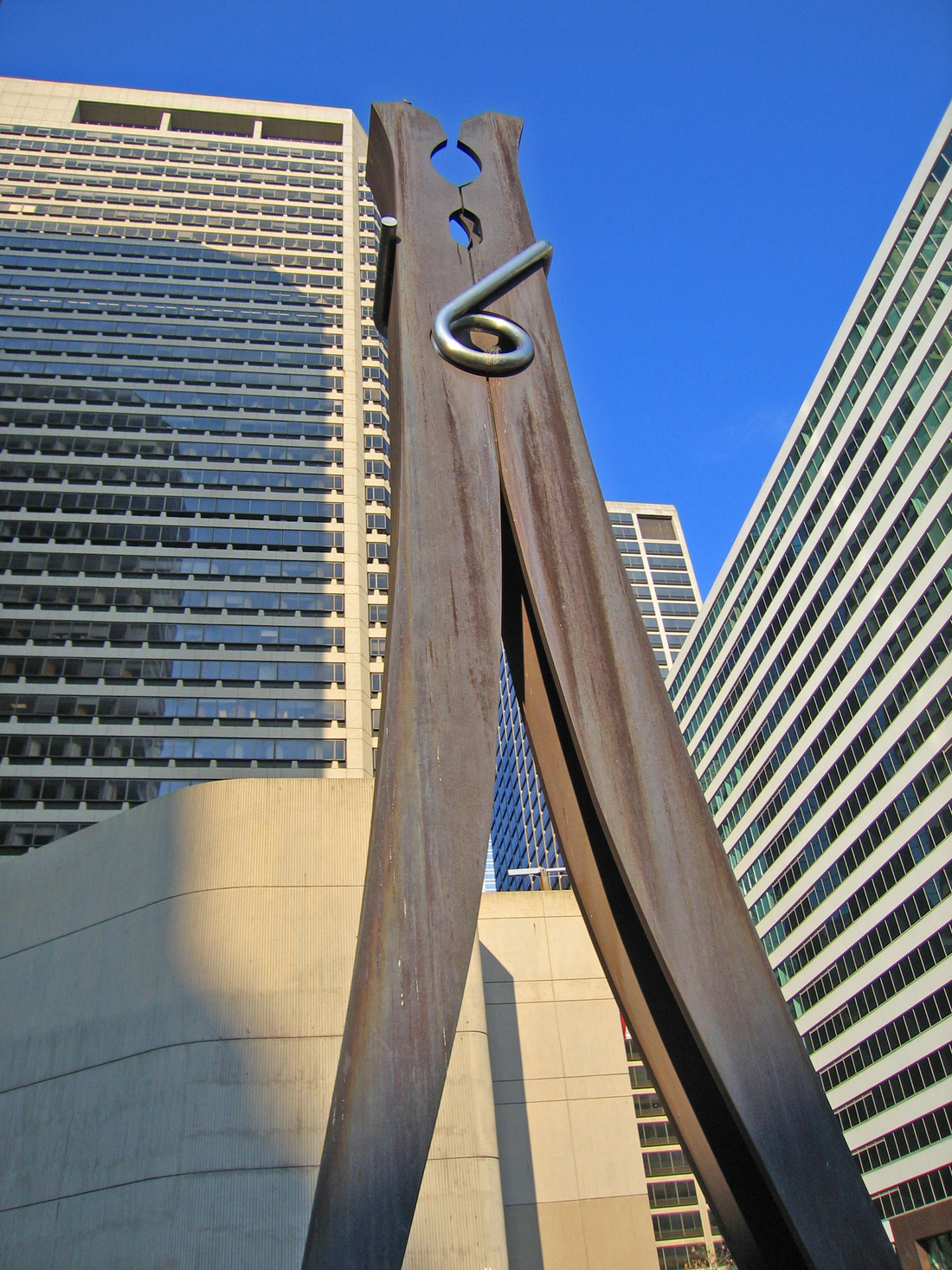
Claes Oldenburg’s Clothespin (1976) was created through Philadelphia's Percent for Art program, the oldest in the U.S. Photo: John Vosburgh via Flickr
Under Oakland’s ordinance, the lawsuit says, the city won’t issue them a building permit unless they either devote up to 1% of construction costs to public art on their property or contribute to the city’s public art fund. The Building Industry Association of the Bay Area, which filed the lawsuit in California’s federal court on July 23, says that requiring private developers to fund public art is the kind of “taking” of property without compensation that is forbidden by the Fifth Amendment. The suit also alleges that because art is expression, requiring developers to install or finance public art is forcing them to engage in government-sponsored speech, which is forbidden by the First Amendment. “The government can’t force you to engage in artistic expression,” says the association’s lawyer, Anthony François of the Pacific Legal Foundation.
The trade group’s argument is based on a U.S. Supreme Court case, Koontz vs. St. Johns River Water Management District, decided in 2013. In the case, the court restricted the government’s ability to exact money from developers before issuing a building permit, determining that in order to be constitutional there had to be a connection between the impact of a development and what the money would be used for. “The question is, can [Oakland] show commercial development causes an impact that requires it to be mitigated through art?”.....
:::::||CONTINUE READING||---»-» https://www.artsy.net/article/artsy-editorial-oakland-court-case-percent-for-art

Subscribe to:
Posts (Atom)