Tuesday, October 7, 2025

a shortcut to wisdom


AI will never be a shortcut to wisdom

Real understanding, argues Jeff DeGraff, doesn’t come from outputs — it comes from practice.
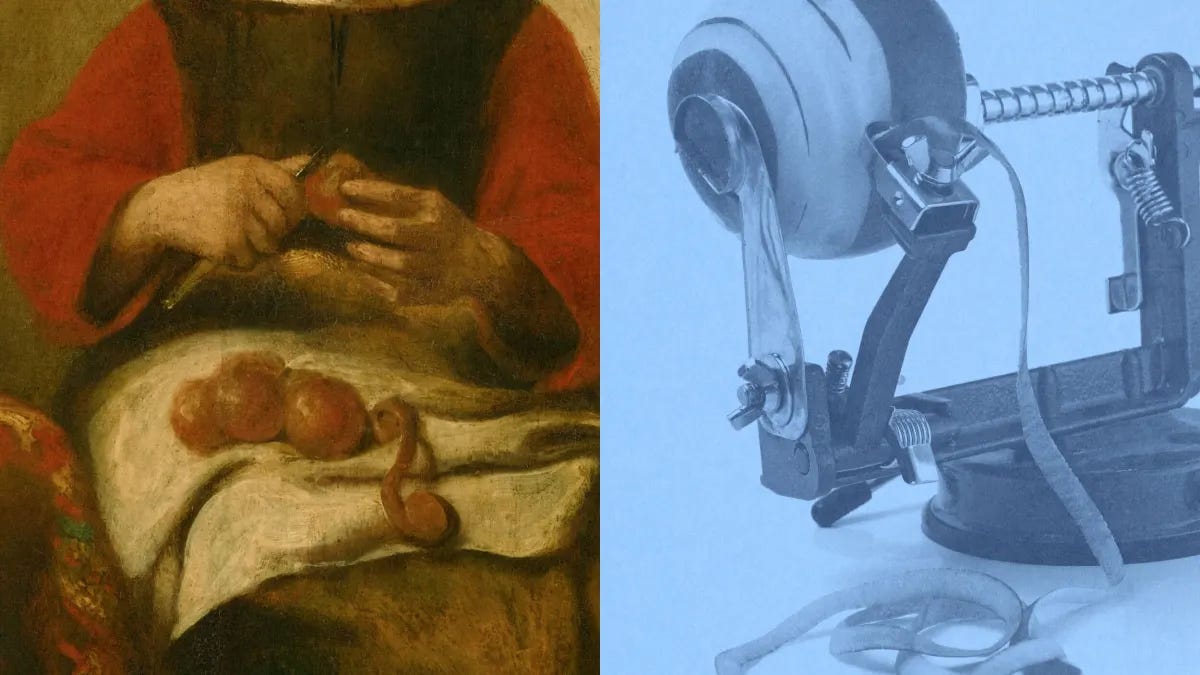
Nicolaes Maes (1655) / Public Domain / Hickendorf / Adobe Stock

Once upon a time — not so long ago — the internet opened like a library with no closing hours. It offered us Google, and then Wikipedia, and with them a curious kind of magic: everything we ever wanted to know, right there, blinking in front of us. It was harmless enough, even liberating. We no longer had to argue about who directed Casablanca or the difference between a quark and a lepton. Answers flowed like tap water.

But something happened in that flood. We began mistaking the map for the terrain.

Not long after came the shortcuts — CliffsNotes for Shakespeare, then for Kant, then for life itself. Everything abstract or difficult was carved into quick summaries, punchy headlines, 30-second reels. Learning became a buffet of “life hacks,” each one promising to make you smarter, faster, richer, or more “optimized.” We began slicing reality into slivers, assuming that each fragment bore the same shimmering reflection as the whole. It was as if a single puzzle piece, held aloft and scrutinized, could reveal the full picture.

But ask anyone who actually knows something — really knows it. A scientist who’s spent decades in a lab, an artist whose hands are stained with pigment, a leader who’s failed forward more times than they can count. They’ll tell you: a fact out of context is just a shard of glass. It cuts. It glints. But it doesn’t build a window. That’s why we ask contestants in a spelling bee to “use the word in a sentence.” It’s not about rote recall. It’s about anchoring meaning in context — about knowing when, why, and how a thing matters.

Then came AI.

At first, it was dazzling. It finished your sentence, cleaned your prose, did your homework. The answers got longer, smoother, more convincing. It stopped being a search engine and became an oracle. A velvet voice in your ear. An expert on demand.

But there’s a catch to all this knowing. Nothing is earned. Nothing is practiced. It just is. And anything that is instantly known — like the answer to a Trivial Pursuit card — has no real value. It’s not applied. It’s not integrated. It’s just data, sitting in a sterile little bubble, whispering its useless perfection.

Now, I’ll admit I’m a bit prone to oldtimeritus. After nearly forty years teaching graduate students and advising some of the most inventive companies on the planet, I’ve earned the right to sigh a bit. But this isn’t about “kids these days.” In fact, it’s not about youth at all. The shift I’m seeing — this collapse of intellectual agility — is striking all generations. All cultures. All walks of life.

Studies on cognitive flexibility, coupled with anecdotal observations about the death of long-form journalism and the slow drift of reader attention, suggest something dire: We are growing unable to sit still with ambiguity. We no longer walk through the fog of a complex question — we skip across it, like stones. Our thoughts sprint, but the world is a marathon. And so, we are left with answers to the wrong questions.

The answer is only simple if you don’t understand the question. This is the danger of living in a world where thinking is outsourced. Where cognition becomes project management.

What happens when we can no longer think through contradiction, paradox, tension? When climate change, homelessness, political division, and regional conflict are seen as disconnected problems with easy answers — when, in truth, they are tangled systems that resist simplicity?

The answer is only simple if you don’t understand the question.

This is the danger of living in a world where thinking is outsourced. Where cognition becomes project management. Where uncertainty is eliminated, not explored. Where truth is boxed and shelved, not wrestled with. If the world is a box of nails — individual facts, sharp and ready — then our minds become hammers. Tools of force and certainty. Banging out conclusions. Flattening nuance. And who builds a cathedral with a hammer? Who composes a symphony with a hammer?

This is no way to live. Because if you see the world as nails, you’ll mistake noise for knowledge. You’ll assume volume means validity. And when you no longer know how to recognize true expertise — because you yourself have never gained any — you will fall for the confident fool. The YouTube doctor. The Instagram monk. The LinkedIn philosopher.

They will tell you there’s a miracle diet, a shortcut to riches, a way to find your purpose before breakfast. They will sell you answers, already boxed and branded. But don’t mistake the packaging for the product. The machines don’t have your answers. Not the real ones. Not the complete ones. Because real understanding doesn’t come from outputs — it comes from practice. From doing the work. From trying, failing, adapting, and trying again. From making your own map.

This is not to say AI has no place. I use it. I respect it. It can amplify intelligence. But it cannot replace wisdom. And wisdom is forged in friction — in living, in suffering, in waiting, in seeing how a thing fits with another thing, and another, until the world begins to reveal not only what it is, but what it means.

If you want to reclaim your mind — not as a hammer, but as a compass, or a loom, or a garden — start here:

  1. Ask better questions.

  2. Be suspicious of certainty.

  3. Practice long-form attention.

  4. Sit with something confusing until it teaches you something.

We are not meant to be hammerheads in a world of nails. We are meant to wonder, to wander, to build. The true mind does not pound — it inquires, connects, reshapes. It listens to contradiction without collapsing. It plays. And most of all, it remembers that the world was never simple. It was just, for a while, flattened by search engines.

So, take it back. Make your own sentence. Put the fact in its place. And live into the question.

Check out more of Big Think’s content:
Big Think | Mini Philosophy | Starts With A Bang | Big Think Books


Saturday, October 4, 2025

The wedding planner


Bloomberg

Hello, Sarah Rappaport, your luxury reporter in London here. I’m back at my desk in the newsroom after getting married abroad in Greece at Island Resort Athens Riviera. With the Aegean Sea as our backdrop, we said our vows in front of 61 of our closest friends and family, with our first dance to Queen’s “You’re My Best Friend.” At midnight, chicken gyros were brought out to keep the party going—and it kept going until 4 a.m. 

People are likely to throw rose petals at you only once in your life. Photographer: Tonia & Theodore Photography

It was even better than I had hoped. Sometimes life can outdo your imagination, and I hadn’t known quite how it’d feel to have people I’ve loved from all parts of my life together in the same space.

Why Greece? It’s been a favorite vacation destination of mine for some time, for the sun, sea, hospitality, culture and incredible food. Dan and I had also been there several times on trips together, and we said to each other before we got engaged that we’d love to get married in our favorite vacation spot.  

Still, throwing a big party in a foreign country has its own challenges, especially in a country where I can’t speak the language and have only visited as a tourist.

So as someone who has recently graduated from wedding planning, here are some tips on how to have a destination wedding—or really any wedding—without losing your mind, just in case you or someone you know is considering tying the knot abroad.

This is what the view at Island Resort Athens Riviera looks like. (It’s not AI.)  Photographer: Tonia & Theodore Photography

Get Local Help

I’m extremely organized and love a spreadsheet. Still, I couldn’t have planned a wedding abroad and still managed to have a job, a healthy social life and relationship, and the occasional gym session. You’ll want to have local help too.

I hired an Athens-based wedding planner, Rena & Co., and Rena Tzevelekou was invaluable in both making everything run smoothly on the day and bringing my ideas to life. She has relationships with local vendors such as florists and makeup artists, so I didn’t have to spend hours on Google Reviews trying to line people up for my date, and the ones we picked more than delivered. 

My planner was also full of ideas that referenced the destination. One of them was having an olive bar during cocktail hour with different types of local olives and olive oils for guests to try. At dinner, there were tiny bottles of extra virgin olive oil for guests to take home as gifts. 

Little gifts for guests. Photographer: Tonia & Theodore Photography

Trust Your Instincts When It Comes to the Budget

We wanted to wow our guests with the views at our venue and have a generous buffet of Greek food, so that’s what we invested large parts of the budget on. Also, I have a big sweet tooth (if you’re in London, I put that to work finding the best bakeries a few years ago!) and wanted a showpiece dessert, so we spent a bit more to have a giant pavlova that we decorated in front of our guests in lieu of a more traditional wedding cake. People are still talking to me about my giant pavlova, so that expense was more than worth it.

What I think wasn’t worth it was the pair of sky-blue Jimmy Choos that I splurged on. They looked gorgeous in photos, but I struggled to walk and dance in them, and they got swapped for a pair of sandals within an hour. I am one of the many people who stopped wearing heels during the pandemic and never got back into it, so I don’t know why I deluded myself into thinking I’d be a different person on my wedding day. 

Also, stay off TikTok. Influencer Becca Bloom (aka “the Queen of RichTok”) got married a few weeks before I did, and we have wildly different budgets—I’m a journalist and not the queen of anything. I was wondering if I could get rainbow fireworks like she did for her Lake Como wedding. I didn’t end up paying for any fireworks. The wedding was still great. 

Accept That Not Everyone Will Make It 

The trade-off of having a wedding abroad is that people you thought would make it can’t come, whether because of distance, not having enough vacation days, budget concerns or general unwillingness to travel. 

In some ways, any wedding I had would have been a destination wedding because I’m from Chicago, my husband is from Wales, and we live in London, but skipping the places we’re from and planning a destination wedding somewhere else entirely did mean that not everyone we wanted to attend could end up coming.

Have you ever seen anyone happier about a giant dessert? Photographer: Tonia & Theodore Photography

Make Sure Everyone Knows the Rules

I travel regularly, but that’s not the case for all of our friends and family. A few months ago, my father-in-law discovered that his passport would expire a few weeks after our wedding in September. I had to work to convince him that he couldn’t travel abroad on it, despite the fact that it was still technically valid. 

That applies to the actual wedding paperwork too. We found out pretty quickly that it’d be a lot more work to get legally wed in Greece, so we booked a town hall ceremony in London a few days prior. In a small way, it took some of the pressure off, since we were already wed in the eyes of the British government. Too late for cold feet!

Roll With the Punches

A lot of my vendors wanted payments in cash, which meant transporting thousands of euros through Heathrow Airport. I almost never use cash in my day-to-day London life—I’d say 99% of my transactions are via Apple Pay—so withdrawing large amounts, let alone traveling with it, was nerve-wracking. 

I also had a last-minute addition of a few guests whose RSVPs didn’t come through, which meant last-minute table shuffling. At the time this felt extremely taxing, but I was glad for the extra guests in the end. 

I’m manning up for those thank you notes: Hand-writing letters and cards is more important than ever. Source: Montblanc

Accept that you can’t control everything! I recommended my brother visit Paros (one of our Where to Go 2025 ideas!) after the wedding, and he had a wonderful time. That said, he got stuck on the island for an extra day because of a high-wind sailing ban on the Aegean and missed his flight back to Chicago, despite building an extra day into his schedule. Travel mishaps can happen even to the best of planners. Throw a major life event and party on top of that, and there’s so many plates spinning in the air. But it was all fine!

Enjoy the process, and take a minute to enjoy yourself with your new spouse. We had a sweetheart table, and before dinner I stared at my family from Chicago and New York, as well as friends from every part of my life, from my childhood to my 20s and early 30s in London, and I felt so loved. It was all worth it in that moment!