Monday, September 22, 2025

Mayor’s New Clothes


The Mayor’s New Clothes: Luxury on the Paris Taxpayers’ Dime
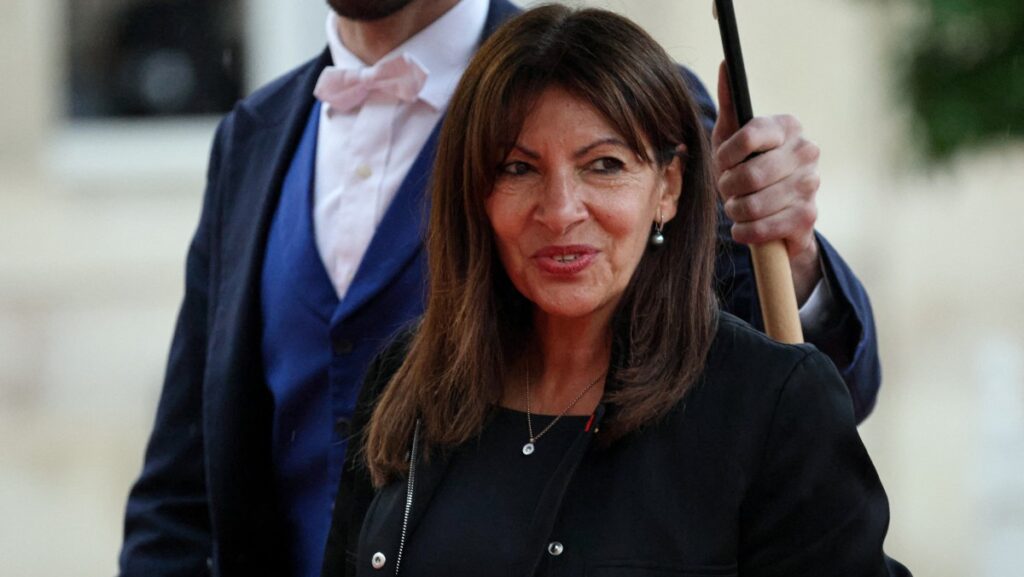
Paris Mayor Anne Hidalgo arrives at The Élysée Presidential Palace ahead of a state dinner on June 5, 2025.


Ludovic Marin / AFP

Hélène de Lauzun is the Paris correspondent for The European Conservative. She studied at the École Normale Supérieure de Paris. She taught French literature and civilization at Harvard and received a Ph.D. in History from the Sorbonne. She is the author of Histoire de l’Autriche (Perrin, 2021).

Our community starts with you

Subscribe to any plan available in our store to comment, connect and be part of the conversation!

Parisians have furnished the socialist mayor with luxury designer wear in several different sizes, along with other items difficult to justify as representation expenses.


You may also like

For months, Anne Hidalgo, the socialist mayor of Paris, has refused to disclose her expense reports to the public, as required by law. Forced to do so by the courts—thanks to the tenacity of a journalist and a determined watchdog group—she finally handed over her receipts, exposing the insane scale of her personal purchases financed by Parisian taxpayers. This goes beyond individual misconduct: it is part of a systemic abuse, emblematic of a political caste that has held positions of responsibility in France for decades without ever being held to account.

The first credit for these revelations goes to Stefan de Vries, a Dutch journalist. Since 2019, he has been waging a relentless war against the mayor of the French capital to get her to publish—as she is legally obliged to do—details of her professional expenses financed by Parisian taxpayers. His investigation was prompted by a legitimate curiosity about how Paris had managed to win the coveted right to host the 2024 Olympic Games. In March 2023, after years of delaying tactics on the part of Hidalgo and her staff, the Council of State took up de Vries’ cause and finally authorised him to visit the City Hall offices to collect the precious supporting documents. An initial set of receipts was then released to the French press. 

Today, the case has resurfaced with the disclosure in the press of a multitude of new receipts and invoices related to Hidalgo’s expenses during the last years of her term of office—documents requested and obtained by Transparence Citoyenne, an anti-corruption association, building on the groundwork carried out by Stefan de Vries. Like the Dutch journalist, the association initially encountered a wall of silence. Its request, submitted in March 2024, took months to come to fruition.

The 118 receipts sent to the association last April correspond to items purchased by Anne Hidalgo between June 2020 and April 2024, for a total amount of €75,050.65. The details are striking. They include both luxury designer clothing and everyday items that are difficult to justify as “representation expenses.” 

Upon closer inspection, inconsistencies, not to say scandals, abound. The mayor’s office has always defended its purchases of high-end brands on the grounds that, as mayor of the capital of luxury and elegance, Hidalgo had a duty to fly the flag for French fashion. How, then, can we explain the purchase of a coat from the British brand Burberry for just over €3,000? But there’s more: A careful examination of the receipts shows that Anne Hidalgo did not just buy clothes for her own use but also allowed her entourage to take advantage of her payment facilities. The sizes of the clothes vary from one day to the next; there are receipts for clothes in size 36—which, with all due respect to the mayor of Paris, is objectively not the size of a woman of her stature. On another day, she bought four pairs of jeans of the same model, one in size 42, two in 40 and one in 38. In case she feels like going on a diet? 

Other expenses are pure pettiness: Anne Hidalgo has claimed the purchase of her Legion of Honour pins as business expenses, which is prohibited by law. The Legion of Honour is an honorary decoration, not a work tool. And what about the three massages paid for at the spa of the luxury Okura Tokyo hotel during one of her undoubtedly exhausting trips to Japan? “What accountant, auditor, ethics officer, URSSAF inspector or tax inspector would accept this in a private company, even during a business trip?” asks one internet user, with good reason.

The Left, keen to defend its champion, has found a counterargument: Transparence Citoyenne allegedly received funds from Pierre-Edouard Stérin, the universal villain and financier of the far Right. But even if that were true, Hidalgo’s abuses remain nonetheless real.

Since the publication online on Wednesday, September 17th, of supporting documents on Transparence Citoyenne’s X account, web investigators have been having a field day, at the invitation of the association, which encourages internet users to comment and contribute their findings and observations. For example, we discover that Anne Hidalgo spent more than €14,000 in a single shop called Apostrophe, owned by a certain Patrick Hazan. The entrepreneur was on her support committee in 2014 and again in 2020 and, by happy coincidence, won the contract to renovate the Hôtel de Coulanges, a 17th-century architectural gem transformed into a luxury concept store, thanks to the support of a socialist councillor on the Paris Council.

Faced with this flood of revelations, the woman nicknamed “Notre-Drame de Paris” is keeping her head down and insists she has “no lessons to learn about ethics.” Some of her close associates are forced to acknowledge “a blunder,” reveals Le Parisien.

The issue of luxury clothing is a sensitive one in the political memory of the French. It should be remembered that in 2017, the favourite candidate of the conservative Right, François Fillon, fell from grace a few months before the presidential election, which he had every chance of winning, over a story involving two luxury suits that had been given to him improperly when he was a member of parliament. The estimated value of the suits was around €6,500 each. They were given to him as gifts. 

Today, we are talking about tens of thousands of euros for Ms. Hidalgo, all funded by public money. Responsible for a deficit of more than €10 billion in France’s largest city, the mayor of Paris should have resigned long ago, but the French Left enjoys a privilege of immunity that is clearly unlimited. All this to garner less than 2% of the vote in the elections. In these great revelations, at least one thing is certain: Anne Hidalgo was quite incapable of buying voters.


Sweden’s Gang Crisis


Sweden’s Gang Crisis: Bombings, Teen Hitmen, and a Nation on Edge


Stockholm now ranks among Europe’s most dangerous cities, as shootings, bombings, and gang turf wars leave the country reeling


You may also like

Zoltán Kottász is a journalist for europeanconservative.com, based in Budapest. He worked for many years as a journalist and as the editor of the foreign desk at the Hungarian daily, Magyar Nemzet. He focuses primarily on European politics.

Our community starts with you

Subscribe to any plan available in our store to comment, connect and be part of the conversation!

The adult education center Campus Risbergska school in Orebro, Sweden, on February 6, 2025, two days after a shooting there left eleven people dead.

Jonathan NACKSTRAND / AFP

Sweden, once regarded as one of Europe’s most peaceful nations, is now grappling with levels of gang violence unprecedented on the continent.

According to Euronews, Stockholm is one of the most dangerous cities in Europe: it has recorded 55 shootings up until August this year, resulting in nine deaths, while nationwide, there have been 113 incidents, leaving 33 people dead.

The country has become a hotspot for drug gangs that often deploy teenage hitmen and makeshift explosives in their violent turf wars.

The scale of the problem is not confined to the capital. Malmö, Gothenburg, and Uppsala are also scarred by shootings, bombings, and killings linked to rival groups.

Sweden’s homicide rate involving firearms ranked third highest in Europe in 2022, behind only Montenegro and Albania. This marks a stark departure from the country’s historic image of Nordic order and stability.

Arvid Hallén, Program Director at the Oikos conservative think tank in Sweden, told europeanconservative.com:

Clearly, we have had for a long time a very strongly increasing amount of crime, especially gangster-associated crime. These criminal organisations, to a quite exceptional degree, commit crimes using guns and bombings—at a level which is unique in Europe.

A series of high-profile attacks has highlighted the crisis. In April this year, three young men were gunned down in an Uppsala hair salon in a feud between two gangs. In August, a man was killed in a shooting outside a mosque in Örebro.

The Swedish government has been forced to introduce sweeping changes to combat the crisis. New legislation will lower the age of criminal responsibility from 15 to 13 for serious offences such as murder and bombings, aiming to disrupt the gangs’ recruitment of minors.

“The reason the government is lowering the age at which you can prosecute people and put them in jail is because these gangs use very young people. We have underage people committing murders, and we haven’t been able to punish them properly,” Hallén explains.

Police say the gangs’ leaders increasingly operate from abroad, issuing orders via social media and encrypted messaging apps. Children as young as 12 are recruited to carry out shootings or plant explosives, lured by the promise of money and status. Europol has warned that what began in Sweden is now spreading across Europe “like wildfire.”

The fear generated by this wave of violence is tangible. A recent survey shows that nearly one in three women aged 16 to 29 have avoided going out at night for fear of threats or attacks.

Hallén argues that the roots of the problem lie in decades of mismanaged immigration policy:

This is all, of course, a direct consequence of the last few decades of irresponsible immigration policy in Sweden. If Sweden had had mass immigration from Denmark or Germany or Poland, we wouldn’t have these issues, but the problem is that we’ve had immigration from the Middle East, North Africa, mostly the Horn of Africa. These groups are much harder to integrate.

This is one of the most important issues people in general care about most in politics, and has been for the last five, ten years. That’s why the current government was elected to fight this kind of crime and to reduce third-world immigration.

There are some signs of progress. Sweden recorded a fall in homicides in 2024 compared with the previous year, with police crediting new surveillance powers and tougher laws. However, gun violence remains the most common cause of violent death and claimed 45 lives in 2024, eight fewer than in 2023.

“The policies seem to be working quite well, but crime is still at a very high level and there is still a lot of work to be done,” according to Arvid Hallén.

Indeed, the bombings continue, rising from 149 incidents in 2023 to 317 in 2024. In January of this year, Stockholm endured more than 30 bombings in a single month, most of them linked to gang extortion schemes.

The crisis has also become a flashpoint in European politics.

On the tenth anniversary of the beginning of the European migration crisis, Hungarian Prime Minister Viktor Orbán repeatedly contrasted Sweden’s gang-ridden streets with Hungary’s tougher law-and-order approach.

In his latest post published on X on Friday, September 19th, he wrote:

Migrants didn’t fall from the sky. Someone opened the door, someone must answer. The Swedish government lectures us on the rule of law while their own cities burn with violence, bombings, and underage perpetrators. Instead of fixing their mess, they spend their time picking on us. Here, we’ve found better ways to use our time: 0 illegals, 0 bombings.

Sweden’s Prime Minister Ulf Kristersson has accused Orbán of spreading “lies” about Sweden, but the Hungarian leader’s words strike a chord with critics who see Sweden as Europe’s cautionary tale—a country struggling to restore order after years of unchecked gang crime and spiralling violence.