Monday, August 19, 2019

Berlin’s Top Collectors Are Opening Their Art-Filled Private Spaces


Berlin’s Top Collectors Are Opening Their Art-Filled Private Spaces to the Public for One Special Night

A dozen of Berlin's leading collectors are joining forces in what could become an annual event.
Installation view of The Feuerle Collection. Khmer Deities from 10th to 13th century with Chinese Platform, Han Dynasty, China, 2nd century BC – 2nd century AD. Photo: def image © The Feuerle Collection.
Have you ever dreamed of seeing inside the homes and spaces of top contemporary art collectors? Then get yourself to Berlin next week.
A group of the city’s most prominent collectors are opening up their art-filled spaces for a special, late-night event this month. By joining forces, they hope to not only make their art more accessible, but also debunk the myth that the German capital is home to just a small handful of significant contemporary art collectors.
A dozen collectors, including Christian and Karen Boros, Julia Stoschek, and Désiré Feuerle, are taking part in the inaugural event next Friday, August 23. During the newly christened Collection Night Berlin, all participating spaces will be open from the early evening until midnight, with several organizing special programs. Wartime bunkers, a 19th-century ballroom, and a historic private villa are among the venues that will be accepting visitors.
“Our idea was to create a common initiative for the public between the city’s collections,” says Juliet Kothe, director of the Boros Collection and co-initiator of the inaugural event. “Berlin is not typically known for having a strong art market, but we are actually one of the few places in Germany that has such a wealth of private collections that are also often accessible to the public,” she says.
The Boros Collection, Installation view with work by He Xiangyu. Photo © NOSHE
The event is a pilot to test the demand for late-night openings of the city’s private collections. Usually, such events are timed to coincide with citywide initiatives, such as Gallery Weekend Berlin in April and Berlin Art Week in mid-September. But the collectors are keen to turn Collection Night Berlin into an independent initiative if they determine it has enough appeal on its own.
Some collections are extending their usual hours, while others, like the Haubrok Foundation, are opening their doors to the public for the first time. Haubrok will be hosting a one-night exhibition of works by the recently deceased American artist Joyce Pensato that aims to evoke her legendarily messy New York studio.
Julian Rosefeldt, Deep Gold,( 2013/2014.) Courtesy: Sammlung Wemhöner © Julian
Rosefeldt und VG Bild-Kunst, Bonn 2019.
Meanwhile, collector Ulrich Seibert will present his unusual collection of Pop-Surrealist and Pop-Comic Surrealist art, which is not typically open for public viewings. Visitors can also get a pre-renovation peek at the future home of the Wemhöner Collection, which is due to officially open in a 19th-century ballroom in two years. For one evening, it will host a screening of Julian Rosefeldt’s film Deep Gold (2013–14), which explores the decadence of 1920s Berlin.
Also that evening, the German publishing house DISTANZ will unveil a new book called PRIVATE ACCESS. The pocket-sized guidebook provides a glimpse into around 90 private museums across Germany, Austria, and Switzerland, including details about how to visit them and other insider tips. It will be presented Lapidarium am Landwehrkanal (Hallesches Ufer 78, 10963 Berlin).
Most of the collections will be open from 5 p.m. until midnight, though registration may be necessary for certain collections. For more information, click here.
See the spaces taking part in the inaugural Berlin Collection Night below.

The Bergmeier Collection

Bülowstr. 90 10783 Berlin
Michael Müller Monster, (2016/2017). Installation view, Galerie du Monde, Hong Kong, 2018. Photo: Kitmin Lee
Courtesy Sammlung Bergmeier and the artist.
Collector Geraldine Michalke’s eclectic holdings range from German art informel and concrete poetry to Minimalist and conceptual art. Her current group exhibition, “Klappe zu, Affe tot,” includes work by Channa Horwitz, Michael Müller, and others. Entrance is free.

Boros Collection

Reinhardtstrasse 20 10117 Berlin
Boros Collection, exterior Bunker. Foto: © NOSHE
The Boros Collection, which focuses on contemporary works from the 1990s to present, will be open by appointment for tours late into the evening. Works by Martin Boyce, He Xiangyu, Yngve Holen, Michel Majerus, Katja Novitskova, and Pamela Rosenkranz are on view in the space’s converted bunker.  Pre-registration is necessary and entrance costs €15.

The Feuerle Collection

Hallesches Ufer 70 10963 Berlin
The Feuerle Collection. exterior, Photo: def image © The Feuerle Collection
Like the Boros Collection, the Feuerle Collection is located in a former World War II telecommunications bunker. The collection focuses on early Imperial Chinese furniture and objects as well as international contemporary art by such star names as Zeng Fanzhi and Anish Kapoor. Pre-registration is necessary and entrance costs €18.

Haubrok Foundation

Temporary Space at Weydingerstr. 10 10178 Berlin
Joyce Pensato’s studio 2018 (detail). Courtesy: Haubrok Collection. Photo credit: Haubrok Collection
The Haubrok Foundation will host a one-night exhibition in a temporary space featuring work by the recently deceased American artist Joyce Pensato in an installation that evokes her messy, art-filled studio. The foundation will also show selections from its large collection of contemporary photography. Entrance is free.

Kienzle Art Foundation

Bleibtreustrasse 54 10623 Berlin
Exhibition "Gaming - the system," with Malte Frey und Julian Reiser at Kienzle Art Foundation Photo: Eric Tschernow.
Exhibition “Gaming – the system,” with Malte Frey und Julian Reiser at Kienzle Art Foundation Photo: Eric Tschernow.
Former art dealer Jochen Kienzle founded the Kienzle Art Foundation with Annette Gmeiner in 2009. The contemporary art collection includes works by Jonathan Lasker, Jack Whitten, and Jack Goldstein. The current show presents young painters Malte Frey and Julian Reiser. Entrance is free.

Me Collectors Room / The Olbricht Foundation

Auguststrasse 68 10117 Berlin
The Cabinet of Curiosities. Olbricht © me Collectors Room Berlin, Stiftung Olbricht, Photo Daisy Loewl.
Offering a bit of meta-commentary on private collecting, the Me Collectors Room will screen a film by Grit Lederer and Minh An Szabó de Bucs looking at the rise of Chinese super-collectors. In addition to the screening, the foundation’s the Olbricht Wunderkammer—a cabinet of curiosities that features 300 objects from the Renaissance and Baroque periods and is among the most important private collections of its kind—will also be open for visitors, as will the group exhibition “BEYOND,” which includes works by Jonas Burgert and Jake and Dinos Chapman, among others. Entrance is free.

Rocca Foundation

Dubrowstrasse 17 14163 Berlin
ROCCA Stiftung. Photo: Kerstin Müller.
Art historian Joëlle Romba and her husband, lawyer Eric Romba, live with their art collection in a villa that dates back to 1908. Their holdings focus on photorealistic painting, Op art, architecture in art, and contemporary art. Their collection will be on view by appointment only for a one-night open house. Entrance is free.

Ulrich Seibert Collection

Oranienburgerstrasse 32 Heckmannhöfe 1. OG 10117 Berlin
Sammlung Ulrich Seibert, Installation view.
Renowned German collector Ulrich Seibert will open the doors to his unique collection of mostly West Coast art that focuses on Pop-Surrealism, Pop-Comic Surrealism, and Lowbrow art. Featured artists include Terry Rodgersand Ron English, among many others. Entrance is free and no appointment is needed.

Julia Stoschek Collection

Leipzigerstrasse 60 10117 Berlin
Julia Stoschek, with Kill-Wallpaper, (2003) by Sturtevant. Photo courtesy Şirin Şimşek.
Julia Stoschek, with Kill-Wallpaper, (2003) by Sturtevant. Photo courtesy Şirin Şimşek.
Julia Stoschek will be screening a selection of films from her yearlong program “Horizontal Vertigo,” curated by Lisa Long, which includes works by Rindon Johnson, Chelsea Knight with Shane Aslan Selzer, and Arjuna Neuman and Denise Ferreira da Silva, among others. The works have so far only been shown at her Düsseldorf space. Entrance is free.

Wemhöner Collection

Hasenheide 13 (entrance in backyard) 10967 Berlin
Sammlung Wemhöner © Courtesy Sammlung Wemhöner, Foto Ingo Heine
The Wemhöner Collection will present its future exhibition space, a former ballroom from 1899 that is due to formally open in two years, with a screening of Deep Gold by Julian Rosefeldt. Entrance is free.

Collection Ivo Wessel

Lehrterstrasse 57 House 2, Floor 2 10557 Berlin
Collection Ivo Wessel. Bjørn Melhus, <i>Auto Center Drive</i>, 2003. Courtesy Collection Ivo Wessel
Collection Ivo Wessel. Bjørn Melhus, Auto Center Drive, 2003. Courtesy Collection Ivo Wessel
Computer scientist Ivo Wessel’s collection includes painting, photography, conceptual art, media, and video art. He will show an assortment of work for Collection Night Berlin, including art by Julian Rosefeldt, Luke Willis Thompson, and Peter Vogel. Entrance is free.

Wurlitzer Pied a Terre Collection

Mohrenstrasse 61 10117 Berlin
Roman Ondak. Credit: Courtesy the artist and Esther Schipper, Berlin. Photo © Jens Ziehe.
The Wurlitzer Pied A Terre Collection was initially founded by Gudrun and Bernd Wurlitzer and is held in a historic 1930s building. For the exhibition “Jewels” on Berlin Collectors Night, the Wurlitzers will present art by Joseph Beuys, Alicja Kwade, Jonathan Meese, and Raphaela Vogel, among others.


Follow artnet News on Facebook: 
 
Want to stay ahead of the art world? Subscribe to our newsletter to get the breaking news, eye-opening interviews, and incisive critical takes that drive the conversation forward.
SHARE
Article topics
Luxury Hotels Around the World Where Art Is a Big Part


Here Are 8 Breathtaking Luxury Hotels Around the World Where Art Is a Big Part of the Allure

These striking, design-forward properties are worth visiting for their art programming alone.
Installation view of Timothy Paul Myers's
Installation view of Timothy Paul Myers's "Alizarin" (2019). Photo courtesy The Peninsula.
In recent years, bold, blue-chip art has become a must-have amenity at many of the world’s best hotels. For a lot of travelers, there’s something particularly thrilling about cohabiting with important works of art for a few days, even if you can’t take them home. Indeed, the trend is increasingly redefining what luxury vacations look like. 
Just in time for the last wave of summer holidays this August, we’ve come up with a list of eight hotels worth visiting for their art alone, from noteworthy contemporary collections and experiential outdoor installations, to artist-in-residency programs and crazy decor inspired entirely by artists. 

The Peninsula, Hong Kong

The Peninsula Hong Kong Featuring Janet Echelman's Earthtime 1.26 (2019). Photo courtesy The Peninsula.
The Peninsula Hong Kong featuring Janet Echelman’s Earthtime 1.26 (2019). Photo courtesy The Peninsula.
The Peninsula Hong Kong, the hotel giant’s flagship property, has long been recognized as one of Asia’s best. Beyond its ornate, colonial-era architecture and famous afternoon high tea service, the property has also garnered attention in recent years for its stellar art initiatives.
MINAX's "The Wonder Room" installation at the The Peninsula Hong Kong. Photo courtesy The Peninsula.
MINAX’s “The Wonder Room” installation at the The Peninsula Hong Kong. Photo courtesy The Peninsula.
Beginning with the 2014 “Love Art at the Peninsula Hong Kong” project, which offered public art experiences led by contemporary talents like Tracey Emin and Richard Wilson on the hotel grounds, the Peninsula’s arts program has only expanded. It now includes a conversation series with artists from both Hong Kong and abroad, trips to galleries and museums around the city, and a traveling exhibition for all Peninsula properties titled “Art in Resonance,” that comprises immersive installation works by Janet Echelman, Iván Navarro, Timothy Paul Myers, and the Shanghai-based artist and architect Zhi-gang Lu of MINAX collective. 

The Dolder Grand, Zurich

The Dolder Grand. Photo courtesy the Dolder Grand.
The Zurich-based Dolder Grand hotel, set on the edge of the Swiss Adilsberg forest, offers old-world luxury and a seriously impressive collection of contemporary art. With over 100 paintings and sculptural works by artists like Takashi Murakami, Joan Miró, Niki de Saint Phalle, Fernando Botero, Henry Moore, Damien Hirst, Keith Haring, and Andy Warhol—who greets visitors via an enormous, 11-meter painting hung above the reception desk as soon as you enter the building—the Dolder has become an art destination of sorts in and of itself.
Niki de Saint Phalle, Le Monde (1989). Photo courtesy The Dolder Grand.
Niki de Saint Phalle, Le Monde (1989). Photo courtesy The Dolder Grand.
With sprawling lawns and gardens that host its largest-scale sculptures, the art experience extends outside, offering the prospect of long, aesthetically pleasing strolls through art and nature.

Casa Malca, Tulum

Casa Malca. Photo courtesy of Design Hotels.
New York-based bigwig art dealer Lio Malca—who represents artists such as KAWS, Warhol, and Jean-Michel Basquiat—renovated a property he stumbled upon in Tulum in 2012, filling it with striking contemporary art and turning it into nine-bedroom boutique hotel. At Casa Malca, each bedroom showcases bold artwork that contrasts against its otherwise beach-y, neutral-toned interiors.
The Keith Haring-themed bar. Photo courtesy of Design Hotels.
The Keith Haring-themed bar. Photo courtesy Design Hotels.
The art extends into the rest of the hotel, too: A Keith Haring print wallpapers the hotel bar, a KAWS sculpture features prominently in the lobby, and an immersive light installation provides a backdrop for the ground-floor pool. 

Hotel Lungarno, Florence

The Hotel Lungarno. Photo courtesy of Hotel Lungarno.
Hotel Lungarno. Photo courtesy the Lungarno Collection.
Overlooking the Arno River and the iconic Ponte Vecchio bridge, this understated, classically-designed boutique hotel makes up for what it lacks in bold design with a sizeable—and stunning—art collection. Over 400 works by Pablo Picasso, Jean Cocteau, Antonio Bueno, and several Italian contemporary and postwar painters—including Bruno Cassinari, Virgilio Guidi, Ennio Morlotti, and Ottone Rosai—dot the walls of the rooms, lobbies, restaurant, and charming riverfront Picteau bar.
Inside the restaurant. Photo courtesy of Hotel Lungarno.
Inside the restaurant. Photo courtesy the Lungarno Collection..
The sleek blue-and-white interiors complement the hotel’s place as the sole Florentine hotel property set upon on the Arno itself. Interior designer Michael Bonan likens the Lungarno experience to that of a “cruise ship sailing down the river,” explaining that the hotel was designed “to accentuate the sense of endlessly drifting on the river, but with the Ponte Vecchio—a symbol of Florence—as your point of reference.”

Tourists, Massachusetts

Tourists. Photo courtesy Tourists.
The rooms at Tourists. Photo courtesy Tourists.
Tucked away in North Adams, Massachusetts, a stone’s throw away from the Massachusetts Museum of Contemporary Art, is the recently opened Tourists hotel and riverside retreat. Offering beautiful, city-free vistas from the foothills of the Berkshires, the hotel—conceived as a high-design version of the American motor lodge—comprises 48 beautifully decorated rooms. Among its amenities are hikes around its woodland trails, as well as tours of its immersive outdoor sculptural and installation-based art, all made by young artists.
Luftwerk's outdoor video installation. Photo courtesy of Tourists.
Luftwerk’s outdoor video installation. Photo courtesy Tourists.
Recent projects include Chime Chapel, a life-size playable structure built using wind-chimes by the artist collective New Orleans Airlift, and a psychedelic video installation featuring footage of the surrounding landscape by the Chicago-based artist duo, Luftwerk.

The Hamilton Princess Hotel & Beach Clubs, Bermuda

KAWS, At This Time (2016). Photo courtesy of The Hamilton Princess Hotel & Beach Club.
KAWS, At This Time (2016). Photo courtesy the Hamilton Princess Hotel & Beach Club.
The famed Bermuda-based Hamilton Princess Hotel & Beach Clubs—nicknamed “The Pink Palace” by locals—has been around since 1885. The beachfront property boasts around 300 modern and pop artworks, strewn about the hotel and its grounds, including pieces by Banksy, Warhol (a whopping 40 works!), Jeff Koons, Damien Hirst, KAWS, Julian Opie, Yayoi Kusama, and Ai Weiwei.
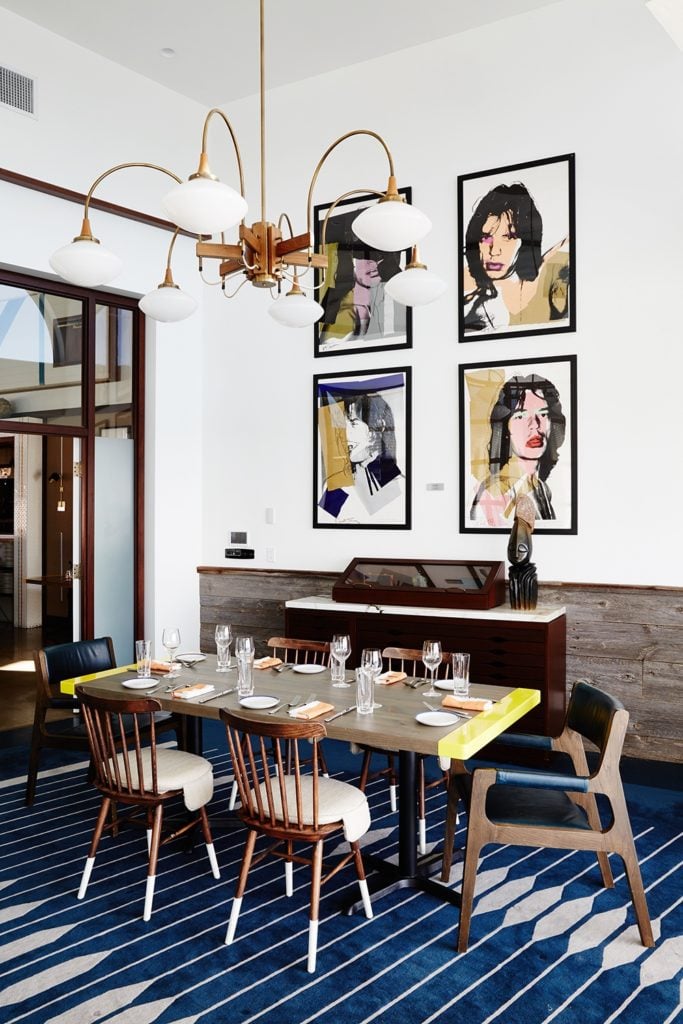
Four of Andy Warhol's Mick Jagger screen prints. Photo courtesy The Hamilton Princess Hotel & Beach Club.
Four of Andy Warhol’s Mick Jagger screen prints. Photo courtesy the Hamilton Princess Hotel & Beach Club.
Every Saturday, the hotel also offers official tours of its art, lead by the in-house curator. 

The Alila Yangshuo, Guilin

The Alila Yangshuo. Photo courtesy the Alila Yangshuo.
It’s difficult to find a resort more beautiful than the Alila Yangshuo, a former sugar factory and cluster of 1960s buildings located an hour south of Guilin, in southern China. The structures were rescued by the Alila group and turned into a state-of-the-art hotel property featuring 117 rooms, restaurants, gardens, and art-filled meditation areas. Surrounded by limestone mountains, caves, and the winding Yulong River, the space serves as a cutting-edge oasis far from China’s bustling cities.
The restaurant at the Alila Yangshuo. Photo courtesy the Alila Yangshuo.
Its raw but sophisticated design nods to its industrial past, built from cement, washed stone, and recycled timber. As for its collection of art, it’s made up solely of works by Chinese artists, from traditional paintings to contemporary pieces by international stars such as Cai Guo-Qiang and Zeng Fanzhi. 

Conrad New York Downtown, NYC

Conrad New York Downtown's lobby featuring Sol LeWitt's "Loopy Doopy (Blue and Purple), 1999. Photo courtesy Conrad Hotels.
Conrad New York Downtown’s lobby featuring Sol LeWitt’s Loopy Doopy (Blue and Purple), 1999. Photo courtesy Conrad Hotels.
The Conrad Downtown in New York’s Battery Park was planned by architects Kohn Penderson Fox with art specifically in mind. Upon entry, an enormous mural by Sol LeWitt features prominently over the hotel’s 16-story atrium lobby, across from which sits a sculptural piece comprised of cable-like wires by architect Monica Ponce de Leon.
Pat Steir, Topsy Turvey (2015). Photo courtesy Conrad Hotels.
Pat Steir, Topsy Turvey (2015). Photo courtesy Conrad Hotels.
Inside, more works by the likes of Ellsworth Kelly, Julian Schnabel, Elizabeth Peyton, and Frank Stella are strewn around the space. All in all, the Conrad collection totals a staggering 2,000 works, and was selected with the help of the New York-based non-profit Public Art Fund.


Follow artnet News on Facebook: 
 
Want to stay ahead of the art world? Subscribe to our newsletter to get the breaking news, eye-opening interviews, and incisive critical takes that drive the conversation forward.
SHARE

Thursday, August 15, 2019

Markets are braced for a global downturn


The world economyMarkets are braced for a global downturn

The signals from bonds, currencies and commodities are increasingly alarming
Looking for meaning in financial markets is like looking for patterns in a violent sea. The information that emerges is the product of buying and selling by people, with all their contradictions. Prices reflect a mix of emotion, biases and cold-eyed calculation. Yet taken together markets express something about both the mood of investors and the temper of the times. The most commonly ascribed signal is complacency. Dangers are often ignored until too late. However, the dominant mood in markets today, as it has been for much of the past decade, is not complacency but anxiety. And it is deepening by the day.
It is most evident in the astounding appetite for the safest of assets: government bonds. In Germany, where figures this week showed that the economy is shrinking, interest rates are negative all the way from overnight deposits to 30-year bonds. Investors who buy and hold bonds to maturity will make a guaranteed cash loss. In Switzerland negative yields extend all the way to 50-year bonds. Even in indebted and crisis-prone Italy, a ten-year bond gets you only 1.5%. In America, meanwhile, the curve is inverted—interest rates on ten-year bonds are lower than on three-month bills—a peculiar situation that is a harbinger of recession. Angst is evident elsewhere, too. The safe-haven dollar is up against many other currencies. Gold is at a six-year high. Copper prices, a proxy for industrial health, are down sharply. Despite Iran’s seizure of oil tankers in the Gulf, oil prices have sunk to $60 a barrel.
PUBLICIDADE


Plenty of people fear that these strange signals portend a global recession. The storm clouds are certainly gathering. This week China said that industrial production is growing at its most sluggish pace since 2002. America’s decade-long expansion is the oldest on record so, whatever economists say, a downturn feels overdue. With interest rates already so low, the capacity to fight one is depleted. Investors fear that the world is turning into Japan, with a torpid economy that struggles to vanquish deflation, and is hence prone to going backwards.
Yet a recession is so far a fear, not a reality. The world economy is still growing, albeit at a less healthy pace than in 2018. Its resilience rests on consumers, not least in America. Jobs are plentiful; wages are picking up; credit is still easy; and cheaper oil means there is more money to spend. What is more, there has been little sign of the heady exuberance that normally precedes a slump. The boards of public companies and the shareholders they ostensibly serve have played it safe. Businesses in aggregate are net savers. Investors have favoured firms that generate cash without needing to splurge on fixed assets. You see this in the vastly contrasting fortunes of America’s high-flying stockmarket, dominated by capital-light internet and services firms that throw off profits, and Europe’s, groaning under banks and under carmakers with factories that eat up capital. And within Europe’s stockmarkets a defensive stock, such as Nestlé, is trading at a towering premium to an industrial one such as Daimler.
If there has been no boom and the world economy has not yet turned to bust, why then are markets so anxious? The best answer is that firms and markets are struggling to get to grips with uncertainty. This, not tariffs, is the greatest harm from the trade war between America and China. The boundaries of the dispute have stretched from imports of some industrial metals to broader categories of finished goods (see article). New fronts, including technology supply-chains and, this month, currencies, have opened up. As Japan and South Korea let their historical differences spill over into trade, it is unclear who or what might be drawn in next. Because big investments are hard to reverse, firms are disinclined to press ahead with them. A proxy measure from JPMorgan Chase suggests that global capital spending is now falling. Evidence that investment is being curtailed is reflected in surveys of plunging business sentiment, in stalling manufacturing output worldwide and in the stuttering performance of industry-led economies, not least Germany.
Central banks are anxious, too, and easing policy as a result. In July the Federal Reserve lowered interest rates for the first time in a decade as insurance against a downturn. It is likely to follow that with more cuts. Central banks in Brazil, India, New Zealand, Peru, the Philippines and Thailand have all reduced their benchmark interest rates since the Fed acted. The European Central Bank is likely to resume its bond-buying programme.
Despite these efforts, anxiety could turn to alarm, and sluggish growth descend into recession. Three warning signals are worth watching. First, the dollar, which is a barometer of risk appetite. The more investors reach for the safety of the greenback, the more they see danger ahead. Second come the trade negotiations between America and China. This week President Donald Trump unexpectedly delayed the tariffs announced on August 1st on some imports, raising hopes of a deal. That ought to be in his interests, as a strong economy is critical to his prospects of re-election next year. But he may nevertheless be misjudging the odds of a downturn. Mr Trump may also find that China decides to drag its feet, in the hope of scuppering his chances of a second term and of getting a better deal (or one likelier to stick) with his Democratic successor.
The third thing to watch is corporate-bond yields in America. Financing costs remain remarkably low. But the spread—or extra yield—that investors require to hold risker corporate debt has begun to widen. If growing anxiety were to cause spreads to blow out, highly geared firms would find it costlier to roll over their debt. That could lead them to cut back on payrolls as well as investment in order to make their interest payments. The odds of a recession would then shorten.
When people look back, they will find plenty of inconsistencies in the configuration of today’s asset prices. The extreme anxiety in bond markets may come to look like a form of recklessness: how could markets square the rise in populism with a fear of deflation, for instance? It is a strange thought that a sudden easing of today’s anxiety might lead to violent price changes—a surge in bond yields; a sideways crash in which high-priced defensive stocks slump and beaten-up cyclicals rally. Eventually there might even be too much exuberance. But just now, who worries about that?■


This article appeared in the Leaders section of the print edition under the headline "Markets in an Age of Anxiety"


Wednesday, August 14, 2019

In praise of the semicolon


BOOKS

In praise of the semicolon, a most maligned punctuation mark

Semicolon: The Past, Present, and Future of a Misunderstood Mark by Cecelia Watson reviewed

August 8, 2019
12:53 PM
Semicolon: The Past, Present, and Future of a Misunderstood MarkCecelia Watson
Ecco, pp.224, $17.99
Now, how shall I start this review?
‘I loved this book. I really did. (Too abrupt.)’
‘I loved this book, I really did. (Too rushed.)’
‘I loved this book: I really did. (Too planned.)’
‘I loved this book — I really did. (Too afterthoughty.)’
‘I loved this book… I really did. (Too uncertain.)’
‘I loved this book; I really did.’
Ah, that’s more like it. The semicolon gives me the best of both worlds. It helps me pause, and have a think, and yet pushes me forward to what I want to say next. It separates and unites simultaneously. It does a job that no other punctuation mark does. And the way to see this is to develop a sense of the contrast. What happens if we punctuate a sentence differently?
This isn’t something that can be summed up in a simple rule, and those who have tried over the past 200 years to find rules governing punctuation have failed miserably, as Cecelia Watson shows in the opening chapters of her insightful book. Punctuation tries to capture two incompatible drives: the desire to mark grammatical structure, and the desire to express the dynamic of the speaking voice. The tension between them means that no two people share exactly the same set of preferences. That’s easy to demonstrate. Give a group an unpunctuated page and ask them to mark it up, and you’d be lucky to find two who would do it in exactly the same way.
Watson approaches her subject historically. She begins by recalling writers who have gone on record as hating the semicolon, such as Kurt Vonnegut, and traces its history of transformation ‘from a mark designed to create clarity to a mark destined to create confusion’. We see its origins in 1494, when Aldus Manutius first presented it, and then the way it came to be treated in the convoluted ‘grammar wars’ of later centuries, as writers struggled without success to reduce its complexities to simple rules. Two fascinating chapters show the way semicolons have played a central role in court cases — including the horrifying story of Salvatore Merra, in which the much-debated legal interpretation of a sentence containing a semicolon ultimately led to his execution.
The power of the book lies in its leisurely literary illustrations of the way writers have used semicolons to great effect, including Irvine Welsh, Raymond Chandler, Herman Melville, and brilliantly in Martin Luther King’s ‘Letter from Birmingham Jail’ — a moving sequence of semicolon-separated plaints that build to one of the most powerful climaxes I have ever read. I’d defy anyone to repunctuate this and retain the rhetorical effect. The extracts from Welsh and Chandler are especially well chosen, for they give the lie to those, like Vonnegut, who thought that the only purpose of semicolons is to show that the writer has ‘been to college’. Her example from Trainspotting is as far away from college as you can get, and Mark Renton’s description is all the more powerful for the use of a semicolon. (‘The sweat wis lashing oafay Sick Boy; he wis trembling.’)
A great deal that Watson says is basic linguistics, and especially stylistics — domains that, curiously, she doesn’t mention. And yet she would find huge support for her approach there, especially in the way a semantic and pragmatic perspective helps to remove the restricting effect of a naive grammaticism. It’s the approach I’ve used myself in Making a Point: you see the system in language by observing the options that the language makes available. Punctuation is a system, though not subject to the same kind of rules that we see in some other areas of language. Watson’s examples of contrasting marks illustrate this very clearly.
This is no pedestrian account of how semicolons work, with boring sentences taken out of context and their marks defined in an abstract way. The author wants us to appreciate the ‘beauty in language that rules can’t comprehend’. She wants us to see that trying to put a ‘protective fence’ around punctuation is a limiting response that doesn’t allow us to see the true power of language in communication. Recognizing this is liberating. We begin to realize that instead of punctuation controlling us, we can control it.
Watson thinks of herself more as a punctuation therapist than a punctuation theorist, and her clarity and good humor pervade the book, along with some cheeky illustrations by Anthony Russo. Some people will hate her for even trying to make us appreciate semicolons, but not me. As I say, I loved this book; I really did.

This article was originally published in The Spectator magazine.