Friday, July 12, 2019

‘The Farewell’s’ Lulu Wang and Awkwafina want you to cry, then call your grandma


‘The Farewell’s’ Lulu Wang and Awkwafina want you to cry, then call your grandma


‘The Farewell’s’ Lulu Wang and Awkwafina want you to cry, then call your grandma
"Based on an actual lie": Awkwafina, left, stars in "The Farewell," inspired by director Lulu Wang's own experience, about an American woman who joins a family trip to China to visit her dying grandmother. (Myung J. Chun / Los Angeles Times)
Over breakfast on a recent morning in Beverly Hills, Awkwafina proudly estimated that 80% of the people she’s met at screenings of her latest film, “The Farewell,” have come up to her misty-eyed. Hearing that, the film’s writer-director, Lulu Wang, smiled.
Those tears are validating for the rising filmmaker, who based her second feature on an “actual lie” her family agreed to tell her grandmother in 2013. When the matriarch was diagnosed with terminal cancer, family members requested she not be told in order to spare her the grim prospect of facing the truth in her remaining months — a practice not uncommon in China.
“My goal is to leave people talking about the film, or talking about their own lives and their own family, or calling their grandma,” said Wang, whose parents emigrated from China to Miami when she was 6 years old. “That’s my gift to the world. We should all call our grandmas more.”
Awkwafina — the stage name of rapper and actress Nora Lum, who scored a killer pair of breakout roles in last summer’s “Crazy Rich Asians” and “Ocean’s 8” — stars in “The Farewell” as struggling New York City artist Billi. The fictional stand-in for Wang makes a last-minute trek to China to say goodbye to her dying grandmother (Zhao Shuzhen) over the objections of her relatives, including her immigrant parents, Jian (Diana Lin) and Haiyan (Tzi Ma).
They worry Billi is too American to keep her emotions from betraying the truth to her grandma, whom she affectionately calls “Nai Nai.” But as the family gathers at a wedding staged to bring the clan together one last time, conflicting cultural ideas about identity, mortality and filial piety collide as everyone aches from the grief of their shared secret.
The extraordinarily personal inspiration means “The Farewell,” which opens in limited release July 12 and will expand throughout the summer, is more than just a film to Wang; its very existence is part of a real story that continues offscreen.

Awkwafina (center) anchors the ensemble of Lulu Wang's "The Farewell," based on the filmmaker's life. After premiering in January at Sundance, the film hits theaters Friday — and is already eyeing the Oscar race.
Awkwafina (center) anchors the ensemble of Lulu Wang's "The Farewell," based on the filmmaker's life. After premiering in January at Sundance, the film hits theaters Friday — and is already eyeing the Oscar race. (A24)
That’s because (spoiler alert!) the real Nai Nai is still with us, six years after her initial diagnosis — and she remains unaware of both her condition and the premise of her granddaughter’s film.
Nevertheless, Wang shot “The Farewell” in her grandmother’s actual neighborhood and the matriarch was a frequent visitor to the set in Changchun, China, squeezing Lum’s cheeks and attempting to feed her filmmaker granddaughter between scenes. She even has a cameo onscreen, scooting across a busy street in her motorized wheelchair as actors playing her family walk by.
The secret has been upheld this far. But the film just locked a Chinese distributor, which Wang acknowledges could throw a wrench into the family’s pact.

Lulu Wang: "I still think the same thing about the decision, which is that I can’t make a moral judgment around it."
Lulu Wang: "I still think the same thing about the decision, which is that I can’t make a moral judgment around it." (Myung J. Chun / Los Angeles Times)
“I was like, ‘Guys, remember how we were always like, punting the question until later?’ ” Wang said. “We have Chinese distribution, which means they’re going to cut a Chinese trailer, and all the marketing is still going to come out.”
The film’s title in Chinese, she says, translates to “Don’t Tell Her.” Wang shrugged. Yes, it’s complicated. But that’s life.
“I still think the same thing about the decision, which is that I can’t make a moral judgment around it,” she said. “But I do often think that none of this would have happened without the lie, right? The lie has enabled me to make this film, to tell this story, but more importantly it enabled me to spend time with my grandmother.”
Wang’s great-aunt, Lu Hong, connects by phone in the wee hours of the morning from Changchun, where she lives in the same building three floors above her sister, Wang’s grandmother. In a few days she will fly to New York with her husband to see “The Farewell” — which marks her film debut — for the first time. (She’ll sport crimson red shades on the red carpet.)
“I’m glad to report that my sister’s health at this moment is still gradually going down but in general at this moment is stable,” she said via Wang’s father, Haiyan, her nephew, who translated.
Because Lu is Nai Nai’s younger sister, Wang calls her “Lil Nai Nai.” Wang remembers the challenge of casting the pivotal roles of both women. After much convincing she talked Lu into playing herself, and gave her singing dog Ellen a scene-stealing cameo.
“It was very difficult for me to go through this difficult period of time in my life again,” Lu admitted, adding that she’s grateful Wang talked her into it. “But what worried me most of all was that I could not play it well.

Wang (right) had to convince her real great-aunt Lil Nai Nai aka Lu Hong to play herself in 'The Farewell."
Wang (right) had to convince her real great-aunt Lil Nai Nai aka Lu Hong to play herself in 'The Farewell." (Evan Agostini / Invision/ AP)
“If I did OK, it’s because of Lulu’s efforts,” she added with pride. “Lulu spent a lot of time and explained to me line by line. It took a lot of effort. But the bottom line is, Lulu gave me a lot of courage.”
The casting was doubly meaningful since it was Lil Nai Nai who made the choice that her sister, 18 years her elder, should be spared the knowledge of her cancer diagnosis. She acknowledged that when the film eventually comes out in China, her sister may learn the truth.
“It’s a hard question to answer, because I don’t know the answer at this moment,” she said. “She’s also been curious many times, asking, ‘What’s the name? What is the movie about?’ But I had a good excuse to say, ‘I don’t know because I played my part, but the rest of it is in English! I could not understand it,’ ” she laughed.
“We feel conflicted because we want her to see it,” she said. “We want her to see the success of her granddaughter. But for the sake of her health ... she’s been alive for so many years without knowing. I think maybe that’s part of the factors that made her live that long. But I don’t know. I will continue to play by ear.”

Nai Nai (Zhao) oversees the wedding preparations of her grandson and his bride (Aoi Mizuhara and Chan Han, right) unaware that the nuptials are being thrown to let everyone say their goodbyes.
Nai Nai (Zhao) oversees the wedding preparations of her grandson and his bride (Aoi Mizuhara and Chan Han, right) unaware that the nuptials are being thrown to let everyone say their goodbyes. (A24)
Before anyone agreed to finance “The Farewell” in the way she wanted to tell it, Wang shared her personal story in audio form on an episode of “This American Life.” (New York-based indie production company Big Beach eventually came aboard, and will team with budding financier Votiv on Wang’s third feature, the sci-fi adaptation “Children of the New World.”)
To make the film, she fought battles every step of the way, like the notes she’d get when pitching the project to studio execs. Notes urging her to hew closer to conventional Hollywood storytelling and structure — adding a love interest for Billi, for example, or giving her a lesson to learn.
“They were like, ‘But what are the stakes? An 80-year-old Chinese grandma? Who’s gonna care?’ ” remembered Wang. “Now the film’s out and people are like, ‘Oh my God it reminds me of my grandma, I was sobbing,’ and I’m like, ‘THANK YOU.’ ”
For Lum, who was coming off mostly comedic parts in a nascent feature film career, “The Farewell” presented a chance to tackle her first dramatic and lead role.

After opening "The Farewell" this summer, Lum will film her own Comedy Central TV series, "Awkwafina," with roles in Disney's "The Little Mermaid" and more on the horizon.
After opening "The Farewell" this summer, Lum will film her own Comedy Central TV series, "Awkwafina," with roles in Disney's "The Little Mermaid" and more on the horizon. (Myung J. Chun / Los Angeles Times)
The Queens native was raised by her Chinese American dad and grandmother after her mom, who was Korean, died at an early age. As she read Wang’s script, Lum felt a familiarity not only in Billi’s relationship with her Nai Nai but her feelings about Asian American identity.
“I forget what the origin is,” she said. “I think it’s a Norwegian word, and it means a longing for a time and place that no longer exists. I think with Lulu’s story there is something to be said about remembering a time, a happy moment, a home where you felt like you belonged.”
Billi struggles to recall that sense of belonging as she returns to a China she knew as a child. The distance Billi feels between her American life and the customs, values and even language of her Chinese relatives echoes throughout “The Farewell,” which is in both English and Mandarin.
Lum drew on her relationship with her own grandmother — without whom her “Awkwafina” persona wouldn’t exist, she says — to portray Billi’s close bond with her Nai Nai, which helped her slide into character with little rehearsal time once the scrappy five-week shoot began.
“My grandma always nurtured the weirder things I used to get made fun of in school for,” she said. “I would come home and cry and she would tell me, ‘You’re not weird — these are the things that you’ll realize make you special.’ ”
For the cast, meeting members of Wang’s family helped them understand the complex personalities and experiences that shaped the family dynamic. Lin, who plays Billi’s mother, Jian, felt an immediate kinship with Wang’s mother as women who put down roots in new countries.

Diana Lin (left) and Lum as the mother and daughter whose relationship highlights the loving but occasionally at odds generational differences between immigrants and their children in "The Farewell."
Diana Lin (left) and Lum as the mother and daughter whose relationship highlights the loving but occasionally at odds generational differences between immigrants and their children in "The Farewell." (A24)
“We were educated in China,” explained Lin, a native of China who emigrated to Australia, where she is based. “We try to understand the Western world but we are like a floating boat. We really don’t belong to anywhere.”
She lends razor-sharp comic timing to the no-nonsense Jian, who is constantly haranguing Billi over her life choices.
“For me, that’s this Asian type of love,” said Lin. “‘You idiots, why don’t you put on more clothes, it’s a cold day!’ We don’t coddle you. I think the reason you may feel her mom is judgmental and tough is we believe if we tell kids too many good things, they will feel not humble and won’t achieve,” she said with a smile. “And we want you to be 100% perfect.”
Likewise, veteran character actor Ma (“The Man in the High Castle,” “Mulan”) took an instant liking to Wang’s father, a former Chinese diplomat who worked for decades as an interpreter in the States.
“He is an interesting man whom I think Lulu should do a film about,” Ma said with a conspiratorial smile, his Staten Island accent slipping out.

Billi (Lum) and her father Haiyan (Tzi Ma) hold their sadness in similar ways.
Billi (Lum) and her father Haiyan (Tzi Ma) hold their sadness in similar ways. (A24)
Details of the real Haiyan’s life, even those predating the setting of “The Farewell,” proved invaluable for Ma, who plays him with sensitivity as he quietly wrestles with the guilt of having moved his family to America and away from his own mother.
“Those things are monumental for an actor,” he said. “Unfortunately I don’t think we get enough of it, because there’s never enough time to do a role. Tom Hanks gets a year off doing ‘Castaway’ to get skinny and get nasty! We don’t. We’re ready to fly.”
By “we,” he means Asian American actors, who rarely get the chance to play meaty roles in Hollywood. “Very seldom will we get a situation where you’re so valued that they say, ‘We’re going to give you all the time in the world.’ Even in this case, there wasn’t enough time because it was a low-budget film. It wasn’t like we had a whole lot of resources.”
By the time the film landed at Sundance, it scored some of the festival’s strongest reviews and sparked a bidding war. (Wang left a small fortune on the table from an unnamed streaming platform to go with a traditional theatrical release from A24.)
While she and the film have been tipped as award-season contenders, one of the most important critics weighed in as soon as the credits rolled on that very first screening. “Pretty good,” Wang’s father shouted from the audience at Sundance — a reaction the filmmaker later said amounted to an “Asian A+.”

Billi and Nai Nai (Zhao Shuzhen) bond doing morning exercises in the courtyard of her apartment building. "The Farewell" was filmed in the same neighborhood where Wang's real grandmother lives.
Billi and Nai Nai (Zhao Shuzhen) bond doing morning exercises in the courtyard of her apartment building. "The Farewell" was filmed in the same neighborhood where Wang's real grandmother lives. (A24)
A week before the film’s release, the elder Wang described the experience of seeing “The Farewell” take off. He’d been a diplomat and his wife was working as a writer in China when they made the tough choice to leave after the 1989 Tienanmen Square massacre.
“I made the decision at that point that that’s not the government that I want to continue to serve,” he said.
They started from scratch in America, hoping to give their children opportunities they wouldn’t have in China.
“We wanted our children to be free of fear, free of exploitation by the government,” he said, “and many times we felt the fear that maybe that wasn’t a good choice for my children. Or maybe they wouldn’t really appreciate what we had done.”

Billi and her family walk wearily home, feeling the weight of the secret they're keeping from Nai Nai.
Billi and her family walk wearily home, feeling the weight of the secret they're keeping from Nai Nai. (A24)
As many immigrant parents do, he admits that he and Wang’s mother worried over their daughter’s career choice — until they saw her short films and her first feature, the 2014 romantic comedy “Posthumous.”
“I thought, everyone goes to Hollywood, everyone wants to be a movie star, and everyone wants to be a director. But how many people fail? We didn’t think that Lulu could be a success,” he said. “And we realized, she can do it! We’re really happy.
“We’re also moved by the fact that like so many Americans, regardless of whether they’re first-generation Chinese, she can be afforded this opportunity to make a successful movie career,” he said. “That’s unimaginable in my country, China, and in many, many other countries, so we’re grateful to this country.”
While filming in China, Lulu Wang revealed, she and some of her female department heads, including cinematographer Anna Franquesa Solano, had to fight battles on their own set.
“There were times when Anna and I would be like, ‘We don’t have the resources but we want this to be a cinematic film, we want it to have a cinematic language.’ We would fight for something and somebody on the crew would be like, ‘Oh, sorry we’ve got to do it again because the girls want cinema,’ in a very condescending way,” said Wang.
“That’s the thing about Lulu,” smiled Lum, praising the director for pushing to bring her vision to the screen. “We need heroes now. Asian girls need heroes, especially when it comes to writer-directors. We also need heroes that don’t take no for an answer when it comes to something that’s beneficial for the whole project.”
Lum said reactions to the film underscore how strongly “The Farewell” resonates with audiences of all backgrounds — a testament to the value of empowering more voices in the industry. “When you allow us to tell our own stories, you don’t know who they’ll reach.”
“That’s what I hope,” said Wang, “that it’s tangible evidence that when you fight for specificity, [a personal film] can have broad appeal. And that it leads to studios and independent production companies to go and look for those stories, and green light more of them.”

2e8a1c89-a306-4ba9-8ecd-4b91adb267e9.jpg

Trash Talk: On Translating Garbage


Trash Talk: On Translating Garbage

By 
 

ARTS & CULTURE

When we speak of translation in these end-of-days, it is often in the loftiest of tones, as though it were a sacred duty undertaken by devoted adepts prostrating themselves before the altar of language. The self is renounced, the greed for authorship forsworn in service of a greater calling, which is no less than bridging the gaps between the peoples and cultures of the world.
This is certainly true if you’re translating, say, Don Quixote, or Heian-period Japanese poetry, or a new novel by Senegal’s latest rising star. But only a small minority of translators have the skill, opportunity, and financial security required to take on such labors of love. The rest of us, to earn a living wage, will have to make do with whatever garbage we can get. By garbage I mean any or all of the following: corporate-speak, brand manifestos, NGO reports, think tank reports, letters from government agencies replying to American oil companies, letters from government agencies replying to human rights organizations, prose written by self-professed wunderkinds whose trust funds and unearned self-confidence are paying for the translation, and that vilest genre of all, the art text.
*
I never set out to become a translator. It’s just that, as a writer, I needed an actual source of income in order to keep a roof over my head, and it had to align with my extremely narrow skill set. After stints in both copywriting and teaching, I stumbled upon freelance translation almost by accident, and for a while I thought I’d figured out the magic formula, that I’d found the ideal side gig for a writer.
The pitch sounds great: you get to work in the medium you love, your time is your own to divide up as you see fit (mornings for writing, afternoons for translation jobs), the commute is as long as it takes to get from your bed to your desk, and coffee and snack breaks can be had as often as you damn well please.
But it turns out that none of this is exactly true (except for the snack breaks part, which comes to prove less a perk and more an occupational hazard). Because the horrible indignity of freelance work is this: your time is yours in theory alone. In reality, every minute of it now belongs to the client. The client whose perpetually super-urgent job has to be finished in a span of time that would make Google Translate weep. The client who is also often quick to remind you that in this merchant city of Beirut, being multilingual is no special thing, and that there are hordes of people waiting in the wings to perform the same job in less time and for less money. Thus you are always engaged in cruel calculations, trying to estimate whether this job, given the deadline and level of difficulty and/or research required to familiarize yourself with the jargon it entails, might allow you to afford to buy a small measure of your own time back from yourself, even just a couple of mornings a week, to put down on a page some words that won’t make you want to rip your hair out in agony (or at least not in the same way and for the same reasons).
And, to add existential insult to material injury, what you often end up having to translate is writing that makes you hate writing, that bears no resemblance to “the medium you love.”
I said garbage and I mean garbage; I mean trash piles of words arranged in a sequence that follows no syntactical or logical order. I mean sorting through the offal of language, with endless entrails of run-on sentences, adjectives and adverbs that multiply like spores, paragraphs that are dumping grounds of useless information, crawling with disease-carrying vermin quick to infect you and turn your own writing into a diarrhea of undigested thoughts, sometimes leaving you so addled you forget the basic rules of grammar and have to google which prepositions go with which words.
Regardless, the choices you have to make with awful texts are no less delicate or complicated than with the best. If anything, they are fraught with even more dangers and temptations: the temptation of changing what is before you to make it less awful; the danger of producing something that is less a translation and more a hybrid, a collaboration with someone you’d rather not be in collusion with. For example, when a ministry of interior is answering to charges of abuse of detainees and the violent coercion of confessions, it is imperative to preserve the doublespeak faithfully. “Our laws forbid the mistreatment”—here a distinction is made from the harsher abuse—“of detainees, and therefore it is impossible that we are engaging in such practices as they are forbidden by law.” I might be tempted to omit that final clause, repetitive as it is, and yet that empty insistence is in fact the crux of what is being expressed. Sometimes I am tempted to editorialize, as when another ministry replied to a human rights organization: “Honorable Sirs, you are perhaps aware of the fact that we have been devastated by war and sanctions as of late, and therefore it pains us to point out that the Ministry has jurisdiction in name only and it is in fact the militias who are responsible for the torture of refugees.” I pictured an exhausted bureaucrat sitting in one of those bare, tiled offices with peeling walls, a metal desk, and an ancient desktop computer, a city in ruins around him, and I wanted to add, because he didn’t: “Surely you’ve been reading the news? Surely, even if I’m passing the buck, you understand the futility of this entire effort on your part?”
*
These texts are frustrating to be sure, but they are more or less straightforward. See, every translator of garbage ends up with their particular niche, and mine is the art text. Literature-adjacent, one might say, but only in the sense that the majority of such texts ooze with the self-satisfaction of the worst literature. They put on airs, use words they don’t seem to fully understand, name-drop incessantly, and try to gaslight you at every turn of phrase into thinking that your inability to grasp their point is due to some lack on your part instead of theirs.
Nothing drives home the vacuousness of an art text like having to dissect its every hollow carapace of a sentence. I once translated nearly thirty pages of an artist’s manifesto and still for the life of me was unable to picture not only what his work looked like but of what it consisted. Was it a video? An installation? Fluxus performance? (It ended up being found-object sculpture.) The text was so far up its own abstract ass it had entirely lost sight of the actual work (which I have come to understand is the entire point of an art text).
The experience of translating such texts is best described as an attempt to delicately transpose the impossibly thin veneer of a nothing-sentence into something that reads like a real sentence while preserving the crinkly emptiness it is wrapped around. Like picking up a snakeskin without crushing or bending it. At first glance, it looks like a snake, it preserves the anatomy of a snake: head, scales, and tail are all in the right place and in the right order. But it is a thing that will collapse under the weight of the merest scrutiny. For example, behold: “Most of my works have rolling, undulating surfaces, in an attempt to divest the material of its transparency and present it in dramatic visual form, an enticing satire that then finally appears as copious numbers of ‘non-coercive’ surfaces and forms.” I’m pretty sure I closed my eyes in ecstasy after laying that one to rest on the page. And in those moments, when I’m able to work things out just so, I can almost convince myself that I sort of, if not love, then at least like the text. It’s not so bad; I just have to understand it on its own terms.
But then I encounter metaphors so mixed I can hardly make heads or bees out of them. I once had an artist’s color choices soar through the skies of imagination on me, and then suddenly they were diving through the depths of the subconscious, and then before I knew it they were riding a wild horse into the unknown realms of the soul. (This from an impassioned description by an art critic.)
The way I work is this: I first put the mostly raw translation down on the page, setting down the parameters within which I can move. I leave only some choices open, to be made/decided upon/resolved during the final reading, out of the desire, perhaps, to give myself some sense of control/agency/the illusion that I am worthier of this job than Google. I try to be as efficient as possible during this phase, keeping the shudders and eye-rolling to a minimum, trying not to wear myself out before I have to really take in the full horror of what has been wrought.
It is not unusual with art texts, however, to encounter such a roadblock of a sentence that I am forced to ask some questions, to communicate with the author who wrote said text or, worse, with the curator who commissioned it. Curators are often just as protective of an author’s “vision” as the author themselves—sometimes more so, for it is they, after all, who set the parameters for the type of unintelligibility encouraged by their institutions. I cannot tell, as they praise the author’s manifesto, or treatise, or dreamscape, or whatever fancy synonym they’re using for this noxious pile of words, whether this is an emperor’s-new-clothes-type situation, where we are both loath to say the obvious, or whether they truly believe that the beans being peddled here are in fact magic. And so I find that my skills must extend to translating disdain or outrage or bafflement or sometimes all three into impeccable politesse. “What the fuck does ‘the house does not emerge from the house’ even mean?” becomes “I’m not entirely sure of the nuance in this sentence.” And “the constitutional structure of my pieces is characterized by ‘rapid fluctuation’ and ‘compounded suspicion’—this can’t be fucking serious, right?” is better worded as “I’m not entirely sure that ‘suspicion’ can characterize a structure—is there perhaps another phrase that fits better here that I’m not reaching for?” Luckily, unlike my male peers who also do this type of work, I am able to draw on a woman’s entire lifetime’s experience of compressing outraged impatience into a sweet little bonbon of personal incomprehension.
*
I find myself consistently in a moral quandary: is my responsibility to the translation or to language itself? This is not an altogether altruistic concern, because beneath it there is the fear that the reader might decide I am the terrible translator and not the author who is a terrible writer. For example, the author will use the same verb or the same modifier over and over within a single paragraph, often within a single sentence. The translator either has to go on a mission to discover synonyms, or simply accept that her job is to translate the words as she discovers them and make peace with the fact that if her author didn’t take the time to crack open a goddamned thesaurus then by God, neither will she.
It has happened more than once, however, that after submitting a translation, I’ve received an unhappy email from an author insisting that it is imprecise, that I was unable to fully “penetrate the poetics” of the text, and that they couldn’t possibly have written what I’m claiming they’ve written. When presented with detailed evidence to support the choices that were made, more than one has relented by conceding that indeed, English is a dry, corporate language, incapable of French’s playful intellectualism or Arabic’s grandiloquence. Terrible writing, I wish to fire back, by any other language would read as putrid.
If I could do this work dispassionately it wouldn’t be quite as bad. But faced with the audacity of terrible writing I have the reaction of any conservative forced to encounter a blatant flouting of the mores by which they have defined and policed their lives. Rage. Blustering, spitting, middle-age-ruddy-faced-white-man rage, the sort of fire one banks and feeds to keep the snarling wolves of envy at bay. “How dare they,” I think, “How dare they?”—but I myself do not dare finish the thought. “How dare they permit themselves the freedom and authority to write when I have kept myself in check for so many years, producing writing by drips and drops, terrified of being thought lacking, or of awakening the same disdain I feel when reading a text such as this?”
But that rage is also the most convenient translation of the sense of powerlessness this work often makes me feel. Powerlessness over my own time, which I can never reclaim enough of; powerlessness over my financial situation, which remains steadily bad; and the powerlessness of being a cog in this great economic machine powered by words that are making a lot of people a lot of money somewhere but ultimately empowering nothing. All that funding funneled into various institutions and think tanks to produce antiseptic reports, all those words used to bulk up the feeblest artworks, trying to give them a chance to compete in the colosseum of an art market that is brutal and brutalizing at once.
Because when I say garbage, I mean garbage. I mean a sheer waste of words, so many reports, so much information, so much copy generated and then regurgitated in another language, only, I imagine, to sit moldering on some desk somewhere, or to bloom blackly on a gallery wall. The best thing I can say about it is that wading through the trash heap of language is often quite a revealing process, just like rifling through the neighbor’s garbage can give you insight into the inner workings of their lives.
I have learned, for example, that the most bloated and moneyed institutions are the ones that will haggle most insistently over actual cents. (Recently, someone from the procurement office of no less than the country’s premier private university called me after receiving my email to ask, in a wheedling tone: “Can’t you give us a discount, like un geste, just for us?” as though they were a down-and-out family member asking for just a little something to tide them over until the next paycheck.) I have learned that international NGOs, when mobilizing to provide relief and aid in an emergency crisis situation will rarely, if ever, take into consideration the demands of local organizations working on the ground to find out precisely what sort of relief and aid are actually needed (despite being sent letter upon translated letter to detail exactly that). That think tanks will hire the most corrupt and entrenched apparatchiks to write reports about corruption and nepotism. That some writers, seeking to validate a point or two, will make up quotes wholesale and ascribe them to various famous people, so that you have to read entire essays by Kazimir Malevich (after spending hours tracking down free English translations of them) to realize that no, he likely never said that he “longed for exile from the sea” (though interestingly, he did say that “aestheticism is the garbage of intuitive feeling”). That some artists, forced to speak a language they don’t fully understand, will often undercut, misrepresent, or overburden work that would have been better left to stand on its own, and, conversely, that other work has no leg to stand on without the crutch of discourse. That, forced to speak the same homogeneous language, local artists are continuously encouraged to turn the volume up on their own “otherness,” whatever it may be, to crow it from the rooftops in the hopes of being heard above the cacophony, thus further exoticizing/centering that otherness. That many artists (especially the foreign ones), seeking perhaps to justify aestheticizing poverty, war, displacement, and other experiences they have not taken the time to consider fully, will often declaim some grander idea of moral purpose. I have certainly learned to be mistrustful of any piece of art that pretends, in any which way, at moral purpose. That moral purpose is to art what eggs are to a cake. If you can taste them or smell them or see little scrambly bits of them infiltrating the sponge, then this is a failed cake, and eating it is not treat but punishment.
*
Above all, there has been one overarching lesson, harder to abbreviate. It is that, no matter the language from which I’m translating, Arabic or French, there is only ever a single type or style of language employed, strictly beholden to the category to which it adheres. Bureaucratic non sequiturs issuing from official bodies. Dispassionate sentences full of institutional jargon from researchers, followed by hollow, conservative recommendations delivered in the same cautiously optimistic tone. The interchangeable, fill-in-the-blanks paragraphs of press releases about human rights violations. The high-minded aims of institutions big and small, who always inevitably “seek,” “attempt to,” and “intend” the same things. The frenzied Mad Libs of art texts.
Trends abound, in the way that institutions (cultural, academic, et cetera) consciously and unconsciously dictate the nouns through which issues be examined (the archive; memory; entropy;exile; the imaginary), the verbs we use to examine them (confront; problematize; impact; agitate; disrupt; blur), and the objects worthy of examination at all (move over Syria/migrants/postcolonialism, it’s time for climate change/late capitalism/trauma). It is this, above all, that causes despair. Not the content of the trends, but the fact that they function as such; the whiplash speed at which they move; the uniformity of their rise and fall. How even interventions that seem or feel worthwhile are rendered dissonant by the white noise of repeating words, or repeating ideas, or repeating conclusions.
Start to notice trends and you start to see them everywhere: in the cadence of poetry and essays, the voices of stories and novels, in the tenor of our debates, online and otherwise, in what stories, essays, poems, and debates we are exposed to and directed to read. Hard not to think about how our streams of consciousness are directed by the flow of currency (money; attention; cultural capital); harder to resist being swept along by the all-powerful and invisible undertow.
How do I even know whether I’m speaking in my own voice, or acting as a ventriloquist for the monoculture at large? Why do I even want to write? In what tawdry or exalted place does this ambition reside? I am given no answers; only the questions remain, and perhaps this is important. Perhaps it is also important to remember that one of the means to find purpose in/take solace from/derive any sense out of any act, any work, is to find some way to take pleasure from it, no matter how small. In my own writing, in other people’s writing, this translates into the pleasure that arises from the unknowable, from being trusted with questions that are in themselves answers. Bad writing intensifies the pleasure I get from good writing. Makes good writing easier to recognize, because I get to keep refining my own definition of what it is not. It is a pleasure that is modest, simple, private. Above all, subjective. Hence it feels both autonomous and communitarian at once.
As for the pleasure that can be derived from translating garbage, it is, fittingly, a little trashier in nature. Sitting over coffee with a friend one day, I tried to describe the feeling of doing work you love in principle but often find impossible to love in the moment. Of getting intimate with a text you have nothing but disdain for, but having it get under your skin nevertheless, so that little snatches of it keep flashing into your head all day, long after you’ve walked away.
“Like a hate-fuck?” he said.
“Yes!” I said. “Exactly like a hate-fuck.”
It is commonly held that the pleasure of a hate-fuck lies in the heights of feeling the passion of hate allows you to attain. Orgiastic loathing gives meaning to an ultimately meaningless encounter, empowering you with the sense that you can just take what you need and then walk away to do your own thing on your own time.
But nothing compares to the true pleasure of trash-talking the hate-fuck in question to your friends later. Breezily shitting on that partner as though they had no control over your life, as though you could quit them whenever you wanted, as though you weren’t desperately anxious all the time that they’d leave you high and dry, as though you had the power and freedom to not say, “Yes, of course, right away, anything you want” the next time they call.

Lina Mounzer is a writer and translator living in Beirut. Her work has appeared in Literary Hub,Bidoun, Warscapes, and The Berlin Quarterly. She has contributed long-form features on Middle Eastern literature, TV, and music to AramcoWorld Magazine, Brownbook ME, and Middle East Eye,and she has translated, with pleasure, work by the Lebanese authors Chaza Charafeddine, Hassan Daoud, and Hazem Saghieh.

The Paris Review No. 229, Summer 2019

What’s the Use of Beauty?


What’s the Use of Beauty?

By 
 

THE BIG PICTURE

ÉDOUARD MANET. WOMAN READING, 1880 OR 1881. THE ART INSTITUTE OF CHICAGO, MR. AND MRS. LEWIS LARNED COBURN MEMORIAL COLLECTION.
The halo effect is a type of cognitive bias in which your initial superficial assessment of a person influences your perception of their other, more ambiguous traits. In the name of cultural journalism, I conducted an informal experiment to test this. I posted five different photographs of myself to a website called Photofeeler, which people mostly use for their acting headshots, company photographs, and online dating profiles. Strangers vote on your attractiveness, trustworthiness, and intelligence, and, using a weighted algorithm, the website tells you the percentile you’re in compared with the rest of the people on the website so you can choose the best photograph. The photo of mine that was voted the most attractive—my fingers awkwardly crinkled around a wineglass on a terrasse—was the one in which I was voted smartest and most trustworthy. The photograph in which I was deemed ugliest—sitting in a cab—was the one in which I was voted dumbest and least trustworthy. In every photograph, my perceived attractiveness determined my perceived trustworthiness and intelligence, traits that, of course, are impossible for anyone to actually know from a picture.
The notion of the halo effect and the idea that “beauty is good”—meaning that we assume people who are prettier must also be cleverer, kinder, more moral than uglier people—were first tested in 1972 by the psychologists Karen Dion, Ellen Berscheid, and Elaine Walster. They found that people almost uniformly believed that those who they found more attractive on the basis of three small photographs were also more generous and more stable and had better marriages, better jobs, and better families than less attractive people. A similar study from just a few years ago found that people trust those they consider more attractive significantly more quickly than those they consider less attractive.
Is beauty, therefore, the most useful trait one might have?
From the amount of money people spend on skin care, makeup, haircuts, clothes, and the like, it seems that we may have already subconsciously accepted this as a truth.
In his Essays, Montaigne took stock of the ancients’ wisdom and his own experiences and concluded the same: there is no more persuasive and influential trait than beauty: “I cannot say often enough how much I consider beauty a powerful and advantageous quality,” he wrote.
Socrates called it “A short tyranny,” and Plato, “The privilege of nature.” We have no quality that surpasses it in credit. It holds the first place in human relations; it presents itself before the rest, seduces and prepossesses our judgment with great authority and a wondrous impression.
Beauty circumvents our logic. It “prepossesses our judgment.” Against our better instincts, we succumb to the halo effect again and again. Keats bought into it (“beauty is truth, truth beauty”). Rilke was more suspicious (“beauty is nothing but the beginning of terror … it serenely disdains to destroy us”).

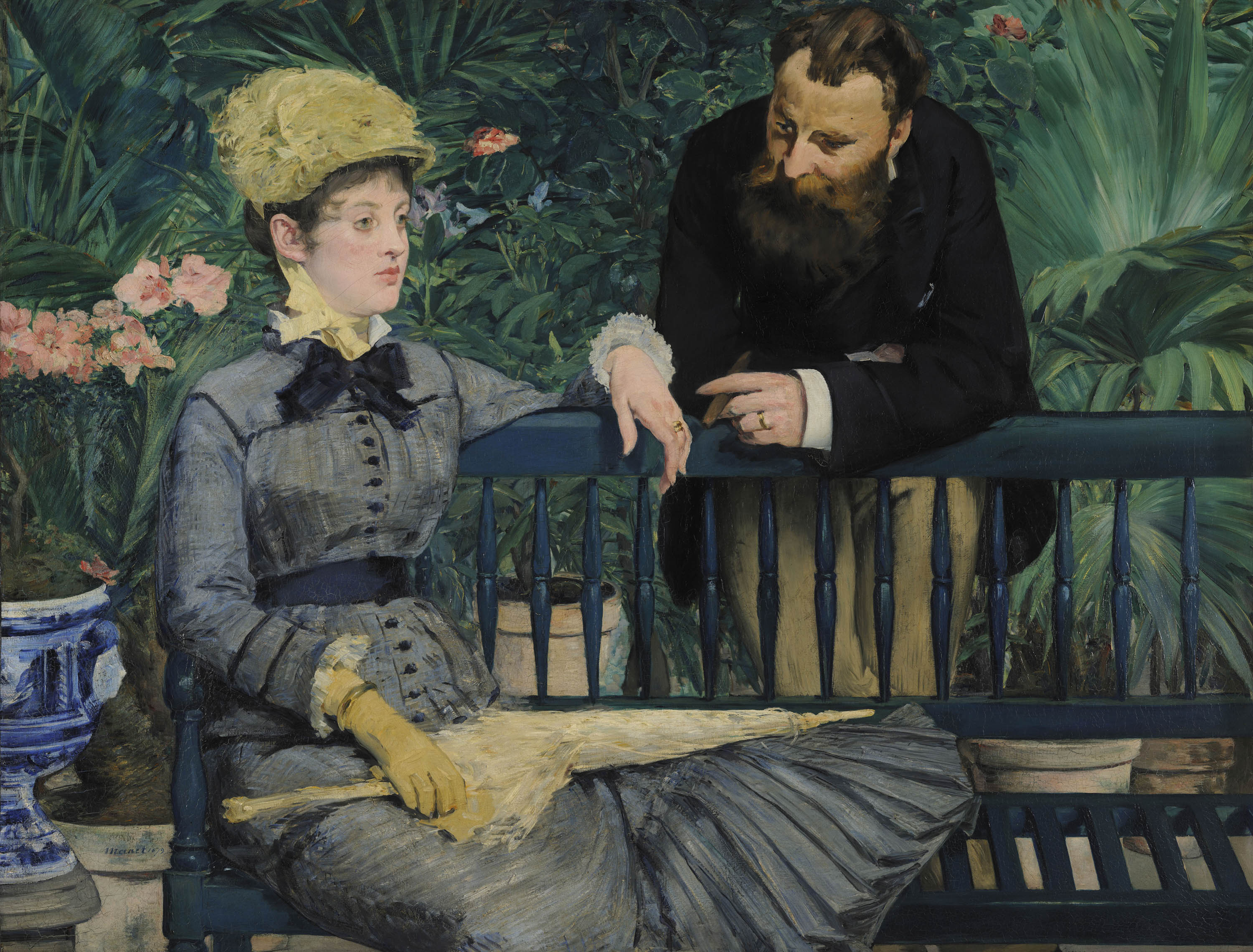
ÉDOUARD MANET. IN THE CONSERVATORY, ABOUT 1877–79. STAATLICHE MUSEEN ZU BERLIN, NATIONALGALERIE.

Is ugliness the absolute biggest setback one might be born with? Of course not. The idea that ugliness might be more of a handicap than race, gender, socioeconomic status, sexual orientation, or some combination thereof is a slippery slope toward the kinds of arguments incels and “proud boys” like to make. But looks are still a significant factor in one’s life. There’s no question that for those on the extreme side of the attractiveness scale—either very beautiful or very ugly—their lives will be fundamentally altered by their looks.The history of beauty is broken into two parts. For the ancients through the medievals, beauty was an empirical and objective concept. The belief, put forth first by Plato, was that beauty was a fundamental property of a person or an object; beauty was inherent and had been “created.”
But in his 1757 essay “Of the Standard of Taste,” David Hume undermined all this forever. The Scotsman set forth the notion that beauty is actually about perception, that the way the mind thinks about an object or person has little to do with the object or person itself. “Beauty is no quality in things themselves,” he wrote: “It exists merely in the mind which contemplates them; and each mind perceives a different beauty.” In other words, beauty is in the eye of the beholder. The only explanation for why we even discuss beauty as a trait at all is because of how it makes us feel.
Hume’s ideas about beauty fueled new ideas about art, too, many of which the Viennese art historian Ernst Gombrich explored in his hundreds of essays, books, and lectures. In his 1960 book Art and Illusion: A Study in the Psychology of Pictorial Representation, Gombrich made the Humean argument that art is based solely on perception, that there is no objective art just as there is no objective beauty.
“There is no reality without interpretation,” he wrote; “just as there is no innocent eye, there is no innocent ear.”
*
This understanding of art—in which beauty is solely about individual perception—is what makes Édouard Manet’s final artworks so confusing and enigmatic. Throughout his forties, the French painter’s health had been suffering, and, in 1879, at age forty-seven, he began hydrotherapy treatments out in Meudon, to the southwest of Paris. The treatments weren’t taking. His doctor in the capital believed that he had a circulatory issue, which caused intermittent paralysis in his legs and pains throughout his body so severe that he often had trouble sitting up. What he actually had, as would be later discovered, was locomotor ataxia, which made him unable to control his bodily movements or to feel his arms and legs. It’s a side effect of syphilis—and a brutal one at that. He would die just four years later, unable to stand for more than an hour or two, experiencing terrible, constant pain in his limbs.

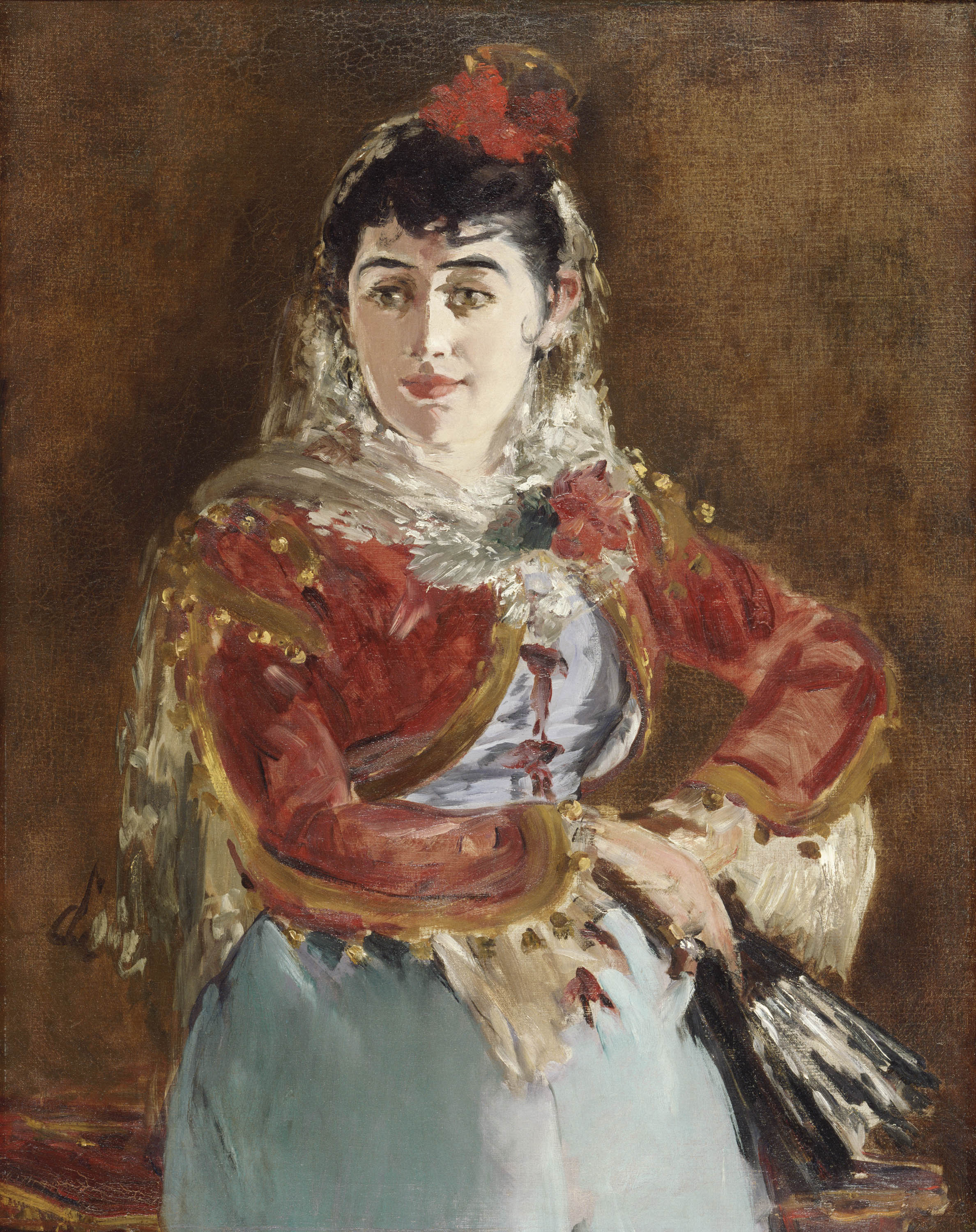
ÉDOUARD MANET. PORTRAIT OF ÉMILIE AMBRE AS CARMEN, 1880. PHILADELPHIA MUSEUM OF ART. GIFT OF EDGAR SCOTT, 1964. COURTESY OF THE PHILADELPHIA MUSEUM OF ART.

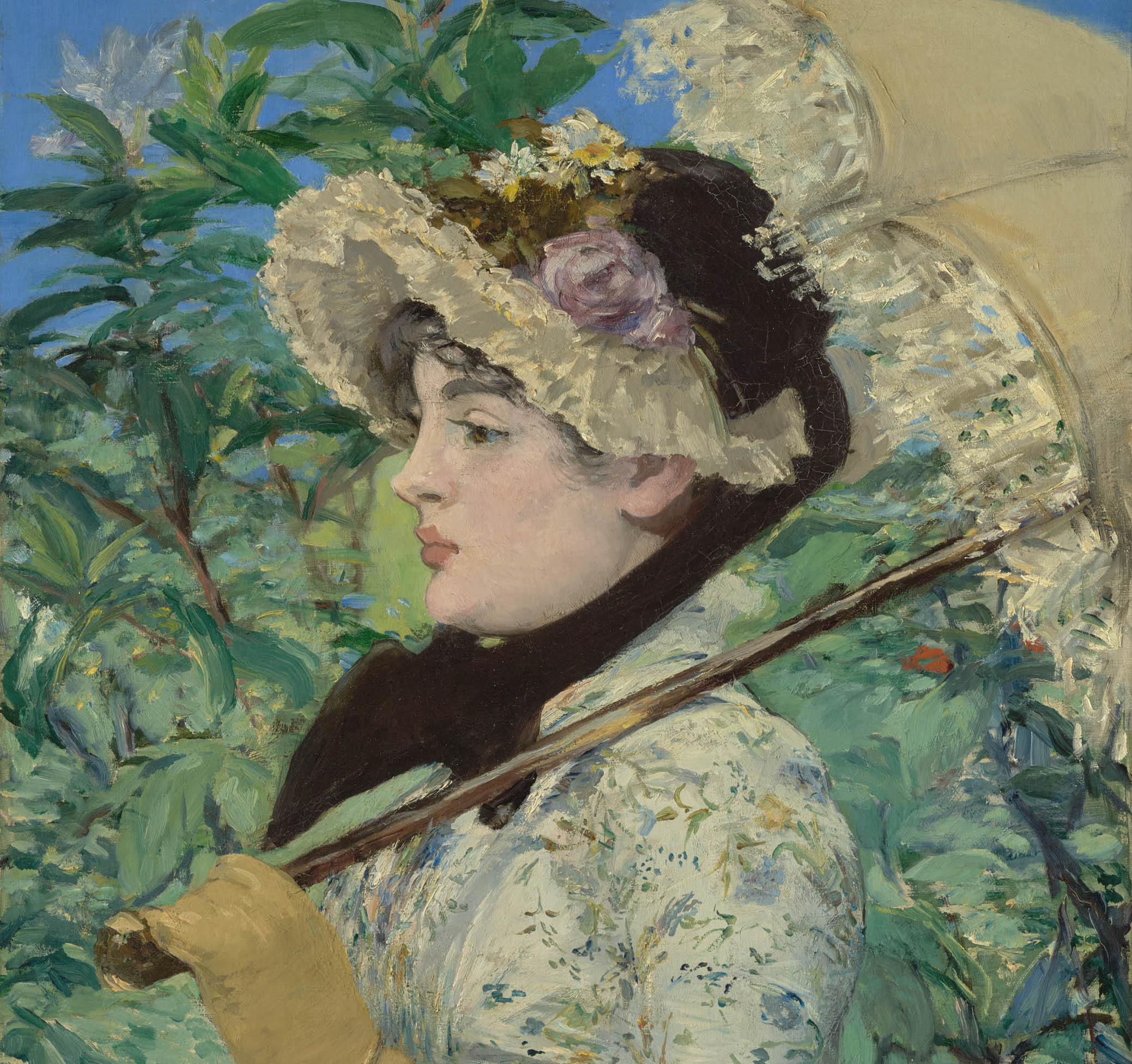
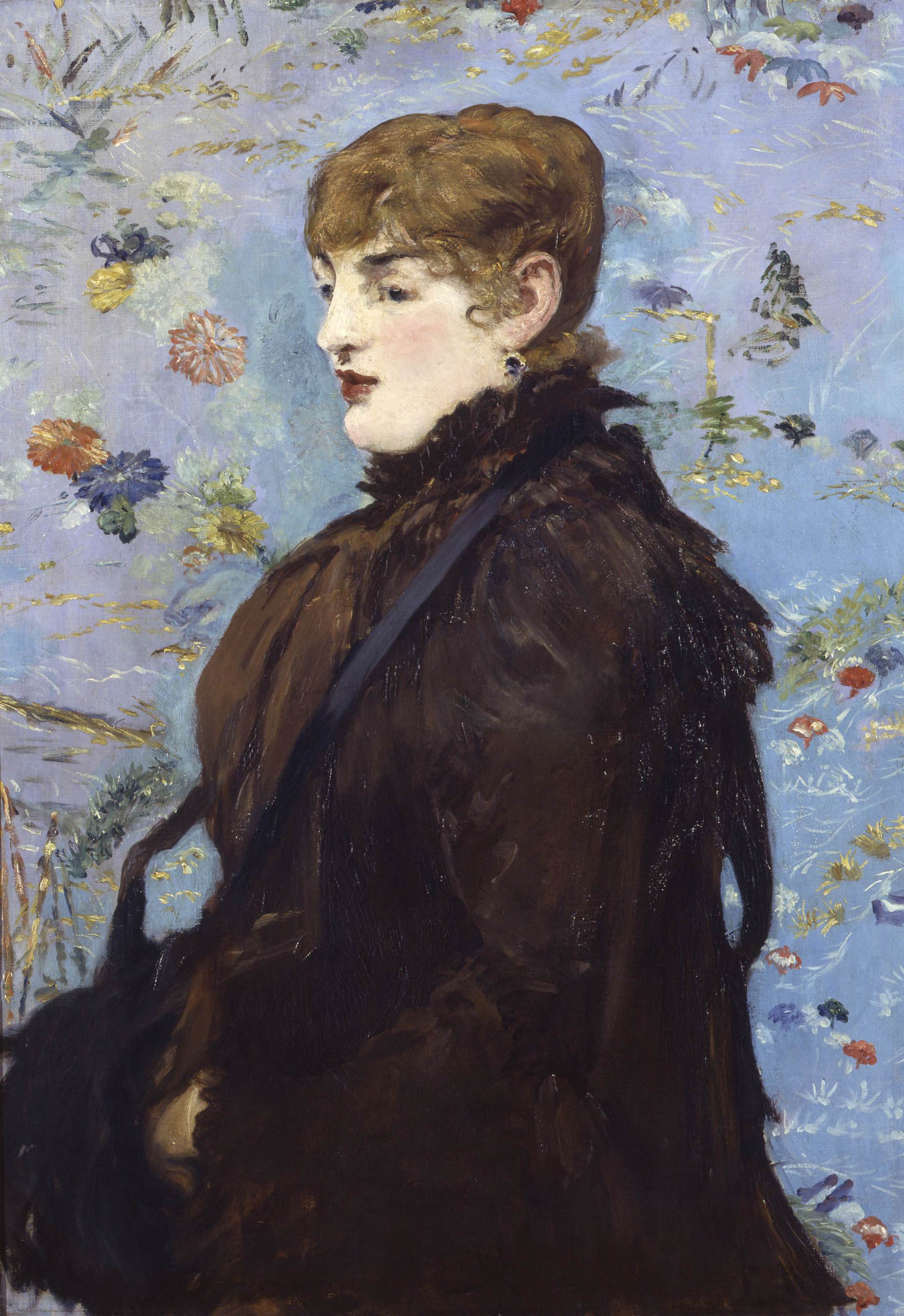
Those final years marked a significant shift in his painting style. He reoriented how he both conceived of and depicted beauty. In his early thirties, he had taken on the massive Modernist projects of Olympia and Déjeuner sur l’herbe, questioning the very fundamentals of formalism and art history. Toward the end of his life he turned to small-scale projects—tiny still lifes of fruits, such as Bunch of Asparagus and The Lemon, and portraits of society women, such as Jeanne (Spring) and Autumn (Méry Laurent). His final project was a series of roughly twenty still lifes of flowers in crystal vases. When he painted them, he was so sick he could not stand and he could barely lift his arms.
What were these seemingly meaningless, end-of-life confections?, many critics have wondered. Most determined that he had capitulated to the comforts of prettiness. The art historian John Rewald wrote, “Manet had to fight frequently against a dangerous tendency to faire joli,” to prettify everything. “Now that he was tired and ill, an opportunity was given to him to obey his whole instinct, to capture his frequently suppressed charm and frivolity.” Jacques-Émile Blanche, a portrait painter and contemporary of Manet, wrote similarly: “It seems that, as the invalid became less able to go out, the society of lively young women of easy virtue and their lovers became an increasingly compelling attraction for him.” The art historian Douglas Cooper, in his monograph of Manet, simply called his last works “a charming diversion.”
While the Frenchman had tended to look toward historical subjects for his paintings—and, with A Bar at the Folies-Bergère, sporadically continued to do so—his end-of-life paintings were almost exclusively smaller in scale both in size and in subject matter. Floral paintings, portraits of bourgeois women—weren’t these the realms of women artists? Why is it that the artist who spent much of his life overturning expectations of vantage points, proportions, framing, even race was now expending his final brushstrokes on painting pictures of pretty women and flowers?

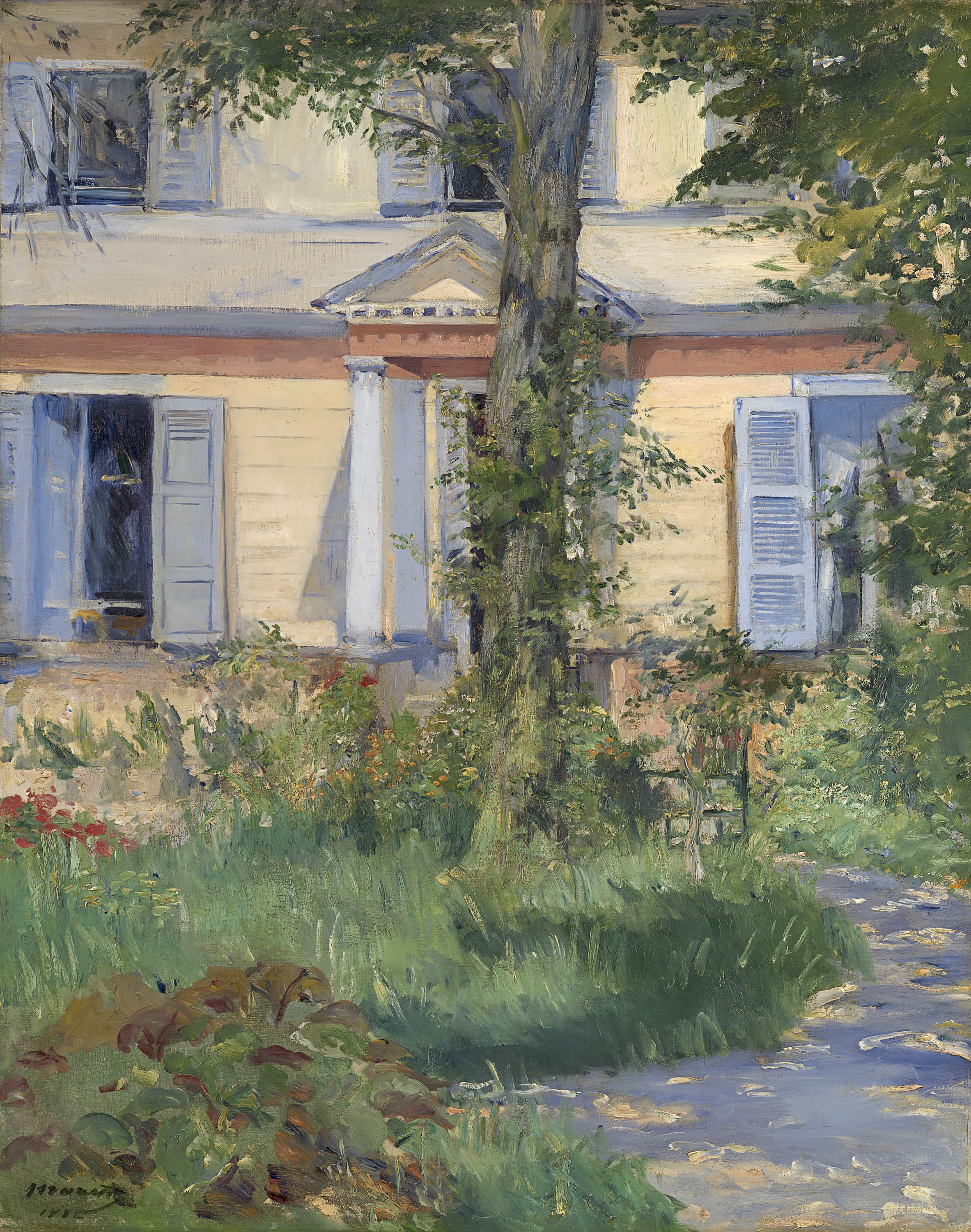
ÉDOUARD MANET. THE HOUSE AT RUEIL, 1882. NATIONAL GALLERY OF VICTORIA, MELBOURNE, FELTON BEQUEST, 1926.

It wasn’t until a feminist mode of art history came into vogue in the 1990s that some began to reason that Manet hadn’t been dumbing down his work or yielding to vapid prettiness; rather, he was redefining art and beauty altogether. The art historian Carol Armstrong identified the “femininity” of his works as a progression of his style rather than a surrender to his illness. Helen Burnham, an art historian and curator, saw his interest in fashion as an epitomizing depiction of modernity, a way for him to make grander points about French society.
Manet was widening the definition of beauty. He was reinventing his own style while using otherwise superficial beauties to fight his illness, his depression, his existential dread. Beauty, he knew, was not something that could be determined by critics or gallery-goers. It was whatever he wanted it to be. And what he wanted was an escape.
“His heightened interest in pretty parisiennes, the still lifes of fruits and flowers … all of these show the ailing artist’s passionate attachment to the delicate beauties and fleeting pleasures of this world,” writes Scott Allan, one of three cocurators of “Manet and Modern Beauty,” which is currently on at the Art Institute of Chicago. “Manet’s last works are among the most gorgeous and vibrant he painted but also, given his personal circumstances, the most poignant, and they reveal a more intimately human side of an artist so often lionized as one of the great heroes and rebels of modern art.”
Beauty, Manet seemed to be saying, can be a philosophy in and of itself. Does looking at these flowers ease your pain, too?, he seems to ask.

ÉDOUARD MANET. AUTUMN (MÉRY LAURENT), 1881 OR 1882. MUSÉE DES BEAUX-ARTS, NANCY. PHOTO: P. MIGNOT.

The viewer, as Hume reasoned, determines what is beautiful. Even the creator of the universe understood this relative nature of beauty, as brilliantly pointed out by Ken-ichi Sasaki, a professor of aesthetics at Nihon University in Tokyo, in his essay “Politics of Beauty.” After God creates the world in six days, he stops and looks at it in order to deem that “it was very good.” One might think that, for God, the beauty and the goodness of the world would be predetermined, that these traits would be a given. But God needed to take a second look at his creation in order to determine its aesthetic and moral quality. He needed not just to create its beauty but to perceive its beauty as well. “Beauty cannot be determined a priori with concepts,” Sasaki writes; “it needs always to be verified a posteriori. In other words, beauty is not made but given.”
Those who criticized Manet’s final works could not see past their own limited definitions of beauty. The macho critics thought of beauty as necessarily including grander meanings or art-historical significance. When their expectations were not met, they classified Manet’s works as superficial, as ultimately pointless other than as his coping mechanism.
A cohesive “philosophy of beauty” is, of course, impossible. We cannot find a universal consensus on that which is beautiful. What, indeed, even is beauty? This is what Gombrich struggled with: what makes good art? One must—simply and not so simply at all—just see it. One must decide for oneself.
There have been attempts at codifying notions of beauty. Lord Shaftesbury, the seventeenth-century writer, thought that a philosophy of beauty might be the solution to all of society’s ills, that if everyone could aspire toward and live with beauty, man’s inherent virtuousness would come through. But Shaftesbury was caught up in a pre-Humean worldview in which he believed beauty to be universal.

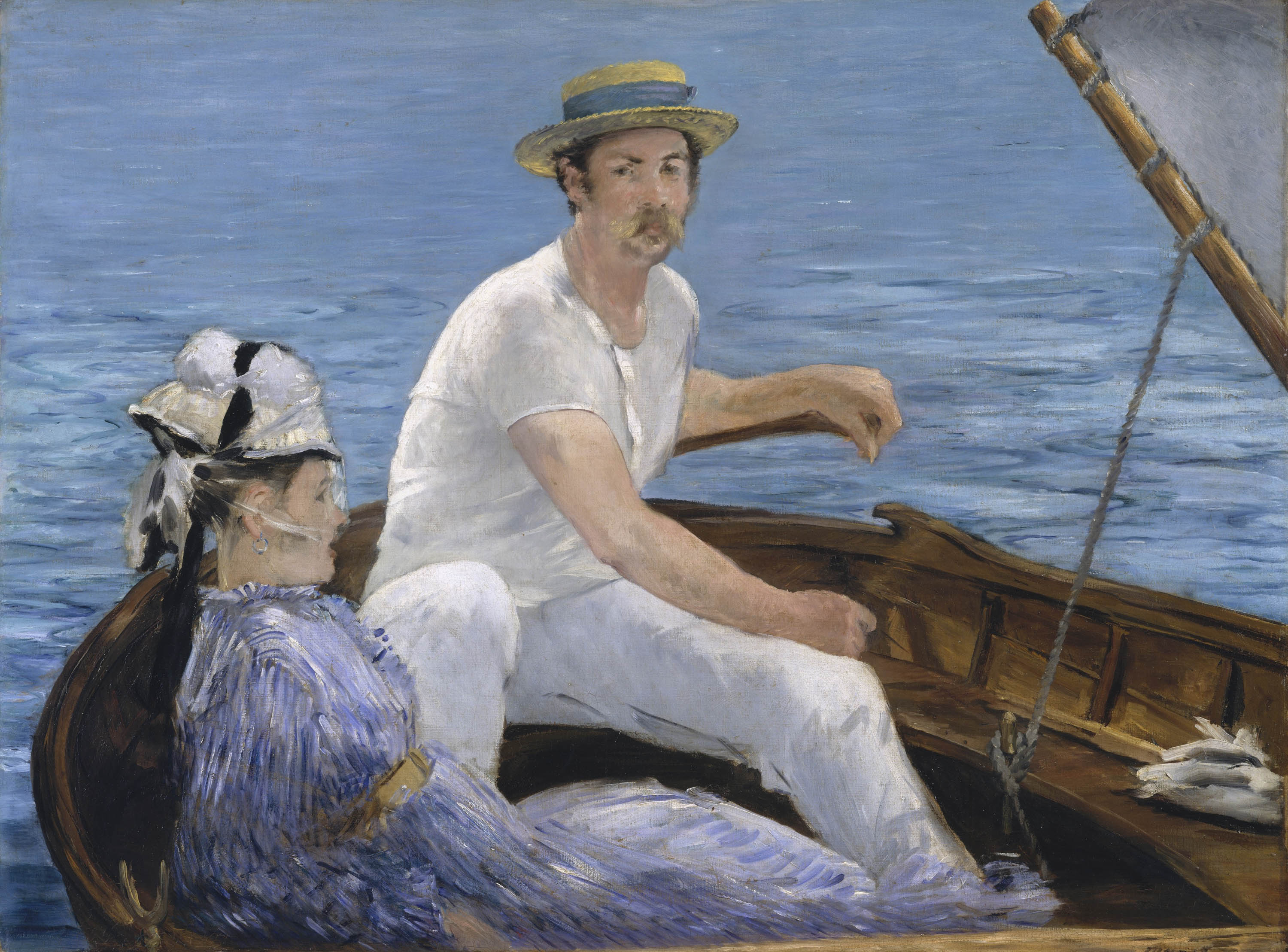
ÉDOUARD MANET. BOATING, 1874–75. THE METROPOLITAN MUSEUM OF ART, NEW YORK, H. O. HAVEMEYER COLLECTION, BEQUEST OF MRS. H. O. HAVEMEYER, 1929.

Even as we cannot agree on the terms of beauty, beauty continues to run society in myriad ways. Beauty is almost always subservient to—or otherwise tangled up in—money and power. The causality works the opposite way, too: those who are wealthier and of a higher social status can make themselves more beautiful.
This is why Manet’s final investigations into beauty remain so important: they begin with a look at the beautiful and powerful (the portraits of bourgeois women) and end with the beauty of nature (the flowers). Although the portraits tie up beauty with wealth and cultural notions of womanhood, his final series of flowers is free of any other context or characteristics. These paintings are natural, simple. To some, this is endlessly frustrating because they want more— they want to be able to see the world more widely through beauty’s lens.
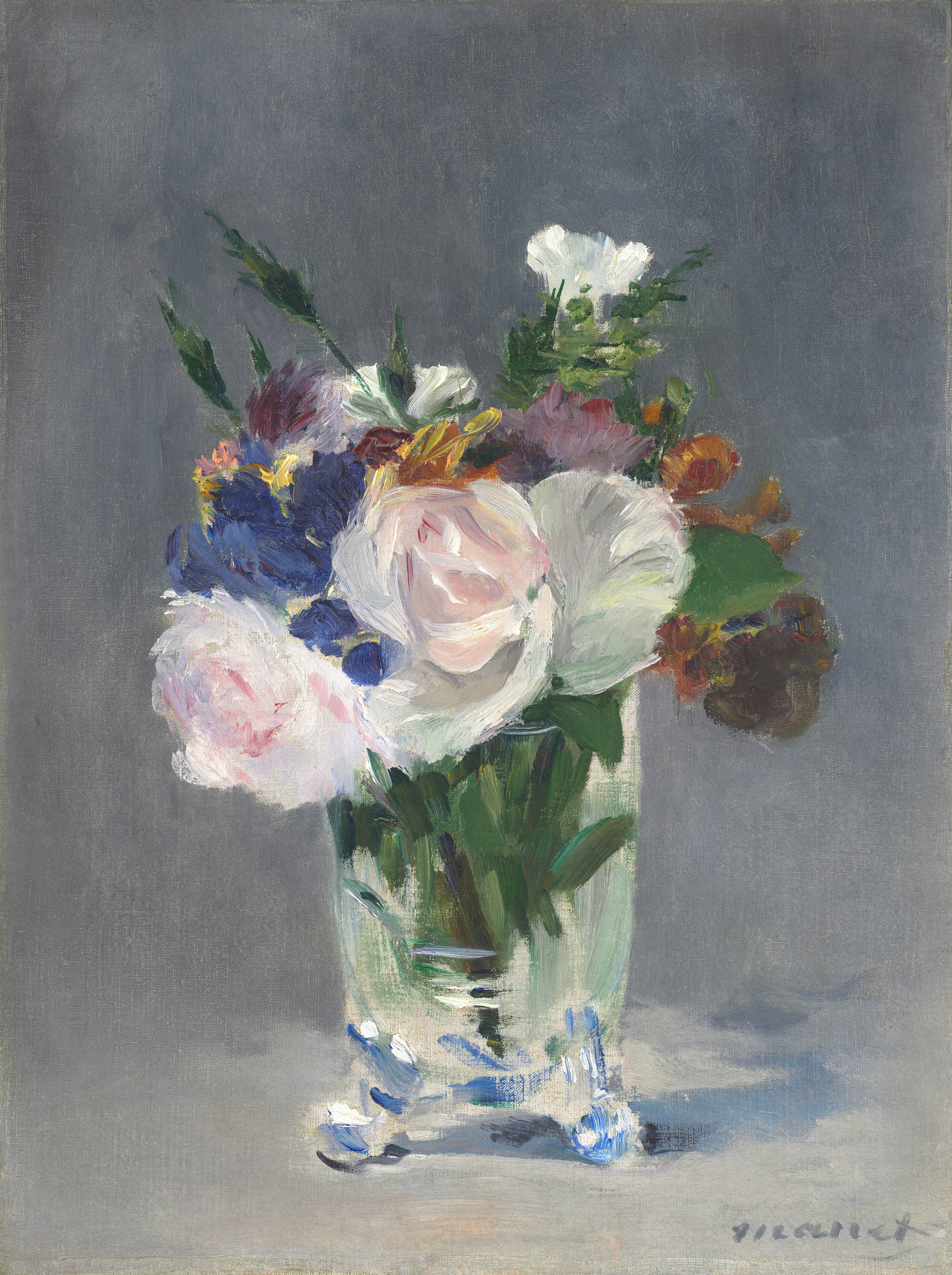
But perhaps beauty really can stand alone. Perhaps those bouquets in their crystal vases, which sit on gray and brown backgrounds, their flowers’ colors muted but real, their water dirtied and darkening, are anything you want them to be. Perhaps their backgrounds’ drabness is a harbinger of the artist’s imminent death. Perhaps the winding brushstrokes and the bursts of vivid floral colors point toward the infinite legacy he would be leaving behind. They contain all of this and none of this. The controversy Manet created is the crux of beauty itself—the infinite variations on a single petal.

ÉDOUARD MANET. FLOWERS IN A CRYSTAL VASE, ABOUT 1882. NATIONAL GALLERY OF ART, WASHINGTON, D.C. AILSA MELLON BRUCE COLLECTION.

Cody Delistraty is a writer and critic in Paris and New York.
Issue 229
du Bois

Wednesday, July 10, 2019

No One Is Trying to Get Into Your Country


Trump Praises Kim on Immigration: “No One Is Trying to Get Into Your Country”

NORTH KOREA (The Borowitz Report)—Setting foot in North Korea for the first time, on Sunday, President Donald Trump praised that nation’s dictator, Kim Jong Un, for his efforts on immigration, telling Kim, “No one is trying to get into your country.”
After crossing into North Korea from the Demilitarized Zone, Trump remarked to the North Korean leader, “Your border is amazing! There are no people whatsoever trying to get in. You should see our border—it’s a complete mess.”
Barely containing his envy, Trump continued, “Of course, you don’t have Congress to deal with, like I do. They’ve caused all the problems I’ve had on immigration. You’ve got a much better deal. You want to build a wall, you build a wall. No one can tell you you can’t.”
Surveying the border admiringly, Trump bemoaned the brevity of his impromptu visit with Kim. “I have so much to learn from you,” Trump said. “You must be doing something right.”