Saturday, June 1, 2019

Do TV Shows Ever Get the Art World Right?


Do TV Shows Ever Get the Art World Right? Here Are 14 (Even More) Memorable Episodes That Try, Ranked by Believability

In part three of our series, we rank episodes from the most ridiculous to the totally realistic.
Still from Broad City
Still from Broad City "Max's Gallery Show," courtesy of Comedy Central.
If imitation is the sincerest form of flattery, what about total cock-ups? The art world is an especially cocooned microcosm where money, celebrity, money, auction houses, and money are so intertwined, that real life sometimes seems positively fictional. But alas, sometimes even the best writers can’t match the intrigue of reality.
In part three of our ongoing series (check out parts one and two), we rank 14 shows, from comedies to dramas, by believability.

1. Elementary, “The Adventure of the Ersatz Sobekneferu” (2018)

Watson visits Venetto's auction house while investigating a murder case. Photo courtesy of CBS.
Watson visits Venetto’s auction house while investigating a murder case. Photo courtesy of CBS.
When Sherlock Holmes and Joan Watson discover a murder victim’s body in the process of being mummified, they realize someone is trying to create a forgery of the female pharaoh Sobekneferu. That mummy, if found, could be worth up to $100 million. Their initial suspect, the so-called Van Faux, is a master forger of Dutch Golden Age paintings. “He doesn’t just copy existing paintings,” Watson explains. “He paints brand new ones in the style of different Dutch old masters, and then passes them off as lost masterpieces.”
By the time Sherlock and Watson track Van Faux down, they discover that the victim was actually his daughter, and that the real murderer is another master forger called the Theban, who once created a fake coffin of Mary Magdalene. There are rumors that the Theban can fool carbon dating tests, but it turns out that his real secret weapon is that he’s an Egyptian antiquities expert by day, regularly hired to authenticate his own fakes. But then the Theban turns up dead as well, and Sherlock and Watson realize that the murder was in fact orchestrated by Armand Venetto of a venerable  auction house. Having knowingly sold hundreds of fakes, Venetto realizes his career is in jeopardy.
Sure, there really was a Sobekneferu, and some of the forgery schemes mentioned are true to life (Van Faux is a modern-day Han van Meegeren, who painted faux Old Masters on real 17th-century canvases), but this episode’s outrageous and convoluted plot is straight out of Hollywood.
Believability rank: 2/10

2. Portlandia, “Portland Secedes” (2017)

When graffiti-style art installations start appearing on buildings in Portland, Fred Armisen’s nebbish, stuttering character, Peter, inexplicably becomes convinced that he is in fact the infamous mysterious street artist Banksy.
Peter feels compelled to turn himself in to the authorities and tells a judge in court that he must “answer for his crimes.” The judge is having none of it, and invites Peter outside, where a newly discovered Banksy installation has just gone up on the side of the courthouse. Once again, Peter  wonders how he could have done it when he was in court all along (“am I Houdini?” he asks).
When a hooded figure with cans of spray paint pulls off a disguise, revealing that he’s the judge, Peter stammers: “Are you Banksy?” To which the judge replies: “No. Banksy is a construct to help build up the value of low-income neighborhoods.”
As funny as the episode is, Banksy is likely not a judge, and this one fails the reality test.
Believability rank: 2/10

3. Billions, “New Year’s Day” (2019)

What kind of hedge-fund billionaire doesn’t put his art in a freeport?
Apparently, Bobby Axelrod (Damien Lewis), the taciturn head of Axe Capital on the finance soap opera Billions. In a recent episode, Bobby gets an unwanted delivery at his office: Picasso’s Boy With Pipe (1905), with the promise of more than a dozen other works he purchased at Art Basel following closely behind. Just one problem: He doesn’t want them. One of his staff members accidentally routed them to the office, and if he accepts them he will be stuck with an enormous tax bill. What’s a hedge-fund manager to do?
He ends up negotiating a deal with frenemy Danny Margolis (Daniel Cosgrove), who recently bought into a fictitious freeport in Newburgh, New York. The two agree that Axelrod will store replicas of the works at the freeport and live with the real ones at home, all while avoiding a hefty payment to Uncle Sam.
There are just a few things wrong with this yarn. First, there is no way a hedgie like Axelrod—a character reportedly based on mega-collector Steve Cohen—wasn’t already stashing art in freeports. Second, Boy With Pipe sold at auction in 2004 for $104 million. The idea that such a pricey work would be sold at Art Basel, instead of at a megawatt auction, strains credibility.
Believability rank: 2/10

4. Riviera, “Villa Carmella” (2017)

Still from <i>Riviera</i> courtesy of AMC.
Still from Riviera courtesy of AMC.
“There is nothing as rigorous as money,” shouts Christos Clios (Demetri Leonidas), son of billionaire (and soon-to-be dead) art collector Constantine Clios (Anthony Lapaglia). Christos is strutting across a stage at what looks like a Wall Street investor conference as images of dollars and genuine artworks (including one by British duo Gilbert and George) flash on a screen behind him.
“Where is money most itself? Money is most itself in the last unregulated  great bazaar: the art market, where money can do what God intended: accumulate,” he says. “Here, as in Alice’s looking glass, a thing costs what some putative, free-spending, mad hatter says it costs.”
As the camera zooms in and out on Christos, he continues: “We trade Picassos, Rembrandts, Degas, Duchamp! We bundle them the way subprimes are bundled. We sell a Warhol short one day, we hedge an Old Master the next. We get in there before regulation tames the last Wild West.”
On the one hand, it’s easy to imagine a philistine, brazen, money-grubber collector like Christos. But the idea that he would have such literary knowledge (Alice’s looking glass, really?) is pure fantasy.
Believability rank: 2/10

5. Broad City, “Max’s Gallery Show” (2016)

"Still
In this episode, Abbi and Ilana go to a gallery opening for Abbi’s former college roommate, who’s an artist. The roommate, Max, is decked out in an over-the-top dress with a dramatic, medieval-looking collar. She’s teetering on huge platform boots. Abbi tells her she looks great, to which Max replies: “I look ridiculous… But you kinda need a look around here.”
They turn their attention to her white-on-white painting. “Be honest, what do you think?” Max asks. “Yeah… it’s… like I get it, I understand it,” Abbi responds. Max then starts describing her process: “I painted it with a feather—not the end that you write with—the soft end of a feather, so it took me two and a half years.” Abbi responds: “Wow! This is like a real gallery dude, they don’t even serve food.”
There is no denying the believability of some of this episode. You can’t event get a stale cracker at a gallery opening anymore. And there is no shortage of strangely dressed art-world people milling about the city. But would a young artist really spend two years on anything? In our Instagram world, where faster is better, it’s hard to imagine anyone having that kind of patience.
Believability rank: 3/10

6. The Girlfriend’s Guide to Divorce, “Rule #36: If You Can’t Stand the Heat, You’re Cooked” (2016)

Girlfriends' Guide to Divorce.
Girlfriends’ Guide to Divorce.
This episode focuses on Phoebe, the tousled-hair, boho-chic, cool mom “with boundary issues.” Having stumbled upon J.D., a young painter with social anxiety, Phoebe decides he is The Next Big Thing, and channels her former career as a model to pose for his Philip Pearlstein-meets-Lisa Yuskavage paintings before tumbling into bed with him and taking the reins of his stalled career (note the boundary issues).
Phoebe calls up her ex-husband Ralf, a moneyed guy in a slick suit, and asks him to come meet her new beau. Ralf praises J.D.’s expert technique (“the genitalia in this piece!”) and Phoebe jumps in squealing, “there is so a show here, right?!”
Oh yes, there sure is, but where to stage it? Phoebe suggests downtown, maybe Skid Row? “Art people love to feel like they’re slumming it,” which, okay, is probably true. Ralf exits with a suggestion: “you find the space, I’ll bring the rich art snobs.” And as promised, by the end of the 38-minute episode, J.D. has sold every work in his impromptu art show and is already struggling with his new identity as a major market star.
Something like this has happened before (see Jean-Michel Basquiat), but it’s not a common occurrence, and this one strains our believability scale.
Believability rank: 4/10

7. Younger, “Sex, Liza and Rock & Roll” (2018)

Still from <i>Younger</i> courtesy of TV Land.
Still from Younger courtesy of TV Land.
Younger tells the story of Liza, a 40-year-old woman who returns to the workforce after years away—and pretends to be 26 to get a job as an assistant at a publishing house.
She lives with her best friend Maggie, an artist who is one of the few aware of Liza’s real age. In this episode, Maggie, who had a loft in Williamsburg before it was cool, finally gets her due: she is invited to be included in the Whitney Biennial. (She helpfully describes it to Liza as “the Super Bowl of the art world,” which, fair?)
The show gets points for genuine emotion from Maggie as a mid-career artist finally being recognized after decades of hard work; for the shout out to ARTnews reporting her inclusion in the show; and for the slick, high-ceilinged gallery space where the exhibition takes place.
But it gets two big demerits: one for the fact that the cocktail party to celebrate the biennial has a black tie dress code (unlikely) and one for the fact that Maggie somehow finds out she is included in the show in the morning, and then by the evening, it all seems to be fully installed and open to VIPs.
Believability rank: 5/10

8. The Marvelous Mrs. Maisel, “Look, She Made a Hat” (2018)

Still of Declan Howell from <i>The Marvelous Mrs. Maisel</i> courtesy of Amazon.
Still of Declan Howell from The Marvelous Mrs. Maisel courtesy of Amazon.
Midge Maisel (Rachel Brosnahan) gets a primer on New York’s downtown art scene from her new boyfriend Benjamin (Zachary Levi), who is awed to spot artists Franz Kline and Robert Motherwell (whose work he collectors). But the episode’s real star is Declan Howell (Rufus Sewell), an alcoholic artist who is likely inspired by Jackson Pollock and Willem de Kooning. Howell is “the most famous unknown artist in the world,” Benjamin tells Midge. “He’s considered one of the greats by his peers, but he can’t sell his art.”
Midge finagles a studio visit with Howell, who shows her—but not the camera—his secret masterpiece. “If you want to do something great, you want to take something as far as it’ll go, you can’t have everything,” Howell warns. “You lose family. Sense of home. But then look at what exists.” It’s a reminder, as Midge grows more serious about her career as a comic, of all that she stands to lose—and gain.
The show gets points for sending Midge to real-life artist hangout the Cedar Tavern, but the show’s second season is set in 1959, by which time Pollock was dead,  de Kooning was finally making a living off his art, and the Abstract Expressionist movement was winding down.
Believability rank: 5/10

9. Gossip Girl, “The Serena Also Rises” (2008)

In this episode, the mother of Manhattan socialite Serena van der Woodsen has her art collection installed in her Upper East Side penthouse by her art adviser. “Kiki Smith greeting you in the foyer, Elm & Drag pulling you into the main room, and making a statement on the stairwell: Richard Philips,” the consultant intones breathlessly. (The Elmgreen & Dragset work is a version of their Prada Marfa, and the piece de resistance is a scaled-down version of Richard Phillips’s Spectrum from 1998).
This art world cameo is not exactly difficult to believe. All together, the three pieces shown would probably be approaching the million-dollar mark. (The episode aired in 2008, and Phillips achieved his highest price at auction—$384,000—the previous year). But seeing as the combined wealth of the van der Woodsen-Bass empire numbers in the billions, this would be no biggie for Lily.
It’s also pretty believable that she would have an art consultant, as is the case with many wealthy collectors who don’t always have the necessary connections (or good taste) to buy art on their own. This particular consultant would have to be well-connected: according to the artnet Price Database, this Phillips painting has not hit the secondary market yet, so presumably Lily’s consultant got it straight from Gagosian.
The show scores more belieavility points later in the episode, when Phillips himself makes a cameo at an auction to make a snide comment about how “celebutantes” have replaced artists at the center of New York’s art world.
Believability rank: 6/10

10. The Simpsons, “Made About the Toy” (2019)

America’s favorite cartoon family paid homage to Elmgreen & Dragset’s Prada Marfa installation in an episode that aired in January. As the family travels through the small Texas town on a road trip to track down one of Grampa Simpson’s World War II buddies, Homer stops to take a leak on the iconic storefront installation. Meanwhile, Marge mistakes it for a genuine storefront.
As for the believability of this one, sure, it’s easy to mistake Prada Marfa for a real storefront. If you’re speeding through Texas at dusk, as the Simpson family was, you’d be forgiven for driving straight past it. And as for urinating on the building, you’d probably get away with it, as the installation is the only thing on the road for miles (and there are no active security guards on duty, though you might get caught on camera). Just hop the chain-link fence around the back and you’re golden—so long as you don’t mind spectators, as there is often a nonstop stream of people pulling up to get a selfie with the famous installation.
Extra points go to the animators for including the fact that only one of each pair of shoes is included in the installation, which discourages anyone from making any illegal additions to his or her wardrobe.
Believability rank: 6/10

11. Russian Doll, “Superiority Complex” (2019)

Still from <i>Russian Doll</i> (2019). Courtesy of Netflix.
Still from Russian Doll (2019). Courtesy of Netflix.
In this episode of Russian Doll, Nadia (Natasha Lyonne) is at a party in an art-filled home belonging to her friend Maxine.
Contemplating two badly framed drawings with a pretentious academic named Mike (Jeremy Bobb), Maxine expresses her position: “I have a lot of interests and I think there is a lot of merit in copying. I’m interested in plagiarism as an art form.” Mike asks if she ever wonders why art doesn’t have the same power it did decades ago. “I’ve literally never wondered that,” Maxine replies. The non-artsy Alan (Charlie Barnett) interrupts—”the Internet,” he says—to which Mike snaps back “AIDS.”
Neither of them are wrong, but the pure arrogance of the moment and its cringe-worthy awkwardness make for a recognizable scene. (Also, we very much relate to the sentiment of an inescapable art party.)
Believability rank: 6/10

12. The Crown, “Assassins” (2016)

When Parliament commissions the painter Graham Sutherland (Stephen Dillane) to paint an 80th birthday portrait of Winston Churchill (John Lithgow), the prime minister is apprehensive from the start, asking the young artist “will we be engaged in flattery or reality? Are you going to paint me as a cherub or a bulldog?” You see, Churchill is also a painter, and he freely alters what he sees in reality to create a more pleasing picture. “For accuracy, we have the camera. Painting is the higher art,” he intones.
Although the two bond during their portrait session—Churchill comes to realize that his favorite painting subject, a pond at his home, symbolizes his dead daughter—the politician is horrified by the finished product, which he feels like looks like he’s “producing a stool.” Although Sutherland insists that “it’s art, it’s not personal,” Churchill declares him to be “a Judas wielding his murderous brush.”
It’s true that Churchill’s wife burned the painting—although she didn’t do it herself—but The Crown perhaps exaggerates the artwork’s importance to UK political history. On the show, the searing humiliation of the canvas’s unveiling, the unflattering portrayal of the prime minister in old age, provides the final push that convinces Churchill to retire, which isn’t how it really happened.
Believability rank: 7/10

13. The Shield, “Riceburner” (2004)

Still from "Riceburner," an episode from season three of FX drama The Shield.
Still from “Riceburner,” an episode from season three of FX drama The Shield.
In a pivotal, disturbing episode of one of the tensest TV series of the 2000s lies a lighthearted and down-to-earth subplot about the market for stolen art, design, and antiques.
With the help of a plugged-in informant (RonReaco Lee), LAPD beat cops Danni Soffer (Catherine Dent) and Julien Lowe (Michael Jace) chase down a pair of high-end chairs—appraised value: $10,000 each—that have been pilfered from the back of a moving truck in downtown Los Angeles. The trail leads first to a pawn shop, where the proprietor says he scoffed at the thieves and their asking price of $200 each, then to a modest furniture store where the owner states that he refused to pay $100 for chairs that look like “torture racks.”
The hunt ends in the parking lot of an unassuming downtown barbershop, where two senior citizens are found playing chess on the chairs. When told their new seating is stolen property, and asked if they’re ready to reveal where they got it from, one of the men replies with an innocent question: “Can we get our 10 bucks back?”
What showrunner Shawn Ryan and his writers get right about art crime is this: It’s not necessarily difficult for hardened criminals to steal valuable works, but good luck flipping them for anywhere near their market value. Unfazed by art-world mythology and pedigree, the average working-class person thinks that contemporary art and design is either a hustle, a delusion, or both.
Believability rank: 8/10

14. The Good Place, “A Fractured Inheritance” (2018)

In this episode, Tahani resolves her lifelong rivalry with her sister Kamilah—but not before trashing the effortlessly successful musician and artist’s exhibition at a Budapest art museum. Tahani joins the queue for Kamilah’s omelet bar/conceptual performance art piece, but resorts to throwing eggs at the paintings when her heartfelt apology is not accepted. Handcuffed by museum security and left to stare at the art while reliving painful childhood memories, Tahani realizes the paintings represent the way the sisters were pitted against one another, and how that rivalry has fueled Kamilah’s creative drive over the years. The two reconcile, and the handcuffs come off.
Easily forgiven art vandalism aside, how realistic is Kamilah’s artwork? Her amazing artist’s statement mentions that her work explores “the relationship between gender politics, copycat violence, and the protective shells we find ourselves in as we grow, mature, and search for meaning. With influences as diverse as Caravaggio, Francis Bacon, and Miles Davis, new variations are distilled from both mundane and transcendent structures.”
On the intellectual fragility and self-flattery of that statement alone, this one wins big on our scale. Who hasn’t read an artist’s statement just like it?
Believability rank: 9/10

Follow artnet News on Facebook: 
 
Want to stay ahead of the art world? Subscribe to our newsletter to get the breaking news, eye-opening interviews, and incisive critical takes that drive the conversation forward.
SHARE


‘I Hate Him, But He’s a Genius’


‘I Hate Him, But He’s a Genius’: How Mega-Dealers Really Feel About Their Colleagues, Artists, and the Cutthroat Game of the Art Market

Larry Gagosian, Richard Prince, Takashi Murakami, and Marianne Boesky all make appearances in this excerpt from Michael Shnayerson's new book, "Boom."
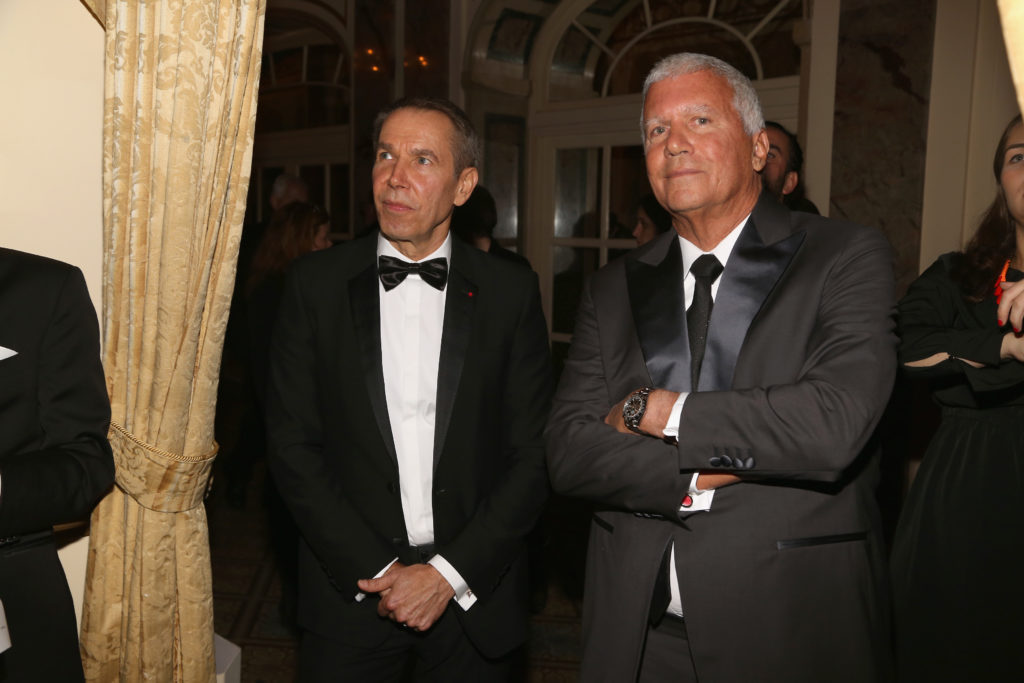
Jeff Koons and Larry Gagosian on October 28, 2016 in New York City. Photo by Sylvain Gaboury/Patrick McMullan via Getty Images.
By the early 2000s, the mega dealers were pulling far ahead of smaller galleries in a market growing with astonishing speed. All four megas were privately held and published no financial statements detailing revenues, expenses, profits, and losses. Even their corporate statuses were unclear. Still, soundings could be taken from art fair sales wrap-ups, when mega dealers broadcast their triumphs, and from the auction houses, where works sold by the mega dealers and their clients sometimes went for multiples of their retail prices. Overall, the total art market in 2002 was $21.151 billion. In 2008, it would grow to more than $62 billion, nearly tripling in volume. These were the years in which Larry Gagosian became the best-known art dealer in the world, his gallery’s growth paralleling the growth of the art market.
With that growth came a new degree of brazenness on many dealers’ parts for luring away artists from rival dealers. A case in point came in December 2003, with the very popular John Currin, whose figurative paintings seemed plucked from the Renaissance, though not without a satirical edge. Andrea Rosen, a midsize dealer, had nurtured his career from 1991, with slowly but steadily rising prices. She had just celebrated the launch of a three-city retrospective, from Chicago to London to New York, when news broke of the 41-year-old’s jump to Gagosian. Artists went from dealer to dealer, but to do so in the artist’s hometown at the end of the tour?
Gagosian was amused by how much ink, as he put it, the New York Times gave to the news, but irked by a quote from David Zwirner, who called Currin’s move “a real shock” and added that “our generation doesn’t have that aggressive behavior.” That was “fucking bullshit,” as Gagosian later put it. “Everyone operates about the same way. To take the high road, or burnish his ethics on my hide—it pissed me off. If the tables were turned, he’d do the same thing. Why try to come off so PC?” No one, he added, had a gun to the head of any artist. “In my experience, it starts with you hearing the artist isn’t happy. In extreme cases, you have a gallery that’s not paying the artist. That’s less likely with a good artist. But it can happen. Or the artist and dealer have just had a falling out. If it’s an artist you like, you pay attention. That’s how I got John Currin.”
Zwirner might feel his generation was different, but he was doing his share of poaching too. “David has actively poached artists,” sniffed one Chelsea dealer. “True, it’s common. But he will court an artist in a certain way. And it’s hypercompetitive.” So it went with Lisa Yuskavage, whose sexually suggestive portraits of women had found an eager market through her shows at the Marianne Boesky Gallery.
Between Yuskavage and her dealer, success had bred tension. “Lisa was going to leave no matter what,” Boesky admitted later of Yuskavage. The artist’s rise had left her critical of Boesky’s “context,” as dealers and artists put it: the other artists at the gallery. She wanted Boesky to kick out certain artists, just as Betty Parsons’s artists had wanted her to do decades ago. Boesky thought of altering the context by taking on artists Yuskavage might like, but how could she be sure the new ones would satisfy Yuskavage in the long run? Still, Boesky was hurt and embarrassed when Yuskavage went with Zwirner. The departure of Japanese artist Takashi Murakami for Gagosian was even more painful, coming as it did after nearly a decade of steering his career from obscurity and widespread rejection to global acceptance.
Murakami had perfected the style he called superflat. As in a Walt Disney animation cell, there was no visual depth, no brushstrokes or evident human imperfections. Boesky had first become aware of Murakami through a small but plucky gallery called Feature Inc., from which Boesky had poached him. Galerie Perrotin in Paris would also play a role with Murakami. But credit for building his career in the United States went mostly to Boesky and a pair of laid-back Santa Monica dealers, Jeff Poe and Tim Blum, whose story said a lot about how the contemporary art market took off.
Poe was the quiet, even taciturn, one, Blum the upbeat salesman. They had started with a small gallery in Santa Monica in 1994 and found themselves struggling to get by. They had one unusual card to play, and so, in desperation, they played it. Tim Blum had become fascinated with Japan in his twenties, enough to live there for four years, learn the language, fall in love with contemporary Japanese art, and work in a Tokyo gallery. Both Blum and Poe were particularly drawn to the then-unknown Murakami. They began to exhibit his work in 1997 and became his Los Angeles dealers. Boesky became his New York dealer, first including him in a group show in 1998, then giving him a solo show the next year.
A bag from Takashi Murakami's Character Bag collection for Louis Vuitton. Photo: Louis Vuitton.
Takashi Murakami bag for Louis Vuitton. Photo: Louis Vuitton.
In 1999, Blum & Poe first showed Murakami at Art Basel: 10 paintings, surrounding a sculpture of mushrooms with a typical Murakami character beside them. “We were looked at as complete idiots by the rest of the fair,” Poe later admitted. “Superflat wasn’t there yet; we were ushering into Western history an Eastern history that had been excluded.”
Murakami had fabricated those first works at his own expense. In 2001, as his reputation grew, he opened a production space in Japan and began hiring dozens of workers. Clearly influenced by Warhol, he worked in both fine art and commercial art, blurring the line between the two. Ultimately, he wanted to make everything from paintings to scarves to keychains, all with his Murakami brand. In 2003, Murakami also embarked on a handbag partnership with designer Marc Jacobs of the fashion brand Louis Vuitton. The handbags were a huge hit.
By now, Murakami had begun asking his dealers to underwrite production costs—not for Vuitton bags, but for much of the rest of his work. Blum and Poe knew that Murakami was no spendthrift. He slept in a converted crate in his office, just outside Tokyo, and worked every waking hour, making all design decisions, no matter how small.
The problem was his ambition: it was just so sweeping. They underwrote as much as they could, as did the artist’s other dealers, but when Murakami announced that his next project would be a 19-foot-high platinum and aluminum Buddha, his dealers balked. Boesky was pregnant in 2006, and Murakami, she recalled, didn’t like the timing of that at all. “You’re lactating, you can’t be my business partner,” she recalled him saying.
After ten years on Boesky’s roster, Murakami severed relations with her and signed with Gagosian as his New York dealer. Blum & Poe stayed in as Murakami’s LA gallery, going so far as to charter a plane from Japan to bring the still-unfinished Buddha to the Los Angeles Museum of Contemporary Art (LA MOCA), where it would be shown as part of a Murakami retrospective. They also bought $50,000 worth of tickets for the opening night gala and provided a six-figure contribution to help finance the show itself. Even more was needed, so Gagosian and Murakami’s Paris dealer, Perrotin, kicked in. And so did Boesky.
Boesky could accept that Murakami would leave her for Gagosian. What galled her was LA MOCA’s subsequent request to borrow key Murakami works that she owned, followed by Murakami’s reaction. As soon as her Murakami paintings were hung on LA MOCA’s walls, the artist stopped communicating with her. “Murakami is a fucking genius,” Boesky said later. “I hate him, but he’s a genius. What I hate is the way he left—without honor.”
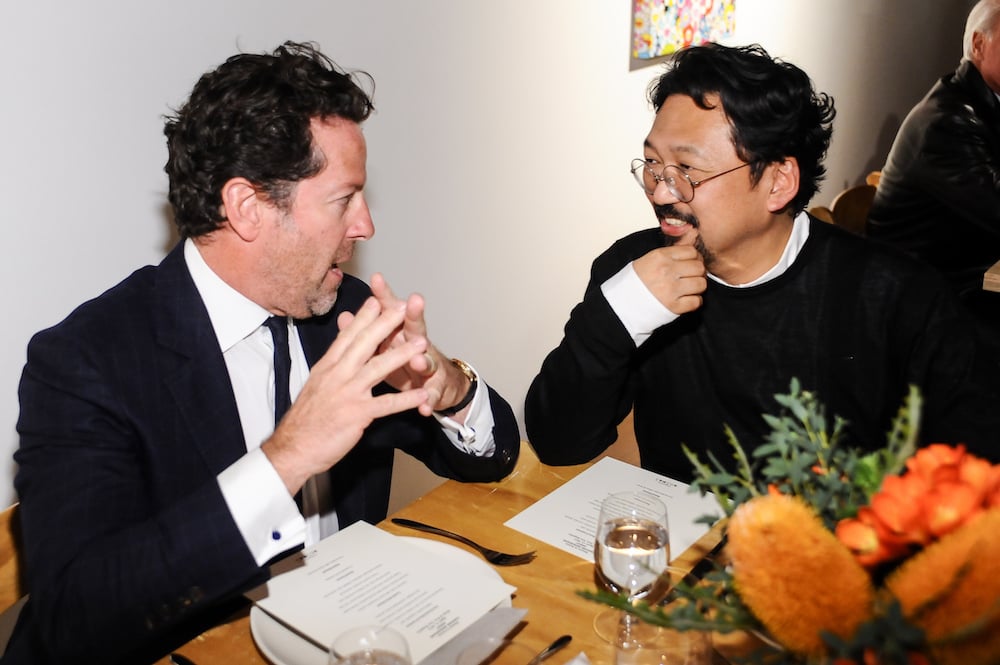
LOS ANGELES, CA - APRIL 11: Tim Blum and Takashi Murakami attend Takashi Murakami Private Preview And Dinner At Blum & Poe on April 11, 2013 in Los Angeles, California. (Photo by Stefanie Keenan/Getty Images for Blum and Poe)
Tim Blum and Takashi Murakami in 2013 in Los Angeles. Photo by Stefanie Keenan/Getty Images for Blum and Poe.
It was not by chance that a paradigm-shifting artist like Murakami was shown at LA MOCA. Nor was the Blum & Poe gallery situated in Santa Monica because its partners preferred sunny California to New York City. For dealers like Blum and Poe, the West Coast was no longer as arid an art scene as it had once been. A new chapter in contemporary art was opening in LA, and it had a lot more to do with the art being made than dealers poaching each other’s artists.
LA’s recent history had begun, in a sense, in 1979, with the opening of LA MOCA that year. At last, the city had the makings of an art center—and one founded by artists, at that. Four years later, the Geffen Contemporary at MOCA added 40,000 square feet of exhibition space in LA’s Little Tokyo historic district. MOCA director Richard Koshalek made a brilliant move in 1984, purchasing part of Count Giuseppe Panza’s historic collection of Abstract Expressionist and Pop art. Trustees groaned at the $11 million price; soon they would realize the purchase had made MOCA one of the world’s top museums of contemporary art—for a song.
With those arrivals, gradually more galleries opened in half a dozen neighborhoods. Richard Kuhlenschmidt opened a basement space on Wilshire Boulevard and made a point of showing challenging art, much of it conceptually based and from the Pictures Generation. Daniel Weinberg brought New York artists to the West Coast, among them Jeff Koons, Robert Gober, Sol LeWitt, and Bruce Nauman. There was no core area until galleries began congregating in West Hollywood, on the Beverly Hills border. Then, in the early 1990s, Santa Monica became the core. Kuhlenschmidt came. So did Weinberg. From New York and Europe came an early international gallery partnership: Luhring Augustine and Max Hetzler. Yet another new gallery in Santa Monica was Blum & Poe.
For Rosamund Felsen, one of LA’s longest-lived dealers, who had opened her first gallery in 1978, the move to Santa Monica from West Hollywood was bittersweet. One after another artist left her, culminating in the departures of Paul McCarthy and Mike Kelley. McCarthy explained that he was about to start making major, expensively fabricated works, financed by his new global gallery, Hauser & Wirth. “Then Mike Kelley came in…. He needed to leave too,” Felsen rued. “All the artists that he had been seen in context with were no longer there.” Santa Monica had grown, but at a cost for small and midsize dealers.
Irving Blum wasn’t surprised. The affable pioneering Warhol dealer had had his own struggles in the LA market, first in the 1960s with the Ferus Gallery, then in 1986, when he gave LA another go with his New York gallery partner, Joe Helman. He was soon reminded why he had left LA in the first place. “The Los Angeles scene is always two steps forward, one step back,” Blum said. “It’s needed some centrality, and Santa Monica has provided it. But the truth is, it hasn’t happened yet that LA has become a major art center. With thirty or so galleries, there just isn’t the density that New York has. Everything seems to be focused here now, and that’s great. But the ongoing problem is that collectors will still only spend up to a certain level. When they want to spend more, they go to New York. That’s what makes the situation ultimately provincial.”
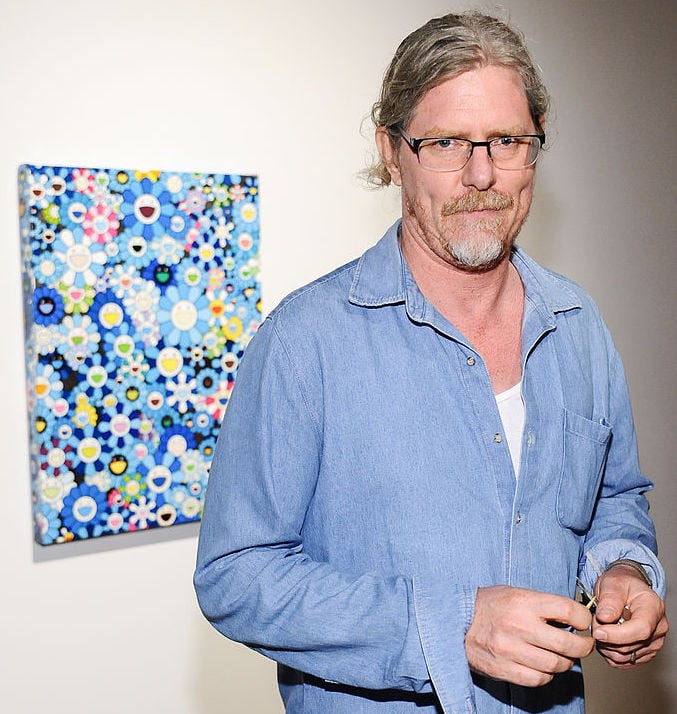
Mark Grotjahn. Photo Stefanie Keenan/Getty Images for Blum & Poe.
Mark Grotjahn. Photo: Stefanie Keenan/Getty Images for Blum & Poe.
Blum and Poe were set on proving the skeptics wrong. From their tiny gallery in Santa Monica, they had an outsize influence on artists as far away as Murakami in Japan and as close to home as Mark Grotjahn in LA. Grotjahn started as a shy aspiring artist who came to the gallery to see other artists’ work. By the time Blum and Poe met him in the mid-1990s, he had been struggling for nearly a decade to find his way. When his world looked bleak, he went on drinking binges. With a friend, Brent Peterson, he opened a small gallery named Room 702 in Hollywood and started working with other artists. The conversation, at least, helped. To earn money for his family he played Texas Hold’em for serious stakes.
As an artist, Grotjahn was struggling without success to find his own style—to the point that in 1993 he started painting the handmade store signs he saw in his neighborhood. Many of the signs, as critic Jerry Saltz later noted, were for dives and quick marts, burger joints and newsstands—and liquor stores, lots of liquor stores. “I deduce someone scared, strange, on the margins, avoiding big, glitzy stores,” Saltz speculated, “invoking a hardscrabble, old-school Raymond Chandler vibe, an almost alcoholic loner.”
True or not, Grotjahn felt that the signs he’d copied weren’t as good as the originals, so he went to the store owners and asked to exchange them. Most agreed, since as far as they were concerned the signs were the same. The sign chapter taught Grotjahn a lot about line and color. It also pulled him out of his cafard. By 1998, he was painting in a new way he liked.
“Mark used to come to the gallery,” Poe recalled, “and see every show and talk to us.” He never showed work of his own. “One time we said, ‘Why don’t you bring in some drawings?’” Grotjahn did, and Poe gave them a look but was unimpressed. Out of politeness, and because Grotjahn was a nice guy, Poe agreed to visit his studio to see more. Poe saw a different body of work there, one that really intrigued him. Grotjahn was doing what looked like landscapes, with what seemed to be rays beaming out from a setting sun. The artist called them two-tiered perspective paintings. Later, they would be known as his butterfly paintings.
Grotjahn’s paintings in his first show at Blum & Poe in 1998 failed to sell. At a second show two years later, Grotjahn sold exactly one, for $1,750. He called the experience a “whipping.” Sometime after that, he bought two large stretched canvases that some other artist had ordered from a vendor but failed to pick up and let them lead him to a new approach. The first of them he painted as one of his horizontal, two-tiered perspective works. After studying the finished painting, he decided he didn’t like its orientation. So he shifted it on the wall from horizontal to vertical. He liked how it looked—enough to make his second canvas vertical from the start. The vertical perspectives looked intriguing and fresh: not sunsets but vortexes. At a third solo Blum & Poe show, in 2002, Grotjahn’s latest paintings stirred growing excitement.
Don Marron, the financier/collector who would soon add Grotjahn to his collection, saw a lot of artists with their dealers. This was a relationship that stood out. “Grotjahn with Blum and Poe is one of the great examples of how steadfast commitment to an artist you believe in can yield tremendous results—rather than seeing how they do for a year and then dumping them. It was real commitment, like Leo [Castelli] and [Jasper] Johns, and like Ellsworth Kelly and Brice Marden with Matthew Marks.” Ironically, Grotjahn would later be one of the first artists of his generation to have multiple dealers—four in his case—and call his own shots.
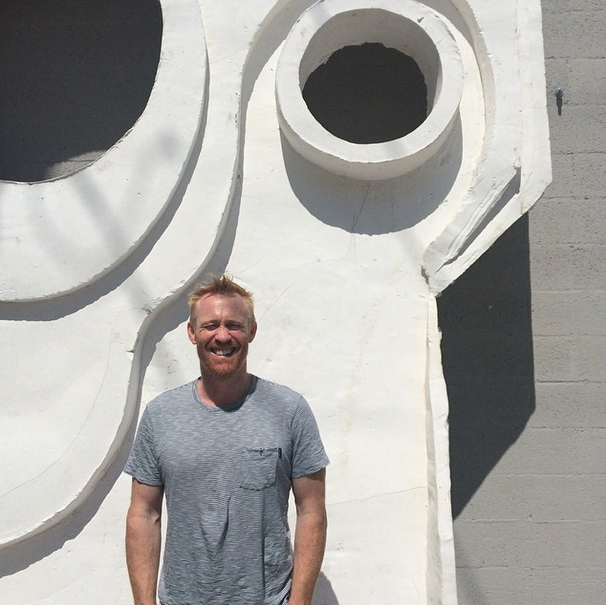
Thomas Houseago, Simon's World, Instagram
Thomas Houseago. Photo: Instagram/@simondepury
LA’s art scene was on the map, but not just because of new galleries and museums. The California Institute of the Arts, founded in 1961 and known as CalArts, had lured a whole generation of future artists and dealers. Some of its teachers were well-known artists. Several had participated in Helter Skelter: L.A. Art in the 1990s, a groundbreaking 1992 show in which 16 artists explored alienation, dispossession, perversity, sex, and violence. Among the curious drawn to LA by that show was David Kordansky, an aspiring artist and dealer who came west from Connecticut. He was fired up by the vision of learning from his heroes—Paul McCarthy, Mike Kelley, and the ultimate mentor, Conceptual artist John Baldessari—and set on being a dealer of contemporary art that mattered.
Kordansky arrived at CalArts to find a seismic shift underway. A number of teachers, led by Baldessari, had left CalArts for UCLA or the ArtCenter College of Design in Pasadena. “It was no longer about the monastery up in Valencia,” as Kordansky put it. Teachers and students were challenging CalArts’ rigor and tradition, where professors mercilessly critiqued students’ work and sent them off in tears. At UCLA and the ArtCenter, students were artists even if they never picked up a paint brush. As CalArts lost its allure, there were fewer painters to be found there either.
Upon graduating in 2003, Kordansky, with a partner, Ivan Golinko, opened his first gallery at 510 Bernard Street, a tiny cul-de-sac in Chinatown. The gallery had a mission: to take on CalArts artists and in so doing promote painting, which CalArts had de-emphasized, and help restore the school’s luster. One of Kordansky’s first artists to achieve a high level of success was Jonas Wood, a friend who assisted Kordansky’s wife, Mindy, herself a sculptor. Wood was becoming known for his portraits of friends. In 2019, he would still be a Kordansky artist, though by then he would be a Gagosian artist as well.
Another of Kordansky’s early finds was the British-born Thomas Houseago, whose outsize sculptures, in bronze among other materials, sometimes depicted figures, sometimes abstractions, and often featured exposed rebar, giving a sense of incompletion. The artist and his dealer became fast friends. “We were young and dumb and were partaking in pretty reckless behavior,” Kordansky readily admitted. “There was an explosive and intoxicating energy between us.” Only one solo show, and one group show, had come out of their alliance by 2005. But Kordansky felt sure that would change in 2008, when he moved to a larger gallery in Culver City. A first Houseago show in the new space came and went—and so, to Kordansky’s shock, did Houseago. “I put my heart and soul into him,” the dealer recounted, still hurt years later, “and he ends up leaving me.” For Kordansky, a career-making artist was gone, a friendship torn asunder. “I was 31,” he recalled. “It was the greatest life blessing.” Like Zwirner after Franz West’s shocking departure, Kordansky saw he needed to grow—to not focus on any single artist, but instead promote all his artists equally.
[…]
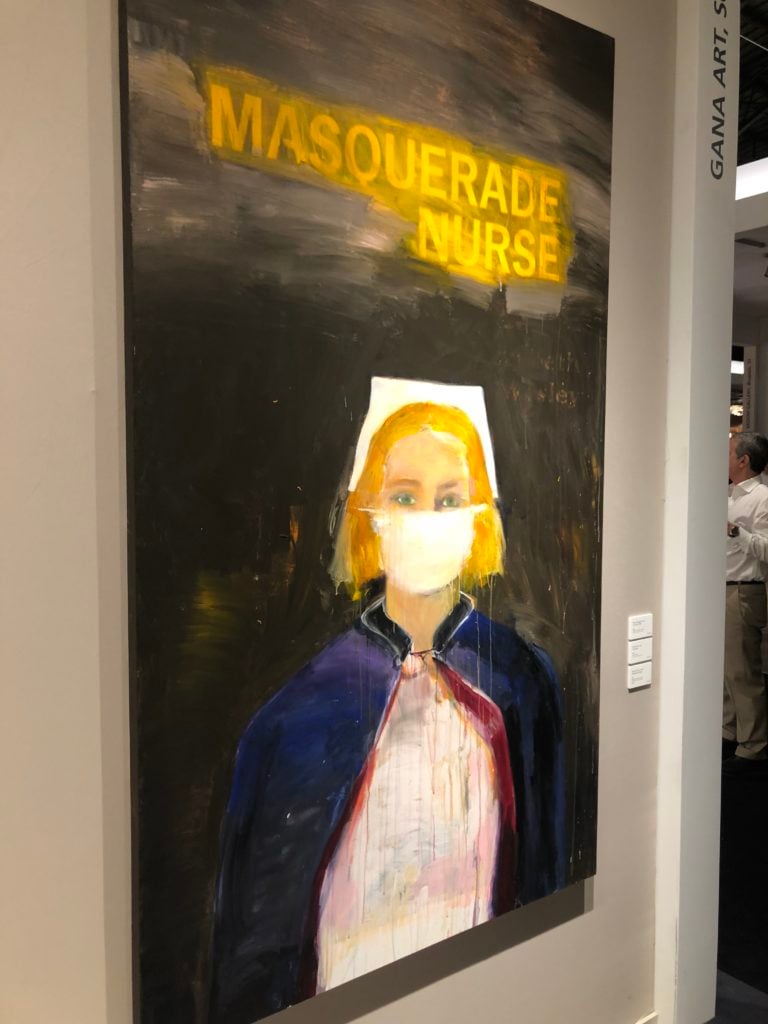
A Richard Prince nurse painting. Photo courtesy of Kenny Schachter.
In 2003, Gagosian was named by ArtReview as the figure who had had the most impact on contemporary art’s value and reputation. He would stay at or near the top of every such annual list from then on. Jackie Blum, wife of dealer Irving Blum, suggested that Gagosian’s brilliant strategy was to live rich before he got rich—to have the fancy Hamptons house and the plane before he could afford them and therefore start socializing with the very rich who would become his clients. Rivals conceded Gagosian’s dominance but still rolled their eyes. “Why do you deal with him?” a Christie’s staffer asked a collector at lunch one day. The collector sighed. “It’s . . . Larry, I don’t know, it’s Larry. I know he’s a rogue but he’s offering me the best stuff.” Others winced at perceived slights from the lord of the realm. “Larry will say hello to me if I’m with someone he wants to meet,” observed one dealer. “In the elevator, if it’s just the two of us, he’ll barely say hello.” Along with the half-dozen or so largest collectors from the previous two decades, a new generation of Gagosian collectors had come aboard. One was real-estate developer and art investor Aby Rosen, another was hedge-fund manager David Ganek, and a third was television producer Bill Bell Jr., a keen Koons collector with his wife Maria Arena. The parties Gagosian threw for these collectors were lavish but, for their host, obligatory. The truth, suggested one observer, was that Gagosian didn’t much enjoy his own parties. “He shows up for fifteen minutes, then leaves unless [Microsoft billionaire] Paul Allen shows up. Larry is great at this. He is unavailable—and then suddenly he is available. He knows how to play it. But he’s not that interested in people as people.” One of Gagosian’s great gets in this period was artist Richard Prince, who had gone from Metro Pictures to Barbara Gladstone. In the mid-2000s, Prince’s Nurse paintings, with their images of nurses taken from 1950s paperback covers, reportedly struck Gagosian as “curator art,” reported the Wall Street Journal. He wasn’t the only one: Arne Glimcher declared that Prince didn’t have a touch. “They’re mildly interesting as book covers—photographing art on art,” Glimcher acknowledged. “But how big was that idea?”
Still, as the artist’s market rose, Gagosian began taking an interest. He was seen socializing with Prince—affecting plaid shirts as Prince did. The turning point was a major Prince show at the Guggenheim. Despite Gladstone’s help in making it happen, the artist’s mind seemed set. He left, as Gladstone noted, right after the Guggenheim show.
Clearly, money figured into the decision. According to the Observer, Gagosian granted Prince a generous sixty-forty split on all sales, with the greater share going to the artist. He also put a Prince on pretty much every one of his collectors’ walls. At Gladstone, Prince’s Nurse paintings had sold in the low six figures. In July 2008, a painting from 2002, titled Overseas Nurse, sold for a record $8.4 million at Sotheby’s, indicative of what Gagosian was doing with his primary work to goose the market. It was the start of a hugely lucrative run for Prince and Gagosian, but one that would be tested by lawsuits brought against Prince and the Gagosian gallery by photographers indignant at Prince’s appropriation of their work for his own.
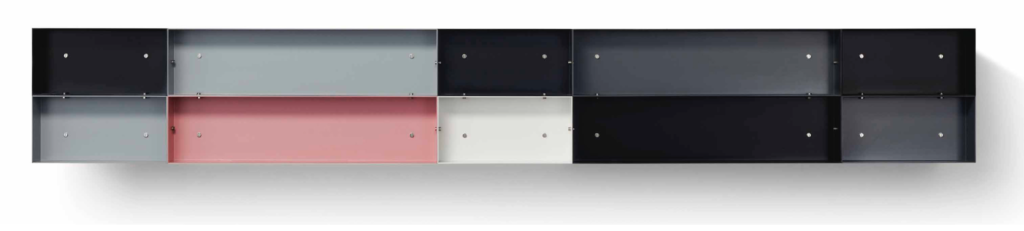
A sculpture by Donald Judd. Image courtesy of Kenny Schachter.
Powerful and wealthy as he was, outpacing all his rivals, Gagosian was not generally regarded as the most adventurous of the mega dealers. Neither was Glimcher. Hauser & Wirth was still feeling its way. Zwirner at this time was the one taking the most chances on edgier artists. A decade or so after signing up his first primary artists, nearly all remained with him, their stars still on the rise, including political painter Luc Tuymans, site-specific installation artist Diana Thater, socially satirical pen-and-ink illustrator Ray Pettibon, and Stan Douglas, the noirish filmmaker.
As if taking on a sideline hobby, Zwirner had also signed up several of the Minimalists and Conceptualists who had made their names in the 1960s and 1970s only to be preempted by the splashy Neo-Expressionists of the 1980s. Most were dead, so signing them up meant working with their estates. Abstract painter Ad Reinhardt, with his monochrome black paintings, was one; he had died in 1967. Fred Sandback, who died in 2003, was a Minimalist/Conceptualist sculptor who had worked with yarn, stretching single strands from floor to ceiling at geometric angles that created sculptural volume.
Minimalism was very much New York based, which left out another Zwirner acquisition, California artist John McCracken, though he, too, worked with simple geometric shapes. McCracken, still living when Zwirner took him on, was best known for his leaning, highly polished planks, somewhere between surfboards and the monolith in 2001: A Space Odyssey. He worked with lacquer, fiberglass, and plywood, ending up with sleek, brightly colored forms that earned him and a few of his West Coast fellow artists the classification of “finish fetishists,” a term he rejected. McCracken was sort of a stoner and believed in the existence of aliens, with whom he said he had had encounters. With McCracken’s death in 2011, Zwirner started working with his estate too.
The most prized of the 10 or so estates Zwirner had, though, was clearly Donald Judd’s. Judd was the acknowledged father of Minimalism, known for his stacked boxes and his extensive writings on the philosophy of art. He had denied that his works were sculptures, preferring to call them “specific objects.” He had also denied that he was a Minimalist, yet the term would stick to his work. Drawn to the sweep and solitude of western landscapes, Judd had traveled extensively through the Southwest, developing desert-based architectural projects. The town of Marfa, Texas, was where he came to rest. Judd created the Chinati Foundation, which showed works by fellow artists John Chamberlain, Dan Flavin, Carl Andre, and Claes Oldenburg, among others. Over time, the foundation came to maintain 70 square miles of undisturbed ranchland.
Zwirner had barely opened his first gallery when Judd died in 1994, at 65. The artist’s works began to rise in value, to the point that in 2013, one of his large-scale sculptures would sell at auction for $14,165,000. That was an all-time high for an esoteric work from 1963; as of 2018, only seven of Judd’s works would have been sold for over $5 million at auction. Still, Judd was clearly a dealer’s prize. Pace represented him for 20 years, both before and after his death, but after a last solo show with Pace in 2011, Judd’s estate moved to Zwirner.
With this Minimalist lineup, Zwirner struck many as the true successor to Leo Castelli. One dealer conceded that Zwirner had, as he put it, “very much of a European tilt to what he’s doing. Gagosian would have hot artists, artists that collectors bought because they thought they’d make money on them. David is a little more cerebral, a little more subtle.”
[…]
Art Basel Miami Beach did more than bring dealers and collectors together for three days of art talk and fun. It pushed prices of hot artists ever higher, as did its precursor, Art Basel. “One day Mark Grotjahn was an artist making a living,” Schiff noted. “The next, all his work is being sold at auction.” Grotjahn’s butterfly paintings were soaring higher than almost anyone else’s work. “He went from five thousand dollars to five hundred thousand,” Schiff rued. “It was at the beginning of this new phase of short-term profits in contemporary art. ‘Let’s dump our butterfly paintings!’ became the rallying cry. I did too,” Schiff sighed. “It was the dumbest thing I’ve ever done but I was scared. All that upswing for your clients. You couldn’t afford not to sell.”
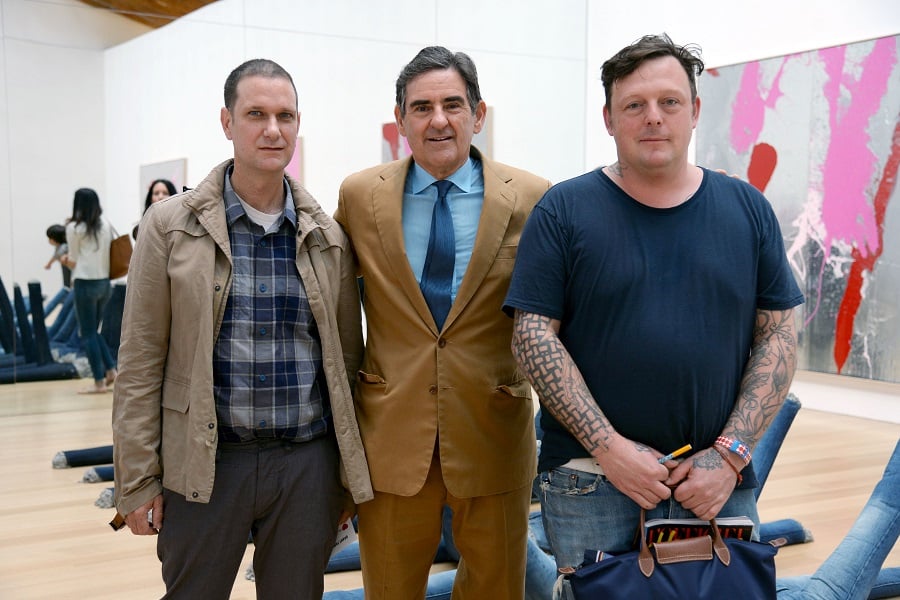
Josh Smith, Peter Brant, and Urs Fischer. Photo: Clint Spaulding/Patrick McMullan.
[…]
The megas weren’t the only dealers having banner years in the mid-2000s. Gavin Brown was backing new and promising young artists, and doing well by them too. He had Conceptual artists like Martin Creed, famous for a piece that consisted of lights being switched off and on. One light switch, one room. That was the work.
One of Brown’s closest artist pals was Urs Fischer, who tested their friendship with a Conceptual work in 2007. One day while Brown was elsewhere, Fischer showed up at his gallery with a work crew toting drills. In short order, the workers jackhammered a deep wide hole, removing earth and debris with a backhoe, in the gallery floor. The process of making the 38-by-30-foot crater was the art.
“I never saw it fresh,” Brown recalled later with a shrug. “But I wasn’t surprised.”
The earth work, titled You, earned lots of critical attention, most of it positive—the more so when Brown sold it to collector Peter Brant. What exactly was Brant buying? “He bought the energy,” Brown said. “He maintained his position in front. Then he went and dug a hole in his own place.”
“It was an environmental piece that could be reproduced,” Brant explained later, “and I reproduced it for an Urs Fischer show. One of our galleries had the hole dug up.” It could be reproduced again—as often, it seemed, as Brant liked.
Brown admitted the whole exercise was a bit crazy. “I think it shows a kind of insanity,” he agreed. “He knew that, the artist knew that, we all knew that. I think we’re in an insane age. I guess you either get on that train or walk to another destination.”
“What’s it worth?” Brant echoed when asked about the value of his pit. “I don’t know. Probably nothing. But it’s an important piece of our history.”
Excerpted from Boom: Mad Money, Mega Dealers, and the Rise of Contemporary Art by Michael Shnayerson. Copyright © 2019. Available from PublicAffairs, an imprint of Hachette Book Group, Inc.

Follow artnet News on Facebook: 
 
Want to stay ahead of the art world? Subscribe to our newsletter to get the breaking news, eye-opening interviews, and incisive critical takes that drive the conversation forward.
SHARE

Thursday, May 30, 2019

"speech bubble" SERIES

"speech bubble" SERIES


by

T f T = The fLIPADOS Team


@ VANTAG galeria


OPUS 1347

OPUS 1401

OPUS 1402

OPUS 1403
OPUS 1404

OPUS 1405

OPUS 1406


OPUS 1407

OPUS 1408
OPUS 1409
OPUS 1410
 ......


OPUS 1412

OPUS 1413


tubicontinud...