Art
Why Artists Love the Eerie Sensation of Characters That Look Almost Human

I learned about the “uncanny valley”—and a lot of other things in my intellectual repertoire, but that’s for another time—from 30 Rock. Tracy, worried about his legacy, has been trying to design the world’s first pornographic video game. Frank warns him that the project is doomed to fail: “As artificial representations of humans become more and more realistic, they reach a point where they stop being endearing and become creepy”—a point known as the uncanny valley. For example: C3PO and R2D2 are cute because they’re robots and they’re not supposed to look like human beings. But Tom Hanks in The Polar Express? CGI Stormtroopers? A wax figure of Nicole Kidman? Nearly human, unsettlingly so.
A tenured robotics professor at MIT couldn’t have explained it to me better. As Frank’s pop culture examples suggest, artists have always imagined beings who are both human and not—and, as Tracy intuits, many of these were beautiful women built to satisfy male creators’ erotic urges, from the legendary Galatea to the iBabes of Her and Ex Machina and Blade Runner 2049. Some of the most arresting art of recent years—
’s love dolls,
’s videos—mock the hubris and lewdness of our species’s attempts to build artificial people, even as they employ the same cutting-edge technologies. At the core of these and other works is an undeniable proposition: In the last few decades, we’ve developed tools that might conceivably allow us to erase the difference between artificial and real altogether. The uncanny valley seems to be the only thing standing in the way.
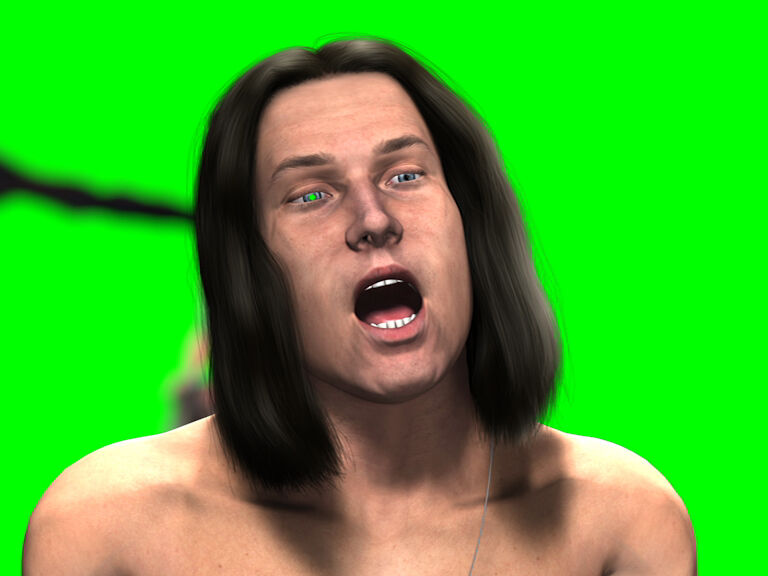
Ed Atkins
Hair by Ed, 2013
That, at least, was the thesis of the Japanese robotics professor who coined the phrase “uncanny valley” in a 1970 essay of the same name. Masahiro Mori, who turns 92 this year, is something of an anomaly: a visionary who has survived long enough to see his predictions come true (it’s telling that no authorized English translation of the essay existed before 2012). Studying the ways in which people interact with toys, puppets, and prosthetics, Mori extrapolated a generation of robots that would inspire revulsion in their users because they looked too human. When the world finally caught up, he found himself highly in-demand—not just among roboticists, but computer scientists, philosophers, designers, and artists.
Mori was highly original in some ways, derivative in others. At the core of his most famous essay is a whimsical and rather un-scientific graph in which he plots the “human likeness” of various things—a toy robot, a healthy person, a doll, an ill person, even a zombie—against their hypothetical shinwakan, i.e. “affinity.” He drew inspiration from his country’s rich theater tradition, arguing that its famous bunraku puppets were both highly lifelike and highly likeable, but perhaps only because audiences viewed them from the comfort of their seats.
By far the most important thing Mori takes for granted in his essay is the existence of a category called the “uncanny.” Like “robot” (or, for that matter, “uncanny valley”), the word “uncanny” is a surprisingly recent invention. It originated in the 16th century, but didn’t acquire its full modern definition until 1919, when Sigmund Freud penned an essay on the subject, citing, by way of example, the creepiness of dolls, puppets, and waxworks. What distinguished these objects was, for Freud, their combination of strangeness and familiarity—the more familiar the observer found them, the stranger they became. More than half a century later, Mori refined Freud’s theories by applying them to the world of robotics.

But for all the attention Mori has received lately, it’s not entirely clear where his most famous essay stands on the biggest question it raises: Will the uncanny valley ever be crossed entirely? Mori, a reclusive type, has suggested on more than one occasion that he thinks it will, but more often, he sidesteps the question. His essay concludes by encouraging designers to build deliberately un-lifelike machines, and in 2012, he said simply: “I feel that robots should be different from human beings.”
Not everyone is heeding his advice. The recent, much-laughed-about cases of Alexa’s blood-curdling laughter suggest that Amazon’s best and brightest may be trapped in a auditory version of the uncanny valley. When it comes to the human face, however, machine-learning programs don’t seem to have any such difficulty. Whether or not the uncanny valley is a dead-end, big tech seems determined to cross it, against the recommendations of its discoverer.
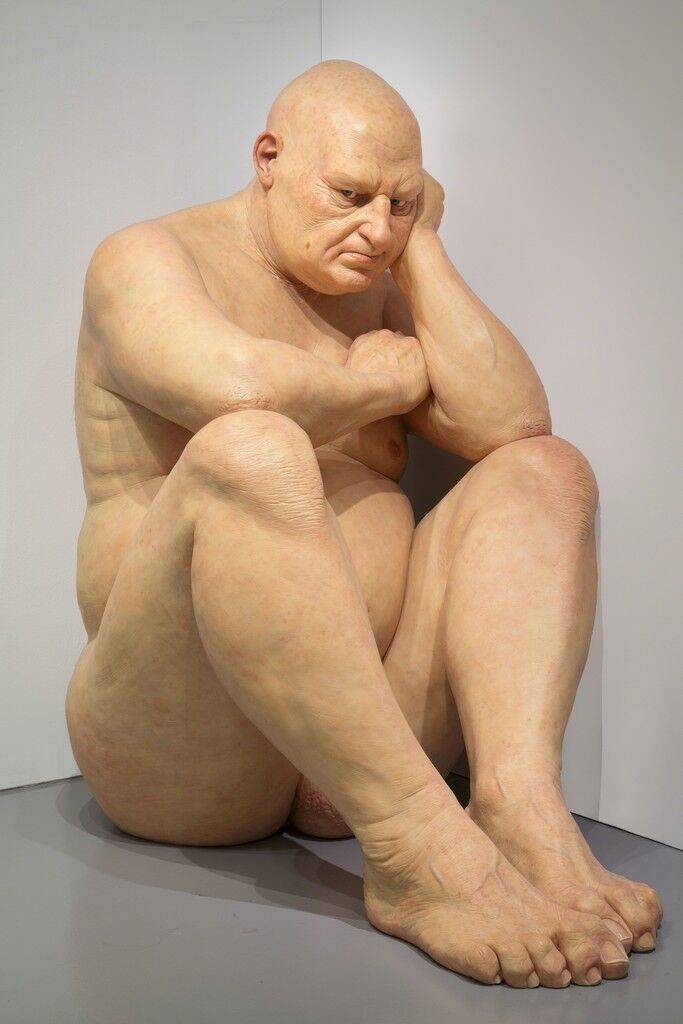
Still, one person’s glitch is another’s creative inspiration. While computer programmers struggle to merge the artificial and the human, artists continue to revel in the uncomfortable gap between the two. It’s safe to say that Freud himself would have admired the sculptures of
and
, both of which are often misleadingly characterized as “hyperrealistic.” Mueck’s figures are undoubtedly lifelike, but they’re often far larger than life, giving them an eeriness impossible to capture in photographic reproductions. Much the same could be said of Hanson’s work: His sculptures—often cast in fiberglass, painstakingly painted, and, finally, dressed in second-hand garments—have all the intricacies of actual human bodies, and yet, by dint of their silence and stillness, they’re firmly lodged in the uncanny valley. Encountering Hanson’s Slab Man (1974–75) as a teenager, I did a triple- or quadruple-take, realized that I was looking at a sculpture, not a person, and finally, overcome by the deadpan humor, surrendered to giddy laughter—the proper Freudian response.
Installation view of Jordan Wolfson, Female Figure, 2017 at the Stedelijk Museum, Amster
It’s no surprise, considering the long relationship between robotics and sex, that some of the most striking artworks evoking the uncanny valley also touch on themes of gender and eros. Even though the artists
have made a career out of puppetry and robotics, their 2014 installation The Marionette Maker still bears special consideration. It features a life-sized replica of the sleeping Cardiff, surrounded by impish, Lilliputian creatures that dance and play guitar as they scamper across her body. The replica could be interpreted as a passive Sleeping Beauty, waiting to be saved—and yet Cardiff and Miller leave open the possibility that she is the titular “maker,” dreaming the whole, uncanny scene.
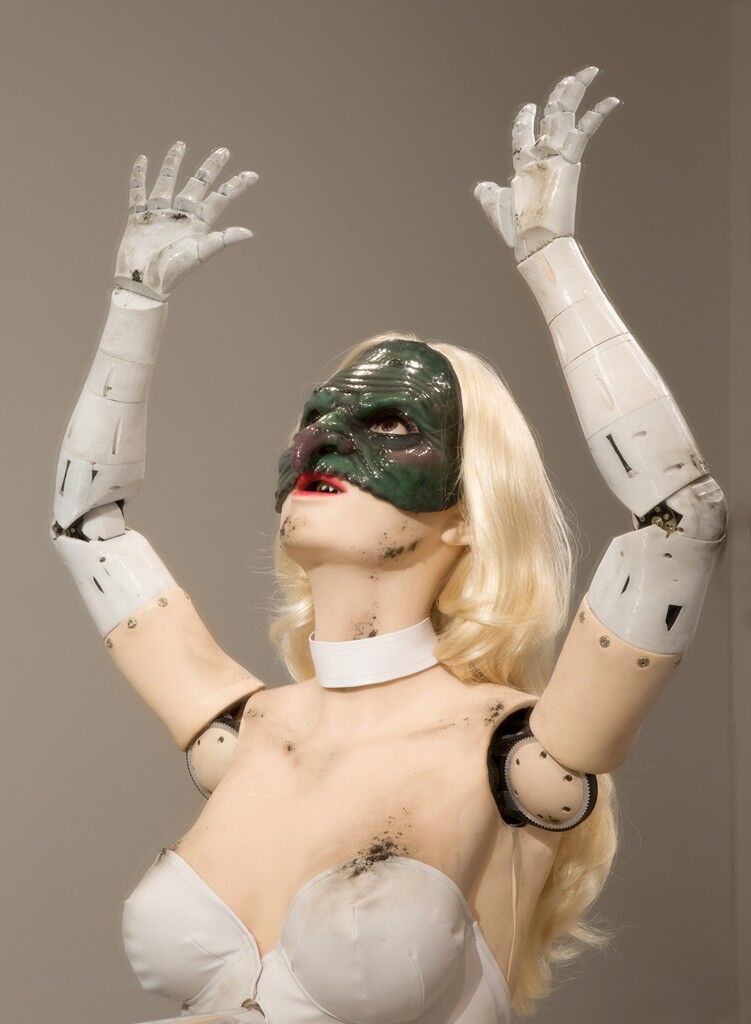
The robotic sculpture in
’s Female figure (2014) is plainly not a woman—and yet. Wolfson gave it a curvy, scantily clad body, but also exposed, factory-like metal joints; red, pillowy lips; flowing, Monroe-ish hair; and a long, hooked green nose like something out of The Witches. This combination of sensuality and
-esque grotesquerie is textbook uncanniness, haunting in a way that neither would be on its own.
Watch a seven-minute video captured at the Stedelijk Museum in Amsterdam, and you’ll see Wolfson’s robot do many things. It mumbles. It has a conversation with itself. It dances to Paul Simon and Lady Gaga. It shakes its ass. Most jarringly of all, it stares straight into the camera. Even as I told myself there was nothing behind its glaring face, I couldn’t force myself to stare back—the illusion that I was confronting a person was too powerful, and too painful. In this way, Female figure sums up a paradox that most tech developers seem not to recognize: The robots that inhabit the uncanny valley—in other words, the ones that are almost, but not quite, life-like—are often the most human.
Jackson Arn