Every now and then I see a page that hasn’t jumped on the bandwagon; we just can’t have that so lets run through how to design for the modern web.
These practices are immutable, you must follow them because I’m a developer advocate. They’re also in effect on quite a few of the top websites as ranked by Alexa, but most importantly, developer advocate.
Let Users Know About Your Mobile Application
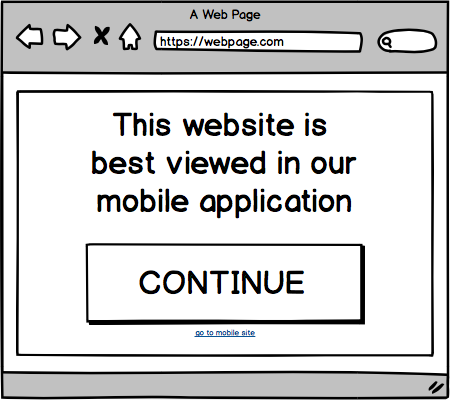
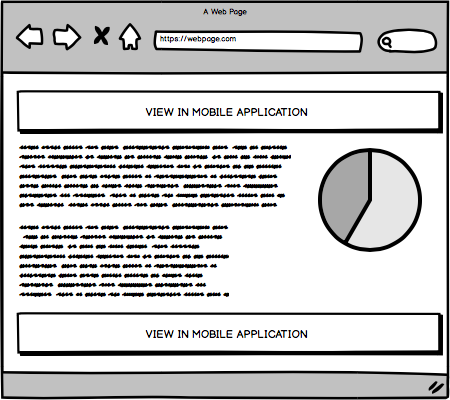
The very first thing you must do when a user visits your website is to show them a big modal dialog telling them that they should just install the mobile application instead.
A neat little trick is to make the link to close the modal small and put it very close to the link that lets the user install the application. This will make users much more happy as it’s so easy to install the application and not accidentally close the dialog!
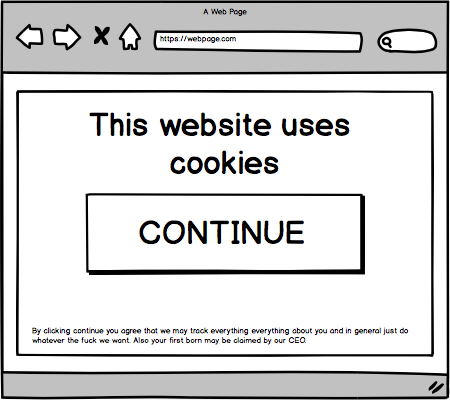
Let Users Know About Cookies
Should the user continue and insist on using the web version we need to let them know that we use cookies to track them.
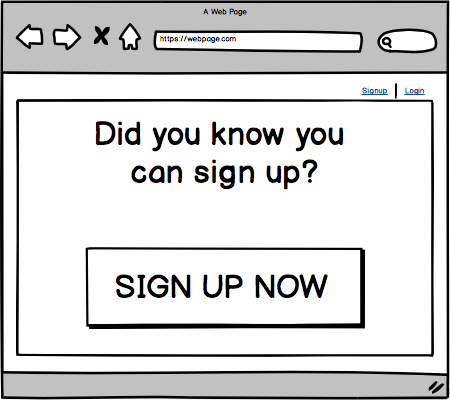
Let Users Know They Can Sign Up
Sometimes a link is not enough, a modal can be pretty helpful here in letting the user know they can actually sign up for your website.
Research has shown that modals that cannot be closed have the best conversion rate.
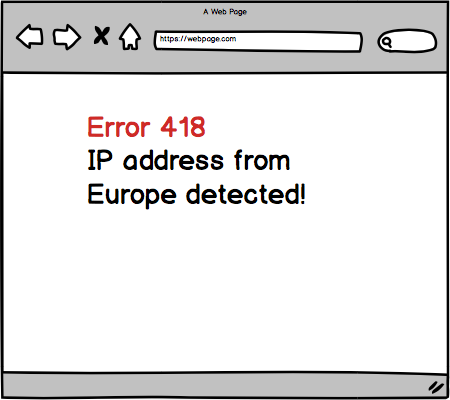
Block Users from Europe
Europeans nowadays have these pesky laws which muddy the waters on what we are allowed to track. The best practice here is just to do nothing, continue tracking everything about your users and just block Europeans from accessing the site.
Denmark is a failed socialist cup cake state anyway, its users are not worth the effort.
Let Users Know About Your Mobile Application
It’s good practice to show the user the dialog again when a user clicks on any link, most likely they just accidentally clicked away the first time.
Again we need to help our users out here, so we make the cancel link very small to minimize the chances of it accidentally being tapped. Happy users everywhere!
Allow Users To Opt-Out
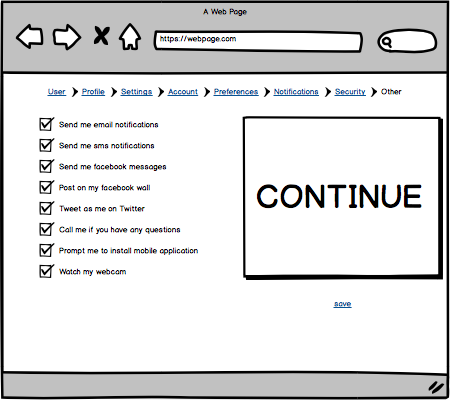
Now it’s very important that we are not intrusive to the user, so we must allow them to opt-out of the mobile application modals.
Best practice is to put it somewhere the user will easily spot it, like inside one of the account preferences pages.
Advertise Your Application
If the user should opt out of the prompt’s for the mobile application, we can till get them in the long run. Advertising the mobile application somewhere on the website works great.
Eventually the users will give in and convert!
Always Bet on JavaScript
These modals obviously require JavaScript, and of course it’s important to have endless scrolling but make sure you future proof yourself by using the latest framework. You may think “oh it’s only a couple of modals” today. But in the future, it may be many many more modals and oh boy! When that happens you’ll regret you did not make an isomorphic application with React and code splitting!
Conclusion
Now that you know these best practices for modern web development, make sure you apply them everywhere. You are now also certified and ready to apply for top ranking sites like Reddit and Medium as long as you remember these simple rules during the interview process.
Don’t know anything about web development at all? Don’t worry you can just take a week long bootcamp!
Josephine Meckseper, “Untitled (Flag 2)” at the University of Kansas, from the Pledges of Allegiance project (2018) (photo by Andy White/KU Marketing Communications)
For three weeks this past July, I sat with my colleagues in a gallery at the Spencer Museum of Art at the University of Kansas, where I work as a curator. A comfortable seating arrangement was set up for talking and thinking together in front of Josephine Meckseper’s “Untitled (Flag 2)” — a collage work featuring an abstract drip painting that resembles the contours of the United States superimposed onto a graphic design of the US flag. We took turns sitting for two-hour shifts during the museum’s visiting hours, as visitors came to see the artwork that had sparked a nationwide debate about the first amendment and the influence of politics at universities.
The work was part of a public art project, called the Pledges of Allegiance,organized by Creative Time in New York. For the series, Creative Time commissioned 16 prominent contemporary artists — including LaToya Ruby Frazier, Yoko Ono, Trevor Paglen, and Pedro Reyes — to create works of art on nylon flags about issues of political importance to them. Participating organizations across the country raised and lowered these flags in unison in a roughly month-long rotating display.
The Spencer Museum’s decision to participate was based primarily on our commitment to engage in public dialogue with our communities and to expose students to the voices of the artists on the project’s roster. We installed a flagpole in front of The Commons, our campus partner on the project, specifically for the purpose of displaying the Pledges of Allegiance flags, where they would be visible to passersby. Two placards were placed at the foot of the flagpole. One gave information about the series as a whole, and the other was changed out regularly to give information about each individual flag on display.
On Wednesday, July 11, “Untitled (Flag 2)” was removed from its flagpole by order of university administration and delivered to the Spencer Museum. Apparently, some viewers had misinterpreted the artwork as a desecrated US flag. The Governor and Kansas Secretary of State, who are in a race for the 2018 gubernatorial election in November, both called for the artwork to be removed from our flagpole. The gubernatorial primary was one week after the installation ended. The same politicians later pushed for the work’s removal from campus entirely, but university administration stood by the work’s remaining on display within the museum. I was never consulted on the decision to move the work, but as the curatorial lead on the Pledgesproject at the Spencer Museum, two things were within my power: to remain vigilantly committed to keeping the work on continuous public display through the run of the project and to continue to support public dialogue.
From the moment Meckseper’s flag arrived inside the museum, my fellow museum workers and I continued its exhibition. We installed the work in a gallery specifically designed to allow museum staffers to respond to the immediate needs of our communities. We made a staff member available for discussion during all gallery hours. We wrote extended explanatory text, with Creative Time staff securing a contextualizing image of Meckseper’s earlier work, and brought out two plinths on which to display an educational binder and a notebook for public comments.
The museum’s careful responsiveness made me proud to be working with our team, but the larger institutional reaction to politics that had evoked our response was deeply disheartening. The point of showcasing the Pledges of Allegiance series on a university campus was to model public engagement in difficult conversations from varying perspectives. Meckseper’s work was not intended to be shown in a gallery.
On the morning of the flag’s first full day on display inside the museum, I got ready for work with no idea how the day might unfold. I sat beside my partner and explained that on this morning, he should understand that I worked for a state university that allows concealed weapons on campus, and that there had been some controversy around the Pledgesart project. I assured him that I loved the work I did, that I loved him, and that I was happy. These are strange times.
On that first full day of “Untitled (Flag 2)”’s display in the Spencer Museum of Art, we spread the word, encouraging people to come to see the work and discuss it. The gallery was filled with allies and supporters. In the wake of the controversy, it was good to be with friends. But we never entered into this project seeking consensus.
As I sat in the gallery with Meckseper’s work over the following weeks—juggling other projects and deadlines in the background—I recalled how, while working at the Museum of Contemporary Art Chicago in 2016, I was thanked for my “stewardship.” I had never heard the word “stewardship” used in a museum context. I was ambivalent about the word; I both endorsed and resisted the idea of being a “steward.” It at once appealed to me with its connotations of caregiving and repelled me through what I read as a patrimonial missionary impulse.
I have come to believe that ambivalence about institutional stewardship is an ethics. Institutional workers should never unconditionally support the institutions for which they work at the expense of the values those institutions purport to defend. The most effective museum worker may be the one whose allegiances are ultimately to self-criticism, especially when the institution is the subject of that critical reflection.
The tension between my roles as a private citizen and an institutional worker highlights the tension between my own strategies for political resistance and what is expected of me in the museums where I work. My ambivalence emerges out of my struggle to articulate my autonomy in the midst of institutional power and along the private-public-institutional spectrum I work within. Artist Glenn Ligon’s 2007 neon sculpture, “Give us a Poem,” comes to mind, relentlessly flashing between the words “ME” and “WE.” Working within institutions can feel like being in a relationship with a jealous lover, one who attempts to limit my relationships with others. But if we leave institutions when they make choices we wouldn’t, who ends up running them and what do they come to stand for?
The late anthropologist and curator Ivan Karp said: “the most fundamental freedom … is the freedom to resist.” Karp almost lost his job for bringing Guillermo Gómez-Peña and Coco Fusco’s 1992–1993 performance piece, “The Couple in a Cage,” to the Smithsonian’s National Museum of Natural History in Washington, DC. The piece is well known for its exploration of the institutional exploitation of indigenous peoples. Karp argued again and again that institutions should be involved in the work of both reproducing and challenging our societies.
The story of Meckseper’s work for Pledges may be retired in the news cycle, but we are still sorting through its implications for other ongoing community struggles. Graduate students are speaking out, and community groups are still involved in protests and counter-protests. The work is never done.
Museums must be answerable to their audiences and communities. That can be difficult, personally and professionally, but it is essential to a democratic society. Museums do not, however, seek permission from the state, and a democratic state should not want them to. If they did, our cultural institutions would become singular and their voices monolithic, and that would be a dark day for democracy.




 Joey Orr