
Art Market
When Does Painting a Portrait Violate the Subject’s Rights?
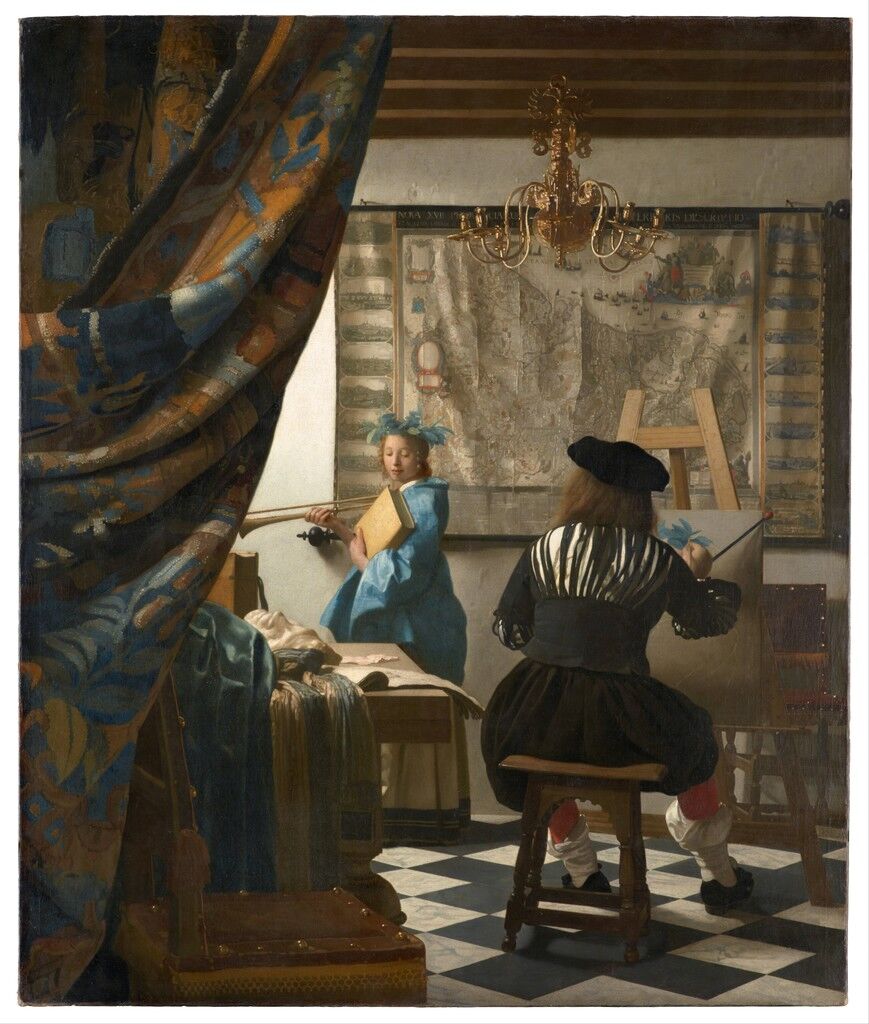
Johannes Vermeer
The Allegory of Painting, ca. 1666
Museum of Fine Art, Vienna
It might be hard to remember now, but there was a time when Tiger Woods was the highest-paid athlete in the world. Ah, the mid-2000s. In his prime, the golfer appeared in advertisements for American Express, Nike, and Buick, among other companies that paid good money to associate his persona with their brand.
But when painter Rick Rush depicted Woods (including his iconic red shirt) in a 1998 artwork titled The Masters of Augusta, he didn’t think he needed to pay the golfer to paint his portrait. Woods felt otherwise—to him, Rush’s so-called “artwork” was glorified commercial sports memorabilia. He sued, alleging that the artist, who put thousands of copies of his piece up for sale online, commercialized Woods’s image without permission or payment, violating what is known as the right of publicity.
The Woods lawsuit raised an aspect of publicity rights litigation that courts often wrestle with: What is the line between art and commerce? It is an important question, given that art enjoys broader free speech protections than the latter. It’s unlikely a Nike TV spot can successfully claim to be art—but what about a painting with limited edition prints sold through a website? When does that line get crossed?
Laws regarding the right of publicity vary from state to state, but generally they allow people to have commercial control over their persona and likeness. The logic is simple enough: Only you should get to profit from your image, and others shouldn’t be able to use it for economic gain without your permission. There are exceptions, notably instances in which the use of an image is in the public interest, such as in a newspaper.
The limits to publicity rights have been repeatedly tested by artists, who assert that constitutional free speech protections guaranteed under the First Amendment trump an individual’s right to control the use of her or his likeness by someone else.
“You have the First Amendment colliding with a purely personal right,” said Christine Steiner, a California-based attorney who has written on this issue. “And typically the First Amendment will prevail.”
In the case of Tiger Woods, the Sixth Circuit Court of Appeals sided with Rush, finding that his work depicted a historic event of cultural value (Woods winning the Masters) and did not “propose a commercial transaction.” Moreover, Rush had significantly transformed Woods’s likeness for his work, with the painting constituting “expression which is entitled to the full protection of the First Amendment.” Today, you can still buy a print online.
Broadly, courts have favored artists in this and similar cases, as long as they refrain from mass-producing the image too widely on commercial goods. “There is a limited right to use someone’s likeness in a ‘fine art’ context, perhaps without their permission,” said Joshua J. Kaufman, head of Venable’s Copyright and Licensing group. “I would steer them away from licensing the artwork—be it on puzzles, keychains, posters, any of those types of uses.”
A major example of a court ruling against an artist came in April 2001, when California’s Supreme Court ruled against artist Gary Saderup, who sold his drawing of the Three Stooges on t-shirts and as lithograph prints. His depiction of Larry, Curly, and Moe violated their rights of publicity—held by a corporate entity even after the Stooges died—not because it appeared on a t-shirt rather than a canvas, but because it was a “a literal, conventional” image that commercially exploited the likeness of the comedians without any creative additions, the Los Angeles Times reported. The court found that “depictions of celebrities amounting to little more than the appropriation of the celebrity’s economic value are not protected expression under the First Amendment.”
The court stepped into the role of art critic, directly comparing Saderup to artists who’ve also used celebrity imagery in their work, like Andy Warhol. Unlike Saderup, Warhol would be safe from a right of publicity lawsuit because his work “went beyond the commercial exploitation of celebrity images and became a form of ironic social comment on the dehumanization of celebrity itself,” according to the judgment.
Because the right of publicity is a state right, different courts will have differing opinions over what constitutes an exception, or who is even entitled to the right. In California, an element of transformation is important. And in that state, even the dead, like the Three Stooges, have a right of publicity that lasts 70 years after dying. Other states have taken different approaches. In Tennessee, the right of publicity law lasts for perpetuity (legislators actually crafted the law for Tennessee native Elvis Presley).
In other states, however, such as New York, the right of publicity holds only during the lifetime of a person. A 1993 case shows the extent to which New York courts have been reticent to curtail artistic freedoms—even when the artist is casting a likeness of a person for a sculpture. Supermodel Cheryl Tiegs entered into a messy legal fight with sculptor Mihail Simeonov over a plaster cast the artist had made of Tiegs with her consent. He planned on selling sculptures he created using this cast, but the supermodel said she never would give permission to the sculptor to sell her image. (Tiegs had agreed to the cast to show that it was not a harmful process and could be used on elephants as part of a wildlife preservation awareness campaign.)
But a New York court found the sculptor’s use didn’t qualify as trade or an advertisement and that his rights under the first amendment exceeded Tiegs’s right to control her image, even though the Tiegs sculpture would quite literally have been cast from the supermodel’s body. “An artist may make a work of art that includes a recognizable likeness of a person without her or his written consent and sell at least a limited number of copies thereof without violating” his or her right of publicity, the court found.
So if you’re not Tiger Woods or Elvis or a supermodel, should you care? Yes, because even the regular, non-famous Jane Q. Public has the right to prevent the use of her likeness for another’s commercial gain. So Coke can’t take your picture while you’re sipping a soda on the sidewalk and slap your face on an advertisement as part of a huge marketing campaign (at least not without permission). But can an artist?
This was the question at the heart of a famous 2005 case involving a private citizen whose photo was taken by Philip-Lorca DiCorcia for his series “Heads.” The photographer snapped photos of unaware New Yorkers walking in Time Square using sophisticated lighting techniques to create stylized portraits. The photographer created 10 prints and three artist’s proofs of each photograph, selling the prints for figures between $20,000 and $30,000 apiece (roughly between $30,000 and $45,000 today).
One subject, Erno Nussenzweig, who was also an Orthodox Jew, was none too happy about his close up. Nussenzweig sued DiCorcia, charging the photograph violated his religious rights, as well as his privacy rights, because it was taken without permission. Nussenzweig argued the photograph wasn’t a work of art entitled to broad First Amendment protections, but rather a commercial object for sale through a commercial gallery.
“The problem of sorting out what may or may not legally be ‘art’ remains a difficult one,” opined the court. But ultimately, it easily found that the photographs did constitute art, pointing to DiCorcia’s reputation and the creative process the photographer used, along with the fact the photos weren’t used to advertise anything but the exhibition itself. The court also found that the First Amendment protects the use of someone’s images in ways that they may not approve of, or even find religiously or spiritually offensive. This is “the price every person must be prepared to pay for in a society in which information and opinion flow freely,” the court noted.
In an age of street photography, when everyone is armed with a camera to take photos and social media accounts to distribute them, there is a growing acceptance that walking outside may mean ending up on someone’s Instagram, if not in a famous photograph. If by some happenstance your face does wind up on the walls of the MoMA in a work of fine art and you’d rather it not, there’s very little you can do. But, hey, at least that’s one thing the average Joe has in common with the most famous celebrity.
Isaac Kaplan is an Associate Editor at Artsy.


