Monday, February 26, 2018

Buying Art Doesn’t Have to Be Intimidating: Yes, There’s an App


Photo
Using the Houzz app, shoppers can virtually hang true-to-scale paintings, mirrors and other wall décor in their homes. CreditTony Cenicola/The New York Times
Buying art can be intimidating. The thought of striking up a conversation with a gallery owner can seem daunting. And the alternative — scrolling through countless paintings and prints online — isn’t much easier. Even if you find something you like at a price you can afford, trying to figure out what it would look like hanging over your living room sofa may be enough to relegate the purchase to the bottom of your wish list. .
To eliminate that last hurdle and help you visualize a limited-edition print or an abstract painting on your wall, online art sellers like Art.com and Saatchi Art have been developing apps that allow you to try out works at home using virtual and augmented reality. Other new apps let you tap into your phone’s camera roll to see what your own photos would look like hanging in your hallway.
Most of the apps, which can be downloaded for free on iTunes, build on the augmented reality development platform that Apple released last year, allowing you to shop from a particular collection of art and use your cellphone camera to virtually hang a three-dimensional rendering of pieces you like on your wall. With the release of Apple’s iOS 11.3 this spring, more apps that can stick things on walls are expected in the coming months. In the meantime, we tried out a few that are available now.

Art.com

HOW IT WORKS Once you select an artwork you like from the more than two million posters, prints and fine art photographs offered by Art.com, tapping “view in room” starts the augmented reality experience. After a simple calibration step in which you align a green line with the base of your wall, a correctly sized 3-D image of the art will appear on your wall, giving a surprisingly realistic idea of how that Joan Miró print would look in your bathroom. You can also swipe through a selection of frames — from “wood mount” to “Chelsea Black” — to see what goes best with your blue velvet sofa, or move the print with a touch of your finger to a different spot on your wall.
Photo
Art.com‘s gallery wall designer is one of several new apps allowing you to visualize the art at home before you buy it. CreditTony Cenicola/The New York Times
Want to create a gallery wall? Tap the frame icon at the bottom of the app, choose your style (contemporary, midcentury modern or rustic) and select a layout (two symmetrical artworks hung side by side or an asymmetrical collection of three or five). Then tap on each frame to browse through recommended pieces of art or pick from favorites you have saved. Prices adjust based on the artwork you select.
Once you have a grouping you like, tap “view in room” to see how that gallery wall would look in your space. A framed trio of “midcentury modern” prints seemed reasonable at about $300 and fit nicely above my streamlined sofa with tapered legs. If you decide to buy, Art.com will send you a full-size paper wall template for easy hanging as of March 1.
Continue reading the main story
  • For Sale
  • For Rent
LIST YOUR HOME
BEST FOR Shoppers looking for a paint-by-number guide to hanging art on the wall who won’t mind if they see the same piece of art in an office hallway or a neighbor’s apartment. (While Art.com offers a selection of exclusive prints through licensing deals and partnerships, many of its posters and fine art giclées are reprints.)

Saatchi Art

HOW IT WORKS If you’re looking for something unique, Saatchi Art has more than 500,000 original paintings, drawings, sculptures and photographs from thousands of emerging artists around the world. You can sort by medium, size and price, or browse curated selections like “artists of the week” or “new abstract expressionist paintings.”
Photo
PictureThat AR lets you see how snapshots in your phone’s camera roll would look hanging over the sofa. CreditTony Cenicola/The New York Times
Tapping on an artist’s name brings up more works by that person. Filtering by price ($100 to $500) and size (large) produced a wide selection, from limited-edition prints like a poster of Wes Anderson’s “The Grand Budapest Hotel” by Robotic Ewe, recreated using the film script ($210), to acrylic paintings like “Amazonia,” a bright abstract by Rashna Hackett, inspired by rain forest parrots ($490).
Tapping “view in a room” displays the art on your wall and allows you to save a photo on your phone. But judging size is a bit tricky, as users must estimate their distance from the wall. When I tried to view “Woods II by Dimitar Hinkov” on my wall, the app pulled up the $500 painting, showing its dimensions (20 inches long by 28 inches high) with the directions “please stand 5.1 feet from wall.” The company plans to introduce an update in coming weeks that eliminates this step by automatically sizing the artwork to scale.
Unlike Art.com’s app, this one has no self-serve feature for viewing your art in frames. But if you have a budget of $1,000 or more, Saatchi Art will connect you with a curator who will put together a selection of art for you to peruse based on your space and style, and work closely with you to produce a mock-up of what that art would look like in your living space.
BEST FOR Beginning and longtime collectors alike with budgets starting at $150, as well as those interested in emerging artists.
Photo
The Saatchi Art app lets you browse more than 500,000 original paintings, drawings, sculptures and photographs from emerging artists around the world and see how the artwork would look on your wall.CreditTony Cenicola/The New York Times

PictureThat AR

HOW IT WORKS If you want to see what your own photos would look like hanging on your wall, PictureThat AR allows you to pull from your phone’s camera roll by tapping a circular icon at the bottom of the screen. The app will serve up a collection of photos from artists found on Instagram; scroll past those until you see your camera roll.
After selecting an image you want to hang, place the phone against the wall and tap “Hang photo.” Then step back to superimpose the image on your wall.
You can adjust the size with a pinch of your finger or add more images to the wall with a tap of your screen, then save the collection to your photo archive or share on social media. Tapping on your superimposed image pulls up its dimensions along with the option to buy a digital print ranging from $36 for a 4-by-6-inch photo to $84 for a 24-by-36-inch one.
The app also allows you to save an image to your camera roll from any website to view on your wall later by using the Action button (that little square icon with the upward-pointing arrow) on your iPhone.
While the app attempts to solve many of the challenges involved with trying to visualize art on a wall, the execution still has a ways to go. During a trial run in my light-deprived apartment, my attempts to virtually hang photos elicited the following response: “Not enough surface detail. Try moving camera or find better lighting.” Though I was able to view the photos on my wall, the images occasionally drifted off the screen. Michael Yagudaev, the chief executive of Nano 3 Labs, a mobile and web development company in Vancouver, British Columbia, which developed the app, acknowledged the issue and said he expects the app to improve as the technology evolves.
Because this app allows you to upload any image from your camera roll onto your wall, it helped with a longstanding issue of my own that the others did not address: All the framed posters and rice-paper prints I bought on vacation in Vietnam years ago that are now stashed at the back of my closet. By taking photos of them, I was able to virtually hang them on the wall to see where I might eventually put them.
BEST FOR Getting an idea of how those skiing shots from your Tahoe vacation would look on your wall or as a way to view art from websites without a 3-D option.

Houzz

This home renovation and design site was the flurry of home furnishing sites that began leveraging Apple’s new augmented reality development platform last year to let you try out furniture at home virtually. Earlier this month it added a new feature that extends those capabilities to wall décor, including ready-to-hang paintings, photographs, fine art prints, clocks, mirrors and wall-mounted lighting.
HOW IT WORKS After you have selected a piece of art, tapping the “View in My Room 3D” button opens up the camera view on your iPhone or iPad. To virtually hang the art on the wall, you scan the floor and place the phone flat against the wall. You can manipulate the item, placing it at the best position and angle to see how, say, a $127 Evelyn Wall Mirror would look in your hall.
Snapshots can be saved to a Houzz “ideabook,” where they can be shared with family, an interior designer or other collaborators. Each product viewed in 3D is automatically kept in a shopping list.
BEST FOR Shoppers who want to see more than just prints, paintings and photos displayed on the wall.

Why Facebook Is a Waste of Time—and Money—for Arts Nonprofits


Why Facebook Is a Waste of Time—and Money—for Arts Nonprofits

The co-founder of the nonprofit Center for Artistic Activism explains why his company has officially de-friended Facebook.
Facebook CEO Mark Zuckerberg in San Francisco, California. Photo: Josh Edelson/AFP/Getty Images.
Like many nonprofits, we use Facebook to connect with our audiences, and they use Facebook to stay in touch with us. It’s not our preferred way, but it’s where more than 4,000 people have chosen to stay informed about what we do at the Center for Artistic Activism. Part of our philosophy at the C4AA is to meet people where they are, and, undeniably, hundreds of millions of people (and some bots) are on Facebook. However, looking at the statistics provided by Facebook, we’ve come to realize that the connection we were after isn’t actually made.
That’s why we’ve decided to stop putting effort into Facebook. The world’s largest social network has become an increasingly inhospitable place for nonprofits.
We currently have 4,093 “fans” of our page on Facebook. For a scrappy organization focused on artistic activism, that’s not bad (especially since we never bought followers to boost our numbers). Those thousands came from years of hard work doing outreach.
From left: Steve Lambert, Rebecca Bray, and Stephen Duncombe, directors of the C4AA. Courtesy of Steve Lambert.
Stephen Duncombe and I started the organization around 2009, shortly after Facebook asked organizations to create “pages” to help differentiate from personal “profiles.” In those early years, we used our fan page to share the progress we were making to support artists and activists fighting corruption in West Africa, to help save lives in the opioid crisis, to get proper healthcare for LGBTQ people in Eastern Europe, and our work to make activism more creative, fun, and effective.
After trainings and other events, our page was especially active as new alumni from countries around the world joined to stay in touch. However, in recent years, the traffic dropped off.

Looking at the Numbers

During that time, we’ve grown significantly as an organization—adding staff positions, increasing programming—but I wouldn’t blame our Facebook followers for thinking the C4AA was dormant, if not dead.
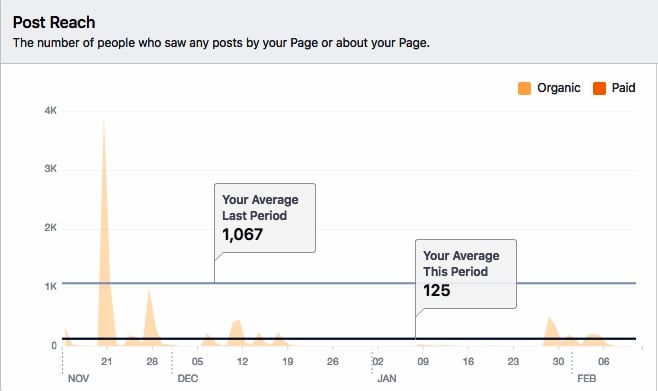
They weren’t seeing everything we shared—and may not have been seeing anything. They’ve asked to hear from us, but Facebook decides if and when they actually do. And in reality, it’s not often. Here are the stats Facebook provides us:
Screenshot of C4AA's Facebook analytics. Courtesy of Steve Lambert.
Screenshot of C4AA’s Facebook analytics. Courtesy of Steve Lambert.
This shows how many people (anyone, not exclusively fans of our page) have seen our posts over the past three months. With a few exceptions, you can see most posts don’t reach more than a tenth of the number who have opted to follow our page. In recent weeks, we’ve reached an average of around 3 percent.
This is by design. People think the Facebook algorithm is complicated, and it does weigh many factors, but reaching audiences through their algorithm is driven by one thing above all others: payment. Facebook’s business model for organizations is to sell your audience back to you.
In the past, you could boost your social media reach by writing better posts and including images and video. But in recent years, targeted spending on advertising has overtaken all other tips and tricks. To reach more people who already requested to hear from the C4AA, we’d have to give our donors’ money to Facebook to “boost” our posts.
Now, are we simply against paying Facebook? Do we not want to give our donors’ money to one of the largest corporations on the planet, one that has enriched its leadership and shareholders by not paying the artists, journalists, and everyday people who give the site value? Do we want to withhold support to a company that’s barely taken responsibility for enabling Russian disinformation to reach US citizens in an effort to undermine democratic elections? Do we think that Facebook is turning the internet from an autonomous, social democratic space into an expanding, poorly managed shopping mall featuring a food court of candied garbage and Jumbotrons blasting extreme propaganda that’s built on top of the grave of the free and open web? Yes, yes, yes, and yes. That’s why we’ve never been big fans, much less paid to use Facebook.

Why Facebook Is Bad News

However, for the sake of argument, let’s imagine that we accept that this is Facebook’s business model, and it is free to create its own rules on its private platform. Fine. There’s still a broader inequity to address.
Facebook’s pricing treats nonprofits and artists the same as a multinational corporation like Coca-Cola, a high-end neighborhood boutique hair salon, or a vitamin supplement scam. The advertising model makes no exceptions for nonprofits—even though we have nothing to sell and our mission, legally bound, is for the common good.
This difference in purpose is significant. It’s why the US government does not charge taxes to nonprofits, and the postal service offers reduced rates. Even other tech companies put nonprofits in a different category. Paypal charges less to process charitable donations and enables fundraising opportunities through partners like eBay.
At the C4AA, we use the messaging system Slack, and were delighted to learn it offers a significant discount to non-profits to upgrade from their free plan to the standard plan. That discount? 100 percent. To upgrade to the top plan, the Plus Plan, the discount is 85 percent. Slack partners with the non-profit TechSoup, which arranges discounted software, hardware, and support from for-profits to nonprofit organizations. One TechSoup partner, Google—yes, that Google—offers thousands of in-kind dollars for “ad grants” so nonprofits can compete to communicate alongside for-profit companies.
Facebook offers no such discount. It considers all communication from any organization to be a form of “advertising.” Facebook will take the money of anyone who pays—whether to sell products or discord.
Sure, we can keep posting there anyway for free, but less than 3 percent of our followers would know.
Meanwhile, the Facebook-using public—around two billion people—is unaware of what they are missing. My social network may consist of a mix of the causes I care about, artists who challenge my thinking, independent news organizations I trust, some friends and family, and even a few businesses I like. But what I select is not what I see—at least not entirely. And this is a system that puts artists and nonprofits at a disadvantage.
In the past two years, we’ve seen this problem get worse. After the 2016 election, the C4AA began considering this decision more seriously, and after much internal discussion among our leadership and a few board members, along with last week’s indictments, we felt it was time. As much as Facebook and Mark Zuckerberg claim to want to build community and bring the world closer together, their business decisions tell another story.

Looking Ahead

For some nonprofits, paying Facebook for access to supporters is a deal they’re willing to make. No judgment here. C4AA staff still use it to stay in touch with friends. Many organizations we work alongside use Facebook for advocacy efforts. We know for some it may not be a reasonable option to withdraw. We’re not insisting anyone needs to adhere to some arbitrary purity standard. We’ve just decided Facebook is not for us.
For now, we’ve found our email newsletters much more effective because at least we know the message reaches the subscribers’ inbox. And while we are no longer investing our time or our donors’ money into Facebook, it’s not a complete departure. We’re letting automated systems repost from our website and from other social networks.
Leaving history’s biggest social network feels risky. We don’t want to lose those 4,000-plus people—though, in a way, they’ve been lost for a long time. And we remember: It’s not that big of a deal! This makes us only slightly more radical than the Unilever Corporation.
If you’re at a nonprofit and wondering what you can do, have a conversation with your leadership and make a conscious choice. Look at your Facebook stats. Are you reaching your audience? Is paying worth it? Is the money, content, and audience you give Facebook consistent with the goals and mission of your organization?
The Center for Artistic Activism is at C4AA.org. You can sign up for the Center for Artistic Activism email newsletter here. You could also follow us on Facebook, but what would be the point?
Steve Lambert is an associate professor of new media at the State University of New York at Purchase College, a co-founder and co-director of the Center for Artistic Activism, and an artist whose work can be seen at visitsteve.com.

Follow artnet News on Facebook: 
 
Want to stay ahead of the art world? Subscribe to our newsletter to get the breaking news, eye-opening interviews, and incisive critical takes that drive the conversation forward.
SHARE

The Gray Market: What Galleries Can Learn From the Outrageous Success of Movie Reboots (and Other Insights)


The Gray Market: What Galleries Can Learn From the Outrageous Success of Movie Reboots (and Other Insights)

Plus, our columnist examines Frieze Los Angeles's opening missteps and "animal spirits" in the art market.
The Los Angeles premiere of "Star Trek" in 2009. Now, galleries are getting in on the reboot business, too. (Photo by Kevin Winter/Getty Images)
Every Monday morning, artnet News brings you The Gray Market. The column decodes important stories from the previous week—and offers unparalleled insight into the inner workings of the art industry in the process.
For this edition, three stories about art-industry resurrections…

DON’T CALL IT A COMEBACK

Just over a week ago, Melanie Gerlis reported in the FT that the gallerist Almine Rech would “revisit” the landmark exhibition “A New Spirit in Painting,” curated in part by Norman Rosenthal at London’s Royal Academy in 1981. She’s even tapped Rosenthal to help her do it.
Rech will split the project into two components separated by five months and one ocean. On May 1, her New York space will open the first leg of the exhibition, centered on works from roughly the same year and set of artists as the original show. Then, during Frieze (London) week, her Mayfair space will host pieces they all made between Y2K and the present.
However, I say “roughly” the same set of artists because Rech and Rosenthal will also use this opportunity to set the historical record straight. How? By supplementing the four male painters originally highlighted in 1981 with two aesthetically simpatico women passed over at the time: Maria Lassnig and Susan Rothenberg. Call it “A New Spirit in Painting” with a new spirit of wokeness.
While I generally think that fashion is the mainstream industry most prophetic for the art world’s next destination, in this case—whether consciously or not—Rech appears to be porting over a strategy that has paid major dividends for Hollywood in the past decade-plus: the reboot.
The idea is ingenious in its simplicity. Take a property that already has what film execs would call “pre-awareness,” i.e. built-in appeal among the desired audience, and re-present it with just enough of a new spin to make people want to buy a ticket again, or for the first time (or, in a way, both).
So if you think James Bond has unwisely become the cinematic equivalent of stale teacakes, have Daniel Craig stuff Jason Bourne’s character into a tux and reboot the whole thing as Casino Royale.
And if you’re certain Star Trek could be huge if only its audience expanded beyond people who revere or resemble a crusty William Shatner, make it a brash origin story with a diverse cast of hot young actors.
Not all reboots are guaranteed hits. For every time Superman Returns to crush the box office, a Beverly Hills Cop TV series quietly gets toe-tagged.
On the whole, however, the resurrection business has been damn good. According to Box Office Mojo, six of the highest-grossing reboots between 2005 and 2012 netted a combined $1.7 billion above their production budgets worldwide.
Will it work in the art market, though? Museums have gotten in on the game in recent years, reviving and reinventing legendary shows such as “Primary Structures” and “When Attitudes Become Form.” And from a commercial standpoint, I think the reboot is a brilliant strategy. None of the artists even have to make new pieces. Instead, the curators just need to source enough surviving material to mount the exhibition, convince a few current owners to part with their works for the right price, and then focus their efforts on re-marketing something already regarded as hugely important in the industry’s mythology.
That’s not easy per se. But it’s easier to ride a pre-existing wave than to generate a new one from the ocean floor. Especially if buyers can see that they now have an opportunity to catch up to something the gatekeepers have already canonized in the intervening decades.
In other words, rebooting a classic exhibition is the next logical step for gallerists to take beyond reviving the careers of overlooked artists. True, the former may yield a shorter-term benefit than the latter. But as Hollywood has shown, that benefit can still be lucrative. So expect “A New Spirit in Painting” to become a new model in exhibiting fairly quickly.
VIP and press day at the Frieze Art Fesival. Photo: Carl Court/Getty Images.
VIP and press day at Frieze. Photo: Carl Court/Getty Images.

FRIEZE GOES HOLLYWOOD

On Thursday, Carolina Miranda of the Los Angeles Times officially broke the news that Frieze will, indeed, launch a fair in LA early next year. A collection of 60 galleries from around the world will exhibit at Paramount Studios from February 14–17, 2019 inside a “temporary structure” designed by Kulapat Yantrasast of local outfit wHY Architecture.
Bettina Korek, the LA art-world mover and shaker hired as the fair’s executive director, also hinted at something even larger, telling Miranda, “As in New York and London, we want to create a week for artists, collectors, curators, and galleries from around the world to… engage with the art scene across the city.”
Now, I wrote a grim diagnosis for Frieze Los Angeles a few weeks ago, when the event was still only a rumor in the streets and a plan behind the scenes. I think Korek and Ali Subotnick, who will oversee the fair’s artist projects and film program, are both smart hires plugged into the Angeleno scene.
But they don’t change my fundamental misgivings about the event. In fact, other details that emerged this week only make me queasier than before.
As my colleague Julia Halperin pointed out, Paramount is the same venue once occupied by the ill-fated Paris Photo LA, which belly-flopped into the afterlife before it could hold its fourth edition. It’s not entirely fair, but I can’t shake the feeling that by choosing to set up shop on the same site just three years later, Frieze Los Angeles is basically building itself on top of a cemetery like the housing allotment in Poltergeist. Spoiler alert: If all you do is move the headstones, coffins start rocketing up from the deep while the TV eats children.
More troubling to me is the schedule. FIAC Los Angeles, the major fair that never was, apparently planned to open at the beginning of the year, too—roughly the same window of time as Frieze LA. Instead, its organizer, Reed Exhibitions, dropped an anvil on the event like a cartoon cat lured to a fateful spot by a sizzling ham.
Sure, on paper, a trip to LA in February sounds like a great idea. But I’m skeptical the industry can handle another major fair at ANY point, now that the global art-fair calendar looks as bloated as one of those boa constrictors that just swallowed an entire water buffalo.
Aside from my personal experience that Valentine’s Day can be one of the worst traffic nights of the year in Los Angeles—I’m reminded of the time it took me 90 minutes to travel three miles home on surface streets—debuting at that time also means Frieze Los Angeles will be parachuting into a battlefield with other capable warriors already dug into their positions on both sides. A mid-February debut will sandwich the fair right between ZONAMACO (currently slated for February 6–10, 2019) and ARCOmadrid (usually held the third week of February).
I’d guess the thinking is that it will be easy (or at least, easier) to convince many buyers and sellers who were just in Mexico to fly north a few days later to LA. But will it actually be easy, especially when it comes to Europeans planning to hit ARCO a few days later? At a certain point, most people just want to go home.
All told, then, Frieze Los Angeles will get awfully close to putting the scientific method in action: the same venue as Paris Photo LA, similar scheduling to FIAC LA, in a city still as geographically defiant of art fairs as ever. If Frieze succeeds, then there’s a strong argument that it truly will have been because of the brand and the people more than any external factor. Either way, get your popcorn ready for whatever happens next.
Guillaume Cerutti and Patricia Barbizet. Courtesy Christie's.
Christie’s CEO Guillaume Cerutti and his predecessor, Patricia Barbizet. Courtesy Christie’s.

SPIRIT GUIDE

Finally this week, let’s dip into the auctions sector en route to a wider view of the industry. On Monday, Kelly Crow interviewed Christie’s CEO Guillaume Cerutti, with the headline teasing “What’s Behind the Art Market’s Turnaround.” Before pivoting into talking up Christie’s so fast that he may have pulled a muscle, Cerutti gave this explanation for the auction sector’s 25%  increase in global sales last year:
“I think there is more confidence in the art market. People were cautious two years ago, but last year they saw that things were still selling well, and they felt better. Everyone feels reassured by how global the market has become.”
Now, I think Cerutti is a smart dude, and that’s a big question to answer succinctly. But this response is either circular logic at its finest, or a savvy insight that should sober up everyone in the business faster than a SWAT team barging into your New Year’s Eve party.
If you re-read Cerutti’s three sentences above, they basically translate to this: “People were buying because they saw that other people kept buying.”
To which you might reply: That’s it? That’s why the auction market recovered?
It’s a completely unsatisfying answer. But you know what? I think it’s largely right.
Cerutti’s thoughts reminded me of an early December 2016 post by my favorite finance writer, Josh Brown (AKA The Reformed Broker). In it, he addressed why many, if not most, Wall Street analysts were turning themselves inside out to argue that Donald Trump’s election—an event they’d been flogging for weeks beforehand as the reason the financial markets would crash or correct—was actually the reason most asset classes were still bull-charging skyward a month later.
Here’s Brown:
“The answer to this question is sentiment, which always follows price. Prices went up, so sentiment changed. What once was bearish and scary is now bullish and exciting.”
Me again: In other words, “People were buying because they saw that other people kept buying.”
Fundamentally, nothing else changed in the auction sector—at least, not so dramatically that it would account for a 25% increase in sales. Any other explanation is probably just a story we’re telling ourselves in an effort to tame the behavioral forces that investors refer to as “animal spirits.”
We can see as much in the rest of Cerutti’s answer to that opening question. He cited two examples to explain Christie’s own recovery in 2017: selling “a major Chinese art collection… in New York instead of Hong Kong” and including Salvator Mundi in a contemporary sale—a move he described as “innovative” and “extremely creative.”
No offense to Cerutti, but neither of these is exactly the discovery of fire. The latter in particular is like saying Domino’s Pizza was “innovative” and “extremely creative” when their shops also started offering up cheese-covered breadsticks with dipping sauces (i.e. a food that is perpetually one hand motion away from being… pizza).
So animal spirits are just as influential in the art market as in the financial markets—if not even more so, considering the “spooky assumption that art is worth anything.”
That means they can revive or supercharge sales at any time. But it also means that we should keep in mind the ending of Brown’s post, too:
“Animal spirits cannot be modeled… We can only accept that they are a part of the game, coming and going at uneven intervals, spreading joy and pain in their path.”
In short, if we pretend that there’s always a greater, more logical explanation, we’re kidding ourselves. Sometimes we really do just get rowdy enough to raise the dead.
That’s all for this week. ‘Til next time: If you think we never get a second chance to make a first impression, you’re probably overestimating how little attention most people pay to anyone but themselves.

Follow artnet News on Facebook: 
 
Want to stay ahead of the art world? Subscribe to our newsletter to get the breaking news, eye-opening interviews, and incisive critical takes that drive the conversation forward.
SHARE