For three consecutive days next week, the artist Alexandra Pirici will take center stage on New York’s High Line, marshaling her troupe of performers amid its increasingly autumnal foliage. The group, consisting of professional and untrained dancers, will become a living, breathing threshold separating the eastern and western Rail Yards at 30th Street between 11th and 12th Avenue, demarcating the passage into the more manicured part of the public park that cuts deeper into the city. For many New Yorkers, this might be their first encounter (in a literal, physical sense) with Pirici’s work, but it’s actually a rather belated introduction. After all, the artist has been steadily conquering the European art world over the past five years, one major event at a time.
In 2013, Pirici (whose name is pronounced
Pea-Reech) seized international attention when she joined with choreographer Manuel Pelmuş to represent their native Romania at the Venice Biennale, memorably using dancers to stage an “immaterial retrospective” of the international show through recreations of artworks, moments, and scandals from the Biennale’s history. In 2014, she participated in the public program of Manifesta 10 in St. Petersburg, curated by Kasper König, where she performed
sculptural additions to the city’s monuments. Then, in 2016, she was invited by DIS Magazine to create an acclaimed, unnerving work for the 9th Berlin Biennale; in the piece, performers in motion-capture suits enacted items of viral web content selected by viewers from a list generated by Facebook’s EdgeRank algorithm.
This year, meanwhile,
Pirici’s performance commissioned by Skulptur Projekte Münster,
Leaking Territories, has become one of the most talked-about attractions at the decennial art show (which continues until October 1). For the work, her troupe occupies a room in the City Hall, where a series of Peace Treaties known as the Treaty of Westphalia were signed in 1648. There, in a multipart performance, the dancers connect the historic site to other such sites around the world—such as Tiananmen Square or the Warsaw Ghetto—by reciting the distance separating the two and then enacting the distant event; at another point, they function as “search engines,” performing search terms requested from the public and providing answers explicitly based on easily perceivable parameters like age, gender, signifiers of social status, and more.
Classically trained as a dancer and choreographer, Pirici got her start in that rigorous, tradition-grounded milieu but found herself naturally transitioning into the art world as her works grew increasingly experimental and the limits of the theater stage began to feel too constrictive. The first of her pieces to be framed in the context of the visual arts was staged in 2011, in Bucharest; titled
If You Don’t Want Us, We Want You, it saw performers bringing to life different historical monuments around the city, as if engaging in arcane rituals. (She doesn’t tackle Soviet monuments exclusively; in 2014,
she reenacted Richard Serra‘s
Tilted Arc in Switzerland.)
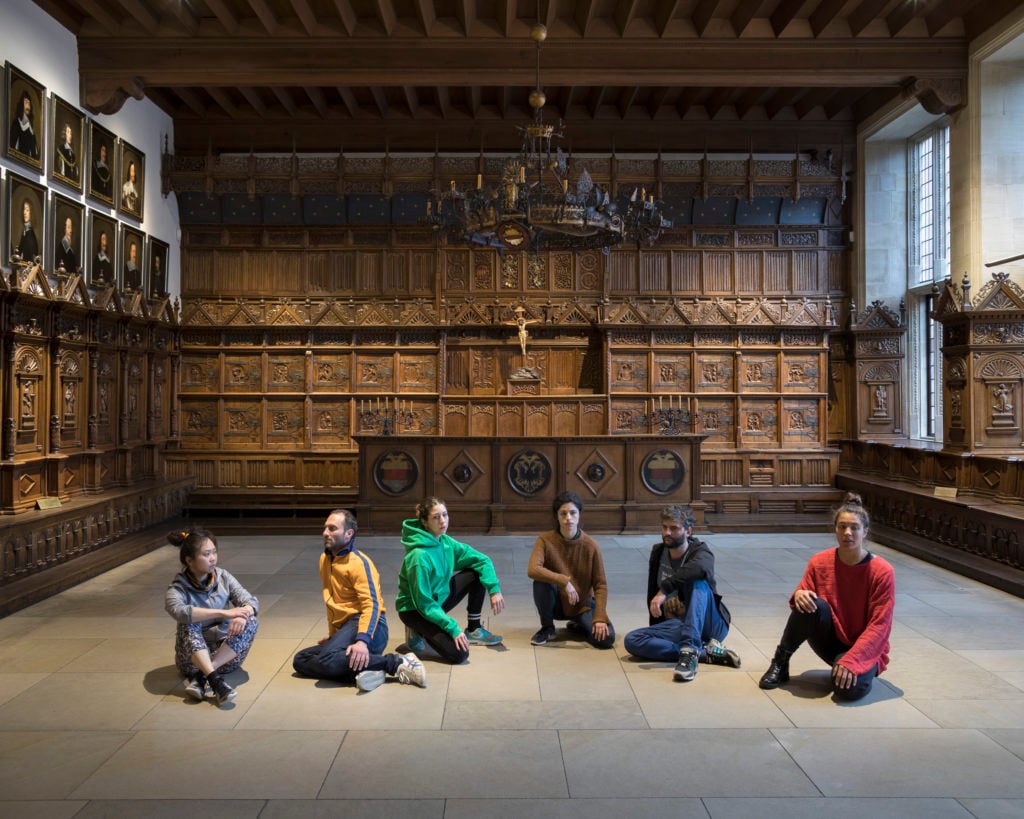
Alexandra Pirici, Leaking Territories, ©Skulptur Projekte 2017, photo: Henning Rogge
“I was looking for other formats, other ways of display, or ways to produce works that are not narrative-based, where you don’t have to build up the action to a point,” she told artnet News in the backyard of the Berlin nonprofit art space N.B.K., where her latest work,
Aggregate—commissioned especially for the site—has just been performed for the last time. “I also wanted to have another experience with the audience, who could come and go as they like, and where I could do a work that’s two minutes, or four hours long.”
For Aggregate, her first institutional solo show in Berlin, Pirici worked with some 82 performers—such a large swarm that it meant the ratio between dancers and audience was often tipped in favor of her troupe, who performed for four long hours every day. This manipulation of space and viewing dynamics evinces a political approach at the heart of her practice. “What does it mean historically that an exhibition space opens to the public?” she asks. “When the first public museum, the Louvre, opened after the French Revolution, the people were supposed to exercise their newly discovered freedom and claim this new concept of the individual, who was free to roam across space. This post-Enlightenment concept was also connected to the colonialist notion that space was empty.”
To embody a more contemporary, relevant understanding of space in Aggregate, Pirici posits a white cube, but one that is crowded, cohabited, and ever-transmuting, sometimes trapping viewers in isolated enclaves. “What impresses me the most about her work is the utterly intelligent ways she finds to evoke social structures and relations, and to render them physically tangible,” Kasper König, who worked with the artist on Manifesta 10 and this year’s Skulptur Projekte Münster, told artnet News in a phone conversation. “Working with her is a win—she knows what she wants, she asks the right questions with her work, and she is not afraid of taking chances.”
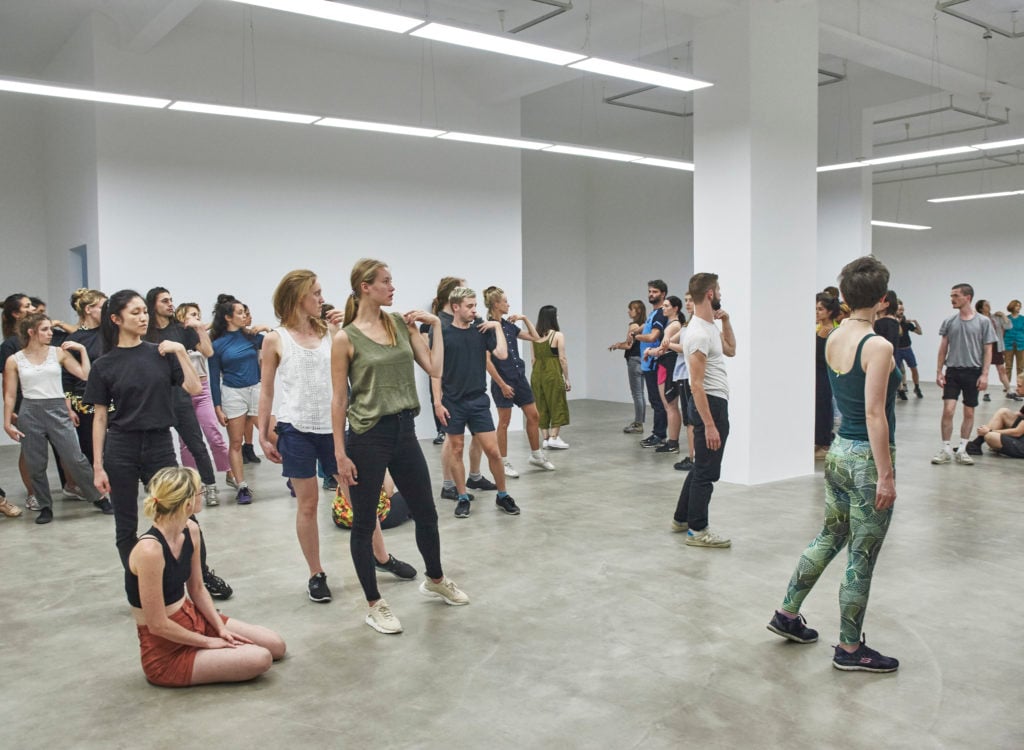
Alexandra Pirici, Aggregate, exhibition view at Neuer Berliner Kunstverein,
2017 ©Neuer Berliner Kunstverein / Joseph Devitt Tremblay
Pirici, who lives in Bucharest, was seven years old when Nicolae Ceaușescu was executed. Shortly thereafter, she was given her first computer, and the world—which was already becoming drastically different than the one she grew up in after the fall of the Iron Curtain—suddenly became accessible in new ways. It should come as no surprise that digital information and new technologies find expression as themes in her works.
“I think that new technologies are interesting to reflect on in terms of how they manifest in the human,” she explained. “I’m interested in creating an experience of what you can intellectually perceive online but without having a feeling of it. Like being profiled—you know it’s happening but you don’t have a physical sensation of it.”
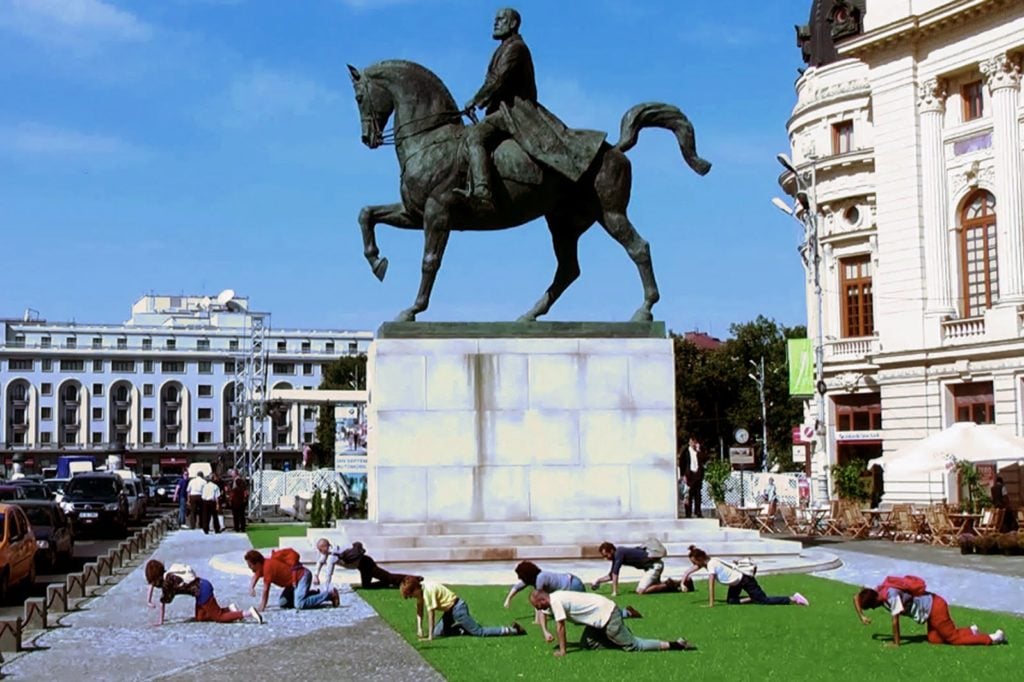
“Alexandra Pirici & co, If you don’t want us, we want you, 2011, postcards documenting public space interventions / sculptures.
Acknowledging that her work is sometimes mentioned together with Tino Sehgal’s (with whom she also shares some Berlin-based performers), Pirici also cites choreographer Jérôme Bel among her contemporary influences, as well as Spanish dancer and artist La Ribot, who is considered the first to sell works of performance art to collectors. (Berlin’s Barbara Weiss gallery is currently showing a retrospective of La Ribot’s films as part of the
Tanz im August festival.)
“An important aspect of my work is that it’s sold and collected as a livework,” Pirici points out. “I never make another object, or props, that I try to sell.” In fact, she says, she’s been approached by several galleries who were interested in representing her on condition that she produce objects or prints related to her live performances. So far, she has demurred.
“I don’t want to do that because I’m interested in how the performance lives on, and how it gets entangled in the market,” she explains. “As a territory, it’s not necessarily new—Tino and others also sell live ‘situations’—but it’s a smaller niche that’s already occupied by larger galleries.” Her insistence has paid off, it turns out, since she has no problem selling works without gallery representation. (For instance, the corporate collection of Deutsche Telekom, which focuses on Eastern European art, has supported the production of
her work for the Berlin Biennale, and now owns it.)
As an artist who navigates both spheres—that of the stage arts, in which she continues to create performances for more avant-garde theaters and festivals, and the institutional art world—Pirici is well aware of the resurgence of dance and performance in the latter, and is not uncritical of it. “The art world’s reception of dance is often very superficial,” she says. “There’s a very big delay in perceiving developments in choreography and dance and in thinking about aesthetics, virtuosity, beauty. Also, oftentimes the dance world had already gone over some things, and then you ‘rediscover’ them in the gallery space.”
“Ideally,” she adds, “this moment in time should allow for more cross-pollination in both directions. I think the visual arts can still learn a lot from dance and theater. The art world, on the other hand, has a better practice of thinking about itself, and being interested in the new.”
Follow artnet News on Facebook.