

The Nazis as occult masters? It’s a good story but not history
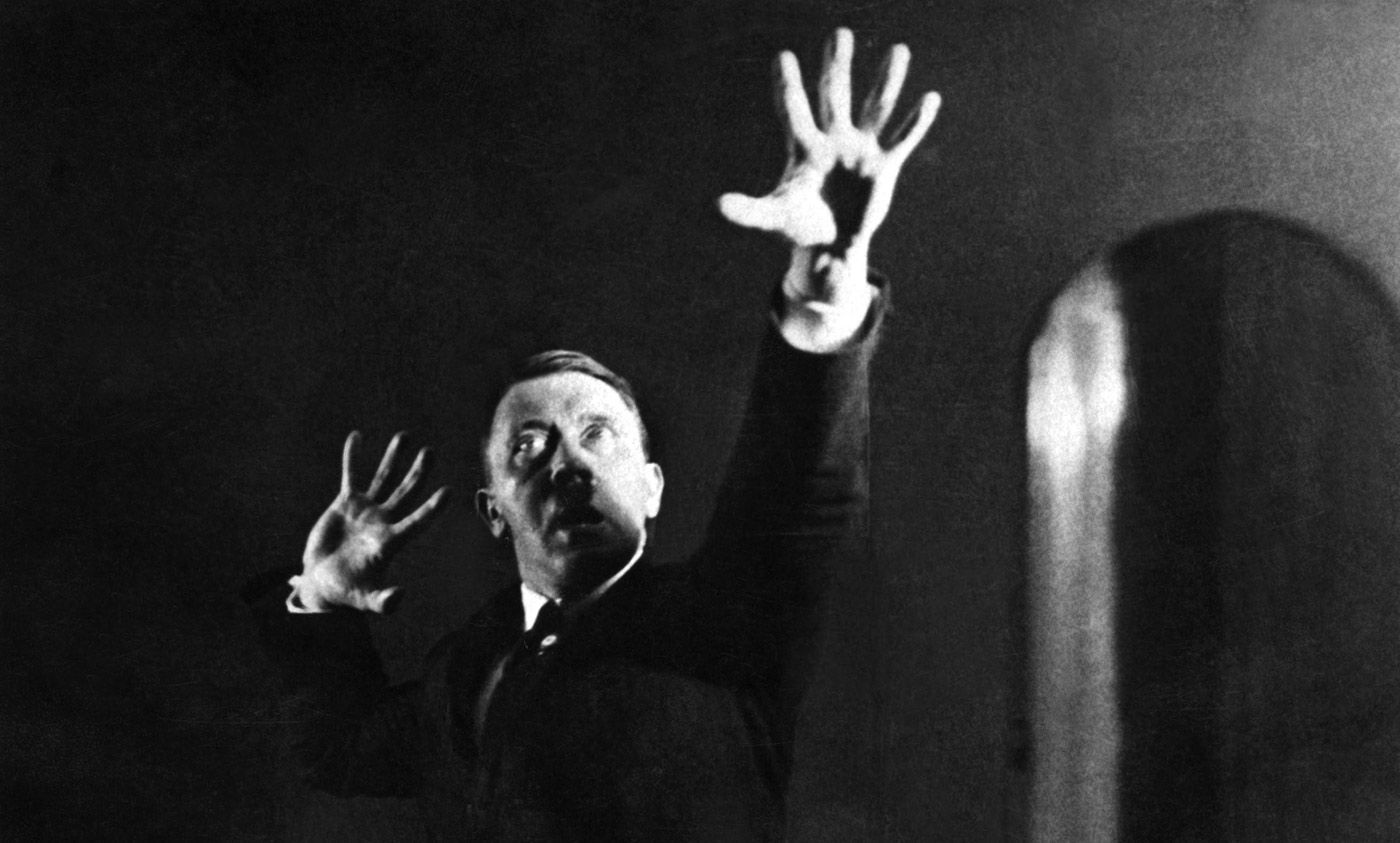
Look into my eyes... Adolf Hitler photographed by his personal photographer practicing for public speaking in 1925. Photo by Gamma/Getty
Maybe it started with Indiana Jones. When Raiders of the Lost Ark premiered in 1981, audiences were treated to the vivid spectacle of bumbling Nazi officials obsessed with esoteric lore, eager to harness ancient occult powers for their own nefarious purposes. Fast-forward a few decades, and today’s popular culture is still awash in the imagery of Nazi occultism. From the History Channel to video games, from Hollywood movies to comic books, from chat rooms to Reddit to YouTube, there is endless speculation about the hidden forces behind Nazi evil. Books on the topic abound. It is a favourite of conspiracy enthusiasts and professional debunkers alike. Somehow, we have all become, like Indy himself, experts on the occult. And a whole lot of us are convinced that its arcane secrets hold the key to understanding Nazism.
The problem with this alluring image is not just that it is false. The myth of Nazi occultism is more than an amusing curiosity, a testament to the power of cinematic suggestion. It actively detracts from a historical understanding of the very themes it highlights. It yields a distorted view of Nazism and a distorted view of occultism. But it also offers an occasion for critical reflection, a chance to see how we might make better sense of the tangled history of occultism in the Nazi era. It might even help us to understand Nazi evil and the not-so-hidden forces behind it.
Why is the association between Nazism and the occult so fascinating and so enduring? Claims about Hitler’s supposed connections to occultism circulated before he even came to power. The image comes in several forms: Nazism as the tool of dark forces, or Nazis as covert masters of the occult. The appeal of these ideas stems from the nature of occultism itself. Esoteric philosophies promise access to a deeper reality, a higher truth lying beyond the veil of the ordinary world. Since ordinary explanations seem so inadequate for the abominations of the Nazi era, the esoteric alternative is enticing. It also fits the rhetoric of Nazism itself: suggestive and seductive rather than plainspoken and straightforward, filled with grandiose dreams and nebulous promises of an ineffable something that transcends everyday reality.
That is where the danger lies. To blame Nazism on otherworldly forces is to exonerate the prosaic causes that brought Hitler to power in the first place. Yet such beliefs persist because they face scarce competition; solid scholarship on the relations between the Nazi regime and occult currents is rare. Not entirely absent, however: historians have often shied away from the apparently disreputable subject of occultism, but there are several incisive assessments of its status in Nazi Germany. Though usually overshadowed by sensationalist treatments, serious works on the topic continue to appear. There is much to debate about the arguments raised in these books, but they do offer a critical examination of a neglected part of history.
And that history looks very different from the myths that have grown up around it. Consider three chief elements in the longstanding popular image of Nazi occultism: the Thule Society, the Ahnenerbe or ‘Ancestral Heritage’ office of the SS, and the Wewelsburg castle. A common perception casts each of these seemingly uncanny phenomena, so suited to the mysterious countenance of the Third Reich, as an integral bond between Nazi rule and the enigmatic world of occultism. Each of them did in fact have some connection to the occult, but the links were more mundane – and, paradoxically, more revealing – than the myths would have us believe.
The short-lived Thule Society, which gained brief notoriety in the aftermath of the First World War, is frequently portrayed as a paradigmatic example of the ‘secret societies’ that supposedly gave birth to the Nazi party. While the organisation was indeed secretive, and its modest membership did include several figures who went on to become leading Nazis, it was not an occult order. The founder of the group, who went by the invented aristocratic name of Rudolf von Sebottendorff (he was in fact the son of a train driver), had extensive occultist interests, but they seem to have been met with indifference from the rest of the members. This is not surprising, since the Thule Society was in reality a political organisation committed to Right-wing radicalism, not esoteric machinations. Aside from spreading anti-Semitic propaganda, its chief activities consisted of militant confrontations with the Left in the Munich area. Hitler had nothing to do with the group. The notion of the Thule Society as incubator of the Nazi party is a product of Sebottendorff’s megalomaniacal imagination; years after the organisation dissolved, he published a spurious memoir claiming that he played a crucial role in nurturing the early Nazi movement. There has never been any evidence for such claims.
What of Heinrich Himmler’s Ahnenerbe? This was an SS department devoted to researching the alleged Aryan origins of the German people. Thanks to Himmler’s personal fascination with the occult, some of the projects pursued under the aegis of the Ahnenerbe had esoteric affiliations. But most didn’t. Until the war started, the organisation largely focused on conventional archeological exploration, folklore and prehistoric studies. After 1939, attention shifted to military matters, including medical experiments on human subjects. As the historian Julian Strube points out: ‘The “research” of the Ahnenerbe was conducted for ideological and propaganda reasons in order to establish an SS influence on the German academic landscape.’ It is tempting to dismiss this sort of thing as pseudo-science, and much of it was just that. But this response lets mainstream science off the hook. A number of figures who worked with the Ahnenerbe were established scholars in their fields, while much of the German academic community willingly accepted funding from Nazi sources, provided material for Nazi projects, and so forth. Labelling all of this as pseudo-science is comforting, but much too simple.
Similar problems bedevil the lurid image of the Wewelsburg castle as a site of SS occult rituals. This peculiarly resilient belief presents a case study in the evolution of historical myths. The castle itself is an imposing centuries-old structure, and Himmler developed extravagant plans to make it the centre of a massive complex for ideological indoctrination after the expected German victory in the war. In the wake of the German defeat, former SS officers found an opportune way to deflect responsibility by accentuating Himmler’s ostensibly demonic ambitions. It took decades for historical research on the castle, and the uses the SS made of it, to catch up with these exculpatory tabloid tales. By then, the legend had long since displaced the reality, obscuring its actual functions within the Nazi system: routine bureaucratic tasks, supplemented by labour from a nearby concentration camp. The myth of the Wewelsburg castle contributed substantially to the ever-popular image of the SS as an occult order, an especially cherished motif in esoteric and neo-Nazi circles.
Not long after the final collapse of the Nazi regime, Theodor Adorno characterised occultism as ‘the metaphysics of dunces’. This harsh judgment has been roundly criticised, often with good reason, by scholars who study esoteric worldviews. Occult traditions are intellectually rich and diverse; there is much more to them than the bizarre and fantastic connotations that typically accompany any mention of esotericism. But Adorno had a point. A fixation on diabolical forces can distract attention from the social forces that shape reality. So it is with efforts to make sense out of the stark senselessness of Nazism. History, of course, does not belong to historians. In this case, however, we would do well to pay attention to what the historical record can and cannot tell us about the unsettling parallels between that time and our own. Attributing the horrors of Nazi Germany to obscure occult sources is all too often a convenient way of absolving ourselves from the hard work of understanding the past.

