Tuesday, July 28, 2015

7 Reasons to Celebrate Marcel Duchamp on His Birthday

People

7 Reasons to Celebrate Marcel Duchamp on His Birthday


490
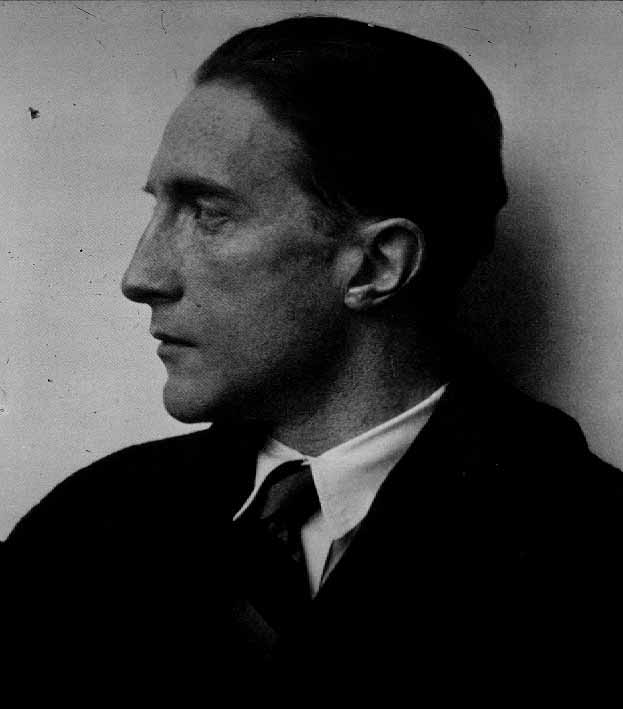
Marcel Duchamp.
Photo: Courtesy of University of Southern Califórnia
 
Marcel Duchamp was a prankster, a rabble-rouser, and an envelope pusher. Over a century after he plunged a bicycle wheel into a four-legged stool, artists are still paying homage to his life and work.
At the time, however, not all collectors were happy with his readymades. According to Tout-Fait, the Marcel Duchamp Studies Online Journal, Dorothea Dreier commissioned Duchamp to create Why Not Sneeze, Rrose Selavy? (1921) for $300; when he submitted the work, she apparently hated it and gave it to her sister, who later sold it to collector Walter Arensberg without a profit. (It's now in the Philadelphia Museum of Art's permanent collection.)
The artist, who passed away in 1968, always had a sense of humor about his work and ensured that no one could map out his oeuvre without noticing his tricks. For example, his 1964 Fountain is a "hand-crafted, editioned, gallery-sanctioned, sort-of-signed simulation of the functional urinal" that Duchamp originally presented to the viewing public in 1917.
Here are seven reasons why we love the artist, on what would be his 128th birthday.
1. Duchamp on art: "I was very happy when I discovered that I could introduce humor into it."
2. Duchamp on his feminine alterego, Rrose Sélavy: "I decided that it didn't suffice me to be a lone individual with a masculine name, I wanted to change my name in order to change, for the ready-mades above all, to make another personality from myself."
3. Duchamp on influences:  "The first thing to know: one doesn't realize one is influenced. One thinks he is already liberated and one is far from it!"
4. Duchamp on "reverse readymades": "That would be to take a Rembrandt and to use it like an ironing board."
5. Calvin Tomkins on Duchamp: "He spoke about how he doubted everything and, in doubting everything, found ways to come up with something new."
6. Duchamp on his Impressionist stage: "When you are 15 and painting like the Impressionists, you are experimenting with yourself… It took me ten years or more to change the style [and] I tried to find something else."
7. Duchamp on Bicycle Wheel (1913): "I enjoyed looking at it, just as I enjoy looking at the flames dancing in a fireplace."
 
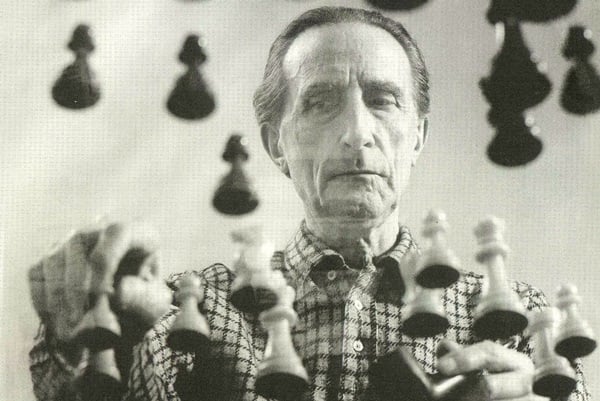
Duchamp plays John Cage in Toronto, 1968.Photo; zettelmagazine.com.
Duchamp plays John Cage in Toronto, 1968.
Photo: via zettelmagazine.com.


https://news.artnet.com/people/7-reasons-celebrate-marcel-duchamp-birthday-318147


concrete-cast ceramics || raised floor


http://www.frameweb.com/news/yusuke-seki-stacks-concrete-cast-ceramics-inside-the-maruhiro-flagship?utm_source=newsletter-28-jul-2015&utm_medium=email&utm_campaign=news&utm_content=news5image

Yusuke Seki stacks concrete-cast ceramics inside the Maruhiro flagship

For over four centuries, a rich history in the production of pottery and porcelain sustained Japan’s Hasami region’s reputation as the source of the traditional tableware. Charged with redesigning the flagship’s interior, architect Yusuke Seki literally elevates artisanal ceramics to a whole new level inside the Maruhiro flagship.

Sourced from the kiln disposal areas of local factories, nearly 25,000 ceramic pieces with imperfections made during the bisque and firing processes were collected and then cast into concrete. The cloned assortment of chipped cups and plates – known as 'Shinikiji' in their ceramic state – were stacked in a brick-like fashion to produce a platform reaching a half metre in height. Accessed with steps, the raised floor becomes the showroom, with impeccable versions of the authentic cups and bowls displayed upon freestanding wooden displays. Despite the tableware's individual fragility, the collective unit acts as a strong foundation – a symbolic message for the region's history as well as the Maruhiro brand.

Photos Takumi Ota

yusukeseki.com
hasamiyaki.jp


Logo
 

podcast || The Two Types of High-Potential Talent

Edie Everette

Comic

Different Dreams for Different Decades


2015 Deutsche Börse Photography Prize


12:39 pm / 23 °C
The First Art Newspaper on the NetEstablished in 1996 Portugal Tuesday, July 28, 2015


MMK exhibits works by the finalists for the 2015 Deutsche Börse Photography Prize
Exhibition view MMK. Photo: Axel Schneider.FRANKFURT.- As part of the photography triennial RAY 2015, the MMK Museum für Moderne Kunst presents, at the MMK 3, the exhibition of the finalists for the 2015 Deutsche Börse Photography Prize: Nikolai Bakharev, Zanele Muholi, Viviane Sassen and, with a joint project, the artists Mikhael Subotzky and Patrick Waterhouse.

This year’s choice of finalists reflects the diversity of approaches in the field of photography, ranging from video works via social documentary pictures to portrait photography. Nikolai Bakharev’s work focuses on the tensions between the public and private spheres. His photographs of Russian bathers on public beaches in the 1980s and 1990s allude to the hypocrisy of official policy, making reference to what images were or were not permitted in the former USSR. In Zanele Muholi’s portraits and in her photographs of members of the LGBTI community in South Africa there is a blurring of the private and the political. Political and social transformations in South Africa are also at the heart of the work by Mikhael Subotzky and Patrick Waterhouse. In their joint work they present an album of pictorial and textual material recording the history of a high-rise building in Johannesburg, once exclusive and still iconic but now run-down and largely occupied by squatters. The other finalist represented in the MMK 3 exhibition is the contemporary photographic artist Viviane Sassen, whose images play with the boundaries of photography and sculpture.

The Deutsche Börse Photography Prize is an annual award, established by the Photographers' Gallery in London in 1997 and since 2005 presented each year in association with the Deutsche Börse Group. The prize, worth £30,000, is awarded to a contemporary photographic artist who in the preceding year made a significant contribution to photography in the form of an exhibition or publication in Europe, and it is regarded as one of the most prestigious international art prizes. This year’s judges are Chris Boot, Executive Director of the Aperture Foundation; the artist Rineke Dijkstra; Peter Gorschlüter, Deputy Director of the MMK Museum für Moderne Kunst, and Anne Marie Beckmann, Curator of the Art Collection Deutsche Börse. The winner was announced at an award ceremony held at the Photographers' Gallery on 28 May 2015.

video || Cézanne's Montagne Sainte Victoire


In Focus on Paintings: Cézanne's Montagne Sainte Victoire


Monday, July 27, 2015

Triennial of Photography Hamburg


6:18 pm / 21 °C
The First Art Newspaper on the NetEstablished in 1996 Portugal Monday, July 27, 2015


Hamburger Kunsthalle presents an exhibition within the Triennial of Photography Hamburg
Almut Linde (*1965) Dirty Minimal #52.2 — Landscape/Cease-Fire. Undiscloset military unit, 2008. 2 Light-jet-Prints, gesamt 206 x 318 cm © Almut Linde.

HAMBURG.- For the Triennial of Photography Hamburg, the Hamburger Kunsthalle presents some 100 works by internationally renowned artists in an exhibition titled WHEN THERE IS HOPE. The photograph is today the prime medium for capturing dreams and fantasies, but also for expressing our search for identity and hope.

As it reveals our yearnings and expectations, however, the photographic image also documents the cruel realities of social and political upheaval. The exhibition is devoted to these ambivalent and highly controversial aspects of the “principle of hope” in contemporary photography.

In these days of globalization and migration, hope has become a motivation for change and relocation, inspiring people to set off for new shores and try to get a fresh start. Hope – which Albert Camus called “the highest form of desperation left behind” – is the driving force behind both collective and individual wishes and utopias. The exhibition thus centers on the theme of emigration as one of the most pressing issues of our time.

A second section explores utopias and places of yearning as possible alternatives or escapes, in connection with the search for identity and the staging of the self. The themes of losing one’s home and exile, along with the associated hopes, figure prominently in the work of many artists, in many cases based on their own biographies. Examples include Yto Barrada, who lives in Tangier and New York, and also the photographer and video artist Adrian Paci, who emigrated from Albania. Paci’s film Centro di Permanenza temporanea documents the moment of desolation and abandonment as a permanent state of limbo. Eva Leitolf’s series Postcards from Europe. Work from the ongoing archives, since 2006 subtly reflects on the sealing-off of Europe’s outer borders, while Clemens von Wedemeyer stages the absurdity of European visa checks by relocating them to the bleak wooded outskirts of Berlin in his film Otjesd. André Lützen shows his photo series Außenlinie Europa border towns and their lodgings from the point of view of refugees.

Photography and film are by contrast used as mediums of illusion and as a means for escaping reality in the works of Zohra Bensemra, Cao Fei, Mohamed Camara and Roman Ondák. The multimedia works of the Chinese artist Cao Fei deal with the younger generation’s abandoned dreams and fantasies and with their strategies for escaping the dreary reality of everyday life. For her film Whose Utopia (2006), Fei asked young factory workers in Foshan to present their visions of a different life, for example as a musician or ballet dancer. Mohamed Camara from Mali shows in his photo series Chambre Malienne (2006) the beauty of mundane moments as a sign of hope and optimism. The Indian photographer Dayanita Singh for her part demonstrates in the photo sequence Dream Villa (2008) how the nocturnal light can transform ordinary landscapes and cities into an unsettling world of mysterious dreams and stories.

Singh’s nocturnal blue mysteries in the series Blue Book (2009) resemble in their melancholy aesthetic Rivane Neuenschwander’s visions of indeterminate places in the photo series A place not far from here (2009). Almut Linde’s photo Dirty Minimal #52.2 – Landschaft/Feuerpause / Landscape/Cease-Fire (2008) shows a soldier lost in reverie contemplating a barren landscape, thus alluding to the traditional motif of longing and hope evoked in the nature paintings of the Romantic artist Caspar David Friedrich.

Nan Goldin makes use of the photograph as a means of self-dramatization for a no-holds-barred autobiographical slide show titled All by myself (1993–96), while Annette Messager evokes in Mes Voeux (1988) a more general impression of lust and physicality in the style of photographic votive offerings.

Participating artists: Yto Barrada (b. 1971), Zohra Bensemra (b. 1968), Mohamed Camara (b. 1985), Cao Fei (b. 1978), Carlos Garaicoa (b. 1967), Nan Goldin (b. 1953), Shilpa Gupta (b. 1976), Roni Horn (b. 1955), Astrid Klein (b. 1951), Eva Leitolf (b. 1966), Almut Linde (b. 1965), André Lützen (b. 1963), Annette Messager (b. 1943), Rivane Neuenschwander (b. 1967), Roman Ondák (b. 1966), Adrian Paci (b. 1969), Anri Sala (b. 1974), Dayanita Singh (b. 1961) and Clemens von Wedemeyer (b. 1974).