| The First Art Newspaper on the Net | Established in 1996 | Portugal | Tuesday, March 7, 2017 |
|\| ART BLOG HUMOR BLOG PHOTO BLOG CULTURE BLOG |:| FOR THE RENAISSANCE MAN & THE POLYMATH WOMAN |/|
Tuesday, March 7, 2017
Exhibition at Museu Nacional de Arte Antiga aims to reconstitute the heart of Lisbon during the Renaissance
Is Art an Object of Passion or an Asset Like Any Other?
ARTSY EDITORIAL
BY ANNA LOUIE SUSSMAN
MAR 3RD, 2017 7:12 PM
As the global ultra-rich snap up trophy artworks and build collections scattered around many homes and storage facilities, art services are becoming an increasingly important part of wealth professionals’ offering to help these collectors manage their financial lives.
A Thursday panel at Deloitte’s U.S. Art & Finance Conference at The Armory Show featured five art and finance professionals discussing the evolving relationship between art and financial services.
It launched with Philip Hoffman, founder and CEO of The Fine Art Group, harking back 18 years to when he was planning the launch of his art investment fund, The Fine Art Fund. Hoffman recalled how at the time, “everyone said it was very crude” to approach art as an asset class, since “art was about passion.” Fast-forward 18 years and now everyone’s doing it, he said, ticking off the names of banks with art services departments.
How did that point of view evolve? One reason is the sheer scale of the value of artworks today. Art transactions have recently accounted for over $60 billion annually. That doesn’t mean all or even most collectors go in with an investment mindset—everyone on the panel stressed that collecting begins with a passion for art. But, said Henry Johnson, vice chairman for the East Region at Northern Trust Wealth Management, sometimes a collection “grows to such a size that you can’t ignore it.” For Johnson, that threshold is roughly 20% of a family’s or individual’s net worth, rather than an absolute number. For example, he’s met families with $50 million art collections who aren’t even thinking about it as an asset.
Leon Bailey, chief financial officer at the Duncan Family Office, said that while his clients collect art on a very personal level, they have over 900 artworks, enough to make the collection account for a serious portion of their wealth. Part of his role is to help track, maintain, and insure the works.
Evan Beard of U.S. Trust/Bank of America Private Wealth Management said his own bank has seen its art lending portfolio grow from $1 billion to $6 billion. One of the key enablers of growth in art-related financial services was the increased comfort and interest on the part of his colleagues in the underwriting and risk-management teams, thanks to the growth and depth of the auction markets.
Beard needled fellow panelist Brook Hazelton, president of Christie’s in the Americas, for offering in-house advisory services to clients that he said are inevitably biased towards a sale. But he said he was grateful for the service auction houses provide: creating a publicly available data set the bank and others can use to understand prices and underwrite loans. In a separate conversation with Artsy, he contrasted today’s environment, with its vast online repositories of pricing data, with the 1980s, when looking up data meant dusting off a bunch of old binders at Sotheby’s.
He described art and other tangible assets such as cars and yachts as the last frontier for clients who have financialized nearly every other aspect of their lives, throwing out an estimate of $1 trillion in tangible assets that every bank is keen to help lend against. “That’s a nut we’re all trying to crack,” he said.
What do these already wealthy people do with their art-secured loans? Beard said he’s seen his clients use the capital raised against their art (typically done at a 50% loan-to-value ratio) to buy more art, to scale up their philanthropy, or to reinvest in their existing businesses. He mentioned a real estate developer who leveraged his art to build cancer centers that will house the collection, a woman who used her art collection to raise the cash to sue her husband in the middle of divorce, and another developer who built enough hotel rooms in his city to host the Super Bowl.
“People are now using it as an internal source of liquidity,” he said. The bank, he said, sees art more as a capital asset than an investable asset, meaning they feel comfortable lending against it, but wouldn’t invest in it with the intention of profiting off a later resale.
Of course, art prices do go up, and that’s another reason art specialists have a role to play in broader wealth management. Johnson described an increasingly common estate planning scenario, in which parents bequeath art to their children based on sentimental attachment. He told one story of a couple who bought two paintings for $500,000 each in the 1970s. They left one, a Frank Stella painting, to one son who went on to become a teacher. The other, Clyfford Still painting, went to the other son, who went on to become a private equity titan. But the Stella is now worth $10 million, while the Still is worth $45 million. He said estate planning that includes specialized art knowledge can help foresee and plan for such eventualities, so as to avoid conflict within the family later on.
That also raised the question of value. Hoffman asked how people could feel comfortable wading into a market where two similar-looking paintings can fetch prices hundreds of thousands of dollars apart. Even if they get a discount, what are they to make of the initially quoted price? How can they move past the information asymmetry, or the conflicts of interest posed by art advisors or dealers who are motivated to make a sale at all cost?
Part of the answer is trusting your gut, said keynote speaker Anne Dias Griffin, in her opening address. In many ways, amassing an art collection requires the same skills as those of a successful investor. Griffin, founder and managing partner of Aragon Global Management, and a former investor under George Soros, is a prominent Chicago-based collector formerly married to hedge fund billionaire Ken Griffin. Both collecting and investing reward pattern recognition, the ability to carefully assess value, and due diligence, but they diverge in one respect: Art collecting is “a really personal endeavor,” she said. A collection “grows into a form of self-portrait.”
“Take risks, make bets,” she said. “If you’ve trained your eye, you will know when it’s right to go for it.”
—Anna Louie Sussman
The Market Is Changing What Art Looks Like
ARTSY EDITORIAL
BY ISAAC KAPLAN
MAR 4TH, 2017 8:00 PM
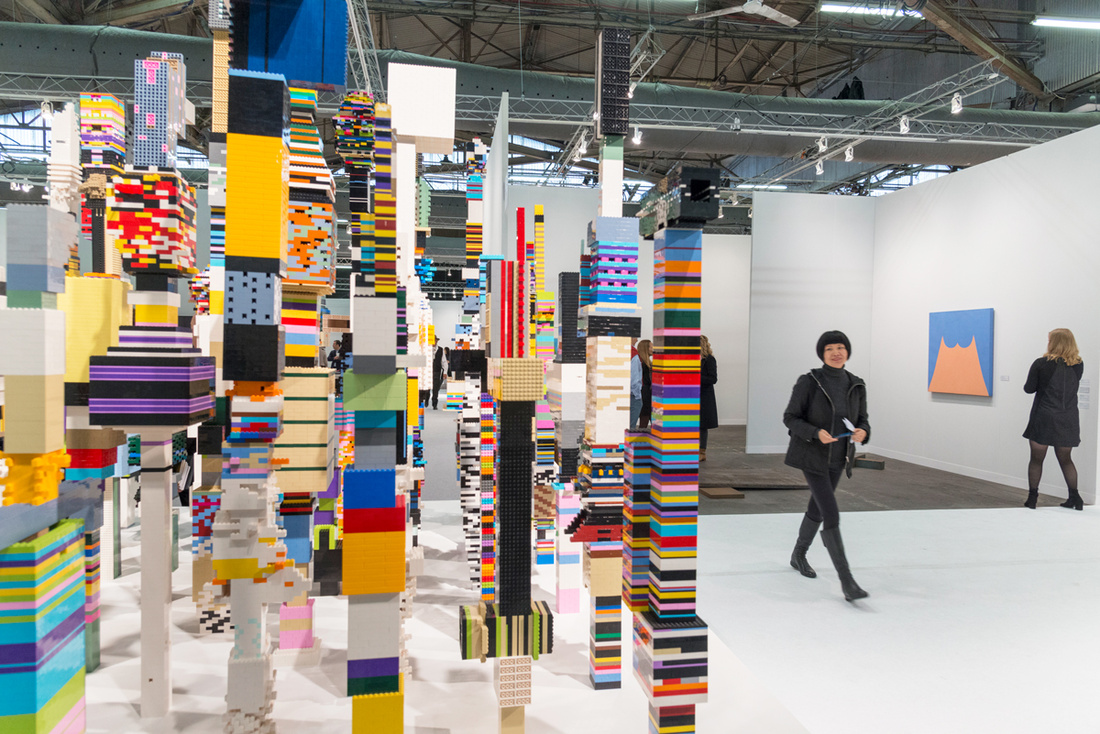
Installation view of Douglas Coupland, Towers, 2014, at The Armory Show, 2017. Photo by Adam Reich for Artsy.
On Friday at The Armory Show, a panel of art insiders gave their thoughts on the future of the market to a packed house. Moderator Kelly Crow of the Wall Street Journal was joined by auctioneer Simon de Pury, art advisor Todd Levin, collector Alain Servais, CEO of Athena Art Finance Andrea Danese, and gallerist Dominique Lévy of Lévy Gorvy.
Crow opened the discussion by prompting the audience members to do the near-impossible: truly use their imaginations.
“Close your eyes and try to conjure a color that you have never seen before,” said Crow, admitting that when asked to do the same thing she failed—only familiar colors came to mind. That reflex is “an apt metaphor for trying to understand the art market,” she said, before diving into a conversation that at times tried to conjure the future, but largely consisted of parsing more familiar recent market trends. That’s not to say there weren’t valiant attempts at prognostication, up to and including the use of props: A smiling Levin at one point pulled out a Magic 8-Ball when asked how he decides if a work of art is a good purchase.
Don’t Expect Data to Tell You What to Do
The art market will never behave the way some investors perhaps yearn for it to behave—that is, as a normal commodity market. “The bottom line is that art is a qualitative object,” Levin said. “Not a quantitative set of data points.” The art world, never one for rapid change and disruption, is nevertheless starting to integrate quantitative data, a primary example being online databases of auction prices. As more information becomes available online, buyers are seeking to complement their subjective taste with quantitative assessments. But available sales data is inherently limited and spotty, particularly for emerging artists with a minimal or nonexistent track record.
Even for more established artists, each work is different, Levin said. If a work has been damaged, or has been burned at auction before, there will always be a role for connoisseurship, knowledge, and personal experience when assessing a purchase. But De Pury acknowledged the desire, even for those who buy a work out of love, to not want to “throw this money out the window,” as he put it. “You feel vindicated if your passion translates into a good investment as well.”
Big Money is Changing the Market
Though the art market is still comparatively miniscule compared to other sectors of the economy (in 2016, it was roughly equal, in total value, to how much Americans spend on pet food, Servais said), it has expanded rapidly in recent years. Servais mentioned the fact that, in 2001, contemporary artists (those born after 1960) at auction netted $48 million annually. In 2007, that figure was $800 million. The size of the market “changed, completely, the rules of the game,” he said. “This is also what brought the finance guys,” Servais continued, putting it on the radar of those looking to financialize art—something he said is a major mistake.
Danese said the amount of wealth pouring into the market may push it to be a more efficient, data-driven area of commerce. Those investors—many of whom come from finance—will want clear information in order to make informed decisions, as they might with stocks or other investments. “There will have to be a dramatic change,” he said. Levin said this was also a function of macroeconomic factors, such as low interest rates, which were intended to jumpstart the economy. One effect they’ve had is to allow vast amounts of money to end up in the hands of a relatively small group of people, often the same people who buy art. “That money has to go somewhere,” Levin said.
RELATED ARTICLE

Is Art an Object of Passion or an Asset Like Any Other?
The Market is Changing What Art Looks Like
A 2016 Deloitte finance report found that 72% of collectors “bought art for passion with an investment view.” And there is no doubt money is impacting, not just the market, but art itself. Servais said that New York is “probably” the “sickest city in terms of the influence of money at all levels of the arts...It even goes to the level of the artist. Because the artists are producing what the market wants.” Take the advent of Zombie Formalism, when artists were pumping out hundreds of monotonous abstract works to meet the demand of speculators. Broadly, the tastes of new collectors without experience, even if they’re not speculators, tend to gravitate towards picking up art that isn’t too challenging, incentivizing artists to produce work for consumption and not for its artistic value.
For her part, Lévy critiqued treating art purely as a question of dollars and cents. “We’re talking about a market, and we’re forgetting we’re talking about art,” she said, adding that to chalk the growth of art simply to more and more money “actually makes me angry.” Challenging the idea that market factors are primarily responsible for a booming interest in art, Lévy instead cited an increasing number of interested collectors, a more globalized world, people venturing out of their cultural niches, and artists entering the digital space as the key factors driving the market. Focusing purely on the monetary and not on the intangible aspects of collecting and the creativity of artists is the “exact thing I would like to see changing,” she said. And despite the emphasis on making savvy financial plays in how one purchases art, she’s seen people buying spontaneously and emotionally.
Though the future is murky, one thing is certain: Even though the art market is comparatively small, there is room to grow. Though some have put excess cash in art, Danese noted only 4% of ultra-high-net-worth individuals are buying or collecting art. “You have a huge opportunity out there, Dominique,” he said, smiling in the direction of the gallerist.
—Isaac Kaplan
What Sold at The Armory Show
ARTSY EDITORIAL
BY ANNA LOUIE SUSSMAN
MAR 5TH, 2017 1:30 AM
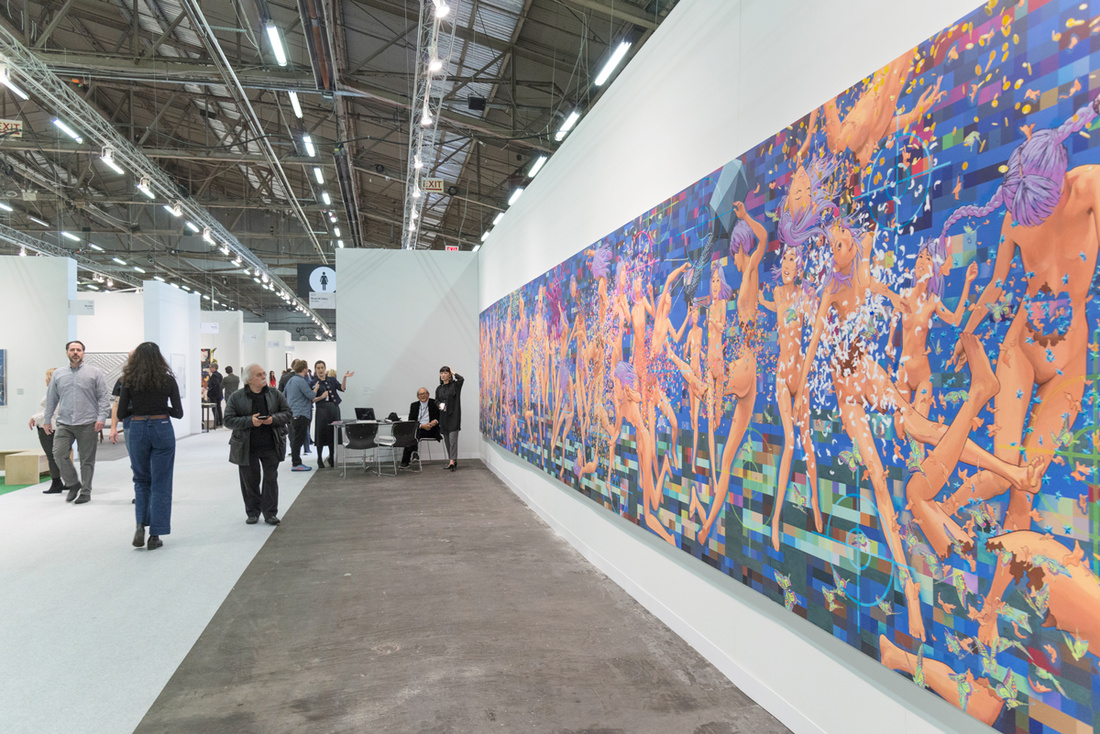
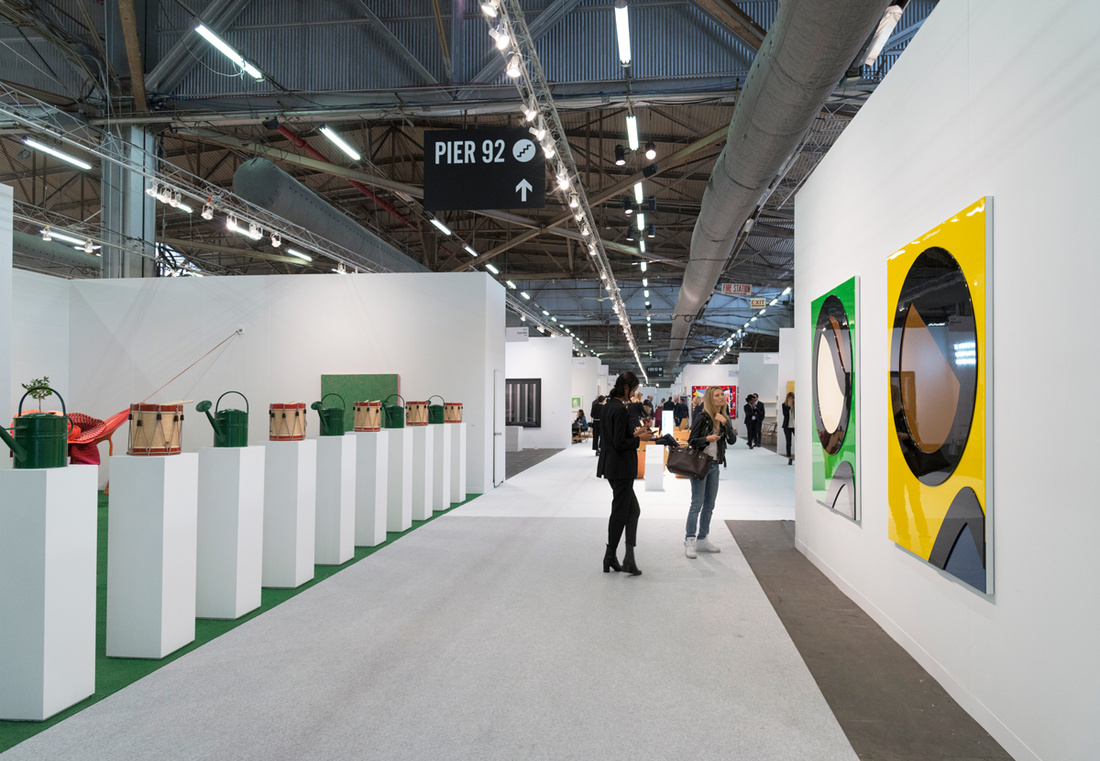
The Armory Show, 2017. Photo by Adam Reich for Artsy.
It was an Armory Show of many “firsts.” The first with the stamp of new executive director Benjamin Genocchio, the first major U.S. art fair under a president named Donald Trump, the first featuring catering by one of Robert Rauschenberg’s favorite Italian restaurants. But somehow all that newness against a backdrop of record stock market heights and unprecedented political mayhem, created a fairly ordinary sales picture.
Perhaps it was the push and pull of those two trends. Sure, a rising stock market creates a “wealth effect” that may induce the rich to spend, but many in the liberal-leaning art world are feeling just plain depressed. Dealers cited the endless stream of negative news as one potential deterrent to sales. It’s hard to get in the mood to buy, they said, while being constantly confronted by potential budget cuts to social programs and the National Endowment for the Arts, allegations of Russian malfeasance, and the like.
“If you always get bombed with negative news, why would you be in the mood to go buy luxury goods?” asked Stefan von Bartha of the Basel-based von Bartha gallery. “It’s great that the stock market is up and all of these things, but the general idea of your president, especially in Europe, is highly negative,” he said.
Sean Kelly, who reported selling out his booth several times over, acknowledged that the “horrible” political situation and strong economy made for “an odd dichotomy.” Still, he said, in his experience, times of political turbulence can create opportunities for dealers, as worried collectors seek solace in art.
“People often go into the art world in a more serious way, because they need beauty and intelligence in their lives,” said the gallerist. And he had much beauty and intelligence that sold, including two works by Shahzia Sikander, a video work that went for $150,000 and a work on paper for $120,000, as well as several smaller works on paper. He also sold a sculpture by Antony Gormley for £350,000, and a painting by Hugo McCloud for $40,000. The works moved so swiftly that he and his colleagues had to change out the inventory on both Thursday and Friday— although they left Sikander’s work up even after it sold, letting its hypnotic imagery draw in passersby.
“We sold an enormous amount,” he said.
Installation view of work by Makoto Aida at Mizuma’s booth at The Armory Show, 2017. Photo by Adam Reich for Artsy.
Kelly had retained his prime location despite a significant reshuffle of the fair layout. But dealers were near-universally enthusiastic about the changes Genocchio had brought about for this year’s edition—as well as their sales results during The Armory Show’s five-day run, which concludes on Sunday. The fair this year welcomed 210 galleries from 30 countries, offering them a chance to connect with the large New York collector and art advisor base as well as the folks flying in from the West Coast and middle America. All told, it draws a public audience of more than 65,000 visitors.
Amidst that foot traffic, most dealers described the pace as “steady,” with many reporting at least one sale per day. It was enough to sustain morale but not drive them away from their booths in celebration of a first-day deluge of activity, something that was characteristic of major art fairs like The Armory Show until two years ago.
Von Bartha had taken a minimalist approach to his booth, with just six pieces on view. “I was a bit nervous coming over here,” he said, but the gamble paid off, resonating with visitors and collectors, including two new clients for his gallery. A five-part painting by Imi Knoebel, Anima Mundi 26-5 (2016), sold for over $100,000, as well as another work by the German abstract artist.
He described this year’s sales pace as more sustainable than in previous years, when the market had been overheated. People were taking a bit more time to make their decisions, and sales were happening in bits and pieces, rather than in a rush in the opening hour. That made it more important for galleries to be intentional about what they bring and how they organize it.
“You have to focus more on what you want to do at the fair,” Von Bartha said.
Installation view of Sprüth Magers’s booth at The Armory Show, 2017. Photo by Adam Reich for Artsy.
Los Angeles-based gallerist Anat Ebgi and her director Stefano Di Paola agreed that collectors had become more thoughtful about their purchasing, something they also said was a hallmark of the New York audience.
“It’s very intentional [at Armory],” Di Paola said, comparing it with fairs in Miami, for example, which he said can feel more like a buying frenzy. The gallery had sold half of the eight Martin Basher paintings they brought as of Friday, and said they were seeing people making return trips: coming back with their friends or advisors to take another look at a potential purchase.
“It’s a good, solid fair,” said Ebgi.
William Pym, director of London gallery Josh Lilley, called this year “terrific,” especially after a less robust 2016. It was the gallery’s eighth year at the fair, and he brought three paintings by a new artist, the 29-year-old Brit Tom Anholt. All three, plus four more paintings back in London, sold, he said, at between $5,000 and $15,000.
Many of the gallery’s artists are now pushing into the mid-career point in their trajectories, said Pym, and the gallery itself has matured from its earlier reputation as an incubator of emerging artists. This growth comes, however, at a time when the market is relatively soft, something which can put them in a bit of a bind when choosing what inventory to place on offer.
“We can’t take a risk with the top, top value works, $50,000 or above; our price point for this fair is $10,000 to $30,000,” he said. “That seems to be the level people like from us.”
A Kathleen Ryan sculpture sold for approximately $18,000, he said, and a difficult sculpture by another new artist, Sarah Pichlkostner, sold for $10,000. She had her first solo exhibition with Lilley in January.
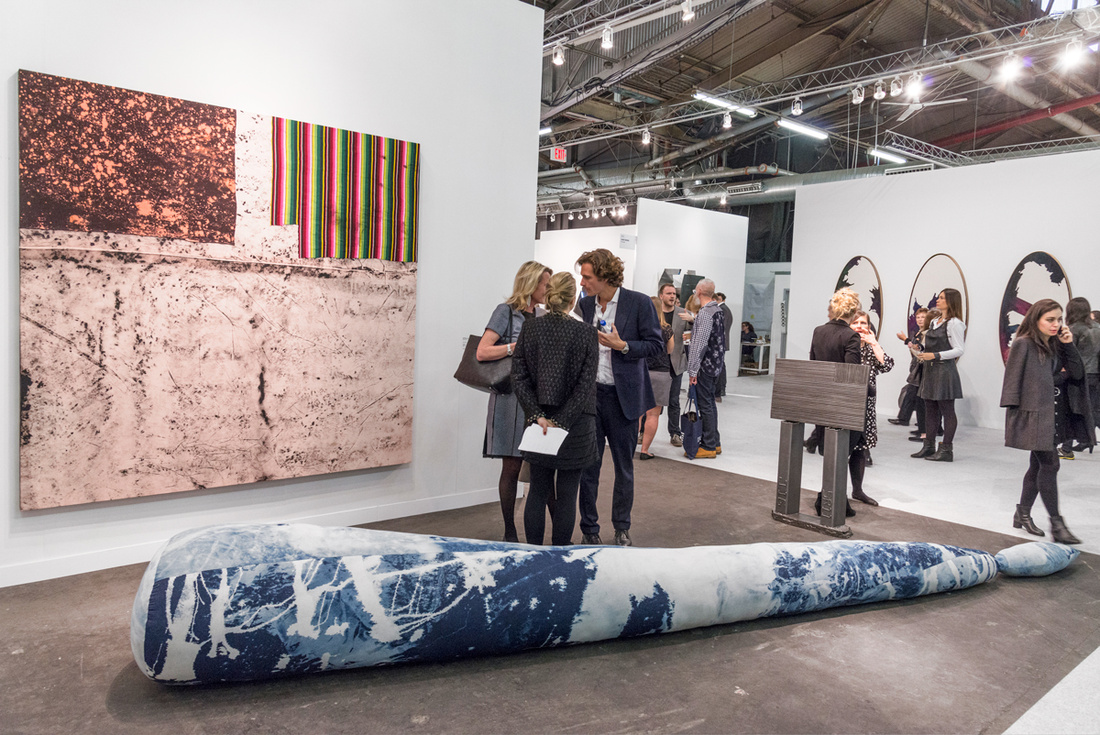
Installation view of Michael Rosenfeld Gallery’s booth at The Armory Show, 2017. Photo by Adam Reich for Artsy.
Dealers across the fair spoke in more businesslike terms than has previously been the case in the art world. With a number of prominent galleries having closed in recent months, dealers said that they are taking extra care in expenditure calculations (particularly with regard to fair attendance) in order to ensure they can continue to support their artists.
Polina Stroganova, director and senior gallery partner at Mexico City’s PROYECTOSMONCLOVA, said the decision to share a booth with London’s Timothy Taylor gallery grew organically out of their close working relationship (the two galleries, both mid-sized, share artists Eduardo Terrazas and Gabriel de la Mora), but also represented significant cost-savings for both parties.
Especially for Stroganova, a first-timer at The Armory Show, sharing the costs and having an experienced partner she trusts made it “a much more comfortable” situation. And thanks to their existing relationship and the work they do together to promote their shared artists, decisions like how to construct the booth, what kind of discount to offer, and how to hang the booth went down “super smooth,” she said.
They each brought two additional artists from their own galleries, and Stroganova said they sold at least one piece by each artist; they are splitting the proceeds from sales of the artists they share. Martin Soto Climent canvases with pantyhose sold for between $20,000 and $30,000, she said, and Terrazas’s works sold for between $40,000 to $50,000. One of de la Mora’s works, a single-panel eggshell work, sold for around $18,000. The gallery also had a work by de la Mora, which comprises the screens of stereo speakers and recalled the artist’s installation last summer at The Drawing Center in SoHo, on offer for $60,000. It did not sell during the fair’s run.
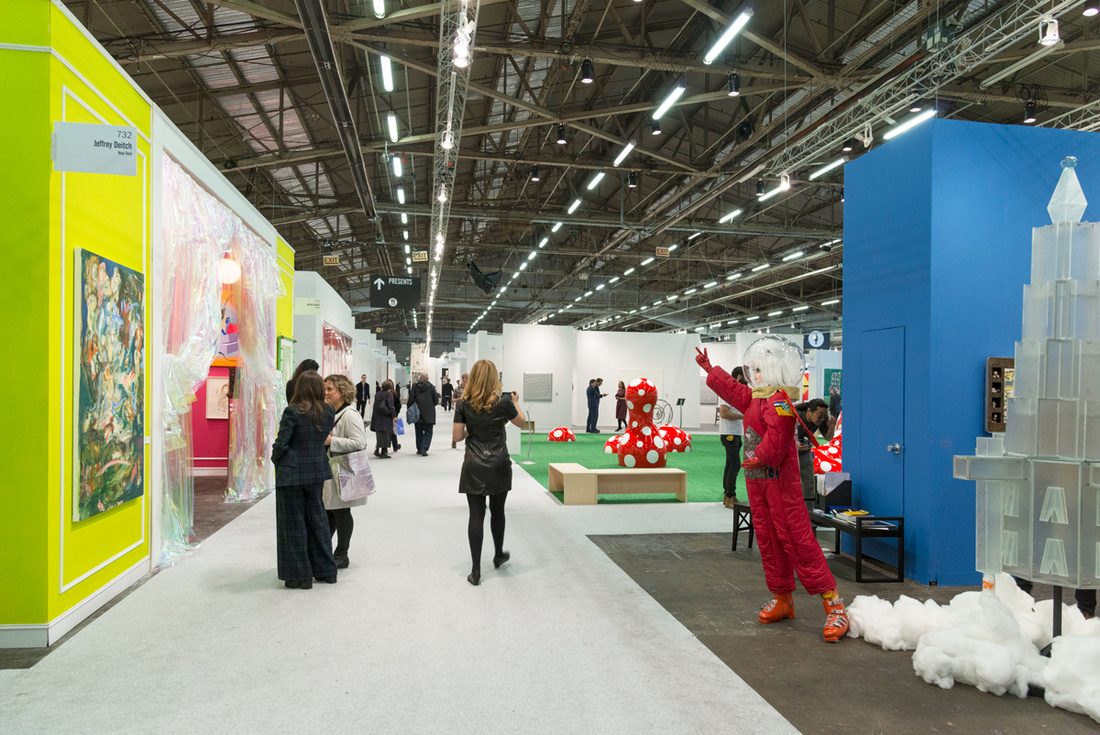
The Armory Show, 2017. Photo by Adam Reich for Artsy.
In another well-regarded gallery collaboration, Thomas Erben Gallery and Lévy Gorvy mounted a joint presentation in the Focus section of American artist Senga Nengudi. In this case, the two galleries operate in very different tiers of the market—Lévy Gorvy is a top-tier Madison Avenue gallery, routinely selling works in the seven figures, while Erben runs his program out of a fourth-floor space in Chelsea and more often works in the five-figure range. But Nengudi’s body of cerebral but tactile works share a conceptual link with Lévy Gorvy’s program and provided a bridge between the two.
And each brought something unique to the relationship. Erben has worked with Nengudi for decades. The two have developed a close collaboration; he knows her exhibition history, where each of her works are, and her pace and rhythm of production. Dominique Lévy brought a high-caliber group of collectors to the booth and has been able to leverage these and institutional relationships to raise Nengudi’s art historical stature.
Each of three photographs sold for $17,000. They are in editions of five, and Erben said the Museum of Modern Art has all three. A recent pantyhose-and-sand sculpture sold for $60,000, while an older one went for $75,000.
Erben said the collaboration could prove a new model at a time when the art market, like the broader economy, is experiencing a concentration in market share and a shrinking middle class.
“There’s a massive consolidation in power,” he said, citing the major blue-chip galleries who operate in multiple cities. “It takes the air out of the medium range.”
—Anna Louie Sussman
Subscribe to:
Posts (Atom)