Monday, January 16, 2017

What Is Fluxus?


What Is Fluxus?
In 1963, an artist named George Maciunas put forward a rallying cry for a new movement in art, one that he would call “Fluxus.” Like many of his avant-garde predecessors and peers, he chose to make his case known in the form of a manifesto. The document was itself a work of art, composed of several dictionary definitions of the word “flux,” from which Fluxus takes its name, followed by handwritten notes that expanded on its various meanings. Beneath the entry defining flux as a purging or discharge of fluids, Maciunas wrote in an insistent hand: “Purge the world of bourgeois sickness, ‘intellectual,’ professional & commercialized culture, PURGE the world of dead art, imitation, artificial art, abstract art, illusionistic art, mathematical art, — PURGE THE WORLD OF ‘EUROPANISM’!”
Fluxus’s spirit of rebellion against the commercial art market, elitism, and the conventions of both art and society had its roots in DadaFuturism, and Surrealism, while its irreverence and youthful energy were in tune with the burgeoning counterculture of the 1960s. Though its nucleus was in New York City, where Maciunas and many other artists were based, Fluxus projects popped up across Europe and in Japan. The movement attracted a loosely affiliated, international group of artists, designers, poets, and musicians who readily embraced one of its central tenets: the total integration of art and life. In his manifesto, Maciunas described the work that would result from this integration as “living art, anti-art…NON ART REALITY to be fully grasped by all peoples, not only critics, dilettantes and professionals.”
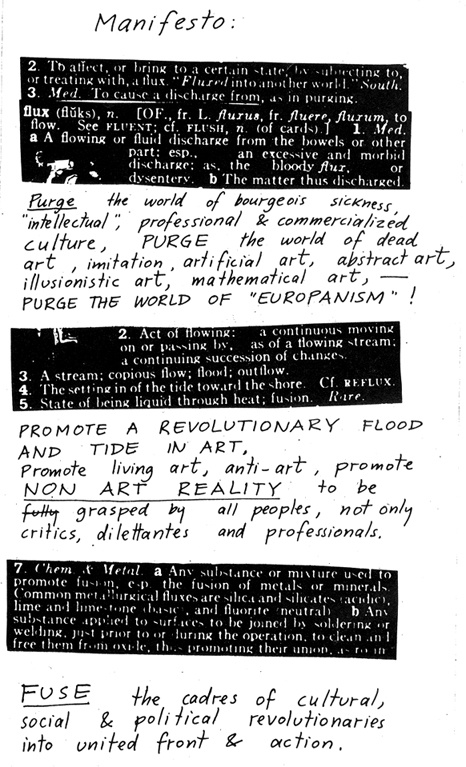

Image via Wikimedia Commons.
Intentionally uncategorizable, Fluxus projects were wide-ranging and often multidisciplinary, humorous, and based in everyday, inexpensive materials and experiences—including everything from breathing to answering the telephone. When asked to define Fluxus, Maciunas would often respond by playing recordings of barking dogs and honking geese, perhaps confounding his questioner but also demonstrating the experimentation and embrace of absurdity at its core. Performances—which Fluxus artists called “Events,” in order to distinguish them from Happenings and other forms of performance-based art—were a significant part of the movement. These were largely based on sets of written instructions, called “scores,” referencing the fact that they were derived from musical compositions. Following a score would result in an action, event, performance, or one of the many other kinds of experiences that were generated out of this vibrant movement.

The Leaders of Fluxus

With Maciunas as its founder and central coordinator, Fluxus lasted from 1962 until the artist’s untimely death in 1978. A polymath, the Lithuanian-born American studied architecture, art history, graphic design, and musicology. This formidable educational background and his highly playful, utopian vision shaped all of his work, not least the movement itself.
The artists, designers, poets, and musicians who rallied around Maciunas’s call for a radical, egalitarian new art were as diverse as the work that came out of the Fluxus movement. Many were inspired by elder artist, composer, and musician John Cage. Through his work and his charismatic teaching, he demonstrated that art and life could be fluidly interchangeable. He did this, in part, by welcoming chance into his musical compositions—including ambient noises or the sounds of audience members coughing, stirring in their seats, and sometimes even heckling the performers—and by using such things as everyday household objects as instruments. Cage’s drive to find artistic potential in the everyday resonated with the Fluxus artists.
Widely recognized as the originator of musical Minimalism, composer and artist La Monte Young was also associated with Fluxus. His compositions were characterized by their pared-down structures and exceptional length. In 1960, he collaborated with artist Yoko Ono to organize a series of events by artists, dancers, musicians, and composers held in Ono’s studio in downtown New York, known as the Chambers Street Loft Series. Maciunas attended, along with many other artists who would become involved with Fluxus. Ono’s studio would become a hub of innovative and experimental new work.
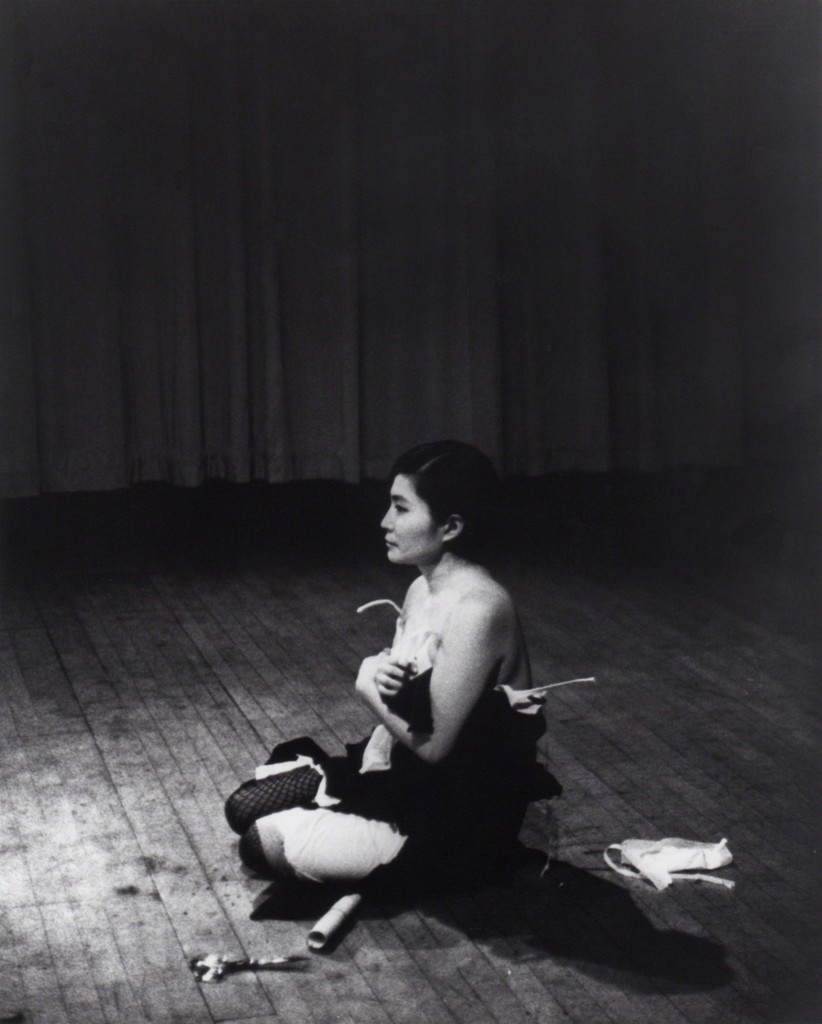
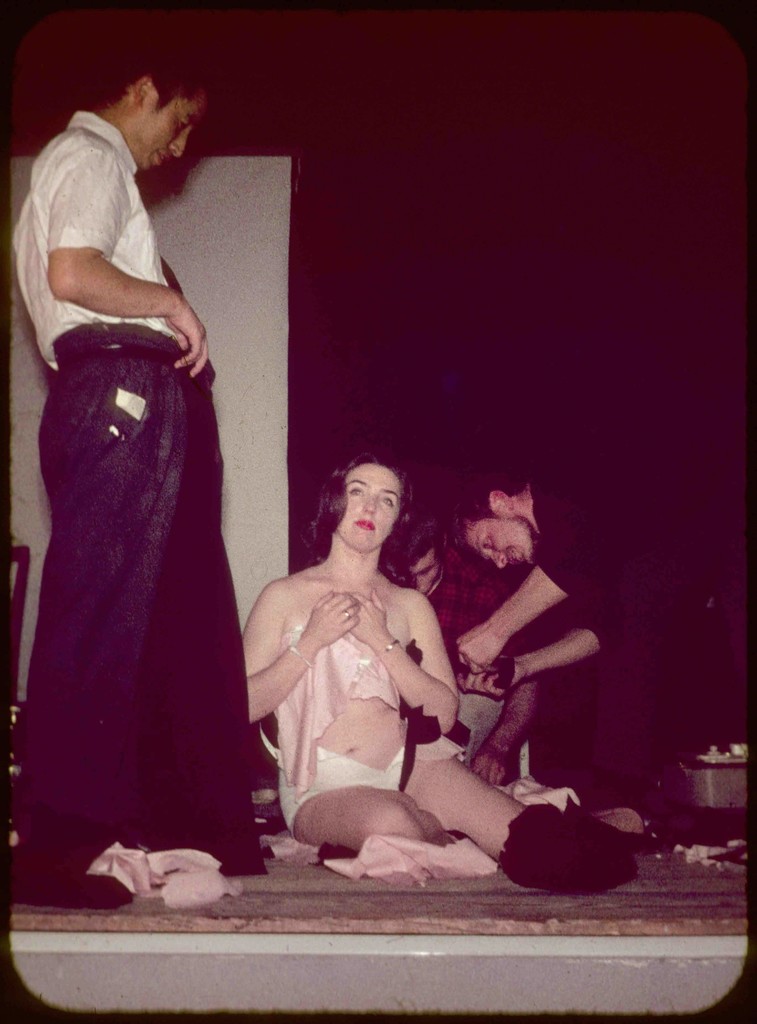
In 1964, Ono debuted one of her seminal performance works, Cut Piece. Sitting alone on a stage with a pair of scissors in front of her, she instructed the audience to take turns approaching her and using the scissors to cut off a piece of her clothing. She remained nearly motionless and expressionless as various audience members obliged, sometimes aggressively. As she wrote about the experience in 1966: “People went on cutting the parts they do not like of me finally there was only the stone remained of me that was in me but they were still not satisfied and wanted to know what it’s like in the stone.” Ono has reprised the piece over the years, and wrote a step-by-step performance score for anyone to recreate it—which many people have done, and many more will likely continue to do.
Like so many of their peers, early Fluxus members Nam June Paik and Alison Knowles worked across media. Paik, considered a progenitor of video art, was one of the first artists to make art out of televisions and video cameras. These technologies form the core of his pioneering sculptures, installations, and performances, which range from austere and meditative to cacophonous and bursting with an onslaught of imagery.
In his performance works, Paik immersed audiences in richly visual and aural experiences, centered upon ingeniously altered television sets and cleverly rigged video cameras. He collaborated with avant-garde cellist Charlotte Moorman on a number of musical performances, including one in which she played his TV Cello (1971). Paik crafted a working cello out of a stack of three television sets whose varying shapes and sizes together mirrored the contours of the actual instrument. Each set displayed images as Moorman played, switching between a live feed of the performance itself, a video collage of other cellists, and a television broadcast.
For her part, Knowles created performances, sound pieces, installations, sculptures, book objects, and prints that have their roots, in part, in her early association with Cage. In 1962, the composer—who, as it turns out, was a mushroom enthusiast—co-founded the New York Mycological Society, which Knowles joined. “You can stay with music while you’re hunting mushrooms,” he once said. “[A] mushroom grows for such a short time, and if you happen to come across it when it’s fresh it’s like coming across a sound, which also lives a short time.” Knowles credits their time together foraging for wild mushrooms as important in helping her to develop her vision and leading to her incorporation of food into a number of her Fluxus projects.

Why Does Fluxus Matter?


While it might be an overstatement to say that the Fluxus movement revolutionized the art world or the real world in the ways that Maciunas called for in his manifesto, it did help to radically change notions of what art could be. With their work, the Fluxus artists pushed art well outside of mainstream venues like galleries and museums. Their informal, spontaneous, and often ephemeral pieces were not only difficult to collect and codify; they were also sometimes hard to recognize as art. But museums and galleries eventually caught up and absorbed their work. So too did younger generations of artists, who continue to build on the freedom that the movement introduced into artmaking with their own work. The next time you walk into an art space and find a pot of curry bubbling on a burner (as in the well-known piece, Untitled (Free), 1992, by the Thai artist Rirkrit Tiravanija) or a sculpture composed of things you might find in your own home, thank Fluxus for helping to lay the groundwork.

—Karen Kedmey
Takeshia Kosugi, Anima I & Ben Vautier, Attaché de Ben & George Maciunas, Solo for Violin. Simultaneous performance, May 23rd 1964, by Ben Vautier and Alison Knowles (not pictured) during “Fluxus Street Theatre” as part of “Fluxus Festival at Fauxhall” New York City. Photography by George Maciunas; Philip Corner’s Piano Activities, performed during Fluxus Internationale Festpiele Neuester Musik, Hörsaal des Städtischen Museums, Wiesbaden, Germany, September 1-23, 1962. Photo: Peter Butler. The Museum of Modern Art, New York. © 2017 Philip Corner. Images courtesy of the Museum of Modern Art.
Unlinked images via Wikimedia Commons.

7 Utopian Design Experiments


7 Utopian Design Experiments, from Le Corbusier’s Radiant City to a Ghost Town in China

Coined by Thomas More in 1516, the word “utopia” stems from the Greek ou-topos—which means “no place” or “nowhere”—but also refers to eu-topos, meaning “a good place.” The very origins of the word therefore reflect the question of whether a good or perfect place can ever exist. Throughout history, religious reformers and visionary starchitects alike have attempted to answer that question by establishing spiritual communes and crafting masterplans for cities of the future. Below, we highlight seven that didn’t quite pan out.


Palmanova, Italy

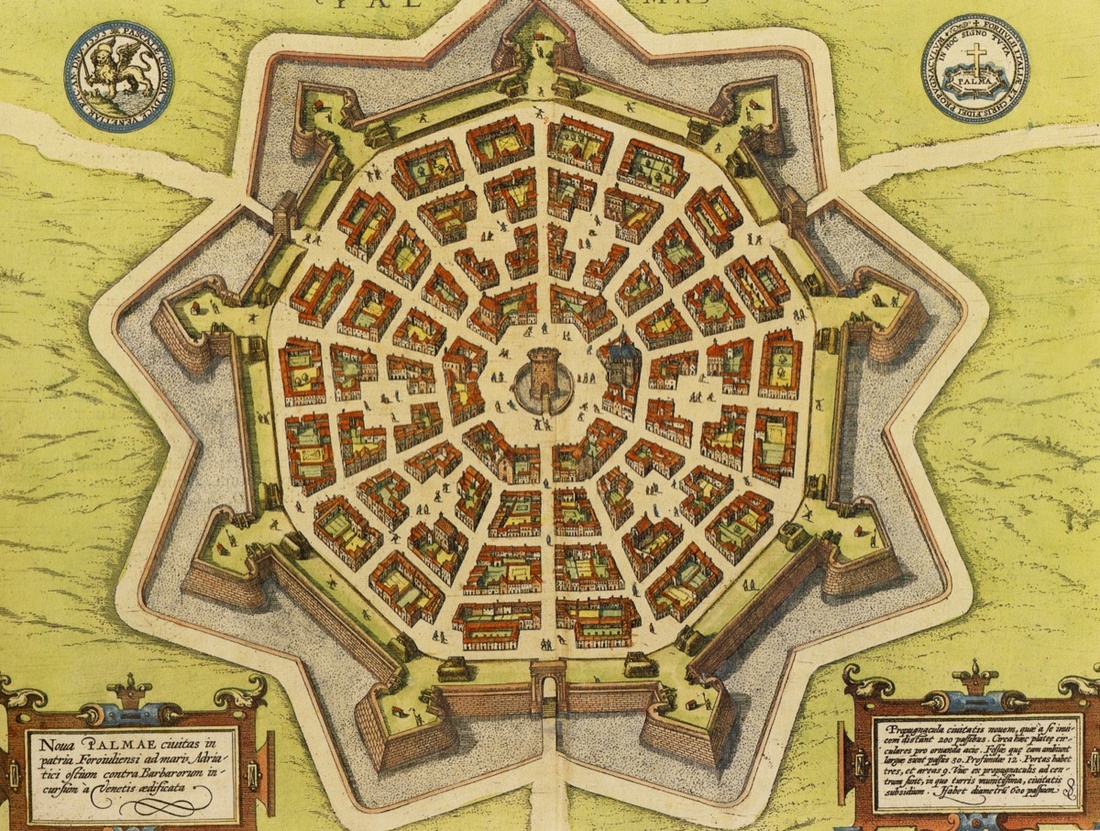
The Venetian model city of Palmanova from Georg Braun and Franz Hogenberg, 1572-1680.
Built strategically near what is now the Slovenian border to defend against the Ottoman Empire in the late 16th century, the fortress city of Palmanova boasted some of the era’s most cutting-edge military features, including nine protruding ramparts as well as a surrounding moat and three guarded entryways. Its harmonious radial symmetry was intended to reflect the goodness of its incoming inhabitants—except no one actually wanted the risk of living in what was essentially a military citadel. Eventually, the Venetian government pardoned prisoners and gave them property in the city to fill its street. Today, Palmanova is home to about 5,400 residents.


Arcosanti, Arizona

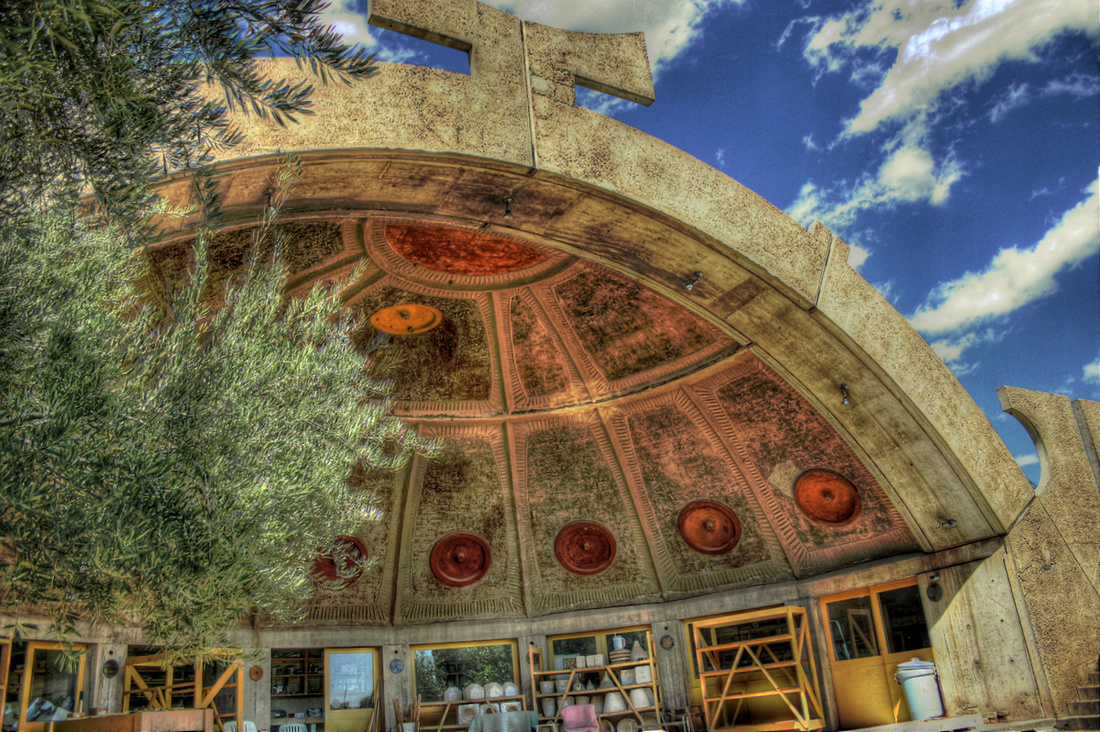
Photo by arcosanti apse, via Flickr.
The sign at the entrance of Arcosanti, in the middle of the Arizona desert, reads: “If you are truly concerned about the problems of pollution, waste, energy depletion, land, water, air and biological conservation, poverty, segregation, intolerance, population containment, fear and disillusionment, join us.” Founded in 1970, the town is the brainchild of Italian architect Paolo Soleri, who envisioned a multi-story housing complex for 5,000 people. There, they would grow their own food, bring no harm to the environment, and support themselves by producing and selling windchimes. Expected to be completed within five years, the town today is three percent complete, though a cohort of about 50 residents continues to cast and carve away at bells in the “New Age crafts retreat,” as The Guardian called it.


Ordos, China

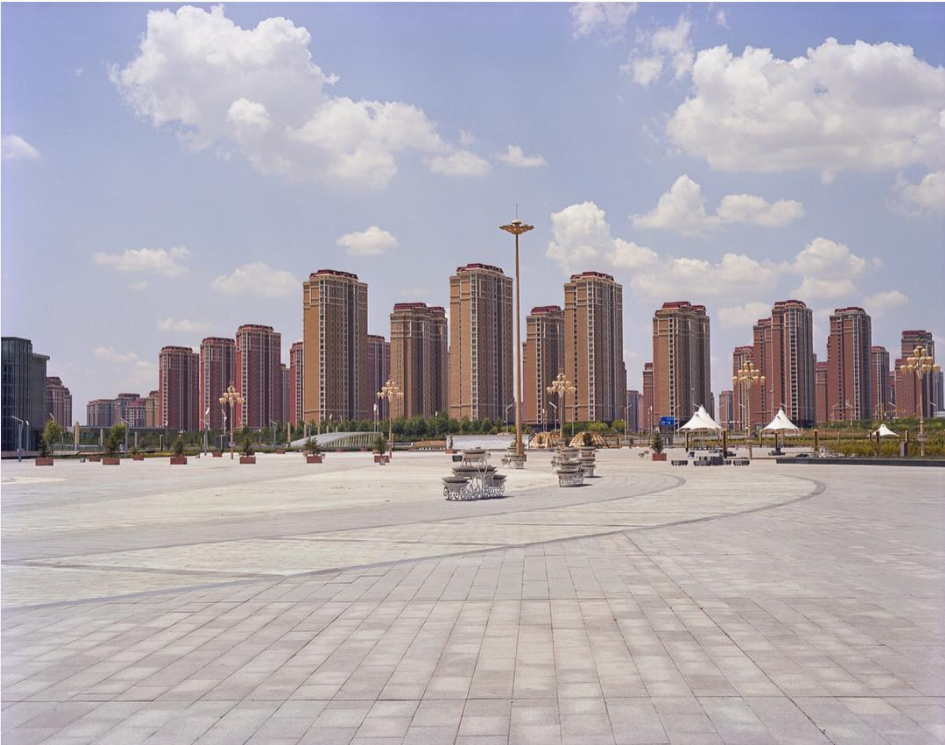
Photo by @matt_e_, via Instagram.
Hundreds of hastily constructed yet nearly uninhabited “ghost towns” have cropped up across China in the past few decades as the country sees unprecedented economic growth and real estate development. New Ordos, located just south of Old Ordos in Inner Mongolia, is one extreme example. In the early 2000s, the Chinese government invested billions of dollars to construct the supercity on bare land in the Gobi Desert. The larger-than-life architectural projects include a huge statue of Genghis Khan overlooking its central plaza, and “Ordos 100,” a now-terminated project by Ai Weiwei and Herzog & de Meuron, featuring 100 villas designed by architects from around the world. Yet the tremendous cost of building the city resulted in some of the country’s highest property values—second only to Shanghai—so, unsurprisingly, few wanted to move in. As photographer Raphael Olivier said following his visit, “The whole place feels like a post-apocalyptic space station from a science-fiction movie.”


Drop City, Colorado

Photo by Clark Richert.
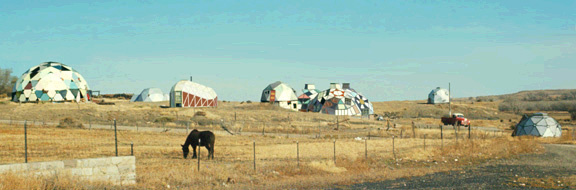
In the spring of 1965, three college graduates bought six acres of land in southern Colorado. It cost $450. There, they established Drop City, a community in which punishment was prohibited, meals were communally prepared, and property was shared among all. For a little while, the inhabitants of this early “hippie commune” all got along: They planted gardens, raised chickens, made art, and built their signature geodesic dome residences from recycled materials. Drop City’s death bell starting ringing in early 1967, when one particularly unruly member proposed hosting a “Joy Fest” for music and art. As the number of residents—and the use of illegal drugs—escalated, members began abusing the communal funds for personal goods. Finding it increasingly difficult to stick to their no-punishment rule, the founders eventually gave up and abandoned their utopian dream.


Le Corbusier’s Radiant City

Photos by Napafloma-Photographe, via Flickr.
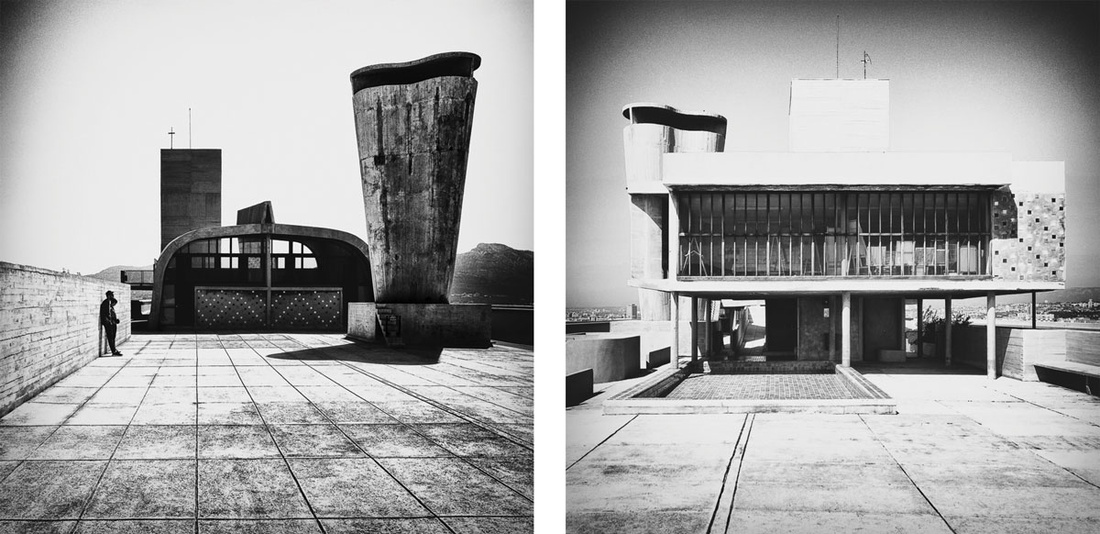
Presented in 1924, Le Corbusier’s plan for the Ville Radieuse (Radiant City) never actually came to fruition—though many of its principles went on to influence modern planning and urban housing complexes across the globe. The city was to operate as a “living machine”: Different areas would be designated for commercial, business, leisure, and residential purposes; a transportation deck in the city center would connect city dwellers, via underground trains, to housing districts consisting of towering premade buildings called “Unités.” Though it was envisioned as a utopian city, modern-day manifestations of Corbusier’s ideas have drawn criticism for their lack of public spaces and a general disregard for livability. Unité-like apartment complexes on urban fringes are now subject to high levels of poverty and crime.


Auroville, India

Photo by ccarlstead, via Flickr.
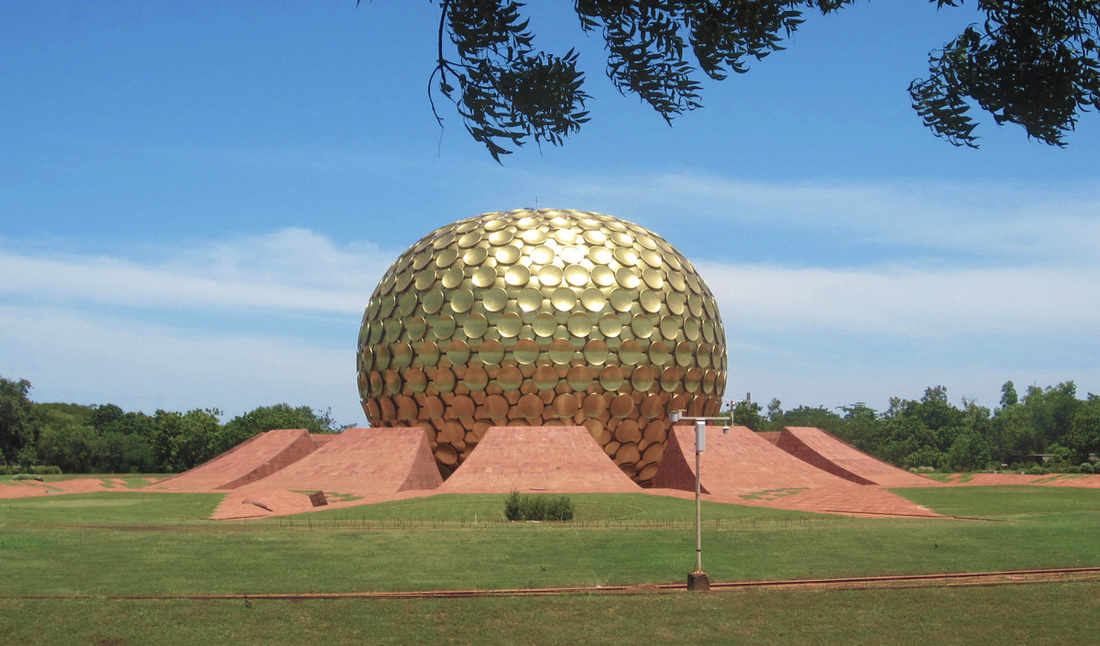
Established in 1968 by Mirra Alfassa, a French woman known as “the Mother,” Auroville (“the City of Dawn”) is the world’s largest spiritual utopia. A four-point charter outlines its founding ideals, including that it “belongs to humanity as a whole” and that it will be “a place of an unending education, of constant progress, and a youth that never ages.” Its labyrinthine, circular plan is anchored by the central “Matrimandir,” a huge dome covered in gold plates. Protected by UNESCO and supported by the Indian government, Auroville is today home to 2,500 people, and it seems to be in good shape—though its idealistic reputation has been undermined by questions of who controls its funds and whether its rules are actually followed. Crime and corruption are significant problems, too.


Frank Lloyd Wright’s Broadacre City

Photo by Kjell Olsen, via Wikimedia Commons.
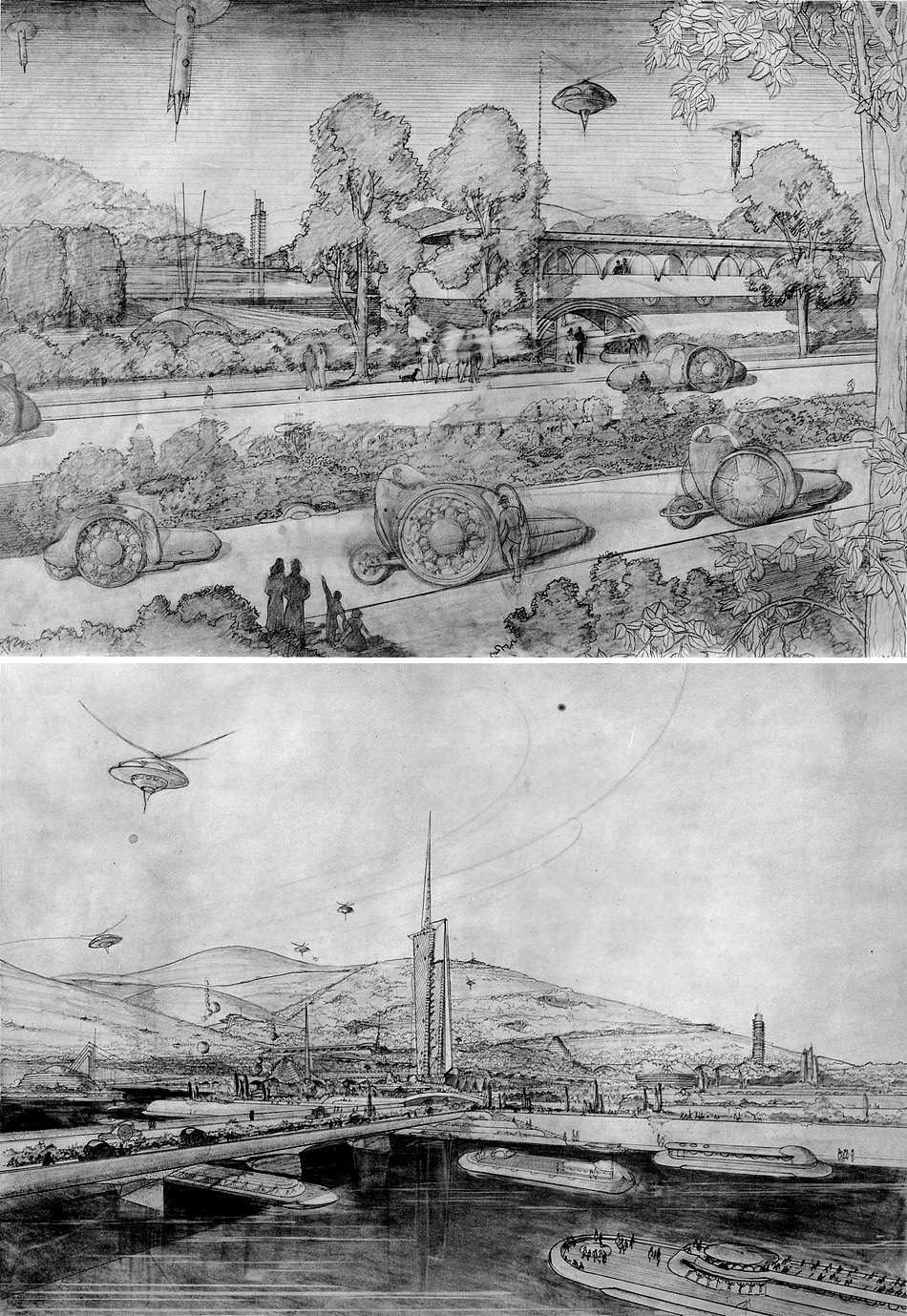
Le Corbusier’s nemesis and fellow starchitect envisioned a different city for America—one that resembled more of a cookie-cutter suburb than a bustling metropolis, with more open space and sprawling landscape than skyscrapers. His city was based on modern technologies found in the automobile, electronic communication, and standardized mechanical production; everything from the size of roads to the proximity of schools and commerce would be based on “a new standard of space measurement—the man seated in his automobile.” However, Wright’s contemporaries found his plan wasteful and egotistical. Art historian Meyer Schapiro deemed it “perfectly consistent with physical and spiritual decay.”

—Demie Kim

SHARE ARTICLE

Sunday, January 15, 2017

THE BIG IDEA What Is Object-Oriented Ontology? A Quick-and-Dirty Guide to the Philosophical Movement Sweeping the Art World

THE BIG IDEA

What Is Object-Oriented Ontology? A Quick-and-Dirty Guide to the Philosophical Movement Sweeping the Art World

What Is Object-Oriented Ontology? A Quick-and-Dirty Guide to the Philosophical Movement Sweeping the Art World
Pierre Huyghe’s Zoodrama (2010)
Ask yourself: what does your toaster want? How about your dog? Or the bacteria in your gut? What about the pixels on the screen you’re reading off now—how is their day going? In other words, do things, animals, and other non-human entities experience their existence in a way that lies outside our own species-centric definition of consciousness? It’s precisely this questions that the nascent philosophical movement known as Object-Oriented Ontology (arising from ὄντος, the Greek word for "being," and known to the cool kids as OOO) is attempting to answer or at least seriously pose, and they’re setting certain segments of the art world on fire.
On some level, this makes sense. Artists, after all, are people who spend their time investing objects with meaning, so the notion that the objects themselves may have something to say naturally strikes a chord—especially at a time when scientific developments are both giving us a better understanding of animal's minds and inching us closer to authentically intelligent machines. The fruits of this kind of thinking can be found everywhere these days, from when the Argentine artist Eduardo Navarro tried to turn himself into a turtle at last year’s New Museum Triennial, to Pamela Rosenkranz's decision to fill the Swiss Pavilion of the 2015 Venice Biennale with flesh-toned liquid and synthesized baby musk. The odds are, your local Post-Internet art exhibition might contain more than a hint of OOO.
For cutting-edge artists looking to lend their work some conceptual heft, Object-Oriented Ontology has become the faddish successor to such previous intellectual trends as structuralism and postmodern theory. However, in an age of rogue chatbotsdreaming computers, and the Internet of Things, not everybody is so enamored with the so-called “object turn.” For those left scratching their heads at this philosophical proliferation, here’s a quick and dirty guide to this novel movement.

THE WORLD ACCORDING TO OOO
 rosenkranz 1Pamela Rosenkranz's Our Product (2015) at the Venice Biennale
In short, OOO (and its intertwined companion Speculative Realism) is dedicated to exploring the reality, agency, and “private lives” of nonhuman (and nonliving) entities—all of which it considers "objects"—coupled with a rejection of anthropocentric ways of thinking about and acting in the world. One of the movement’s founders, American University in Cairo philosophy professor Graham Harman, defined these objects in ArtReview as “unified realities—physical or otherwise—that cannot be reduced either downwards to their pieces or upwards to their effects.”
With this understanding, any “thing” is an object, whether living, nonliving, artificial, or conceptual—an everything-plus-the-kitchen sink approach that gives rise to a near-comical overabundance of lists in OOO writings. In his critical review of the philosophy in Artforum, the Princeton professor Andrew Cole somewhat mockingly describes the theory to encompass “aardvarks, baseball, and galaxies; or grilled cheeses, commandos, and Lake Michigan.” For OOO, your skin cells are objects, and so are you, and so is the population of the nation you live in, and so is the very idea of a nation. 
The crucial point here is that, in contrast to the dominant strains of 20th-century phenomenology that claim things are only real insofar as they are sensible to a human subject, OOO asserts a radical and imaginative realism that not only claims that things do exist beyond the purview of human conception, but that this existence (defined by Harman as “nothing other than [the] confrontation of an experiencing real object with a sensual one”) is almost entirely inaccessible to our understanding.
It's a brand of materialism that goes hand in hand with what you might call posthumanist egalitarianism, or panpsychism: none of the things you can name can be thought of as intrinsically less real, vital, or important than any other—an ecological viewpoint of existence that rejects any idea of human specialness as simple arrogance. As Harman writes, “The world is not the world as manifest to humans; to think a reality beyond our thinking is not nonsense, but obligatory.”
This idea is closely linked to the OOO rejection of “correlationism,” or the habit we humans have of thinking about things only in terms of the effects they have on us. For OOO adherents, this is a tragically limited worldview that at best precludes our ability to imagine the multiverse of beings, and at worst leads directly to the wanton environmental degradation we witness today. The world according to OOO is one full of beings acting on one another according to their own goals and caprices, motivations that cannot be kenned by others.

ART AS CHARISMA
turtle suitEduardo Navarro's costume from Timeless Alex (2015)
OOO creates some interesting issues when it comes to thinking about art. The default stance of the art viewer looking to read an artwork in terms of its creator’s intentions or psychology, or its place in the historical canon in relation to other works, or its specific materials and concepts, or any other traditional criteria would, to an OOO adherent, be little more than anthropocentric hubris. These modes of thought reduce the object to relations with human viewers, a classic OOO no-no.
Instead, writes Timothy Morton (who stands alongside Harmon as the best-known thinkers in the movement), “an artwork cannot be reduced to its parts or its materials, nor can it be reduced to its creator’s life, nor to some other context, however defined  …  Art is charisma, pouring out of anything whatsoever, whether we humans consider it to be alive or sentient or not.” For Morton, the normative modes for thinking and talking about art ignore the agency (which he terms charisma) of the art object as well as its status as a thing that stands separate from (and equal to) all others. The charismatic pull he mentions is the art object acting on its viewers, a property he says all objects possess.

SPECULATIVE REALISM IN THE REAL (ART) WORLD: BABY SKIN
rosenkranz 2Pamela Rosenkranz's Our Product (2015)
In one way of thinking, any artwork from classical sculpture to the latest digital simulation can in some way be used as a proof of concept for this philosophy, insofar as there are no shortage of interpretations one can imagine for the object. That said, however, the whole idea that artworks exist only insofar as they’re available for human viewing and interpretation is entirely opposed to the posthuman perspective OOO promotes. As a result, OOO artworks tend to be more interested in pointing out how objects exist, act, and “live” beyond the realm of human perception, a paradox of sorts given the contrived nature of artworks.
The artist most often associated with these ideas is Pamela Rosenkranz, the young Swiss conceptualist known for her chemically infused performances and installations. Her work Our Product from the 2015 Venice Biennale is a typical example: Rosenkranz covered the Swiss Pavilion’s floor with a mixture of various substances (including silicone, Evian water, and Viagra, among others) to create a liquid imitating what the press release calls “a standardized northern European skin tone,” the same color that the release says is utilized in contemporary advertising as “a proven way to physically enhance attention.”
Combined with the computer-generated sounds of lapping water, an hormonally-enhanced green wall paint, and a smell that somehow mimicked the scent of a newborn baby, the pavilion became a subtle illustration of a central OOO idea—namely, that all objects (themselves made up of myriad other objects) exert their power over the objects around them, creating the push-pull relationship between viewer and artwork that Morton refers to as “charisma.” Ronsenkranz herself comments of her work: “It seems to live, then again, my team and I try not to get it ‘too’ alive… an artwork develops its own kind of audience because of the independence it develops.” 

SPECULATIVE REALISM IN THE REAL (ART) WORLD: TRIPPY CRABS
zoodrama 1Pierre Huyghe's Zoodrama (2010)
The recent work of Pierre Huyghe is also cited as exemplifying some of OOO thought, with a focus on more animate objects (read: animals) the theory engages with. In works like his Zoodram series, different species of invertebrates coexist in specially designed aquaria, while his free-roaming dog Human has been repeatedly employed for Huyghe’s shows in settings from the Pompidou to LACMA. It's hardly the first time live animals have been used as readymade actors in art, but Huyghe’s presentation seems to highlight the fact that these “objects” exist in realms inaccessible to humans—the museum’s doors close at night, but the crabs don’t seem to care. As Huyghe himself has said of his tanks, “I am interested in the strange relationship and separation between the human and a world. They are not encountering each other.”
What’s more, by framing not just the crustaceans but the entire contents of the tank they inhabit as an artwork (the glass, the water, the bacteria, the excrement—these litanies really are inescapable), Huyghe points to the compounded experiences of his materials, who are both acting on and being acted upon all the other objects in the tank (and beyond). To fully comprehend one of his Zoodrams you must take into account the entire list of components and their interactions, something human observers are generally unequipped to deal with.

SPECULATIVE REALISM IN THE REAL (ART) WORLD: ED THE TURTLE
turtle performanceEduardo Navarro performing Timeless Alex at the New Museum Triennial (2015)
Eduardo Navarro works with similar ideas in the opposite direction in his 2015 performance piece Timeless Alex at the New Museum’s “Surround Audience” Triennial. The piece featured the artist crawling into an (artificial) turtle-skin suit and chicken-wire-frame carapace before meditating in an attempt to inhabit the consciousness of the reptile he imitates. Rather than invite viewers to speculate on the lives of other creatures, Navarro makes an avowedly good-faith attempt to enter those lives himself, slowing his breathing and crawling around on all fours to complete the autohypnosis.
His self-reported identification with his subject took him to strange realms; as he’s said in an interview, “When I was doing the performance [I felt] that it wasn’t me trying to transform, but a turtle trying to become human.” The highly personal nature of this experience points yet again to the private lives OOO asserts—whether Navarro really did enter the consciousness of a turtle remains up for debate.

SPECULATIVE REALISM IN THE REAL (ART) WORLD: HOT PECS
 video piecesNiels Betori Diehl's THE HEAT / scene 2 (2003, bottom screen)
The Berlin-based artist Niels Betori Diehl takes a more abstract approach to the new philosophy in his video work THE HEAT / scene 2 (2003), currently on view in Beijing’s Intelligentsia Gallery’s appropriately titled group show “OOO.” His work illustrates just how fluid the OOO conception of an object can be: Betori Diehl filmed shirtless men on a hot day from his window in Prenzlauer Berg, Berlin, taking the phrase “object of desire” quite literally.
He’s interested in how the combination of their flesh and his (or the viewers) sexual and emotional proclivities combine to form a new object: desire itself. The close-ups of glistening pecs may call pornography to mind, but although there is a similar objectification of bodies going on, the subject of the works is really the new object (desire) created by the interaction of Betori Diehl’s embodied psyche with those of his unknowing subjects.
  
OOO OPPOSITION
 zoodrama 2Pierre Huyghe's Zoodrama (2010)
Any new theory or movement is bound to generate some pushback, and OOO is certainly no exception. Critiques from within the art world tend to skip over issues about the validity of these ontological claims—it’s hard to disprove someone who argues that objects have hidden agency that is by its very nature beyond our comprehension—and instead focus on the more human, sociologial issues that repeatedly rear their anthropocentric heads when talking about artworks.
Writing in Artforum, the critic Ben Kafka is clear in establishing what he sees as the fundamental flaw of these systems of thought: “[OOO] almost sounds like a neat idea, until you pause to consider its ethical implications. ‘You’ may indeed get a kick out of comparing yourself to a speck of flea shit or a solar flare. But substitute ‘you’ for pretty much anyone else on the planet and you begin to see how dehumanizing ‘posthumanism’ can be.”
J.J. Charlesworth agrees in a scathing opinion piece in ArtReview, writing, “What speculative realism thinks of as its novel philosophical insights—that humans are no exception to things, that there should be no distinction between human and nonhuman ‘actants,’ and that the subject–object hierarchy in philosophy should be abolished—become the philosophical cheerleaders for a contemporary culture that denounces the idea that human beings can—even should—actively reshape the world in their own interests.” These quotations each tackle the same question: what does it mean for people (some of whom are suffering) when philosophers concern themselves with the travails of inanimate objects?
It's a heady question, and one that gets into issues of ethics. In the words of the critic Barbara Johnson (as quoted by Kafka): “The more I thought about this asymptotic relation between things and persons, the more I realized that the problem is not, as it seems, a desire to treat things as persons, but a difficulty in being sure we treat persons as persons.” It’s exactly this kind of anthropocentric humanism OOO seeks to refute, of course. No wonder artists seeking fresh ideas are drawn to this dizzying mise en abyme of contemporary philosophy.