How to Maximize Your Wall Space: 4 Golden Rules for Hanging Art
By
Loney Abrams
July 11, 2016
A few good rules of thumb
We hate math just as much as the next art
geek—but when it comes to hanging art on the wall, spending a few
minutes to take measurements and follow formulas can make all the
difference. Luckily, interior designers have devised a set of golden
rules to find the perfect size piece for any space. Here, we reveal some
crucial tricks of the trade.
Having trouble finding a piece you like that’s wide enough
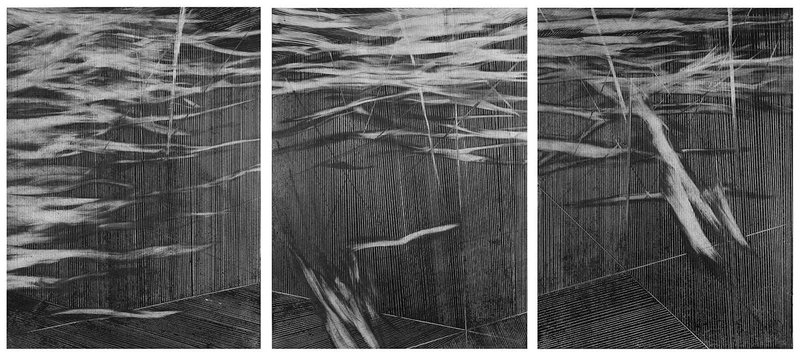
for your setting? Why not consider a diptych or a triptych—i.e., works
that come in sets of twos or threes, respectively—that adds up to the
width you’ve calculated? (Remember to account for two to five inches of space in between the works.) Browse our collections of diptychs and triptychs here.
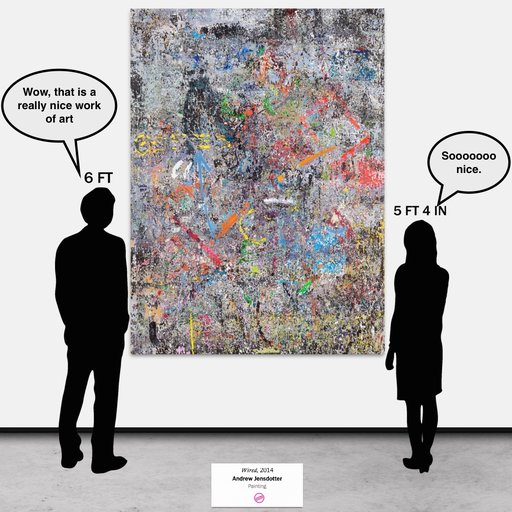
Use this rule when working with an empty wall. The white
space on either side of the artwork should be roughly three-eighths of
the width of a painting. To calculate your ideal width, simply multiply the length of your wall by 0.57. Having trouble finding the size you need? Here are 22 artworks available in variable sizes that will fit like a glove.
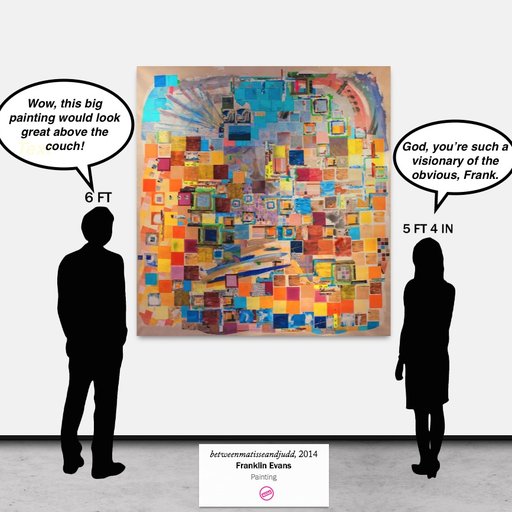
Don't just hang the artworks at eye level—because, frankly, it's just your eye level. Instead, interior decorators and curators always tend to hang a work with a standard 58-inch distance from
the floor to the artwork's center. If your ceilings are really high,
bump that up to 60 inches. And if the artwork is over furniture, have
the bottom of the piece end 8 to 10 inches above the headboard or back of the sofa—hanging the artwork too high will leave your room feeling unanchored. For those of you who are too fabulous for white walls all together, ignore everything we've just told you and instead opt for wallpaper designed by Damien Hirst, or wallpaper from the Maharam Serpentine Galleries Wallpaper collection.
When college tuition rises, fewer people take the plunge into
entrepreneurship, according to a new working paper by Harvard Business
School economist Gareth Olds.
The paper isn’t studying Millennials and how student debt affects their career choices. Instead, it’s focused on their parents.
Olds found that in the U.S., a 10% increase in the average price of
in-state college tuition corresponds with a 13.9% decrease in the number
of parents with college-age children who become self-employed. The
effect is strongest for parents with multiple children and holds up even
after controlling for factors such as state economic conditions.
The theme of Olds’s research is twofold: Financial security makes it easier for people to start businesses, and government programs can help provide that security. His previous papers have documented how food stamps and children’s health insurance each promote entrepreneurship. Other researchers have found similar results for unemployment insurance and for government-provided health insurance for retirees.
Just like would-be entrepreneurs hesitate to leave their jobs for
fear of not being able to afford health insurance, it makes sense that
looming tuition bills might depress a parent’s appetite for career risk.
Is starting a business really worth jeopardizing your child’s
education?
Olds’s paper has important policy implications. Not only would
cheaper tuition potentially mean that more students would have access to
education — itself likely to increase entrepreneurship and innovation —
but also it would free more parents to take risks by launching new
companies. That’s arguably something the U.S. needs, since new business
creation has been in decline over the past few decades.
Olds suggests that “the rising cost of higher education may be
partially responsible for the decline in new business starts in the
U.S.”
He is not the first to make the connection. Last year the Urban Institute, a think tank, published a discussion paper
exploring the link between student debt and entrepreneurship, though it
noted that establishing a causal link between the two would be
difficult. Olds’s paper, focused on tuition rather than debt, may be the
best evidence to date that such a relationship exists.
Another paper,
published last year by researchers at Penn State and the Federal
Reserve Bank of Philadelphia, found a negative correlation between
student debt and the number of new businesses in the U.S. But that
negative relationship held only for companies with fewer than four
employees. The researchers found no statistically significant link
between student debt and the creation of larger firms, which the authors
“interpret to mean that these firms had greater access to outside
capital.” In other words, student debt was a deterrent for entrepreneurs
who couldn’t find investors to back them.
That distinction matters. New small businesses may be an important source of economic mobility, but fast-growing, innovative new firms are what have the largest impact on the overall economy. And there’s less evidence of a shortage of growth startups.
Olds measured entrepreneurship by looking at parents who became
self-employed (and by using their income from self-employment), not by
measuring the headcount or revenues of their businesses. So his research
can’t rule out the possibility that tuition levels matter most for
smaller businesses, even for one-person operations in which a parent is
essentially using self-employment as a bridge between full-time work and
retirement. If that’s the case, it might lower the stakes in terms of
the drag that high tuition places on the overall economy.
Further research should explore the relationship between tuition and
growth startups. Nevertheless, previous work by Olds and others has
documented the link between financial security and entrepreneurship not
just for smaller firms but also for faster growth startups.
As a rule, people are willing to take entrepreneurial risk when they
have some modicum of financial security. Parents a year or two away from
owing tens of thousands of dollars in tuition bills aren’t likely to
feel that they have much of it.
Walter Frick is a senior associate editor at Harvard Business Review.
In
America, we want our women to be girls and our girls to be sex fairies,
and for those sex fairies to live next door to us, for some reason.
This Sharktaugust, there is only one such radiant sex-fairy star to
watch. In fact, you should probably close your eyes when she’s offscreen
and sort of block out with your fingers the parts of the screen she’s
not on when she’s in a scene with someone else. Unless you are a
complete idiot, you already know this star’s name: Jane Neighbor.
Neighbor
is twenty-eight and twenty-two, at once. She is a kind of gorgeous that
can only be found in or very near rivers. She is blonde but also blond,
depending on the spelling. She is tall when she is on a ladder, and
medium-tall when she is halfway up the ladder. Her eyelashes spell
“glory.” Her naked hands can open wet jars, with just the strength of
her slender fingers. She can be sexy and pointy and things that aren’t
even adjectives, like glossary, or aren’t even words, like hilabrion.
Her voice sounds like a truck full of rain.
As
I said, she is from Portugaria. Or maybe I didn’t say that yet. Anyway,
that’s where she’s from. To understand her, you must take a plane to
where she is from, or read the Wikipedia page about it, or learn
Portugarian, or just speak decent English, because she’s fluent and
actually doesn’t even have much of an accent.
Portugaria
is America a few hours ago, because of the time difference. Its people
are a simple people, a throwback people, like Americans but a few hours
ago. In Portugaria, they watch Portugarian “The Ellen DeGeneres Show,”
which is the exact same show as America’s “The Ellen DeGeneres Show.” In
Portugaria, every young, ambitious actress dreams of Hollywood and its
mythic, faraway opportunities for stardom, and every other person just
has that dream where all of his teeth fall out.
Recently,
I met Jane under a bridge next to a defunct dentist’s office, on the
Lower North Side of somewhere in Queens. (It’s a celebrity haunt, in
that I think some famous people were maybe killed there.) I don’t
remember what she was wearing, but I think it was hair? Something was on
the front of her head—either glasses or a nose. I probably should have
taken notes. She made noises with the lower part of her face, and I was
mesmerized.
By now you know all
about Neighbor’s successes: summer blockbusters, winter barnbusters,
suppertime bustblockers, even movies. I asked her what it was like to be
the new face of Sheila, in the remake of the megahit “Sheila the
Exorbitant,” and she shrugged her delicate bones into a croissant-like
shape and laughed a tinkling laugh. Then she responded, but I wasn’t
listening.
The thing is, everyone
wants to author the story of Jane. The famous director Allan Harkness
called her “in one word, a French horn.” The less-famous director Alan
Hankress called her “in three words, a French horn.” But is she? Really?
Can we remove the girl from the nudity, and the actress from the horn?
At least for long enough to write about it?
Back
under the bridge, Jane was looking at me, and I was looking at her, and
we were both expectant—she, that I would ask her another question, and
I, that she would just kind of say something. The seconds passed, laden
with silence, her very presence a lie. (It is far smaller than it
appears on a large movie screen.)
I
asked what it was like to have her sexy parts mash up against famous
actors’ sexy parts. Her answer was both short and long, in turn: a sigh
and a string of syllables forming words that formed a sentence. I let it
hang there, laden with fragility and malaise. I thought about my
financial portfolio, and what I had and hadn’t eaten for dinner, and how
a large man might look in a short robe. I knew that, years later, I
would remember this moment—so lush with silence and yet so not full of
speaking.
Eventually, she said, “Oh,
I think that’s my Uber,” and picked her way back across the sands of
forgotten periodontics, her blondness effulgent, and then evaporating
into the night like the last pale crumbs of a Portugarian pastry, the
only evidence of her ever having done this interview a single, lonesome
note of a French horn.
Sony Kapoor Talks to James Surowiecki About Brexit
The United
Kingdom holds one of the world’s financial capitals; its decision to
leave the European Union caused an earthquake in the markets. Even as
markets stabilize, the political and economic uncertainty in Britain
continues. James Surowiecki, who writes The New Yorker’s
Financial Page column, spoke with Sony Kapoor, a British macroeconomist
and the managing director of the think tank Re-Define, as well as a
staunch opponent of Brexit. The British, Kapoor said, have been acting
like the “spoiled brats” of Europe, complaining about a sweet deal full
of special exemptions and then wanting more. “Whatever comes to us in
terms of, let’s say, the E.U. playing hardball,” he said, “it’s entirely
self-inflicted and very well-deserved.” The complexities of
extrication, he thinks, put the Leave camp in a position that is
politically impossible, and that might be a good thing for the future of
the E.U.
At Euro 2016 Final, Portugal Loses Ronaldo but Defeats France
Éder, center, who entered the
game as a substitute, was mobbed by his teammates after scoring the
only goal in the Euro 2016 final.Credit
Alex Livesey/Getty Images
ST.-DENIS, France — Cristiano Ronaldo
was crying, his chest heaving, his knee throbbing, his heart aching
like never before. Ronaldo, prone on the turf, sat up slowly and did
what he surely never imagined having to do in a game like this: He
wrapped his captain’s armband around a teammate as his eyes clouded
over. Then he lay back, shimmied onto a stretcher and was carried to the
locker room.
That
moment, just 24 minutes into the final of the European Championships at
the Stade de France, felt critical. One of the biggest stars in the
sport going off after less than half an hour? It was the sort of twist
that can — that should — define an entire match. And it did.
Portugal,
faced with the loss of its leader and its motor and its man who is
always in lights, did not wither or wilt or wobble. Instead, the
Portuguese dug in, carried the match into extra time and — with Ronaldo
hobbling up and down the sideline — stunned France with a goal in the 109th minute, beating the hosts, 1-0, to claim Portugal’s first major soccer trophy.
“We
said we would win it for him,” Pepe, the Portuguese defender, said of
Ronaldo. Pepe grinned. “And we just managed to win it for him.”
They
did, though it was far from pretty. Portugal’s run at this tournament
was strange: It tied all three of its preliminary-round games, finishing
in third place in its group (behind Hungary and Iceland), but in this
first Euros of 24 teams, it qualified for the round of 16 anyway.
Then,
after a late goal by Iceland in its final group game shunted Portugal
to the opposite side of the draw away from juggernauts like Italy,
Spain, England, France and Germany, it edged past Croatia in extra time,
beat Poland in a nervy penalty shootout and knocked off Wales in the
semifinals — its only win in regulation of the tournament — before
pulling off the shocker on Sunday.
Critics
will say Portugal was far from entertaining. The team led for only 73
minutes of the 720 it played at this event, but the results were
undeniable. Even without Ronaldo, Portugal never faltered.
Portugal’s Cristiano Ronaldo
during the final of the European Championships in St. Denis, France, on
Sunday. Ronaldo left the match against France with a knee injury in the
24th minute.Credit
Philippe Lopez/Agence France-Presse — Getty Images
“It
defies description; it could be a Hollywood movie,” Portugal’s José
Fonte said afterward. “We’ve written our names down in history.”
At
the final whistle, while Portugal’s players piled on one another in
celebration, the French players sank to the turf. For a country still
recovering from the terrorist attacks last November and enduring
nationwide flooding as well as constant worker strikes, the Euros were
seen as a chance to celebrate something grand together. To smile.
In
the end, there was, perhaps, a surface satisfaction: The tournament was
run smoothly, security was largely effective and there were no major
incidents, but the lingering feeling for the French will be the
disappointment of falling just short.
France
had plenty of chances on Sunday, too, including one at the end of
regulation when André-Pierre Gignac hit the post. Yet there was no
precision, no bite, as France showed in its semifinal victory over
Germany. Antoine Griezmann, who was France’s star and scored a
tournament-high six goals over the last month, struggled to make an
impact and missed an open header from 6 yards out with his best chance
of the game.
“Football can be very cruel,” France’s captain, Hugo Lloris, said. “The overriding emotion is a lot of sadness.”
Adding
to that was most likely the notion that this was an opportunity missed
because of the void left by Ronaldo, who was barely on the field at all.
Just eight minutes into the match, France’s Dimitri Payet poked the
ball away from him with one foot while Payet’s trailing leg crashed into
the side of Ronaldo’s left knee.
Ronaldo
crumpled immediately. No foul was called, and few players from Portugal
protested, but the damage was clear. Ronaldo received treatment and
tried to return to the field but went down again a few minutes later.
Then, after another discussion with the trainers (and with his leg
wrapped), he tried to play once more before, ultimately, sinking to the
ground a final time.
Want to Go to Rio?
The New York Times is sending dozens of journalists
to Rio this summer to cover the Olympics (the good, the bad and the
ugly). Sign up here to get daily updates and analysis from our team.
Twelve
years ago, Ronaldo cried on the field after Portugal was shocked by
Greece, 1-0, in the final of its own home Euros in Lisbon. Ever since,
he had spoken of trying to deliver to Portugal that long-craved glory,
and having finally reached the precipice again, he broke down once it
was clear that he would not be able to see it through.
“It
was unfortunate,” Ronaldo said. “But I always believed that these
players, together with the coach’s strategy, would be strong enough.”
They
were. Fernando Santos, the Portugal coach, took over the team in 2014,
and after losing his first match in charge to France, in this stadium in
an exhibition, Santos told the players that their goal should be to
return here for this final.
That
statement stuck. And even once Ronaldo exited, Santos made all the
right decisions, shifting Portugal’s formation to stifle France’s attack
and, later, bringing on Éder — a forward who is often criticized for
inconsistent play — who delivered the title-winning goal.
With
France pushing forward to try to score in extra time, there was an
opening for Portugal, and Éder slid to his right just outside the
penalty area. With a sliver of space, he unleashed a wicked shot from
about 25 yards out that whizzed past Lloris’s hand and rippled the net
in front of the Portuguese fans.
“We knew we could surprise them at any moment,” Éder said. “So that’s what we did.”
The
final 10 minutes were frantic. Ronaldo, who returned to the bench in
sneakers and a bulky knee brace just before extra time, waved his arms
and shouted at his teammates as the seconds ticked away. Once the
celebrations began, Nani, the vice captain, ran up to him and returned
the captain’s armband as Ronaldo welled up again.
The
French trudged up to receive their silver medals. The Portuguese fans
never stopped singing. Ronaldo joined his teammates on the dais and,
gingerly, stepped to the front to raise the trophy as fireworks and
streamers and sparklers lit up the night.
Then
the Portuguese players returned to the field and gathered for a team
photo. Ronaldo shuffled to the center and sprawled out in front. Hours
earlier, he had lain nearby, tears running down his cheeks. This time,
as the flashbulbs flickered and the trophy gleamed, he lay back again
with his face aglow.
Correction: July 11, 2016
An earlier version of a capsule summary for this article
misstated when Éder scored the winning goal for Portugal in the final of
the European Championships. It was in the 109th minute, not the 105th.