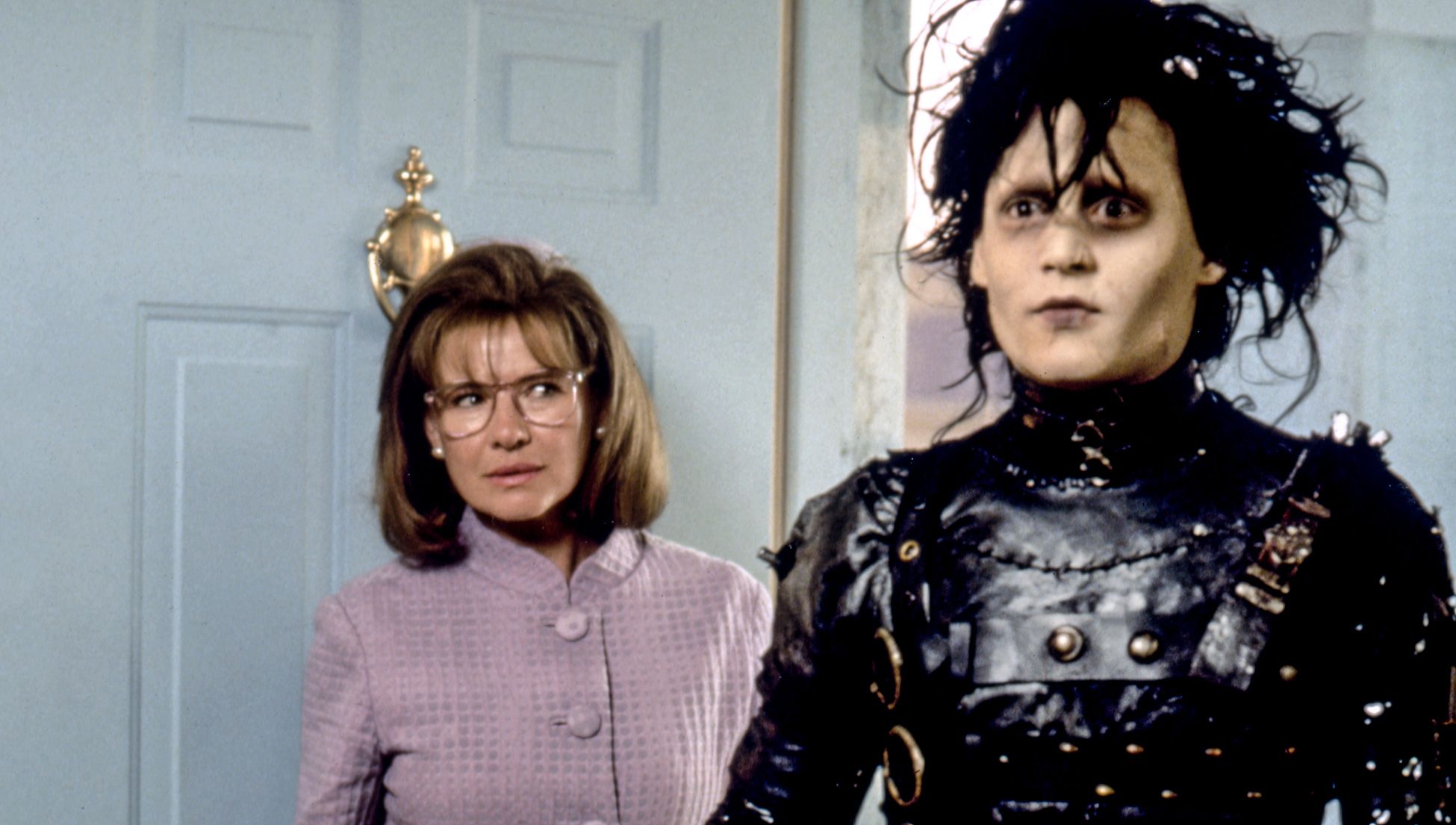
Reflecting on her long-standing love of Edward Scissorhands (1990) amid allegations of domestic violence against its lead actor Johnny Depp, the culture critic Constance Grady wrote in 2019:
I loved this movie. It made me feel all kinds of deep and profound teenage feelings, and those feelings were real and I could not unfeel them. But now, whenever I thought about Johnny Depp, I felt a deep and profound disgust, a moral outrage. That was a real feeling too, and I couldn’t unfeel it either.
There are a range of moral questions surrounding how we should respond to the immoral acts of artists whose work we love. But, for art lovers, a central aspect of revelations about artists’ behaviour is how it makes us feel. Maybe you were raised on the music of Michael Jackson or the novels of Marion Zimmer Bradley, but you’re disturbed by the child-abuse allegations against them; maybe you love Kevin Spacey movies, but find them hard to stomach since you’ve read about his alleged predatory behaviour. In such cases, we’re left with the wrenching discomfort of our heartstrings being pulled in multiple directions.
How do we relieve that emotional torque? We could abandon it all, art and artist. Indeed, some strands of ‘cancel culture’ seem to endorse completely rejecting the artist and their work as a moral imperative. But that doesn’t feel like a way of really reckoning with the injustice and what it means to us as people who love art. Alternatively, we could try to rend apart the art and the artist, as if they’re not parts of a whole. This is what the film critic Wesley Morris described in The New York Times in 2017 as the ‘impossible moral surgery that hopes to cut off the artist to save the art’. But as Morris’s choice of the word ‘impossible’ implies, this approach is challenging to maintain. Trying to artificially separate our positive and negative feelings about a work of art and its creator, perhaps by suppressing one or the other at any given time, doesn’t relax the tension – it simply leaves us of two minds (or two hearts). It’s as if you had two children who weren’t getting along, and so you aimed to keep them from ever being in the same room. Not exactly a tenable solution.
Perhaps we shouldn’t aim to separate the art from the artist, but instead forge a way forward that takes seriously the entanglements between them – eschewing the pitfalls of impossible surgery, and allowing the possibility of a stable, if uncomfortable, emotional equipoise.
The immorality of an artist is a burden, something that must be borne by us if we’re to retain a connection with the art
Philosophy sometimes begins with a way of looking at things, a perspective, rather than an argument. You might think of this as a different vantage point that reveals the best site on which to build, or a lens that allows you to see elements of the world that are otherwise indiscernible. One such perspective is found in an aphorism by the Stoic philosopher Epictetus. It has always stuck with me, perhaps because it is as odd as it is illuminating. He wrote:
Everything has two handles, the one by which it may be carried, the other by which it cannot. If your brother acts unjustly, don’t lay hold on the action by the handle of his injustice, for by that it cannot be carried; but by the opposite, that he is your brother, that he was brought up with you; and thus you will lay hold on it, as it is to be carried.
There’s so much to unpack in this weird metaphor. The brother who acts unjustly is another example involving conflicting emotions – love for a family member, contempt for their immoral action. The idea that this is a situation we must reckon with and move forward from is evoked by the metaphor that it is a thing that must be carried with us. But we can’t carry it in just any way! To focus on the injustice (or to carry the action by that handle) is untenable. Epictetus doesn’t say why, but an answer is apparent in the cases of immoral artists. You can’t approach watching the US sitcom The Cosby Show (1984-92) by foregrounding Bill Cosby’s immoral off-screen acts and thinking about this TV series primarily as cover for a sexual predator. There doesn’t seem to be any viable way forward there. To echo the writer Roxane Gay – who argues for abandoning Cosby’s legacy in her article ‘Can I Enjoy the Art but Denounce the Artist?’ (2018) – his actions seem to destroy the work.
But there’s a different way to carry it. In the instance of the brother who acts unjustly, Epictetus emphasises your emotional connection with him, your history together, and contends that this is the way to grapple with his unjust act. This doesn’t mean ignoring the injustice or leaving it behind. Rather, as I interpret it, the point concerns the attitude that we take toward an injustice. The immorality of an artist is a burden, something that must be borne by us if we’re to retain a connection with the art. By foregrounding our emotional connection with an artist’s work, its personal meaning to us, we offer ourselves a handle by which to carry that burden.
With this approach in mind – focusing on the art and our love of it, while keeping the artist’s immoral actions in view – what might it mean to successfully integrate our conflicting feelings about the art and the artist?
We can find some helpful frameworks in discussions of the seemingly paradoxical conflict of emotions that attends certain kinds of artwork, such as tragedy and horror. How can we enjoy art that saddens or terrifies us? On one account of the paradox of horror, we experience two competing emotions, such as thrill and terror, and the terror, while unpleasant, is simply the price we pay for the thrill. So, perhaps anger or disgust at an artist can be seen as the price one pays to continue enjoying the art, and that’s a sacrifice we might be willing to make if we love the art enough. (Note that this is nothing like the claim that the artist’s immorality is a price worth paying for their art to exist – we’re talking only about our emotions here, not the artist’s actions.)
However we end up balancing the flavours of this emotional stew, the art itself is an indispensable tool
It’s common enough to experience an emotional integration that is not perfectly harmonious. For example, moving to a new place can feel bittersweet: the excitement of a fresh start mingled with the sadness of leaving friends behind. What makes bittersweet qualify as an integrated emotional experience is that the conflicting feelings interact with each other rather than being artificially bifurcated as they are when we suppress one of two opposed emotions.
According to another way of thinking about the paradoxes of horror and tragedy, our feelings aren’t simply weighed against each other but instead actively inform and enhance one another. The pleasure you take in seeing a performance of Romeo and Juliet doesn’t simply outweigh the sorrow of the tragedy, but rather is shaped and developed by it – the ‘strange kind of sadness’ that the philosopher Marcia May Eaton explored in 1982. Perhaps there are some cases in which our negative feelings about an artist can deepen our response to their work, if not in an enjoyable way (nor in a way that would justify their misdeeds).
Views such as these offer models for how our feelings about immoral artists and their work might be integrated in different ways. But however we end up balancing the flavours of this emotional stew, the art itself is an indispensable tool.
Consider Aristotle’s account of the paradox of tragedy. For Aristotle, tragedy offers the opportunity for catharsis, an idea that is subject to multiple interpretations. On one view, catharsis involves the expunging of your emotions – you watch a horror movie and it allows you to release your pent-up fears. On another view, catharsis is about clarifying your emotions. Reading a tragedy offers the opportunity to home in on the source and nature of your own feelings of sadness. Of course, people don’t watch Woody Allen movies and find that they’ve been able to expunge their negative feelings about him. The idea of catharsis as clarifying, however, can provide a useful lens.
I have a lot of affection for Allen’s film Love and Death (1975). When I was younger, I thought the movie’s sensibility (bookish, silly, philosophical, weird) said something about me, represented my taste. Since then, I have found that loving the work of an immoral artist doesn’t need to result only in feelings of betrayal: it can also offer an agent for crystalising my complicated feelings about someone who made art that I love but whose personal behaviour disturbs me.
This doesn’t mean I still want to name Love and Death as my favourite movie, as I did when I was in college. I don’t want Woody Allen to represent me any more
At the end of Love and Death, Allen’s character is (spoiler alert) executed, and he delivers a monologue from beyond the grave before the credits roll and he dances off through the mournful landscape, accompanied by a scythe-wielding Death. During the monologue, he says:
The important thing, I think, is not to be bitter. You know, if it turns out that there is a God, I don’t think that he’s evil. I think that the worst you can say about him is that, basically, he’s an underachiever.
I can see how someone like Allen could write those lines, with their blasé attitude toward morality and responsibility, while still accepting that they can be funny, perhaps even apt.
In the abstract, when we’re not directly engaging with a work of art, it’s easier to conflate the artist and the artwork and to allow our conflicting feelings to become a confused muddle. It’s easier to assume that there’s little hope of recovering my affection for Allen’s film given my negative attitudes towards him. But, in engaging with the work, I find that the focuses of my various emotions are clarified. I discover that the art isn’t equivalent to the artist, even though they are intertwined. I anticipate my favourite scenes and, sure enough, they’re still funny, even keeping Allen’s actions in view. This doesn’t mean I still want to name Love and Death as my favourite movie, as I did when I was in college. I don’t want him to represent me any more, and I haven’t seen a new movie of his in a decade. Nevertheless, I find that turning toward the artwork that I already love, rather than spurning it, is cathartic in the clarifying sense – I emerge on the other end with my feelings of affection (for qualities of the film) and disdain (for the filmmaker) both just as present, but also balanced, more clearly focused.
Of course, returning to a treasured work of art might clarify your feelings by indicating that there’s nothing left to love about the work. You might, in the end, see only loathing for the artist and nostalgia for a work that once inspired but now repulses you. The idea of catharsis that I have invoked doesn’t prescribe any particular conclusion. But there’s nothing easy or obvious about how to work through these complex emotions. It’s a process of discovery. And that shouldn’t be surprising: neither art nor our emotions are well known for being transparent.
Adapted with permission from the book ‘Drawing the Line: What to Do with the Work of Immoral Artists from Museums to the Movies’ (2022) by Erich Hatala Matthes (Oxford University Press).


 CPH” logo and messaging about how cycling could cut congestion and pollution and help improve quality of life.