Monday, April 27, 2020

small galleries will come out alive


    This Is the Toughest Challenge My Business Has Ever Faced. But Here’s Why Small Galleries Like Mine Will Come Out Alive

    The co-founder of Postmasters Gallery explains why the current crisis might bring about a much-needed revolution in the art market.
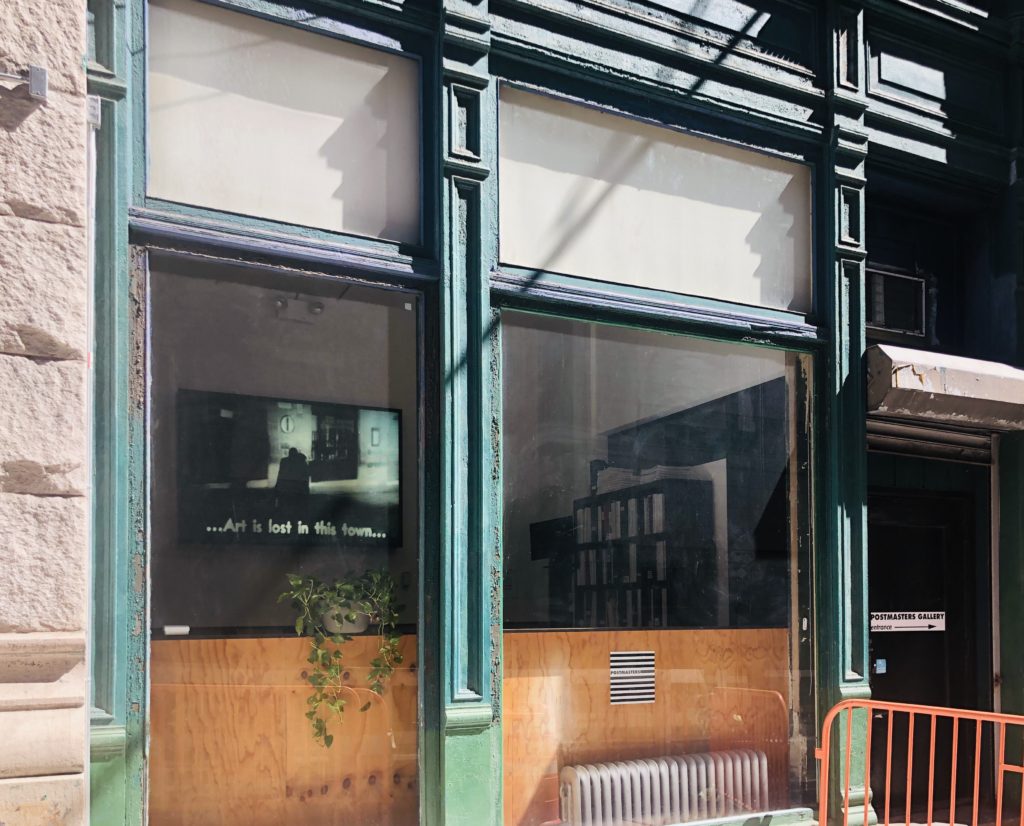
    Postmasters Gallery in Tribeca. Photo courtesy of Magda Sawon.
    We Poles are optimistic fatalists.
    My gallery, Postmasters, opened in New York on a murky Saturday night on December 13, 1984—the anniversary of the post-Solidarity imposition of martial law in Poland, no less. In the gallery’s 35 years, my partner Tamás Banovich and I have weathered many storms and upheavals. We moved four times as gentrification pushed us back and forth across the city (from the East Village to Soho to Chelsea and, in 2013, to Tribeca). We survived the savings and loans crisis of the late ‘80s; 9/11; the Great Recession; Hurricane Sandy; and various smaller setbacks along the way. The global pandemic and subsequent economic collapse are, by far, the toughest challenges we’ve faced.  
    But I have hope for galleries like ours. In fact, I see a path forward from our current, painfully deficient online existence to one in which IRL galleries—and, specifically, small-to-midsize galleries—become vital again. 
    There will be a revolution. Art fairs will be dead for a long long time, maybe forever. Gallery culture will be redefined. Survival will be based on innovation, adaptation, flexibility… and smallness. At the moment, oversized, shiny vessels control the spotlight. They have the resources and the PR apparatus. But in the end, it is little sailing boats that can best navigate choppy waters.
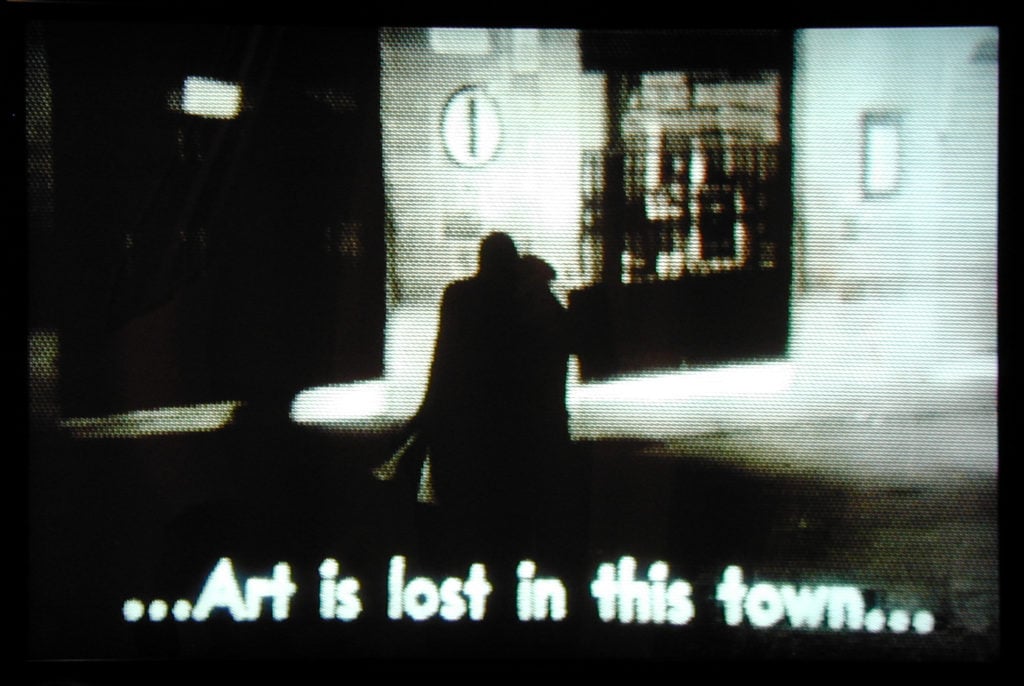
    Wolfgang Staehle, Art Is Lost in This Town (1989). Photo courtesy of Postmasters Gallery.
    Let me explain.
    The art ecosystem as we know it has not been a healthy, diverse place for a long time. Even before COVID-19, we had a bloated, predatorial, and over-industrialized art complex, rife with speculative collecting, surreal pricing, and risk-averse dealers with ears bigger than their eyes and brains trained to prize profit above all. 
    As the collector Alain Servais has tracked with his Twitter hashtag #GroworGo since 2012, there has been a systematic erosion of the lower levels of the art ecosystem, with many of the most vital, progressive galleries unable to stay in the race. This dynamic of destructive consolidation has been seen in other fields, too, but perhaps no more than in the contemporary art market. 
    The current virus may well be the equivalent of the asteroid that killed the dinosaurs. Because sometimes, the system has to be destroyed in order to be liberated—and to make room for evolution.

    The Opposite of “Size Matters”

    The health and vitality of art is exclusively dependent on the bottom of the food chain. It relies first and foremost on the artists, who reflect on the world and the time we live in, and secondarily, on institutions, organizations, and galleries that have the passion and foresight to support them. 
    Tamás and I came to the US by choice as adults, and became Americans. But we never developed that acutely American “entrepreneurial gene,” instead searching for challenging and relevant art that the market has not yet swallowed whole. We look for new forms of creative expression that do not yet have the benefit—or the burden—of years, decades, or centuries of history behind them. We never wanted to anticipate where the market was headed. Rather, we aspired to challenge the market and, perhaps, to teach it. We like selling things and have, over the years, sold some rather impossible art, like websites by Rafaël Rozendaal and art literally stolen from others by Eva and Franco Mattes.

    The author in a mask. Photo courtesy of Magda Sawon.
    It has been a hard road that has been made possible by having a lean but muscular operation. We are a big small gallery or small big gallery (I forget which). Our core team is three people in New York and one in Rome. And I believe this type of efficient model is best equipped to emerge post-pandemic.
    Here is the opposite side of the “size matters” argument: 
    Tamás used to sail competitively when growing up in Hungary. He sailed Finn dinghy, the smallest Olympic-class boat with a huge sail-to-hull ratio. One-man boats, Finns are beautiful: refined, deceptively simple, and extremely sensitive to wind and waves. Both sailor and boat must constantly adjust to changing conditions on the water. They are unforgiving and capsize easily, but can also recover fast. When compared to, say, cruise ships, the gas-guzzling floating entertainment centers with an obscene crew-to-passenger ratio, guess which vessel can maneuver and adapt better? 
    Back to the galleries.

    Only the Small Survive 

    Better people have written beautifully about the need for art to be seen in real spaces to deliver a full spectrum of contemplative experience. But not all of these spaces will recover equally. 
    Galleries—which are by definition local, low-density environments—will be allowed to open their doors first. And people starving for non-virtual encounters will come. As theaters and other performing-art spaces have to reconsider their very structures to serve audiences safely, galleries will be able to reopen without too much change. (This is already happening in Shanghai, Berlin, and Vienna.) 
    Museums will follow. The logistics of re-opening them are far more complex, but manageable (as excellently laid out by András Szántó).
    By requiring restrictions on travel and crowds, this pandemic has devastated the event industry. No sports games, no concerts, no Oktoberfest, and… no art fairs. As a result of the one-stop-shopping vacuum, collectors will inevitably visit galleries more. Of course, in an economy where most galleries have generated almost half their revenue from art fairs, there will be attrition as a vast segment of buy-to-sell collectors disappears. 
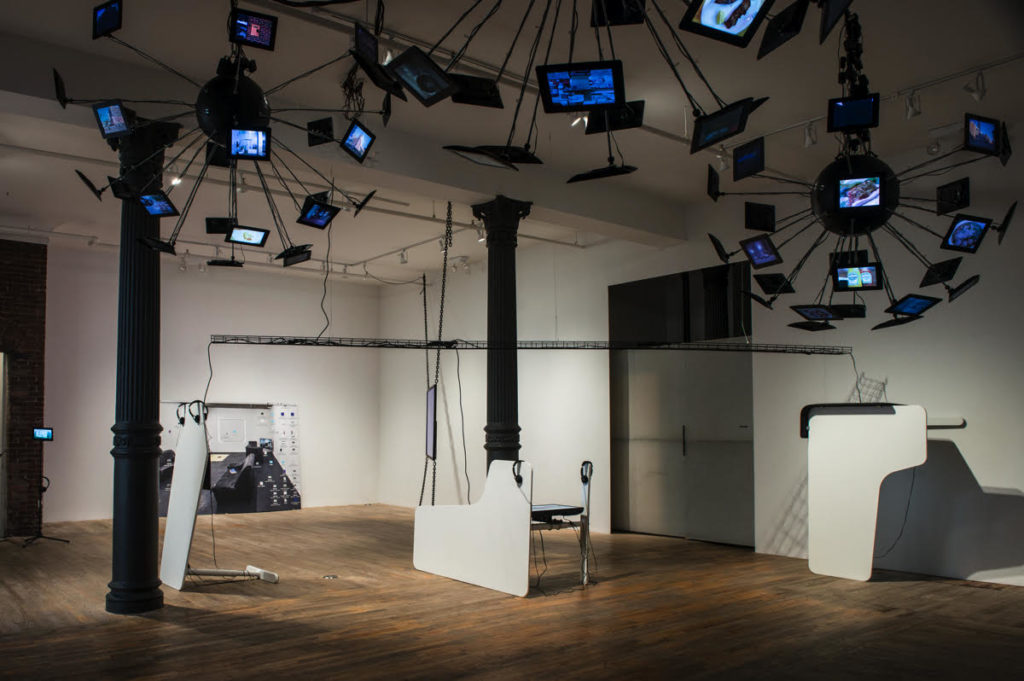
    Installation view of “saved by the web” (May/June 2017) at Postmasters, a three person show of Eva and Franco Mattes, Hasan Elahi and Lin Ke. Image courtesy of Postmasters Gallery.
    But I prefer to bet on the curiosity, vision, and connoisseurship of the collectors who stay in the game, and the new ones that will come along. The new paradigm—which will force people to engage intimately with art in a gallery setting—will favor them and the galleries that serve them. Artnet News columnist Tim Schneider has posed the theory that true collectors will return in force because they simply can’t help it. To keep the naval metaphors going, I am on board with this. True collectors are junkies in search of cultural value rather than a liquid asset. They will always look for new voices, not just the branded and easily consumable ones. 
    Perhaps, in the “new normal,” collectors will become more connected to their local scenes, Perhaps a shared experience of the world collapsing violently around us will favor content, which is good news for art that requires attention and the galleries that support it.
    Even before we return to our physical galleries, the online migration of the past few months has shone a light on net and screen-based art (the only art, by the way, that is actually meant to be viewed online) and the (small and midsize) galleries like ours that have supported it. An incredible trove of historic and new material is out there, ready to take the spotlight, and ready to be collected—no shipping involved. We have championed media art (beginning with now historic “Can You Digit?” show in 1996) and used online platforms for documentation, dissemination, and sales for many years, which puts us at an advantage among galleries that have focused only on brick and mortar until now.

    What’s Next

    Just like in the world at large, the virus has exposed the gaps in wealth, connections, and access that already existed in the art market. We need more radical initiatives to save our industry, and to save art. Except for the newly announced and promising Platform LA and David Zwirner’s generous gestures (hosting selected young galleries online and, before the pandemic, hosting the displaced Volta), there is minimal cross-pollination in the gallery ecosystem. Top just takes from the bottom. Gives nothing. 
    Collaboration takes place among peers only, with small galleries banding together to share resources (Condo, NADA) and mega-galleries banding together to optimize business (see: Pagavella’s management of the Marron Collection). 
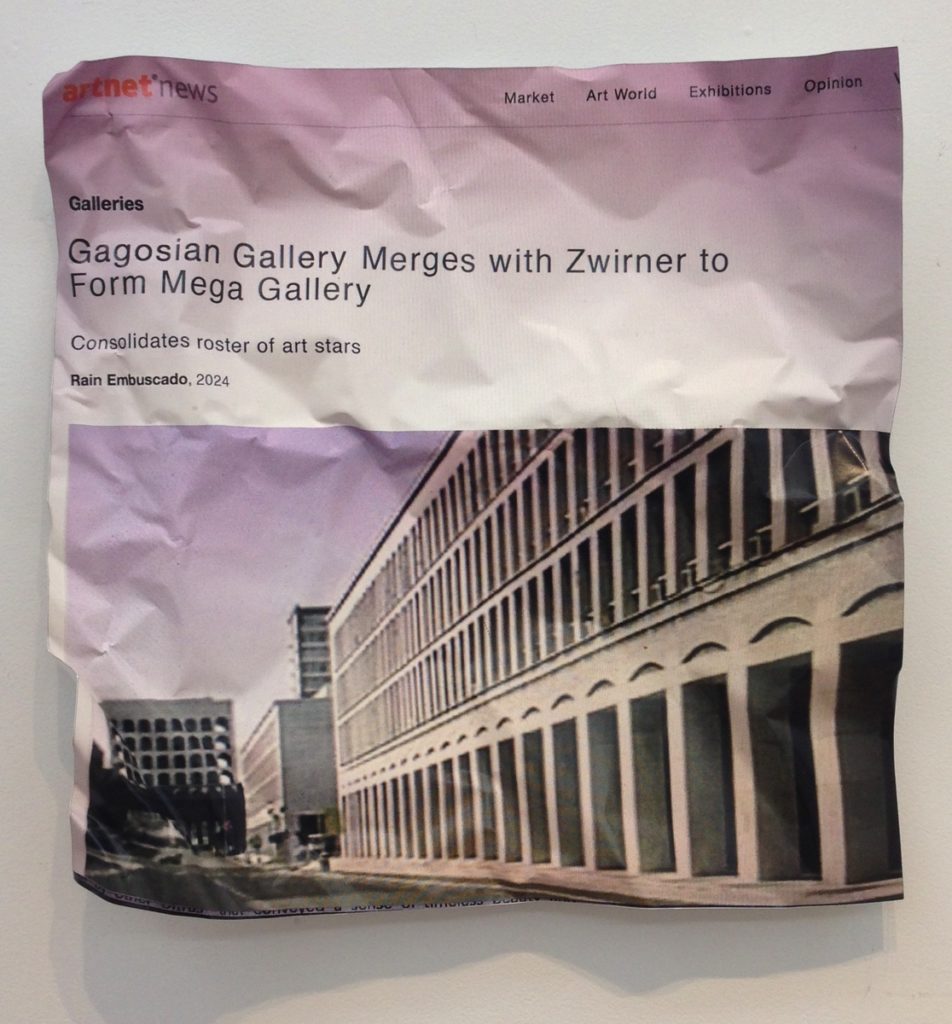
    William Powhida’s Didactics (Gagosian and Zwirner) (2017). Courtesy of the artist and Postmasters Gallery.
    But revolutions and change never come from the top. What we need is new, progressive ideas for both galleries and artists working separately and together rather than trying to plug the hole in a sinking ship. William Powhida, an artist we represent, recently came up with “Store-to-Own,” a novel way to distribute his work and get it out of storage. He offered select artworks to people to live with for free; they could purchase it at an increasing discount over the years or sell it and share the profit. It proved very successful. This kind of initiative offers no direct benefit to galleries—but it opens up a system that is in dire need of reinvention. 
    In the famous words of the infamous Donald Rumsfeld, “You go to the war with the army you have.” The post-Covid art world will be physically local and virtually global as the regional scenes (a domain of smaller galleries) gain relevance while “long-distance” art business continues and grows online. 
    Art is needed, and art will rise. To paraphrase Dylan: “Come gather Finn Dinghies wherever you roam…”
    All this may be naive and delusional. Along with many others, I may not be here in a few months, bankrupted and unable to continue. But this is the time. You know the David vs Goliath story. And you know how it ends. Take care, everybody. 

    Magda Sawon is the co-founder of Postmasters Gallery. 

    Follow artnet News on Facebook:

    Want to stay ahead of the art world? Subscribe to our newsletter to get the breaking news, eye-opening interviews, and incisive critical takes that drive the conversation forward.

    artnet news
    It looks like you're using an ad blocker, which may make our news articles disappear from your browser.
    artnet News relies on advertising revenue, so please disable your ad blocker or whitelist our site.
    To do so, simply click the Ad Block icon, usually located on the upper-right corner of your browser. Follow the prompts from there.
    SHARE

    Chef Gabrielle's reassessment


      The Gray Market: Why Chef Gabrielle Hamilton’s Reckoning Offers an Important Example for Gallery Owners (and Other Insights)

      Our columnist examines the parallels and possibilities in Gabrielle Hamilton's radical reassessment of her restaurant, Prune.
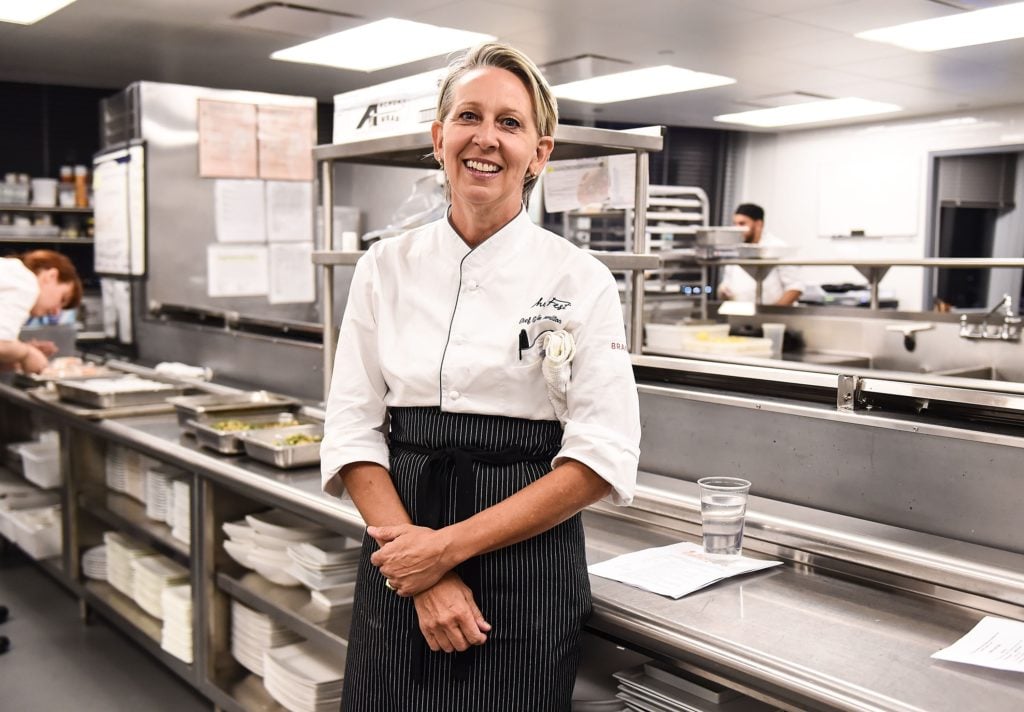
      Gabrielle Hamilton, chef and founder of East Village bistro Prune, behind the scenes at a 2017 event. (Photo by Daniel Zuchnik/Getty Images for NYCWFF)
      Gabrielle Hamilton, chef and founder of East Village bistro Prune, behind the scenes at a 2017 event. (Photo by Daniel Zuchnik/Getty Images for NYCWFF)
      Every Monday morning, Artnet News brings you The Gray Market. The column decodes important stories from the previous week—and offers unparalleled insight into the inner workings of the art industry in the process.
      This week, slicing down to the essentials, even when it hurts…

      TABLE FOR TWO

      On Thursday, the New York Times Magazine published a poignant—and pointed—essay by Gabrielle Hamilton, chef and founder of the New York bistro Prune, titled “My Restaurant Was My Life for 20 Years. Does the World Need It Anymore?” Her thoughts on her place in the food scene after the shutdown contain a jarring amount of crossover with the existential crisis now facing many gallery owners. And her conclusions stand as a bracing reminder that succeeding, not just surviving, on the other side of this mess may demand questioning everything about why, and how, we all do what we do. 
      In Hamilton’s mind, Prune has now reached an inflection point familiar to many dealers whose spaces debuted nearer to Y2K than the onset of the social-distancing era. She describes opening her restaurant in the East Village in October 1999, years before the foodie scene as we know it today existed (even in New York), because she was “driven by the sensory, the human, the poetic and the profane—not by money or a thirst to expand.” 
      And yet, expand she did. First, Hamilton almost impulsively actualized what she labeled the “dreamy proposition” of adding weekend brunch. The meal’s runaway success generated enough capital for her to buy out her investors roughly nine years after launching Prune. She contrasts that choice with the more calculated one she made a few years later to start serving lunch on weekdays primarily so she could offer her staff health insurance. While the latter move may have been partly (even largely) altruistic, it’s also entrepreneurially sensible: good businesses understand the value of continuity, meaning they do what they can to keep good employees in place if the math works.
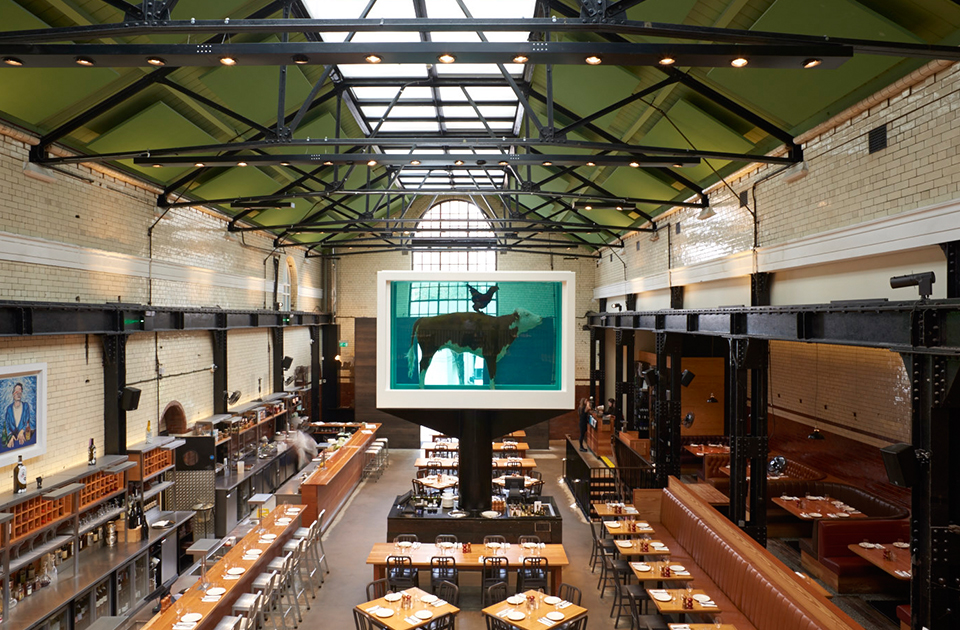
      Damien Hirst's Cock and Bull (2012) in Hix's 'Tramshed' restaurant. Photo: Hix Restaurants
      Damien Hirst’s Cock and Bull (2012) in Hix’s ‘Tramshed’ restaurant. Photo: Hix Restaurants.
      However, the feel-good success of Prune’s first decade dissipated during its second, and the story its founder tells locks into eerie alignment with the farewell announcements and op-eds we’ve seen from a wave of small and modestly sized art dealers since the 2008 recession. Here’s Hamilton:
      But Prune at 20 is a different and reduced quantity, now that there are no more services to add and costs keep going up. It just barely banks about exactly what it needs each week to cover its expenses. I’ve joked for years that I’m in the nonprofit sector, but that has been more direly true for several years now.
      She goes on to recount a moment of clarity that arrived last summer: lying face down on Prune’s floor in coveralls soaked through with food waste, at age 53, using a garden hose to blast a mixture of bleach, dish soap, and degreaser behind the sauté station. Her margins had gotten too parchment-thin to allow her to outsource such a thankless cleaning job, let alone shutter the restaurant for 10 days to do more thorough repairs, as she used to do every July. Prune simply needed every single day’s cash too desperately to slow down or subcontract. 
      Many, if not most, owners of modest galleries have undoubtedly experienced similar come-to-Jesus moments in the years leading up to the shutdown: exhibiting at yet another art fair that they couldn’t afford to do, but felt they could afford to miss even less; undertaking a precarious install or a punishing art move alone because the budget is somehow even tighter than it used to be; feeling pressure to close a deal with a client or intermediary they don’t trust purely because turning down any transaction, no matter how suspect, might mean the end of the line.
      Even the most profitable businesses continually face tough choices and narrow margins for error—narrower than outsiders tend to realize. But when the hardships increase the longer you endure, any striver in any industry arrives at the same dilemma Hamilton did in those grimy coveralls: “It had always been hard, but when did it get this hard?”
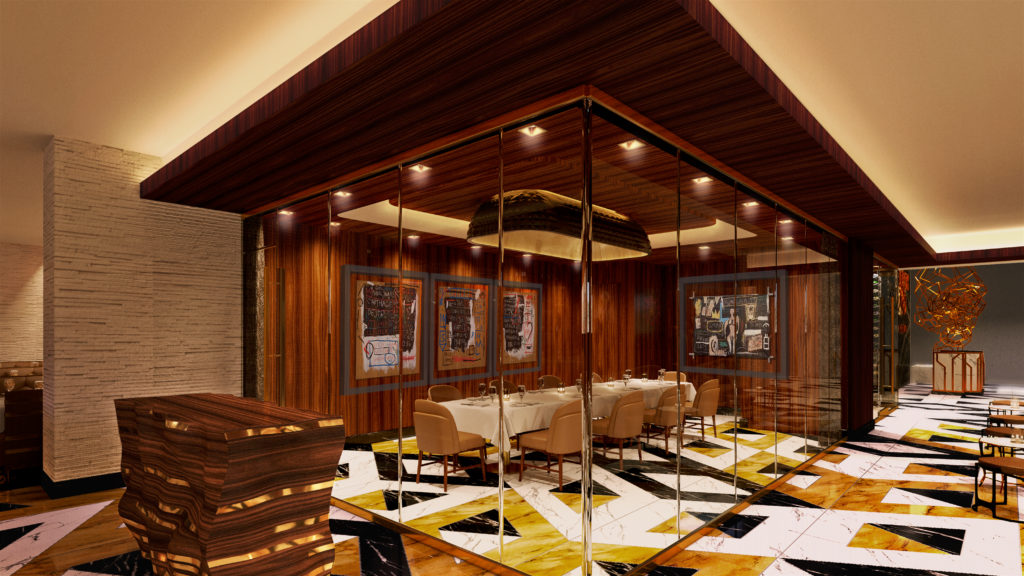
      Works by Jean-Michel Basquiat at the Scotch 80 Prime steak restaurant. Photo: Courtesy of the Palms Hotel and Casino.

      RESERVATIONS AND REIMAGININGS

      Since the “grow or go” dynamic has been rigorously analyzed inside and outside the art market for years, I’m not interested in dredging the past for a literal answer to Hamilton’s question here. Instead, like her, I’m more concerned with what comes next in our respective industries. 
      Given the increasingly unforgiving circumstances of the food-and-beverage space, Hamilton goes on to question whether concerned observers will even be able to tell how many eateries lost during the lockdown met their fate because of the lockdown. Even without a mass stay-at-home order, she argues, a substantial number would have gone under within 16 months from “lack of wherewithal or experience.” Current events will also provide cloud cover for any “weary veteran chef” who finally decides to “quietly walk out the open back door of a building that has been burning for a long time” due to a brutal real-estate market, an ever-growing stampede of competitors, and so much more. 
      The extraordinary circumstances will obscure outcomes in the gallery sector in the same way. And as she describes in her own case, those who bow out may be just as motivated by a sense of placelessness and inferiority as by hard costs and sacrifices: 
      In economic terms, I don’t think I could even argue that Prune matters anymore, in a neighborhood and a city now fully saturated with restaurants much like mine, many of them better than mine—some of which have expanded to employ as many as 100 people, not just cooks and servers and bartenders but also human-resource directors and cookbook ghostwriters.
      Of course, from hundreds-strong staff sizes to a cadre of specialists who would have seemed unthinkable two decades earlier (think: directors of special (publishing) projects and social-media managers), these specifics are a fact of life in the dealer sector, too. And while I’d argue that growth is not inherently bad—every gallery run well enough to move out of a shoebox is as much a testament to this notion as Prune’s first decade was—they can quickly become unsustainable when larger market forces turn expansion into a nonstop necessity.
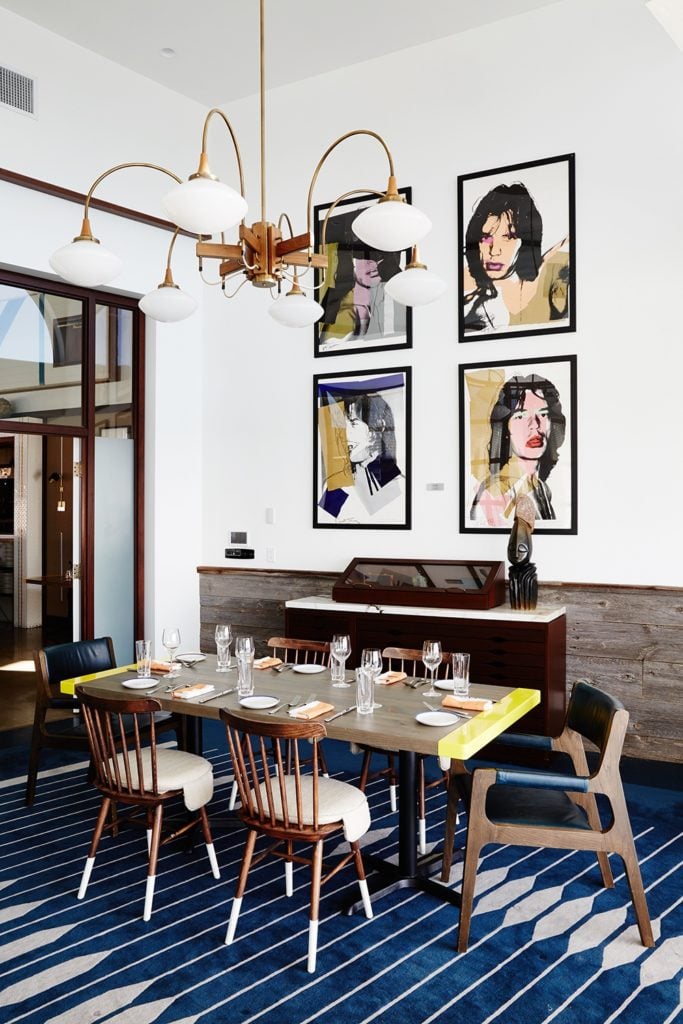
      Four of Andy Warhol's Mick Jagger screen prints inside the restuarant at Bermuda's Hamilton Princess Hotel & Beach Club. Photo by Nicole Franzen. Courtesy the Hamilton Princess Hotel & Beach Club.
      Four of Andy Warhol’s Mick Jagger screen prints inside the restaurant at Bermuda’s Hamilton Princess Hotel & Beach Club. Photo by Nicole Franzen. Courtesy the Hamilton Princess Hotel & Beach Club.
      Not every aspect of Hamilton’s narrative, or the restaurant business in general, maps onto the art world. The early backing of a consortium of investors, commercial success based on volume service, the physiological reality that people need food in a way they don’t need art—all of these, and more, separate the two industries in undeniable ways. 
      Yet the business of small restaurants doesn’t need to be identical to the business of small galleries in order to be instructive. Hamilton’s passion and economic circumstances will resonate with almost anyone striving for a career in the arts. And that’s why the perspective she reaches at the end of the piece should be, too. 
      Weeks of reckoning with Prune’s history during the shutdown have led Hamilton to begin envisioning a dramatically different future for her restaurant—one born out of equal parts romanticism and realism. She describes her cravings to parachute out of the weekend-brunch-industrial complex she unwittingly helped build; to exchange every minuscule two-top table for a more communal setup; to rearrange opening hours and reconstitute her business to recapture the sense of connection with regulars and food that drove Prune’s founding back in 1999. 
      In short, she’s ready to shred the entire pre-crisis blueprint for what a New York restaurant should be—and as a result, to confront the prospect that there may no longer be a place for Prune in the third decade of the 21st century. If there is, though, she’s fully embraced that it will come from radical transformation.
      I think every independent gallery owner now has to confront these same prospects, too. Whether by choice or against their will, not every one of them will return. But when the world reopens, those with the best chance of finding their footing and rhythm again will be those who were willing to re-evaluate every aspect of the way things are done. And as Hamilton proves, that metamorphosis has to start now.  

      That’s all for this week. ‘Til next time, remember: sometimes it takes the prospect of losing everything to feel like you’re free to do anything.

      Follow artnet News on Facebook:

      Want to stay ahead of the art world? Subscribe to our newsletter to get the breaking news, eye-opening interviews, and incisive critical takes that drive the conversation forward.
      artnet news
      It looks like you're using an ad blocker, which may make our news articles disappear from your browser.
      artnet News relies on advertising revenue, so please disable your ad blocker or whitelist our site.
      To do so, simply click the Ad Block icon, usually located on the upper-right corner of your browser. Follow the prompts from there.
      SHARE

      Modernism’s principles


      Form follows function: Modernism’s guiding principles 31.03.20

       Villa Savoye by Le Corbusier 2The Villa Savoye by Le Corbusier is one of the most recognisable example of a modernist house

      In the first half of the twentieth century, changes in technology and society led to the birth of a vision of an urban utopia that could be achieved through modernist design.

      Although its origins can be traced to the late nineteenth century, modernism began in earnest in the early 1920s. In Germany the term modernism was synonymous with the Bauhaus, perhaps the most famous design school to have ever existed. Signifcant figures in the Bauhaus, including founder Walter Gropious and its final director Mies van der Rohe, became major modernist architects.
      Although many modernist buildingsd date from the interwar period, the movement gained global popularity after the Second World War. The industrial demands of the war had left shortages of building materials like steel. Architects began to move away from traditional styles and embrace plate glass, cast iron and reinforced concretes to enable taller buildings with lighter structures. 
      Seagram Building by Mies van der Rohe in New YorkSeagram Building by Mies van der Rohe in New York
      Many buildings needed reconstruction after the war. Modernism aimed to address the failures of traditional architecture when it came to solving the basic social needs of populations. It became the dominant style after World War II for institutional and corporate buildings, such as educational facilities and urban housing.
      During the twentieth century it was also more possible than ever for a movement and its theories to spread quickly: architects were able to travel easily, collaborate internationally and discuss ideas and philosophy at a global scale. 
      The Barcelona Pavilion by Mies van der RoheThe Barcelona Pavilion by Mies van der Rohe
      Modernist architecture has two chief guiding principles: form follows function and truth to materials. Functionalism, a term coined by American architect Louis Sullivan, stated that the building’s purpose was paramount to the design, and took precedence over beauty. Truth to materials was a principle that indicated that materials that best served the building should be used where needed and not disguised: timber was left unpolished, concrete exposed and unpainted. 
      There are several other recognisable characteristics to modernist design. Modernist buildings rejected elaborate trimmings and decorative holdings, leaning towards buildings that were clean and simple. Modern materials, such as exposed concrete, steel columns and raw timber were used with an emphasis on the natural expression of the material. 
      Houses were shaped in cubic and cylindrical shapes, with an emphasis on horizontal and vertical lines. Definite planes and solid boxes created a multitude of 90 degree angles. Roofs were predominantly flat and large windows in horizontal lines were often incorporated in the design. 
      New York's Guggenheim Museum by Frank Lloyd WrightNew York's Guggenheim Museum by Frank Lloyd Wright
      Interior spaces were often designed using open floor plans so that living spaces and kitchens flowed into one another, and huge amounts of glass ensured that the outdoors were highly visible for the inside of the houses. This also allowed large amounts of natural light inside, while the comfort of the occupants and internal temperature was enhanced with the use of sun and shade.  
      Amongst the most famous modernist buildings are the Guggenheim Museum in New York and Fallingwater House by Frank Lloyd Wright, Le Corbusier’s Villa Savoye and Mies van der Rohe’s Barcelona Pavilion. These buildings exemplify modernisms theories with their geometric, simple forms. 
      Fallingwater House by Frank Lloyd WrightFallingwater House by American architect Frank Lloyd Wright
      In the 1970s, modernist architecture was declared dead and many modernist buildings were demolished. Its supposedly timeless icons were seen as outdated. Dead or alive, the legacy of modernism is evident in the buildings of today and the furniture that fills them. Open-plan living, built in kitchens and the origins of loft living are all part of today’s inheritance from the modernist godfathers. 

      Related