Monday, December 24, 2018

How Art Helps Makes Sense of...


How Art Helps Makes Sense of Donald Glover’s ‘This Is America’ Video & More Critical Thoughts on Culture

Plus, Tony Cokes turns tweets into art, and one very eerie paparazzi pic.

Childish Gambino in the video for
Childish Gambino in the video for "This Is America." Photo courtesy RCA Records.
This week, I’m trying something different, taking a kind of cross-section of culture, looking at art in the galleries and as it pops up in wider media world. 

The Evolution of “America”

Childish Gambino/Donald Glover’s disconcerting and virtuosic “This Is America” video has sent the internet into a delirium of interpretation. Its YouTube view count stands, a week and change after release, north of 135 million. Thinking about the clip and reading the reactions, what strikes me about it is how much its densely packed enigmas both assume a climate of interpretation and withdraw from it.
Part of what is brilliant about Hiro Murai’s direction, with its whiplash tonal shifts and spellbinding long takes, is how much it manages to produce tableaux that feel urgently symbolic but deliberately can’t be reduced to a snap reading. It’s not a coincidence that Glover has simply demurred from explaining himself, saying, “I’ll just let it be.”
Thus, the cartoonishly extreme violence references murderous police and vigilante killings inflicted on black people—that’s clear enough—but it is Glover himself who is perpetrating it as an active agent. The dancing (choreographed by Sherrie Silver) invokes minstrelsy, but switches from its caricatured exaggerations to faithful riffs on a huge variety of contemporary black dance styles, including South Africa’s Gwara Gwara.
Does the horse and hooded rider shooting through the background evoke the Klan, or an escaped slave fleeing, or something more apocalyptic, “Death on a Pale Horse?
Are the kids in the balcony with their phones documenting the violence below as activists, or consuming it as passive spectators locked into their screens?
The video ends with Glover fleeing a shadowy stampede of figures—but they are ambiguous and could represent the nightmare hordes of US racism or the frenzy of mindless fans out to consume him, a hybrid of A Hard Days Night and Get Out.
The clip’s conscious channelling of Jim Crow imagery combined with the “Looney Tunes logic” (as Murai puts it) of its violence make me think of Kara Walker‘s controversial cartoon cut-out fantasias of terrorizing racist imagery. These have historically provoked the same kind criticism that “This Is America” has caught, here and there, for not being clear enough about where it stands and for trivializing real atrocities.
But the artworks that most say something to me about the video are Glenn Ligon’s black-painted neons of the word AMERICA, one of which hangs currently in the lobby of the Whitney Museum. Indeed, “Glenn Ligon: America” was the name of his Whitney career retrospective a few years ago—though it’s more than just the word on its own that connects the dots between his work and “This Is America.”
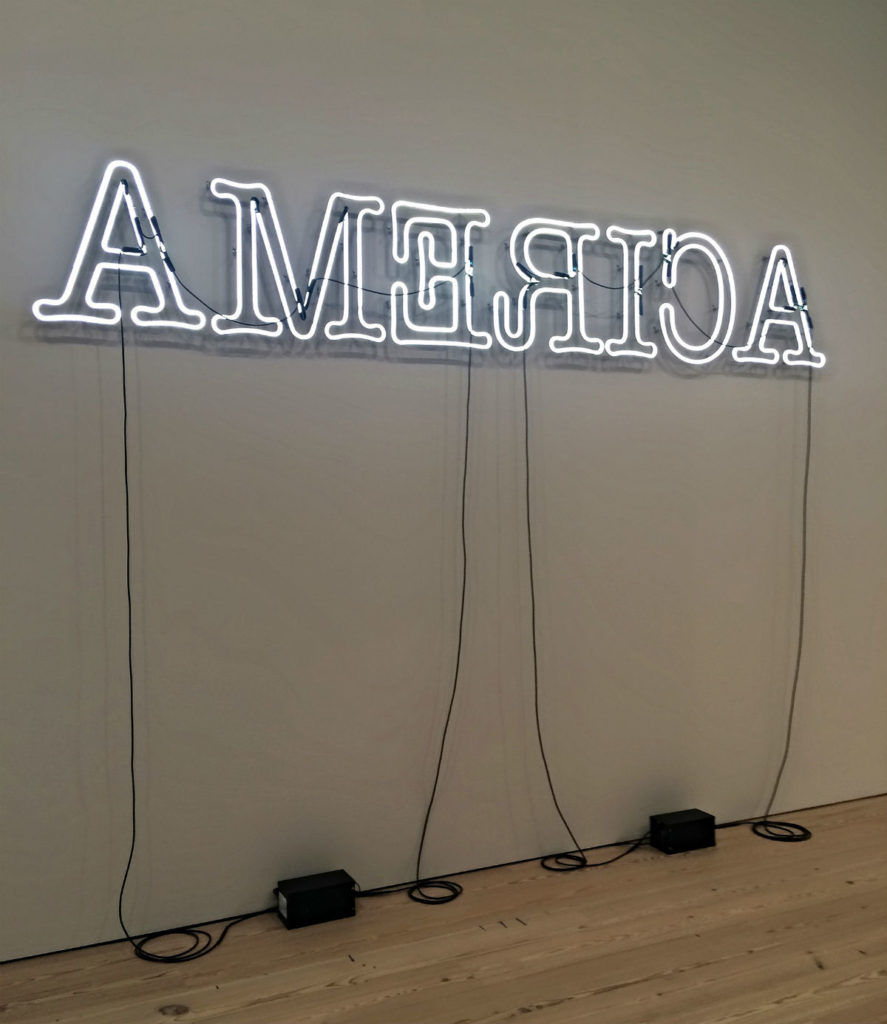
Glenn Ligon, <em>Rückenfigur</em> (2009). Image courtesy vl04 on Flickr.
Glenn Ligon, Rückenfigur (2009). Image courtesy vl04 on Flickr.
Ligon thought of these works, which subtly scramble the letters or mute the light by turning the illuminated part into the wall, as conveying the sense of being stuck with contradictory, maybe incompatible senses of America. “The dichotomies between rich and poor, progress and going backwards seemed to be where we were at in America,” he explained of his work. “Those things going on at the same time seemed, to me, embodied in the word ‘America.’”
The flickering ambiguity in those neon works was very much a product of the Obama years. Ligon spoke very concretely about these neons as working through the simultaneity of promise alongside pain: “There is this sense that America, for all its dark deeds, is still this shining light. That’s how the piece came about, because I was thinking about Dickens’s ‘the best of times, the worst of times.’ Yes, that’s where America is.”
That was 2008. A decade later, in Glover/Gambino’s “This Is America,” America’s “dark deeds” are more present than ever, while the US as “shining light” is less certain in the age of Trump. America offers success—it’s hard to think of anyone who is amassing a more dizzying breadth of cultural credibility than Donald Glover right now—but that’s not exactly the same as promise that it might be redeemed, and the awareness that the same society that allows power and visibility also creates violence and exploitation seems all the more intense, inescapable, irreconcilable.

The Pleasures of “On Non-Visibility”

As one Twitter wag quipped, “Donald Glover’s ‘This is America’ song and video is our reward for surviving Kanye West’s week of white supremacy.” The Childish Gambino video dropped amid the fuss around Kanye’s seeming flirtation with the alt-right.
In a more recent media ruckus, Danish film auteur Lars von Trier has returned to his customary amoral provocateur role, launching the ultra-graphic The House That Jack Built at Cannes, a purported critique of Trump’s America that wallows in torture, and provoked a mass walkout.
It so happens that both West’s and von Trier’s public provocations feature as raw material for an art show by Tony Cokes (b. 1956) currently at Greene Naftali, titled “On Non-Visibility” (through June 9).
Cokes is a brainy and serious artist who teaches at Brown University. Working in a vein not totally removed from someone like Ligon, he characteristically examines public statements and images, extracting them from their usual context and often juxtaposing them with pop music in slideshows or videos to tease out new associations.
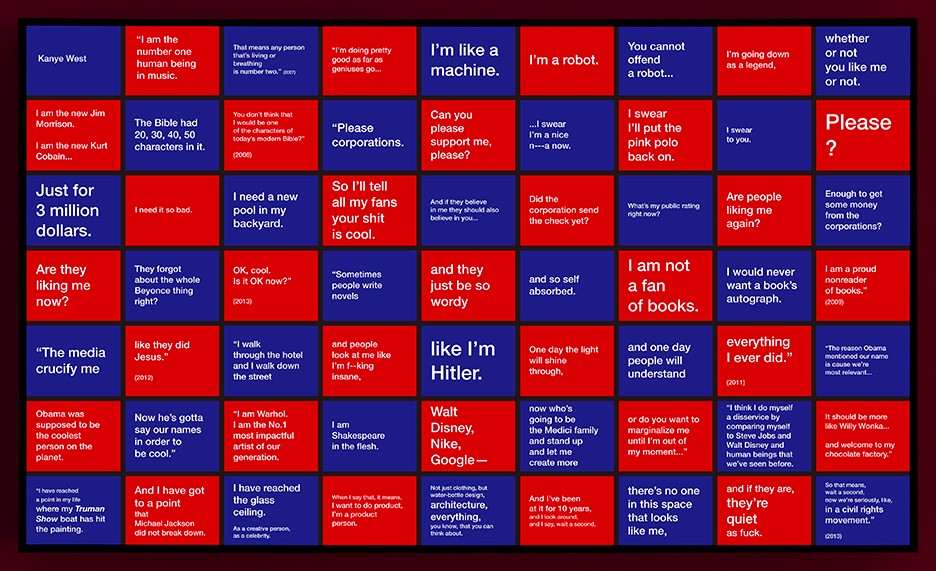
ony Cokes, Face Value (Kanye West) (2018). Courtesy of the artist and Greene Naftali.
Tony Cokes, Face Value (Kanye West) (2018). Courtesy of the artist and Greene Naftali.
Two works in the show dwell on snippets from an interview with von Trier and a stream of tweets by West, respectively, organized into grids on a lightbox. Von Trier’s quote comes from a weird discourse where he flirts with Nazism (on Hitler: “he’s not what you call a good guy, but I sympathize with him a little bit”); West’s statements are culled from various Twitter rants and display his well-known and increasingly alarming megalomania (“The media crucify me / like they did Jesus”).
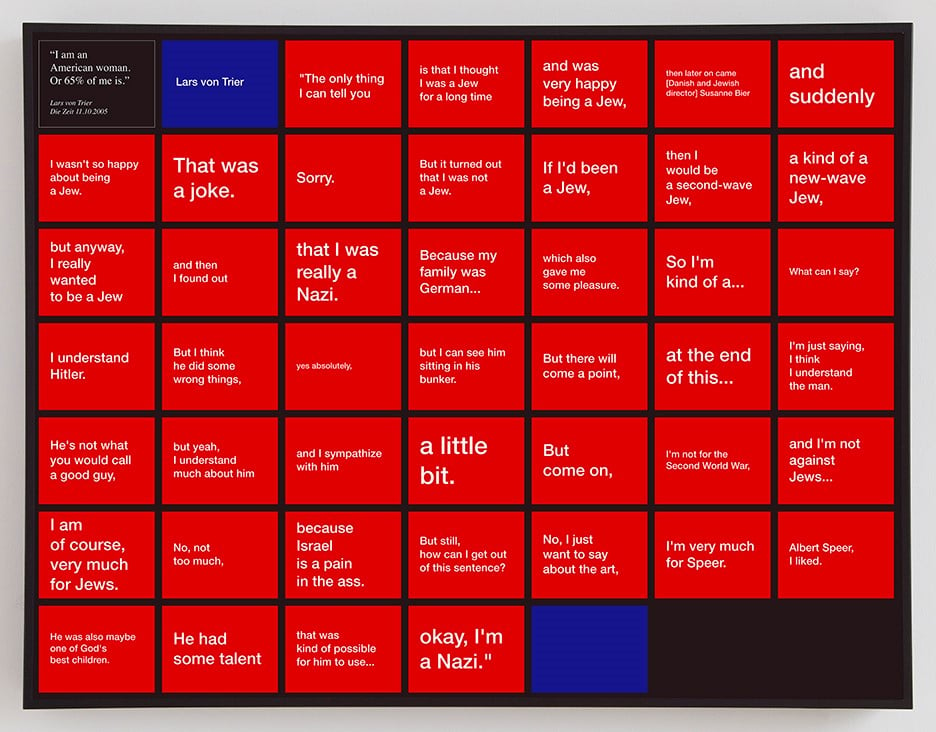
Tony Cokes, <em>Face Value (Lars von Trier)</em> (2018). Courtesy of the artist and Greene Naftali.
Tony Cokes, Face Value (Lars von Trier) (2018). Courtesy of the artist and Greene Naftali.
Cokes is always concerned with how representation works. As his show title suggests, he deals with media images by focusing on texts extracted from their associated imagery. What you get is a kind of pop art extracted from the pop part, Tweets super-cooled into text art and extracted from the endlessly distractible flow of hype and hot takes. (Commentators have noted that this ability to diffuse each new outrage by creating another seems to be a secret of President Trump’s power; a Trump monologue about his love of women is the subject of another Cokes video at Greene Naftali.)
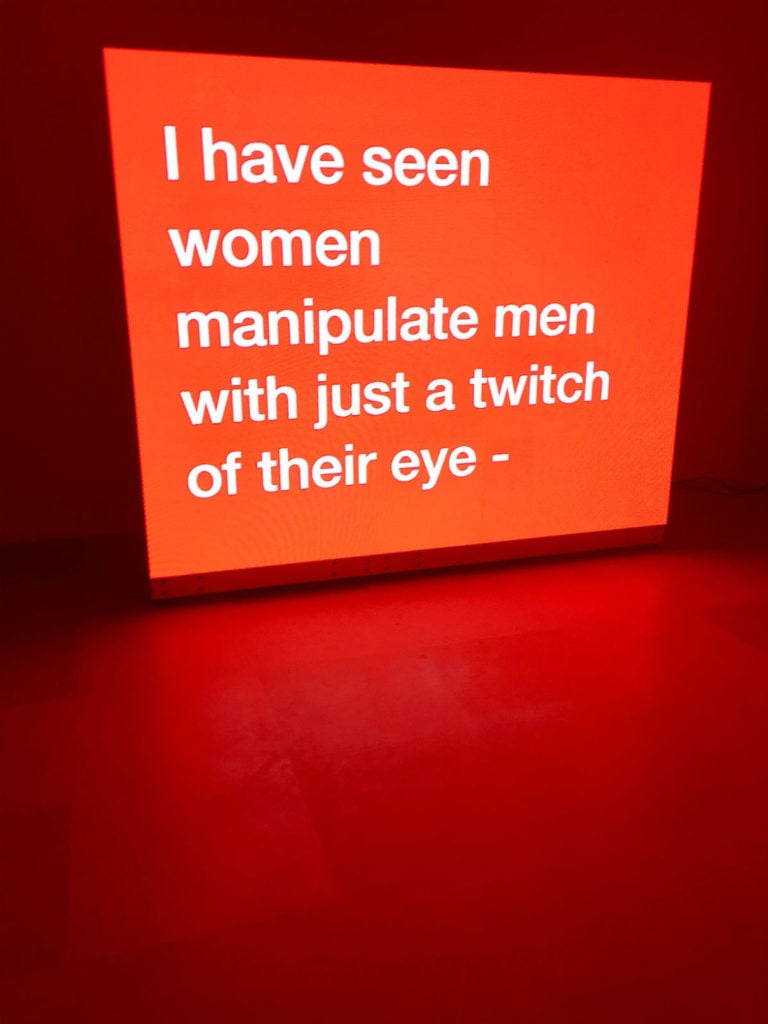
Tony Cokes <em>Evil.66.1 (DT.sketch.1.8)</em> (2016). Image courtesy Ben Davis.
Tony Cokes Evil.66.1 (DT.sketch.1.8) (2016). Image courtesy Ben Davis.
There are claims made for this kind of art-as-media-critique that I don’t really buy. The fact that von Trier and West happen to be in the headlines as Cokes’s show is up in New York surely makes it topical—but also shows how these figures definitely do not want for scrutiny. Infinite criticism generated by trolling has only expanded their buzz, giving them a kind of air current to float on. In fact (and like “This Is America,” in a way), what is distinctive about Cokes’s intervention is how withdrawn it is from easy framing criticism or moral positioning.
It may be more interesting to ask what Cokes’s works propose, not as a form of criticism, but as a style of aesthetic pleasure. To me, their interest amounts to this: Given the endless noise thrown off by such figures, there is a jolt of pleasure in the works’ contrasting sense of clarity, their stripped-down post-conceptual matter-of-factness, their submission of public personae grown out of control to a simple checkerboard in flat colors, decorative but restricted.
Tony Cokes, Face Value (Kanye West) [detail] (2018). Courtesy of the artist and Greene Naftali.
Extracting a sense of order from the chaos of nature was the classical formula for the beautiful: the viewer discovered evidence of ordering principle hidden in a disordered world, and therefore found an affirmation of the power of rationality. Some kind of displaced contemporary echo of this effect lurks in “On Non-Visibility,” with the chaos of the natural environment replaced by the frenzy of a turbocharged media environment. The pleasure of the work is the sense of affirming the capacity to claim power over this messy spectacle.

Paparazzi Art History 

Finally, as a palette cleanser: Last week’s viral sensation was this photo of Cake by the Ocean singer Joe Jonas and Game of Thrones actress Sophie Turner, the duo frozen stone faced like the American Gothic couple out for a sunny brunch. Some comedian called it “a surrealist painting criticizing celebrity culture.”
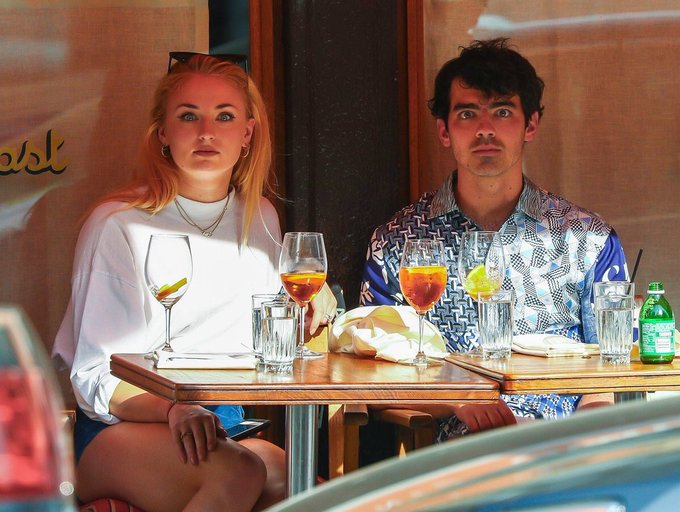
No one asked me, but myself I would have said that it most reminds me of Diane Arbus’s Identical Twins, Roselle, New Jersey (1967) (the inspiration for Stanley Kubrick’s creepy twins in The Shining). Still the quip made me ask myself: Can I think of any such Surrealist painting?
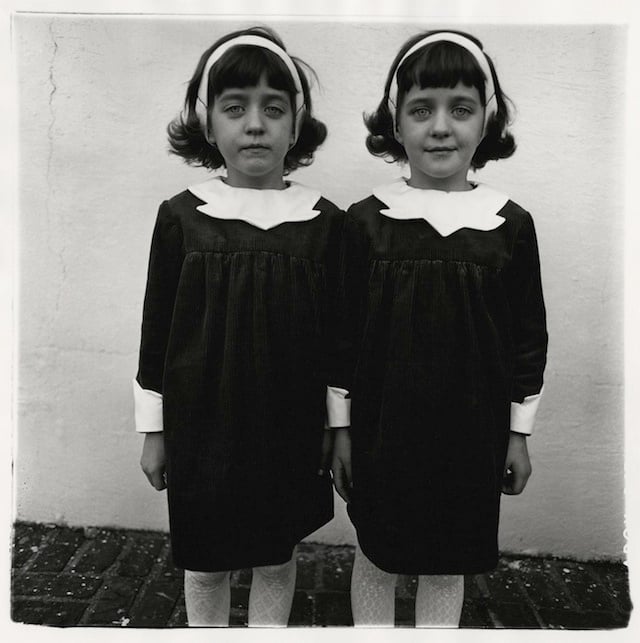
Diane Arbus, <em>Identical Twins, Roselle, New Jersey</em> (1967).
Diane Arbus, Identical Twins, Roselle, New Jersey (1967).
Actually, I think figures gazing out are sort of rare in Surrealist art, which is all about evoking looking in on a dream-like space. In an exception like Magritte’s similarly lunchtime self-portrait The Magician (Self-Portrait With Four Arms), the flat gaze is an anchor, a nod to the neutral gaze of classic portraiture. It provides the deadpan contrast that makes whatever is strange in the surrounding environment seem that much stranger.
Rene Magritte, <em>The magician (Self-portrait with four arms) </em> (1952). Image courtesy Wikiart.
Rene Magritte, The magician (Self-portrait with four arms)(1952). Image courtesy Wikiart.
The same is true of Leonora Carrington’s 1937-38 self-portrait in the Met collection; or Dorothea Tanning’s 1942 self-portrait Birthday in the Philadelphia Museum of Art’s collection; or, most relevant to Joe and Sophie, Frida Kahlo’s twinned self in something like Two Fridas (1939)
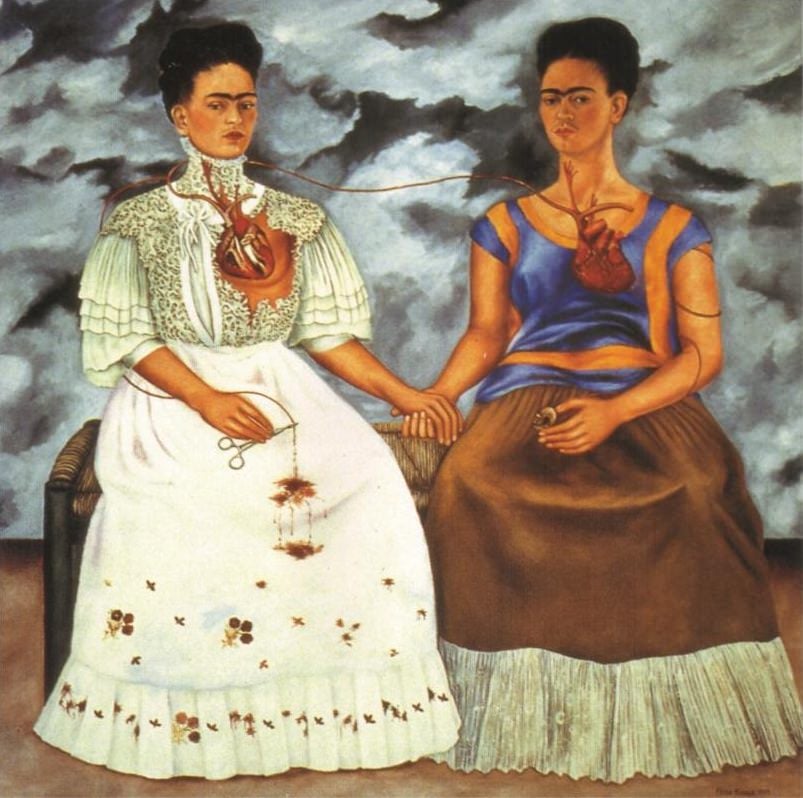
Frida Kahlo, <em>The Two Fridas</em> (1939).
Frida Kahlo, The Two Fridas (1939).
By contrast, our celebrity couple’s dead gaze is not what is normal but what is weird about the photo in question, against the background of colorful cocktails. So maybe we could call the image something like “reverse Surrealism.”

Follow artnet News on Facebook: 
 
Want to stay ahead of the art world? Subscribe to our newsletter to get the breaking news, eye-opening interviews, and incisive critical takes that drive the conversation forward.
SHARE

Comprehend a Work of Art Without a Woman Next to It


Is It Even Possible to Comprehend a Work of Art Without Seeing a Woman Next to It (for Scale)?

Examining an enduring and strange stock photo phenomenon.
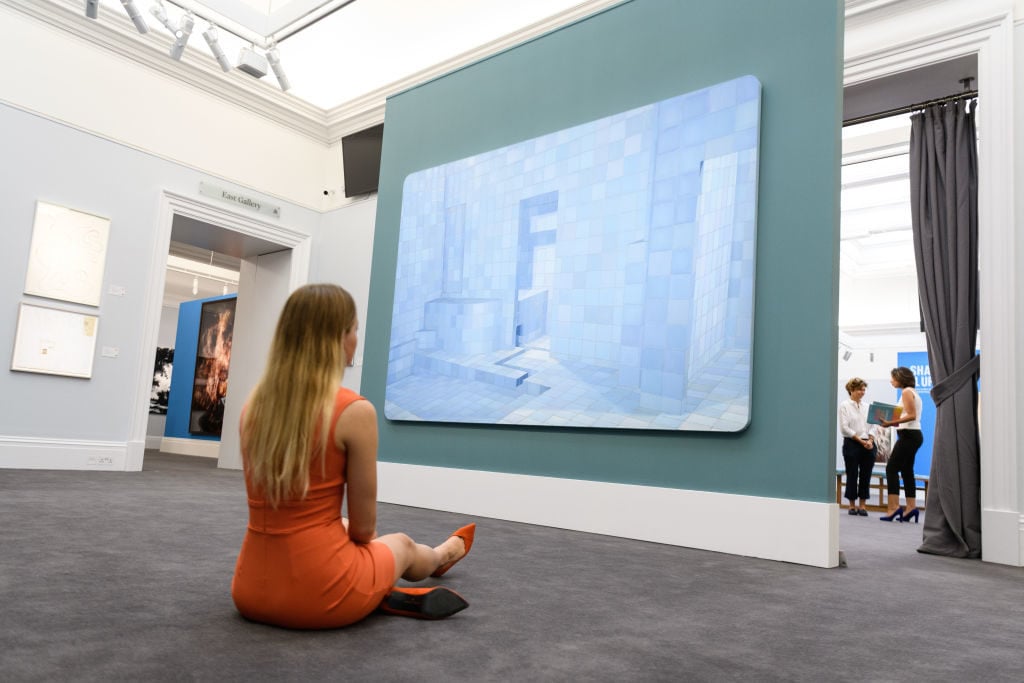
A member of the Sotheby's auction house staff poses in front of Blue Sauna by Adriana Varejao at the press preview of the “Shake It Up Online” auction of works from the private collection of photographer Mario Testino on September 8, 2017 in London. Photo by Leon Neal/Getty Images.
A member of the Sotheby's auction house staff poses in front of Blue Sauna by Adriana Varejao at the press preview of the “Shake It Up Online” auction of works from the private collection of photographer Mario Testino on September 8, 2017 in London. Photo by Leon Neal/Getty Images.
Spend enough time looking at auction reports, as you inevitably will if it is auction season and you are on editing duty, and you’ll feel like you are stuck in some kind of “glitch in the Matrix”-style loop of art-business cliches about how the “market is robust” and collectors are willing to pay “top prices for top material.” You’ll also find yourself looking at a lot of pictures of auction previews, which really occupy the overlapping space in the Venn diagram where the bland, the posh, and the uncanny meet.
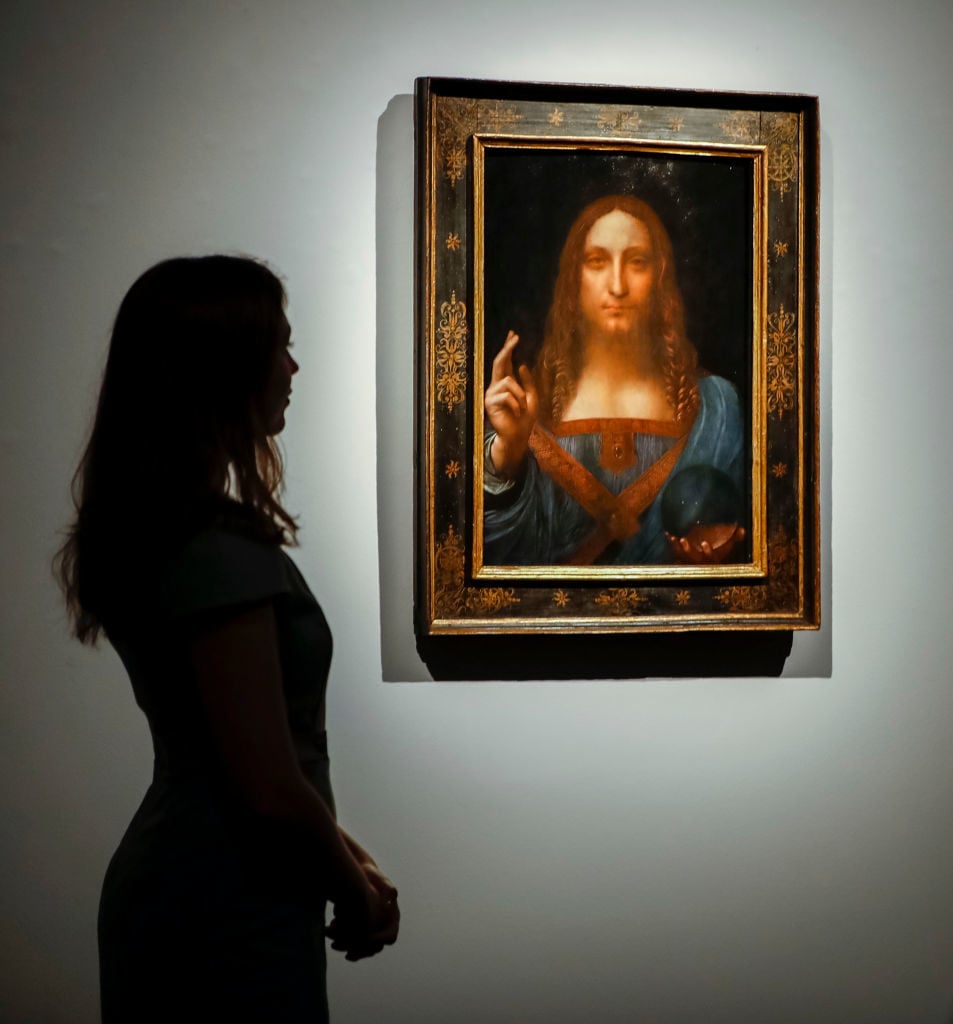
In these photos, taken and supplied by press agencies and used in auction coverage across the globe, you’ll see a lot of art handlers pictured handling art, lending a little dynamism to otherwise deadly dull installation shots. With high-profile lots like Leonardo’s Salvator Mundi at Christie’s last year, you’ll see major paintings flanked by sour-faced guards or animated specialists, to signify “Importance.”
But the really, really notable cliche of the “auction preview” genre is “women standing awkwardly near art for scale.” It’s seriously weird, and it is undying.
There are many questions that this genre invites: Can the women positioned at these angles actually see what they are looking at? Why in god’s name would a photographer ever ask one to sit down? Has there been a rapture just before each photo was taken that sucked up anyone who is not thin, white, and between the ages of 23 and 33?
We think it’s pretty clear why these strangely positioned images exist—but we’ll let someone who’s actually worked one of these things explain. Alice Gregory’s all-time-classic 2012 n+1 essay details her experience navigating the strange office culture inside Sotheby’s, and it so happens that it concludes with her being asked by a photographer to pose in front of an Andy Warhol “Fright Wig” work for just such an occasion:
“Oh, good. She’s blonde,” said the photographer. I made a face at him. “For the contrast.” He sighed. “You’ll stand out against the purple.” I followed his instructions and approached the painting, gazing up at it from a few feet away at a quarter-angle to the camera. I shifted my weight subtly from one hip to the other and pretended to see things on the canvas that I hadn’t before. Standing next to the painting, I was a live specimen of powerlessness: in service of sums of money too great and too senseless for me to comprehend. “Back up a little,” the photographer instructed. “No, that’s too much. Yeah, stay right there. I need you to look diminutive.”
So, inspired by the classic post “Women Laughing Alone With Salad” from the Hairpin (RIP), we’ve pulled together a few years worth of the phenomenon as a demonstration. Happy bidding!
Christie's employees pose in front of a painting entitled Salvator Mundi by Italian polymath Leonardo da Vinci at a photocall at Christie's auction house in central London on October 22, 2017 ahead of its sale at Christie's New York on November 15, 2017. Photo courtesy Tolga Akmen/AFP/Getty Images.
Christie’s employees pose in front of a painting entitled Salvator Mundi by Leonardo da Vinci at a photocall at Christie’s auction house in central London on October 22, 2017. Photo courtesy Tolga Akmen/AFP/Getty Images.
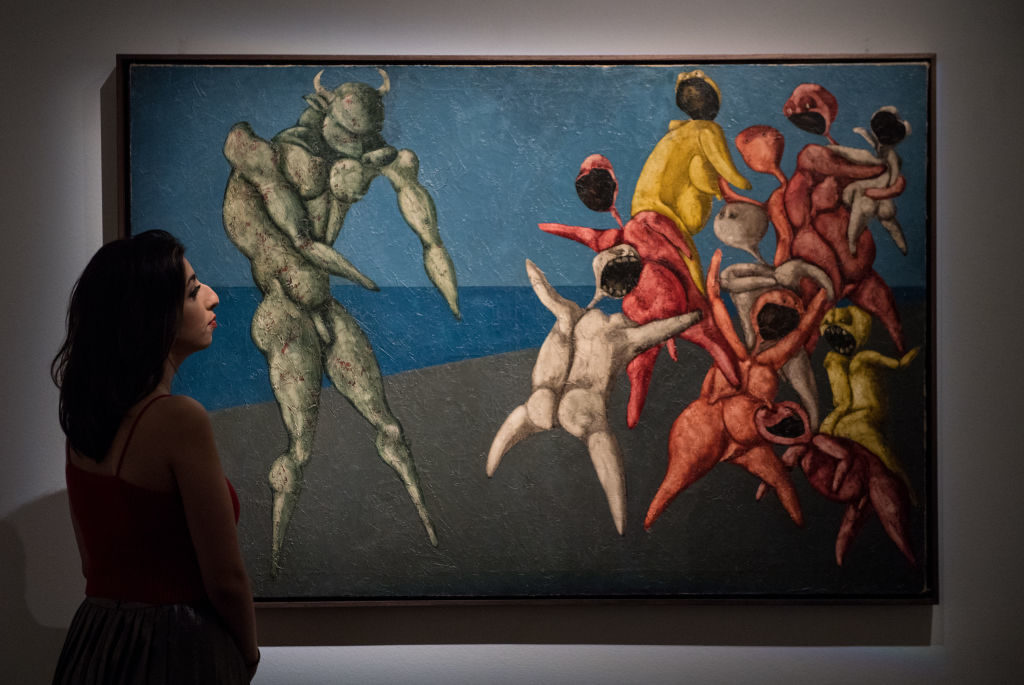
A Sotheby's employee poses next to <em>Il Minotauro fa Paura alla Gente per Bene</em> by Bahman Mohasses during a press preview of Orientalist and Middle Eastern Art Week at Sotheby's on April 20, 2018 in London, England. Photo by Chris J Ratcliffe/Getty Images for Sotheby's.
A Sotheby’s employee poses next to Il Minotauro fa Paura alla Gente per Bene by Bahman Mohasses during a press preview of Orientalist and Middle Eastern Art Week at Sotheby’s on April 20, 2018 in London. Photo by Chris J Ratcliffe/Getty Images for Sotheby’s.
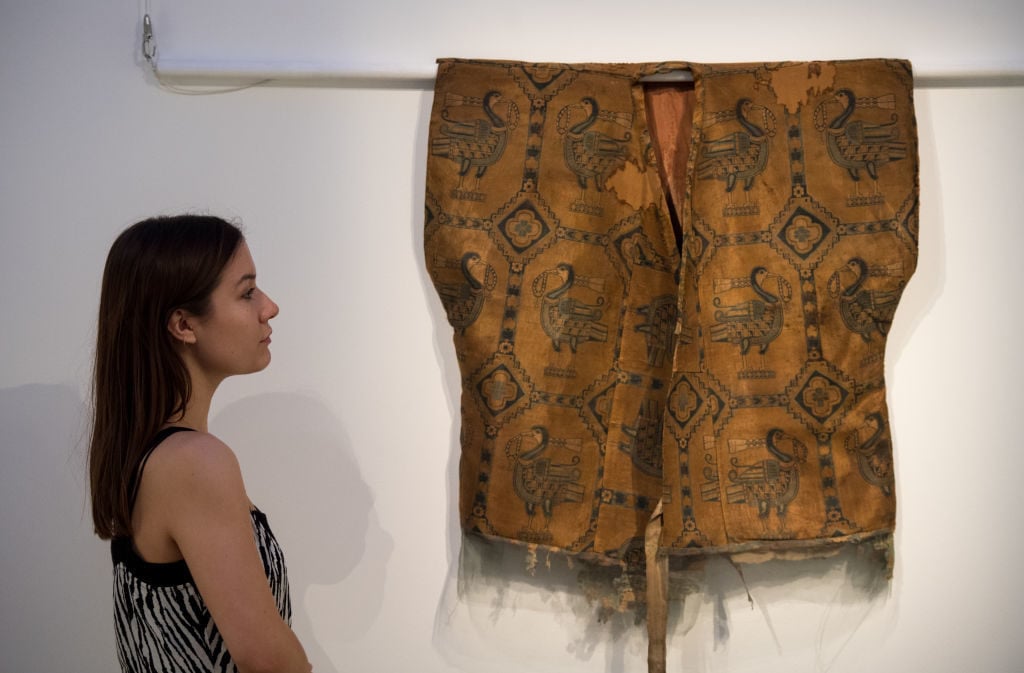
A Sotheby's employee poses next to a samite shirt with ducks during a press preview of Orientalist and Middle Eastern Art Week at Sotheby's on April 20, 2018 in London, England. Photo by Chris J Ratcliffe/Getty Images for Sotheby's.
A Sotheby’s employee poses next to a samite shirt with ducks during a press preview of Orientalist and Middle Eastern Art Week at Sotheby’s on April 20, 2018 in London. Photo by Chris J Ratcliffe/Getty Images for Sotheby’s.
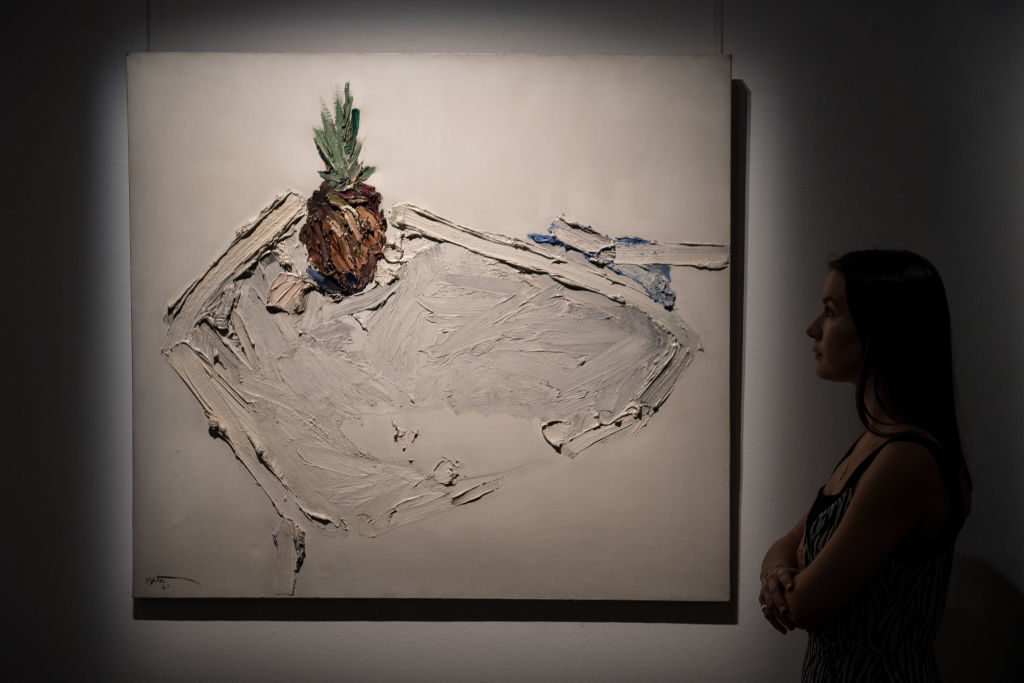
A Sotheby's employee poses next to 'Untitled (Still life with pineapple)' by Manoucher Yektai during a press preview of Orientalist and Middle Eastern Art Week at Sotheby's on April 20, 2018 in London, England. Photo by Chris J Ratcliffe/Getty Images for Sotheby's.
A Sotheby’s employee poses next to Untitled (Still life with pineapple) by Manoucher Yektai during a press preview of Orientalist and Middle Eastern Art Week at Sotheby’s on April 20, 2018 in London. Photo by Chris J Ratcliffe/Getty Images for Sotheby’s.
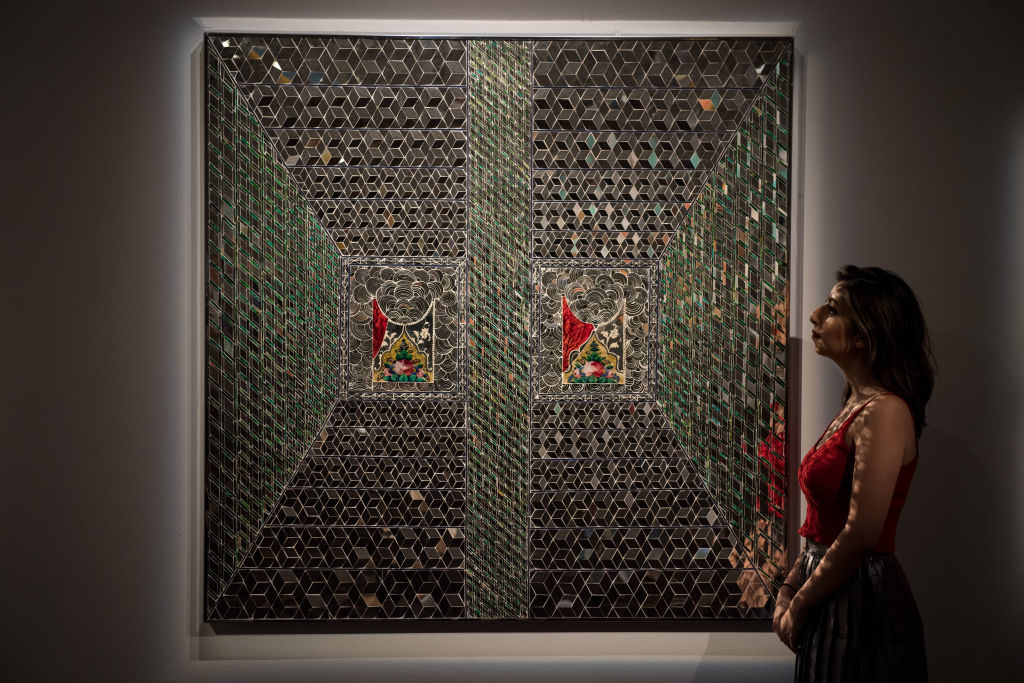
A Sotheby's employee poses next to <em>Recollections I</em> by Monir Farmanfarmaian during a press preview of Orientalist and Middle Eastern Art Week at Sotheby's on April 20, 2018 in London, England. Photo by Chris J Ratcliffe/Getty Images for Sotheby's.
A Sotheby’s employee poses next to Recollections I by Monir Shahroudy Farmanfarmaian during a press preview of Orientalist and Middle Eastern Art Week at Sotheby’s on April 20, 2018 in London. Photo by Chris J Ratcliffe/Getty Images for Sotheby’s.
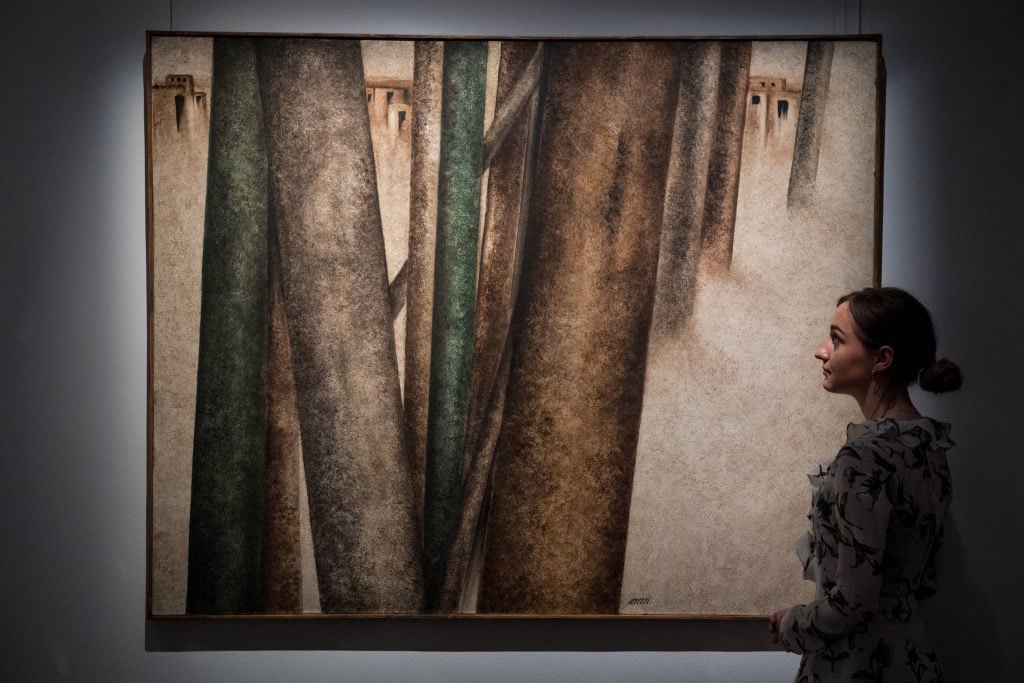
Sotheby's employee poses next to <em>Untitled (Tree trunks and village scene)</em> by Sohrab Sepehri during a press preview of Orientalist and Middle Eastern Art Week at Sotheby's on April 20, 2018 in London, England. Photo by Chris J Ratcliffe/Getty Images for Sotheby's.
A Sotheby’s employee poses next to Untitled (Tree trunks and village scene) by Sohrab Sepehri during a press preview of Orientalist and Middle Eastern Art Week at Sotheby’s on April 20, 2018 in London. Photo by Chris J Ratcliffe/Getty Images for Sotheby’s.
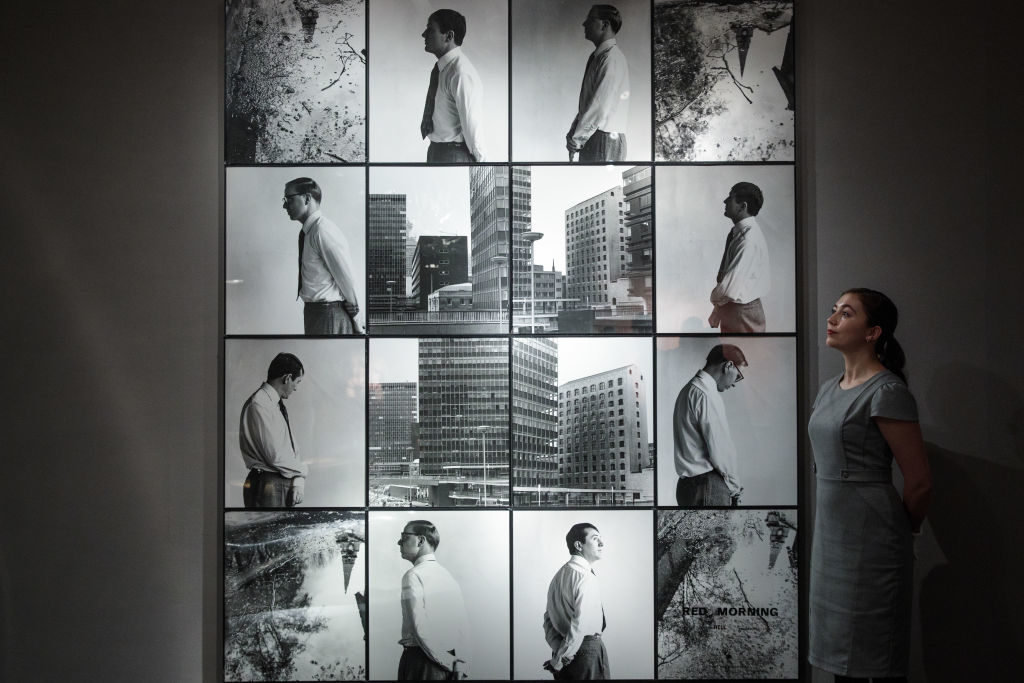
An employee poses with Red Morning (Hell) (1977) by Gilbert & George at Christie’s London on September 29, 2017 in London, England. Photo by Jack Taylor/Getty Images.
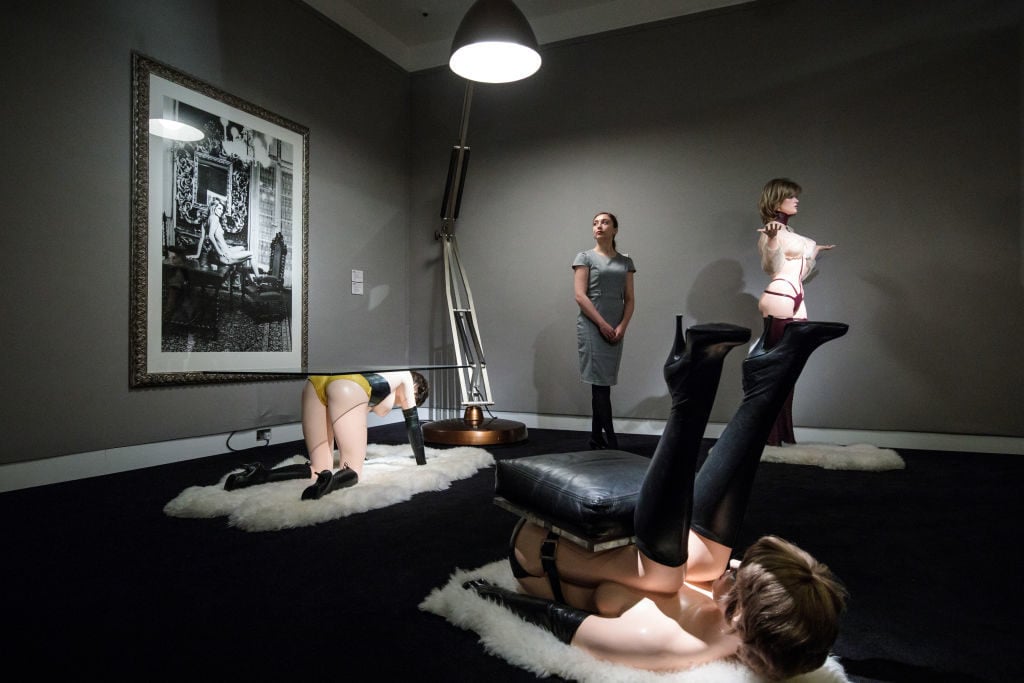
An employee poses with various furniture designs by Allen Jones (each estimated at £600,000 - £800,000), the photograph Charlotte Rampling at the Hotel Nord Pinus Arles, France 1973 by Helmut Newton (estimate £200,000 - £300,000) and Moloch Floor Lamp, 1971 by Gaetano Pesce (estimate £60,000 - £80,000) at Christie's London on September 29, 2017 in London, England. Photo by Jack Taylor/Getty Images.
An employee poses with various furniture designs by Allen Jones, the photograph Charlotte Rampling at the Hotel Nord Pinus Arles, France (1973) by Helmut Newton, and Moloch Floor Lamp (1971) by Gaetano Pesce at Christie’s on September 29, 2017 in London. Photo by Jack Taylor/Getty Images.
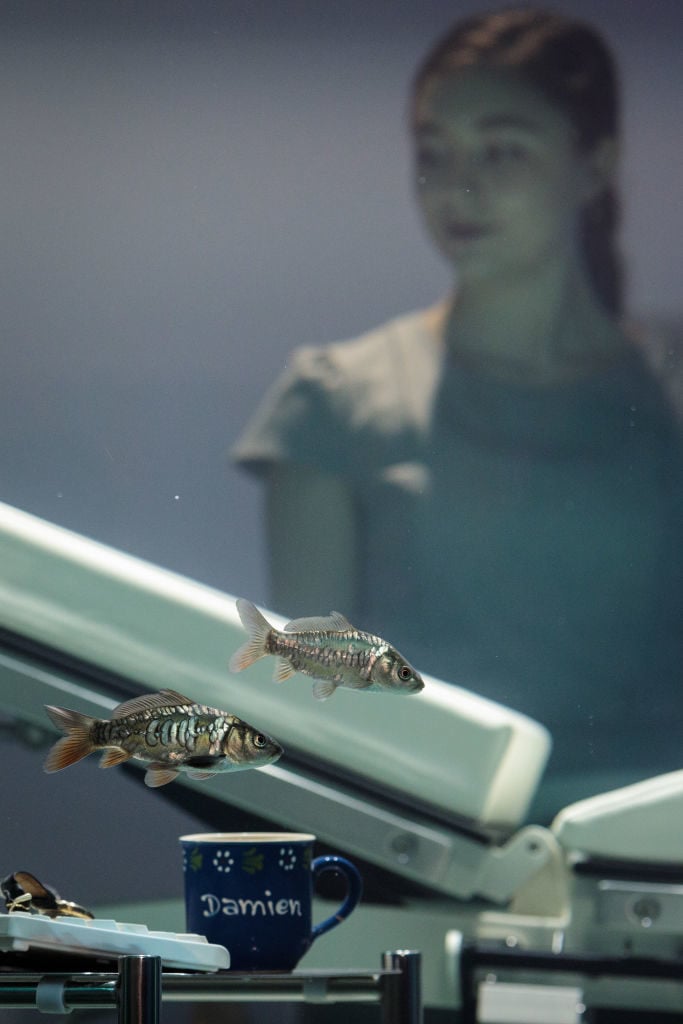
An employee poses with 'Love Lost', 1999, by Damien Hirst (estimate £1.2 - £1.8M), which features 20 live carp at Christie's London on September 29, 2017 in London, England. Photo by Jack Taylor/Getty Images.
An employee poses with Love Lost (1999) by Damien Hirst, which features 20 live carp, at Christie’s on September 29, 2017 in London. Photo by Jack Taylor/Getty Images.
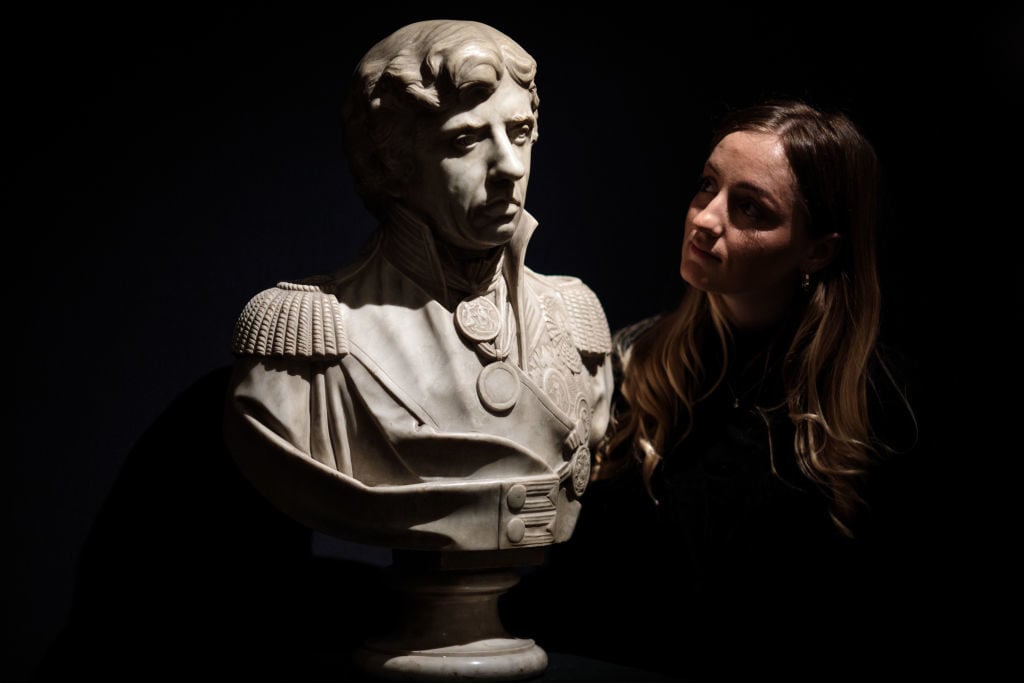
An employee poses with a marble bust of Lord Horatio Nelson, circa 1800 (est. £18,000-25,000) at Sotheby's on January 11, 2018 in London, England. Photo by Jack Taylor/Getty Images.
An employee poses with a marble bust of Lord Horatio Nelson (ca. 1800) at Sotheby’s on January 11, 2018 in London. Photo by Jack Taylor/Getty Images.
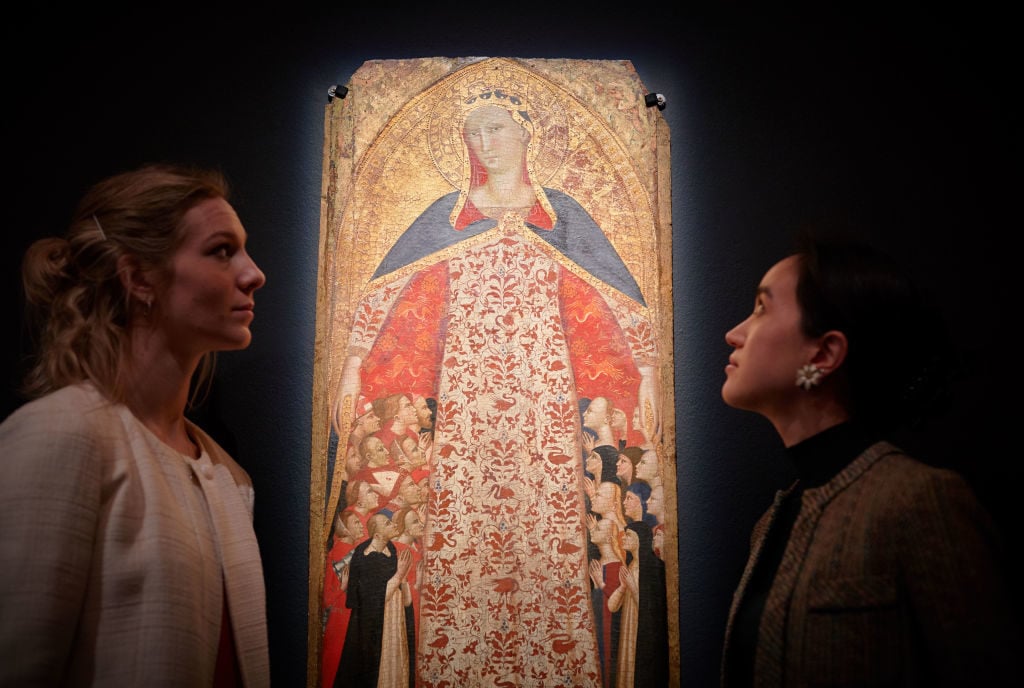
<em>The Madonna of Mercy</em> by The Master of 1336, est. £400,000-600,000, goes on view as part of Sotheby's London Old Masters Evening Sale, on December 1, 2017 in London, England. Photo by Michael Bowles/Getty Images for Sotheby's.
Two women pose with The Madonna of Mercy by The Master of 1336 goes on view as part of Sotheby’s London Old Masters Evening Sale, on December 1, 2017 in London. Photo by Michael Bowles/Getty Images for Sotheby’s.
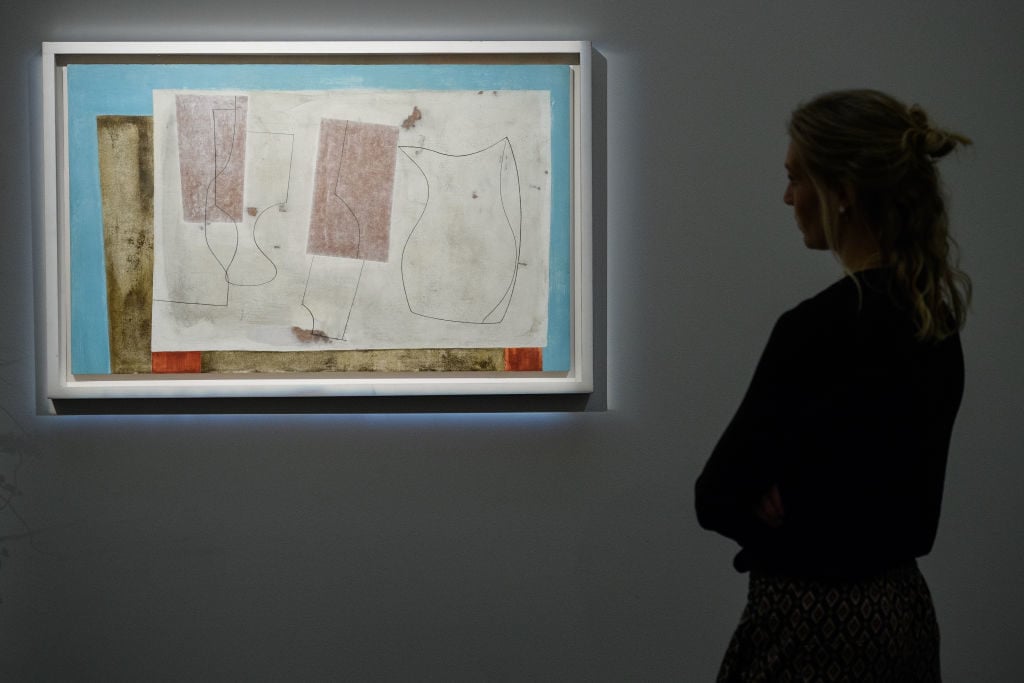
A gallery assistant poses with <em>Sept 58 (Iseo)</em> (est £400,000-600,000) by Ben Nicholson, at Sotheby's auction house on November 17, 2017 in London, England. Photo by Leon Neal/Getty Images
A gallery assistant poses with Sept 58 (Iseo) by Ben Nicholson, at Sotheby’s auction house on November 17, 2017 in London. Photo by Leon Neal/Getty Images.
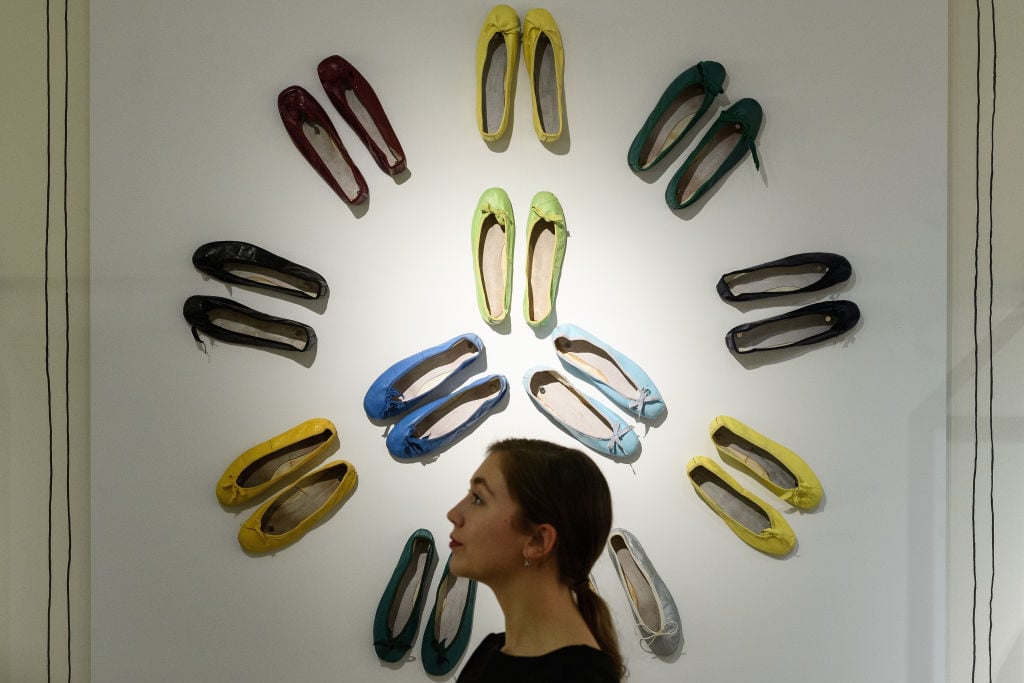
A gallery assistant poses in front of a selection of ballet shoes during a preview of items from the sale of actrees Audrey Hepburn's personal collection at Christies on September 22, 2017 in London, England. Photo by Leon Neal/Getty Images.
A gallery assistant poses in front of a selection of ballet shoes during a preview of items from the sale of actrees Audrey Hepburn’s personal collection at Christies on September 22, 2017 in London. Photo by Leon Neal/Getty Images.
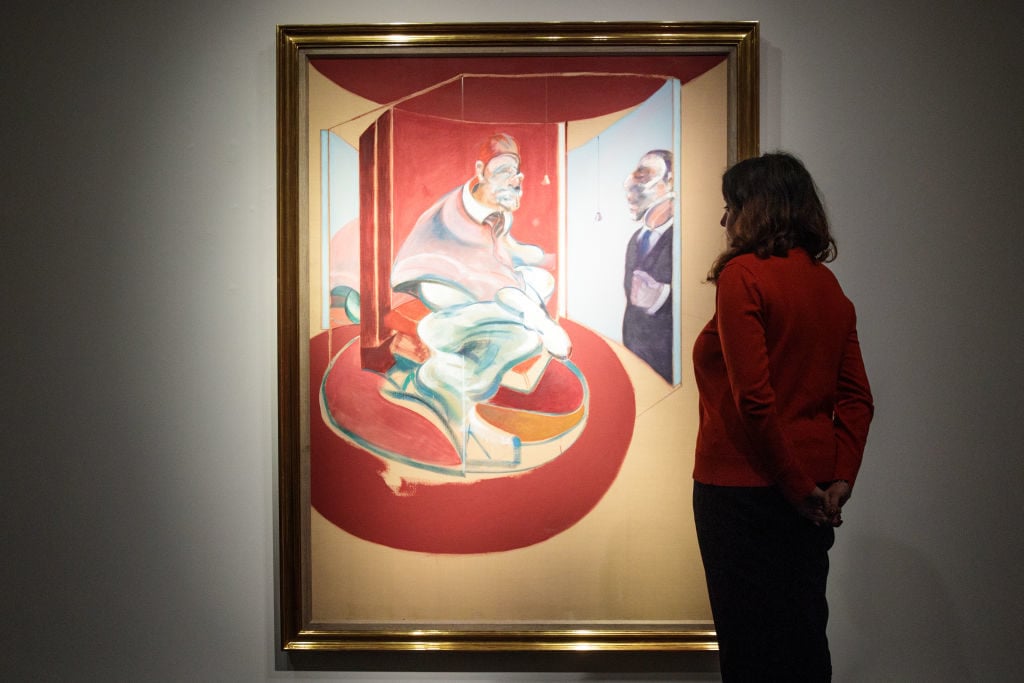
A Christie's employee poses with Study of a Red Pope, 1962. 2nd Version 1971 by Francis Bacon at Christie's on September 15, 2017 in London, England. Photo by Jack Taylor/Getty Images.
A Christie’s employee poses with Study of a Red Pope1962. 2nd Version (1971) by Francis Bacon at Christie’s on September 15, 2017 in London. Photo by Jack Taylor/Getty Images.
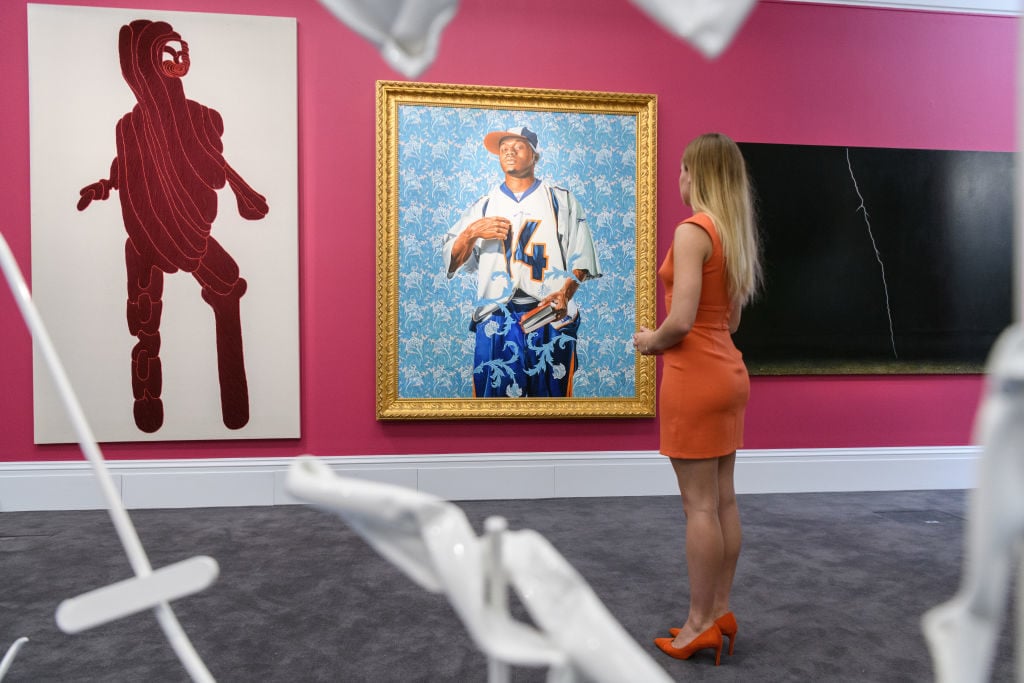
A member of the Sotheby's auction house staff poses with <em>We Work As A Collective</em> by Enrico David (estimated sale price £8,000-12,000) (L), <em>Saint Francis</em> by Kehinde Wiley (estimated sale price £30,000-40,000) (C) and <em>Scandalous Magic Par Excellence (with Iggy Pop)</em> by Nigel Cooke (estimated sale price £50,000-70,000) (R) at the press preview of the 'Shake It Up Online' auction of works from the private collection of photographer Mario Testino on September 8, 2017 in London, England. Photo by Leon Neal/Getty Images.
A member of the Sotheby’s auction house staff poses with We Work As A Collectiveby Enrico David (left), Saint Francis by Kehinde Wiley (center), and Scandalous Magic Par Excellence (with Iggy Pop) by Nigel Cooke (right) at the press preview of the “Shake It Up Online” auction of works from the private collection of photographer Mario Testino on September 8, 2017 in London. Photo by Leon Neal/Getty Images.
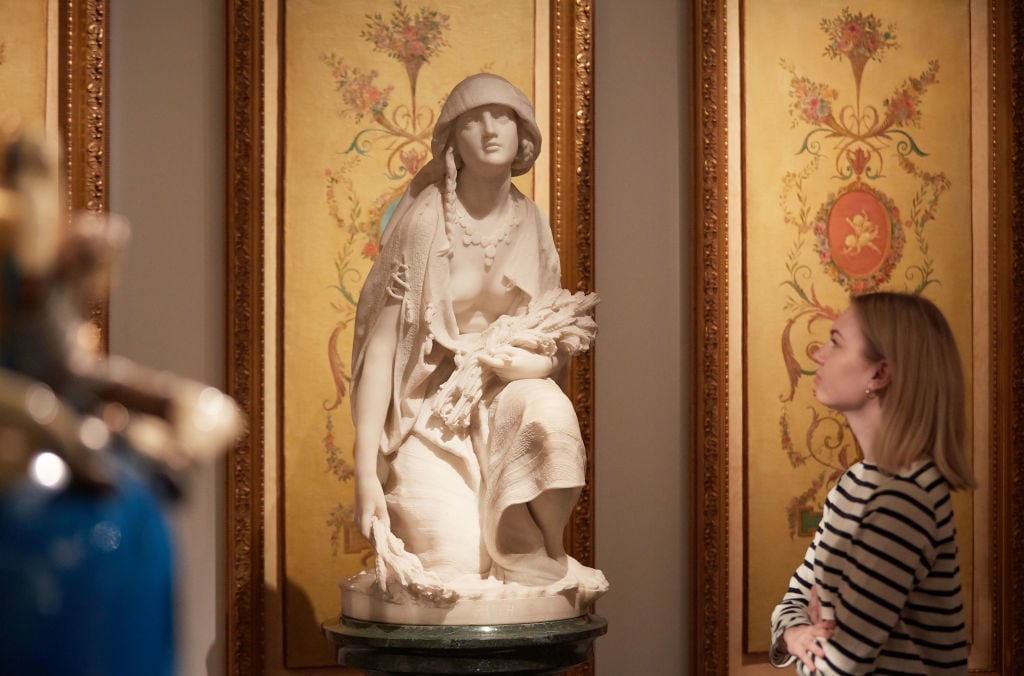
A member of Sotheby's observes Professore Rossi's white marble sculpture <em>Ruth</em> (est. £30,000-50,000), at Sotheby's on May 19, 2017 in London, England. Photo by Michael Bowles/Getty Images for Sotheby's.
A member of Sotheby’s observes Professore Rossi’s white marble sculpture Ruth, at Sotheby’s on May 19, 2017 in London. Photo by Michael Bowles/Getty Images for Sotheby’s.
An employee poses with an artwork by <em>untitled (Demoiselles de Port-Novo Series)</em> (2012), by Benin artist, Leonce Raphael Agbodjelou priced at 4,000-6,000 pounds / 5,000-7,500 dollars during a photocall to promote the forthcoming inaugural 'Sale of Modern and Contemporary African Art' at Sotheby's in London on May 12, 2017. Photo courtesy Daniel Leal-Olivas/AFP/Getty Images.
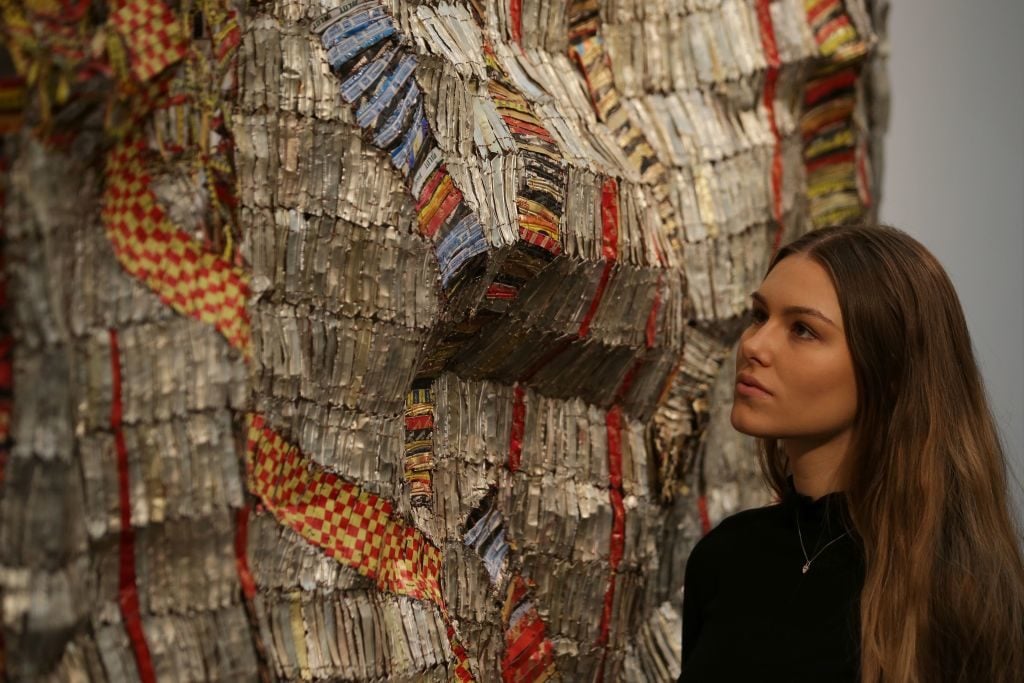
An employee poses with El Anatsui, Earth Developing More Roots (2011) during a photocall to promote sale of Modern and Contemporary African Art at Sotheby’s in London on May 12, 2017. Photo courtesy Daniel Leal-Olivas/AFP/Getty Images.
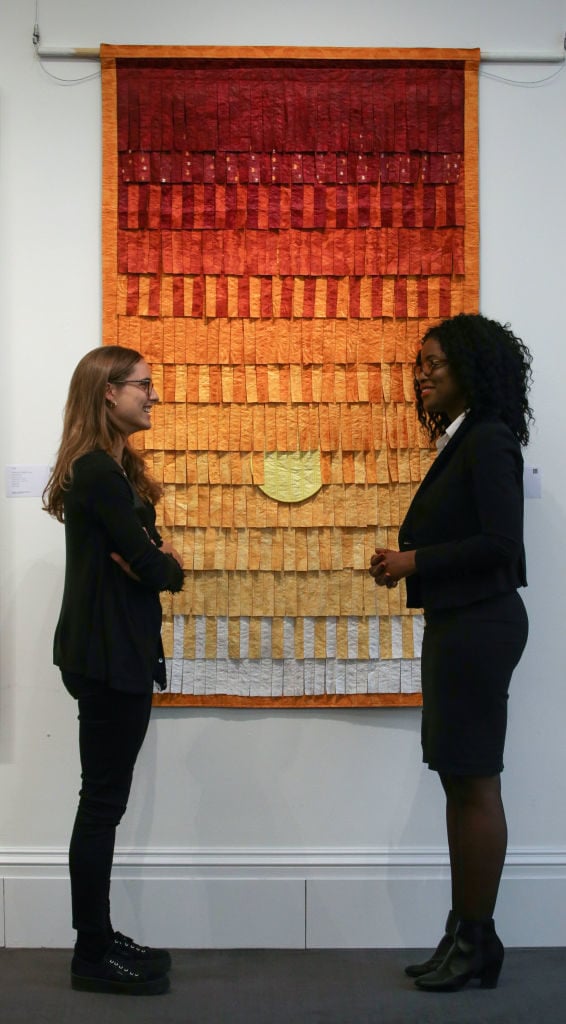
Employees pose with an artwork entitled <em>Composition No. 25 (soleil)</em> (2015), by Malian artist, Abdoulaye Konate with an starting price of 10,000-15,000 dollars / 12,500-18,700 dollars during a photocall to promote the forthcoming inaugural 'Sale of Modern and Contemporary African Art' at Sotheby's in London on May 12, 2017. Photo courtesy Daniel Leal-Olivas/AFP/Getty Images.
Employees pose with an artwork entitled Composition No. 25 (soleil) (2015) by Abdoulaye Konate during a photocall to promote the “Sale of Modern and Contemporary African Art” at Sotheby’s in London on May 12, 2017. Photo courtesy Daniel Leal-Olivas/AFP/Getty Images.
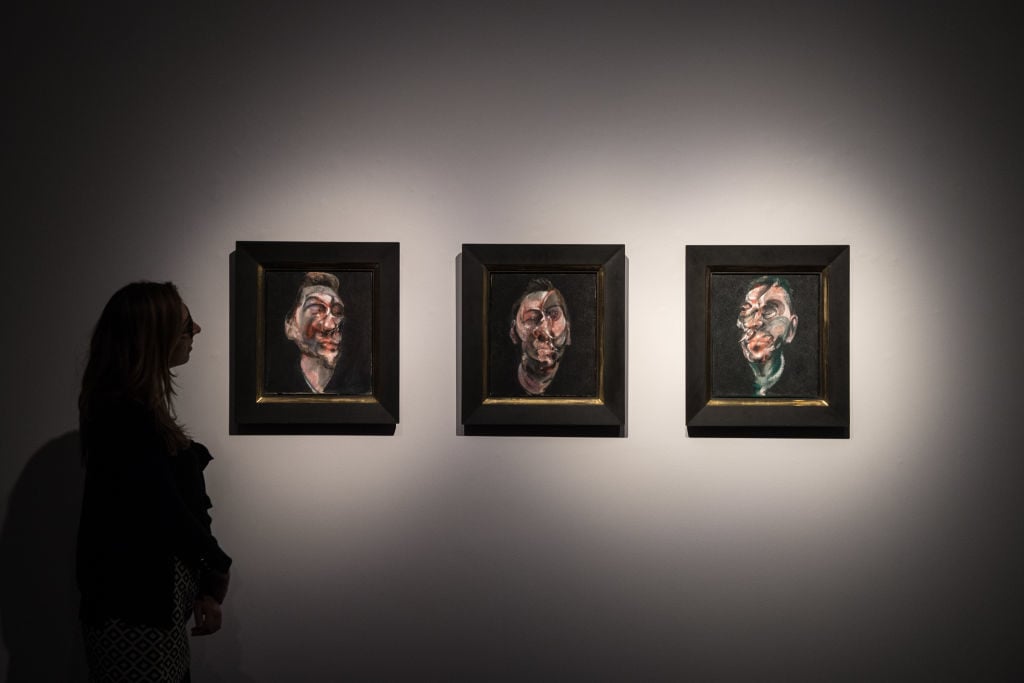
Christies employees pose for photos with <em>Three studies for a portraits of George Dyer</em> by Francis Bacon, estimated at $50-$70 million, at Christies on February 24, 2017 in London, England. Photo by Chris J Ratcliffe/Getty Images.
Christie’s employees pose for photos with Three studies for a portraits of George Dyerby Francis Bacon, at Christie’s on February 24, 2017 in London. Photo by Chris J Ratcliffe/Getty Images.
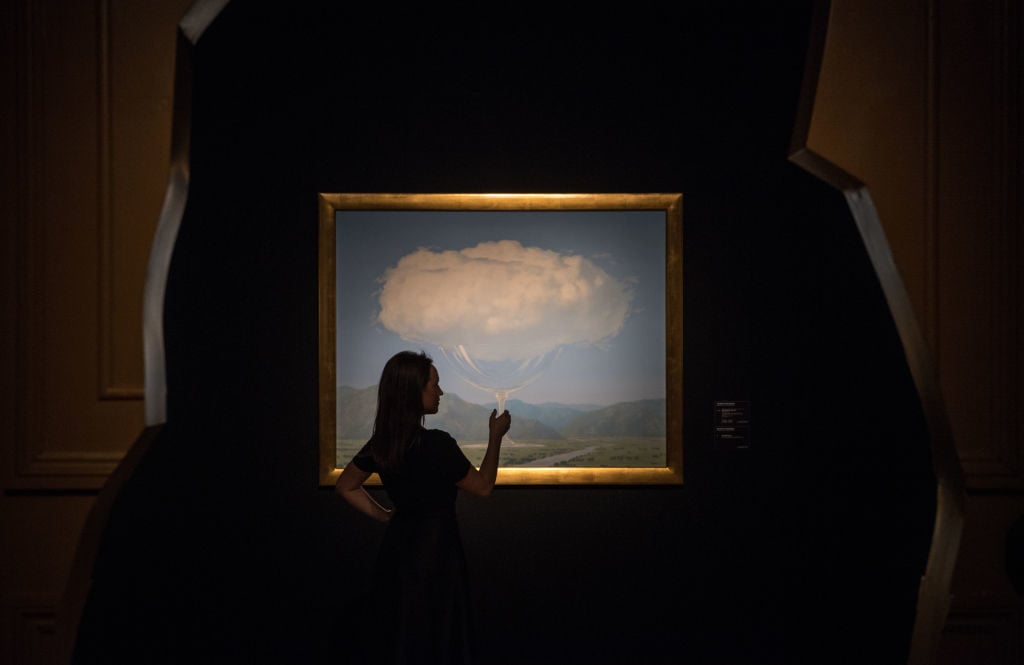
A woman poses for a photo in front of <em>La corde sensible</em> by Rene Magritte, estimated at £14-£18 million, at Christies on February 24, 2017 in London, England. 'The Art of the Surreal' sale will take place at Christies on 28 February, 2017. Photo by Chris J Ratcliffe/Getty Images.
A woman poses for a photo in front of La corde sensible by René Magritte, at Christie’s on February 24, 2017 in London. Photo by Chris J Ratcliffe/Getty Images.
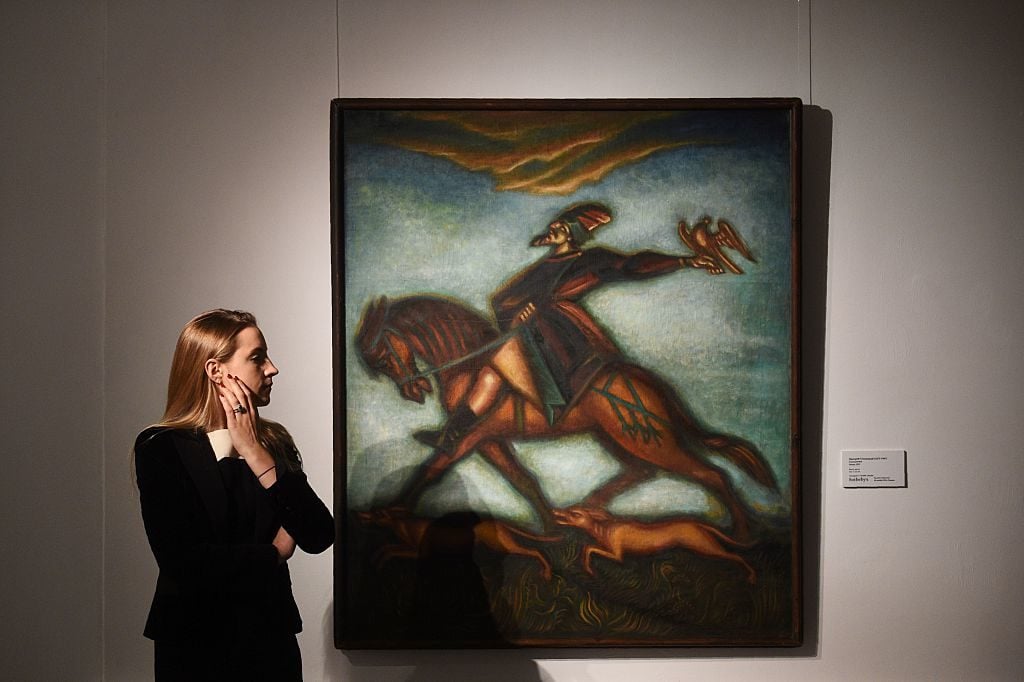
A woman stands by the painting <em>The Hunter</em> by Dmitri Stelletsky during a preview of Sotheby's forthcoming Russian Pictures Including the Bar-Gera Collection of Soviet Non-Conformist Art Sale in London, in Moscow on November 2, 2016. Photo credit Natalia Kolesnikova/AFP/Getty Images.
A woman stands by the painting The Hunter by Dmitri Stelletsky during a preview of Sotheby’s “Russian Pictures Including the Bar-Gera Collection of Soviet Non-Conformist Art Sale,” in Moscow on November 2, 2016. Photo credit Natalia Kolesnikova/AFP/Getty Images.
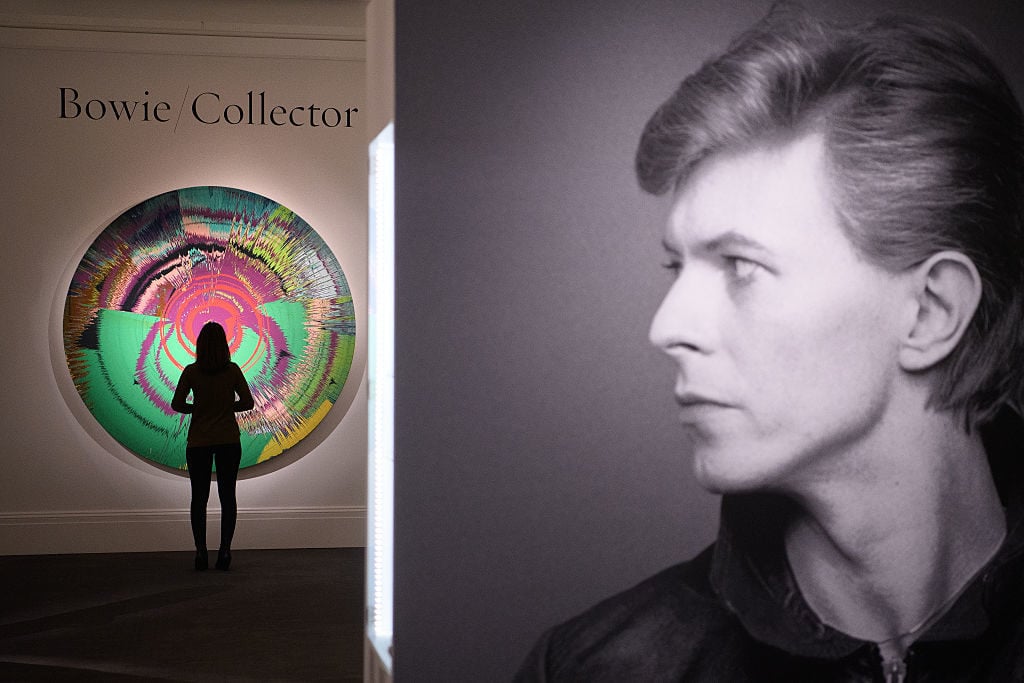
A gallery assistant poses with <em>Beautiful, Hallo, Space-Boy Painting</em> by Damien Hirst with David Bowie (est. £250,000-350,000) during the press preview of the "Bowie/Collector" auction at Sotheby's on November 1, 2016 in London, England. Photo by Leon Neal/Getty Images.
A gallery assistant poses with Beautiful, Hallo, Space-Boy Painting by Damien Hirst with David Bowie during the press preview of the “Bowie/Collector” auction at Sotheby’s on November 1, 2016 in London. Photo by Leon Neal/Getty Images.
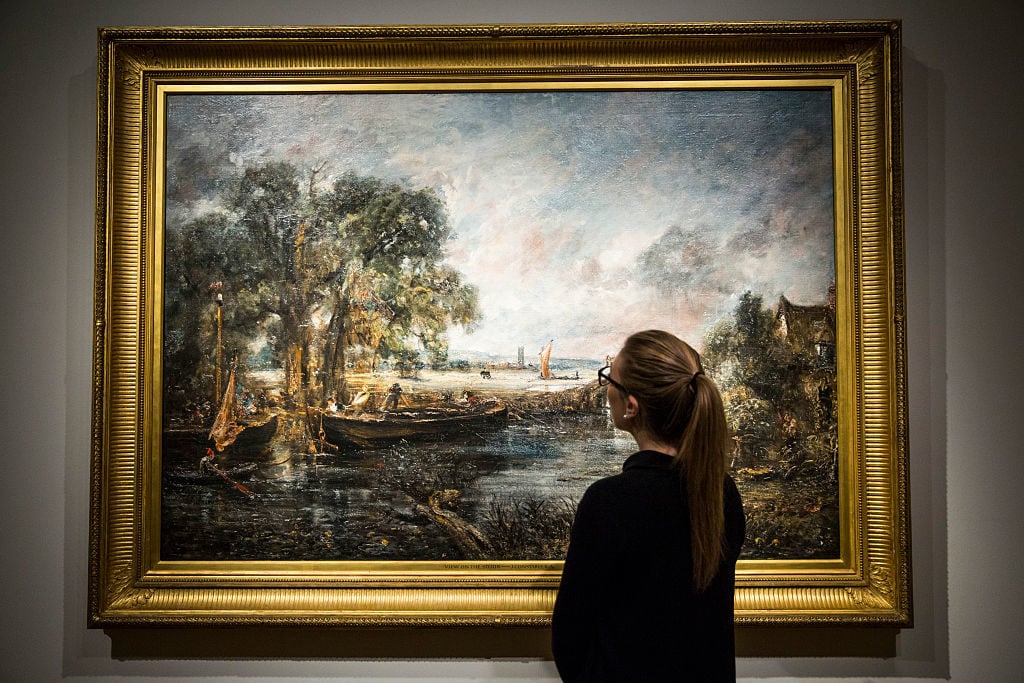
A Christie's employee poses with <em>View on the River Stour near Dedham</em> circa 1821-1822 by English painter John Constable at the auction house on May 26, 2016 in London, England. Photo by Jack Taylor/Getty Images.
A Christie’s employee poses with View on the River Stour near Dedham (ca. 1821-1822) by John Constable at the auction house on May 26, 2016 in London. Photo by Jack Taylor/Getty Images.
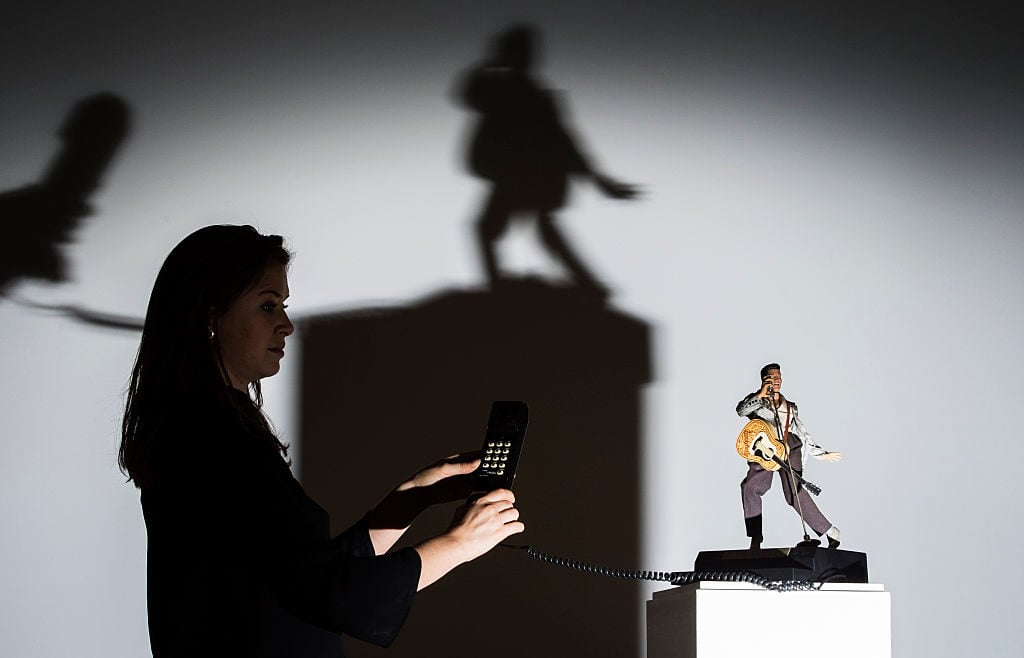
A Sotheby's employee stands with a novelty Elvis telephone during the pre-auction preview of the personal collection of Deborah Cavendish, Duchess of Devonshire at Sotheby's on February 26, 2016 in London, England. Photo by Justin Setterfield/Getty Images.
A Sotheby’s employee stands with a novelty Elvis telephone during the pre-auction preview of the personal collection of Deborah Cavendish, Duchess of Devonshire at Sotheby’s on February 26, 2016 in London. Photo by Justin Setterfield/Getty Images.
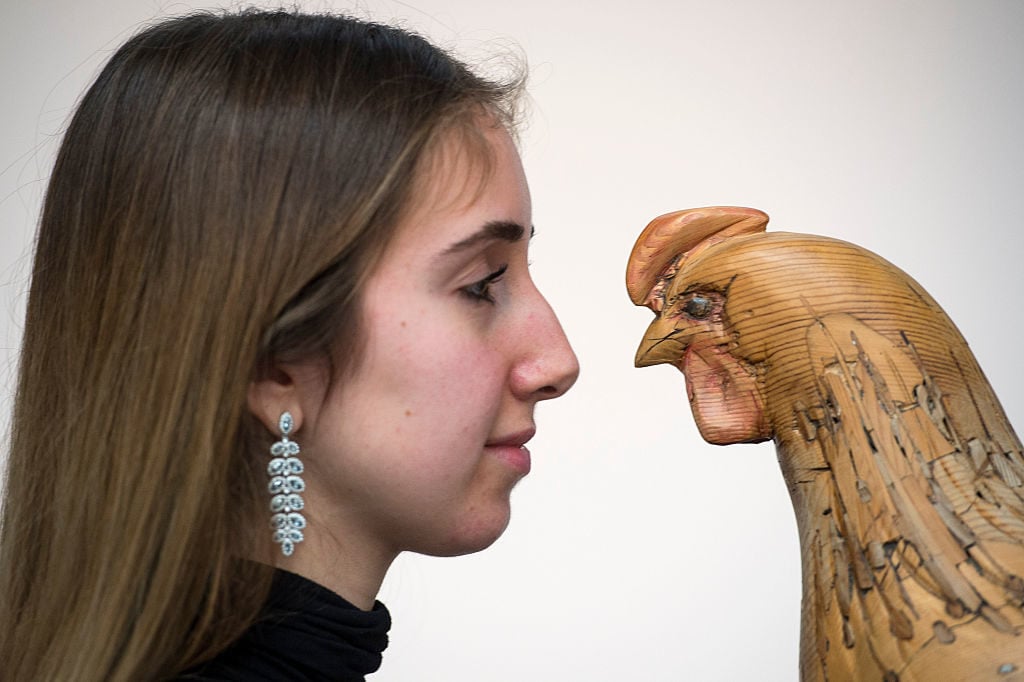
A Sotheby's employee stands next to a model of a hen by Nicholas Johnson during the pre-auction preview of the personal collection of Deborah Cavendish, Duchess of Devonshire at Sotheby's at Sotheby's on February 26, 2016 in London, England. Photo by Justin Setterfield/Getty Images.
A Sotheby’s employee stands next to a model of a hen by Nicholas Johnson during the pre-auction preview of the personal collection of Deborah Cavendish, Duchess of Devonshire, at Sotheby’s at Sotheby’s on February 26, 2016 in London. Photo by Justin Setterfield/Getty Images.
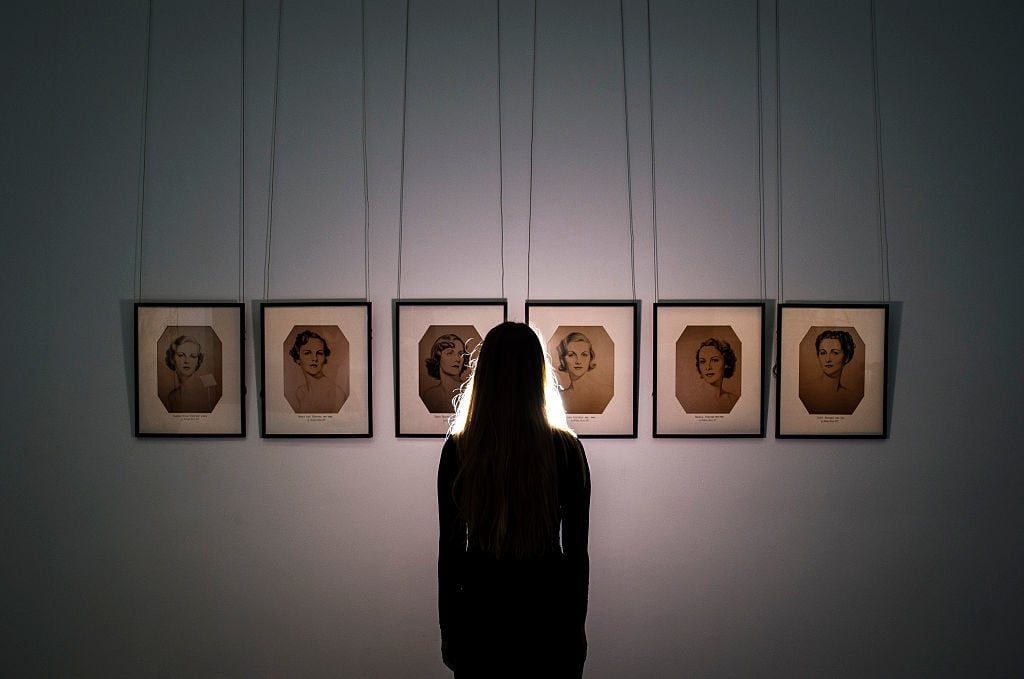
A Sotheby's employee stands in front of a series of portraits of the Mitford Sisters during the pre-auction preview of the personal collection of Deborah Cavendish, Duchess of Devonshire at Sotheby's on February 26, 2016 in London, England. Photo by Justin Setterfield/Getty Images.
A Sotheby’s employee stands in front of a series of portraits of the Mitford Sisters during the pre-auction preview of the personal collection of Deborah Cavendish, Duchess of Devonshire at Sotheby’s on February 26, 2016 in London. Photo by Justin Setterfield/Getty Images.
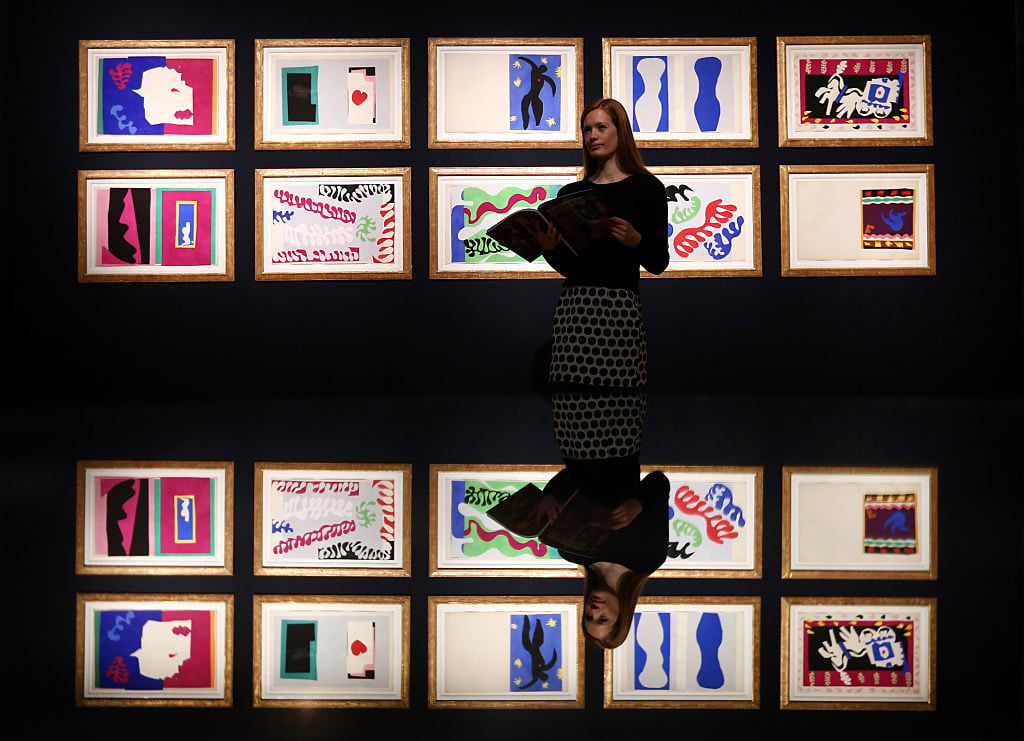
A member of staff is reflected as she poses next to a collection of Henri Matisse original prints from his jazz portfolio at Christie's auction house on February 17, 2016 in London, England. Photo by Carl Court/Getty Images.
A member of staff is reflected as she poses next to a collection of Henri Matisse original prints from his jazz portfolio at Christie’s auction house on February 17, 2016 in London. Photo by Carl Court/Getty Images.
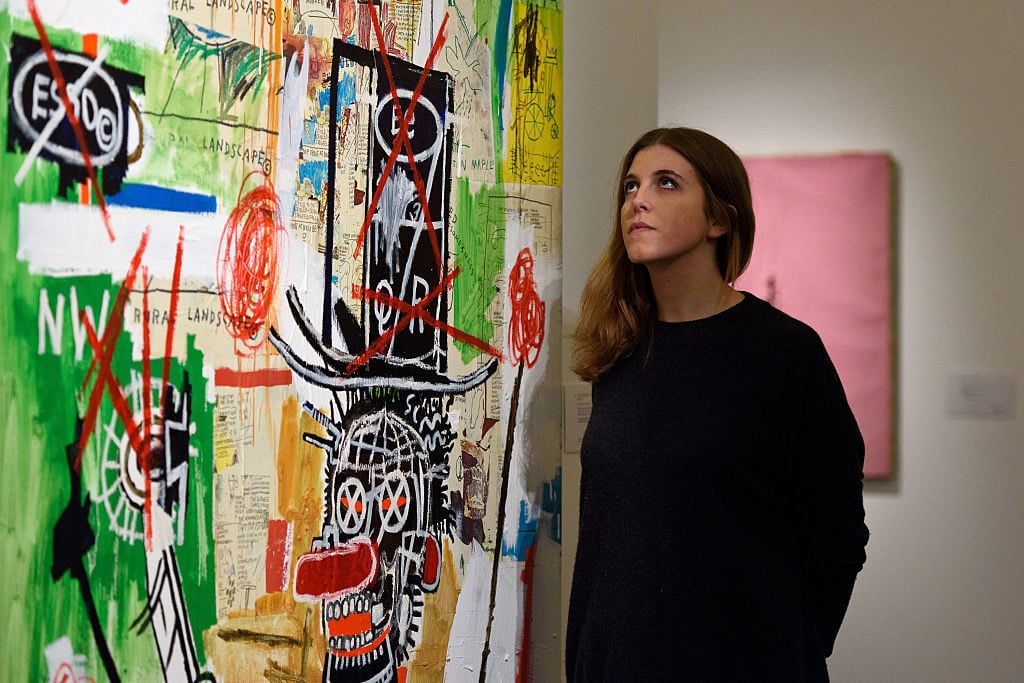
A gallery assistant views <em>Despues De Un Puno</em> by Jean Michael Basquiat which is expected to fetch 6 to 8 million GBP at Sotheby's on January 28, 2016 in London, England. Photo by Ben Pruchnie/Getty Images.
A gallery assistant views Despues De Un Puno by Jean Michael Basquiat at Sotheby’s on January 28, 2016 in London. Photo by Ben Pruchnie/Getty Images.
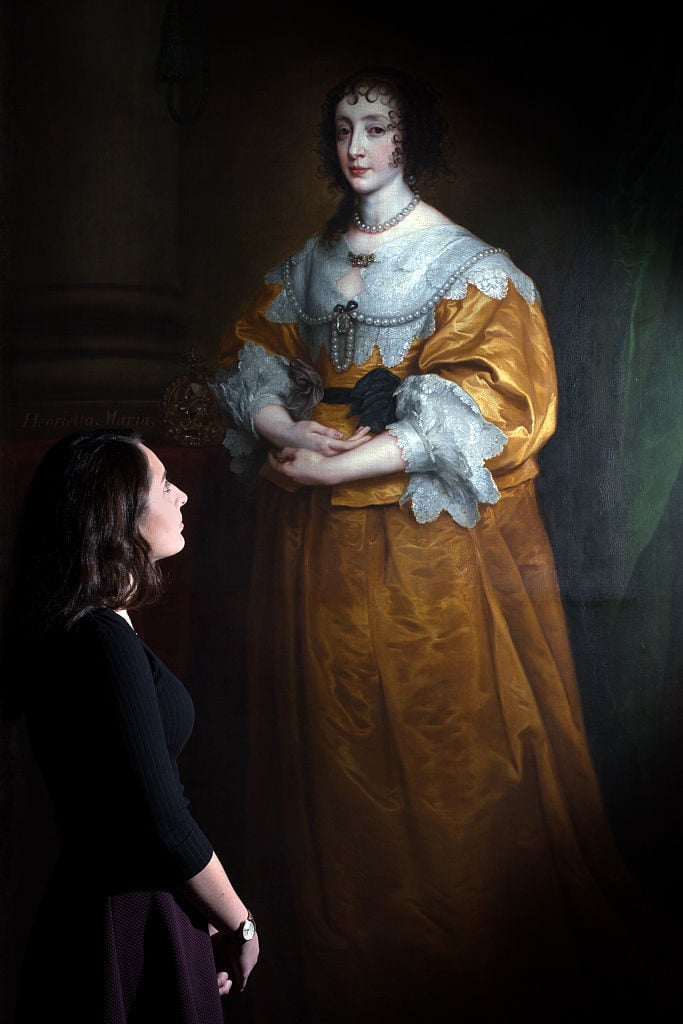
A member of staff poses next to a painting by Sir Anthony Van Dyck entitled <em>Portrait of Queen Henrietta Maria,/em> during a press preview at Sotheby's on December 4, 2015 in London, England. Photo by Carl Court/Getty Images.
A member of staff poses next to a painting by Sir Anthony Van Dyck entitled Portrait of Queen Henrietta Maria, during a press preview at Sotheby’s on December 4, 2015 in London. Photo by Carl Court/Getty Images.
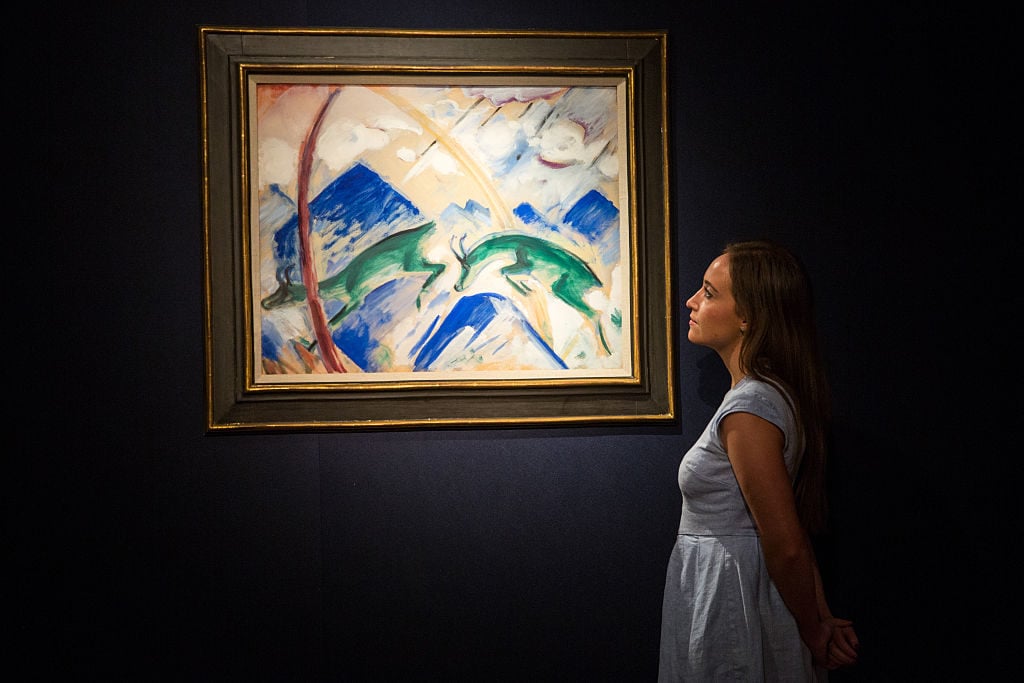
A member of staff poses beside Franz Marc's 1991 piece <em>Gemsen</em>, estimated at between £1.8-2.5 million, at Christie's King Street auction house on June 19, 2015 in London, England. Photo by Rob Stothard/Getty Images.
A member of staff poses beside Franz Marc’s 1991 piece Gemsen, at Christie’s King Street auction house on June 19, 2015 in London. Photo by Rob Stothard/Getty Images.
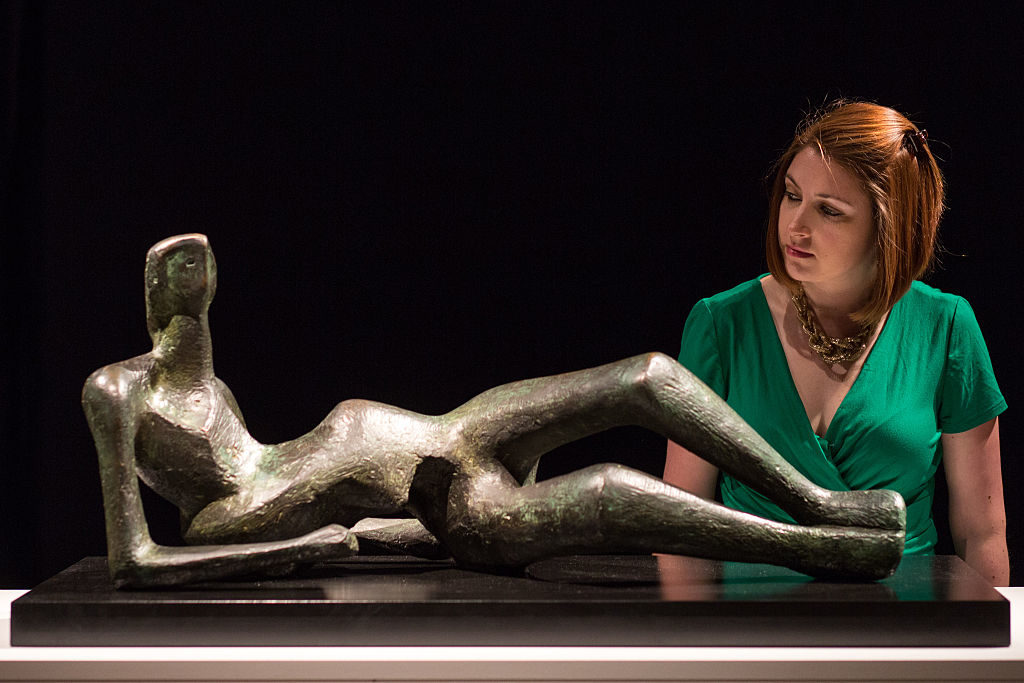
A member of staff looks at Henry Moore's sculpture <em>Reclining Figure No. 2</em>, conceived in 1952 and estimated at between £900,000 Ð £1,200,000, at Christie's King Street auction house on June 19, 2015 in London, England. Photo by Rob Stothard/Getty Images.
A member of staff looks at Henry Moore’s sculpture Reclining Figure No. 2, conceived in 1952, at Christie’s King Street auction house on June 19, 2015 in London. Photo by Rob Stothard/Getty Images.
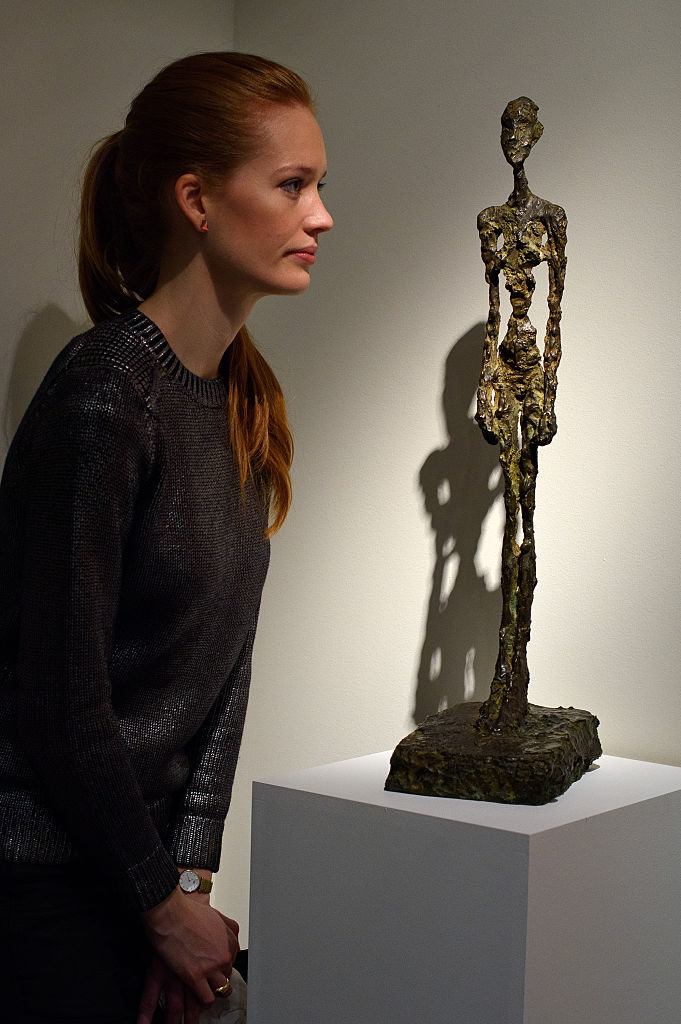
A guest views <em>Femme Debout</em> by artist Alberto Giacometti during the preview ahead of the artist's muse: a curated evening sale in Christie's New York on October 9, 2015 in London, England. Photo by Ben Pruchnie/Getty Images.
A guest views Femme Debout by artist Alberto Giacometti during the preview ahead of “the artist’s muse: a curated evening sale” at Christie’s New York on October 9, 2015 in London. Photo by Ben Pruchnie/Getty Images.
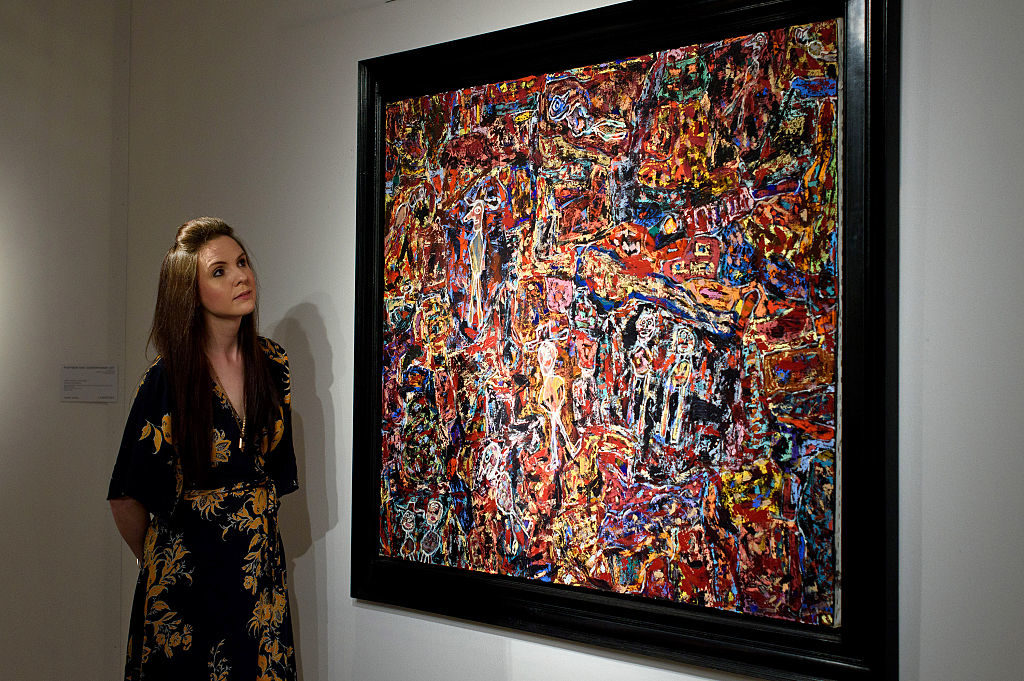
A guest views <em>Cote Chipote</em> by artist Jean Dubuffet during the preview ahead of Christie's New York post war and contemporary art sale on October 9, 2015 in London, England. Photo by Ben Pruchnie/Getty Images.
A guest views Cote Chipote by artist Jean Dubuffet during the preview ahead of Christie’s New York post war and contemporary art sale on October 9, 2015 in London. Photo by Ben Pruchnie/Getty Images.
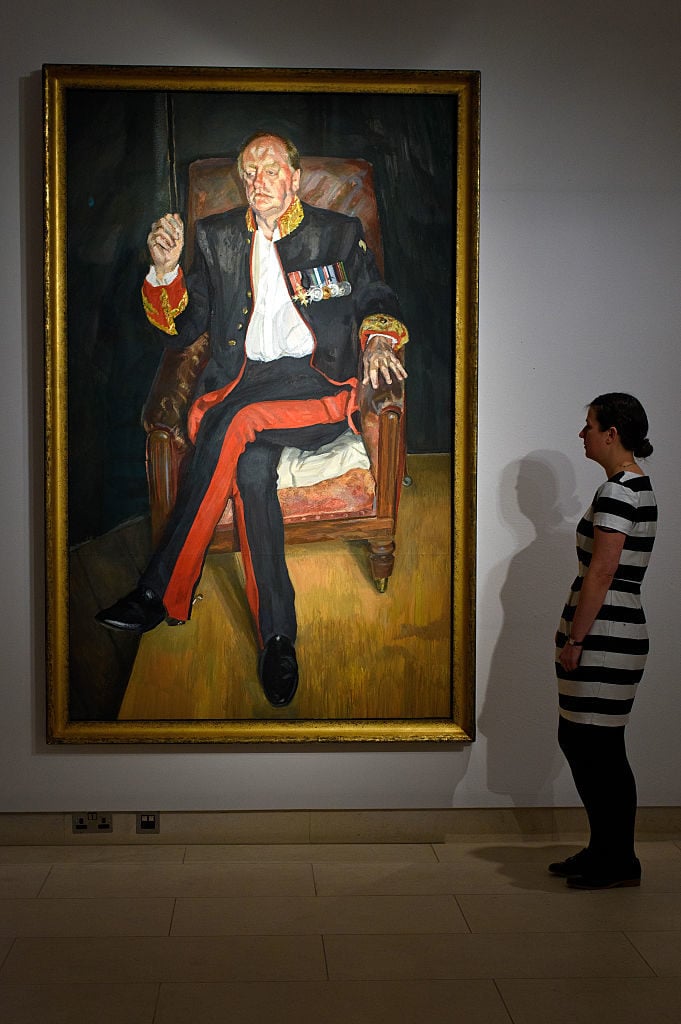
A gallery assistant views <em>The Brigadier</em> by artist Lucian Freud during the preview ahead of Christie's New York post war and contemporary art sale on October 9, 2015 in London, England. Photo by Ben Pruchnie/Getty Images.
A gallery assistant views The Brigadier by artist Lucian Freud during the preview ahead of Christie’s New York post war and contemporary art sale on October 9, 2015 in London. Photo by Ben Pruchnie/Getty Images.
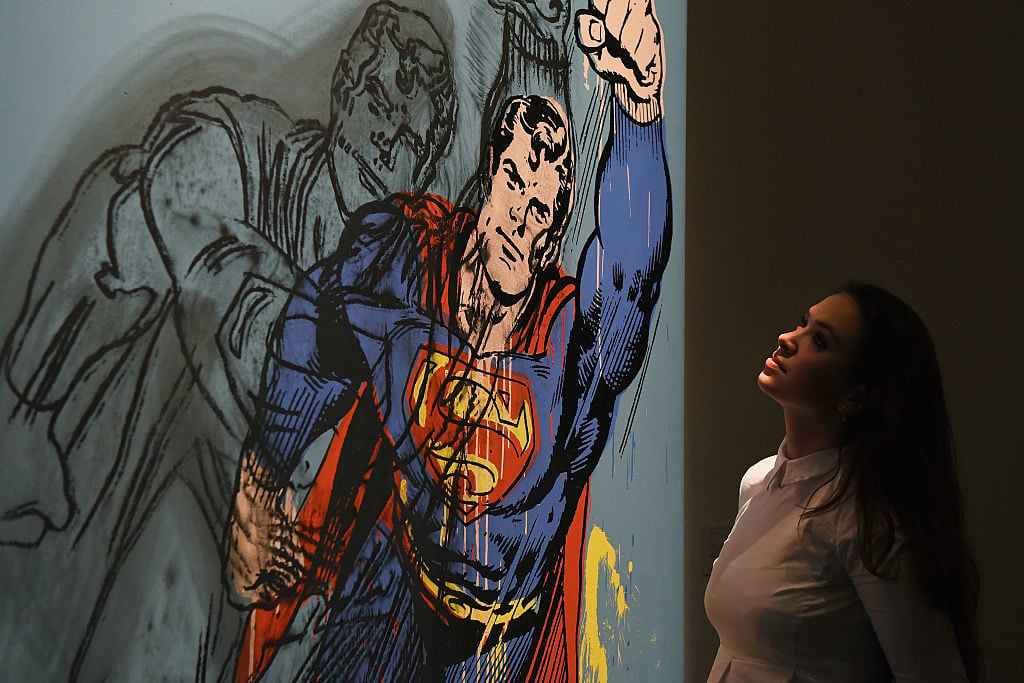
A gallery assistant looks up at Andy Warhol's <em>Superman</em> (1981) (estimated in the region of $6/8m), which has gone on show at Sotheby's on April 10, 2015 in London, England. Photo by Mary Turner/Getty Images for Sotheby's.
A gallery assistant looks up at Andy Warhol’s Superman (1981), which has gone on show at Sotheby’s on April 10, 2015 in London. Photo by Mary Turner/Getty Images for Sotheby’s.
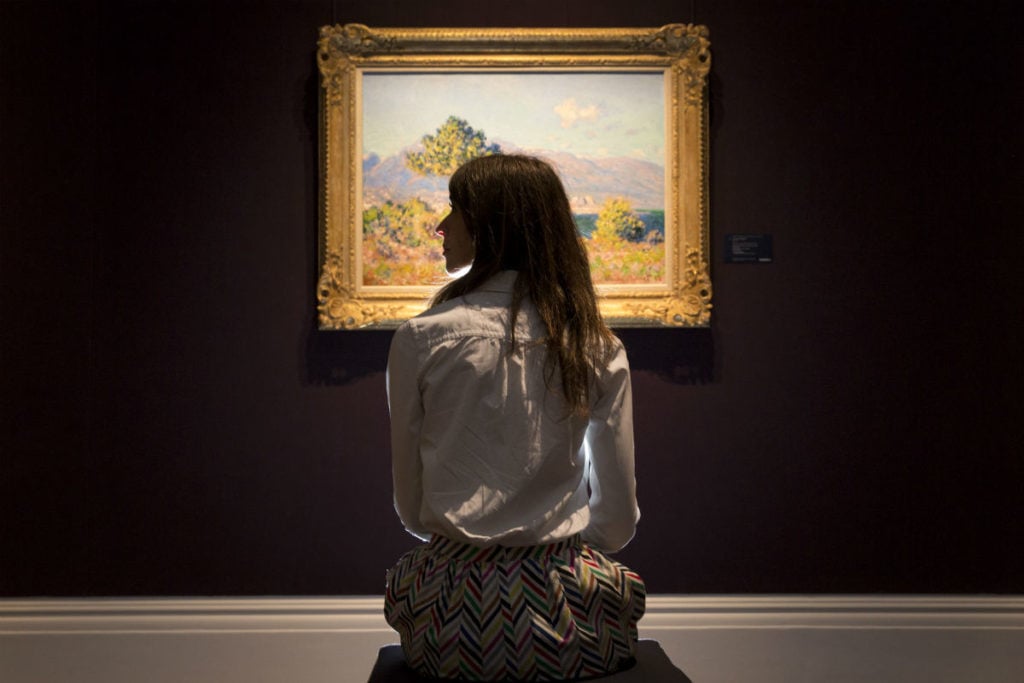
A woman sits in front of Claude Monet's 1888 piece <em>Antibes, vue du plateau Notre-Dome</em>,estimated to sell for £6-£8 million, on display at Sotheby's auction house on June 18, 2014 in London, England. Photo by Rob Stothard/Getty Images.
A woman sits in front of Claude Monet’s 1888 piece Antibes, vue du plateau Notre-Dome, on display at Sotheby’s auction house on June 18, 2014 in London. Photo by Rob Stothard/Getty Images.
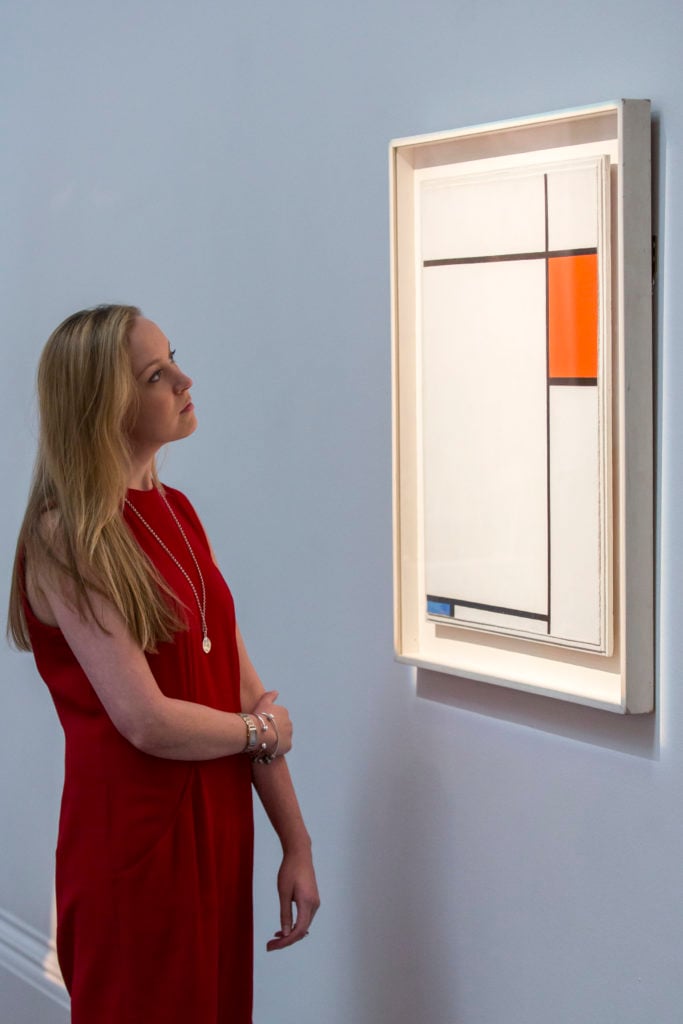
A member of Sotheby's staff poses with Piet Mondrian's 1927 piece <em>Composition with Red, Blue and Grey</em>, estimated to sell for between £13-£18 million, on display at Sotheby's auction house on June 18, 2014 in London, England. Photo by Rob Stothard/Getty Images.
A member of Sotheby’s staff poses with Piet Mondrian’s 1927 piece Composition with Red, Blue and Grey, on display at Sotheby’s auction house on June 18, 2014 in London. Photo by Rob Stothard/Getty Images.
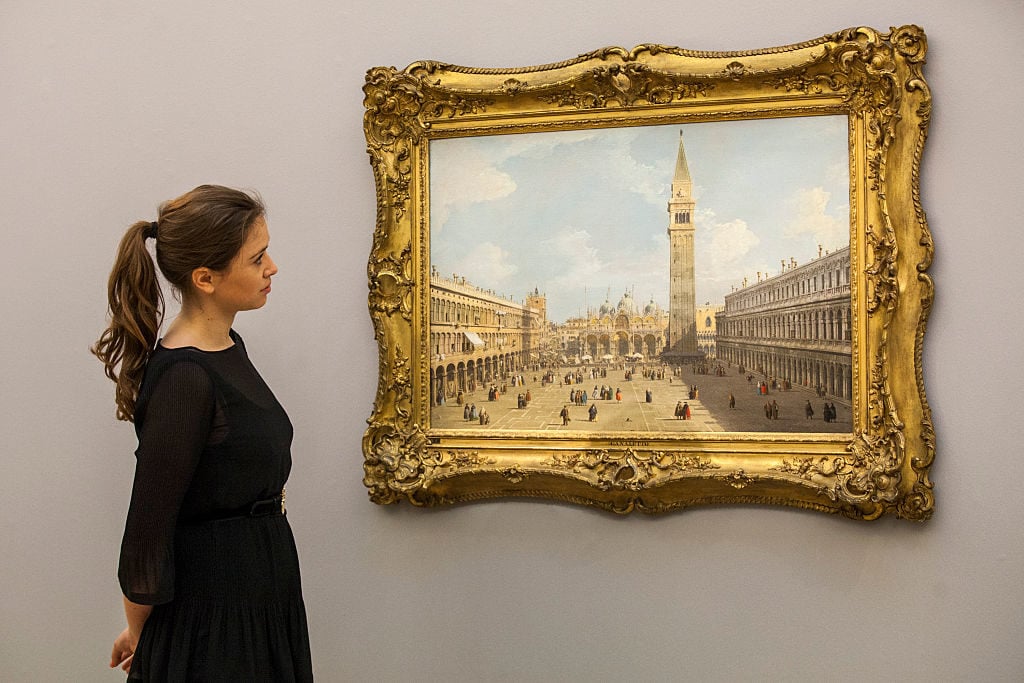
A Sotheby's auction house employee views <em>Venice, a view of Piazza San Marco looking east towards the Basilica</em> by Canaletto on November 28, 2014 in London, England. Photo by Rob Stothard/Getty Images.
A Sotheby’s auction house employee views Venice, a view of Piazza San Marco looking east towards the Basilica by Canaletto on November 28, 2014 in London. Photo by Rob Stothard/Getty Images.
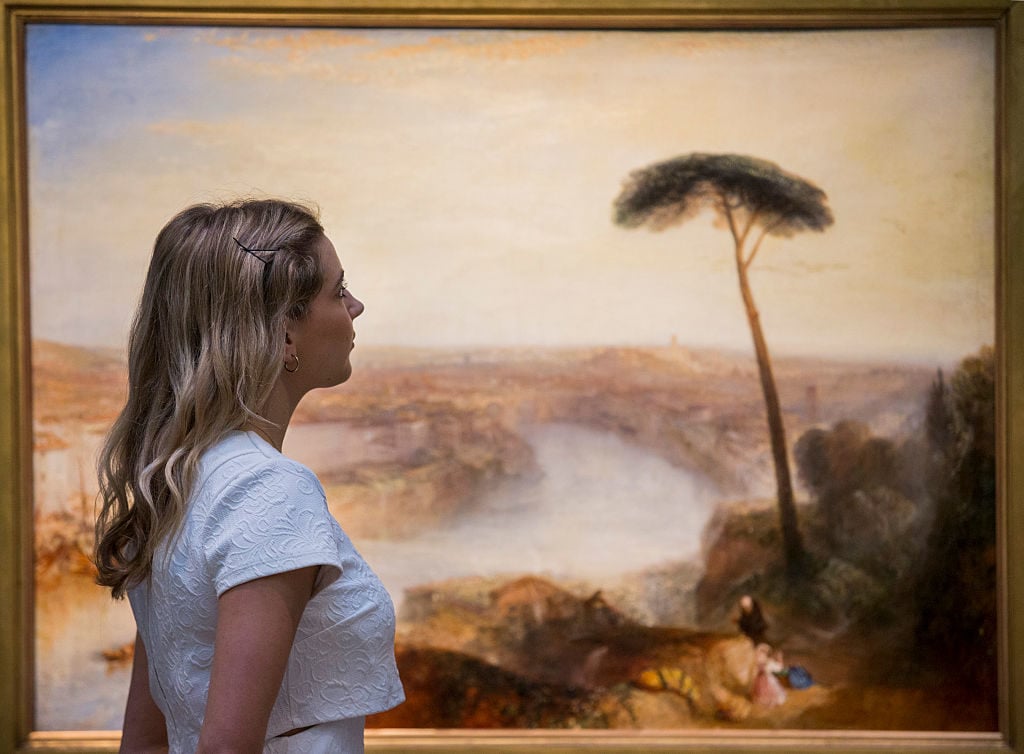
A Sotheby's auction house employee views <em>Rome, from Mount Aventine</em> by J.M.W. Turner on November 28, 2014 in London, England. Photo by Rob Stothard/Getty Images.
A Sotheby’s auction house employee views Rome, from Mount Aventine by J.M.W. Turner on November 28, 2014 in London. Photo by Rob Stothard/Getty Images.
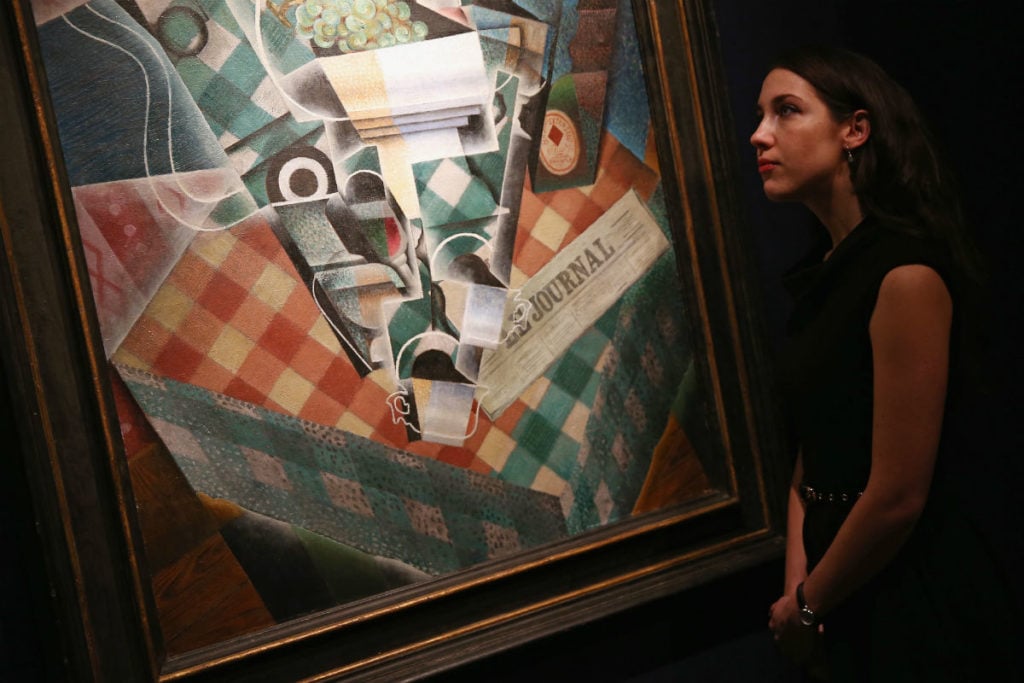
A Christie's employees pose besides a piece of work entitled <em>Nature morte a la nappe a carreaux</em> by Juan Gris at Christie's auction House on January 30, 2014 in London, England. Photo by Dan Kitwood/Getty Images.
A Christie’s employees pose besides a piece of work entitled Nature morte a la nappe a carreaux by Juan Gris at Christie’s auction house on January 30, 2014 in London. Photo by Dan Kitwood/Getty Images.
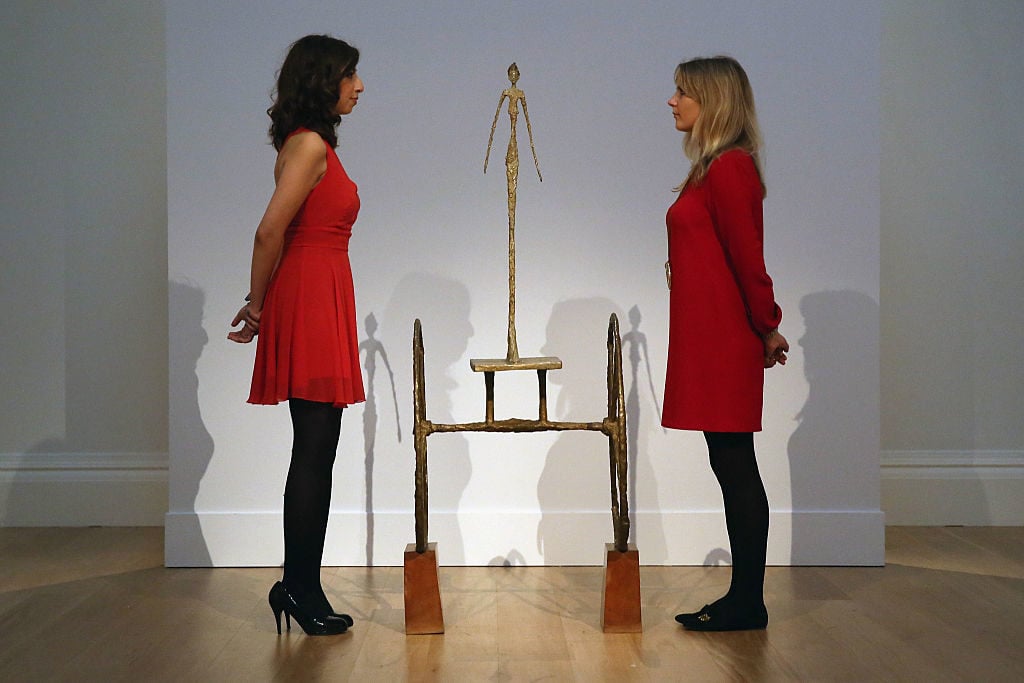
Employees pose next to a sculpture by Italian artist Alberto Giacometti entitled <em>Chariot</em> during a press preview at Sotheby's on October 10, 2014 in London, England. Photo by Carl Court/Getty Images.
Employees pose next to a sculpture by Italian artist Alberto Giacometti entitled Chariot during a press preview at Sotheby’s on October 10, 2014 in London. Photo by Carl Court/Getty Images.

Follow artnet News on Facebook: 
 
Want to stay ahead of the art world? Subscribe to our newsletter to get the breaking news, eye-opening interviews, and incisive critical takes that drive the conversation forward.
SHARE