Monday, July 16, 2018

Tower to Be an Ideal Home for Art Collectors


The Art of Living: Developer Aby Rosen on How He Designed His New Manhattan Tower to Be an Ideal Home for Art Collectors

Rachel Feinstein, Bryan Hunt, and Federico de Francesco are among the artists whose work appears in Rosen's newly developed tower.
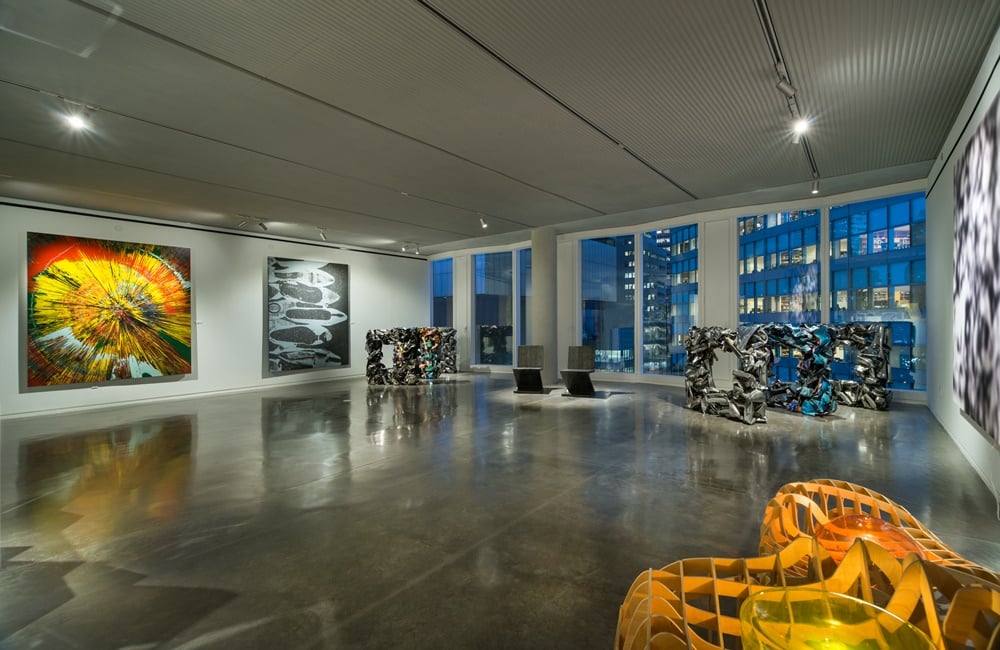
Two-bedroom loft living room. Photo by Bjorg Magnea
Who better than a top New York art collector to design a luxury Manhattan tower that caters to other art lovers and collectors?
Real-estate developer and mega-collector Aby Rosen is behind the new 63-story building in midtown, known as 100 East 53rd, which is directly adjacent to the Seagram building, which Rosen’s RFR Realty company owns and operates.
Rosen, who is co-founder and principal of RFR, worked with his favorite architect, Norman Foster of Foster + Partners, to design the building, which has more than 94 units. In-house perks include a swimming pool, spa, private lounge, and a restaurant helmed by chef Joël Robuchon. Apartments start at $2.3 million and go up to $65 million for a duplex penthouse. (According to reports, George and Amal Clooney and Cindy Crawford and her husband Randy Gerber have already snapped up units in the building.)
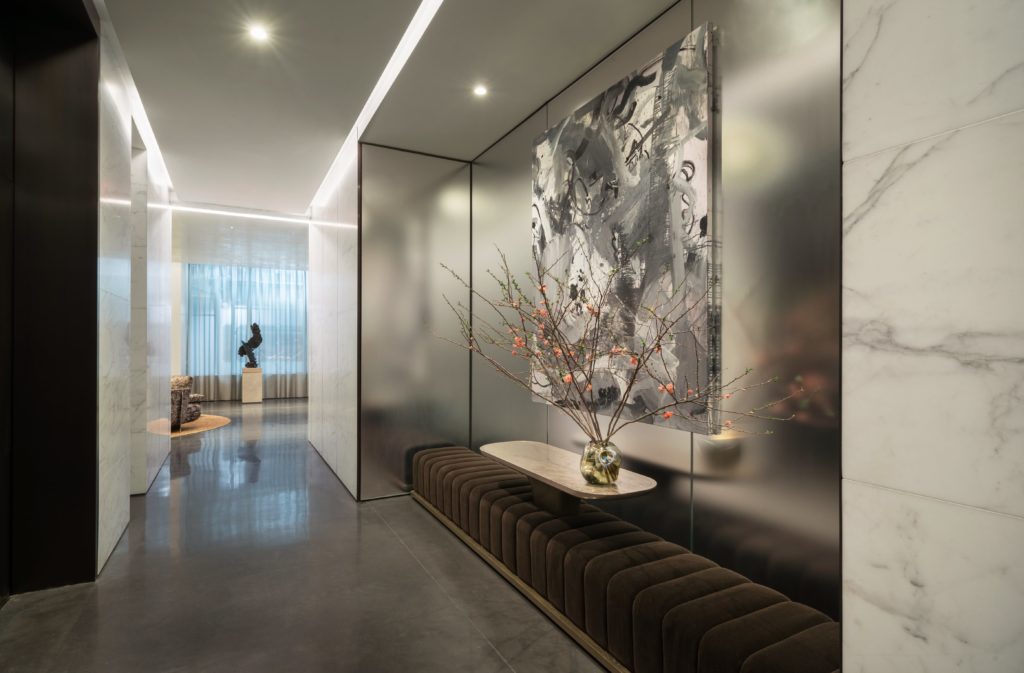
Oh, and did we mention the art? Not only has Rosen studded model apartments with works from his own collection to give buyers a sense of how their new homes might look, he and his sales staff are offering to advise or connect clients with art advisors. Rosen has also commissioned site-specific works and acquired permanent pieces for the lobby.
We caught up with Rosen to talk about the inspiration for the building and its fusion of art, architecture, and design.
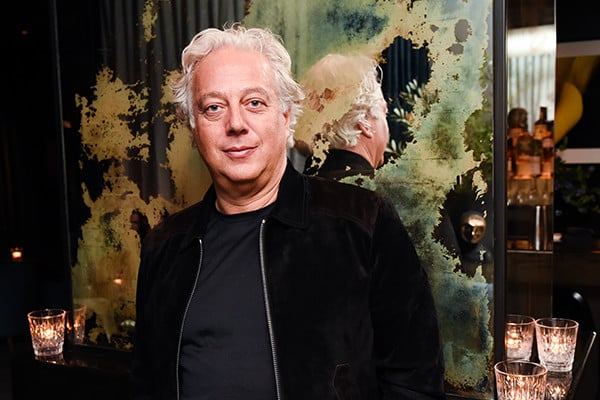
Aby Rosen. Photo: courtesy BFA.
Tell us about the first works of art that visitors encounter—the art in the lobby.
We commissioned a whole installation by Rachel Feinstein here. I love her work and we did a show with her at Lever House. The new one is Panorama of New York, and she painted on mirror with acrylic and resin. It hangs in the vestibule of the building and you can see into it. You see a silhouette of the Empire State Building and the Woolworth Building. It really draws your eye but it’s not like a regular mirror that you look into to make sure that you look good. It’s like a fantasy cityscape and reflects the energy of what New York is all about. It’s a really playful moment. Then there is a painting by young dynamic artist Federico de Francesco that hangs close to the elevator, and a mid-1990s bronze CAIRN II sculpture by Bryan Hunt, which fits with another theme.
Which is?
Well, Norman Foster was very smart in saying to us, “Pick something that is in the neighborhood that is strong and significant and that adds quality to our building.” With the Seagram building in mind, we chose bronze. There is nothing better than bronze. It ages really well, so we pulled that in and incorporated the so-called neighbor into this building with bronze touches throughout.
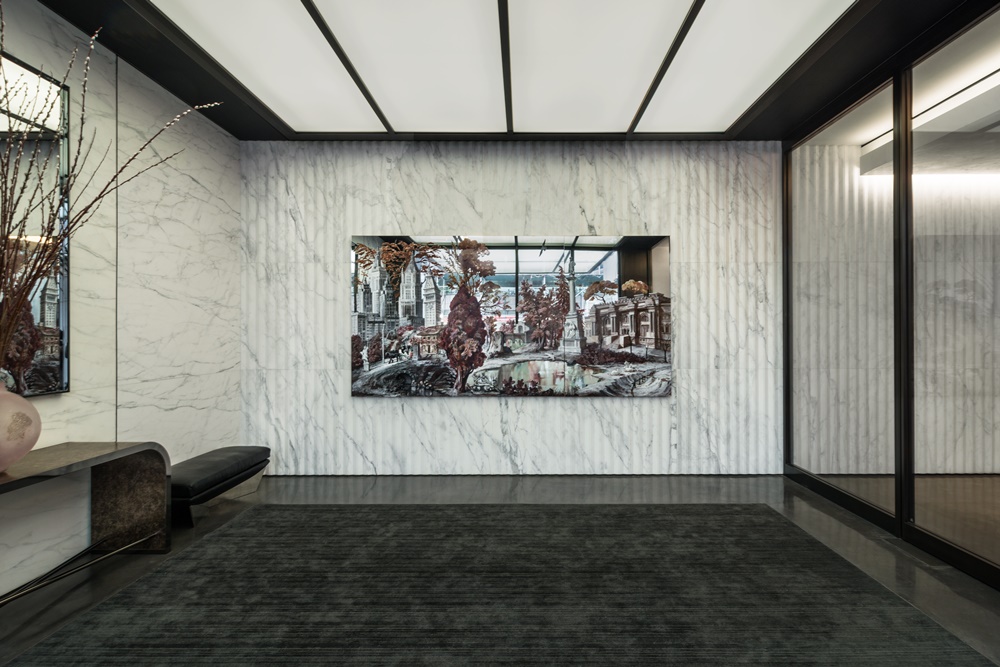
Lobby with Rachel Feinstein work. Photo by Bjorg Magnea
Lobby with Panorama of New York by Rachel Feinstein. Photo by Bjorg Magnea.
Are you the sole decision maker when it comes to selecting the art?
Yes. This is a dictatorship here and a benevolent dictator makes decisions. We do take care how we curate the spaces, what books we put there, what kind of accessories. We agonize over every detail. In the end, it’s all in the detail. 
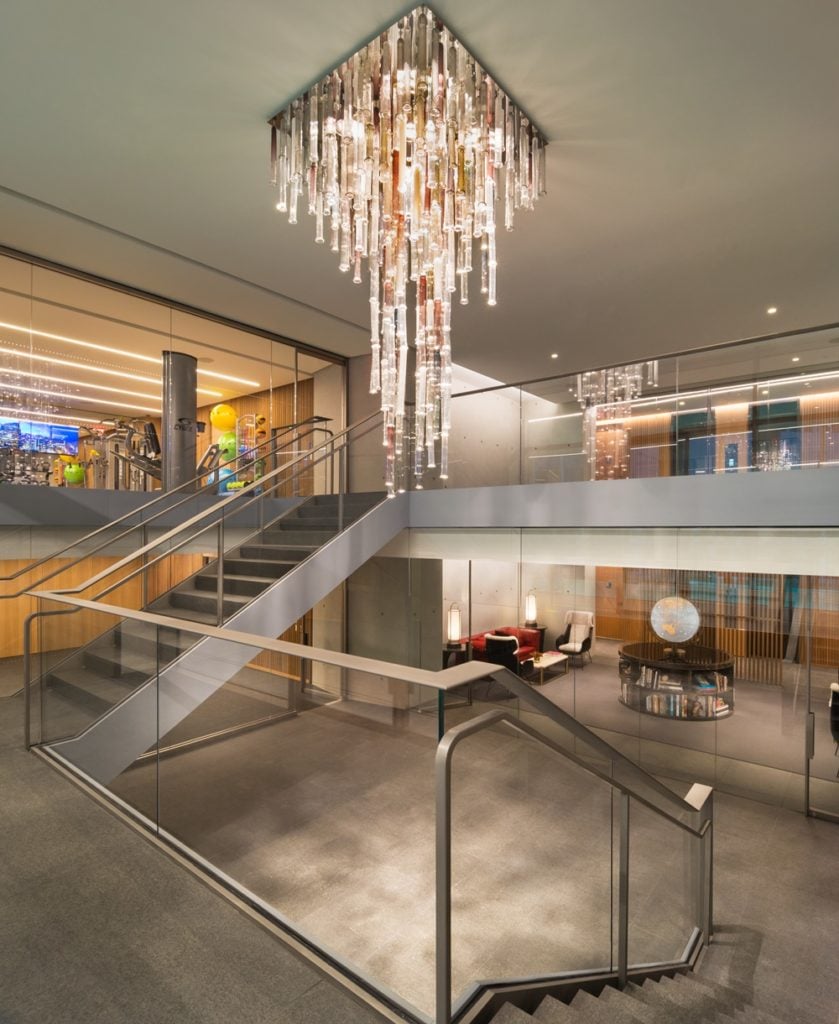
Private residents' club. Photo by Bjorg Magnea
Private residents’ club. Photo by Bjorg Magnea.
Tell us about the apartments themselves.
The fifth- through ninth-floor loft apartments have very much a kind of downtown feel with gray walls and concrete floors. They have kind of a gritty feel. Higher up we have some model apartments with beautiful furniture, some art, some photography, and drawings that give somebody a more finished version of how the home might look.
What about the furniture and interior design?
In addition to showing both big and smaller paintings to help buyers envision living with their collection, another dialogue we have is about how the right furniture is equally important. It’s no accident that design sales in the last two to three years are through the roof at all three major auction houses. A $20,000 lamp is today a $200,000 lamp—it becomes like a piece of art. If you look at any Giacometti lamp or table they are easily $300,000 to $400,000. So it’s not always about what goes on the wall. It’s also about what goes on the floor, and how art, architecture, and furniture all work together.
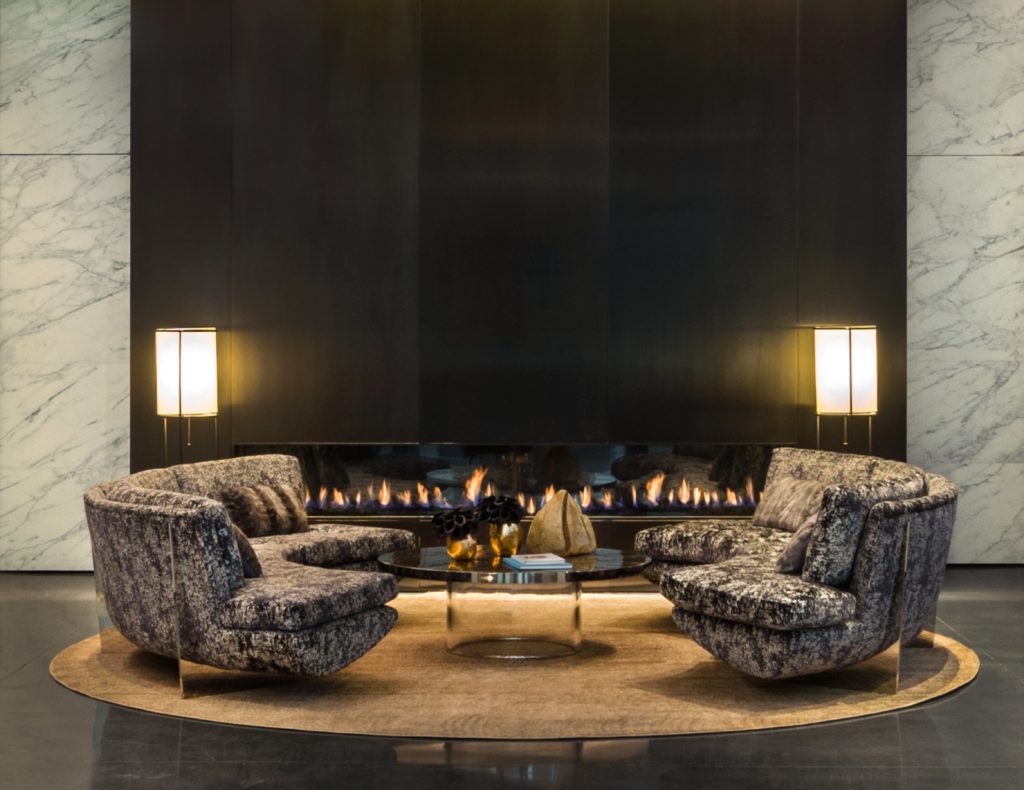
Lobby seating area. Photo by Bjorg Magnea
Who do you envision buying apartments here? Do you have to be a collector?
We’re trying to promote and talk about a different lifestyle than you find on Fifth Avenue and Park Avenue. Maybe for younger people who grew up in those buildings, they don’t necessarily want to go back to this kind of environment but instead one that’s a bit more unstructured and contemporary.
Beyond that, there are many different types of buyers. Some people plan three years in advance, while others need instant gratification. Then there are the art and architecture junkies who are drawn to the fact that the building is designed by Norman Foster or those that wait to buy when it’s 98 percent done because they want to wait and see what is actually happening and then move in three months later.
Federico de Francesco, Homage to Romanian Blouse III-1 (2017). 
Federico de Francesco, Homage to Romanian Blouse III-1 (2017). Photo by Bjorg Magnea.
Given that ultra-competitive landscape, what else sets 100 East 53rd apart?
The more we’re pushing this whole art, architecture, and design concept, the more we realize we’re on the right track. We have the sourcing and we have the right people working for us so it’s like selling a package, an idea. The more we get into a dialogue with buyers the more of a chance we have to actually close out a transaction. It’s not only square footage that makes the difference, it’s the energy and the time that the developer spends with the builder that shows we have shared interests and are on the same wavelength with potential buyers. People understand our story and we have a compelling story to tell.

Follow artnet News on Facebook: 
 
Want to stay ahead of the art world? Subscribe to our newsletter to get the breaking news, eye-opening interviews, and incisive critical takes that drive the conversation forward.
SHARE
Article topics

the Fastest-Growing Forces in Art Collecting


Women and Millennials Are the Fastest-Growing Forces in Art Collecting, a New Study Finds

Nearly one third of wealthy women own art or are interested in buying it.
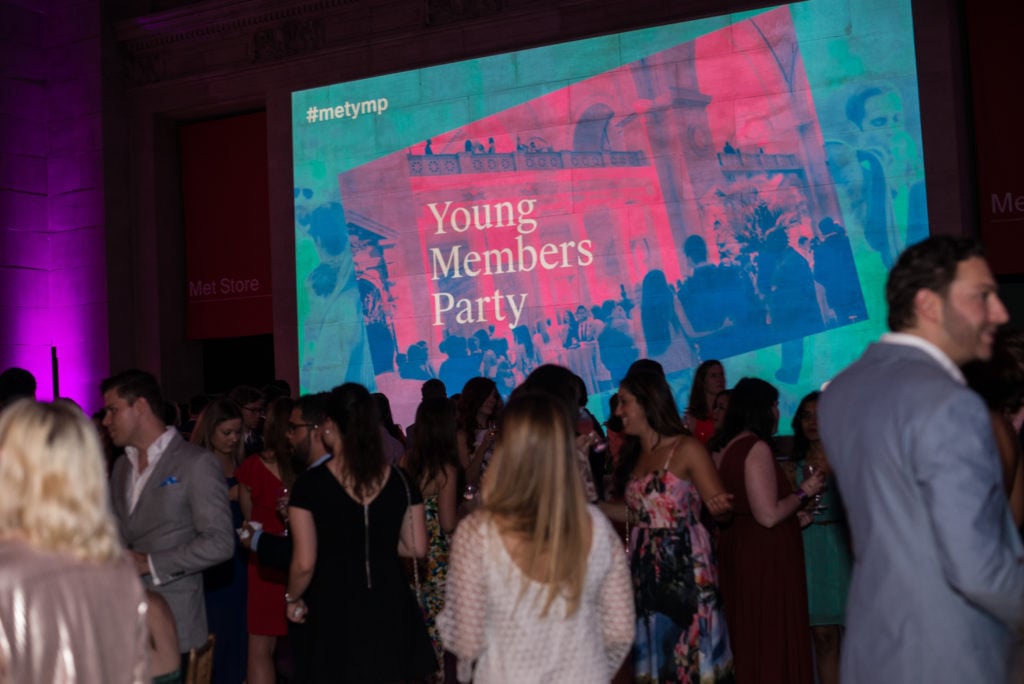
The Metropolitan Museum of Art. ©Patrick McMullan, Jared Michael Siskin/patrickmcmullan.com.
Statistics about the collecting patterns of new or newly wealthy art buyers are notoriously hard to come by, apart from what can be gleaned through analyzing auction data, usually at the very top of the market. However, the latest survey from US Trust, the private wealth management division of Bank of America, may help shine more light on the matter.
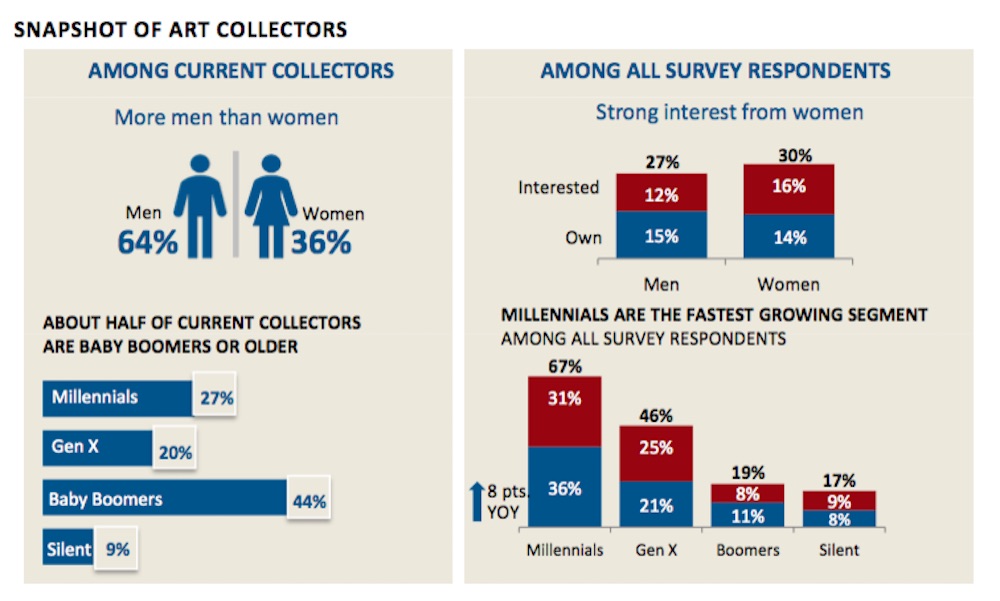
The findings showed that while the traditional art market is still largely dominated by male collectors, women are an undeniably growing force. Among all survey respondents, one in three high-net-worth women either owns art (14 percent) or is interested in collecting (16 percent), with interest among women higher than men. A considerable uptick in online art buying is also being largely driven by women, the survey found.
US Trust has been periodically surveying wealthy households since 1993. The latest independent study surveyed 892 high-net-worth and ultra-high-net-worth households across the country. The special section on art includes findings about respondents’ reasons for buying, frequency of buying and selling, and their longer-term views of their art holdings, such as aesthetic value versus financial appreciation.
Source: US Trust
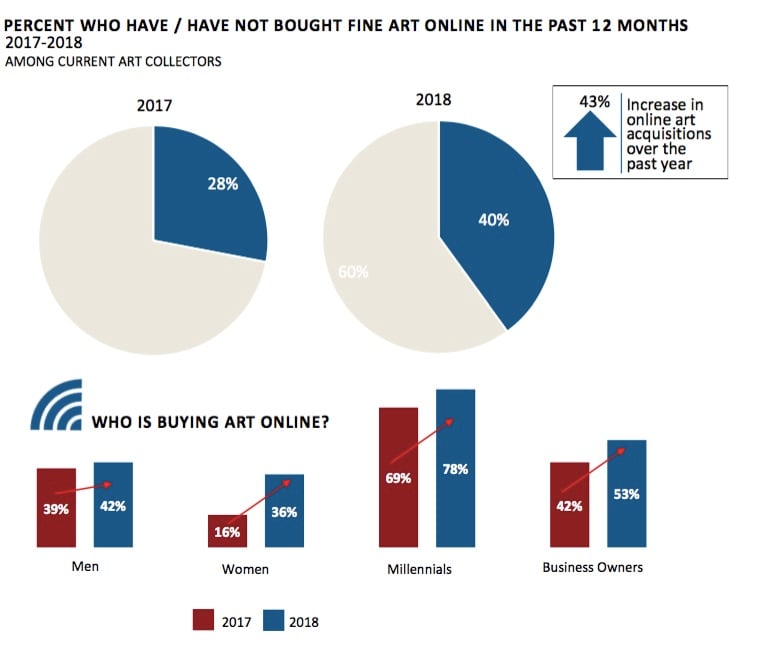
Source: US Trust
While baby boomers are still the dominant generation of art collectors—comprising about half of all current collectors—millennials are the fastest growing segment. Their rates of art ownership rose 8 percent since last year, to 36 percent of the total respondents.
While aesthetic enjoyment continues to be the primary reason for collecting art, “a generational shift is now underway,” the survey said. Younger collectors tend to be more financially driven and attuned to the role of art as a financial asset, with a third of millennial collectors seeing their art as an asset to leverage into more wealth. This new generation of aspiring collectors is also drawn to the social aspects of collecting, such as engaging with other collectors and artists, the survey found.
Source: US Trust
More than 75 percent of the collectors polled said they “anticipate making a purchase this year.” Nearly all (97 percent) of millennial collectors and 60 percent of Gen X collectors said they would buy this year. Plus, younger collectors appear to have less reservation when it comes to selling: “The old adage that collectors aren’t sellers is fading. . .Expect more market churn going forward, especially via digital channels, which may bode well for auction houses and dealers.”

The survey also showed a considerable uptick in online art buying: 43 percent more collectors bought art online in the past year compared with 2017. Women were the biggest drivers of the growth in online acquisitions, which may be partly attributed to the “rise of the digital channel for decorative arts in particular,” according to the survey.

Follow artnet News on Facebook: 
 
Want to stay ahead of the art world? Subscribe to our newsletter to get the breaking news, eye-opening interviews, and incisive critical takes that drive the conversation forward.
  • Access the data behind the headlines with the artnet Price Database.
SHARE
Article topics

Artists Poor?... Hardwired Into Their Brain Chemistry


Why Are Artists Poor? New Research Suggests It Could Be Hardwired Into Their Brain Chemistry

The dopamine reward systems in artists' brains don't react much to money.
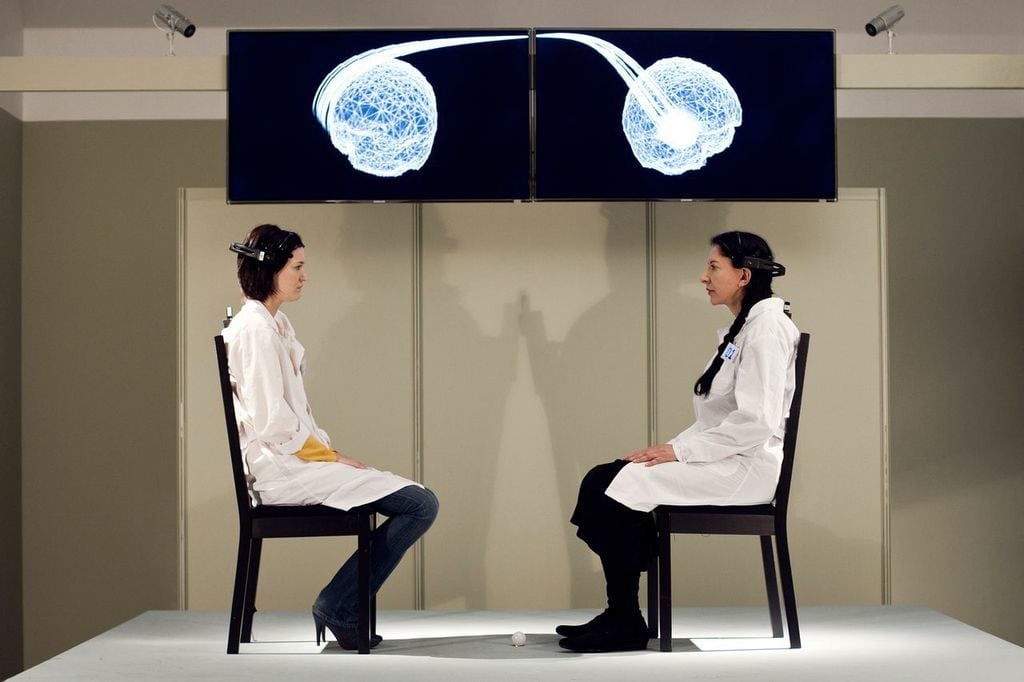
“Measuring the Magic of Mutual Gaze,” by Marina Abramovic, Suzanne Dikker, Matthias Oostrik. ©Marina Abramovic, 2011. Photo by Maxim Lubimov, Garage Center for Contemporary Culture.
Most artists work for exceptionally low pay. Despite the precarious nature of the art economy, they carry on, ostensibly sacrificing monetary compensation for the loftier reward of creative freedom. But what if some artists are actually—physiologically—hardwired not to care about money?
That’s the implication of a new study published in the Creativity Research Journal, led by Dr. Roberto Goya-Maldonado, who is head of the systems neuroscience and imaging in psychiatry lab at the University Medical Centerin Göttingen, Germany. The research team watched for activity in the parts of the brain that produce dopamine—the chemical that delivers rushes of excitement often associated with sex, drugs, and gambling—when groups of both artists and non-artists were presented with offers of free cash.
It’s worth mentioning up front that the sample size of the study is pretty small. Twenty-four participants completed the test and had their brain scans analyzed. Twelve of them worked in the arts, either as actors, painters, sculptors, musicians, or photographers. The other group of 12 included an insurance salesman, a dentist, a business administrator, and an engineer, among other professions, none of whom self-identified as “creative.”
Each participant wore a set of goggles that showed a series of squares in different colors. When the green square appeared, they could select it with a button and receive money (up to €30). They were also asked to select other “target” colors, but those did not result in any monetary reward.
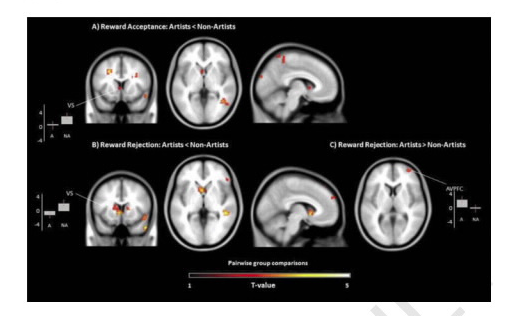
At the same time, researchers scanned participants’ brain activity using functional magnetic resonance imaging (fMRI). They found that artists showed significantly reduced activation in the ventral striatum, part of the brain’s reward system, when they selected the money-making green squares compared to non-artists.
Brain scans looking at the dopaminergic reward system of artists and non-artists in the new study “Reactivity of the Reward System in Artists During Acceptance and Rejection of Monetary Rewards” in the Creativity Research Journal.
Adding a twist to their findings, the researchers also discovered in a second test that artists showed a greater response in another dopamine-related part of the brain (the anterior prefrontal cortex) when they were told to reject the green squares. In other words, artists get less worked up about receiving money and more worked up when they know they can’t have it.
“Collectively, our results indicate the existence of distinct neural traits in the dopaminergic reward system of artists, who are less inclined to react to the acceptance of monetary rewards,” the researchers write.

Follow artnet News on Facebook: 
 
Want to stay ahead of the art world? Subscribe to our newsletter to get the breaking news, eye-opening interviews, and incisive critical takes that drive the conversation forward.
SHARE

Wes Anderson Is Bringing His Retro Whimsy to Vienna for His Curatorial Debut


Mummies in Tweed? Wes Anderson Is Bringing His Retro Whimsy to Vienna’s Art History Museum for His Curatorial Debut

The filmmaker is curating the show with his partner, Juman Malouf.

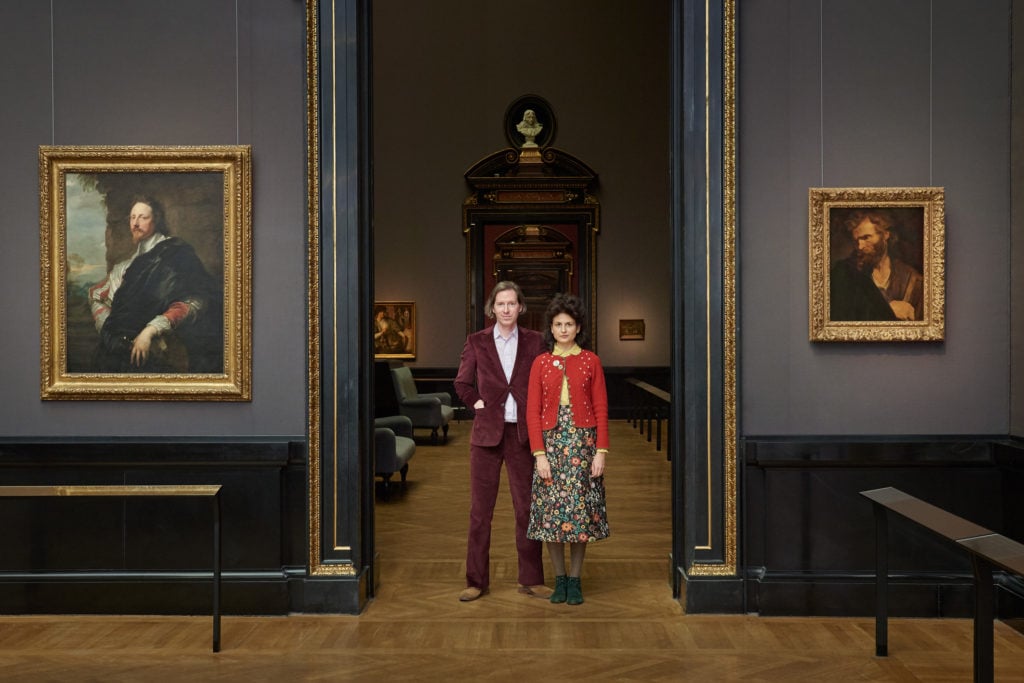
Wes Anderson and Juman Malouf. Courtesy of Kunsthistorisches Museum Vienna.

Vienna’s preeminent art history museum, the Kunsthistoriches Museum, intrigued audiences earlier this year when it announced that acclaimed filmmaker Wes Anderson and his partner, illustrator and costume designer Juman Malouf, were going to curate an exhibition there.
Now, the museum has finally released a few details about the mysterious project, which will be called “The Spitzmaus Mummy in a Coffin and Other Treasures from the Kunsthistorisches Museum​.” The exhibition dates have also changed, moving back a few months from September to early November.
In a brief teaser video, museum curator Jasper Sharp gives a quick rundown of some of the kinds of objects viewers can expect to see. “We have given Wes and Juman a very special but somewhat overwhelming invitation: to sort through all of the objects in our museum,” Sharp says in the video. The collections contain “an embarrassment of riches,” he says, including Egyptian mummies, Greek and Roman antiquities, Old Master paintings, and crown jewels.
Sharp says the project is unlike anything the museum has done before. It is, however, part of an unusual ongoing exhibition series that began in 2012 to invite artists in various fields to curate their first shows. First up that year was American photographer Ed Ruscha, followed by British artist and author Edmund de Waal in 2016.
Anderson is known around the world for his quirky vintage aesthetic and highly curated film sets, which makes the leap to curating at the Kunsthistoriches Museum, Austria’s largest and most prestigious arts institution, seem like a natural fit.
“The Spitzmaus Mummy in a Coffin and Other Treasures from the Kunsthistorisches Museum​” will be on view at the Kunsthistoriches Museum in Vienna from November 6, 2018 through April 28, 2019. 

Follow artnet News on Facebook: 

Want to stay ahead of the art world? Subscribe to our newsletter to get the breaking news, eye-opening interviews, and incisive critical takes that drive the conversation forward.
SHARE

Pussy Riot Members Storming the Field During the World Cup Final


Four Pussy Riot Members Are Arrested After Storming the Field During the World Cup Final

The activist group's performance "Policeman Enters the Game" is a show of solidarity with Russia's political prisoners.

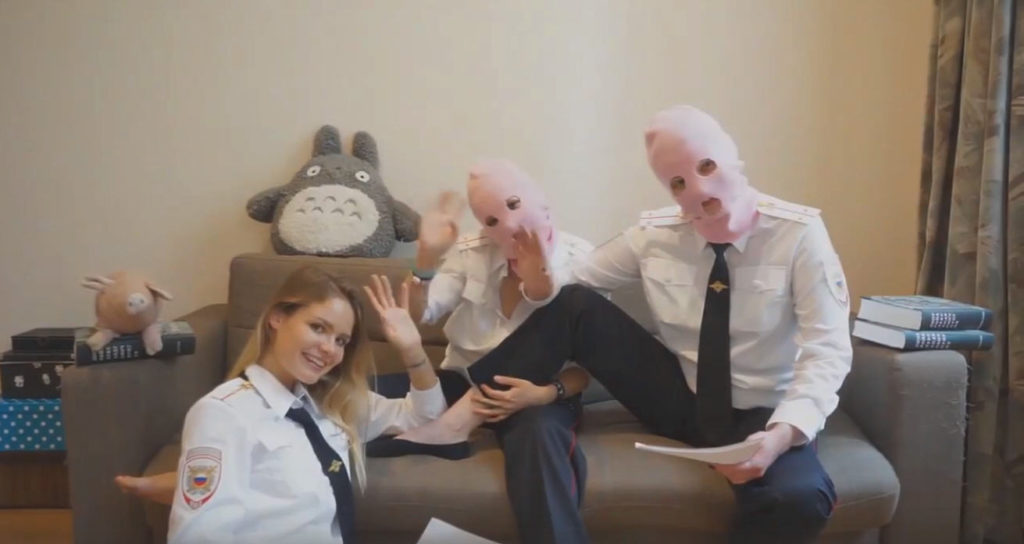
Members of Pussy Riot released a video taking credit for storming the field during the FIFA World Cup finals on Sunday evening.

The world of sports had a surprise interference from the art world at the FIFA World Cup finals this Sunday. Four activists dressed as Russian police stormed onto the pitch during the game between France and Croatia, chased by security staff before being dragged off the field. Members of the activist collective Pussy Riot took credit for the spectacle via Facebook, saying it was a protest on behalf of political prisoners. The match on Sunday in Moscow was watched by the Russian President Vladimir Putin and a global TV audience of hundreds of millions.
One of the activists high-fived the French player Kylian Mbappé, while Croatia’s Dejan Lovren helped detain another. The Russian Interior Ministry confirmed the arrest of three women and one man. In a statement, Pussy Riot said the members had been detained overnight in Moscow and that they are due to come before a court today, but that they have not been provided details about when the hearing will take place and have not been permitted to speak to their lawyer. 
The performance, which Pussy Riot said online was called “Policeman enters the Game,” marked the 11th anniversary since the death of Russian dissident artist and poet Dmitriy Prigov. Referencing Prigov’s concept of the “heavenly policeman,” the group compared his poetic archetype with an “earthly policeman,” who disperses rallies, disregards rules, and is fearful of World Cup celebrations. The heavenly policeman, on other the hand, respects rules, polices well, and celebrates Russia’s World Cup. The earthly policeman “breaks our world apart,” they say in a statement.

An unverified video that surfaced shows two of the field runners being interrogated by officials, both still breathing heavily after their sprint. The official says: “Sometimes I regret that it isn’t [19]37,” a reference to the Great Terror unleashed by the dictator Josef Stalin. The Soviet leader ordered the imprisonment or death of an estimated 1.2 million people who were deemed opponents to the State between 1936 and 1938.
The post-punk feminist art collective has been operating at the intersection of art and politics since 2011, criticizing Russia’s political surveillance and the oppression of free speech. Last winter, London’s Saatchi Gallery hosted the Russian “artivists” and their immersive theatre performance called “Inside Pussy Riot,” which set out to recreate the experience of being in Russian prison. Pussy Riot’s Nadya Tolokonnikova and Maria Alyokhina were arrested and charged with hooliganism in 2012 after performing a “punk prayer” in Moscow’s Christ the Saviour cathedral. Both spent nearly two years in jail. This April, the group released a line of merchandise to support the independent investigative Russian newsite Mediazona, which they helped establish in 2014.
Their list of demands following the World Cup demonstration are:
1. Let all political prisoners free.
2. Not imprison for “likes.”
3. Stop Illegal arrests on rallies.
4. Allow political competition in the country.
5. Not fabricate criminal accusations and not keep people in jails for no reason.
6. Turn the earthly policeman into the heavenly policeman.
Russian police later stated that the protesters will be fined up to 200,000 rubles ($2,700) or have to perform 160 hours of community service.

Follow artnet News on Facebook: 


https://news.artnet.com/art-world/disguised-as-russian-policemen-pussy-riot-storms-the-field-at-world-cup-finals-in-moscow-1318526?utm_content=from_&utm_source=Sailthru&utm_medium=email&utm_campaign=Europe%20July%2016&utm_term=New%20Euro%20%2B%20Newsletter%20List


SHARE