Sunday, July 15, 2018

Sense of Humor


Exhibition celebrating history of humor in prints and drawings opens at National Gallery of Art


Robert Crumb (artist, author), Apex Novelties (publisher), Zap #1, 1968. 28-page paperback bound volume with half-tone and offset lithograph illustrations in black and cover in full color. Sheet: 9 1/2 x 6 3/4 in. National Gallery of Art, Washington, Gift of William and Abigail Gerdts


The First Art Newspaper on the Net Established in 1996PortugalSunday, July 15, 2018


Exhibition celebrating history of humor in prints and drawings opens at National Gallery of Art
Giovanni Francesco Costa, Scholars Consulting Books and a Globe, c. 1747. Etching, hand-colored with watercolor and gouache, on laid paper, plate: 20.4 x 29.7 cm (8 1/16 x 11 11/16 in.), sheet: 23.2 x 33.1 cm (9 1/8 x 13 1/16 in.) National Gallery of Art, Washington, New Century Fund.


0
  
WASHINGTON, DC.- Prints and drawings have consistently served as popular media for humor in art. Prints, which can be widely replicated and distributed, are ideal for institutional mockery and social criticism, while drawings, unmediated and private, allow for free rein of the imagination. Sense of Humor will celebrate the rich yet often overlooked tradition of humor in works on paper, ranging from the 15th to 20th century. On view in the West Building of the National Gallery of Art, Washington, from July 15, 2018, through January 6, 2019, the exhibition is organized broadly chronologically, tracing the variety of forms that comical prints and drawings have taken over time, from Renaissance caricature to British satire in the 18th century and counterculture comics of the late 1960s. Drawn entirely from the Gallery’s collection, works are by artists including Pieter Bruegel the Elder, Jacques Callot, William Hogarth, Francisco de Goya, Honoré Daumier, George Herriman, Alexander Calder, Roger Brown, the Guerrilla Girls, and Art Spiegelman. Many works will be shown for the first time.

"Humor is a fundamental element of the human experience, and has too often been overlooked in the history of art," said Earl A. Powell III, director, National Gallery of Art, Washington. "This exhibition takes a closer look at the many ways comedic works of art—specifically works on paper—have been used to elicit a laugh, make a critique, or reveal a truth. This exhibition would truly not have been possible without the extraordinary depth and breadth of our collection of prints and drawings."

The first section of Sense of Humor focuses on the emergence of humorous images in prints and drawings from the 15th to 17th centuries. Satires and caricatures gained popularity during this era, poking fun at the human condition using archetypal figures from mythology and folklore. While not yet intended as caricatures of individuals, Italian works reflected the Renaissance interest in the human figure and emotion. Leonardo da Vinci explored facial features and expressions in drawings like Two Grotesque Heads (1510s). Created by his pupil, Francesco Melzi, the pen-and-ink drawing of an elderly woman and man in profile appears to be more a generic type than a study of an actual figure, but shows the exaggerated features that would come to define caricature. Typical examples from northern Europe include Daniel Hopfer's Bolikana and Markolfus (early 16th century), which derives from the popular story of a clever peasant outwitting a person of higher status and education.
Sponsored by Connatix


Several later works by Jacques Callot, the brilliant 17th-century French observer of courtly life and costume, include a vibrant pen-and-ink drawing. Satirical images referring to specific people, events, or behaviors became common toward the end of this period. These are seen in early political cartoons such as the German Allegory of the Meeting of Pope Paul II and Emperor Frederick III (c. 1470), showing the pope and emperor engaged in a wrestling match. A later Dutch etching, No Monarchy, No Popery (c. 1690) by Romeyn de Hooghe, depicts William of Orange's defeat of King James II of England.

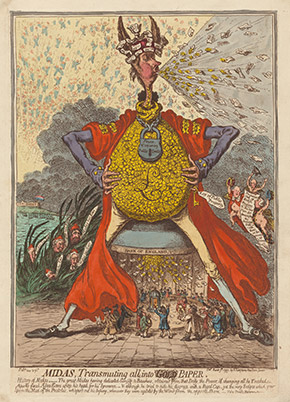
The second room of Sense of Humor continues with works from the 18th and 19th centuries, when certain artists dedicated themselves exclusively to comical subjects. A group of etchings by William Hogarth includes Strolling Actresses Dressing in a Barn (1738), contrasting the actresses' roles as Roman goddesses with the earthly and humble preparations behind the curtain as they practice lines, mend stockings, and imbibe. While Hogarth considered himself more a comic painter than caricaturist, later British artists like James Gillray embraced caricature. Gillray's Wierd-Sisters; Ministers of Darkness; Minions of the Moon (1791) parodies Henry Fuseli's painting Weird Sisters (1783), replacing the three witches from Macbeth with three ministers gazing at a moon with the faces of King George III and Queen Charlotte on it, concerned that the king has been declared unfit to rule after his bout of madness. Francisco de Goya, inspired in part by the English satirists, turned a scornful eye to the vices of humanity in his Los Caprichos (1799).

The development of lithography in the 19th century allowed for a new level of dissemination because prints could be reproduced quickly and affordably. Artists such as Honoré Daumier took advantage of these developments to create fierce political satires and caricatures that landed him in jail. Included in the exhibition is Daumier's Le Ventre Législatif (The Legislative Belly) (1834), a famous image that mocks the conservative members of France's Chamber of Deputies. While the identity of each politician would have been known at the time, the print continues to resonate today as a satire of politicians, generally. Satire reached the height of its influence during the 19th century and was censured as a result. In response to the threat of severe punishment and even jail, artists adapted by creating more nuanced and universal criticism of current events.

The final room of Sense of Humor focuses on the 20th century and encompasses both the gentle fun of works by George Bellows, Alexander Calder, and Mabel Dwight and the biting satire of Hans Haacke and Rupert García. Works by professional cartoonists such as R. Crumb, George Herriman, Winsor McCay, and Art Spiegelman are presented alongside mainstream artists like Calder, Roy Lichtenstein, Jim Nutt, and Andy Warhol. Especially in the second half of the century, artists used humor to expose biases and inequities in modern society. Posters on view by the Guerrilla Girls, the feminist art collective founded in 1985, drip with tongue-in-cheek irony to draw attention to the unequal treatment of women by the art establishment. Even revered works of art become the target of lampooning. In his Reflections on The Scream (1990), Lichtenstein satirizes Edvard Munch's The Scream, replacing the Norwegian artist's iconic depiction of existential suffering with a more banal type of pain: a screaming baby who appears as a black hole of discontent.


IRECTIONS  
OPEN TODAY: 11:00 TO 6:00
Sense of Humor
July 15, 2018 – January 6, 2019
West Building, Ground Floor

James Gillray, Midas, Transmuting All into Paper, 1797, etching with hand-coloring in watercolor on laid paper, Wright and Evans 1851, no. 168, National Gallery of Art, Washington, Purchased as an Anonymous Gift
Humor may be fundamental to human experience, but its expression in painting and sculpture has been limited. Instead, prints, as the most widely distributed medium, and drawings, as the most private, have been the natural vehicles for comic content. Drawn from the National Gallery of Art’s collection, Sense of Humorcelebrates this incredibly rich though easily overlooked tradition through works including Renaissance caricatures, biting English satires, and 20th-century comics. The exhibition includes major works by Pieter Brueghel the Elder, Jacques Callot, William Hogarth, James Gillray, Francisco Goya, and Honoré Daumier, as well as later examples by Alexander Calder, Red Grooms, Saul Steinberg, Art Spiegelman, and the Guerrilla Girls.
The exhibition is curated by Jonathan Bober, Andrew W. Mellon senior curator of prints and drawings; Judith Brodie, curator and head of the department of American and modern prints and drawings; and Stacey Sell, associate curator, department of old master drawings, all National Gallery of Art, Washington.
Organization: Organized by the National Gallery of Art, Washington
Passes: Admission is always free and passes are not required


Friday, July 13, 2018

face tragedy with humour and flexibility


To be resilient, face tragedy with humour and flexibility


Steven Southwick
is the Glenn H Greenberg professor of psychiatry at the Yale School of Medicine. He is the co-author of Resilience: The Science of Mastering Life's Greatest Challenges (2nd ed, 2018) with Dennis Charney.
Dennis Charney
is professor of psychiatry, neuroscience and pharmacological science at the Icahn School of Medicine at Mount Sinai in New York. He is the co-author of Resilience: The Science of Mastering Life's Greatest Challenges (2nd ed, 2018) with Steven Southwick.
1,400 words
Edited by Pam Weintraub
REPUBLISHING NOT PERMITTED
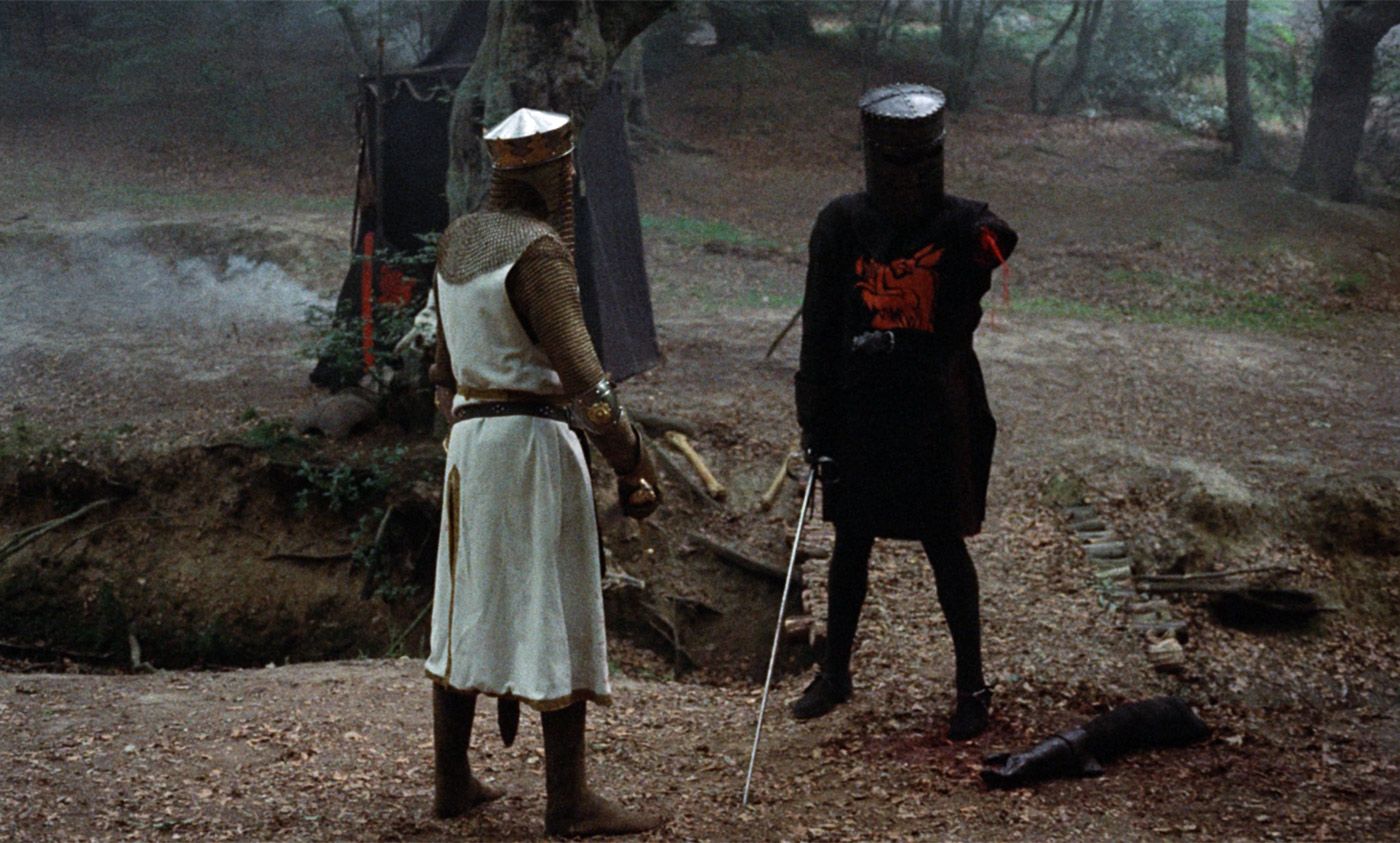
‘’Tis but a scratch!’ From Monty Python and the Holy Grail. <em>Courtesy EMI Films</em>
‘’Tis but a scratch!’ From Monty Python and the Holy Grail. Courtesy EMI Films
People who are resilient tend to be flexible – flexible in the way that they think about challenges, and flexible in the way that they react emotionally to stress. They are not wedded to a specific style of coping. Instead, they shift from one coping strategy to another depending upon the circumstances. Many are able to accept what they cannot change; to learn from failure; to use emotions such as grief and anger to fuel compassion and courage; and to search for opportunity and meaning in adversity. 
As the American entrepreneur and motivational speaker Pete Koerner observes: ‘Life=change. If you’re changing anyway, why not change for the better? Better or worse are your only choices; you can’t stay where you are forever.’
As a young man, Jerry White was a Judaic Studies major at Brown University in Rhode Island. He had a particular interest in the teachings of Jesus Christ, so in 1984 during his junior year he chose to study in Israel. He was hiking with two friends in the Golan Heights when an explosion knocked him off his feet. Blood poured from his leg, the skin was shredded and charred, and splinters of bone were covered with dirt and blood. ‘Where’s my foot?’ he screamed. As he lay injured, his friends removed their own shirts, wrapped one over Jerry’s stump, and tied a makeshift tourniquet around the injured leg. Ultimately, an Israeli man from a nearby kibbutz came to their aid.
White went on to co-found the International Landmine Survivors Network (since renamed Survivor Corps). Thirteen years after he lost his foot in Israel, he was among a coalition of activists awarded the Nobel Peace Prize in honour of their work on the international campaign to ban landmines.
How did White progress from victim to ‘super-survivor’? He answers these questions in five steps in his book, I Will Not Be Broken (2008): 1) face facts: accept what has happened; 2) choose life: live for the future, not in the past; 3) reach out: connect with other survivors; 4) get moving: set goals and take action; and 5) give back: service and acts of kindness empower the survivor to be an asset rather than a victim.
White’s story is an example of what numerous researchers have found. As Donald Campbell, professor emeritus at the US Military Academy at West Point, and colleagues have found, ‘Rather than seeing themselves as victims of a terrible and mindless fate, resilient people and groups devise ways to frame their misfortune in a more personally understandable way, and this serves to protect them from being overwhelmed by difficulties in the present.’
An important component of cognitive flexibility is accepting the reality of our situation, even if that situation is frightening or painful. To remain effectively engaged in problem-oriented and goal-directed coping, we must keep our eyes ‘wide open’, and acknowledge, rather than ignore, potential roadblocks. Avoidance and denial are generally counterproductive mechanisms that can help people for a while, but ultimately stand in the way of growth, interfering with the ability to actively solve problems.
In the scientific literature, acceptance has been cited as a key ingredient in the ability to tolerate highly stressful situations. This has been cited among survivors of extreme environmental hardship and threats to life, among highly successful learning-disabled adults, and among individuals with a variety of medical and mental disorders. In a surveyof individuals shortly after the terrorist attacks on the United States of 11 September 2001, researchers found reduced levels of post-traumatic stress symptoms in those who accepted the situation. In a study of mothers whose children had life-threatening cancer and were undergoing bone transplants, those who accepted the situation reported fewer symptoms of depression.
Another ingredient of resilience is the ability to reappraise a situation – a skill called cognitive reappraisal. Several years ago, while conducting a study on the psychological and neurobiological consequences of the Holocaust, a colleague asked an elderly survivor of the Nazi concentration camps if she had ever dreamed about her experience. ‘Oh yes,’ the woman replied. ‘I’ve never stopped dreaming about those times. I just had a dream the other night.’
Our colleague replied: ‘My goodness, it must be horrible to still have those nightmares after all those years.’
‘Oh no,’ the woman said. ‘It’s OK. It’s OK because when I awaken, I know that I’m here and not there.’
Positive reappraisal requires us to find alternative positive meaning for neutral or negative events, situations and/or beliefs. In reviewing an extensive scientific literature on cognitive strategies to regulate emotion, the psychologists Allison Troy and Iris Mauss at the University of Denver propose that positive cognitive reappraisal fosters resilience through its effect on negative emotions. More specifically, reappraising the meaning of a stressful event as less negative or more positive changes emotional reactions to the event and results in a more adaptive and resilient response.
We can take cues from those around us to help us interpret (or reinterpret) our own experiences in a more positive light. For example, in the workplace, a manager or supervisor might point out the positive aspects of an adverse situation or event, providing employees with cognitive and emotional tools to view the adversity as a challenge.
Resilience demands the emotional stability to handle failure, what the late US Navy vice-admiral James Stockdale referred to as the ‘ability to meet personal defeat with neither the defect of emotional paralysis and withdrawal, nor the excess lashing-out at scapegoats or inventing escapist solutions’. In our experience, people who are resilient generally meet failure head-on and use it as an opportunity to learn and to self-correct.
Recent research on coping has shown that successful adaptation depends less on which specific strategies people adopt than on whether they are applying coping strategies flexibly depending on the nature of the stressor. Sometimes it is wise to accept and tolerate a situation, while at other times it is best to change it. Similarly, emotion theorists argue that expression of emotion is not necessarily better than suppression. What helps people to cope is having the ability to express or suppress emotions in accordance with the demands of a given situation.
Humour helps, too. In his book Man’s Search for Meaning (1946), Viktor Frankl refers to humour as ‘another of the soul’s weapons in the fight for self-preservation. It is well-known that humour, more than anything else in the human make-up, can afford an aloofness and an ability to rise above any situation, even if only for a few seconds.’
Like other positive emotions, humour tends to broaden one’s focus of attention and thereby foster exploration, creativity and flexibility in thinking. Humour can also serve as a tool to help us face our fears. It provides distance and perspective, but does so without denying pain or fear. It manages to present the positive and negative wrapped into one package. As the Frankl scholar Ann Graber puts it, humour combines ‘optimism with a realistic look at the tragic’. Without Pollyanna-like optimism, humour can actively confront, proactively reframe, and at times transform the tragic.
In sum, people who are resilient tend to be flexible; they know when to accept that which cannot be changed and how to positively reframe life’s challenges and failures; they use humour to reframe the tragic and that which is frightening; and they regulate their emotions, sometimes suppressing feelings and at other times expressing them. Resilience requires creativity and flexibility: the creativity to explore multiple viewpoints and the flexibility to embrace a positive but realistic assessment – or reassessment – of a challenging situation.
Reprinted from ‘Resilience: The Science of Mastering Life’s Greatest Challenges’, 2nd edition by Steven M Southwick and Dennis S Charney. Copyright © 2018 by Steven M Southwick and Dennis S Charney, published by Cambridge University Press, reproduced with permission. All rights reserved.


Exclusive Date with Rembrandt at Edinburgh


An Exclusive Date with Rembrandt at Edinburgh

An Exclusive Date with Rembrandt at Edinburgh
Landscape with the Rest on the Flight into Egypt, 1647 by Rembrandt (Rembrandt Harmensz van Rijn), National Gallery of Ireland, Dublin
(Courtesy: Scottish National Gallery)
An “exclusive new exhibition” of Dutch Master Rembrandt's works will be held at the Scottish National Gallery in Edinburgh from August 1-31, 2018. The exhibition will reveal how the taste for Rembrandt's work in Britain evolved over the past 400 years.
From early beginnings around 1630, the fascination for Rembrandt's work gripped collectors and art lovers across the country, reaching a fever pitch in the late-eighteenth century. The exhibition will also reveal the profound impact of Rembrandt's art on the British imagination, by exploring the wide range of native artists whose work has been inspired by the Dutch master, over four centuries, right up to the present day.
Highlights of the show will include key paintings by Rembrandt drawn from British collections, such as “Belshazzar’s Feast” (1635) from the National Gallery in London and “Girl at the Window” (1645) from Dulwich Picture Gallery, as well as star paintings now overseas, such as The Mill from the National Gallery of Art in Washington DC.
Rembrandt is renowned for the penetrating realism of his self-portraits and some particularly fine examples will be up for viewing, including the extraordinary “Self-Portrait,” aged 51 (on long-term loan to the Scottish National Gallery) and Portrait of the Artist as Young Man (c.1629-31) from the Walker Art Gallery in Liverpool, which was the first painting by the artist to leave Holland and the first to enter a British collection, when it was presented to Charles I in the early 1630s.
The exhibition will include Rembrandt’s only portraits of ‘British’ sitters, “Rev Johannes Elison and his wife Maria Bockenolle” (both 1634), on loan from the Museum of Fine Arts, Boston, and key landscapes including “The Rest on the Flight into Egypt” (1647) from the collection of the National Gallery of Ireland in Dublin. Although they were painted in Amsterdam, the Boston portraits depict a Dutch couple who lived in Norwich, and the paintings were in Britain by 1677. They are one of only three pairs of full-length portraits painted by Rembrandt, and have not been seen in the UK since 1929.
Among the British artists represented in the exhibition will be William Hogarth (1697-1764) and Sir Joshua Reynolds (1723-92), both of whom betray a heavy debt to Rembrandt, seen in works such as “Reynolds’s Self-Portrait when Young” (1753-8).
The exhibition will also include a powerful version of “A Woman bathing in a Stream” (1654) by the renowned British painter Leon Kossoff (b.1926), as well as the work of artists such as John Bellany (1942-2013), Eduardo Paolozzi (1924-2005), and Frank Auerbach (b.1931).
The exhibition will be on view from August 1 through August 31 at the Scottish National Gallery.
http://www.blouinartinfo.com/                                              

friday

Imagem relacionada

Resultado de imagem para thank god it's friday


Time to relax and unwind it's Friday...

Time to relax and unwind it's Friday...
Loved on:www.google.com