Friday, June 30, 2017

What’s the Path to Winning an Art Prize?

https://www.artsy.net/article/artsy-editorial-path-winning-art-prize


What’s the Path to Winning an Art Prize?
Around two years ago, a collector encouraged New York-based ceramic artist Jennie Jieun Lee to apply for an art prize. “I was a little bit scared. I’d applied to a few things in the past and been rejected, so I was bummed by that,” she admits. “I entered not thinking that I was going to win, but that it would be a good exercise to go through the process.”  
It paid off. She was among several artists in 2015 who won an Artadia Award—an unrestricted, merit-based prize of up to $10,000, which is given to visual artists working in certain U.S. cities. The winnings, as well as the experience, helped Lee push her career forward.
“That money enabled me to move into a bigger studio and buy a larger kiln,” she explains. “With that movement, I was able to make my career.” And the momentum continued: More recently, she won a Pollock-Krasner grant that she used to move cross-country and fund a residency in the ceramic department at California State University, Long Beach.
Lee is by no means alone. While we’ve all heard of the boldfaced awards, like the Turner Prize or the Hugo Boss Prize, which tend to anoint artists when they’re already well known to the art world, a wealth of awards are available for lesser-known and emerging artists.
While applying for these opportunities can be daunting and time-consuming, it’s rewarding in more ways than one (even if you don’t end up winning). Artist prizes can be a path to prestige and profits, as well as a way to land exhibitions, make influential contacts, and gain valuable feedback about your work.
Based on conversations with artists who have won several different prizes, we share guidance below on how to go about applying for these opportunities, navigating the process, and benefiting from the positive outcomes they can offer.

Finding the Prize That’s Right for You


Artists should seek out opportunities based on their eligibility and the kind of work they make. “Don’t change to accommodate prizes,” advises London artist Allyson McIntyre, who won the 2015 HIX Award, which gives artists £10,000 to go towards a solo show at the London gallery HIX ART. “Be authentic to your practice and find the prizes that work for what you do.”
It’s important to recognize the distinction between prizes and awards—which are generally given in recognition of past work—and grants, which typically serve to facilitate future projects. Many artists note that they apply to both types of opportunities based on recommendations by word-of-mouth; they find that peers, former teachers, or other art-world contacts can share valuable input. New Orleans-based artist Aron Belka, who won the BOMBAY SAPPHIRE® Artisan Series in 2015, advises artists to search for opportunities locally, through art schools, regional arts councils, art centers, and museums.  
For those who perhaps do not have a tight-knit network of artist peers, there are several open-call websites and listservs that aggregate information on prizes, grants, and juried exhibitions. These include Submittable and Call for Entry. On the latter, artists can create a profile, upload artwork images, and browse opportunities.

  • Illustration by Tomi Um for Artsy.

The Application Process


Most awards will require several images of your work, as well as a written artist statement to provide some context. With higher-stakes prizes, artists may be asked to submit recommendation letters from peers or professionals.
A somewhat obvious, though easily botched, element of the application process is following directions. “You have to be careful not to get lazy with how you submit, as it may lead to you being disqualified, which is just a waste of your time,” McIntyre explains. Be sure to read the fine print and adhere to all particulars regarding preparing, labeling, and submitting application materials.
Organizations administering prizes will allow artists to submit several—typically three to eight—images. They are generally interested in seeing recent work, created over the past two or three years. Some prizes may specify that artists create a new, original work to submit. Artists should be sure to send high-quality photographs; if resources allow, hire a photographer (or recruit a qualified friend) to have works shot professionally.
For those artists who work across mediums—perhaps printmaking one day, performance the next—know that it might not be advisable to try to include the full breadth of your practice in a single application. “Try to hone in on a single idea, or a couple of ideas,” says artist Alex Podesta, who won the BOMBAY SAPPHIRE® Artisan Series in 2013, and has also served as a juror for other awards. “I’ve been on the other side of this a number of times, and when you’re reviewing applications it’s confusing and not helpful to have an artist submitting sculpture, painting, and a video piece. Focus on one aspect of your work.”
In addition to images, a written artist’s statement that explains and contextualizes the artist’s work is important, too. Artists should get in the habit of updating their statements regularly, adapting their texts to accurately reflect their current practices. Artist Yevgeniya Baras, who won an Artadia Award in New York in 2015, notes that she rewrites or edits her artist statement every two years.  
For certain awards, artists may need to be able to speak about their work with jurors in person. If this is the case, be prepared to take full advantage of the opportunity. Baras notes that for Artadia, the panel of jurors visited her studio; she was careful to delve deeper into elements of her work that don’t come across through two-dimensional images or her online application. For the Meurice Prize for contemporary art, artists must give an oral presentation of their work. “While we don’t judge the artist on their ability to conduct a perfect verbal presentation of the work, we are of course interested to hear the artist speak of their work in a very intimate way, and that can actually be the decisive sector,” says Jennifer Flay, director of the art fair FIAC, and a juror for the Meurice Prize.

Application Fees


While it’s free to apply for some awards, it’s not uncommon to pay a fee in the range of $20 to $75—which can make a difference for artists looking to apply to multiple opportunites. Belka notes that if the stakes are high, an application fee may be worth it, but he advises that artists do their research before submitting said fees to avoid scams.
McIntyre recalls that she once applied to a competition that promised winners a show in Venice. “I was accepted, but they asked for an outrageous artist fee of €500,” she says. Later she learned that fellow artists had fallen for the scam and lost their money—and the works they had submitted. “Have discretion and awareness that your money may amount to nothing,” she counsels.

Set Expectations and Be Persistent


No one wins every award; there’s often a trail of rejections on the way to any prize. Baras, who landed the Rema Hort Mann Foundation Emerging Artist Grant in 2014 and the Artadia Award thereafter, notes that there’s been plenty of failure mixed in with those successes. (She estimates that she submits around 10 award or grant applications per year.)
“Assume that for nine out of every 10 applications that you send in, it’s not going to be the work they’re looking for,” Podesta says. “Younger artists, especially, shouldn’t get daunted. Remember that the work just isn’t resonating with the [specific] people reviewing it.”
It helps to go into the application process with an open mind, and reasonable hopes. “I went into it not expecting it to make my career, but rather for it to be an addition to it,” says Kristine Mays, who won the BOMBAY SAPPHIRE® Artisan Series in 2014. Artists, she adds, should simply stay true to their craft, and keep working away.
Remember that rejection, while disappointing, can be a learning experience. “Without this kind of risk, you can’t really put yourself out there,” Baras says. “Most applications, for many amazing awards, just take a few days. It’s a way to see a new community, to seek new eyes, and I think that’s a necessary and healthy risk for an artist to take.”
Lee advises fellow artists to cast a wide net and apply to as many opportunities as possible, developing a thick skin as they do. “If you get rejected one year, apply again the next,” she says, simply. “It’s about being persistent and not taking anything personally.”

  • Illustration by Tomi Um for Artsy

Make the Most of Winning


Depending on the prize, artists may be awarded a stipend to create new work for a show or unrestricted funds to further their careers. In both cases, artists report that these funds have gone towards keeping their art practices up and running, be it through realizing new works and shows or for subsidizing rent, bills, and the costs of production and supplies.  
For example, the Meurice Prize, which supports artists under the age of 45 who show with French galleries, awards €20,000, which is split between the artist and their gallery. This year, the BOMBAY SAPPHIRE® Artisan Series (which is only open to entrants from North America) awards a grand prize winner a stipend of $10,000 to create a public artwork.
In some cases, like Lee’s, a sizable prize could help an artist move into a bigger studio, relocate to another city, or participate in a residency. “Before, I never even thought about moving out of New York,” she says. “The Pollock-Krasner grant gave me the freedom to possibly move cross-country to explore this residency. I feel like it’s completely changed my life, and now I’m not sure when I’m coming back.”

It’s More Than Just Money


Baras notes that even if she hadn’t won the Artadia Award it would’ve been a rewarding experience due to the panel of jurors she encountered. “Whether you win or not, whoever’s on the panel remembers your work,” she says. “It’s beneficial regardless to put yourself out there because you really never know who might notice.”  
Other prizes similarly award artists with the opportunity to exhibit their work to a new audience. The Daiwa Foundation Art Prize, awarded each year to a British artist, serves to give that artist a solo gallery exhibition in Japan. And the Luxembourg Art Prize gives finalists the opportunity to show their work in a group exhibition in Luxembourg; the winner is awarded €25,000 to produce new work for a solo presentation at Galerie Hervé Lancelin for an exhibition the following year.
For Belka and Mays, who both won the chance to show their work at the Scope Art Fair in New York through the BOMBAY SAPPHIRE® Artisan Series, winning led to important exposure and networking opportunities. “Overall, the most positive outcome was being able to put myself in arenas I’d never been in before,” Mays says of her experience. She saw it as a “jump start” for her career; she’s been busy making and showing her work steadily since her Scope debut.
“I made a point of greeting and speaking to everyone that came to the space,” Mays adds. Both artists recommend being prepared with business cards and following up with the contacts you make via email. Belka notes that he made an important collector contact that he maintains today. “Come prepared to talk about your work, have cards, spread your name, and get yourself out there,” says Belka.
Mays was also inspired by the feedback she received from viewers of her work. “Many times we overlook the value of feedback from people, the ideas that can come out of conversation with people,” she says.

Building Confidence


Most artists agree that one of the most impactful parts of winning a prize is the vote of confidence that it provides. Formal recognition can be a sign of assurance that they were right to pursue a career as an artist, and can inspire them to get back in the studio.  
“It’s a nice confirmation to know that you can communicate to people you don’t even know, and just continue along the path of making your work,” Baras muses. “I see it as a kind of hug. Generally, you’re sort of hugging yourself as an artist—but once in awhile, you get an acknowledgment from the outside world.”

—Casey Lesser

Header animation: Illustration by Tomi Um for Artsy. Animation by Ale Pixel Studio.

SHARE ARTICLE

What’s the Path to Winning an Art Prize?
The BOMBAY SAPPHIRE® Artisan Series is a search to discover top emerging artists from North America. The Grand Prize winner will receive a cash stipend and collaborate with Artsy to create a public installation. Submissions for this exciting opportunity are now open through August 3, 2017.


BE BRILLIANT AND INSPIRED. DRINK RESPONSIBLY!
©2017. BOMBAY SAPPHIRE AND ITS TRADE DRESS ARE TRADEMARKS. IMPORTED BY THE BOMBAY SPIRITS COMPANY U.S.A., CORAL GABLES, FL. GIN - 47% ALC. BY VOL.
PRESENTED IN PARTNERSHIP WITH


When Collectors—Not Curators—Dictate Art History

When Collectors—Not Curators—Dictate Art History

  • Photo by Matt Cardy/Getty Images.
Walk up the steps of the Metropolitan Museum of Art’s famous Fifth Avenue entrance; keep heading straight ahead. Go through the Great Hall and medieval art galleries, pass under a massive choir screen, and then you’ll glimpse it: a brightly lit, angular pavilion at the end of a span of darkened rooms. A few more steps and, as if crossing through a wormhole, you’ve moved from the middle ages into a high-ceilinged space of Renoirs, Seurats, and other work from the 19th century.
This isn’t an unexpected experience at the Met, where decades of history are displayed feet apart. But strolling through the space, one might ask why this curious room at the back of the Met shows work more at home in the Impressionist galleries upstairs; why are there dazzling medieval artworks in a series of back galleries rather than in the darkened rooms leading up to this space; and why, oddly, but enjoyably, does one of the galleries, in the style of a homely living room, have a frumpy couch?
Known as the Robert Lehman Collection, the hundred or so works on view in these thematic rooms stem from the acquisitions of one man who bequeathed them to the Met in 1969. The terms of Lehman’s will required that a portion of his collection of some 2,600 pieces, spanning thousands of years and numerous styles and media, be on display for perpetuity.
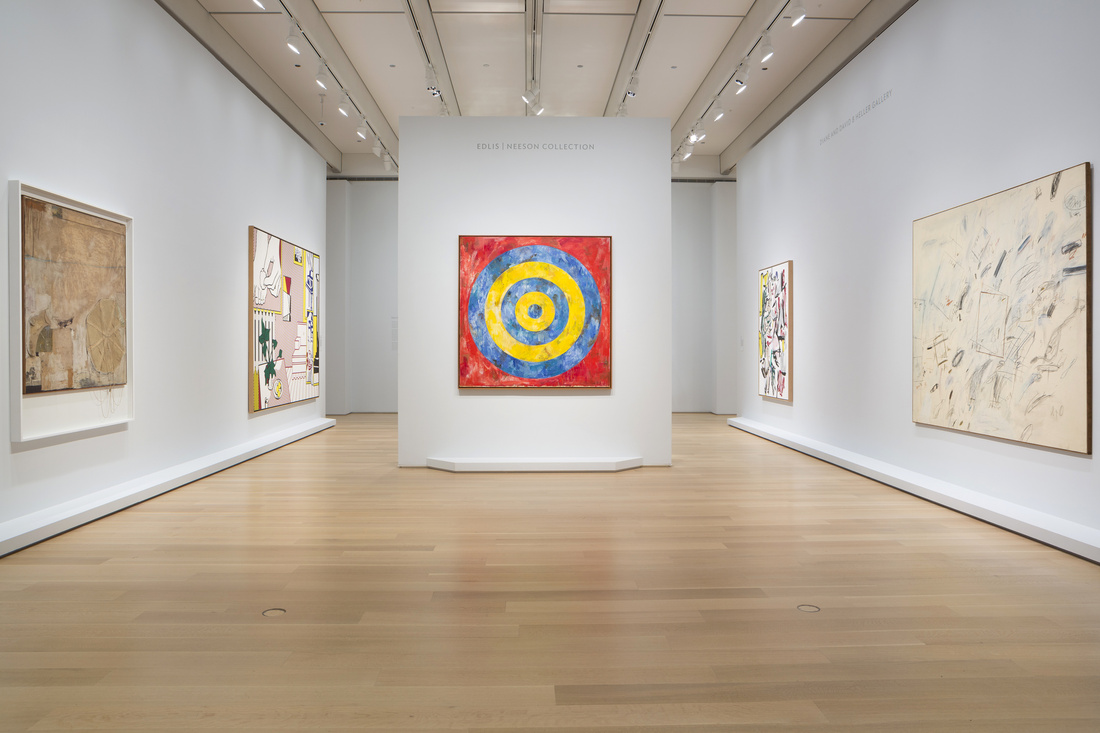
The Robert Lehman Collection’s museum within a museum is far from alone in having been given to and accepted by a museum on the condition of display terms. More recent, though not as stringent, examples include the Fisher Collection, given in a long-term loan to SFMOMA in 2009, and a donation from Stefan Edlis and Gael Neeson to the Art Institute of Chicago in 2015.
These gifts have each brought an influx of significant work out of private homes or storage units and into the public domain. But whether the terms attached to them ultimately help the receiving museums’ overarching mission to serve the public, or hurt that goal by hindering the ability of curators to freely exhibit artworks, remains a subject of fierce debate.

Seeing a Collector’s Vision


Though the pieces from the Lehman Collection can be temporarily loaned to other places in the museum, over the years there have been a number of public and private calls to permanently assimilate the pieces with the rest of the museum’s holdings. Art historian Robert Storr is among those critical of museums accepting display terms attached to gifts. He argues that curators should have the freedom to display work as they see fit.
“Those works are hostage to that particular collector’s vanity, and the public can only see them under certain circumstances,” he said.
Others, however, say that such terms allow the public to see a wider selection of work than they otherwise might. The Robert Lehman Collection’s former curator and current chief curator of the Yale University Art Gallery, Laurence Kanter, argues that integrating the Lehman collection into the rest of the Met’s holdings wouldn’t add value for the public.
“What the Met would do is pick off the trophies and everything else would go in storage,” he said. “Who wins with that?”
Kanter noted that the collection is, in fact, curated. For example, he oversaw an effort to remove “goofy” furnishings the Met originally included to recreate Lehman’s house and instead moved to display the work in rooms that offer an intimate but more more general approximation. Nonetheless, the singular view on unique objects provided by collectors is, Kanter argues, unique and should be preserved.
“It’s mostly the collectors—not museums—who revel in the intrinsic quality of objects and the personal experience of them,” he said. “I think it’s one of the great experiences available to American audiences that in some museums around the country, you can share that.”

  • View of the Edlis/Neeson Collection. Courtesy of the Art Institute of Chicago.

A Nuanced Question


Unlike the strictly governed institutional practice of deaccessioning work, there are few firm rules for institutions on whether or in what cases to accept collections with strings attached. The Met, for example, states on its website that it generally does not accept donations with terms. But it and other museums like it are free to craft their own rules but can also make exceptions if needed. Observers say this flexibility is important given the reality of donations and the fact that, as museum acquisition budgets shrink, gifts have become the main avenue for adding masterpieces to public collections.
“Decisions on accepting a gift of a collection or singular work of art need to be assessed on a case by case basis, and reflect the best interests of  the museum, art, and donor,” wrote Christa Clarke, president of the Association of Art Museum Curators, an advocacy group that sets standards for its profession, in an email.
“There’s a kind of dance that has to go on, if you will, between the private collector and the public institution,” said Jeffrey Cain, a founding partner of the consulting firm American Philanthropic.
When offered a donation with terms that limit unencumbered curatorial freedom, the director, the board, and often the curators of an institution weigh numerous factors in deciding if to accept it. These include the prominence of the works, the duration the works must be exhibited, and what, if any, gaps exist in the museum’s own collection.
Recent donations to major public institutions that have included display terms haven’t been nearly as restrictive as the Lehman Collection’s but have still generated attention.
The Art Institute of Chicago’s acceptance of 42 works by artists including Andy WarholCy TwomblyCindy Sherman, and Jeff Koons significantly bolstered its contemporary collection. But the donation came with the condition that the approximately $400 million in art stay on view for 50 years. For the first half of that time period, they must be shown together in the museum’s contemporary galleries.
The terms, which were disclosed in the press release announcing the donation, were key in helping the Art Institute of Chicago win the donation. “I have donated works of art to museums for years but have been frustrated by their lack of exposure,” said Edlis, echoing a sentiment felt by many collectors who attach display conditions out of concern that their work will wind up in a basement.
In an email to Artsy, James Rondeau, president and director of the Art Institute of Chicago, firmly rejected the idea that the terms amounted to a burden on curators in a way that would set art history in amber, arguing that showing the works bolsters the museum’s ability to craft narrative through contemporary art and that the ultimate beneficiaries of the pieces are its audiences, artists, and the public.
“We made our selections precisely because these are works of art we will want—and we believe future stewards of the collection will want—our visitors to experience,” Rondeau wrote. “Stefan and Gael have given us total freedom to lend these works to other museums, and to rotate for conservation purposes,” he added, calling the collection “dynamic, not static.”
Indeed, when museums are accepting gifts with terms attached, collectors and institutions often think far into the future. There is, for example, a significant difference between a gift with display conditions that extend in perpetuity versus those with shorter restrictions. Adrian Ellis, founder of AEA Consulting, which offers services in the cultural and creative industries, urges taking a long view when donations are restricted for even a few decades given museums are supposed to exist for centuries.
“Sucking it up for 20 years isn’t the worst thing in the world, to put it bluntly,” he said.

Why Collectors Include Terms


Multiple individuals interviewed for this story suggested that the practice of donating works to institutions with terms attached is on the rise. However, Diana Wierbicki, global head of art law at law firm Withers Worldwide, said that in her nine years directly facilitating such transactions, there hasn’t been a discernible uptick.
Headlines may be deceiving, she suggested: They most often cover major donations of huge collections, which, in turn, provide donors the most leverage in a negotiation with a museum. These donations are, however, a rarity compared to one-off gifts that infrequently make news or attract attention but provide crucial depth to institutions.
Wierbicki said that what motivates most of her clients to attach terms to their gifts is a genuine passion for the works they’ve assembled. “They want to give the public the most benefit from that art,” she said. Some collectors support work, which mainstream institutions show all too rarely and might be pushed to exhibit more, further compelling them to get assurances from institutions that the public will see the works. Wierbicki said this is particularly true when it comes to art by women.
“The donors really care about the cause,” she said. “They’d really like to see these artists displayed and not have work go into storage.”
Storr said, however, that even when applied with good intentions, applying strict terms to donations can actually undermine—rather than solidify—a collector’s legacy over time. This is especially the case if the terms imperil the ability of an institution to survive financially or make sound curatorial choices.
The former senior curator of painting and sculpture at MoMA said he turned down donations while at the museum because of the terms attached and he argues that directors need to “stand up” to collectors, for their own good and for the long-term benefit of the institution under their care.
“Collectors do not always know best,” Storr said. “And if the idea is to get yourself a place in history, who wants to have a place in history that makes you look bad?”

  • Installation view of  "Approaching American Abstraction: The Fisher Collection exhibition." Photo ©  Henrik Kam, courtesy of SFMOMA.

Transparency


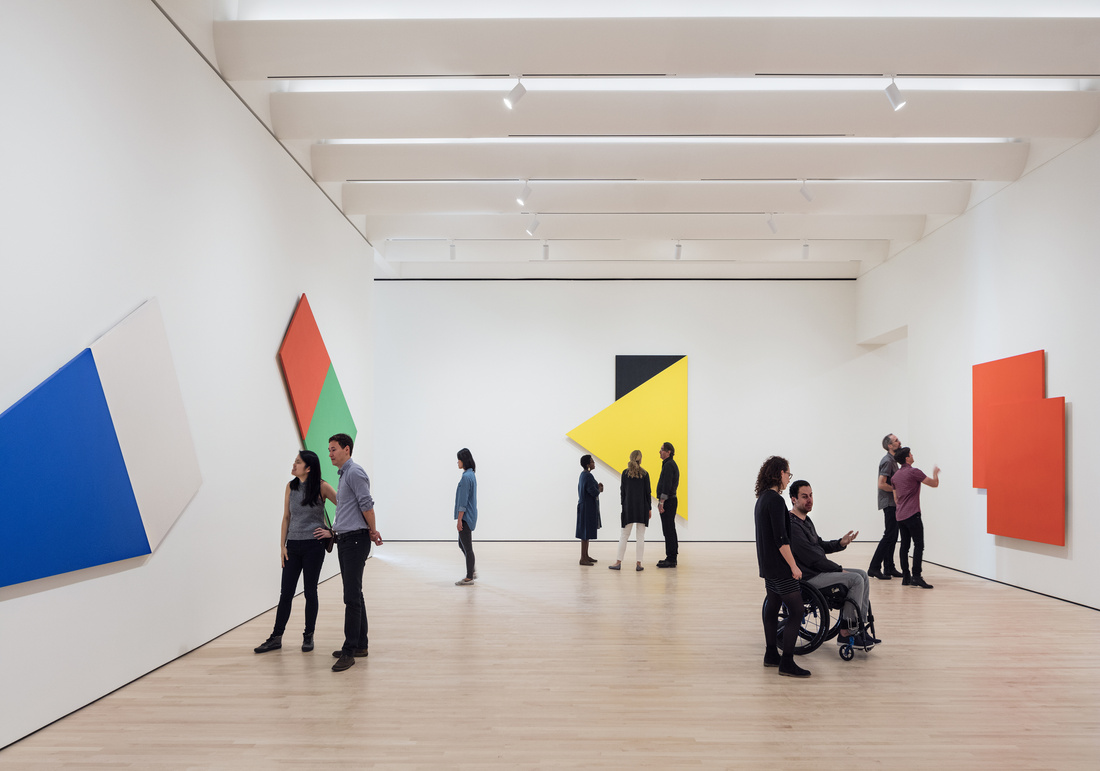
SFMOMA expanded dramatically to house the collection of Donald and Doris Fisher, a long-term loan of 1,100 works by masters of the post-war era including Warhol, Richard SerraEllsworth Kelly, and Anselm Kiefer. It represented a stunning increase in art available on public view to those in the Bay Area, though the collection has been critiqued for lacking diversity. The museum doubled in size, moving to a new building at a cost of $305 million. Yet, according to San Francisco Chronicle art critic Charles Desmarais, there should be great transparency around the terms. Especially since those who visit the museum may not be aware that part of the selection of works they’re viewing was a stipulation of that gift.
Seventy-five percent of the Fisher Collection galleries, which span 60,000 square feet and three floors of SFMOMA, must be comprised of works from the collection. And a monographic show dedicated to the collection must go up once every 10 years. Greater transparency, Desmarais argued, is warranted about these and other terms.
“Simply put, as you enter the Fisher galleries, it should say precisely what the deal is,” he said.
Those inside the institution have long asserted that they have the flexibility needed to ensure the Fisher galleries remain fresh. “There are so many possibilities about how to approach this collection,” Gary Garrels, senior curator of painting and sculpture, previously told Artsy. “Some much more unorthodox ideas are already bubbling for future rotations.” He also noted that the Fisher Collection’s donation has also helped spark additional gifts from other collectors.
But, outside of SFMOMA, obversevers note that transparency is an important part of any major gift. “I see no intrinsic evil in accepting donations whatsoever,” said Ellis. “But you need to be very clear about the terms of donations.”
Even with transparency, Storr argues that limitations on how works are displayed privileges the collector over the work itself in ways that undercut a museum’s responsibilities. Curators need to be able to “shuffle the decks regularly, rewrite art history on the walls, and make comparisons” in ways that challenge the canon and integrate disparate materials.
Though a gift to a public museum as monumental and encumbered as the Lehman Collection is perhaps a thing of the past, the question of how the terms attached to it and other donations shape what art is seen remains one viewers should ponder—perhaps while they sit on an overstuffed couch.

—Isaac Kaplan