Expropriados em Goa. Portugueses desesperam sem solução à vista
559 partilhas
Goa aprovou uma lei em 2014 que anula todos os títulos e bens concedidos "pelas autoridades portuguesas durante a era imperial. "Fomos espoliados", diz Pietro Nigra, membro da família Mascarenhas.
A Igreja de Nossa Senhora da Conceição é uma das muitas heranças portuguesas em Goa. É esse legado que está em causa, diz a família Mascarenhas
A história dos Mascarenhas cruza-se com o passado e com o presente da Índia. Na árvore genealógica da família não faltam governadores e vice- reis, distribuídos ao longo de vários séculos de influência portuguesa no país. Mas é em Cuncolim, Goa, que as raízes mais se confundem. Em 1666, por decreto assinado pelo rei D. Afonso VI, Francisco Mascarenhas, segundo filho do 1º Marquês de Fronteira, era nomeado o 1º Conde de Cuncolim. Hoje, mais de três séculos depois, esta família corre o risco de perder todos os bens e propriedades que possui naquela região.
Em causa, está uma lei que o Executivo goês aprovou unilateralmente, violando o tratado internacional assinado entre portugueses e indianos em 1974, quando Portugal aceitou a integração do território na Índia. Na prática, e de acordo com o novo diploma, todos os títulos ou propriedades concedidos “pelo antigo governo/regime português” são “abolidos”, “permanentemente extintos” e deixam de ter qualquer “efeito” legal. Esta decisão, assim, não afeta só a família Mascarenhas. Como ela, várias outras famílias podem perder tudo o que têm em Goa se a nova lei for aprovada pelo Estado indiano.
“Fomos simplesmente espoliados”, revolta-se Pietro Nigra, membro da família Mascarenhas. “Não estamos a falar de dinheiro, nem a discutir quinhões. Estamos a falar de história”, insiste. Da história da família em Goa, claro, mas também da história coletiva dos portugueses na Índia. É uma impressão digital que o Governo goês quer, a todo custo, apagar acusa.
O diferendo entre as famílias portuguesas com propriedades em Goa, que chegou a ser capital do Estado Português da Índia, e as autoridades indianas não é novo. Arrasta-se desde 1961, aquando da invasão do território – ou libertação de Goa, como então lhe chamou o governo de Nova Deli. Nesse ano, corria o mês de dezembro, as forças armadas indianas – em número e equipamento esmagadoramente superiores – derrotaram a resistência portuguesa, que acabou por se render, desrespeitando as ordens que chegavam de Lisboa. Além de Goa, cairiam ao mesmo tempo os enclaves de Damão e de Diu. Terminava assim a soberania portuguesa na região.
The title of an exhibition by the two-artist team Faile at the Brooklyn Museum is certainly promising: “Savage/Sacred Young Minds.” Considering American society’s neurotic preoccupation with youth and the hugely profitable exploitation of that obsession by a vast array of commercial enterprises, it’s a potentially rich vein for imaginative mining. In recent decades, artists like Mike Kelley and Jim Shaw have fruitfully excavated the weird, dark side of adolescent consciousness to reveal its narcissism, hypersexuality, grandiosity, and penchants for magical thinking and instant gratification.
Unfortunately, while the two members of Faile — Patrick McNeil and Patrick Miller, Brooklyn residents in their early 40s — demonstrate impressive industry and ambition, the more thought-provoking possibilities inherent in the topic of modern youth evade them. The word Faile is a rearrangement of letters spelling “a life,” but there’s not a lot of real life in the duo’s work.
This exhibition’s main attractions are two installations, both dating from 2010. Presented in the museum’s spacious, neo-Classical rotunda gallery on the fifth floor, “Temple” is a life-size, walk-in construction of a seemingly ancient pagan chapel with a U-shaped footprint and a partly ruined barrel-vaulted roof. Its exterior has ceramic tiles arranged in large, raking modern letters spelling the words Savage Young Minds Sacred around its perimeter. Built into the outer wall’s upper register are large ceramic reliefs, glazed off-white, that are derived from sensational pulp-fiction book and magazine illustrations. One features the image of a girl menaced by a big snake and the headline “She Couldn’t Fight Temptation Any Longer.”
Going up semicircular steps and passing between open iron gates, visitors enter an extravagantly decorated sanctum. On a mosaic floor of stone tesserae stand two rows of five-foot-tall cylinders based on Tibetan prayer wheels. The upper halves, made of white plastic, have slogans like “Eat With the Wolf” and “Double Barreled Delights Seen Amongst the Stars” incised into them. Give one cylinder a push, and it revolves, albeit for no particularly clear purpose.
Above the front door, a relief depicts a woman posing within the jaws of a Tyrannosaurus rex above the words “Journey on the Wings of Madness.” At the other end of the room is a nearly life-size sculpture of the upper half of a horse outfitted with scuba diving gear. It’s the funniest and least expected piece of the whole installation. While some other parts of the temple are amusing, intense vibes of savagery, sacredness or insanity are absent. How those psychic states might be related is obscured by Faile’s bewilderingly overwrought and unfocused magpie appropriation of graphic signifiers from many times and places, from ancient Egypt to 20th-century comic books.
Back outside the temple are two larger-than-life, figurative sculptures that were machine-carved from marble, both from this year. “Untitled (Girl With Skateboard)” represents a teenager in a windblown skirt cradling a skateboard in her arms as if it were a baby. It’s a beguiling image. “Eat With the Wolf” is heavy-handedly obvious. It shows a man in a ripped-up business suit on his knees, wearing a wolf’s head and howling at the sky. It looks as if it were inspired by the movie “The Wolf of Wall Street.” But if you think about the ugly depravity represented in that film, you may grasp what’s missing from Faile’s work. It’s more PG-rated kitsch than seriously unsettling art for grown-ups.
The other installation is a collaboration between Faile and an artist who goes by Bäst, known in the street-art world for pasting subversive posters on urban walls à la Shepard Fairey. “The Faile & Bäst Deluxx Fluxx Arcade” has two galleries designed to imitate game emporiums. One room has two foosball tables in a gallery illuminated by purple UV lights. The walls are plastered floor-to-ceiling with fluorescent posters blaring images of sexy women, racecars, werewolves and much more demotic imagery. A connecting gallery, with walls covered by black-and-white surrealistic photomontages, has eight pinball machines and 12 video game consoles. They’ve all been modified by Faile and Bäst’s graphics, which don’t improve much on the visual aspects of unaltered machines of this sort. All are free to play.
The simulated arcade might have prompted thoughts about distraction, addiction and urban ennui. As it is, it’s hardly distinguishable from what it represents. The young visitors I saw playing the games when I was there seemed oblivious to whatever meanings Faile and Bäst had in mind.
In Times Square, another Faile project was unveiled on Monday. Sponsored by Times Square Arts Partners and situated on the Broadway plaza between 42nd and 43rd Streets, “Wishing on You” is a wooden gazebo housing a wooden prayer wheel about four feet in diameter and over six feet tall. (You’re supposed to be able to make the wheel revolve, causing colored ceiling lights to go on and off, but I had a hard time budging it more than a couple of inches.) The wheel and most of the other surfaces of the structure are covered with lowbrow imagery and bumper-sticker-like signs carved in low relief and painted in muted colors. With pictures like that of an alluring mermaid; words like “Never Never Land Brooklyn”; and signs advertising the lottery, cigarettes and cold beer, the construction resembles a restoration of an antique Coney Island attraction. In the electrified, hyperactive ambience of Times Square, it has a certain quaint, old-fashioned appeal, which is about the nicest thing you can say for it.
Only one seminude woman was spotted in Times Square on Thursday evening, having her breasts painted. Other female panhandlers said they were avoiding the area for a while.Credit Richard Perry/The New York Times
The young women approach tourists in Times Square and pose for photos, wearing nothing but a thong and a feathered headdress, their bare breasts painted with patriotic colors in a thin simulation of a bikini top. Then they ask for a tip.
Are they performance artists?
Are they panhandlers?
And, perhaps most important, can the city move against them without violating their right to free speech?
Those are among the questions the courts may have to answer if Mayor Bill de Blasio of New York pushes ahead with plans to rein in the activities of the women and their handlers, who have come under fire from business leaders and politicians worried they are driving away tourists.
Whatever action the city takes to control the women, it will face legal challenges at every turn. Civil rights lawyers argue the women are bare-breasted panhandlers, and so they are protected, first by two state high-court rulings that made it legal to go topless and to panhandle, and then by the free-speech clauses in the state and federal constitutions.
New YorkBy AMY ZERBAPlay Video1:20‘The Heart of the City’
Costumed characters and visitors said the pedestrian plazas in Times Square were a great place to relax and people watch. Removing them would be sad, they said.
By AMY ZERBA on Publish Date August 20, 2015. Photo by Damon Winter/The New York Times. Watch in Times Video »
So complex is the issue that Mr. de Blasio, who has angrily vowed to put a stop to the practice, suggested on Thursday that one option would be to simply tear out the pedestrian plazas where the women operate.
The mayor met this week for almost three hours with police and city officials on how to restrict the women’s activities before deciding more study was needed, his aides said. On Thursday, he announced that he had formed a task force of city officials, local politicians and business leaders and gave it until Oct. 1 to come up with strategies.
“It’s complicated, and he wants to get it right,” the mayor’s spokeswoman, Karen Hinton, said.
At least temporarily, Mr. de Blasio seems to have gotten his wish. Times Square on Thursday was virtually free of the women, who have adopted the label desnudas, or Spanish for naked, and who were apparently lying low after all of the critical attention.
But if the sudden high-level mobilization — even Gov. Andrew M. Cuomo, a fellow Democrat, has called for their removal — seems extraordinary for a dozen or so women in body paint, it is partly because their presence stirs up many questions about civil rights, as well as prurience and gender equality.
Some see a double standard at work. While a state law limits the ability of women to work topless, there is no similar law regarding shirtless men. One well-known example of the latter is the Naked Cowboy, who appears in nothing but his underwear, hat and boots (and his guitar), and has become as much a part of Times Square as its giant billboards.
Even some social media sites, perhaps the new public sphere, maintain the same distinction; some users of Instagram, for example, have called on the site to drop its restrictions on pictures of women’s nipples.
A 1992 Court of Appeals ruling on the state law said that women could indeed be topless in public, but let stand the prohibition against public female toplessness for commercial purposes. The court also did not settle the issue of whether the law discriminated against women, though some judges believed that it did.
Photo
Women, bare-breasted except for body paint, and costumed characters parading in Times Square for tips from tourists.Credit Damon Winter/The New York Times
Some legal scholars say that ruling, in a case of seven women who purposely tested a topless ban in a Rochester park, seems to leave a door open for the city to arrest the desnudas for being topless if it could be proven they are engaged in a business. They note the United States Supreme Court has held that limits on nudity at erotic dance clubs are not violations of free speech.
“It sounds like it is commercial,” said Eugene Volokh, a First Amendment expert at U.C.L.A. School of Law. “The city could say if you are naked in a public place for a commercial purpose, we are going to apply the law to you.”
Holly Van Voast, an artist who was arrested in New York several times for going topless and filming the reaction of passers-by, sued the Police Department and obtained a $40,000 settlement. She said the Court of Appeals should revisit the law and finally settle whether the double standard for men and women in New York is discriminatory.
She also said she did not view the activities of the desnudas as true artistic expression. “It’s obviously commercial,” she said. “That’s not supposed to be right as far as the ruling goes.”
City officials, however, say arresting the women for indecency is not an option. That is because they can make a strong argument that they are street performers, exempted by the state law and protected by the First Amendment, the officials said.
Furthermore, the state’s highest court also ruled in 1992 that panhandling was a form of protected speech, so unless the women aggressively solicit money, or harass people, they cannot be arrested, the officials said.
“It’s their argument that they are artists, or street entertainers, and not just someone hanging around half-naked,” said Larry Bryne, the deputy police commissioner for legal matters. “As long as they are performers exercising their First Amendment rights in a lawful way, it’s not a criminal law-enforcement issue that we can address.”
Instead, the mayor’s new task force will look into limiting the number of desnudas or restricting where and when they can operate. Similar “time, place and manner restrictions” have been placed on street vendors in crowded parks.
Photo
Robert Burck, who performs as the Naked Cowboy, wore a bra as he walked through Times Square on Wednesday.Credit Jason Szenes/European Pressphoto Agency
“They have First Amendment protections,” said Zachary W. Carter, the city’s corporation counsel, “but these protections are not without limitations.”
Civil rights lawyers argue in response that limiting where the women can ask for tips might still be judged a violation of their free speech. Courts have held that such restrictions cannot discriminate against a group because of its message. But the mayor and other city politicians have said the women’s partial nudity is the reason they would be asked to stay out of certain areas, said Ronald L. Kuby, a civil rights lawyer.
“They have already dug themselves a constitutional hole by declaring bare breasts are the problem,” Mr. Kuby said.
Norman Siegel, former director of the New York Civil Liberties Union, said the city would also have a hard time arguing in court that the women were blocking traffic or the entrances of buildings, which are common reasons given for putting limitations on speech. “These women can stand there all day” and have people take their pictures, Mr. Siegel said.
Carl Weisbrod, the city planning commission chairman and co-chairman, along with Police Commissioner William J. Bratton, of the new task force, said the group would also consider stepping up police enforcement against desnudas, as well as costumed characters, who cross the line from asking for donations into harassment. Changing the physical layout of the area to alter foot traffic, or making it a city park, where panhandling is not allowed, are also options being considered.
“I do believe it’s going to require a blend of approaches,” Mr. Weisbrod said.
That enforcement has already begun. On Wednesday night, the police arrested Christopher Olivieri, who works with a team of desnudas, on a warrant for an unrelated harassment charge.
Times Square was largely devoid of the painted women on Thursday, as some said they were avoiding the area for now because of negative press. One 24-year-old desnuda said the city’s effort to regulate the desnudas was not only unfair, but also a waste of resources.
“They want to criminalize us when we’re not doing anything wrong, and there are bigger problems in the city,” she said.
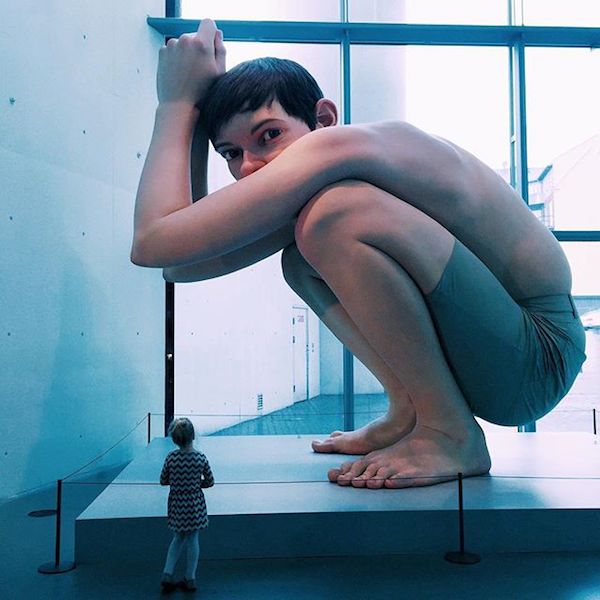
Photo by @missmillemaria, with Ron Mueck's "Boy," appearing under the #ArtWatchers hashtag
Image: Courtesy @missmillemaria Instagram
“I gave a lecture once where someone in the audience seriously asked, ‘is it true that you have to use at least five hashtags per Instagram post?,'" JiaJia Fei, the Guggenheim's associate director of digital marketing, told me recently.
The answer to that query is “no," but the fact that it stood out as a burning question shows that hashtags—which themselves have only been around since 2007, when they were invented by Chris Messina, a former Google employee—have become an important part of the way that art circulates via platforms like Twitter and Instagram, just as they have become a vital tool in politics, activism, and many other fields.
Major public art projects come pre-branded with hashtags (think Creative Time's #karawalkerdomino), and most big art events spawn their own (thus #whibi becomes the place where people share their gripes about the Whitney Biennial).
When it comes to tapping into conversations that escape a specific event, however, you quickly run into problems of clutter: because everyone on Twitter who has ever put a brush to canvas tags their painting #painting, it's not that useful. There are, however, a number of hashtags that are useful for keeping track of different key conversation in contemporary art, magic passwords that are more granular than #art but less specific than #JennyHolzerAtHauserAndWirthSomerset.
When Victoria’s Secret calls and asks if you’d like to spend the day with an Angel, there’s only one thing to do: drop everything and pack your bags! So on Wednesday I did just that and jetted off to Houston, Texas where I met the beautiful Sara Sampaio on the latest stop of the Body by Victoria tour. The trip marked the first solo appearance for the Portugal native, who landed her coveted wings back in April. “I couldn’t believe it,” Sampaio tell us about hearing the news for the first time. “Only when it went public did things get very surreal.” Becoming an Angel was a dream come true for the 24-year-old, who has grown up idolizing former Angels Gisele Bundchen, Heidi Klum, and Tyra Banks. “All of them are incredible women and have branched out of Victoria’s Secret to do amazing things,” she says. “I hope one day that is me.”
As Sampaio is quickly learning, the life of a VS Angel is never dull. Case in point: her whirlwind 24-hour trip to The Lone Star State, complete with radio and local news appearances, three mall signings, and a stop at a local Tex-Mex favorite. We followed along to get a firsthand look at a VS Angel’s typical work day, and between appearances and outfit changes caught up with Sampaio to talk about everything from the new Body by Victoria collection to her guilty pleasures. Keep reading for exclusive photo diary.
6:00am: Hair and makeup arrive
Early morning call times are de rigueur for VS Angels. Luckily, Sampaio had her go-to hair and makeup team—Dominick Pucciarello and Dominique Samuel, respectively—on hand to create her bombshell beauty look for the day.
7:45am: And we’re off!
In the first look of the day—Ted Baker’s matching Salsah Ottoman Knit Crop Top ($125) and crop top and Sashaey Ottoman Knit Midi Skirt ($175)—Sampaio heads to the Rod Ryan Morning Radio Show. As Ryan put it, Sampaio was “rolling deep” with a crew of nine people.
8:15am: On the radio
We arrived at the Rod Ryan Morning Show and we’re quickly ushered into the green room. No stranger to radio, Sampaio was a pro on the air. “It was fun,” she tells us of the experience. “I was a bit nervous. I feel like the first interview of the day is always the hardest, but radio is usually easier than doing TV.”
9:15am: Talking Body by Victoria on Fox 26
Next stop, Fox 26 studios, where Sampaio chatted with Melissa Wilson and Rita Garcia about the new Body by Victoria collection.
10:45am: Photo Op
We arrive at the Houston Galleria, and Sampaio slips into look number two, a lace Alex Perry dress. Time to meet the press! The beauty dishes on the new Body by Victoria collection, revealing her favorite style, the Lace Lounge Bralette ($29). “It’s so comfortable to lounge in when you’re at home,” she says. And I love the lace, because it gives it that sexy touch.”
12:00pm: Lunch Break
Comfort food is key for Sampaio during long press days. Her lunch of choice? Pizza! “If I do not eat things I like, I’ll get very grumpy,” she says. “I go for stuff like popcorn and pizza, and tons of coffee. Cheat days are very important for your sanity.” So what’s her secret to staying fit and healthy? “If I’m on the road, I try not skip meals,” Sampaio tells us. “I try to workout at least two to three times a week, but if I need to get in shape fast, I run.”