Tuesday, November 19, 2019

Remains of Route 66, Road Trip Trash


só mesmo os americanos para venerar lixo... não têm história e depois precisam de monumentos... :(

...|...


Along the Remains of Route 66, Road Trip Trash Has Become Treasure

Welcome to the “throw zone.”
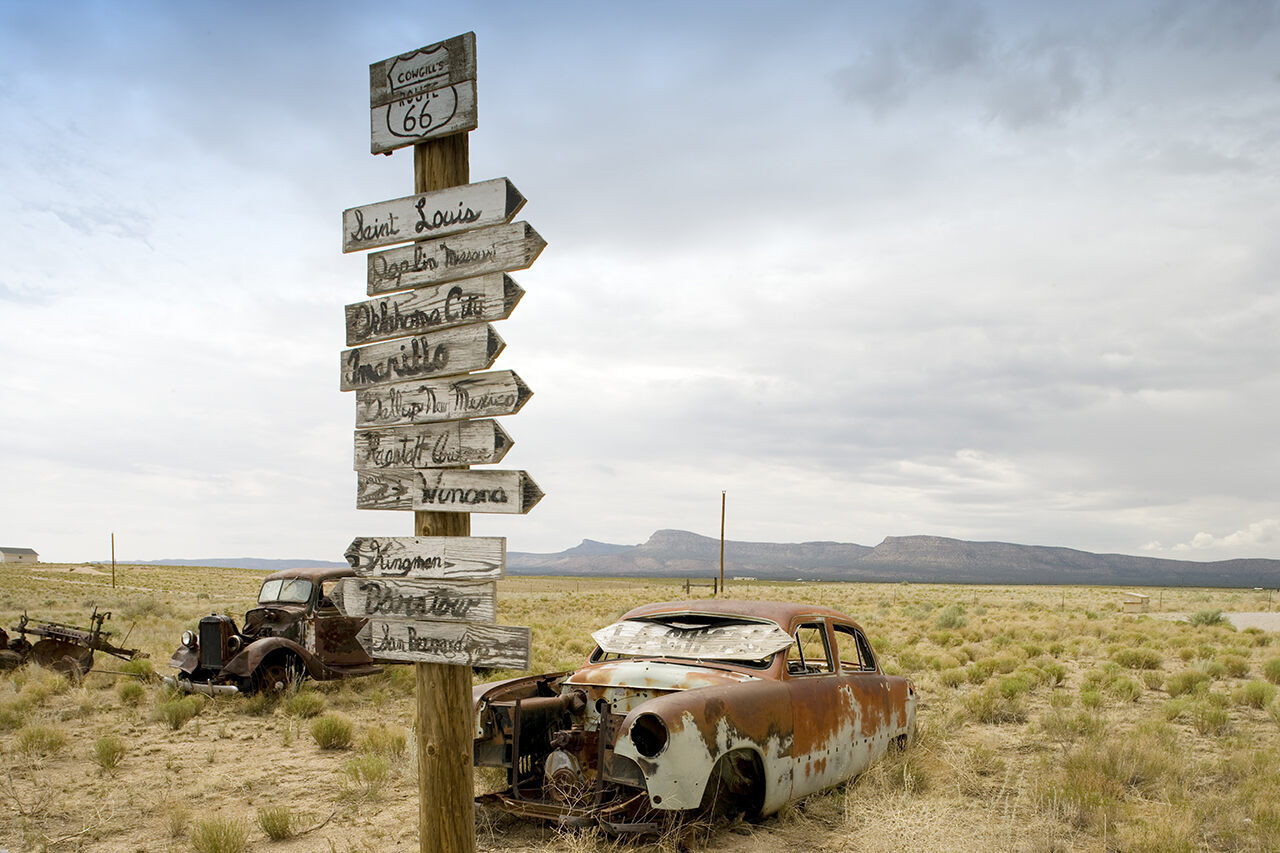
The road is no longer in use, but there's still a lot of nostalgia around it.
The road is no longer in use, but there's still a lot of nostalgia around it. PHOTOGRAPHS IN THE CAROL M. HIGHSMITH ARCHIVE, LIBRARY OF CONGRESS, PRINTS AND PHOTOGRAPHS DIVISION.

AS AMERICA’S HIGHWAY SYSTEM SPRAWLED in the middle of the 20th century, families began to spend vacations on the road. Route 66, also known as the “Main Street of America” or the “Mother Road,” was one of the country’s major asphalt arteries. Beginning in the 1920s, it took drivers west and back—more than 2,000 miles from Chicago to Los Angeles. Parents folded and unfolded maps, while the kids saw Missouri, Kansas, Oklahoma, Texas, New Mexico, and Arizona blur past from the backseat.
Though Route 66 was more or less out of commission by the mid-1980s, you can visit portions of its old path—and, if you look closely, you’ll still find evidence of the drivers and passengers of decades past, in the form of the garbage they chucked out their windows.
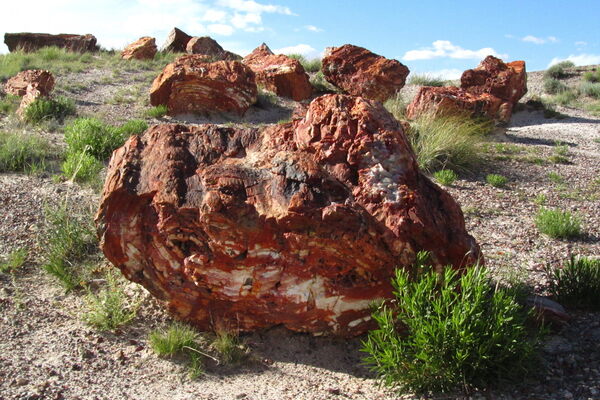
Petrified Forest National Park in Arizona is the only national park that contains a segment of Route 66. The park is famous for its stony, sculptural tree stumps and sherbet-striped desert, but amid the sagebrush are a dozen or so old telephone poles, stripped of the wires that once linked them. That’s the old highway, and it’s strewn with a trove of midcentury trash.
That section of Route 66 was bypassed in 1958 by what became I-40. “Almost immediately after it was bypassed, the park removed asphalt from the surface, but left the roadbed itself,” says William Parker, the chief of science and resource management at the park. The roadbed is composed of the heaps of dirt and aggregate that elevated the road so it wouldn’t flood and wash out in storms, and it was flanked by ditches. That’s where the trash accumulated.
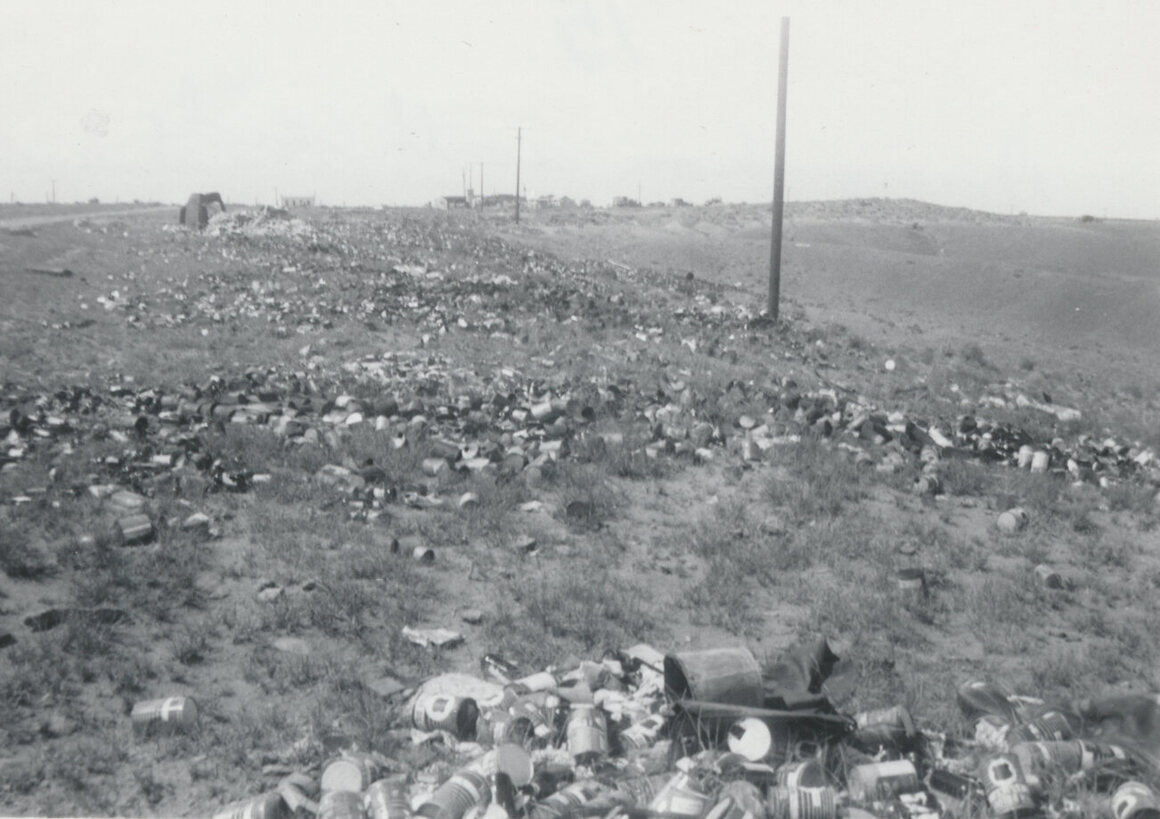
In 1955, the ditches flanking Route 66 accumulated lots of trash.
In 1955, the ditches flanking Route 66 accumulated lots of trash. NATIONAL PARK SERVICE
As the remains there show, desert drivers might nurse a 7-Up, or Kist soda, or A-1 beer, an Arizona speciality. When a bottle or can was empty, they just flung it. “It was socially acceptable at the time to just roll down the window and throw the trash out,” says Parker.
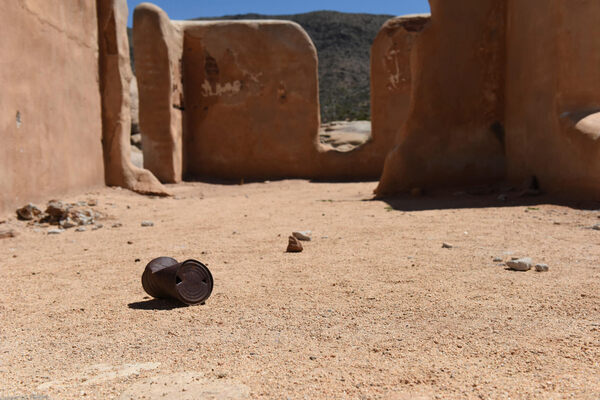
The densest concentration of trash came to rest about 10 to 15 feet from the roadbed, in a band Parker and his colleagues affectionately call the “throw zone”—“about as far as you can huck a bottle out of a moving vehicle,” he adds. It was once so thick with garbage that it looked as though someone had torn open a trash bag and shaken its contents loose. Decades later, the “throw zone” is still home to smashed porcelain plates, bits of car door handles and mangled tires, and toys, such as cap guns and marbles picked up at the “trading posts” that once dotted the highway. Accessories such as aviator sunglasses turn up, too. There are easily hundreds of bottles and cans.
Some of the sun-baked, sand-whipped items are too scoured or rusted to read, but their shapes, materials, and mouths are clues to their identity. The cans are largely steel instead of aluminum, Parker says. They might be flat-topped—requiring a churchkey to open in the days before pull tabs—or have a conical top that evokes a can of motor oil. “They’re all from the 1930s to the 1950s, which is exactly what we’d expect,” Parker says, since that’s when the highway was active. Some of the bottles are stamped with the city where they were made. Parker can imagine a family stopping for soda in Gallup, New Mexico, driving west, and then needing to replenish their supply by the time they passed through the park en route to Flagstaff.
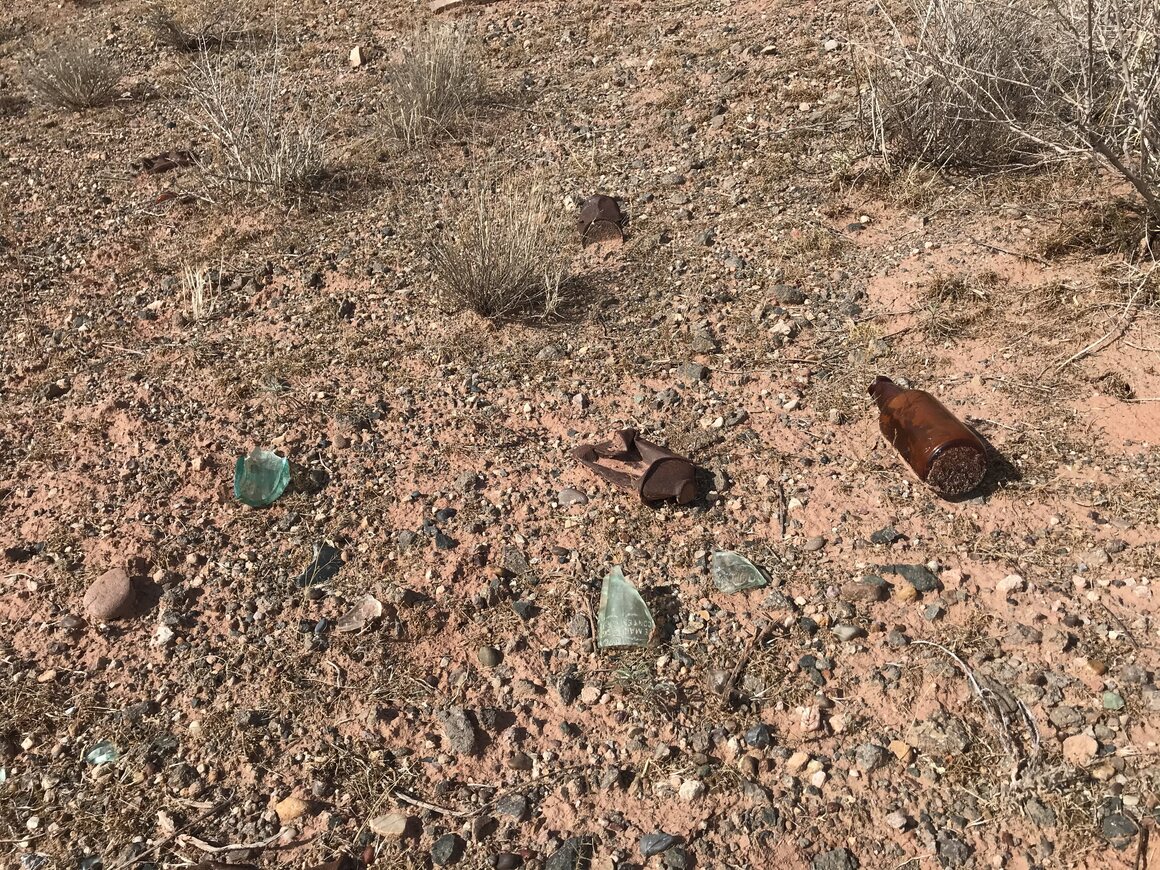
The ditches are cleaner today, but still contain old bottles and cone-top cans.
Immediately after the highway was torn out, Parker says, park staff did a cursory tidying up of the ditches, but they didn’t pick them clean, and it would have been hard even if they’d tried. Over time, some of the trash was buried by blowing dirt. (At the time, the park and much of the private land around it lacked trash pickup, Parker says. Garbage elsewhere in the park was either burned or deliberately buried.) Now, along the roadbed, more “throw zone” trash is resurfacing as the mounds shift and erode.
Though Route 66 hasn’t existed in decades, there’s still a lot of nostalgia around it. It hits all the most resonant Americana notes—a journey, big skies, no looking back. The road “is a cultural resource in its own right,” says Jason Theuer, now cultural resources branch chief at Joshua Tree National Park, who worked at Petrified Forest in the 2000s. During his time at the park, Theuer says, he met visitors who fondly remembered driving the original route.
In 2006, the park installed a turn-off spot that commemorates the highway with a smattering of little attractions, including an interpretative panel and a rusty, wheel-less 1932 Studebaker propped up on concrete supports. Parker estimates that somewhere between a quarter and a half of the park’s 700,000 to 800,000 annual visitors stop by the display. About a dozen artifacts from the “throw zone,” mostly kids’ toys, are on display in a permanent exhibition at the park’s Painted Desert Inn. A few dozen representative objects have also been added to the park’s museum collection, which is generally locked up in metal cabinets. Elsewhere, the Route 66 Corridor Preservation Program, a Park Service project, has compiled oral histories, preservation reports, and ephemera, and produced an itinerary for contemporary road-trippers, including everything from lodges to chicken joints.
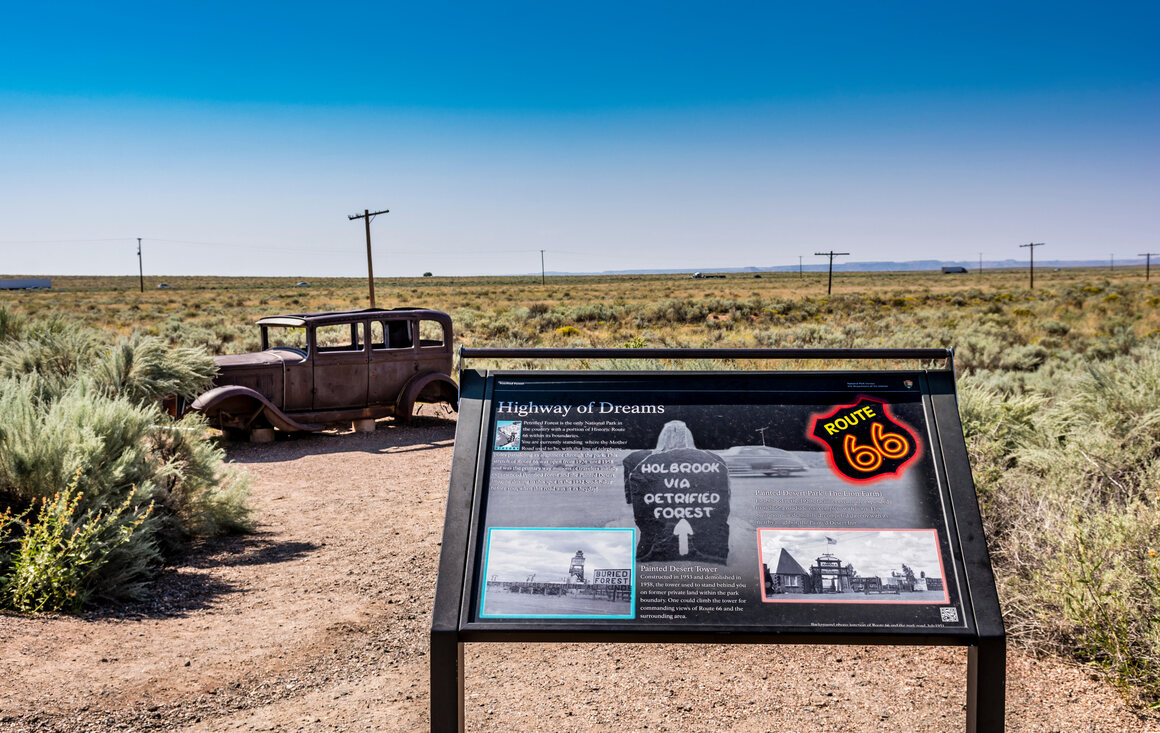
In 2006, the park installed interpretive information and a rusted Studebaker near the old roadbed.
In 2006, the park installed interpretive information and a rusted Studebaker near the old roadbed. BHAMMOND/ALAMY STOCK PHOTO
These days, Parker says, “for the most part, visitors are good about putting things in cans.” The only fresh trash he observes are tangles of paper and occasional plastic bags that blow in on gusty fall days.
If you do see some old-looking rubbish in the park, just leave it be: Trash that is more than 50 years old and left in place is considered historic. Think of it as a window into midcentury recreation. “It’s funny that someone would throw these bottles or cans out and not think that in 50 years they’d be in a museum somewhere,” Parker says. 

“As we progress through time, things are constantly becoming historic.”


Second edition footer

editioned works by Gerhard Richter


not a selfie  :)))


Gerhard Richter, Betty, 1991. Offset print on lightweight card with a layer of nitrocellulose varnish, mounted on plastic, in artist's frame, 50 1/8 x 39 7/8 x 1 in. 127.2 x 101.1 x 2.5 cm. Edition of 25 © Gerhard Richter 2019 (07102019) Photo: Rob McKeever. Courtesy Gagosian.


1:35 pm /
The First Art Newspaper on the Net Established in 1996PortugalTuesday, November 19, 2019


Gagosian exhibits editioned works by Gerhard Richter spanning fifty years
Gerhard Richter in his studio, Dusseldorf 1966. © Gerhard Richter 2019 (29102019)
Courtesy Gagosian.


1
  
NEW YORK, NY.- Gagosian is presenting editioned works by Gerhard Richter spanning fifty years.

Throughout his distinguished career, Richter has remained at the forefront of contemporary abstraction and image-making, embracing haptic process and technological advancements in equal measure and harnessing found imagery in groundbreaking ways. Editions are a central feature of his practice. He modifies details and sometimes entire compositions from his oeuvre, producing artworks that are simultaneously self-referential and new. Divergent in medium, scale, and style, the editions mirror Richter’s mercurial artistic processes and explore the dynamic relationship between source image and pictorial representation.

Many of Richter’s prints are based on personal photographs. He produced his earliest edition Hund (Dog) (1965) by sweeping a paintbrush across a still-damp screenprint depicting the family dog; blurred with a visible texture from the brush hairs, the resulting image is a print that references both painting and photography. Richter also rephotographed newspaper illustrations, altering them to simulate the appearance of industrial print media. In Flugzeug I (Airplane I) (1966), he purposely misaligned the screenprint’s two layers of gray ink, mimicking the errors common to off-register printing. Other early works, such as the offset print Elizabeth II (1966), were intentionally printed with shifted plates to create a moiré pattern.

Betty (1991) poses questions of identity and veracity in portraiture and printmaking. It is titled after Richter’s daughter, who is depicted here in a floral robe, her head turned away from the viewer. The image is layered in mimesis: it is offset-printed from a photograph of Richter’s iconic 1988 painting of the same name, which was itself painted from a photograph of the subject taken by the artist. Richter’s portrait speaks with the intimate visual language of a family photograph, yet its repeated technical mediations refute any affective connection with the anonymous subject.

In 1993, as a special project for the international journal Parkett, Richter produced Grün-Blau-Rot (Green-Blue-Red), a sequential series of unique small paintings following a basic chromatic principle. He applied the same three vivid oil-based pigments onto 115 uniformly sized canvases with a squeegee, employing the regimented process of his Abstraktes Bilder series, which allows for the relatively uncontrolled interaction of color. Made by the artist’s own hand without the restraining grid of the printing process, each work exists as a unique variation on the same theme.

Richter’s oeuvre continues to function as a creative springboard in his 2011 series of Strips. To create these large-scale inkjet prints, he digitally divided his oil-on-canvas Abstract Painting (724-4) (1990) into 4,096 vertical segments. Segments were then randomly selected and repeated until they lengthened out into thin horizontal strips of uniform color, allowing a single painting to spawn multiple new images. Clean and crisp, appearing as sort of horizontal barcodes, the Strips subvert their painterly origins with an air of modern detachment. Richter’s impulse to modify and reinterpret his own works resurfaces in Cage Grid (2011), a series of inkjet prints created by dividing a photograph of his 2006 oil painting Cage 6 into a four-by-four grid of squares.

https://flipadosteam.wixsite.com/the-flipados-team

www.vantag.eu

Sunday, November 17, 2019

PSP persegue pantera e reboca carros!

Que raio de ideia esta?! O segurança do prédio a tocar à campaínha às 6h50 da madrugada de domingo!

"Tem que tirar o carro! A polícia vai rebocar!"
Sempre que há corridas na cidade e passam na Avenida do Parque já sabemos que não podemos tirar os carros da garagem e sair da zona até depois da hora de almoço. Uma coisa é ficarmos "bloqueados" e ter que sair a pé ou de bicicleta... outra coisa é não poder estacionar carros e isso nunca tinha sido proibido antes (que eu saiba).
Dado que os lugares de garagem estavam já cheios, toca a levantar e ir estacionar o carro numa rua fora da zona do atletismo.
Pelo que se passou a seguir, foi excesso de zelo do segurança:
- não vi o reboque (será que o porteiro o viu? ou foi só ameaça da PSP?)
- às 9h50, ainda passaram carros na avenida; 
- um estacionou em frente ao prédio sem qualquer preocupação - o carro da polícia passou e nada fez; 
- outro continuou a circular e a polícia berrou no megafone que tinha que sair dali... olhei para o outro lado da avenida e já se aproximavam os corredores mais adiantados!!!
Brilhante organização :(


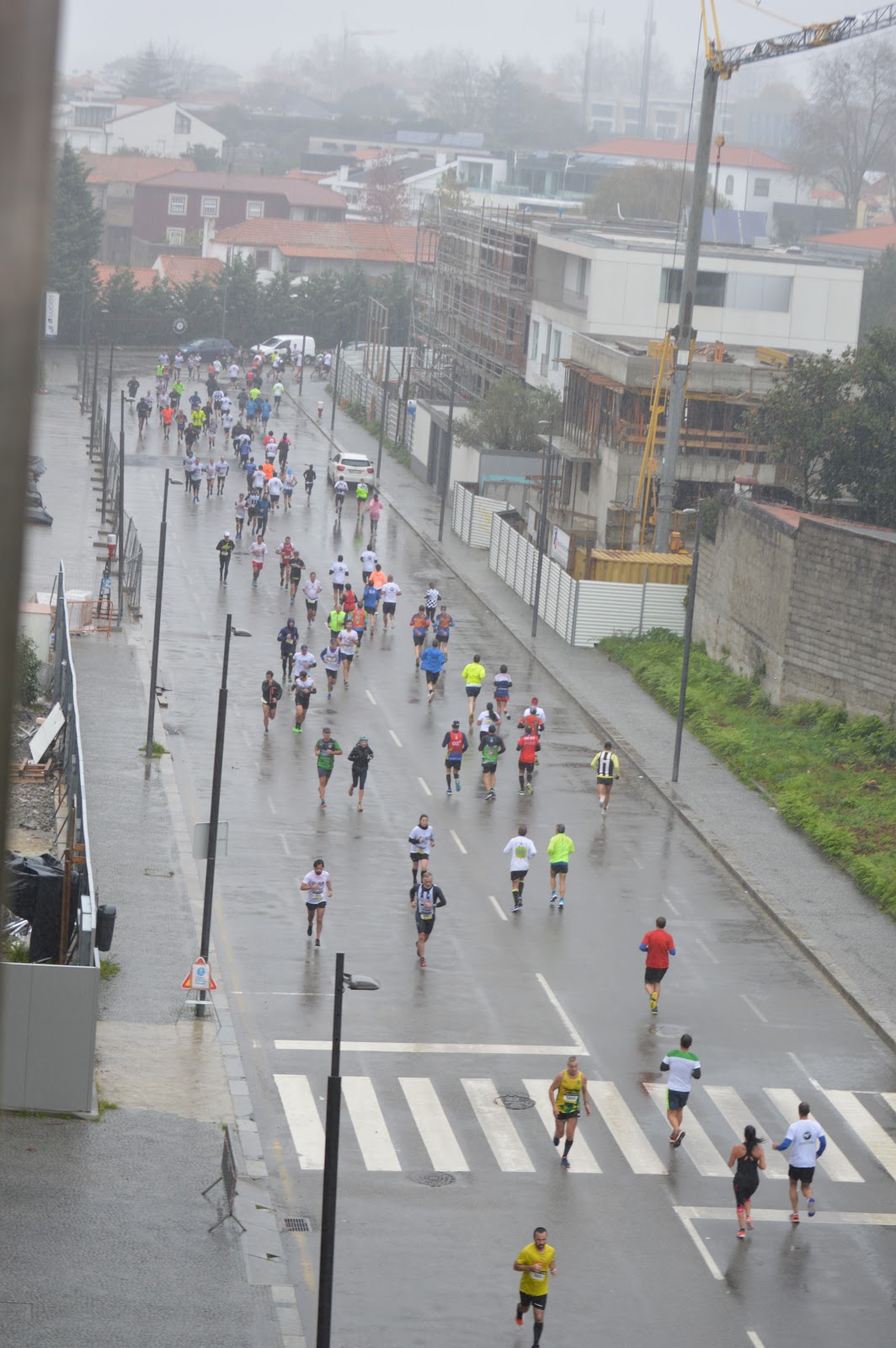
As indumentárias de proteção contra a chuva levaram a algumas fotografias engraçadas...

A avenida foi usada, como se deduz pelas fotos, para correr nos dois sentidos... separador não existia e por isso foi mais uma vez o carro da polícia que quase atropelou os primeiros corredores a gritar no megafone para chegarem à direita que o retorno era pela mesma via!

Outra cena bastante rústica foi o diálogo do motolícia (inventei agora) com a última concorrente em prova... virou-se para um peãolícia que "guardava" a curva na avenida e gritou:
"Passa aí o chicote!"
Mas a concorrente continuava a caminhar em vez de sprintar!
Perante esta função (como no ciclismo) de carro-vassoura  [ou melhor mota-esfregona] tão insistente pensei que haveria mais corridas a seguir...
mas ainda nem 11h eram e já carros voltavam a entrar na avenida!!!
Tanta cena para isto!


Parece que a corrida se chamava da pantera... depois de ter visto algumas camisolas quadriculadas de preto e branco deu para perceber.... coitado do Boavista... a pantera estava afinal cinzenta...

... e a PSP também.

...|...

T f T - The fLIPADOS Team

...|...