Saturday, September 23, 2017

The Law Behind New York’s Multi-Million-Dollar Art-World Tax Probe, Explained


The Law Behind New York’s Multi-Million-Dollar Art-World Tax Probe, Explained

Like a meteor shower through the night sky, every so often a government tax probe of the art world tears across the headlines. Some end in a public flourish, with big fines and even jail time being incurred by their targets. Others end as suddenly as they began, without a bang but still with millions added to city and state coffers.
According to several recent reports, the art world is currently in the midst of another investigation, initiated by New York Attorney General Eric Schneiderman. And though this one has new names and faces to go with the stories, the tax law at the heart of the matter is the same as in years past: sales and use tax. The buyer’s resulting tax burden (8.875% in Manhattan, the global capital of the art market) can amount to a significant chunk of change. So it should come as no surprise that some look for ways to minimize their exposure to taxes (legally) or evade the taxes entirely (and illegally).
But what exactly are these taxes and how can they be sidestepped? Here are three purchasing scenarios, all imagining a transaction in New York:


SCENARIO 1:


You walk into a gallery and buy a nice Koons for the foyer of your Upper East Side manse.

Since you’re buying and using the work in the same location, your invoice should include (and you need to pay) sales and use tax. There are tactics to lessen other taxes paid later on, however. For example, if you purchased the work as an investment and hold onto it for a year, you could claim any profits as long-term capital gains when you sell, and therefore incur a lower tax rate on that income. 


SCENARIO 2:


You buy a work with the exclusive purpose of reselling the piece. (You’ll need the required paperwork to back it up.)

In this instance, you are legally exempt from paying sales or use tax. But the specifics can get tricky, and sit at the crux of Schneiderman’s tax probe. Essentially, Schneiderman is alleging that hundreds of artworks purchased exclusively for resale, and therefore incurring no sales or use tax, were hung in homes and businesses. The probe interprets this as qualifying the artworks as having been used. And that is not allowed. As the AG put it in a statement, “Art buyers may not avoid sales or use tax simply by claiming that artwork they enjoy at home is intended for resale.”
One figure who has attracted the AG’s attention is Aby Rosen, a prominent real estate developer. Rosen will fork over $7 million to settle allegations that he inappropriately avoided paying sales tax on $80 million in art purchases. The settlement applies to 200 works of art that Rosen bought or commissioned through separately established companies from 2002 to 2015. Though he’s paying up, Rosen ardently denies Schneiderman’s charges, and the settlement comes with no admission of wrongdoing. The mogul chalks the AG’s zealousness up to the desire to fill state coffers and, perhaps more importantly, a failure to recognize that Rosen’s apartment and office are places of business where works for sale are being shown. While this may be true, tax authorities raise an eyebrow at such an interpretation. “You’re only permitted to use a resale certificate to get the exemption from sales tax if you’re planning to exclusively use the work for resale,” explains Diana Wierbicki, Partner and Global Head of Art Law at Withers Bergman LLP. “That’s the key term New York keeps focusing on.”
The other settlement so far is with Victoria Gelfand, a Gagosian director. (Gelfand’s transactions in question were private and the gallery isn’t implicated.) Gelfand set up two companies and purchased 31 works totalling over $1 million. She claimed the pieces were for resale. But some were shown in Gelfand’s home, and it is those works that are covered by her $210,000 settlement. Gelfand’s lawyer notes her client doesn’t “necessarily agree” with Schneiderman’s allegations.
“Exclusively for resale” can seem an uncertain hurdle to jump for those in the art market, where a home isn’t an absurd place to make a transaction. “You have an industry that is accustomed to marketing art in a personal setting, which makes sense because most of your buyers will be buying it for a personal setting,” says Wierbicki. Trouble also brews for those looking to deal art on the side. “If you have a secondary business where you’re an art dealer, you may not have a gallery in which to display works. If you don’t have that, where else are you supposed to show [works] to a client?” asks Wierbicki. As the investigations continue, it’s possible that Schneiderman’s rationale will become more clear cut and collectors and dealers will be able to act accordingly. Don’t use your house as a gallery seems to be the overriding message thus far, and, as always, document transactions carefully. (Wierbicki has more good advice in Forbes.) 


SCENARIO 3:


You buy a work for the pool house of your home out of state.

You’ll be charged use tax at the rate dictated by the state where you’re using, storing, or consuming (if, say, you bought a Felix Gonzalez-Torres) the work. Understanding the difference between sales tax and use tax is important, both for your wallet and in order to be on the right side of the law. You pay sales tax when you buy something in a state and first use the object in that same state. If, however, you ship a work from one state immediately to another state, then you pay use tax at the rate dictated by the state to which the work was shipped. And you do not pay sales tax to the state in which the work was purchased.
Some states’ use tax rates are more advantageous to collectors than others. For example, you can have a Manhattan gallery or auction house ship the work directly to a home or museum in a state which doesn’t have use tax at all. These include New Hampshire, Delaware, Alaska, Montana, and Oregon. Two years ago, the New York Times ran a piece questioning why major works were heading straight to the Portland Art Museum. The works included Three Studies of Lucian Freud (1969), which had just become the world’s most expensive artwork to sell at auction, having made $142.4 million when it hit the Christie’s New York auction block. The answer, it turns out, may have something to do with use tax, which, again, isn’t imposed under Oregon state law. But the move doesn’t necessarily get the buyer off the hook for sales tax long-term. When someone who qualifies as New York resident for sales tax purposes (a much lower bar than income tax purposes) brings a work back to New York from, say, Portland, they would still have to pay use tax in New York.
The practice of sending a work out of state to minimize your tax burden can certainly be legal. So can purchasing art for resale. But there’s a lot of grey area, and authorities are likely to leave it that way if it means over-compliance rather than under-compliance. The key is to have proper and transparent documentation, should the taxman come knocking. Missteps (intentional or otherwise) when it comes to paying taxes on art can have serious consequences. If the AG can prove you committed fraud, the penalty is twice the amount of the unpaid taxes plus interest at 14.5% and potential jail time. In short, folks, consult an attorney and an accountant, and keep good records.

—Isaac Kaplan

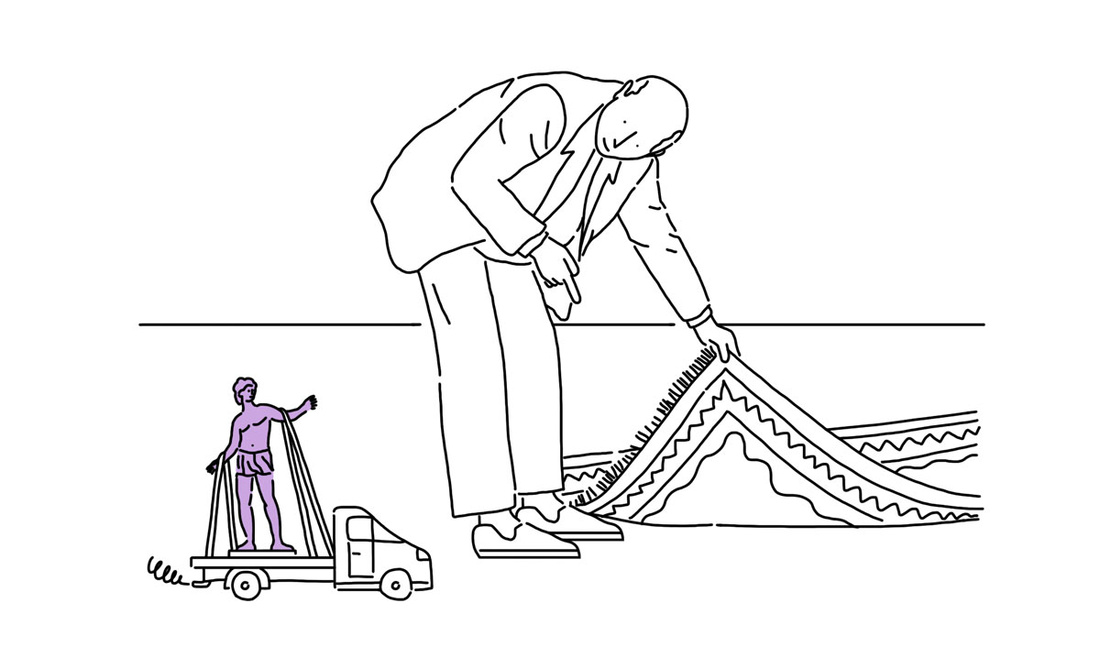
Illustration by Jan Buchczik for Artsy

The Paris Review by decades


‘Radical Women’ of Latin American Art


Blouin Artinfo


‘Radical Women’ of Latin American Art at Hammer Museum

Limitada (Limited), 1978, by Marie Oresanz (Argentine, born 1936). Black-and-white photograph, 35 X 50 cm.
(Courtesy Collection of Mari e Orensanz; courtesy Alejandra Von Hartz Gallery. ©Mari e Orensanz)
“Radical Women: Latin American Art, 1960–1985” will be on view at the Hammer Museum in Los Angeles from September 15 through December 31.
As a part of “Pacific Standard Time: LA/LA” — an effort by Getty and other arts institutions across Southern California to explore the birth of the Los Angeles art scene— “Radical Women” brings a fresh perspective to the work of a cross-section of internationally influential women artists who helped shape experimental art in Latin America and the United States between 1960 and 1985. The show’s organizers say it aims to address a vacuum in art history, giving visibility and context to the radical and feminist work that was produced during these decades, but that has been underserved in the academic world. Included are an assortment of 260 works in mediums including photography and video by 116 artists from 15 countries. Lygia Pape, Ana Mendieta, and Marta Minujín are among the artists featured, but the show also includes lesser-known figures such as the Cuban-born abstract artist Zilia Sánchez, the Colombian sculptor Feliza Bursztyn, and the Argentine mixed-media artist Margarita Paksa. “The artworks in ‘Radical Women’ can be viewed as heroic acts that gave a voice to generations of women across Latin America and the United States,”says Ann Philbin, the director of the Hammer Museum.

“Human Life Is Punishment,” and Other Pleasures of Studying Latin


“Human Life Is Punishment,” and Other Pleasures of Studying Latin


By 
 

ON LANGUAGE


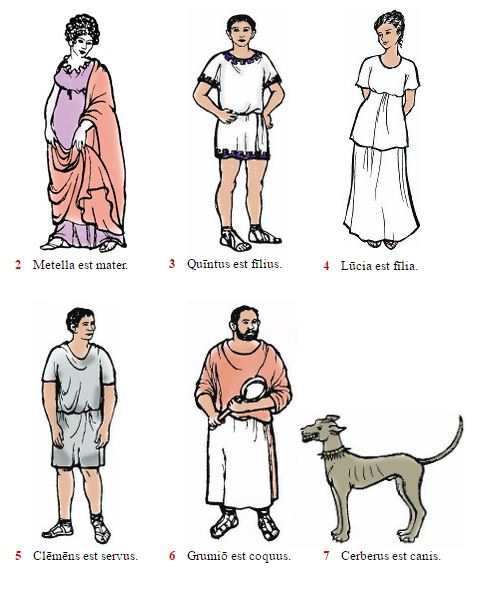
FROM THE CAMBRIDGE LATIN COURSE 4TH EDITION.
The Iowa Writers’ Workshop, where I am currently enrolled, doesn’t require you to do much of anything. Time is largely unstructured here; as long as your writing gets done, you barely have to get out of bed for two years. When I first realized this, I panicked, and then I registered for an undergraduate course in elementary Latin. I don’t even get academic credit for it. I just wanted something in my life, amidst the subjective muck of the creative process, that I could be objectively good at—the occasional dopamine rush of a check mark, an A grade, a scribbled Great job! from an authority figure—and I remembered being good at Latin.
It had been almost two decades since I last looked at a Latin textbook, but I was optimistic that I’d retained a lot. My seventh-grade Latin textbook left a vivid impression on me. It followed the fictionalized adventures of a real-life Pompeian household (vocab words for the final chapter included volcano, to erupt, smoke, ashes, in despair), and to this day, I remember the whole cast of characters: Caecilius, a banker; Metella, his wife; Grumio, their cook; and Cerberus, the dog, who stays by his master’s side to the very end (RIP, little buddy). I’ll never forget the passage in which Melissa, a newly purchased slave girl, is first presented to the household: my translation was “Melissa pleases Caecilius. Melissa pleases Grumio. Uh-oh—Melissa does not please Metella!” It was pretty juicy material, by seventh-grade standards. (I just Googled these names, so I can tell you that the book was The Cambridge Latin Course: Book 1, and that it has a surprisingly robust fandom on Tumblr.)
My middle school required two years of Latin, and the worse I did socially, the better I did at Latin. At the social nadir of my seventh-grade year, on the heels of my thirteenth birthday and my parents’ divorce, my best friend unexpectedly dumped me dramatically in a crowded school hallway. “You’re a BITCH from HELL,” she shouted in my face, “so FUCK OFF!” I had never had such language directed at me before, and over the following weeks, as I reeled from the shock of the incident, I found myself thinking about it in Latin. The verb vituperare, which can be translated as “to yell at,” “to find fault with,” “to reproach,” “to castigate,” et cetera, summed it all up in a way that no English word could. Amelia me vituperavit, I whispered to myself on the subway, in the crowded school hallway, in the cafeteria where I now ate lunch alone. O Amelia, cur me vituperavisti?

FROM THE CAMBRIDGE LATIN COURSE: BOOK 1.
This obsession continued to the point where I eventually composed an entire Latin paragraph asking Amelia why, indeed, she had me vituperavit. Playfully, I coined the word Cerbera, a feminized form of Cerberus: literally, “female dog from hell”. Idne est verum? Num Cerbera sum? In Latin, I was more vulnerable than I allowed myself to be in English, and though I was angry, at the end of the passage, I surprised myself by asking Amelia to be my friend again. The process was very therapeutic.
Then I emailed her the whole thing over AOL.
I don’t know what I had expected, but I was crushed when she wrote back informing me that there was no way she was going to translate all that (somehow, I had lost sight of the fact that she would have to), and that, furthermore, I was “so weird.” We never spoke again.
At the end of that year, I scored 110 percent on the Latin final. Even the teacher, a kind, soft-spoken man named Kai Ashante Wilson, seemed concerned by the fervor with which I’d thrown myself into this dead language. He never played favorites, but on the last day of school, he took me aside and gave me a special present: an illustrated Latin guide for kids, so that I could study Latin on my own over the summer. I was moved almost to tears. But when I got home and opened the book, I realized it was a poorly edited entry in a cheap series designed to teach non-dead languages. Each chapter contained increasingly surreal instructions for achieving oral fluency: visit Latin-speaking communities, the book suggested, and practice conversation with native Latin speakers. I’d make Latin-speaking friends in no time!
I decided not to continue studying Latin in high school. It met at the same time as chorus, and of the two, Latin seemed more dangerous—a seductively solitary pursuit that could, like drugs, swallow up anyone who enjoyed it too much.
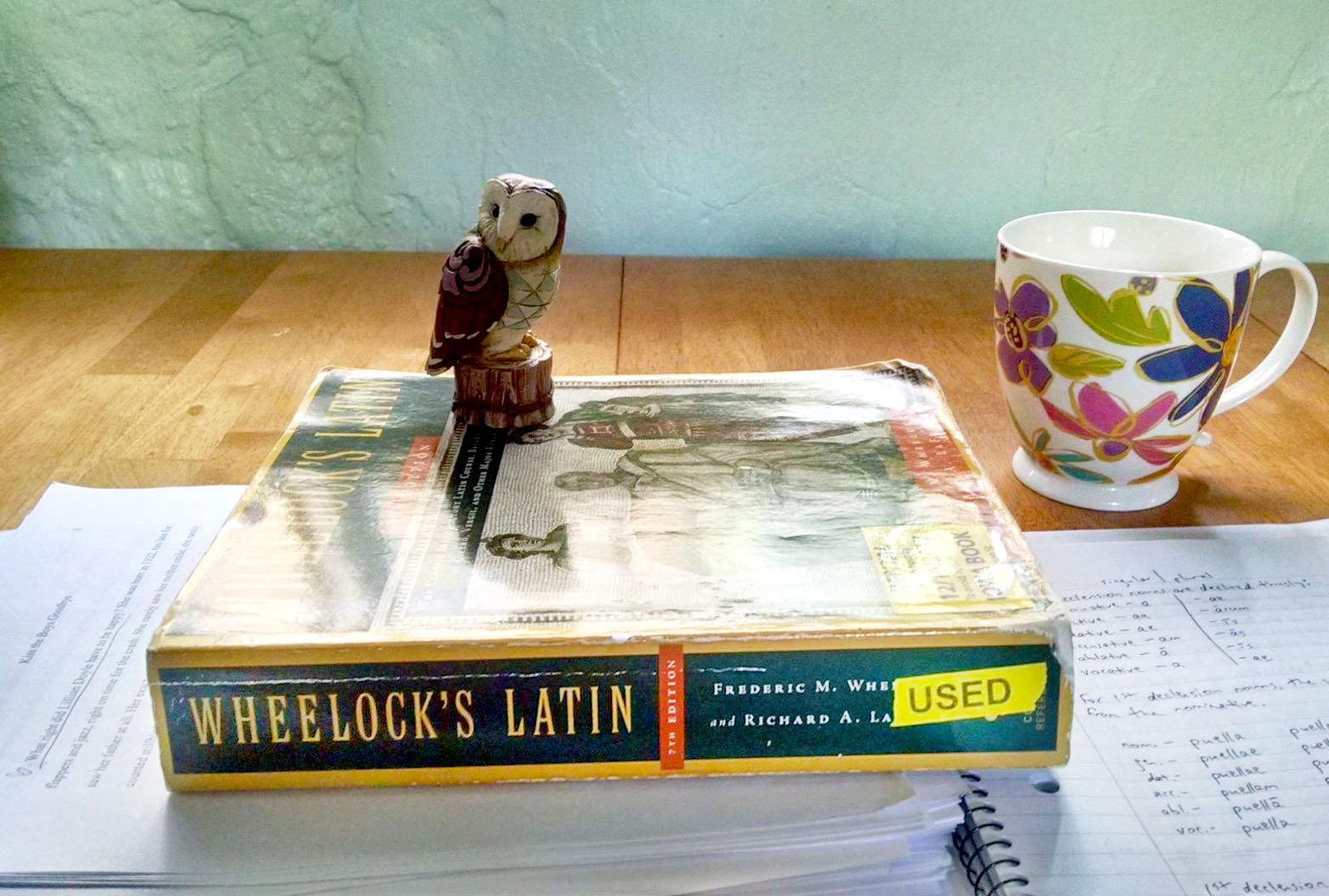
The University of Iowa uses a different textbook, Wheelock’s Latin, for the beginner classes. I miss Caecilius and Metella and the whole doomed Pompeian gang, but Wheelock (as we chummily personify the text) has his own pleasures, especially for those of us who spent the bulk of our academic careers studying living languages. Here are some sentences you’re likely to encounter in beginner French or Spanish:
I would like a salad.
This is a pencil.
Where is the library?
Here are some actual sentences that appear, context-free, in the first few chapters of Wheelock:
You are in great danger.
Few men have true friends, and few are deserving of them.
Human life is punishment.
Our translation exercises are epic, portentous, full of grandeur and violence. Wheelock is particularly preoccupied with the idiom poenas dare, which he translates as “to pay the penalty.” People in Wheelock are always paying the penalty for their anger, their greed, their foolishness. “You are all to blame, thunders one sentence, “and tomorrow you will pay the penalty. As with all of Wheelock’s sentences, you can easily imagine it delivered by a Hollywood super villain. Seize him, you fools!

THE AUTHOR’S DESK IN IOWA CITY
My class meets for an hour at ten thirty every morning, and as I labor to decipher our daily Wheelockian pronouncements, I remember why I loved Latin to begin with. Each sentence is a little puzzle, a Rubik’s Cube of words to be rearranged into their proper order based on arcane rules and hidden clues. There’s a creative thrill, too, in the task of transforming Latin into English, the miniature power trip of deciding whether to translate superare as “to rise above,” “to overcome,” “to conquer,” or even—if I’m feeling saucy—“to fucking crush.” The relative sparseness of Latin vocabulary makes me savor the richness of English all the more.
English is constantly on my mind in Latin class. Unlike non-dead languages, Latin places no pressure on the beginner student to outgrow the training wheels of one’s native language. Spontaneous conversation is not the goal, and thank the gods for that. Even at the highest levels, all Latin study is undertaken with an eye toward translation. In this respect, it hardly qualifies as “learning a language” at all; it has more in common with my mother’s addiction to those maddening cryptic crosswords in The Nation. Or, for that matter, her fondness for the crime novels of Walter Mosley and Michael Connelly. Every Latin sentence is a mystery to be solved, and the joy of translation, as with all detective fiction, is the promise that life can be untangled and reorganized into something neat and orderly.
More than anything, though, I love Latin because it has nothing to do with me. It has nothing to do with anything in my life. Classics evangelists who argue for the practical utility of Latin, its historical significance and English vocabulary-building potential, are profoundly missing the point: Latin is fun because all its native speakers are dead and will never have to meet you. Even if you could communicate with them through space and time, and even if your Latin skills were up to the task, what could you possibly say that would mean anything to them? You, personally, have no place in Latin. As far as Latin is concerned, you don’t matter; you don’t even exist. Studying Latin is an exercise in ego death.
I’m realizing now that this must have been what drew me to Latin in the seventh grade, when I wanted nothing more than to flee my own existence. Today, at the age of thirty, I enjoy my existence much more, but there’s still something to be said for starting every day with an hour of structured self-annihilation, especially when one is meant to spend the rest of the day working on a novel. I suspect that Kai Ashante Wilson, my gentle Latin teacher from middle school, would agree: I just Googled him and discovered that he is now a Hugo- and Nebula Award–nominated science-fiction author.
Seeing this news, I laughed with delight—who’d have guessed it?—and felt a new appreciation for the best part of Latin: not studying it, but leaving it behind. At the end of every class, when I pack up Wheelock and step into the bright light of an Iowa City morning, I am ready to inhabit the world again. I am ready to superare it all. I might even be ready to write about it.

Frankie Thomas is the author of The Showrunner, which received special mention in the 2013 Pushcart Prize Anthology. Her writing has also appeared in The Toast, The Hairpin, and Vol. 1 Brooklyn. She is currently studying fiction at the Iowa Writers’ Workshop.

Sample Trees


Sample Trees


Thomas Demand & Ben Lerner

ISSUE 212, SPRING 2015


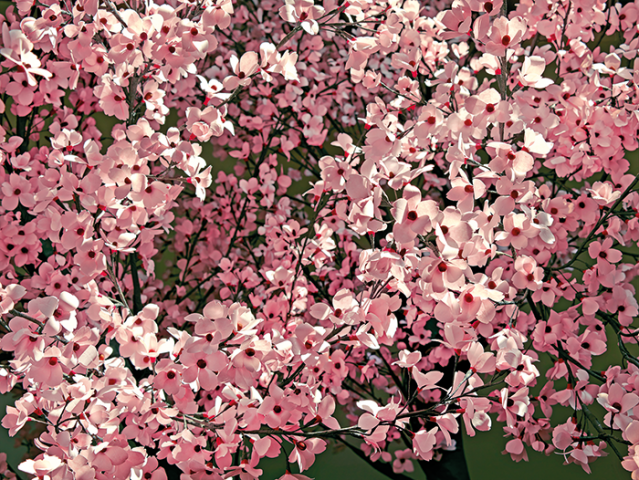
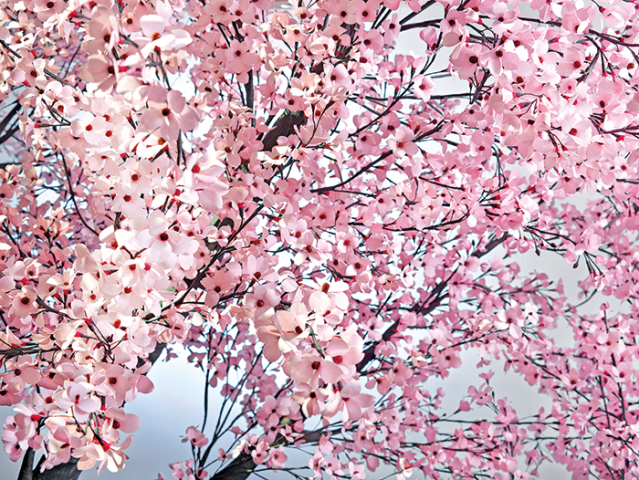
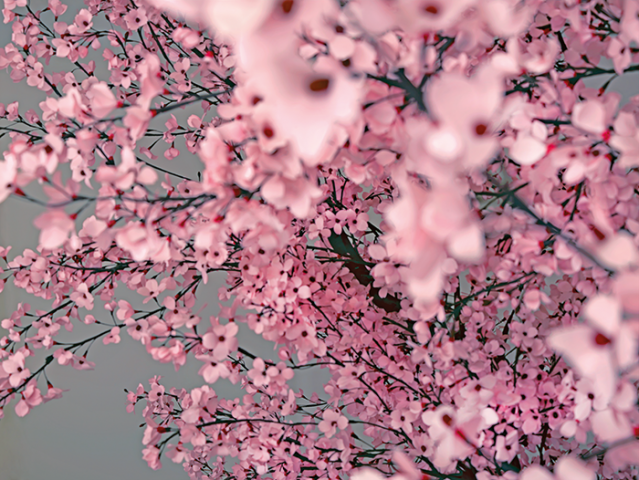
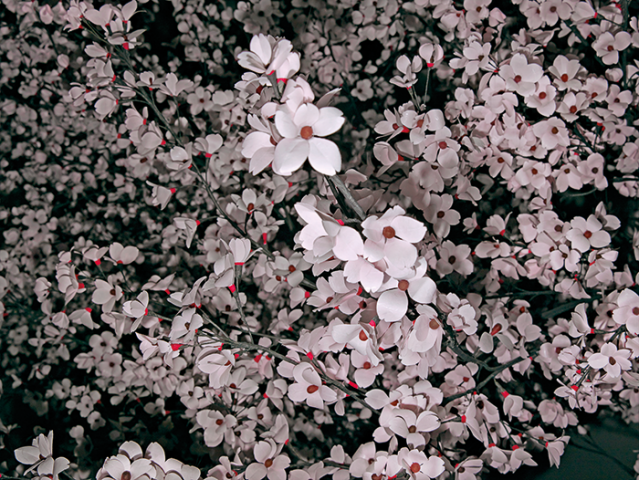
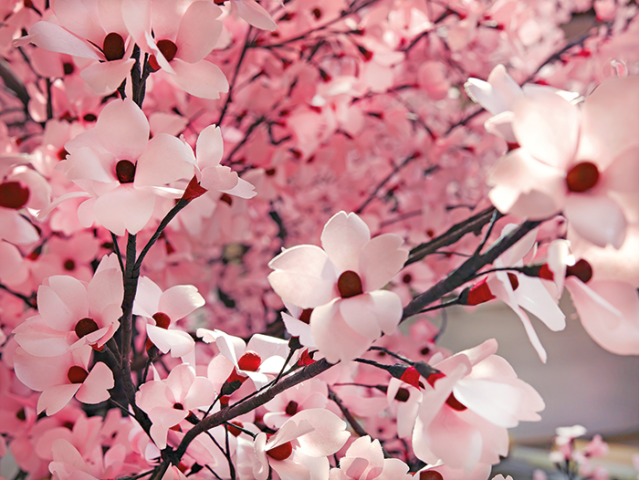
The following images of paper flowers, constructed and photographed by Thomas Demand, are based on a detail from a news photo of Katherine Russell, widow of the Boston Marathon bomber Tamerlan Tsarnaev. These images, and the accompanying poems by Ben Lerner, are part of a larger cycle, Blossom, which will be published in book form this summer.


Traditionally, you drink plum wine
Deepening the evening, a length of cloud
Then confuse a falling blossom with

A butterfly / In the photograph
Of the tradition, flowers in small corymbs
Papery against electric light

Blossoming en masse, in time lapse
You refer to a place where water flows
Over a vertical drop in culture / Poems

Fail to mention fission or decay
In the traditional ways, focusing instead
Then renouncing focus, a shimmering effect

In the middle distance, there is a monk
Likening this world to an echo, smoke
Slowly rising from some pyre, another year  

Gone, frostwork on the grass/glass
The nu suffix expresses completeness
The mu suffix indicates intention, I

Function to measure impermanence
“Like a passing dream on a night in spring”
The petals shed their details


The suspicion that, too rapidly to be perceived
As they pass behind a stand of ornamentals
These clouds are being removed and then replaced

With identical masses of frozen crystals / I
Am the embodied form of that suspicion / I
Have traveled all night to sing it / I

Was robbed and beaten on the road
Between two period styles, my eyes removed
Dipped in something, and replaced

When luminance sensitivity peaks
A shift toward the blue end of the spectrum
Inclines my song to natural satellites

Reflected in transparent fluids and/
Or glimpsed through branches, whether real
Paper or imagined, my song appeals

Not to be recorded, therein its claim
On the tradition, the fission and decay
Of a temple bell across a lonely mountain

Somewhere in LA, a man has captured
And thereby canceled, the transience
Of syllables falling onto man-made lakes


If six flowers bloom on the sample tree
The day of opening is officially declared
Signifying death in battle, the flowers appear

In the letters of young pilots, the ritual
Suicide a season is, the rising sun
Militarizes grasses, I have come

Writes one such pilot, to an understanding
With the petals and associated structures
The corolla of light my body makes  

As it opens in a market or a bus, whorl
Of sepals at the base or finish line
Of a marathon, improvised devices like

kireji, or “cutting word” / In English
There is no equivalent, only the ellipse
Where once there was a season, plums

Bloom prematurely, overtaking cherries
Confusing bees and viewing parties, both
Anachronisms / My vision separated

So that I could watch myself become immortal
Over the Pacific from my body
Where it remains, a shimmering effect


This page is blank except where indicated
This line left blank intentionally
There is a white so white that it appears

Only over many years, a period snow
Sparkling in belated light / Once erased
A poem can start, but how to end

Without beginning, I wrote this right
To left, but intended it to be read
From the margins in, the way birds scavenge

Or, as the film rewinds, the fire spreads
“I have taken considerable delight
In your ability to picture grass (Rasen)

Straw (Stall), trees (Lichtung)
A dead plant (Klause), gold (Bullion)
A rumpled pillow (Raum), dirty water

To name a few of the things that seem
A long way from paper,” but how to figure
The will to capture, abstracted slowly

From Berlin, where, in lieu of falling
Which, in lieu of melting / While
In lieu of passing: “snow” “scars” “time”


The leaves move/are moved in small
Increments between frames, easy to mistake
For traditional wind, the invisible hand

The phantom limb / A bomb or blazon
Breaks the beloved into parts
“Referred pain” is the beautiful phrase

All photographs bring to mind, if I
Can call this ensemble of excitable cells
A locus of sense, a lotus of sentiment

A flower with the rare capacity to revive
After centuries of stasis, or what I call
“Photography” / A big part of my practice  

Is being mistaken for a lily, the silence
Of aquatic perennials an influence
I hope your catalogue essay will acknowledge

With a ragged margin or blank pages
On the perennial verge of being turned
In the sense of soil: lower layers exposed  

To obliterating light / Please refer all pain
Less to the properties of surfaces than eyes
The sleep of color, the sun at night


Socrates speaks of three bees: one that stings
Beyond sensation, one made by a carpenter
And one made by an artist in imitation  

Whereas I perceive a fourth, hovering
In the floral passage between forms
Generating unlikely forces with its wings

Before dying at the onset of the winter
Socrates speaks of three winters, nested
Winters of decreasing size, the smallest  

Turned from a single piece of wood, while I
Think of winter as a kind of knowledge
Autumn gains too late to be of use

To the philosopher queen in her paper nest
Open celled, under eaves or ledges
Presiding over twenty thousand imitations

Socrates says that ignorance is flight
From the knowledge of spring that summer is
Unless I have misread the passage, a mimesis

Made of pale blue filaments / The leaves
Close when touched or captured
By a brief exposure to the negative


As flowers mimic female insects, luring males
As female flowers mimic male flowers
As hemiparasitic shrubs mimic the foliage

Of the host, so I mimic vocal patterns
Facial expressions, and I laugh
When collectors laugh, and when they weep

I place glistening glass beads
Beneath the area where my eyes should be
(My actual eyes are two dark holes

From which no information can escape)
I started as a sculptor, then became
Sculpture, translucent fiberglass and latex

Which my phone corrects to seppuku/
Sepulcher (I’m typing with my thumbs
From the River of Three Crossings)  

In the afterlife, the flowers provide
Sensory signals without nectar, and the bees
Aren’t bees, only sphinx moths, gifted

Mimics that cannot sting (the t is silent)
But exhibit the characteristics of a stinger
Warning colors and false sentiment