Neurocomic: A Graphic Novel About How the Brain Works
From the caves of memory to the castles of deception, by way of naughty neurotransmitters and giddy ganglia.
By Maria Popova
Scientists are only just beginning to understand how the brain works — from what transpires in it while we sleep to how to optimize its memory to what love does to it to how music affects it — and the rest of us fall somewhere on the spectrum between fascinated and confused when it comes to the intricate inner workings of our master-controller.
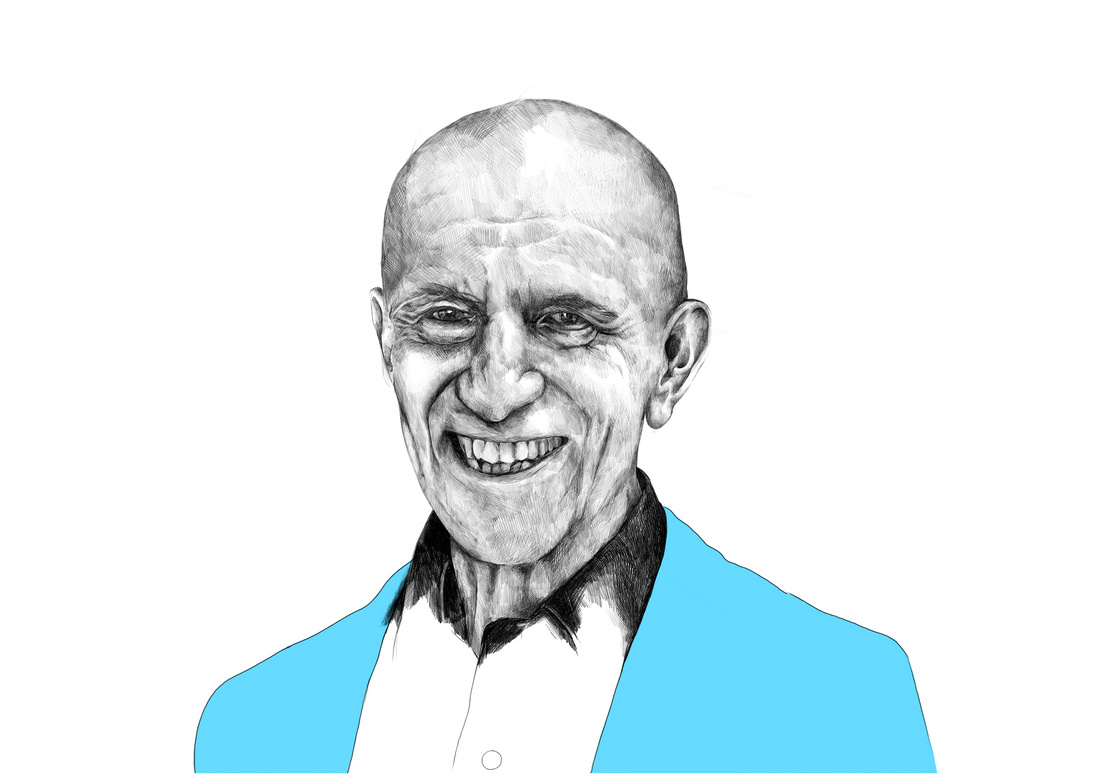
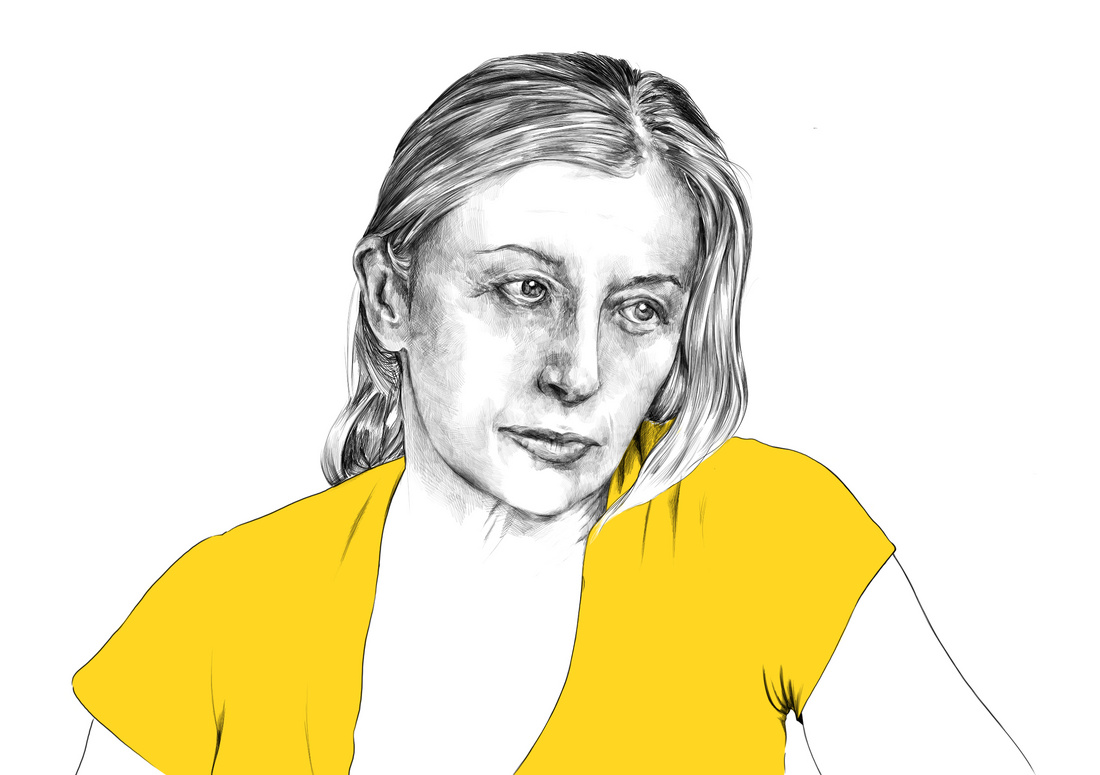
From British indie press Nobrow — who also brought us Freud’s graphic biography, those lovely illustrated chronicles of the Space Race and aviation, as well as Blexbolex’s magnificent No Man’s Land — comes Neurocomic (public library | IndieBound), a graphic novel about how the brain works. This remarkable collaboration between Dr. Hana Roš (and dog knows I love few things more than a female neuroscientist) and neuroscience-PhD-turned-illustrator Dr. Matteo Farinella, with support from the Wellcome Trust, explains the inner workings of the brain in delightful and illuminating black-and-white illustrations, covering everything from perception and hallucinations to memory and emotional recall to consciousness and the difference between the mind and the brain.
We take a stroll through a forest of neurons, then learn about neuroplasticity. (“This is the great power of the brain, it’s plastic!” they tell us in one of the most heartening and reassuring parts. “Once you learn something it is not set in stone, it’s continuously shaped by experience.”) We meet Pavlov and his famous studies of memory in 1897 Russia. We visit the haunting memory caves and the convoluted castles of deception.
This wonderful trailer for the film about the project, directed by Richard Wyllie, takes us behind the scenes of the duo’s marvelous collaboration and creative process:
Some of Today’s Most Prominent Artists on Courage, Creativity, Criticism, Success, and What It Means to Be a Great Artist
Wisdom from Ai Weiwei, Marina Abramović, Damien Hirst, Laurie Simmons, Carroll Dunham, and more.
By Maria Popova
“Whether you succeed or not is irrelevant — there is no such thing,” Georgia O’Keeffe wrote in her spectacular letter to Sherwood Anderson. “Making your unknown known is the important thing — and keeping the unknown always beyond you…” And yet, as human beings, we orient ourselves in the darkness of the unknown by grasping blindly for familiar points of reference, seeking to construct a compass out of similarities and contrasts relative to our familiar world, and out of those we try to construct a framework for what we call success. This is especially true of such nebulous subjects as art, where there is no true North, no universal gold standard of success, so we seek tangibles — like the market — to orient ourselves in the maze of merit. The result can be a great crisis of confidence in artists and a great arrogance in audiences, leaving us still more unsure, as individuals and as a culture, of what makes great art and what it really means to be an artist.
In 33 Artists in 3 Acts (public library) — a belated but wildly worthy addition to the best art books of 2014 — journalist Sarah Thornton sets out to answer these delicate but crucial questions by peering into “the nature of being a professional artist today” and “how artists move through the world and explain themselves” via visits and conversations with such titans of contemporary art as Marina Abramović, Ai Weiwei, Yayoi Kusama, Laurie Simmons, Jeff Koons, Damien Hirst, and Cindy Sherman. Thornton spent four years traveling several hundred miles to interview 130 artists, of whom she chose 33 — those most “open, articulate, and honest,” who fall “at diverse points along the following spectrums: entertainer versus academic, materialist versus idealist, narcissist versus altruist, loner versus collaborator” — hailing from five continents and fourteen countries. She then divided the great sensemaking task of her project into three umbrella themes — politics, which examines the relationship between the artists’ work and their ethics, attitude to power, and sense of civic responsibility, with a special focus on freedom of speech and human rights; kinship, which explores the ecosystem of peers, influences, and patrons of which Art is woven, all the way from the large-scale creative lineage of inspirations to one actual nuclear family: photographer Laurie Simmons, painter Carroll Dunham, and writer-actor-director Lena Dunham; and craft, a survey of the practicalities of art, from skills to routines to studio spaces.
Thornton writes in the introduction:
Artists don’t just make art. They create and preserve myths… In a sphere where anything can be art, there is no objective measurement of quality, so ambitious artists must establish their own standards of excellence. Generating such standards requires not only immense self-confidence, but the conviction of others. Like competing deities, artists today need to perform in ways that yield a faithful following.
The walk and talk of an artist has to persuade, not just others but the performers themselves. Whether they have colorful, large-scale personas or minimal, low-key selves, believable artists are always protagonists, never secondary characters who inhabit stereotypes. For this reason, I see artists’ studios as private stages for the daily rehearsal of self-belief.
Nowhere is this interplay between the public and private personae more central to the process and product of art than in performance art itself. For her now-legendary 2010 MoMA show The Artist Is Present, Marina Abramović — an artist who sees “immaterial energy” as her medium and believes that “nonverbal interaction is the highest form of communication” — sat in a wooden chair for more than 700 hours as she offered “unconditional love to complete strangers” — some half a million of them, many of whom were moved to tears in the presence of such piercing intensity. Marina Abramović, The Artist Is Present, performance, 2010, duration: 3 months, Museum of Modern Art, New York. Courtesy of the Marina Abramović Archives.But for the grand dame of performance art herself, the experience required a Buddhist-like quality of presence, a Buddhist-like attitude of welcoming everything that is. She tells Thornton:
Your shoulders drop, your legs swell, your ribs sink down into your organs… When you have so much pain, you think you will lose consciousness. If you say to yourself, ‘So what, lose consciousness,’ the pain goes away.
But Abramović, who indeed heeds the teachings of Tibetan monks, seeks not the showmanship but the higher purpose of such experiences. Her medium is, above all, the human spirit — something she handles with meticulous care and deep respect, with staunch opposition to nihilism, and always with an eye toward the essential sense of purpose that nourishes the human experience. That her art would take on the hues of a secular cult is neither accidental nor surprising. She tells Thornton with conviction “like a hurricane-force wind”:
Many people spend so much time doubting. Before you choose a profession, you have to stand still, close your eyes and think: who am I? … You know you are an artist when you have the urge to create, but this doesn’t make you a great artist. Great artists result from the sacrifices that you make to your personal life.
She sees the role of the artist as E.B. White saw the role of the writer, and as William Faulkner did in his Nobel Prize acceptance speech, extolling the writer’s duty “to help man endure by lifting his heart.” Abramović tells Thornton:
The public is in need of experiences that are not just voyeuristic. Our society is in a mess of losing its spiritual center… Artists should be the oxygen of society. The function of the artist in a disturbed society is to give awareness of the universe, to ask the right questions, to open consciousness and elevate the mind.
Marina Abramović, The Artist Is Present, Day 1 (Photograph: Marco Anelli courtesy of MoMA)Perhaps because these deeper desires for meaning are so quintessential and universal, Abramović echoes young Virginia Woolf’s belief that all art merely imitates nature and negates the notion of creative influence between artists:
I have never been influenced by another artist… I like to go to the source, to all the places in nature that have a certain energy that you can absorb and translate into your own creativity as an artist.
And yet, as an artist who wholeheartedly embraces her contradictions — Abramović is a vegetarian, doesn’t drink, fasts regularly, yet freely admits to loving fashion — she acknowledges the arrogant myth of originality:
We can’t invent anything in this world which is not there already. It’s about seeing in a different way. Anything that is revolutionary is in front of your nose and it is never complicated. But you don’t see it until you have a safe mind. Performance can help people to get into a state of mind to perceive the simplicity.
Even so, Abramović is a relentless proponent and practitioner of self-reinvention and risk-taking as the ultimate duty of the artist:
When you repeat, you really lose respect for yourself… For me, the studio is a trap to overproduce and repeat yourself. It is a habit that leads to art pollution. Nothing new happens. You don’t surprise yourself. Artists are here to risk, to find new territory. Risk, especially when you are a known artist, includes failing. It is an essential part of process. Failure is healthy for your ego.
Ai Weiwei, ‘Dropping a Han Dynasty Urn,’ 1995Chinese artist, authority-provocateur, and human rights activist Ai Weiwei has made risk-taking his medium, having dedicated his life to challenging his country’s long history of muffling free speech under a blanket of government propaganda and outright, often militant suppression — a mission that has landed him under arrest, led the Chinese authorities to completely wipe his writing from the country’s patch of the internet, and on one occasion resulted in undercover police pulling a black hood over his head, throwing him into a van, and driving him to a hotel two hours away, where he was kept for two weeks before being transferred into a high-security military compound to endure more than fifty interrogations while handcuffed to a chair. He tells Thornton via translator:
Criticism and finding trouble is, in the Chinese context, a positive, creative act.
But it was precisely this trouble-finding creativity that his father, Ai Qing — who was among the intellectuals exiled during the anti-rightist campaign preceding China’s Cultural Revolution — tried to discourage in young Ai, adamantly demanding that his son be anything but an artist. Ai Weiwei tells Thornton:
He always said forget about literature or art. Be an honest worker. [But] I became an artist because, under such pressure, my father still had somewhere nobody could touch. Even when the whole world was dark, there was something warm in his heart.
And yet under threats from the Red Guards to punish his family, Ai Qing gave up poetry and ended up cleaning the public toilets in a village in a remote Chinese province. Ai Weiwei recalls:
Only in the movies or in the Nazi time could you see things like that. It was very frustrating because this man was not a criminal. But people threw stones at him; the children used sticks to beat him; they poured ink on his head — all kinds of strange things in the name of justice and reeducation. The village people didn’t even know what he had done wrong. They just knew he was the enemy.
This early and deep sense of injustice became the raw material for Ai’s art and the lens through which he views the role of art in society, and yet he describes himself as an “eternal optimist” and tells Thornton:
Art is a mental activity, an attitude, a lifestyle.
With an eye to the endangered art of being alone, he considers the relationship between art and activism, the fusion of which defines his own work:
If you have never felt lonely, you should become an activist. Loneliness is a valuable feeling. Artists need to know how to walk alone.
His views on fame both parallel Einstein’s and better honor the complexity of the subject as he tells Thornton:
It comes too quick, too much. It is kind of ridiculous but I have good intentions. Fame needs to have content. If you use it for a purpose, it becomes different. So I am very happy that I have this chance to always speak my mind.
Although he recognizes the great hunger for commercial success in art today, Ai’s opinion of such aspirations is unambivalent. Thornton writes:
In his opinion, to be a “business artist” requires two qualities: “emptiness and shamelessness”… Emptiness and shamelessness are not uncommon in Western art, I say. Some of the most successful artists appear to be nihilists who don’t believe in much other than themselves and the luxury goods market. Ai nods. “For them, art has become pure play, lacking any essential truth,” he says.
This unflinching dedication to truth shows in Ai’s definition of authenticity, which he offers Thornton after a moment of reflection:
[Authenticity] is a habit. It is a road we are comfortable with.
[…]
Being somebody is being yourself. An artist’s success is part of the downside. You can lose yourself. Being yourself is a very difficult game.
Painter Carroll Dunham offers a complementary perspective on this delicate relationship between sense of self and artistic success:
A long career in the art world is hard on the ego.
[…]
The most fun time to be an artist is when you are young and when you are old… Getting through the weird middle period with a sense that you’ve kept growing is a challenge.
Laurie Simmons, ‘Love Doll: Day 27/ Day 1 (New in Box),’ 2010Photographer Laurie Simmons — Dunham’s wife and the other half of their self-described “classic extrovert-introvert couple” — considers the trajectory of one’s relationship with criticism over this long game of an artist’s career:
When you’re younger and get a bad review, you think they hate you. It’s the recovery time that changes. You have to know how to pick yourself up, brush yourself off, and get back to work. That’s the key to maturity. It’s what divides the artists that do what they do from those who are not up to it.
[…]
When you are younger, you think about eradicating self-doubt. But, as you age, you understand that it is part of the rhythm of being an artist. As I get older, I have developed my ability to examine self-doubt in private, to play around with it, rather than push it away.
Echoing Sherwin Nuland’s undying wisdom on what everybody needs, Dunham considers the heart of what makes criticism burn:
Negative commentary makes you feel misunderstood. So I often say to myself, “Apparently, I haven’t been clear enough with you people!”
[…]
Interesting artworks are always hypotheses about what an artwork could be… Why would anyone think that new art should resemble what art already looks like?
The general public doesn’t understand art so they think that a con has been perpetrated on them.
And yet artists, he suggests, do perpetrate cons when they take market over mystery and deploy cheap tricks like surface shock value in lieu of deeper inquiries into the human experience, which is itself shocking in a much more profound way:
Shock is just another move in the entertainment complex. It’s bullshit. Who are you supposed to shock? Rich hedge fund managers? Do you find the fact that you’re going to die shocking? I do. Art can bracket those human conditions. It can cause you to have a moment of insight.
In those moments, Dunham argues, the viewer is rolfed by creative communion with the artist:
You know the difference between a soothing back rub and truly deep bodywork. The latter is not pleasant while it’s happening but afterward you feel quite changed from it. Shock, awe, whatever. I’m not looking for a back rub from art. I’m looking for something that feels like it matters.
Simmons adds a piercing articulation of the great, disquieting fact of creative work, embracing which sets great creators apart:
Any work that is really great hovers between terrific and terrible.
There is this reverb. You have to make art to be an artist, but you have to be an artist to make art. It’s about getting your self-representation and your actual activities into alignment. I’ve gone through moments where I thought ‘I hate this, I don’t want to do it anymore,’ but I always come back to the fact there isn’t anything else that would better suit my sense of who I am.
It’s hard to imagine that such strong opinions and unflinching dedication to the integrity of art wouldn’t be passed on to Dunham and Simmons’s daughter, Lena Dunham — herself one of the most courageous creative mavericks of our time. In a testament to the notion that parental presence rather than praise fosters a healthy relationship with achievement, Dunham — who defines creativity as “an ineffable bug that takes you over but also something that you can learn” — reflects on the creative conditions and conditioning of her childhood:
I was given the tools, the space, and the support to do whatever I wanted. New approaches to old problems were encouraged… My parents taught me that you can have a creative approach to thinking that is almost scientific. You don’t have to be at the mercy of the muse. You need your own internalized thinking process that you can perform again and again.
She considers the rewards of the creative life:
As an artist, you get the opportunity to write the world — or create the world — that exists in your fantasies. It’s a really beautiful thing to do.
But beautiful as the overall sense of purpose might be, the fantasy-world of this inward gaze often requires being intensely present with one’s darker demons:
The kind of shame I deal with in my work is about returning to the scene of the crime with all my senses operating. I agree with Woody Allen’s theory that tragedy plus distance equals comedy.
(It should be noted that Dunham’s conversation with Thornton took place before Woody Allen rendered himself existentially disagreeable — “nauseating,” even — to Dunham and to many of us.)
Legendary Italian curator Massimiliano Gioni — whose inclusion in Thornton’s survey springs from her belief that “curators are vital cocreators of the myths” — offers a complementary take on this notion of art as a conduit to self-knowledge, folding into it a necessary dissent with our culture’s dominant definitions of what makes an artist:
Our media understanding of an artist as a successful professional who makes entertaining objects that sell for a lot of money is very restrictive. Artists are people who do things with images in order to understand the world. They have a fierce desire to know themselves.
In a related sentiment, Turkish filmmaker and contemporary artist Kutlug Ataman elegantly captures the essential tension between culture and commerce with which all artists must tussle:
Art that goes forward can take a long time to be understood, whereas art that moves sideways — that is just elaborating — can be very commercial… As an artist, you have to decide which way you want to go.
That choice is often mired in the question of originality — something that recurs across Thornton’s interviews, and a subject of ambivalent skepticism for artists long before Mark Twain’s famous proclamation that “all ideas are second-hand, consciously and unconsciously drawn from a million outside sources.” Visual artist and composer Christian Marclay offers an insightful perspective on this role of the borrowed and the begotten in creative work:
Am I being original this morning? You sense the wonder of discovery when you’re doing something that feels new… But, who knows, maybe someone has been there before. Every image that I use is from someone else. But you can be original in what you steal and how you display your bounty.
33 Artists in 3 Acts is a superb read in its hefty totality. Thornton herself embodies what one of her subjects, the great Italian curator Francesco Bonami, observed of his profession — that curation is “about taking care of the artist” — as her own immeasurable insight on the creative experience illuminates and elevates the artists who entrust their ideas in her care.
Complement this treasure trove of wisdom with Teresita Fernández’s spectacular commencement address on what it means and what it takes to be an artist and Dani Shapiro on the ultimate task of the artist.
— Published January 12, 2015 — https://www.brainpickings.org/2015/01/12/33-artists-in-3-acts-thornton/ —
Rashida Jones, Pete Yorn Collaborator Boss Selection on Compounds & Elements
Who: I am Sunny Levine a.k.a. Boss Selection Where he was born: I was born in West Hollywood Where he lives now: I live in Venice, CA What he does: I make jams. I produce, I write tunes, I engineer, I drink espresso and I wear shoes
How he captures ideas:
Using a butterfly net.
If he were a sound:
A pretty chill sound with a slightly slamming beat.
He believes in:
Count Basie.
His most recent artistic reference:
This past week I’ve been deep in mid 90s RnB while getting together a remix of the song on my Boss Selection record featuring Rashida Jones. Along with a strict diet of SWV, Brownstone, Mary J Blige, Jodeci, Aaron Hall, Groove Theory, Faith Evans, and Brandy. With some everyday Arthur Russell listening for good measure.
If he could see a social disruption:
I’d really dig it, if all of a sudden formulas and the dumbing down of art was deemed unacceptable, rather than being the norm. If everyone took more chances and strived to be the realest version of themselves, then, we might have more interesting things to read, watch and listen to. If creators had a violent Clockwork Orange style reaction when they weren’t being authentic to themselves, things might get more interesting. I see so many talented people making wack sh*t because they think they have to be relevant.
Something great he’s read:
I read anything and everything I can find by the writer Richard Brautigan. His writing can always reset the way my brain works, especially if I get stuck thinking too bland, basic or one dimensional.
Something great he’s seen:
There are these clips on YouTube of Marly Marl rebuilding some of his classic hip hop productions from scratch on the new MPC – he shows how he put all the samples together – it’s some hip hop kid geek stuff, and I love it.
Heavy rotation:
There’s a song called “Quasimodo’s Dream” by an Australian band called the Reels from the 80’s. I can’t get enough of that song, lately. I just discovered it and it hits me so right.
He needs to change:
Currently changing lots of things. Moving my studio, changing up some gear, getting complicated haircuts for the first time since I was a teenager.
Why he makes music:
I make music for the thrill of trying to combine elements and aspects of production in a way that turns me on. My approached to making music always involves a combination of exploring and problem solving.
Sunny’s WILD Wish:
I’d like to have a proper amount of dollars where all I would do is book sessions with friends and musicians that I admire. I really like my life, but when I fantasize about “more,” that’s what I end up thinking about. I’d overpay everyone, have amazing meals, and just over dub on things all day, every day. It’s my favorite part of making music. Once you’ve written the bones of a track – the tune – inviting people to then put their own touches to the piece…that’s when you have something magical to play with. That’s my happy place.
I love Ling Jian for his suave, sultry and visually tricked-out paintings of impossibly waif vixens and freaky deaky shark porn. Yep, the Chinese painter and provocateur makes insanely killer compositions of great whites fornicating, alchemical canvases that teem with scantily clad sexpots and sassy symbology that will make your taste filters bristle.
In his latest exhibit, at the always kickass Klein Sun Gallery in Chelsea, you see Ling riffing on art history and philosophy, referencing things like surrealism, Taoism, feminism, and even evolutionary biology; all replete with metaphysical heft, subtle cheekiness, and an inventive combo of chaos and control. Titled Nature Chain, Ling unloads visual zings of shattered skulls, loamy hungers of the flesh and portraits of pretty PLA soldier girls. Mashing up critical theory, feminism and a touch of fetishism, we see racy renderings of the female figure, alabaster skin beauty queens in skimpy undies, rail thin bods and blissed out dispositions.
Ling’s whirling-dervish depictions of copulating sea creatures and their alien-like genitalia reveals his fixation with the aquatic life and sexual symbolism, weaving together subplots that may be semi-psychotic but nevertheless intriguing and enlightening (in a Nat Geo Wild kind of way). Ling’s art is expertly infused with intense hues, hyper-real texture, haptic qualities and bucketloads of zest. The exhibit allows you to grasp how he integrates a multitude of schools and tools—neo-Dada, Confucian classics, proprietary techniques, and hybrid aesthetics—to arrive at a number of gnarly niches and exquisite optics while commenting on China’s ongoing artistic and socio-economic upheavals. launch gallery
It's both the blessing and the curse of the modern book lover: great titles come out at lightning speed each month in buzzy lists and flashy blurbs. We add them to our reading queues, promising to check out each interesting one when there's time, but as the churn of publishing never stops, we soon realize there's simply never enough time.
That interesting book about Beanie Baby economics is forgotten for the Ta-Nehisi Coates that finally came in for you at the library, or the latest Ferrante that your friend pushed into your hands.
Alas, don't punish yourself for having obligations outside reading 24/7 that prevent you from absorbing all of the books. Instead, rejoice at the wide range of literary options we have each year (added to the many still available to read from the last thousand few thousand years of the written word -- no pressure, though). If you're looking at the calendar and realizing you're craving the voyeuristic pleasure of getting in another's head, or want to stock up on fun facts to share at the holiday office party, these 20 options published in the last 12 months will do you good.
'Hammer Head' by Nina MacLaughlin
W. W. Norton
For: 9-to-5-ers who dream of escaping the cubicle.
This memoir is a tender, articulate look at the ...
In conducting our annual review, we pulled from a wealth of data sources* and our editors’ insight to determine which living artists wielded the greatest influence in 2015. Several are the mainstays of such rankings you might expect. But the list’s new additions ring in exciting advancements for the art world and beyond—from a forebear of this year’s biggest trend in painting to a figurehead for free expression and a Chicagoan serving as a catalyst for social change.
B. 1957 IN BEIJING, CHINA. LIVES AND WORKS IN BERLIN, GERMANY and BEIJING, CHINA.
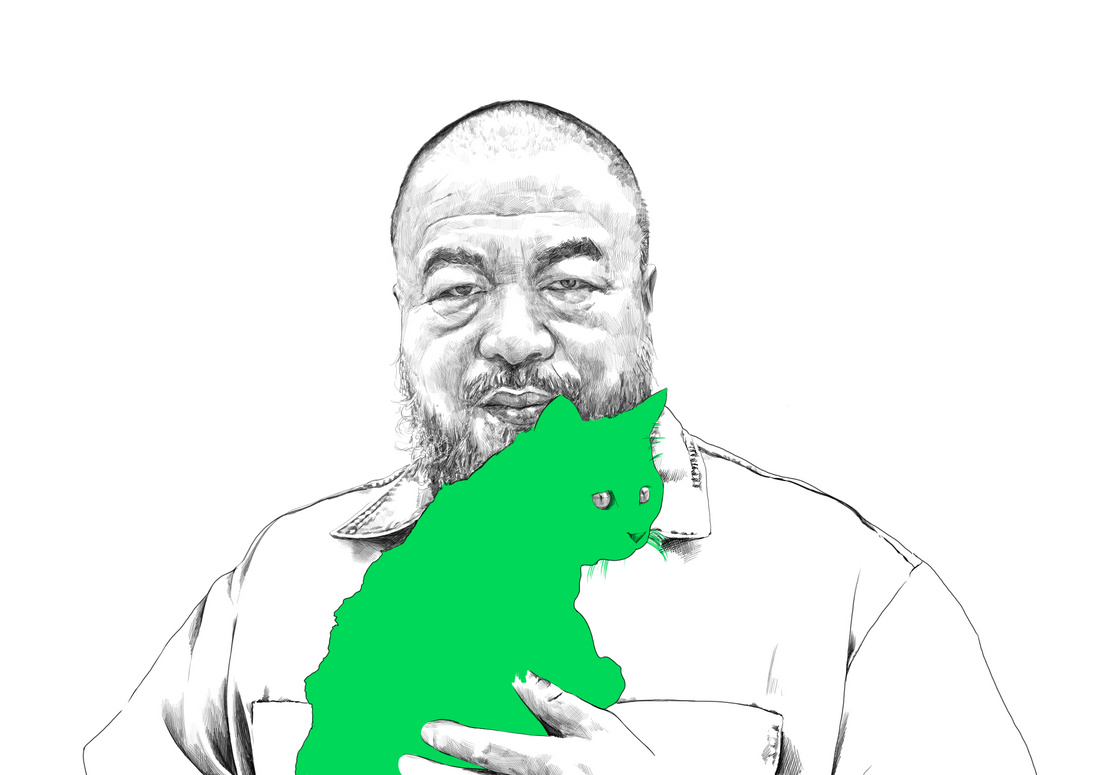
Illustration of Ai Weiwei by Rebecca Strickson for Artsy, based on a photograph by Matthew Niederhauser.
This year marked the end of a four-year-long struggle for Ai Weiwei. On July 22nd, the dissident artist received his passport back from the Chinese authorities, who had kept it in their possession since Ai was detained upon trying to depart Beijing for Hong Kong in 2011. The artist’s detention stretched on for 81 days and led to an international campaign from art world and civil rights leaders for his release. Known for conceptual works, which unpack the underpinnings of cultural value and political ideology, Ai advised on the so-called “Bird’s Nest” National Stadium that served as a hallmark of the major soft-power push that was the 2008 Beijing Olympic Games. However, his work became increasingly critical of the regime following an earthquake that same year in Sichuan Province, which resulted in the death of over 5,000 children. Ai announced the receipt of his passport via Instagram—appropriate considering the artist’s use of social media over recent years as a platform for resistance. The artist left almost immediately for Berlin, where, for several years, a studio has been waiting for him, along with an invitation to join the faculty at the city's Universität der Künste; he now serves as a guest professor there.
Ai has been the subject of numerous major museum exhibitions in recent years, beginning with his 2009 show at Munich’s Haus der Kunst and including his traveling retrospective “According to What?” which touched down at the Mori Art Museum in Tokyo, the Pérez Art Museum Miami, and the Brooklyn Museum, among others. He repped Germany at the Venice Biennale in 2013 and had his largest-ever exhibition at Berlin’s Martin-Gropius-Bau last year. Topping Ai’s CV in 2015 is a major survey of his work from the past 20 years, which closed December 13th at London’s Royal Academy of Arts. “Andy Warhol | Ai Weiwei” which recently opened at Melbourne’s National Gallery of Victoria, will travel to Pittsburgh’s Andy Warhol Museum next year. Both were among the first opportunities Ai was afforded to see his work on public view in four years, the first being his exhibition at Beijing’s Galleria Continua and Tang Contemporary Art, which authorities approved to open on June 6th in what was seen as a positive indicator of the eventual return of Ai’s passport.
B. 1955 IN YORK, PENNSYLVANIA. LIVES AND WORKS IN NEW YORK, NEW YORK.
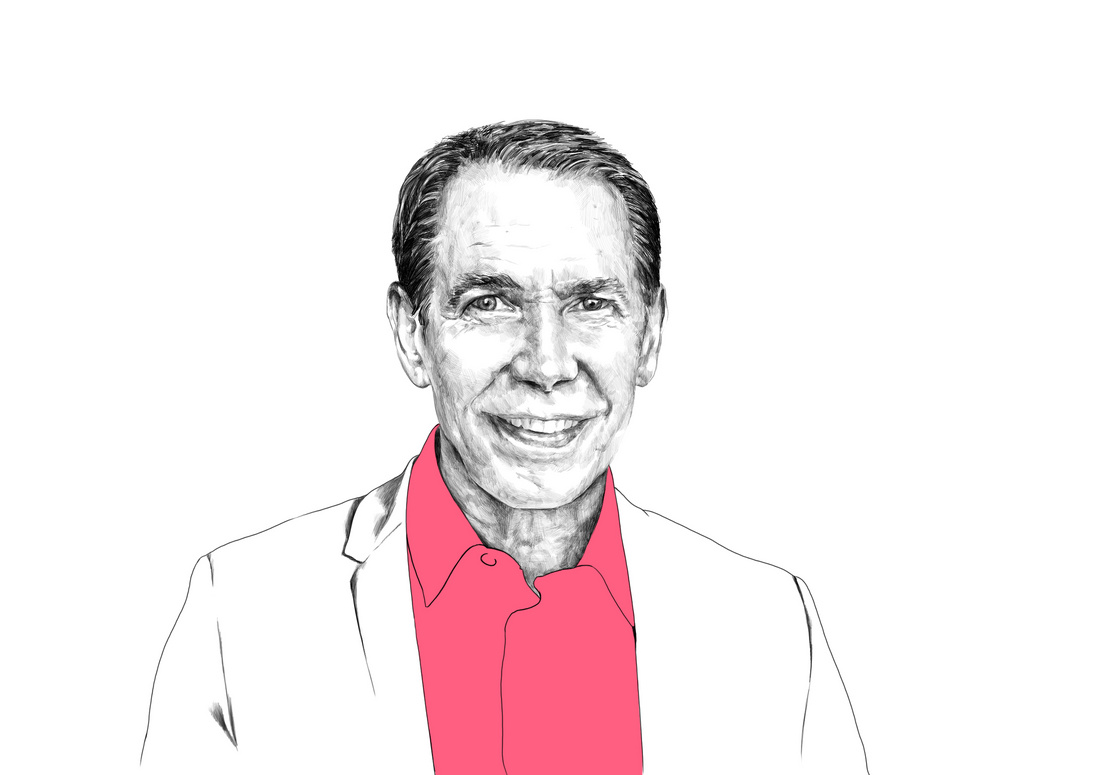
Illustration of Jeff Koons by Rebecca Strickson for Artsy, based on photograph by Angela Pham/BFA.com.
While milestones are a mainstay for Koons, 2015 saw a major one for the most expensive living American artist: 60 years of age. For Koons, age is nothing but another increasing value (at Christie’s in May, the artist beat his record for a painting at auction). While this year was perhaps not as headline-heavy as the last, his unprecedented 2014 Whitney retrospective went on to show at the Centre Pompidou and then to star as a summer blockbuster at the Guggenheim Bilbao. The show spanned the artist’s rollercoaster career since the 1980s, from suggestive vacuum cleaners in lit vitrines, kitschy polychromes including the infamous Michael Jackson and Bubbles (1988), and finished off with the lavish “Celebration” series and one obligatory balloon dog. Covering his trajectory from ingénue to pariah to indelible blue chip artist, the retrospective offered the artist’s keen ability to elevate signifiers of mundane, middle-class life into glossy, acclaimed artworks.
The artist continued to cement his ties with the art historical canon this year, something made impeccably clear during this fall alone. In September, the gleaming yellow Pluto and Proserpina (2010-13) was erected outside Palazzo Vecchio in Florence, near the famous replica of Michelangelo’s David (1501-04), while inside Gazing Ball (Barberini Faun) (2013) lounged alongside Donatello’s Judith and Holofernes (c. 1457-64). And as Vienna’s Natural History Museum unveiled a new wing to house the 29,500-year-old Venus of Willendorf in October, Koons’s giant Balloon Venus (Orange) (2008-12) garnered a share of the spotlight. To top it off, November saw the debut of “Gazing Ball Paintings,” where dozens of giant metallic blue gazing balls brushed up against perfect copies of art history’s masterworks, from Mona Lisa to Monet’s water lilies, at Gagosian Gallery’s 21st St. space in New York. Koons’s unflappable aptitude for success appears as lasting as his sprightly sexagenarian form.
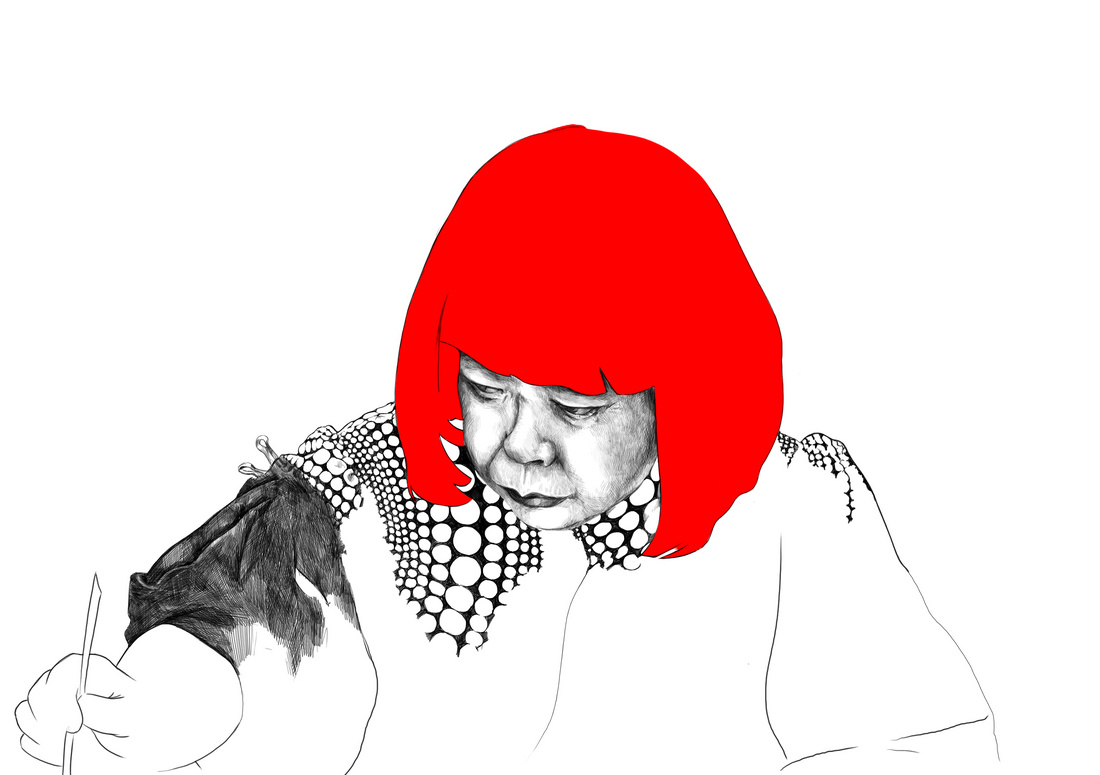
At 86 years old, the scarlet-haired Kusama is the kind of artist for which the art world lines up; If she were a rockstar, she’d be Mick Jagger, her fans pulling all-nighters in sleeping bags on city sidewalks to score front-row seats. This spring Kusama’s Obliteration Room (2002-present)landed at David Zwirner’s pair of 19th St. galleries, with visitors queuing up for hours in a testament to contemporary art’s six-decade-in-the-making love affair with the Japanese artist. The show marked the U.S. debut of an all-white prefab home for which, upon entry, visitors were allocated colorful, circular stickers, which ultimately rendered the interior unrecognizable, unless, of course, as a vision of Kusama. (And when the New York art world was suddenly covered in mysterious, multi-colored spots in the midst of Frieze Week, this was no art-fair-ailment they were stricken with.)
The artist’s passion for polka dots is rivaled only by the market’s demand for them. At the age of 10, Kusama painted spots to combat mental illness by visualizing her hallucinations. By the ’60s, she was staging New York happenings among the city’s avant-garde set (think: polka-dot painted orgies). And today, on occasional leave from the Tokyo sanitarium where she’s lived by choice since 1977, she’ll grace a charmed crowd with an appearance, clad head-to-toe in dots (not even her wheelchair is spared).
But despite worldwide acclaim, 2015 was a year of firsts for Kusama—her first major retrospective in Scandinavia, at the Louisiana Museum of Modern Art, as well as her first solo show in Russia to inaugurate the Garage Museum of Contemporary Art’s stunning new space. “We’ve never had so many visitors!” says Kate Fowle, the museum’s chief curator, who recalls lines around the building and visitors in the thousands waiting to see what she describes as Kusama’s “mesmerizing, mirrored polka dot room,” among other installations.
B. 1965 IN BRISTOL, U.K. LIVES AND WORKS IN DEVON AND LONDON U.K.
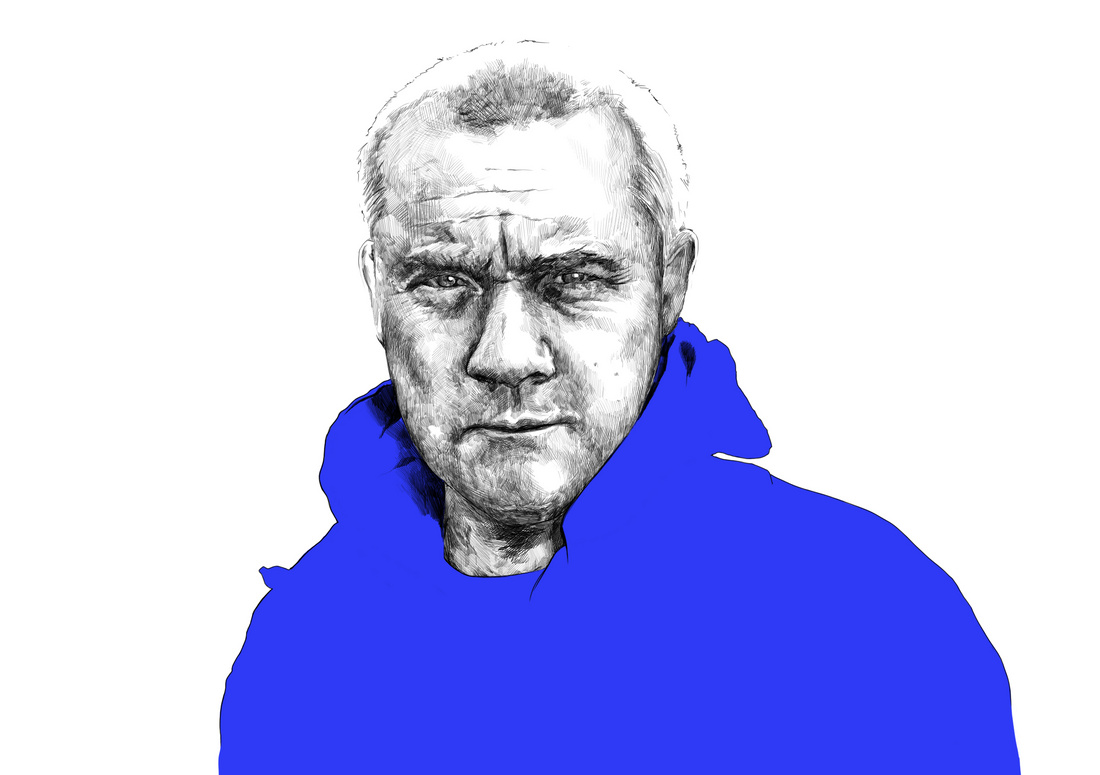
Illustration of Damien Hirst by Rebecca Strickson for Artsy, based on a photograph by Anton Corbijn.
With the opening of his Newport Street Gallery in Vauxhall, South London, in October 2015, Young British Artist (YBA) Hirst has punctuated another sentence in his long and varied career. The respected architects Caruso St John designed the space, which opened with an exhibition focused on British abstract painter (and personal hero of Hirst) John Hoyland. Reviews of the new museum have been overwhelmingly positive, though critical reappraisal of Hoyland has been mixed. And by the measure of interest around the museum’s opening, it might be enough for Hirst to bounce back from a bumpy few years for his market. After the high of the now-infamous 2008 Sotheby’s auction where £111 million of Hirst’s work sold, the artist’s prices nosedived as the global economy tanked, and a 2012 show at London’s White Cube was savaged by critics. At Newport Street, Hirst appears to be returning to his roots: he was notoriously the curator of the 1988 exhibition “Freeze,” which launched the career of many of his fellow YBAs while they were still students at Goldsmiths College, and jump-started his own ascent.
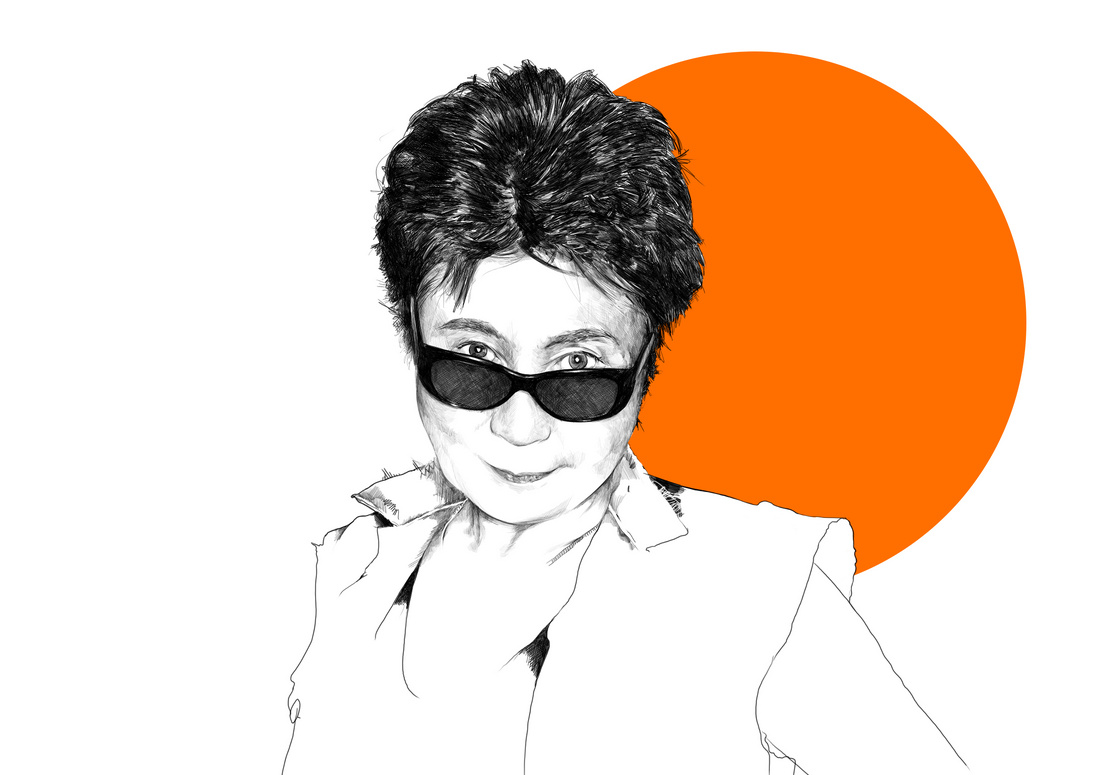
In December 1969, Yoko Ono and John Lennon launched a viral, global campaign, plastering 10 cities with a simple, resounding message: “WAR IS OVER!” and in smaller letters, “IF YOU WANT IT.” At a salient moment this December, Ono revived the initiative, turning to social media and her website to once again propel peace. And while the artist’s actions for peace have been a persistent force since the death of her husband in 1980, Ono’s influence was especially palpable this year, be it through denouncing gun violence via Twitter, organizing thousands of people to form a giant peace sign in Central Park, or inspiring audiences through her art, which saw a much-deserved spotlight at MoMA this year. “Yoko Ono was so ahead of her time that only now—four or five decades after some of her seminal early pieces—her work seems finally contemporary in a sense that a larger audience can uncover its layers of meaning” explains Klaus Biesenbach, director of MoMA PS1 and chief curator at large at MoMA. “As a pioneer in conceptual, social and performance practices she is one of the most innovative and groundbreaking artists of our time.” “Yoko Ono: One Woman Show, 1960–1971” led us through the artist’s young career, with doses of painting, performance, video, photography, and text in equal measure, all the while enveloping visitors in a sequence of experiential, engaging moments.
The show, and the rich time period it drew from, rejected any doubts around Ono’s visionary practice and her role as an artist in her own right. Performances on view included a recreation of Bag Piece (1964), with a live performer stretching and squirming on a small stage in a black bag, and a screening of Cut Piece (1964), where Ono sat still, solemnly, as audience members took scissors to her outfit. At the center of the space a new commission, a tall, wobbly spiral staircase—much like one on view now at Beijing’s Faurschou Foundation—beckoned viewers to climb upwards, finding at the top a skylight and a moment of respite. The show unwound like a cathartic exercise, delighting as it unfolded, bolstered by the artist’s small instructional tome Grapefruit (1964), its pages lining the walls with contemplative reflections, like “Listen to the sound of the earth turning.” Similarly instructive is “THE RIVERBED,” Ono’s current two-part exhibition, which will evolve over its run at Andrea Rosen Gallery and Galerie Lelong in New York. Again the artist invites meditative experience, this time asking audiences to sit and think on simple terms like “remember” and “wish,” and to contribute their thoughts and actions to the installation’s final form.
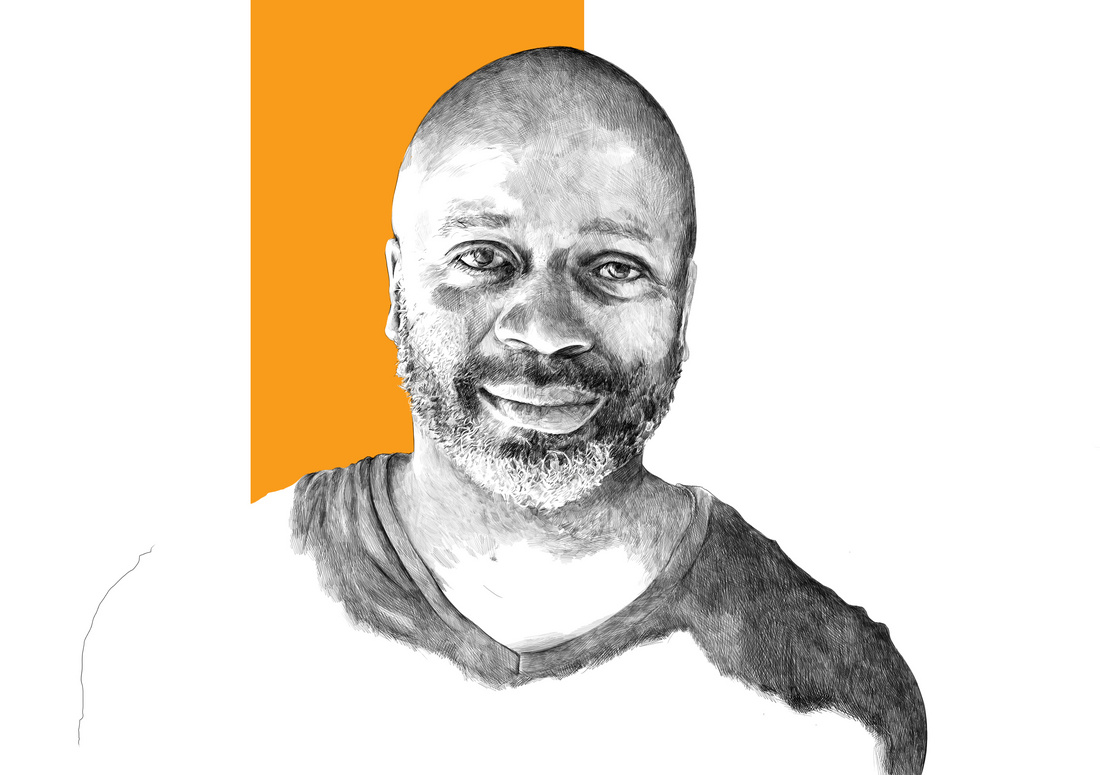
Illustration of Theaster Gates by Rebecca Strickson for Artsy, based on a photograph by korhan karaoysal. Original photograph courtesy of the artist.
With degrees in urban planning and ceramics under his belt, Chicago-based Gates elegantly balances commercial success with a practice that actively addresses—and interacts with—class struggle, urban growth, and community activism. Over the past five years, the artist’s large sculptures, often built from repurposed materials found in blighted urban neighborhoods, have featured in a rash of major surveys that gather the world’s most progressive work—2010’s Whitney Biennial, 2013’s dOCUMENTA, and 2015’s Venice Biennale. At the Biennale, his room-sized installation, Martyr Construction (2015), breathed new life into tiles, statues, and a bell from a Chicago church that had been demolished.
This year, after a much-regaled solo show at blue-chip gallery White Cube, Gates opened a 17,000-square-foot nonprofit arts center, the Stony Island Arts Bank, in his struggling Chicago neighborhood. “Theaster has crafted a practice that is literally like no other in the world of contemporary art. The mobius strip he has created that links his fine art practice, his urban planning concerns, and the financial viability of the neighborhood in which he lives is nothing short of revolutionary,” comments Michael Darling, chief curator at Chicago’s Museum of Contemporary Art. “Very few artists with interests in the social realm have found a way to be as directly effective as he has, and if they have, they probably have left truly innovative artmaking behind. Theaster hasn’t.”
B. 1936, MALDEN, MASSACHUSETTS. LIVES AND WORKS IN NEW YORK.
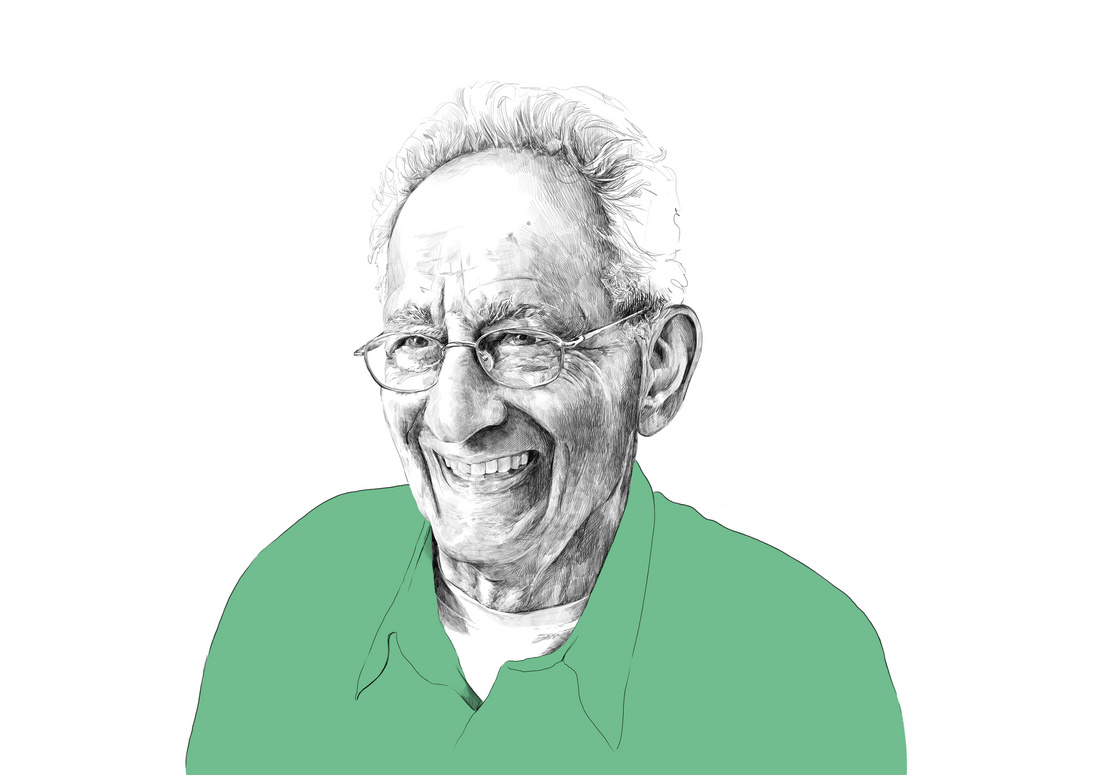
Illustration of Frank Stella by Rebecca Strickson for Artsy, based on a photograph by Kristine Larsen.
This fall, the Whitney dedicated the first major retrospective to grace its newly opened, Renzo Piano-designed home to none other than Frank Stella. In the late 1950s, Stella was one of the first painters to reign the dynamism of Abstract Expressionism into angular compositions and flat planes of color. His monumental canvases, inspired by architecture and executed with house paint, have been hailed as harbingers of Minimalism. And his famous line, “What you see is what you see,” was crowned as the movement’s appropriately clear-cut rallying cry. The exhibition is one of Stella’s largest to date, spanning around 100 works and his entire career, from the “Black Paintings” that propelled him into the art historical canon, to his later works, controversially exuberant mash-ups of shapes, gestures, and styles. “There is a lot of discussion these days about abstract painting; its resurgence, relevance, and continued validity. This is not the first time in art history that abstraction has faced these challenges,” says the retrospective’s curator, Michael Auping. “Stella faced them in the late 1950s, following the high water mark of Abstract Expressionism. He answered them with his ‘Black Paintings,’ which became the Holy Grail of Minimalism. He has been answering challenges to abstraction for five decades since, revitalizing and retooling it with each new series. Other than Willem de Kooning, I can think of no other artist who has had such a sustained impact on his genre.”
B. 1968, HAVANA, CUBA. LIVES AND WORKS IN NEW YORK.
Illustration of Tania Bruguera by Rebecca Strickson for Artsy, based on a photograph by Claudio Fuentes. Original photograph courtesy of Studio Bruguera.
Cuban dissident performance and installation artist Tania Bruguera has been challenging and probing political systems—as well as the boundary between art and activism—and advocating for freedom of expression for over two decades. In one of her best-known works, Bruguera had policemen on horses ride around Tate Modern’s Turbine Hall, controlling crowds of unsettled museum-goers. Last year, she planned a provocative performance in Havana, in which she created a soapbox for individuals to voice their grievances about the communist Cuban government. However, the work first drew the attention of the authorities, who detained the artist and confiscated her passport, preventing it from taking place. She has since had her passport returned and is back on U.S. shores, where she’s currently in the midst of an artist residency with New York City Mayor’s Office of Immigrant Affairs.
A sustained force for immigrant rights, Bruguera collaborated with the Queens Museum in 2011 to found Immigrant Movement International, a knowledge-sharing and support group for immigrants, and a think tank to imagine a more humane culture of international migration. MoMA acquired one of her radical performance and video works this year, confirming Bruguera’s status as one of the preeminent performance artists of our time. The world’s authority on performance art, RoseLee Goldberg, tells Artsy, “Tania Bruguera’s work remains as radical today as it was when I first encountered it in the mid-’90s, with a work entitled What Belongs to Me, a two-hour silent piece on censorship.”
B. 1927, BROOKLYN, NEW YORK. LIVES AND WORKS IN NEW YORK AND LINCOLNVILLE, MAINE.
Illustration of Alex Katz by Rebecca Strickson for Artsy, based on a photograph by Vivien Bittencourt.
In the 1950s, when Abstract Expressionism was still in vogue, Katz broke irreverently away from the wanton brushstrokes of Pollock and de Kooning to begin painting in his signature style—bold, stylized close-ups of elegant figures assembled from intersecting planes of saturated color. Now 88 years old, Katz has been hailed as the father of contemporary figurative painting, and his portraits and landscapes—both sprawling and small, intimate and brimming with cinematic drama—have headlined solo shows for decades.
This year, though, was an especially momentous one for the artist, with major exhibitions at the High Museum of Art, the Guggenheim Bilbao, the Colby College Museum of Art, and the Metropolitan Museum of Art. “Alex Katz’s importance lies, certainly, in his experimentation with the form and structure of painting—his early experiments with shaped supports were revelatory and pioneering—but just as significant is his investigation into the mechanics of perception,” explains Kelly Baum, Curator of Postwar and Contemporary Art at the Met. “When it comes down to it, most, if not all, of his paintings are about how we see.”
In step with 2015’s figurative painting resurgence, young artists are taking note, and citing Katz as an inspiration left and right. “Alex’s work constantly renews itself. It is always contemporary because he studies what other artists, especially emerging artists, are doing, and he uses these observations to generate the questions and problems that motivate his practice,” says Diana Tuite, who curated his show at Colby. “Even at this stage in his career, after having arrived at a mature and established style, he approaches painting very much as its student.”
B. 1954 GLEN RIDGE, NEW JERSEY. LIVES AND WORKS IN NEW YORK, NEW YORK.
Illustration of Cindy Sherman by Rebecca Strickson for Artsy, based on a photograph by Cindy Sherman. Original photograph courtesy of Cindy Sherman and Metro Pictures, New York.
There are few photographers—let alone female photographers—who have enjoyed the longevity, dynamism, and influence of New-Jersey-born artist Cindy Sherman. In a career spanning five decades, she has transformed herself into countless fictional figures: movie stars, clowns, victims, ingénues, predating contemporary obsessions with self-representation. “Public discussion about the fluidity of identity has become so commonplace that it might be difficult for a younger audience to appreciate how original and startling Cindy Sherman’s work was,” says Marco Livingstone, co-curator of “Post Pop: East Meets West” at London’s Saatchi Gallery, which closed in March and featured Sherman’s work. “Her art, however, has since moved far beyond such circumscribed concerns about the self.”
Pieces from her “Untitled Film Stills” series, portraits inspired by movie stills shot in the late 1970s, first got her noticed and still draw crowds today—the work is currently on show at the Rubell Family Collection in Miami, as part of its female-only show “No Man’s Land.” “She was the proto-selfie practitioner extraordinaire,” says London-based writer, curator, and dealer Kenny Schachter, who has collected the artist. “From the very start of her career she really took the Warhol notion of everyone becoming a celebrity, and made herself one in so many different situations; she was so far ahead of the time.”
**Data sources for this story included Artsy’s data (pageviews, artist follows, artwork inquiries for over 50,000 artists) and data from UBS’s art news app Planet Art (artists, exhibitions, and news mentioned among 146,000 articles).







 Email
Email