Wednesday, July 27, 2022

Toughest Mountain Bike Race


73ed94ee-f881-4ea1-8e1f-44f98483021c.png
July 27, 2022


The Toughest Mountain Bike Race in the World

In Kyrgyzstan, determined riders persevere through blizzards, lack of sleep, and disintegrating shoes.
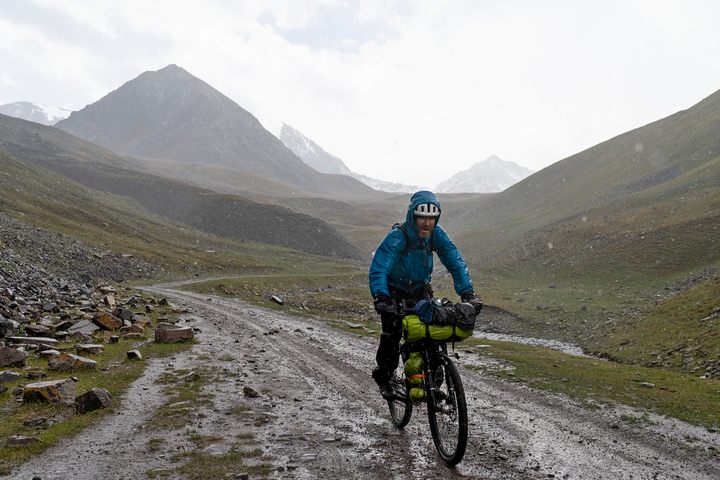
Caught in a hail storm during the the Silk Road Mountain Race, Robert Sirre from the Netherlands cycles on. ALL PHOTOS: ©YAM G-JUN

Sleeping as little as possible was the French racer Sofiane Sehili’s strategy. In 2020, he won Morocco’s grueling Atlas Mountain Race by sleeping a total of two hours over four days. The ability to remove sleep from the equation meant that he was able to ride further than his rivals, adding six to 12 miles more than other riders each day. But that was a different race. Now, a year later, alone in the unforgiving mountains of Kyrgyzstan, the difficulty of the route left Sehili exhausted as never before, and he had to sleep three or four hours a day just to be able to get back on his mountain bike and continue.

Eight days, 14 hours and 35 minutes after he began the 2021 Silk Road Mountain Bike Race, Sehili was the first to the finish line. Only a handful of people—the race’s organizers—were there to congratulate him. There was no prize money or even a shiny trophy. Instead, without much fanfare, Sehili was given an Ak-kalpak—a traditional Kyrgyz hat of embroidered white felt—and a few cans of beer as his reward.

Nearly half the field had already dropped out by the time he crossed the finish line. But behind Sehili, there were 51 riders somewhere in the mountains, fighting grueling ascents and dangerous descents, unpredictable extreme weather, and their own limits to complete what’s widely known among bikepackers as the toughest mountain bike race in the world.
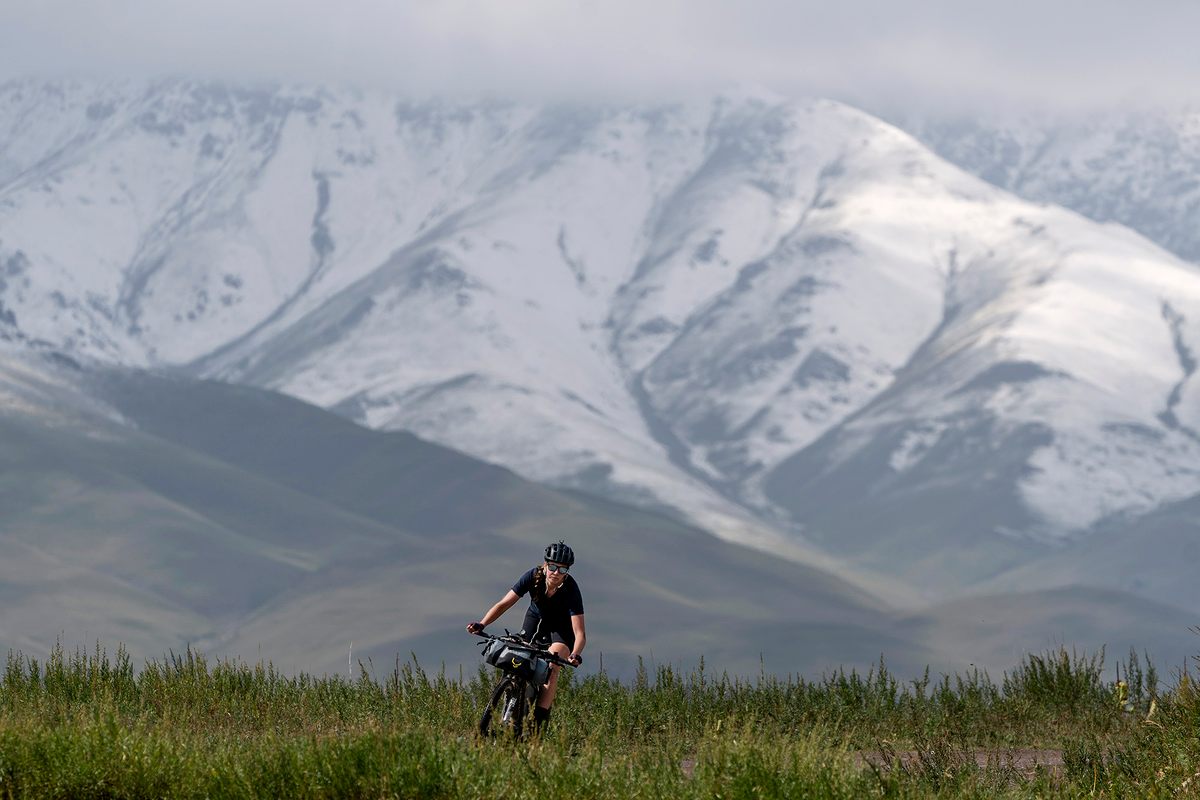
Jenny Tough from Canada rides in the mountains of Kyrgyzstan.

The Silk Road race stretches about 1,155 miles across Kyrgyzstan’s mountains, from frigid, treeless alpine tundra down to green, sweltering valleys, and back up again. Riders who finish will log over 101,200 total feet of ascent over the week-plus race. The annual event, held in August, requires participants to be self-supporting. There are no friends or family to cheer them on. There is no hospital or mechanic to mend bodies or bikes. Much like the traditional nomads of Kyrgyzstan, every cyclist’s bike is their horse, their tent is their yurt, and the only food and water they have is what they carry through wind, rain, snow, and heat until the next resupply point, scattered along the route.

The event was created by current race director Nelson Trees, a towering athletic Englishman who first encountered Kyrgyzstan’s scenic extremes—endless steppes and imposing mountains— during his bikepacking tour from Shanghai to Paris in 2013. The wild, natural landscape was etched into his consciousness. “I took a mental note to come back here,” says Trees. In 2018, he returned to start the first Silk Road Mountain Race.

“Fitness and athletic prowess alone won’t win you the race,” says Trees. In fact, it’s perhaps the mentally challenging nature of the event that draws riders from around the world. Locals along the route may cheer as racers pass by their villages, but beyond the rural settlements and towns of old, Soviet-built concrete, the route snakes through an inhospitable environment of limited resources and no human contact. Riders often find themselves alone in tough situations.
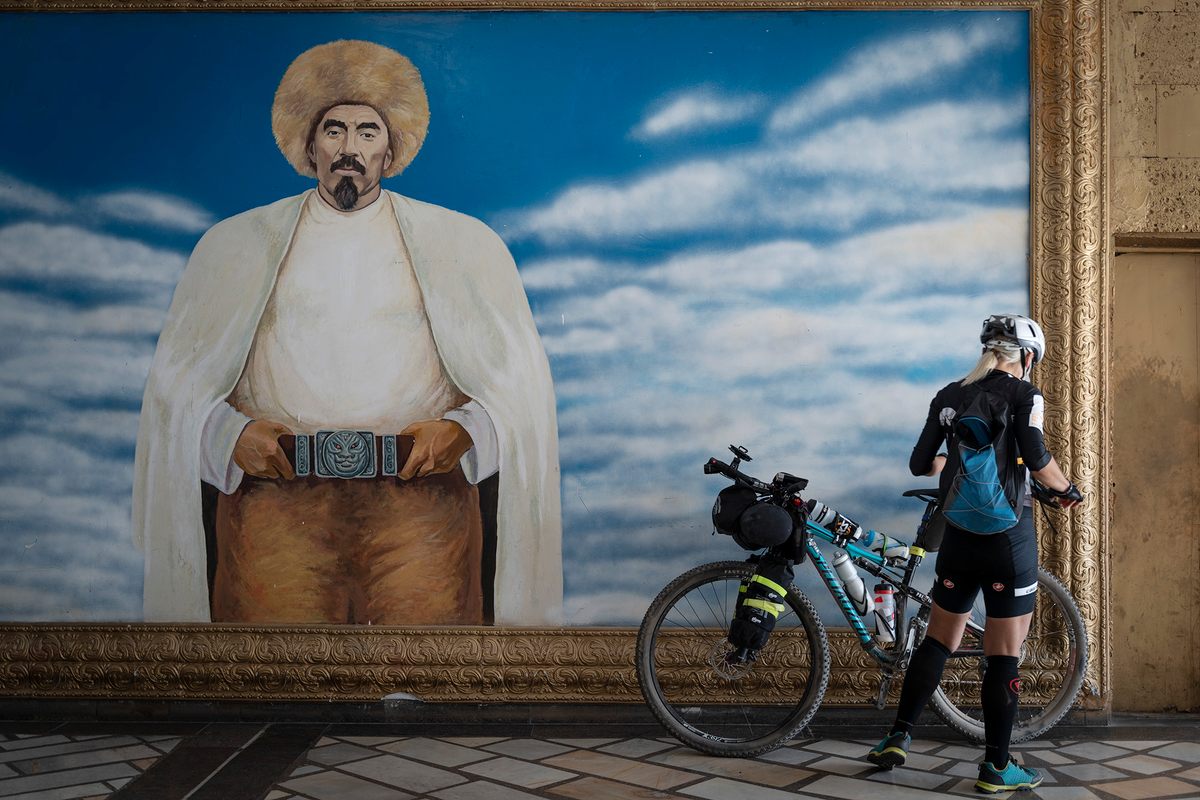
Bernarda Juric from Slovenia checks on her bike during registration in Bishkek.

More than a week before Sehili crossed the finish line, the race began at 4:23 a.m. in the small town of Talas, with a light but chilly breeze. The path illuminated by their headlamps, 95 riders took off into the dark. Their first challenge was Terek Pass, with an elevation of 12,172 feet. For centuries, the pass was on the main route of the Silk Road. Marco Polo crossed it on his way to China, and Ghengis Khan and his Mongol army used it in their relentless advance westward across Central Asia.

The path descending from Terek Pass is littered with sharp rocks. One rock slashed open the rear tire of Levente Bagoly, a slight Romanian with the muscular legs of a seasoned mountain biker. Without the equipment he needed to make a permanent repair, Bagoly patched it up and kept going. But he had to stop every six miles to pump air back into the tire. He had spent a great deal of energy in the beginning of the race chasing and passing other competitors. Now, every time he stopped, those riders would zoom past him. Slowly, keeping score in his head, Bagoly started to lose more than his position. In the inaugural 2018 race, he had finished second, and being in the top five again meant a great deal to him.

“I am a competitive person by nature, but I had lost all motivation to compete. I felt hopeless,” says Bagoly, looking back on what happened after Terek Pass. His frustration soon manifested itself physically. He experienced severe headaches and an irregular heartbeat. On the third day he vomited and collapsed. He left the race, promising to be back another year.
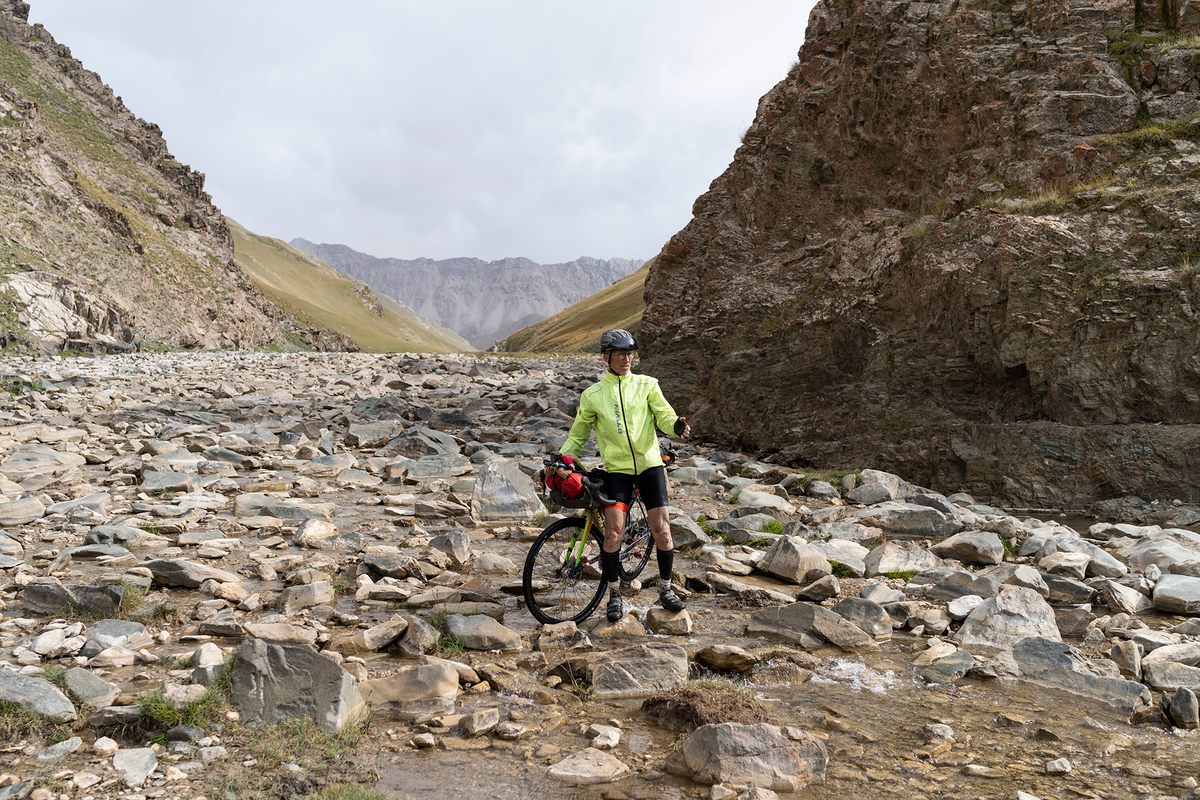
Frederic Laforge from France contemplates which route to take to Tash-Rabat.

A few days later, it was not exhaustion but blindness—snow blindness—that nearly ended the race for riders Axel Brenner and Adrien Liechti. They were at the top of Arabel Pass, at 12,467 feet, when a storm hit and deposited several feet of snow. The gray mountain turned white, like everything else around them, and the two riders were forced to navigate the rocky, treacherous terrain with few visual cues. Hours later, the sun returned and melted all evidence of the blizzard conditions. Brenner and Liechti not only made it safely down from the pass, but would finish in second and third place, respectively.

In fact, changeable and often fierce mountain weather is the biggest wild card of the race. Dark clouds can quickly shut out the warmth of the mid-morning sun, dumping rain and hail on the course. Minutes—or hours—later, the sun may reappear and bake the steep mountain valleys, forcing riders to shed their winter layers. In addition to dangerous terrain and temperature extremes, they also experience some geopolitical reality.

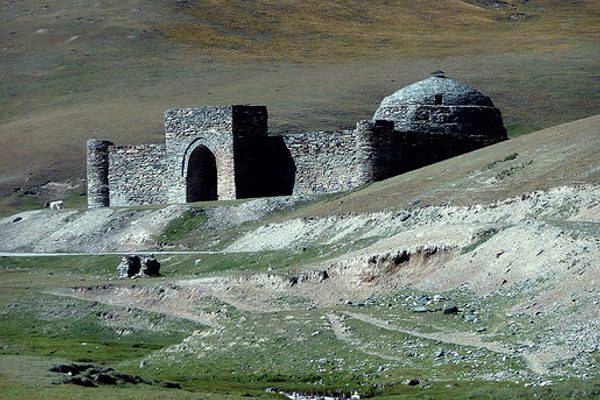
To reach the rest stop of Tash Rabat, an idyllic, well-preserved caravanserai that has welcomed passing travelers since the 15th century, riders must first cross an empty land of 18 miles. Here, a long, straight fence marks the border between Kyrgyzstan and China. No one lives in this zone, and race participants must check in with border guards to gain access to this stretch of the route. Although mostly flat, the uneven gravel road takes a toll on the rider’s body; non-stop vibrations can leave their hands numb for hours or days.
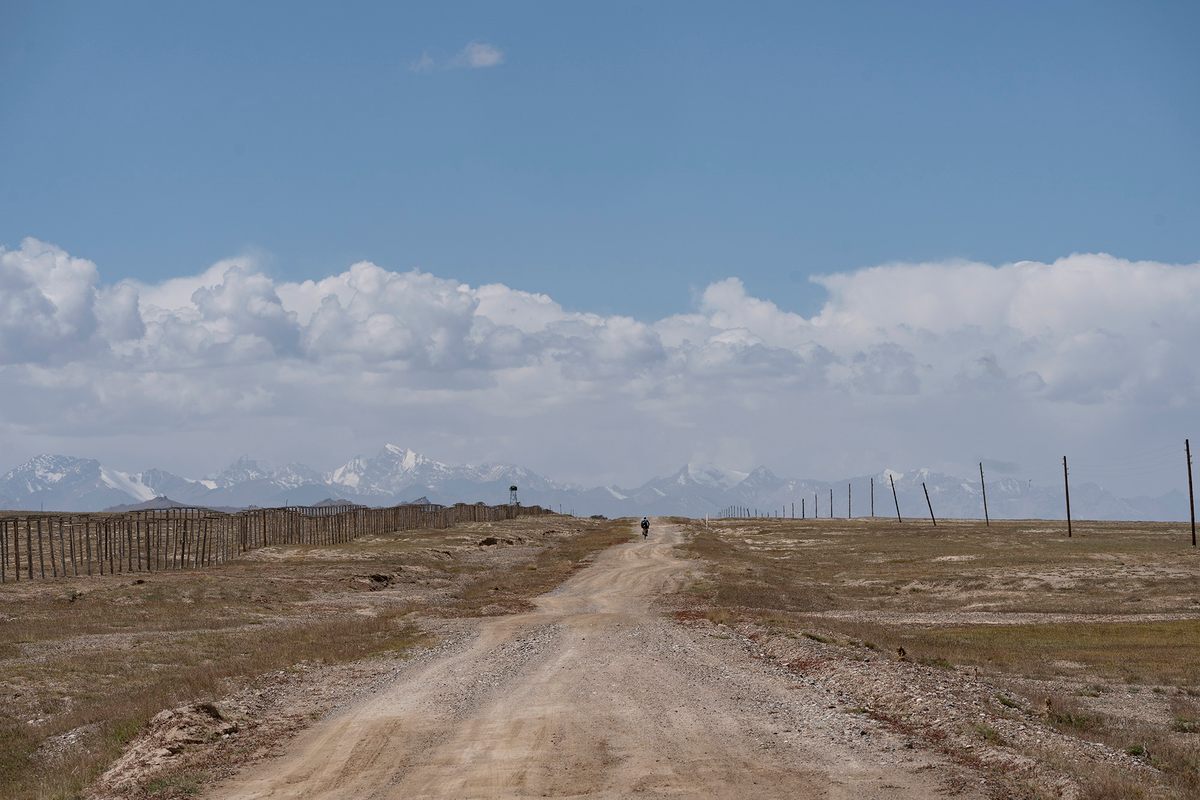
In the distance, Dmitriy Makarov from Kazakhstan rides along the Chinese border in Kyrgyzstan.

From the no-man’s-land near the border, the route returns to the mountains, rising 984 feet in a little over a mile. Some riders end up carrying their bikes over their shoulders and hiking up; bikepackers call it a “hike-a-bike.” The descent is equally as steep, requiring finesse: Heavy braking could lift the rear wheel up and send the rider tumbling downhill. A few river crossings, the water’s course littered with massive boulders, signal the end of the descent. Only then do riders catch sight of Tash Rabat, where modern yurts skirt the old stone caravanserai, opposite a small stream. Many riders pause here for shelter and sustenance, just as Silk Road traders did for centuries before them.

“The yurts are like a mini oasis. Shelter, warmth, comfort, and food. All the things that soften you,” said Steven Moatt, a cheerful, middle-aged Englishman. “A danger zone as far as time is concerned! So it’s best not to get too comfortable.”
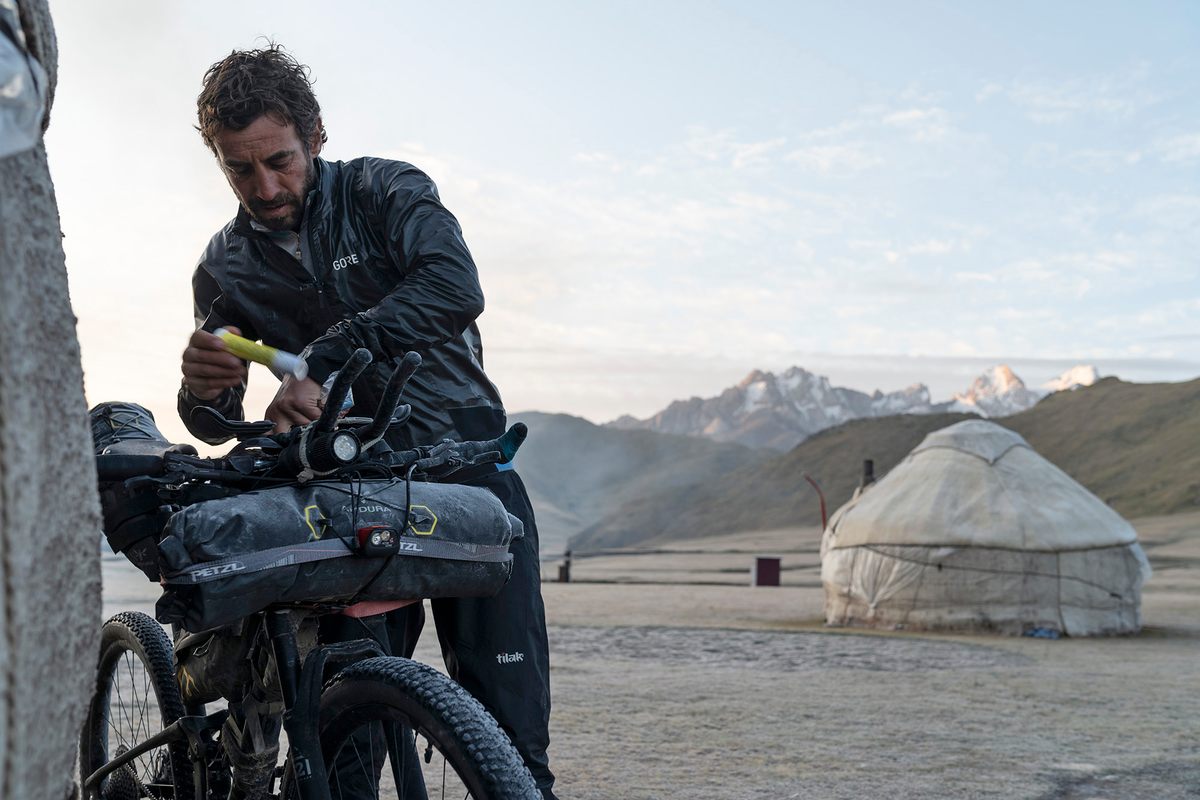
Martin Písačka from the Czech Republic packs his equipment before heading out of a checkpoint.

For Moatt, the ancient rest stop was more than a brief but welcome break; just making it there was a victory. The day before, he had fallen off his bike, dislocating his shoulder. “That morning, the sun was out and it was warm sitting on the grass just outside the yurt,” he says of his time at the site. “It was a relief getting to Tash Rabat as this proved to myself that I was still physically able to continue.”

The sheer determination to keep going may be the most universal quality of the race’s riders. Canada’s Jenny Tough was caught in a rainstorm mid-race. Exhausted and sick, she forced herself to keep going to reach the next resupply town, Baetov. Tough arrived just in time for dinner—and then set off the next morning at 3 a.m., while the other riders were still asleep. She would be the only female contestant who rode solo to finish the race.

Another rider, Martin Písačka from Czech Republic, gave new meaning to the phrase “by any means necessary.” About 125 miles from the finish—a day’s ride in good conditions—Písačka’s bike gears and pedal dislocated from the rear wheel at the top of 12,572 foot Kegety Pass. It could not be fixed.
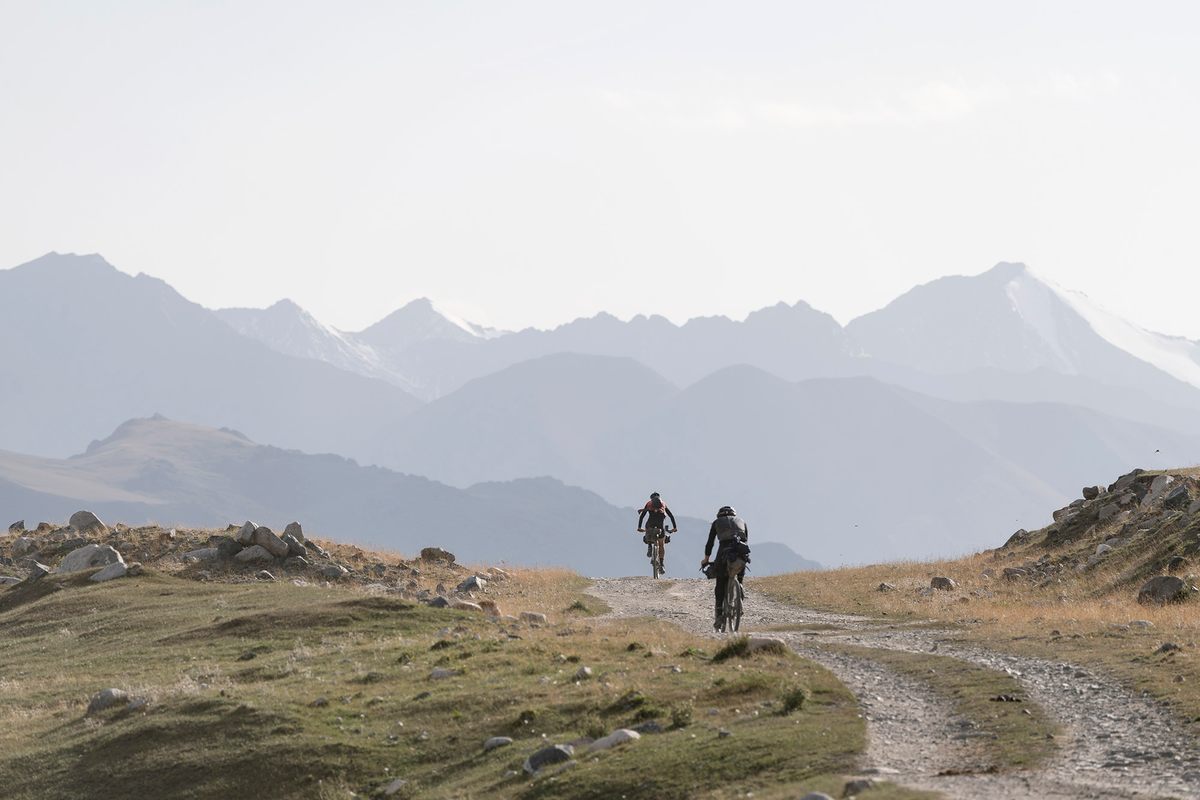
Passing one another at different stages of Tosor Pass, Allan Shaw from Scotland battles it out with Lukasz Ugarenko from Poland.

Rather than giving up, Písačka decided to walk to the finish line. It took him three days, including one of the most challenging passes in the entire race and a 2,296-foot hike-a-bike. He later said that his shoes disintegrated, and locals gave him two replacement pairs but neither fit well. He crossed the finish line barefoot, with a grin.

“I know that this sport is a selfish endeavor,” Písačka says, looking back at the moment. “However, when in the mountains, my mind is at ease. I do not think about anything else but the race, food and shelter. Life becomes much simpler. In those moments, the views are perfect, the people I meet are perfect, and every day is the best day.”


Tuesday, July 26, 2022

Abramović into Metaverse


Marina Abramović Charges into the Metaverse

The cult performance artist discusses her first-ever NFT release, 'The Hero 25FPS', and fostering the next generation of Web3 creatives

A
BY ANGEL LAMBO IN INTERVIEWS | 25 JUL 22

With the release of her first NFT project, the self-styled ‘warrior’ of performance art Marina Abramović steps into the Web3 space. In collaboration with digital art and culture platform CIRCA, she revisits her 2001 film The Hero, which has been split into hundreds of unique frames to form a set of NFTs called The Hero 25FPS. With this ‘performance on the blockchain’, as CIRCA calls it, the artist responds to global instability and the public’s deteriorating trust in the institutions built to protect them. 


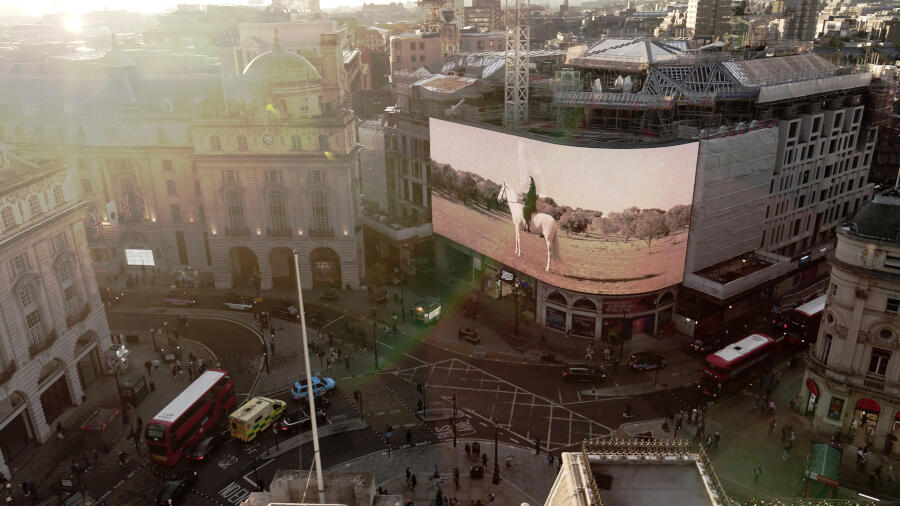
The Hero, which was originally created in memory of the artist’s father, who fought against the Nazis in Yugoslavia during the Second World War, depicts a valiant Abramović holding a white flag while astride a white horse. Today, the image speaks to Abramović’s desire to inspire a new generation of incorruptible heroes who can bring real change to a fractured world.

The Hero (2001): Marina Abramović sits on a white horse while holding a white flag in Spain
Marina Abramović, The Hero 25FPS, example NFT, 2022; Courtesy: CIRCA and the artist 

Angel Lambo: In recent interviews about your inaugural NFT project, you stated that we need ‘less artists and more heroes’ and have spotlighted individuals like Txai Surui, a climate activist, Pussy Riot’s Nadya Tolokonnikova, a political activist and Volodymyr Zelensky, Ukraine’s wartime president, as paragons of heroism. Some may say figurehead worship is at odds with the philosophy of Web3, which privileges collectivist action. Does The Hero 25FPS challenge the lone, exceptional hero trope in any way?


Marina Abramović: I love this question because you’re absolutely right and it has really made me think. I have two thoughts. First of all, every revolution needs a hero. Every battle needs a hero. Every story needs a hero. When Josef O’Conner (founder of CIRCA) approached me about doing [this project] I felt a great need to share The Hero with the world because right now we are at a turning point in human history and this time calls for new ideas of heroism. This brings me to my second thought: Why the figurehead? Why Nadya? Why Txai? Why the lone soldier? What should heroism look like today for it to really serve the collective purpose? What is the purpose of heroism today? So many questions.


The answer I have is a question. And the question is, What matters the most? Because that is why we create art. If people engage with this work ­­– if they see it appear on Piccadilly Lights or in Times Square or on their phone — and it makes them stop and think, ‘Who is my hero?’ then I have succeeded. Art is about planting ideas and allowing those ideas to grow into trees. Trees create forests and those forests give oxygen, which supports an entire ecosystem. Right now, we are building a new collective ecosystem that will hopefully pull us as away from this nightmare. Hopefully not as far away as inhabiting another planet, but far away from nuclear weapons. Far away from toxic masculinity. Far away from Trump. Far away from all this bullshit. That is what the future demands of us all. We need new heroes. 

Sepia-toned image of Marina Abramovic as a child with her father in military attire
Image of Marina Abramović as a child with her father Vojin Abramović; Courtesy: CIRCA and the artist

AL: For decades you have pushed the boundaries of performance art and found new ways to build intense, visceral connections with your audience. How is this ‘performance on the blockchain’ a continuation of that legacy? 


MA: What excites me the most about entering this new Web3 space is how it divides opinion. And at 75 years old, [for me] to still divide opinion is a privilege. But if we are talking about legacy, this project reminds me a lot of what it was like in the 1970s when we pioneered performance and people genuinely thought we were crazy. They didn’t understand what we were doing by engaging in the immaterial. How do you hang a performance on the wall? Well, you take a photograph of it. You film it. But nobody used to buy film. So, this was the dilemma.  


I could never have performed ‘The Artist Is Present’ (2010) in the ’70s because the audience wasn’t prepared for it then. Timing is so important when making art. Around 1985-86, I was asked what the future of art is. I said that I see it as the transmission of the artist’s experience to the audience in an immaterial way — an exchange of energy. And now it looks like this prediction is coming true with NFTs. What we were doing in the ‘70s has manifested its way into this new space where a generation of artists are finding innovative ways to support their practice, and we must support them because they are the future.


I never expected a symmetry to emerge between my past and present through this project. In a way it’s quite romantic and I am happy to support this new generation by donating a percentage of the funds generated from this NFT project towards Hero Grants. I am inviting people working within Web3 to submit ideas. Ideas that make the world a better, more beautiful place. People who demonstrate heroic vision will then receive a grant in the coming months. The grants we award from The Hero 25FPS is my small way of contributing to this future.

Portrait of Marina Abramović dressed in black and looking downwards
Portrait of Marina Abramović, 2022; Courtesy: CIRCA and the artist; Photographer: Marco Anelli 

AL: How has this project changed your approach to time-based art?

MA: I didn’t do NFTs for a while because I needed to find the right concept. With The Hero 25FPS, people who want to own the work can collect as many seconds as they want. Marcel Duchamp said that the public completes the work and with this performance on the blockchain, people can either collect a single frame (.jpg) or a sequence of frames (.gif) to complete the work. 


If you think about my most famous works, they have always relied on an audience to be present. It is the same with this project because the audience can decide how much of the movement and how much of the experience they want. 

Render of 'The Hero' (2001) at Piccadilly Lights
Render of The Hero, 2001, at Piccadilly Lights; Courtesy: CIRCA and the artist

AL: Early performance artists like yourself were ridiculed in the same way that artists working in Web3 and on the blockchain are today. Based on your own experience, what advice would you give to them?


MA: I’m doing something better than giving advice, I’m giving grants. These Web3 artists don’t need my advice, they need our support and understanding. It’s tough out there and I don’t know how this generation finds time to earn enough money to pay rent, buy food and then make work. I am collaborating with CIRCA because of the amazing work they do with #CIRCAECONOMY (a programme that generates funds to provide young artists with original commissions, scholarships and grants). We are now doing something similar with Hero Grants. I initially wanted to give money to Ukraine but I did that already this year when we raised USD$150,000 reperforming ‘The Artist Is Present’ in collaboration with Sean Kelly Gallery. Now I want to focus on unlocking new ideas of heroism within the Web3 space. So my advice would be to go to the nft.circa.art website and apply for a hero grant.


AL: From experimenting with virtual reality technology in your climate-conscious project Rising (2019) to staging an opera in 2020 inspired by the American soprano singer Maria Callas, and now NFTs, are there any other mediums that you plan to explore in your work?


MA: I am very passionate about exploring the medium of doing nothing. We have all become far too busy and preoccupied with life. There are so many emails and news alerts. Sometimes you just have to say ‘Okay fuck it, I’m doing nothing today’ and that’s fine. In fact, that’s great. Why? Because life opens itself up to you in ways that one can’t possibly imagine when you are doing nothing. This is the greatest medium of them all. When I was doing nothing, I dreamt up some of my most important ideas. I strongly recommend everyone reading this to do nothing today.


'The Hero 25FPS' NFTs by Marina Abramović launched 25 July 2022 at 2PM UTC on the Tezos blockchain.


Main image: The Hero2001, image render at Piccadilly Lights; Courtesy: CIRCA and the artist

Angel Lambo is associate editor of frieze. She lives in Berlin.


SHARE THIS